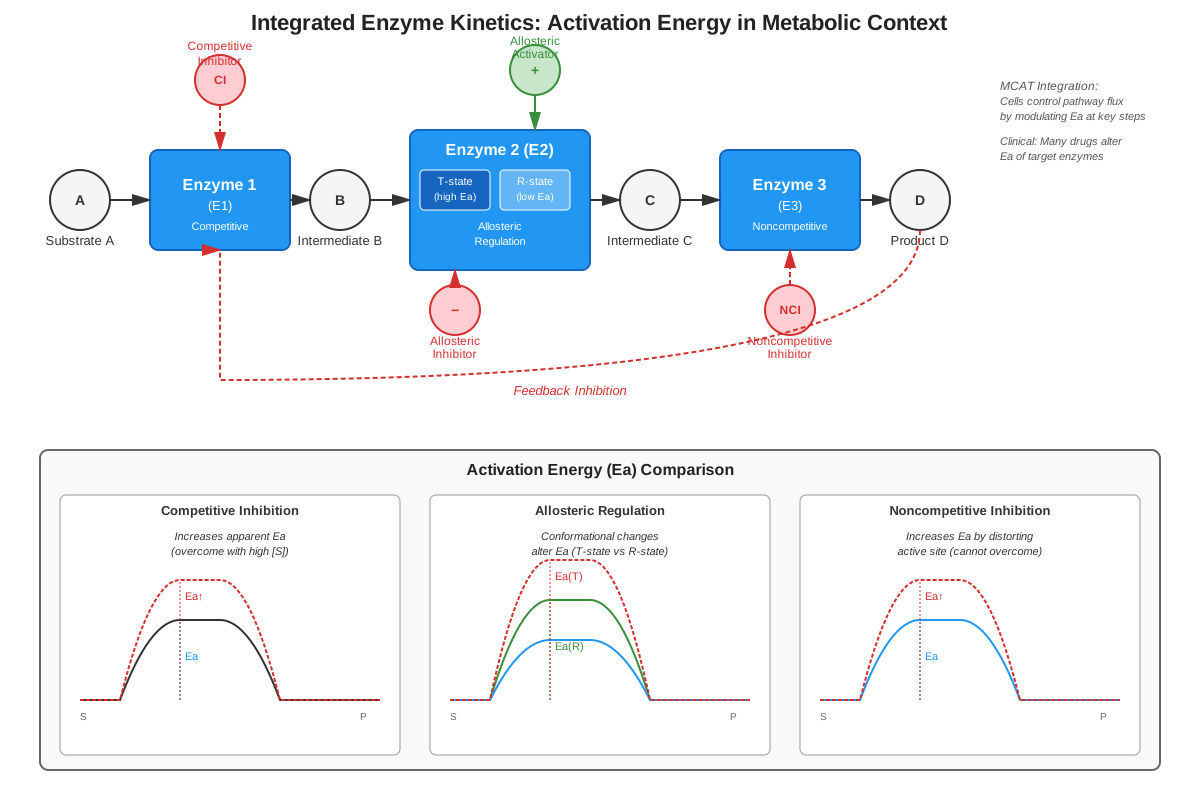
Overview
Activation energy is one of the most fundamental concepts in Biochemistry and represents a cornerstone principle tested extensively on the MCAT. At its core, activation energy (Ea) describes the minimum energy barrier that reactant molecules must overcome to transform into products during a chemical reaction. This concept bridges thermodynamics and kinetics, explaining not just whether a reaction can occur (thermodynamics), but how quickly it will proceed (kinetics). Understanding activation energy is essential for grasping how enzymes function as biological catalysts, why certain reactions occur spontaneously while others require input, and how cells regulate metabolic pathways with exquisite precision.
The MCAT tests activation energy concepts across multiple contexts within the Biochemistry and Biological Sciences sections. Questions may present reaction coordinate diagrams requiring interpretation of energy barriers, ask students to predict how enzyme inhibitors affect activation energy, or embed activation energy principles within passage-based questions about metabolic regulation. The topic appears in approximately 15-20% of enzyme-related questions and frequently connects to broader themes including thermodynamics, enzyme kinetics, and metabolic pathway regulation. Mastery of this concept enables students to quickly eliminate incorrect answer choices and recognize the mechanistic basis for biological catalysis.
Beyond exam performance, activation energy explains phenomena central to living systems: why body temperature regulation matters for metabolism, how enzymes achieve rate enhancements of 10^6 to 10^17-fold, and why certain drugs work by altering reaction barriers. This topic integrates seamlessly with enzyme mechanisms, transition state theory, and the energetics of coupled reactions—all high-yield MCAT content areas. Students who develop a robust mental model of activation energy gain significant advantages in both discrete questions and complex passage analysis.
Learning Objectives
- [ ] Define activation energy using accurate Biochemistry terminology
- [ ] Explain why activation energy matters for the MCAT
- [ ] Apply activation energy to exam-style questions
- [ ] Identify common mistakes related to activation energy
- [ ] Connect activation energy to related Biochemistry concepts
- [ ] Interpret reaction coordinate diagrams and identify activation energy values for forward and reverse reactions
- [ ] Quantitatively compare activation energies between catalyzed and uncatalyzed reactions
- [ ] Predict how changes in temperature, enzyme concentration, and inhibitors affect activation energy and reaction rate
Prerequisites
- Basic thermodynamics: Understanding of Gibbs free energy (ΔG), enthalpy (ΔH), and entropy (ΔS) provides the foundation for distinguishing thermodynamic favorability from kinetic accessibility
- Chemical kinetics fundamentals: Knowledge of reaction rates, rate constants, and the relationship between concentration and reaction velocity enables interpretation of how activation energy influences reaction speed
- Molecular structure and bonding: Familiarity with bond energies, molecular collisions, and energy distribution in molecular populations explains why only a fraction of molecules possess sufficient energy to react at any given moment
- Enzyme basics: General understanding that enzymes are biological catalysts sets the stage for learning how they specifically lower activation energy barriers
Why This Topic Matters
Clinical and Real-World Significance
Activation energy principles underlie numerous clinical phenomena and therapeutic interventions. Fever, for instance, increases reaction rates by providing more molecules with sufficient energy to overcome activation barriers—explaining why elevated body temperature accelerates both immune responses and pathogen metabolism. Pharmaceutical development heavily relies on activation energy concepts; many drugs function by raising the activation energy for unwanted reactions (enzyme inhibitors) or lowering barriers for beneficial processes (enzyme activators). Understanding activation energy also explains why certain toxins are dangerous: they may lower activation barriers for destructive reactions or raise barriers for essential metabolic processes.
MCAT Exam Statistics
Activation energy appears in approximately 8-12 questions per full-length MCAT exam, distributed across both discrete questions and passage-based items. The topic most frequently appears in:
- Enzyme mechanism passages (40% of activation energy questions)
- Metabolic pathway regulation passages (25%)
- Thermodynamics and kinetics discrete questions (20%)
- Experimental design passages involving reaction rates (15%)
Questions typically test the ability to interpret reaction coordinate diagrams, predict effects of catalysts on energy barriers, distinguish between thermodynamic and kinetic control, and apply the Arrhenius equation conceptually. High-performing students recognize that activation energy questions often contain trap answers that confuse ΔG with Ea or incorrectly state that enzymes change reaction equilibria.
Common Exam Presentations
The MCAT presents activation energy through several recurring formats: reaction coordinate diagrams requiring identification of Ea values; experimental data showing temperature effects on reaction rates; passages describing enzyme mutations that alter catalytic efficiency; and questions comparing spontaneous versus non-spontaneous reactions. Recognizing these patterns enables rapid question categorization and strategic approach selection.
Core Concepts
Definition and Fundamental Nature of Activation Energy
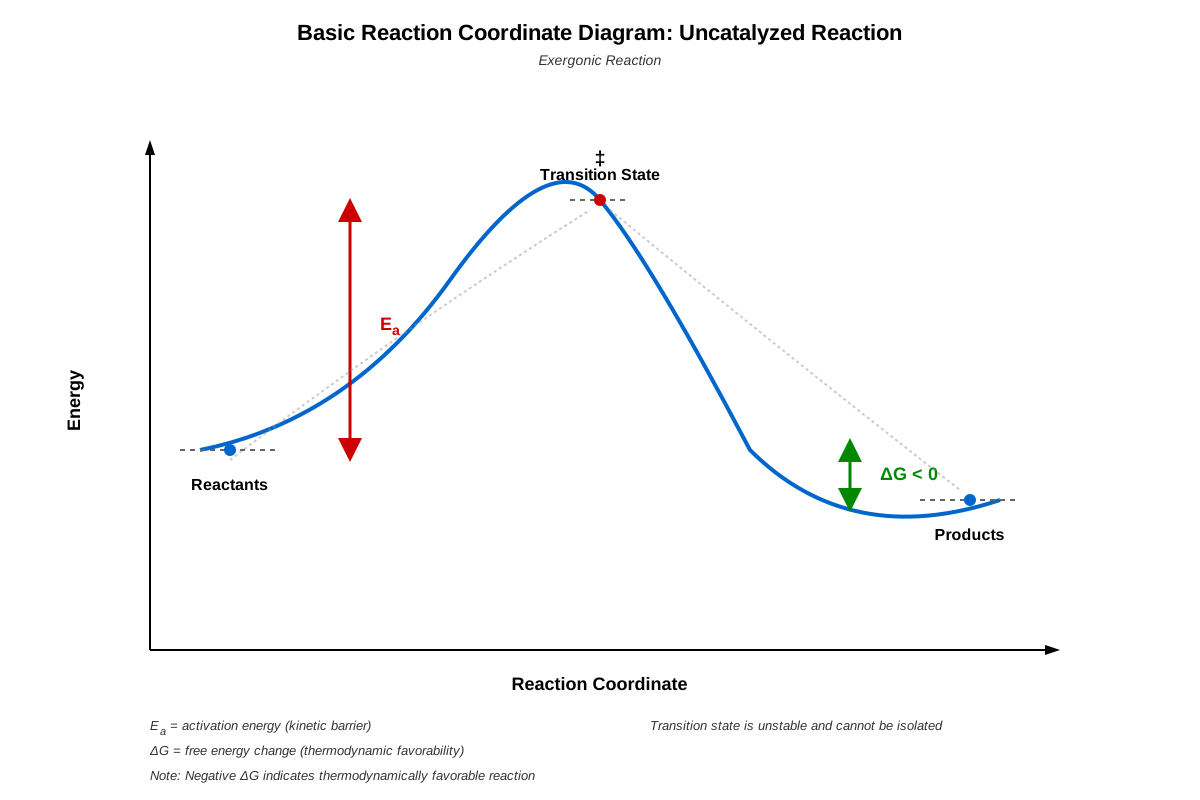
Activation energy (Ea) represents the minimum energy required to initiate a chemical reaction by reaching the transition state—the highest-energy, unstable molecular configuration along the reaction pathway. More precisely, activation energy is the difference in energy between the reactants in their ground state and the transition state. This energy barrier exists because chemical reactions require breaking existing bonds before forming new ones, and bond breaking always requires energy input regardless of whether the overall reaction releases or absorbs energy.
At the molecular level, only molecules possessing kinetic energy equal to or greater than the activation energy can successfully react upon collision. The Boltzmann distribution describes the population of molecules at various energy levels; at any given temperature, only a small fraction of molecules possess sufficient energy to overcome typical activation barriers. This explains why many thermodynamically favorable reactions (negative ΔG) proceed slowly or not at all without catalysts—the kinetic barrier prevents reactants from accessing the lower-energy product state.
The Arrhenius Equation and Temperature Dependence
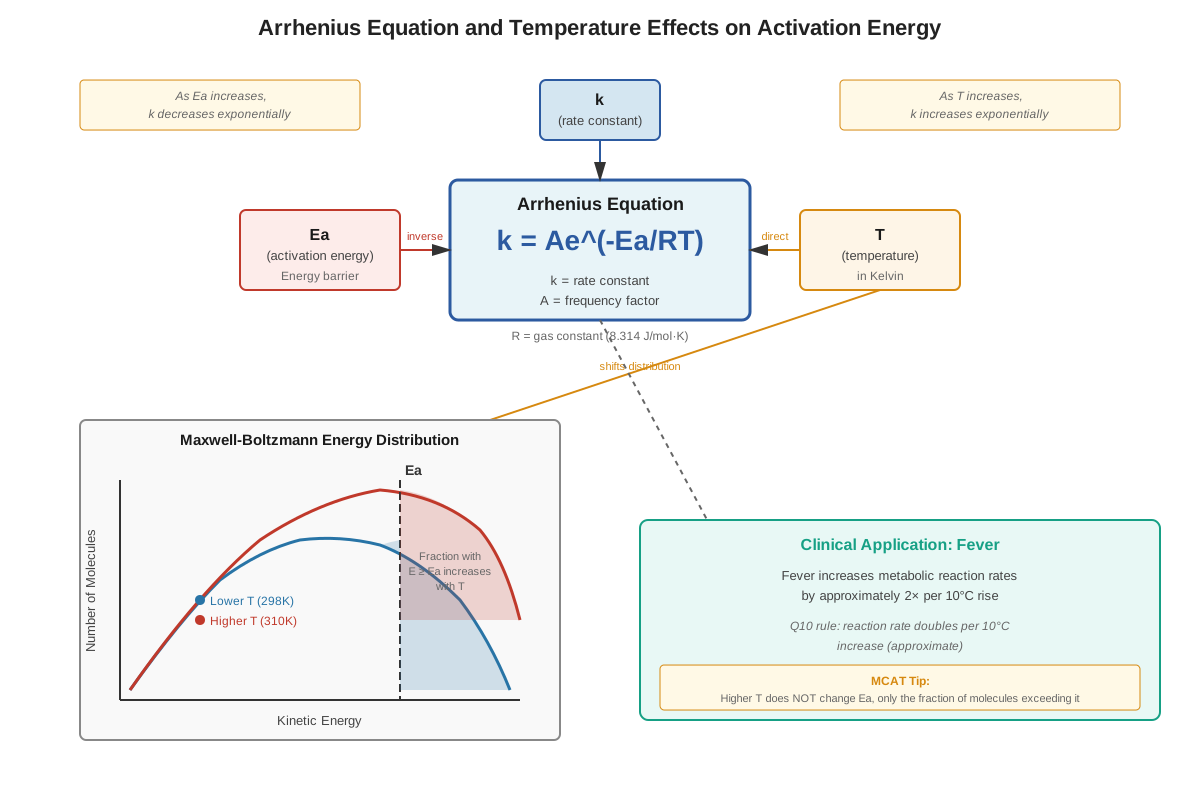
The quantitative relationship between activation energy, temperature, and reaction rate is expressed by the Arrhenius equation:
k = A × e^(-Ea/RT)Where:
- k = rate constant
- A = frequency factor (collision frequency and orientation)
- Ea = activation energy
- R = gas constant (8.314 J/mol·K)
- T = absolute temperature (Kelvin)
This equation reveals several critical insights for the MCAT. First, the rate constant (and therefore reaction rate) increases exponentially as temperature increases, explaining why biological systems are temperature-sensitive. Second, reactions with higher activation energies show greater temperature sensitivity—a 10°C increase typically doubles or triples reaction rates for biological processes (the Q10 effect). Third, even small changes in activation energy produce large changes in reaction rate; a decrease of just 5-10 kJ/mol can increase rates by factors of 10-100 at physiological temperature.
Reaction Coordinate Diagrams
Reaction coordinate diagrams plot energy versus reaction progress, providing visual representations of activation energy and thermodynamic changes. These diagrams are ubiquitous on the MCAT and require careful interpretation:
| Feature | Description | MCAT Significance |
|---|---|---|
| Y-axis | Free energy (G) | Represents total energy state |
| X-axis | Reaction coordinate (progress) | Represents structural changes from reactants to products |
| Peak | Transition state | Highest energy point; determines reaction rate |
| Ea(forward) | Energy from reactants to peak | Activation energy for forward reaction |
| Ea(reverse) | Energy from products to peak | Activation energy for reverse reaction |
| ΔG | Energy difference between reactants and products | Determines equilibrium position, NOT rate |
A crucial MCAT concept: the activation energy for the forward reaction minus the activation energy for the reverse reaction equals ΔG for the reaction. Mathematically: Ea(forward) - Ea(reverse) = ΔG. This relationship allows calculation of any one value if the other two are known.
Catalysts and Enzymes: Lowering Activation Energy
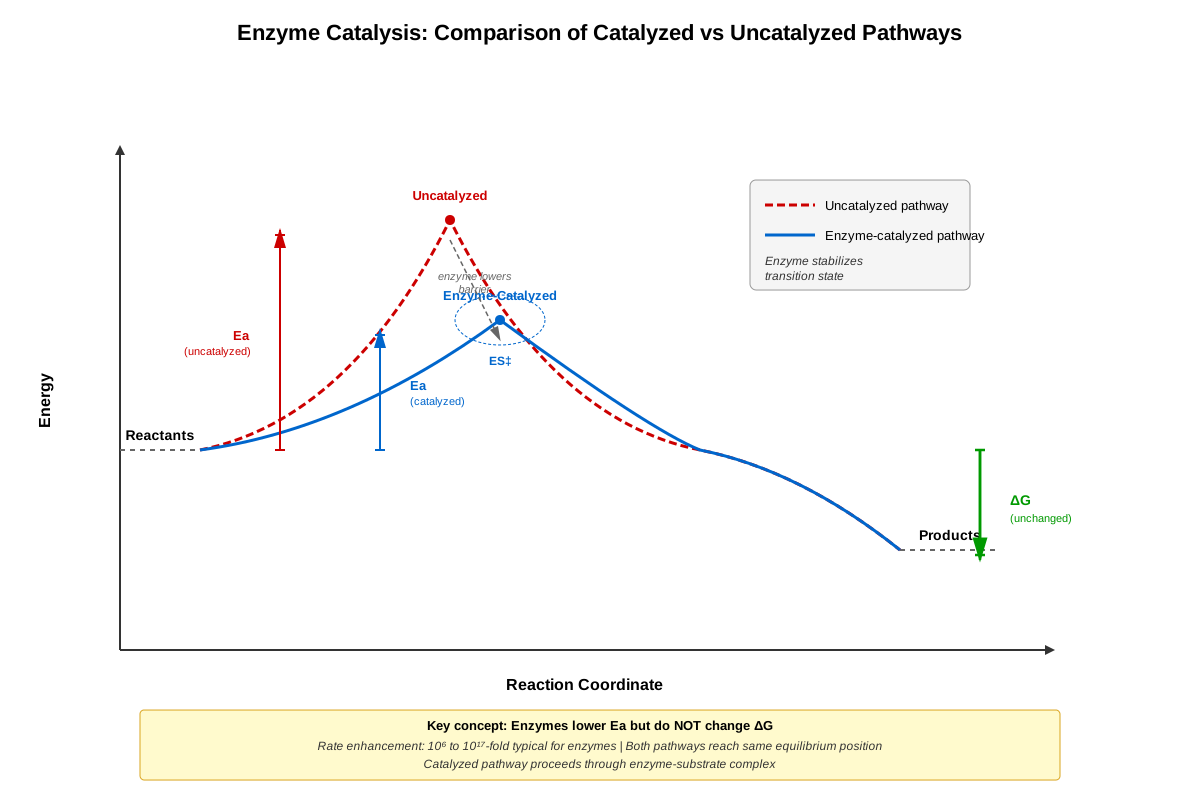
Enzymes function as biological catalysts by lowering activation energy without being consumed in the reaction. This is the single most important concept connecting activation energy to Biochemistry and the MCAT. Enzymes achieve this through multiple mechanisms:
- Proximity and orientation effects: Enzymes bind substrates in optimal positions for reaction, increasing the effective concentration and proper collision geometry
- Transition state stabilization: The active site is complementary to the transition state structure (not the substrate), stabilizing this high-energy configuration and lowering the energy required to reach it
- Strain and distortion: Enzymes may distort substrate bonds, bringing them closer to the transition state configuration
- Microenvironment effects: The active site provides optimal pH, charge distribution, and hydrophobic/hydrophilic environments
- Covalent catalysis: Some enzymes form transient covalent bonds with substrates, creating alternative reaction pathways with lower barriers
MCAT High-Yield: Enzymes lower activation energy for BOTH forward and reverse reactions equally. They do NOT change ΔG, equilibrium position, or the thermodynamic favorability of reactions. They only affect how quickly equilibrium is reached.
Distinguishing Thermodynamics from Kinetics
A fundamental source of MCAT questions involves distinguishing thermodynamic parameters (ΔG, ΔH, ΔS, Keq) from kinetic parameters (Ea, rate constant k, reaction rate). This distinction is critical:
Thermodynamics (ΔG) determines:
- Whether a reaction is spontaneous
- The equilibrium position
- The relative stability of products versus reactants
- The maximum work obtainable from a reaction
Kinetics (Ea) determines:
- How fast a reaction proceeds
- The temperature sensitivity of the reaction
- Whether a catalyst is necessary for practical reaction rates
- The mechanism and pathway of the reaction
A reaction can be thermodynamically favorable (negative ΔG) but kinetically slow (high Ea)—such reactions are "thermodynamically favorable but kinetically unfavorable." Conversely, some reactions with positive ΔG can proceed quickly if given sufficient energy input. The MCAT frequently tests whether students recognize that spontaneity (ΔG) and speed (Ea) are independent properties.
Transition State Theory
Transition state theory provides the theoretical framework for understanding activation energy. The transition state (also called the activated complex) represents a fleeting molecular configuration at the energy maximum along the reaction coordinate. Key characteristics include:
- Extremely short lifetime (10^-13 to 10^-14 seconds)
- Partial bond formation and breaking
- Highest free energy along the reaction pathway
- Unstable configuration that proceeds to either products or reactants
The transition state differs from reaction intermediates, which occupy local energy minima and have measurable lifetimes. On reaction coordinate diagrams, intermediates appear as valleys between peaks, while transition states are always peaks. The MCAT may present multi-step reactions with multiple transition states and intermediates, requiring identification of the rate-determining step—the step with the highest activation energy, which controls the overall reaction rate.
Energy Distribution and Molecular Populations
At any temperature, molecules in a system possess a distribution of kinetic energies described by the Maxwell-Boltzmann distribution. Only molecules in the high-energy tail of this distribution—those with energy exceeding Ea—can react upon collision. Increasing temperature shifts the entire distribution to higher energies, increasing the fraction of molecules capable of reacting. This explains the exponential temperature dependence in the Arrhenius equation.
When enzymes lower activation energy, they effectively decrease the energy threshold, allowing a much larger fraction of the molecular population to react. This is why enzymes can increase reaction rates by factors of 10^6 to 10^17 without changing temperature—they make the existing thermal energy sufficient for reaction.
Concept Relationships
Activation energy serves as a central hub connecting multiple Biochemistry concepts tested on the MCAT. The relationships flow as follows:
Thermodynamics → Activation Energy → Kinetics: Thermodynamic parameters (ΔG, ΔH, ΔS) determine whether a reaction is favorable, but activation energy determines whether that favorable reaction occurs at a measurable rate. This creates the distinction between thermodynamic and kinetic control of reactions.
Activation Energy → Enzyme Function: Understanding that enzymes lower Ea explains their catalytic power and connects to enzyme kinetics (Km, Vmax, kcat), enzyme regulation (competitive/noncompetitive inhibition), and enzyme specificity (transition state complementarity).
Activation Energy → Temperature Effects → Metabolic Regulation: The temperature dependence of activation energy explains why organisms regulate body temperature, why fever affects metabolism, and why cold-blooded animals show temperature-dependent activity levels.
Transition State Theory → Activation Energy → Reaction Mechanisms: The transition state concept explains why certain reaction pathways are favored, how enzymes achieve specificity, and why some reactions require cofactors or coenzymes.
Activation Energy → Reaction Coordinate Diagrams → Experimental Interpretation: The ability to interpret energy diagrams enables analysis of experimental data, comparison of catalyzed versus uncatalyzed reactions, and prediction of inhibitor effects.
Within the topic itself, concepts build hierarchically: Basic definition → Arrhenius equation → Reaction coordinate diagrams → Enzyme mechanisms → Transition state stabilization. Each level requires mastery of previous concepts, making activation energy an excellent example of integrated Biochemistry knowledge.
Quick check — test yourself on Activation energy so far.
Try Flashcards →High-Yield Facts
⭐ Activation energy is the minimum energy required to reach the transition state, NOT the energy difference between reactants and products (which is ΔG)
⭐ Enzymes lower activation energy for both forward and reverse reactions equally; they do NOT change ΔG or the equilibrium constant
⭐ The rate-determining step in a multi-step reaction is the step with the highest activation energy
⭐ Increasing temperature increases reaction rate by increasing the fraction of molecules with energy ≥ Ea, following the Arrhenius equation
⭐ On reaction coordinate diagrams, Ea(forward) - Ea(reverse) = ΔG for the reaction
- Catalysts provide alternative reaction pathways with lower activation energies but identical starting and ending points
- The transition state is the highest energy point on a reaction coordinate diagram and has an extremely short lifetime (~10^-13 seconds)
- Competitive inhibitors do not change the activation energy of the catalyzed reaction; they reduce the effective enzyme concentration
- A reaction with negative ΔG (spontaneous) can still be kinetically slow if Ea is high—thermodynamics and kinetics are independent
- The frequency factor (A) in the Arrhenius equation accounts for collision frequency and proper molecular orientation
- Enzymes achieve rate enhancements of 10^6 to 10^17-fold primarily through transition state stabilization
- Activation energy has units of energy per mole (kJ/mol or kcal/mol), while ΔG also has units of energy per mole
- The Q10 value (rate change per 10°C increase) is typically 2-3 for biological reactions, reflecting moderate activation energies
- Irreversible inhibitors may increase activation energy by covalently modifying the active site
- The activation energy for an uncatalyzed biological reaction is typically 50-100 kJ/mol, while enzyme-catalyzed reactions have Ea values of 10-30 kJ/mol
Common Misconceptions
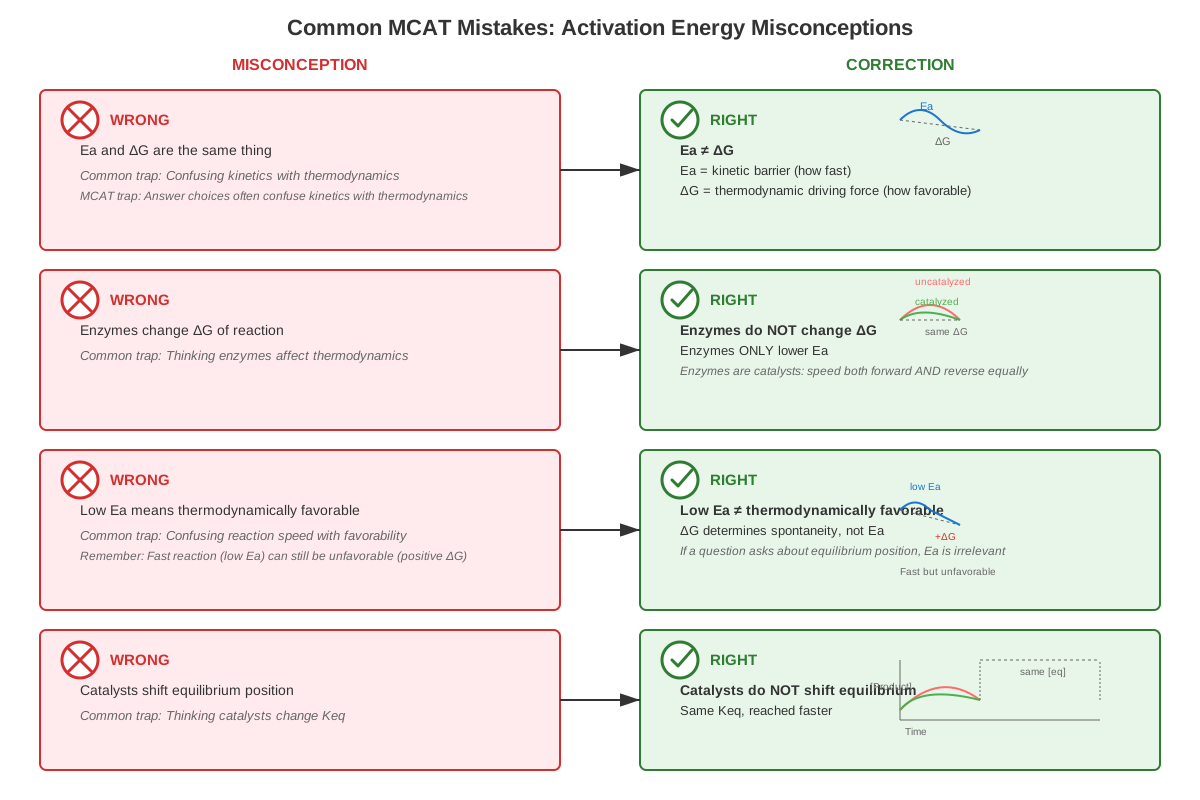
Misconception: Activation energy and ΔG are the same thing.
Correction: Activation energy (Ea) is the energy barrier to reach the transition state and determines reaction rate. ΔG is the free energy change between reactants and products and determines spontaneity and equilibrium position. A reaction can have negative ΔG (spontaneous) but high Ea (slow), or positive ΔG (non-spontaneous) but low Ea (fast if driven).
Misconception: Enzymes change the equilibrium position of reactions by lowering activation energy.
Correction: Enzymes lower activation energy for both forward and reverse reactions equally, allowing the system to reach equilibrium faster without changing the equilibrium position. The equilibrium constant (Keq) depends only on ΔG (Keq = e^(-ΔG/RT)), which enzymes do not alter.
Misconception: Adding a catalyst makes an unfavorable reaction (positive ΔG) become favorable.
Correction: Catalysts and enzymes only affect reaction rate, not thermodynamic favorability. A reaction with positive ΔG remains non-spontaneous regardless of catalyst presence. However, coupling an unfavorable reaction to a favorable one (changing the overall ΔG) can make the combined process spontaneous—this is a thermodynamic change, not a catalytic effect.
Misconception: Higher activation energy always means a slower reaction.
Correction: While higher Ea generally correlates with slower rates at a given temperature, the absolute rate also depends on temperature and the frequency factor (A). A reaction with high Ea at elevated temperature might proceed faster than a reaction with lower Ea at room temperature. The Arrhenius equation shows that both Ea and T determine the rate constant.
Misconception: The transition state is the same as a reaction intermediate.
Correction: The transition state is the highest-energy point on a reaction coordinate (a maximum) with an extremely short lifetime, while intermediates occupy local energy minima (valleys) and have measurable lifetimes. Transition states cannot be isolated; intermediates sometimes can be. On energy diagrams, peaks represent transition states, and valleys represent intermediates.
Misconception: Competitive inhibitors increase the activation energy of enzyme-catalyzed reactions.
Correction: Competitive inhibitors do not change the activation energy of the catalyzed reaction. They compete with substrate for the active site, reducing the effective enzyme concentration available for catalysis. The reactions that do occur proceed through the same mechanism with the same Ea; there are simply fewer of them per unit time.
Misconception: Exothermic reactions have low activation energies, and endothermic reactions have high activation energies.
Correction: The sign and magnitude of ΔH (or ΔG) are independent of activation energy. An exothermic reaction can have a very high Ea (like combustion of paper, which requires a match), and an endothermic reaction can have a low Ea. The activation energy depends on the transition state structure, not the thermodynamic properties of reactants and products.
Worked Examples
Example 1: Interpreting a Reaction Coordinate Diagram
Question: A reaction coordinate diagram shows reactants at 50 kJ/mol, a transition state at 120 kJ/mol, and products at 30 kJ/mol. An enzyme catalyzes this reaction, lowering the transition state energy to 75 kJ/mol. Calculate: (a) the activation energy for the uncatalyzed forward reaction, (b) the activation energy for the enzyme-catalyzed forward reaction, (c) ΔG for the reaction, and (d) the activation energy for the uncatalyzed reverse reaction.
Solution:
(a) Uncatalyzed forward Ea: The activation energy is the difference between the transition state and the reactants.
- Ea(uncatalyzed) = 120 kJ/mol - 50 kJ/mol = 70 kJ/mol
(b) Catalyzed forward Ea: With the enzyme, the transition state is lowered to 75 kJ/mol.
- Ea(catalyzed) = 75 kJ/mol - 50 kJ/mol = 25 kJ/mol
- Note: The enzyme reduced Ea by 45 kJ/mol, a dramatic decrease that would increase the reaction rate by many orders of magnitude according to the Arrhenius equation.
(c) ΔG for the reaction: This is the energy difference between products and reactants, independent of the pathway.
- ΔG = 30 kJ/mol - 50 kJ/mol = -20 kJ/mol
- The negative value indicates a spontaneous, exergonic reaction. Importantly, the enzyme does not change this value.
(d) Uncatalyzed reverse Ea: This is the energy difference between the products and the transition state.
- Ea(reverse, uncatalyzed) = 120 kJ/mol - 30 kJ/mol = 90 kJ/mol
- Verification: Ea(forward) - Ea(reverse) = 70 - 90 = -20 kJ/mol = ΔG ✓
Key Learning Points: This example demonstrates that (1) enzymes lower activation energy without changing ΔG, (2) the relationship Ea(forward) - Ea(reverse) = ΔG always holds, (3) the reverse reaction has a higher activation energy than the forward reaction for an exergonic process, making the forward reaction kinetically favored, and (4) all energy values are referenced to the reactant or product energy levels, not to an absolute zero.
Example 2: Applying the Arrhenius Equation Conceptually
Question: An enzyme-catalyzed reaction proceeds at a rate of 100 μmol/min at 37°C (310 K). The activation energy for this reaction is 50 kJ/mol. A mutation in the enzyme increases the activation energy to 60 kJ/mol. Approximately how much slower will the mutant enzyme catalyze the reaction at the same temperature? (R = 8.314 J/mol·K; assume the frequency factor A remains constant)
Solution:
The Arrhenius equation states k = A × e^(-Ea/RT). The ratio of rate constants for the two enzymes is:
k₂/k₁ = [A × e^(-Ea₂/RT)] / [A × e^(-Ea₁/RT)] = e^[-(Ea₂-Ea₁)/RT]
Where:
- Ea₁ = 50 kJ/mol = 50,000 J/mol (wild-type)
- Ea₂ = 60 kJ/mol = 60,000 J/mol (mutant)
- ΔEa = 10,000 J/mol
- T = 310 K
- R = 8.314 J/mol·K
Calculate the exponent:
- -(ΔEa/RT) = -10,000/(8.314 × 310) = -10,000/2,577 = -3.88
Therefore:
- k₂/k₁ = e^(-3.88) ≈ 0.021
The mutant enzyme catalyzes the reaction at approximately 2.1% of the wild-type rate, or about 50 times slower.
At the original rate of 100 μmol/min, the mutant would produce approximately 2 μmol/min.
Key Learning Points: This example illustrates that (1) even modest increases in activation energy (10 kJ/mol, or 20% increase) dramatically reduce reaction rates, (2) the exponential relationship in the Arrhenius equation means small changes in Ea have large effects on rate, (3) enzyme mutations that impair transition state stabilization increase Ea and reduce catalytic efficiency, and (4) for MCAT purposes, recognizing the qualitative relationship (higher Ea → slower rate) is often sufficient without detailed calculation.
Exam Strategy
Approaching MCAT Questions on Activation Energy
When encountering activation energy questions on the MCAT, employ this systematic approach:
- Identify the question type: Determine whether the question asks about (a) interpreting a diagram, (b) comparing catalyzed versus uncatalyzed reactions, (c) distinguishing thermodynamics from kinetics, or (d) predicting effects of temperature or inhibitors.
- Locate key information: For diagram questions, immediately identify reactant energy, product energy, and transition state energy. For passage-based questions, note any experimental conditions (temperature, enzyme concentration, inhibitor presence).
- Apply the fundamental principle: Remember that Ea determines rate, ΔG determines spontaneity, and enzymes affect only Ea, not ΔG.
Trigger Words and Phrases
Recognize these high-yield terms that signal activation energy concepts:
- "Transition state" → Think about the energy maximum and how enzymes stabilize it
- "Rate-determining step" → Identify the step with highest Ea
- "Catalyst" or "enzyme" → Lower Ea for both forward and reverse reactions
- "Spontaneous but slow" → Negative ΔG but high Ea (kinetically unfavorable)
- "Temperature dependence" → Arrhenius equation and Ea relationship
- "Equilibrium position" → Not affected by Ea or enzymes; determined by ΔG only
Process-of-Elimination Tips
Use these strategies to eliminate incorrect answers:
- Eliminate any answer stating enzymes change ΔG or Keq → This is always incorrect
- Eliminate answers confusing Ea with ΔG → If a question asks about reaction speed, ΔG is irrelevant
- For diagram questions, eliminate answers with incorrect energy relationships → Verify that Ea(forward) - Ea(reverse) = ΔG
- Eliminate answers suggesting competitive inhibitors change Ea → They reduce effective enzyme concentration, not Ea
- For temperature questions, eliminate answers suggesting linear relationships → The Arrhenius equation is exponential
Time Allocation Advice
- Reaction coordinate diagram questions: 60-90 seconds. These are typically straightforward if you know the relationships.
- Passage-based questions: 90-120 seconds. Spend time understanding the experimental setup, then apply principles quickly.
- Calculation questions: 90-120 seconds. The MCAT rarely requires detailed Arrhenius calculations; focus on qualitative relationships and order-of-magnitude estimates.
Exam Tip: If a question seems to require complex calculations, look for a conceptual shortcut. The MCAT tests understanding more than computational ability. For activation energy questions, knowing that a 5-10 kJ/mol decrease in Ea increases rate by 10-100 fold at body temperature is often sufficient.
Memory Techniques
Mnemonics and Acronyms
"RATE" for what activation energy determines:
- Reaction speed
- Arrhenius equation
- Temperature sensitivity
- Enzyme effect magnitude
"CATS Don't Change Equilibrium" for enzyme effects:
- Catalysts
- Alter
- Transition
- State energy
- Don't Change Equilibrium (ΔG or Keq)
Visualization Strategies
The Mountain Pass Analogy: Visualize activation energy as a mountain pass between two valleys (reactants and products). The height of the pass (Ea) determines how difficult the journey is (reaction rate), while the elevation difference between valleys (ΔG) determines which valley is lower (equilibrium position). An enzyme is like building a tunnel through the mountain—it provides an easier path (lower Ea) but doesn't change which valley is lower.
The Energy Barrier Diagram: Always sketch a quick reaction coordinate diagram when solving problems. Mark reactants, products, and transition state. This visual reference prevents confusion between Ea and ΔG and helps identify what the question is asking.
Conceptual Anchors
The "Spontaneous but Slow" Concept: Memorize a concrete example—diamond converting to graphite. This reaction has negative ΔG (spontaneous) but extremely high Ea, so it doesn't occur at measurable rates. This example helps distinguish thermodynamics from kinetics.
The "Enzyme Magnitude" Anchor: Remember that enzymes typically lower Ea by 20-50 kJ/mol and increase rates by 10^6 to 10^17-fold. These numbers provide context for evaluating answer choices.
Summary
Activation energy represents the minimum energy required for reactant molecules to reach the transition state and proceed to products, serving as the kinetic barrier that determines reaction rate independent of thermodynamic favorability. This concept is central to understanding enzyme function in Biochemistry, as enzymes achieve their catalytic power by lowering activation energy through transition state stabilization, proximity effects, and optimal microenvironment creation. The MCAT extensively tests the ability to distinguish activation energy (kinetic parameter determining rate) from Gibbs free energy (thermodynamic parameter determining spontaneity and equilibrium), interpret reaction coordinate diagrams showing energy relationships, and predict how temperature, catalysts, and inhibitors affect reaction rates. The Arrhenius equation quantifies the exponential relationship between activation energy, temperature, and rate constant, explaining why small decreases in Ea produce dramatic rate increases and why biological systems are temperature-sensitive. Mastery requires recognizing that enzymes lower activation energy for both forward and reverse reactions equally without changing ΔG or equilibrium position, understanding that the rate-determining step has the highest activation energy in multi-step reactions, and applying these principles to experimental scenarios and clinical contexts.
Key Takeaways
- Activation energy (Ea) is the energy barrier to reach the transition state and determines reaction rate, while ΔG determines spontaneity and equilibrium—these are independent properties
- Enzymes function by lowering activation energy through transition state stabilization, increasing rates by 10^6 to 10^17-fold without changing ΔG or Keq
- On reaction coordinate diagrams, Ea(forward) - Ea(reverse) = ΔG, allowing calculation of any value if two are known
- The Arrhenius equation (k = A × e^(-Ea/RT)) shows that reaction rate increases exponentially with temperature and decreases exponentially with activation energy
- The rate-determining step in a multi-step reaction is the step with the highest activation energy, controlling the overall reaction rate
- Competitive inhibitors reduce effective enzyme concentration but do not change the activation energy of the catalyzed reaction
- A reaction can be thermodynamically favorable (negative ΔG) but kinetically slow (high Ea), requiring catalysts for practical rates—this is the basis for enzyme necessity in metabolism
Related Topics
Enzyme Kinetics (Michaelis-Menten): Understanding activation energy provides the foundation for enzyme kinetics, where Km and Vmax describe how efficiently enzymes lower activation barriers for specific substrates. The relationship between kcat (turnover number) and activation energy explains catalytic efficiency.
Enzyme Inhibition: Competitive, noncompetitive, uncompetitive, and mixed inhibition mechanisms all relate to how inhibitors affect the enzyme's ability to lower activation energy, either by blocking substrate binding or altering the active site structure.
Thermodynamics and Free Energy: Mastering the distinction between Ea and ΔG enables deeper understanding of coupled reactions, where unfavorable reactions (positive ΔG) are driven by favorable ones, and why ATP hydrolysis can drive biosynthetic reactions.
Metabolic Pathway Regulation: Activation energy concepts explain how cells regulate metabolism through allosteric enzymes, covalent modification, and compartmentalization—all mechanisms that alter activation barriers for key reactions.
Transition State Analogs and Drug Design: Advanced applications include understanding how transition state analogs serve as potent enzyme inhibitors by binding more tightly than substrates, exploiting the enzyme's complementarity to the transition state.
Practice CTA
Now that you've mastered the core concepts of activation energy, it's time to solidify your understanding through active practice. Work through the accompanying practice questions, focusing on reaction coordinate diagram interpretation, distinguishing thermodynamic from kinetic parameters, and applying the Arrhenius equation conceptually. Use the flashcards to reinforce high-yield facts and relationships, particularly the effects of enzymes on Ea versus ΔG. Remember: activation energy appears in approximately 8-12 questions per MCAT exam, making this topic a high-return investment of your study time. Your ability to quickly identify activation energy concepts and apply systematic problem-solving strategies will significantly boost your Biochemistry score. You've built a strong foundation—now demonstrate your mastery through deliberate practice!
Sign up free to keep reading
Create a free AnvayaPrep account to finish this MCAT guide on Activation energy — plus flashcards and practice questions.