Overview
Pedigree analysis is a fundamental tool in Molecular Biology and Genetics that allows scientists, clinicians, and researchers to trace the inheritance patterns of traits and genetic disorders through multiple generations of a family. This systematic approach uses standardized symbols and conventions to represent family relationships and phenotypic expressions, enabling the determination of whether a trait follows autosomal dominant, autosomal recessive, X-linked dominant, X-linked recessive, or mitochondrial inheritance patterns. For the MCAT, pedigree analysis represents a critical intersection of genetics theory and practical application, requiring students to synthesize knowledge of Mendelian inheritance, chromosomal behavior, probability, and molecular mechanisms.
Mastery of pedigree analysis Biology extends beyond simple symbol recognition. The MCAT frequently presents complex multi-generational pedigrees within passage-based questions, requiring test-takers to deduce inheritance patterns, calculate probabilities of offspring genotypes, identify carriers, and predict disease risk in future generations. These questions assess not only factual recall but also analytical reasoning and the ability to apply genetic principles to novel scenarios. Students must rapidly identify key features such as generation skipping, male-to-male transmission, and affected-to-affected mating patterns that distinguish between inheritance modes.
The significance of pedigree analysis MCAT preparation cannot be overstated within the broader context of Biology mastery. Pedigree questions integrate multiple high-yield topics including dominance relationships, sex-linkage, Hardy-Weinberg equilibrium, genetic counseling, and population genetics. Furthermore, pedigree analysis connects directly to clinical medicine, genetic screening, and personalized healthcare—themes that align with the MCAT's emphasis on scientific foundations of medicine. Understanding pedigrees also reinforces comprehension of meiosis, chromosomal segregation, and the molecular basis of genetic variation, making this topic a nexus point for demonstrating comprehensive genetics knowledge.
Learning Objectives
- [ ] Define pedigree analysis using accurate Biology terminology
- [ ] Explain why pedigree analysis matters for the MCAT
- [ ] Apply pedigree analysis to exam-style questions
- [ ] Identify common mistakes related to pedigree analysis
- [ ] Connect pedigree analysis to related Biology concepts
- [ ] Distinguish between all five major inheritance patterns (autosomal dominant, autosomal recessive, X-linked dominant, X-linked recessive, and mitochondrial) based on pedigree characteristics
- [ ] Calculate the probability of specific genotypes and phenotypes for individuals in a pedigree using Mendelian genetics and probability rules
- [ ] Determine carrier status and genotypes of individuals with incomplete information using logical deduction
Prerequisites
- Mendelian genetics and laws of segregation and independent assortment: Essential for understanding how alleles are transmitted from parents to offspring and predicting offspring ratios
- Dominance relationships (complete dominance, incomplete dominance, codominance): Necessary to interpret phenotypic expressions in pedigrees and determine genotypes from observed traits
- Chromosomal basis of inheritance and sex determination: Required to distinguish autosomal from sex-linked inheritance and understand X and Y chromosome behavior
- Basic probability and multiplication/addition rules: Critical for calculating the likelihood of specific genotypes in offspring and determining carrier probabilities
- Meiosis and gamete formation: Fundamental for understanding how genetic information is packaged and transmitted across generations
Why This Topic Matters
Pedigree analysis holds profound clinical significance in modern medicine. Genetic counselors use pedigrees to assess disease risk, guide reproductive decisions, and recommend genetic testing for families with hereditary conditions. Conditions ranging from cystic fibrosis and sickle cell disease to Huntington's disease and hemophilia can be traced through families using pedigree analysis, enabling early intervention, informed family planning, and targeted screening. The ability to interpret pedigrees directly impacts patient care, making this skill essential for future physicians.
On the MCAT, pedigree-based questions appear with moderate frequency, typically 1-3 questions per exam, but they carry high discriminatory power—meaning they effectively separate high-scoring students from average performers. These questions most commonly appear in passage-based formats within the Biological and Biochemical Foundations of Living Systems section, though they occasionally surface in discrete questions. The MCAT favors complex scenarios requiring multi-step reasoning: determining inheritance patterns from ambiguous pedigrees, calculating compound probabilities for multiple offspring, identifying obligate carriers, and integrating pedigree data with molecular genetics information such as DNA sequencing results or biochemical pathway disruptions.
Exam passages frequently embed pedigrees within broader genetics contexts, such as describing a novel genetic disorder and asking students to deduce its inheritance pattern, calculate recurrence risk, or explain why certain individuals are affected. The MCAT also tests the ability to recognize exceptions to typical patterns, such as incomplete penetrance, variable expressivity, and new mutations. Questions may present pedigrees with missing information, requiring logical deduction to fill gaps. Additionally, the exam integrates pedigree analysis with population genetics, asking students to apply Hardy-Weinberg principles to calculate carrier frequencies or disease prevalence based on pedigree data.
Core Concepts
Pedigree Symbols and Conventions
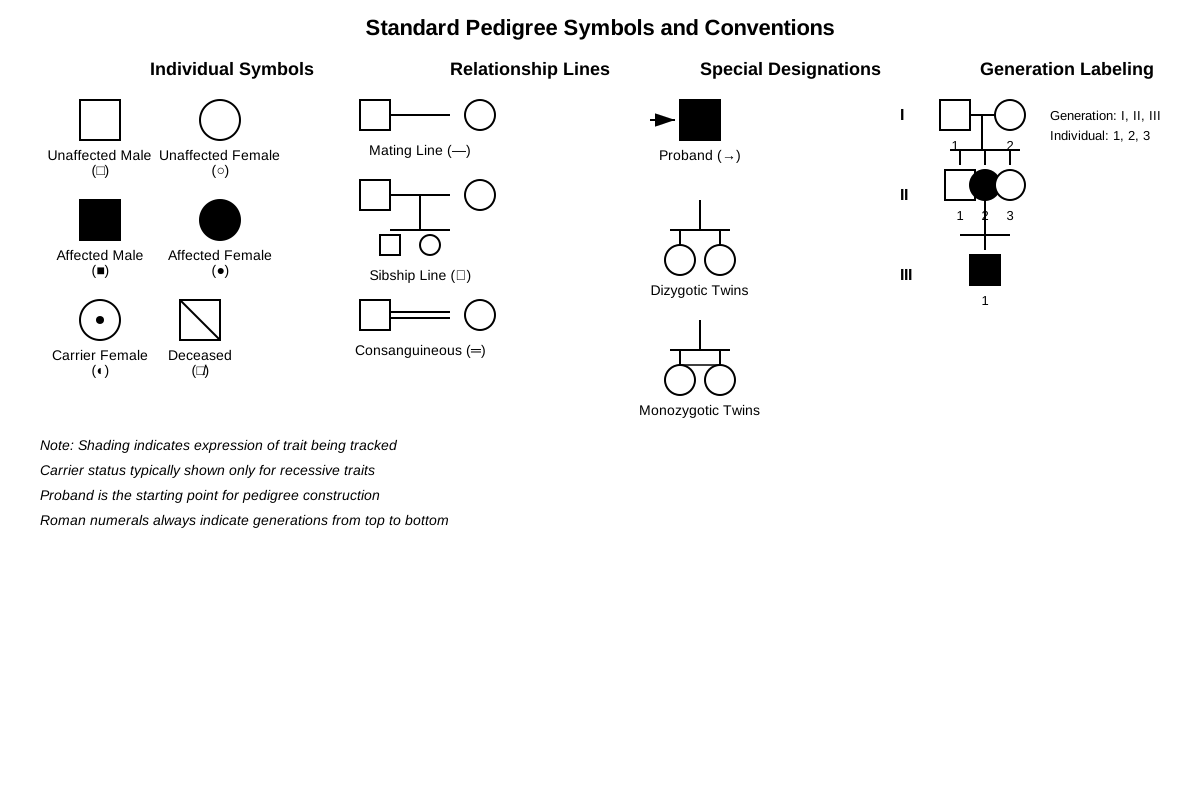
A pedigree is a diagram that depicts family relationships and tracks the inheritance of specific traits or genetic conditions across multiple generations. Standard symbols ensure universal interpretation: circles represent females, squares represent males, and diamonds indicate individuals of unknown or unspecified sex. Filled (shaded) symbols denote affected individuals expressing the trait of interest, while unfilled symbols represent unaffected individuals. Half-filled symbols may indicate carriers or individuals with partial expression.
Horizontal lines connecting a circle and square represent mating relationships (marriages or reproductive partnerships), while vertical lines descending from these unions lead to offspring. Siblings are connected by a horizontal line above them, branching down from their parents' union. Generations are labeled with Roman numerals (I, II, III) from top to bottom, and individuals within each generation are numbered from left to right with Arabic numerals. A proband (the individual through whom the family came to medical attention) is indicated by an arrow. Deceased individuals are marked with a diagonal line through their symbol.
Additional conventions include: double horizontal lines between partners indicating consanguinity (mating between relatives), symbols with dots indicating known carriers of recessive alleles, and multiple symbols stacked or a number inside indicating multiple offspring of the same phenotype. Twins are shown by lines diverging from a single point, with identical twins connected by an additional horizontal bar.
Autosomal Dominant Inheritance
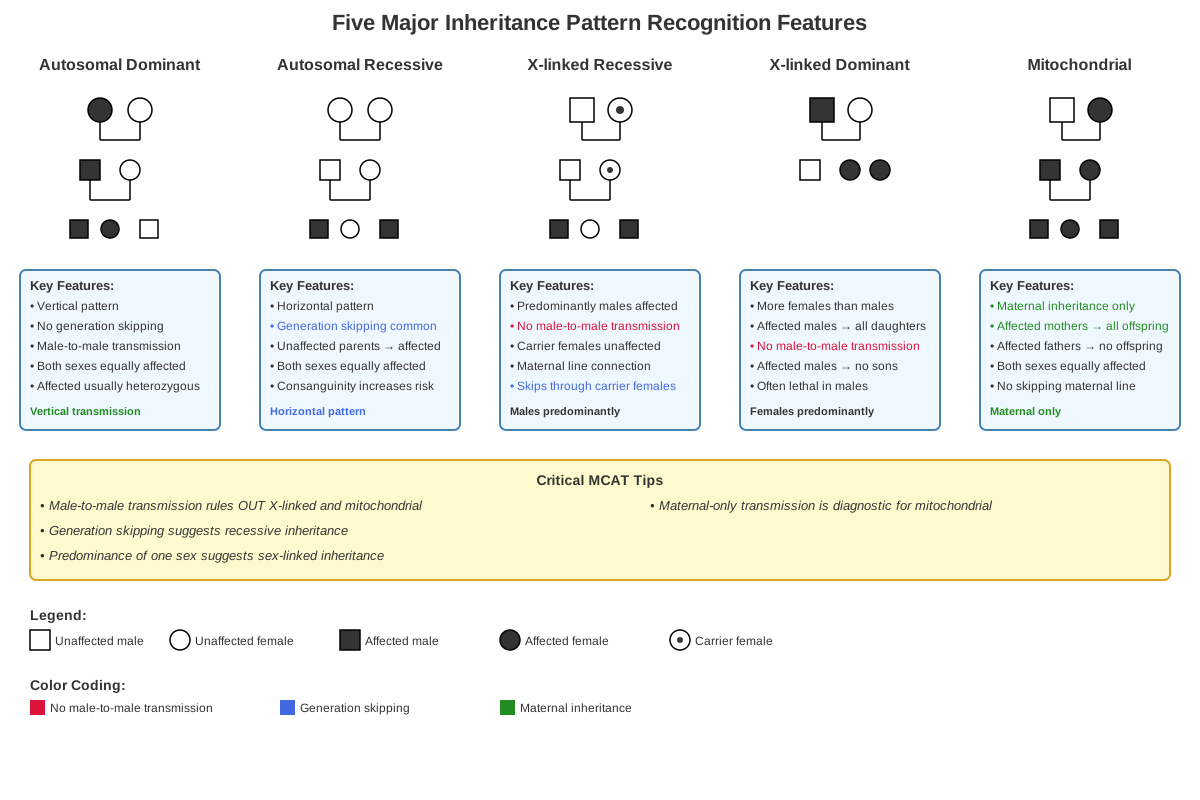
Autosomal dominant inheritance occurs when a trait is expressed in individuals carrying at least one copy of the dominant allele on a non-sex chromosome. Key identifying features in pedigrees include: the trait appears in every generation (no generation skipping), affected individuals typically have at least one affected parent, both males and females are affected in roughly equal proportions, and male-to-male transmission occurs (ruling out X-linkage).
The genotype of affected individuals is either homozygous dominant (AA) or heterozygous (Aa), though heterozygotes are far more common for disease alleles due to the rarity of homozygous dominant individuals in populations. Unaffected individuals must be homozygous recessive (aa). When an affected heterozygote (Aa) mates with an unaffected individual (aa), each offspring has a 50% chance of being affected—a hallmark ratio for autosomal dominant conditions.
Classic examples include Huntington's disease, achondroplasia (dwarfism), and familial hypercholesterolemia. Important considerations include incomplete penetrance (not all individuals with the dominant allele express the phenotype) and variable expressivity (the degree of phenotypic expression varies among affected individuals). These phenomena can complicate pedigree interpretation but don't change the fundamental inheritance pattern.
Autosomal Recessive Inheritance
Autosomal recessive inheritance requires two copies of the recessive allele for trait expression. Distinctive pedigree features include: the trait often skips generations, affected individuals typically have unaffected parents (who are carriers), approximately 25% of offspring from two carrier parents are affected, both sexes are affected equally, and consanguineous matings increase the likelihood of affected offspring.
Affected individuals have genotype aa, while carriers (heterozygotes) have genotype Aa and appear phenotypically normal. When two carriers mate (Aa × Aa), the expected offspring ratio is 1 AA : 2 Aa : 1 aa, meaning 25% affected, 50% carriers, and 25% homozygous dominant. Horizontal transmission patterns (multiple affected siblings in a single generation with unaffected parents) strongly suggest autosomal recessive inheritance.
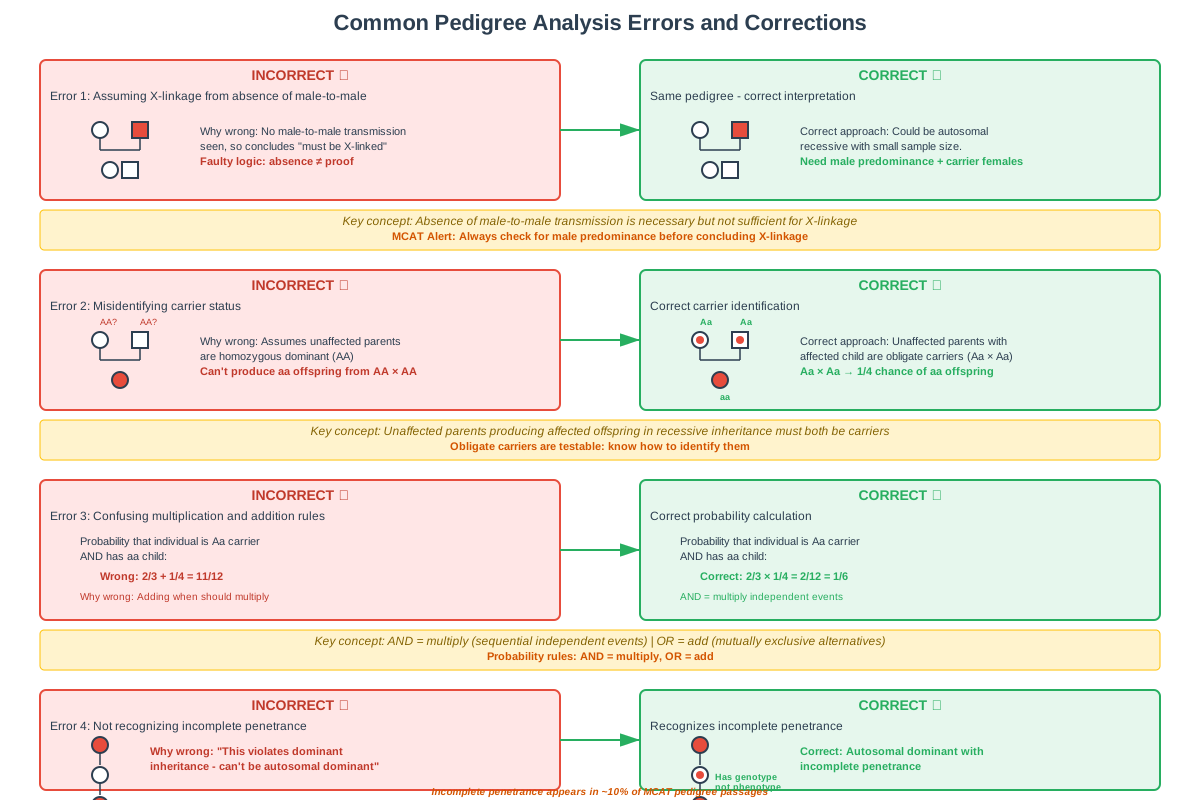
Representative conditions include cystic fibrosis, sickle cell disease, Tay-Sachs disease, and phenylketonuria. Carrier detection is crucial for genetic counseling, and pedigree analysis helps identify obligate carriers—individuals who must be heterozygous based on their offspring or parents. For example, unaffected parents of an affected child must both be carriers.
X-Linked Recessive Inheritance
X-linked recessive inheritance involves genes located on the X chromosome, creating distinctive sex-specific patterns. Hallmark features include: predominantly affected males with very few or no affected females, no male-to-male transmission (affected fathers cannot pass X-linked traits to sons), affected males often have unaffected parents but may have affected maternal grandfathers, and carrier females may have affected sons and brothers.
Males are hemizygous for X-linked genes (possessing only one X chromosome), so a single recessive allele (X^r Y) produces the affected phenotype. Females require two copies of the recessive allele (X^r X^r) to be affected, making affected females rare. Carrier females (X^R X^r) are typically unaffected but have a 50% chance of passing the recessive allele to each offspring. Carrier females mating with unaffected males (X^R X^r × X^R Y) produce offspring in the ratio: 25% affected males, 25% unaffected males, 25% carrier females, and 25% unaffected females.
Classic examples include hemophilia A, Duchenne muscular dystrophy, and red-green color blindness. The characteristic "knight's move" pattern (affected grandfather → carrier daughter → affected grandson) is highly diagnostic. Affected males always pass the recessive allele to all daughters (who become obligate carriers) but never to sons (who receive the Y chromosome).
X-Linked Dominant Inheritance
X-linked dominant inheritance, though rare, shows distinct patterns: affected males have all affected daughters and no affected sons, affected heterozygous females have a 50% chance of affected offspring regardless of sex, both sexes can be affected but females are more commonly affected (approximately 2:1 ratio), and the trait appears in every generation.
Affected males (X^D Y) pass the dominant allele to all daughters but no sons. Affected heterozygous females (X^D X^d) transmit the allele to half their offspring of both sexes. Homozygous dominant females (X^D X^D) are rare and may have more severe phenotypes. Some X-linked dominant conditions are male-lethal, resulting in pedigrees showing only affected females and spontaneous abortions or stillbirths of affected males.
Examples include hypophosphatemic rickets (vitamin D-resistant rickets) and Rett syndrome. The absence of male-to-male transmission distinguishes X-linked dominant from autosomal dominant inheritance, while the presence of affected females with affected fathers distinguishes it from X-linked recessive patterns.
Mitochondrial Inheritance
Mitochondrial inheritance follows unique rules because mitochondrial DNA is inherited exclusively through the maternal line. Diagnostic features include: all offspring of affected mothers are affected, affected fathers never transmit the trait to any offspring, both males and females can be affected, and the trait appears in every generation through the maternal lineage.
This pattern reflects the fact that egg cells contribute virtually all cytoplasmic organelles (including mitochondria) to the zygote, while sperm contribute primarily nuclear DNA. Mitochondrial disorders often show variable expressivity due to heteroplasmy—the presence of both normal and mutant mitochondrial DNA within cells, with the proportion varying among tissues and individuals.
Examples include Leber's hereditary optic neuropathy and mitochondrial myopathies. The vertical transmission through maternal lines without any paternal contribution creates a distinctive pedigree pattern that cannot be confused with other inheritance modes once recognized.
Determining Inheritance Patterns: A Systematic Approach
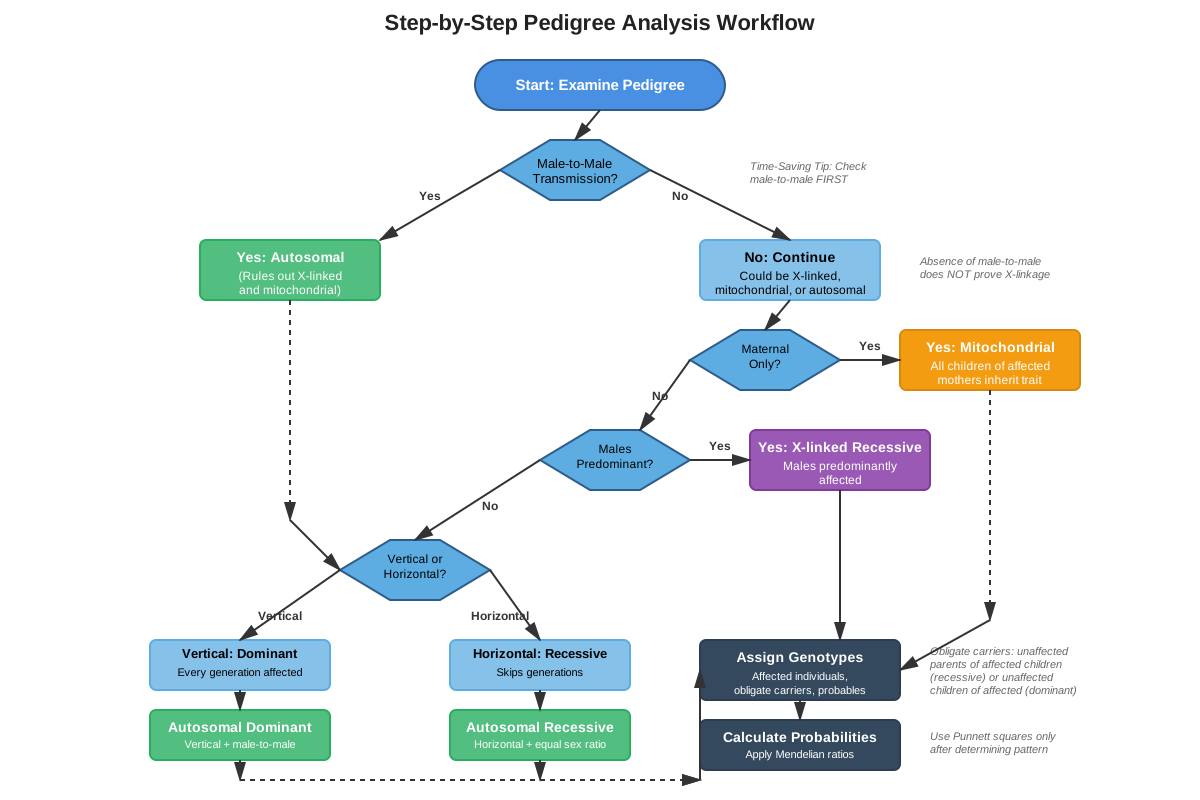
When analyzing an unfamiliar pedigree, apply this systematic decision tree:
- Check for male-to-male transmission: If present, the trait must be autosomal (dominant or recessive); X-linked inheritance is ruled out
- Assess sex distribution: If only or predominantly males are affected, consider X-linked recessive; if both sexes are equally affected, consider autosomal
- Examine generational patterns: If the trait appears in every generation, consider dominant inheritance; if generations are skipped, consider recessive
- Look for affected-to-affected matings: Analyze offspring ratios to distinguish between inheritance patterns
- Check maternal transmission: If all offspring of affected mothers are affected but affected fathers have no affected offspring, consider mitochondrial inheritance
| Inheritance Pattern | Male-to-Male Transmission | Sex Distribution | Generational Pattern | Key Diagnostic Feature |
|---|---|---|---|---|
| Autosomal Dominant | Yes | Equal | Every generation | Affected parent → affected child |
| Autosomal Recessive | Yes | Equal | Skips generations | Unaffected parents → affected child |
| X-Linked Recessive | No | Mostly males | Skips generations | Carrier mother → affected sons |
| X-Linked Dominant | No | More females | Every generation | Affected father → all daughters affected |
| Mitochondrial | No | Equal | Every generation (maternal line) | Affected mother → all offspring affected |
Calculating Probabilities in Pedigrees
Probability calculations are essential for predicting offspring genotypes and phenotypes. The multiplication rule states that the probability of independent events occurring together equals the product of their individual probabilities. The addition rule states that the probability of either of two mutually exclusive events occurring equals the sum of their individual probabilities.
For sequential probability problems, multiply the probability of each generation's transmission. For example, if a carrier female (Aa) has a child with an unaffected male (aa), the probability that the child is a carrier daughter is: P(carrier) × P(female) = 1/2 × 1/2 = 1/4.
When determining probabilities for individuals with unknown genotypes, use conditional probability. If an individual is unaffected but has an affected sibling (suggesting carrier parents), calculate the probability they are a carrier by excluding the affected genotype from possible outcomes. For carrier parents (Aa × Aa), offspring ratios are 1 AA : 2 Aa : 1 aa. If the individual is unaffected, they are either AA or Aa in a 1:2 ratio, making the probability of being a carrier 2/3 (not 1/2).
Quick check — test yourself on Pedigree analysis so far.
Try Flashcards →Concept Relationships
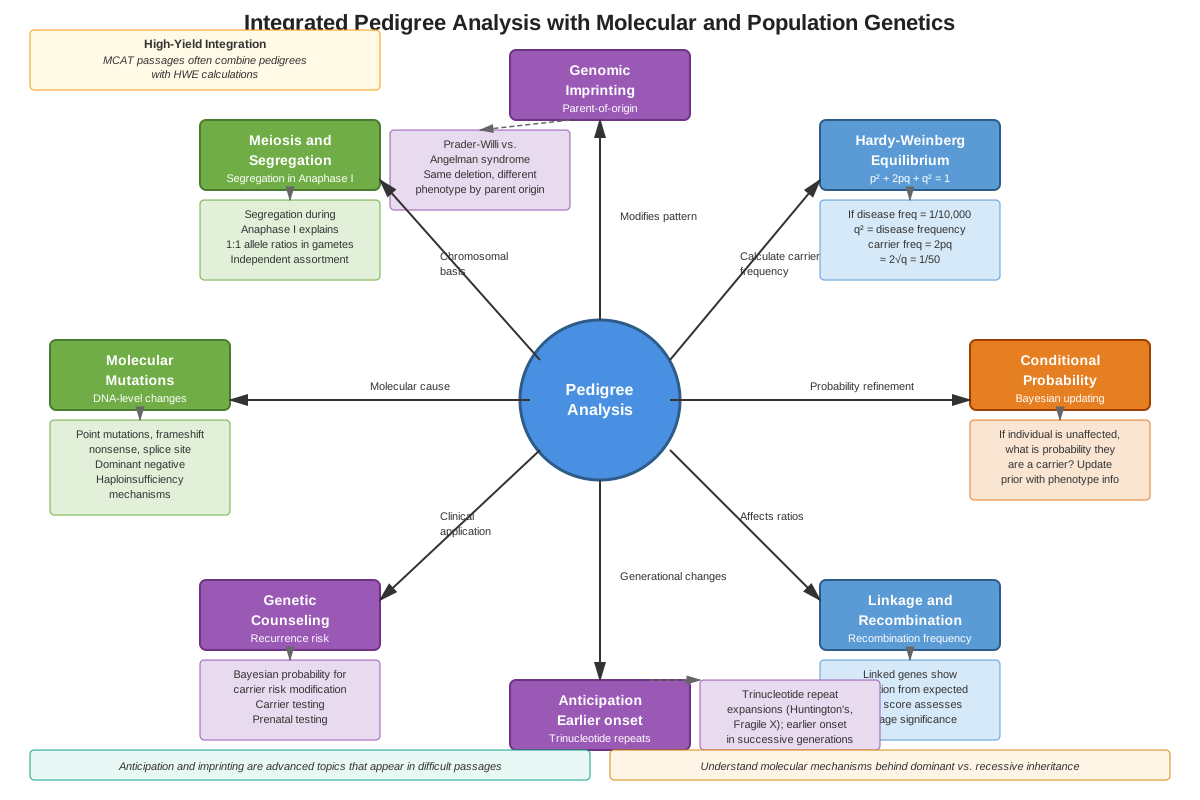
Pedigree analysis integrates multiple foundational genetics concepts into a unified analytical framework. Mendelian inheritance provides the theoretical foundation, with Mendel's laws of segregation and independent assortment explaining how alleles separate during gamete formation and recombine in offspring. These principles directly determine the ratios observed in pedigrees and enable probability calculations.
The chromosomal theory of inheritance connects pedigree patterns to physical chromosome behavior during meiosis. Autosomal patterns reflect the equal inheritance of autosomes by both sexes, while sex-linked patterns arise from the unique inheritance of X and Y chromosomes. Understanding meiotic segregation and the formation of gametes explains why heterozygous parents produce offspring in predictable ratios.
Probability theory transforms qualitative pedigree observations into quantitative predictions. The multiplication and addition rules, combined with conditional probability, allow calculation of genotype likelihoods for any individual in a pedigree. These calculations connect to Hardy-Weinberg equilibrium, which can be used to estimate carrier frequencies in populations based on disease prevalence observed in pedigrees.
Pedigree analysis also relates to molecular genetics and gene expression. Concepts like incomplete penetrance and variable expressivity reflect the influence of modifier genes, environmental factors, and epigenetic regulation on phenotype. Modern pedigree analysis often incorporates molecular data such as DNA sequencing, linking classical inheritance patterns to specific mutations and molecular mechanisms.
The relationship flow can be mapped as: Meiosis and chromosome segregation → Mendelian ratios → Pedigree patterns → Probability calculations → Genetic counseling and risk assessment. Additionally: Molecular mutations → Phenotypic expression → Observable pedigree traits → Inheritance pattern determination.
High-Yield Facts
⭐ Autosomal dominant traits appear in every generation and show male-to-male transmission; affected individuals typically have at least one affected parent.
⭐ Autosomal recessive traits often skip generations; affected individuals usually have two unaffected carrier parents.
⭐ X-linked recessive traits predominantly affect males, show no male-to-male transmission, and often display the "knight's move" pattern (affected grandfather → carrier daughter → affected grandson).
⭐ The presence of male-to-male transmission definitively rules out any form of X-linked inheritance.
⭐ For autosomal recessive conditions, when both parents are carriers (Aa × Aa), each offspring has a 25% chance of being affected, 50% chance of being a carrier, and 25% chance of being homozygous dominant.
- X-linked dominant traits show affected fathers having all affected daughters and no affected sons.
- Mitochondrial inheritance shows maternal-only transmission: all offspring of affected mothers are affected, while affected fathers never transmit the trait.
- Consanguineous matings (mating between relatives) significantly increase the probability of autosomal recessive conditions appearing in offspring.
- For an unaffected individual with two carrier parents and an affected sibling, the probability of being a carrier is 2/3 (not 1/2), using conditional probability.
- Obligate carriers are individuals who must be heterozygous based on pedigree logic, such as unaffected parents of affected children in autosomal recessive pedigrees.
- Incomplete penetrance means not all individuals with a disease genotype express the phenotype, which can make dominant traits appear to skip generations.
- Variable expressivity means the severity of phenotypic expression varies among individuals with the same disease genotype.
Common Misconceptions
Misconception: If a trait skips a generation, it must be recessive. → Correction: While generation-skipping strongly suggests recessive inheritance, incomplete penetrance can cause dominant traits to appear to skip generations. Always consider multiple pedigree features before concluding the inheritance pattern.
Misconception: X-linked traits only affect males. → Correction: X-linked recessive traits predominantly affect males, but homozygous females can be affected (though rare). X-linked dominant traits affect both sexes, with females often more commonly affected than males.
Misconception: The probability of being a carrier is always 50% for offspring of a carrier parent. → Correction: The probability depends on the other parent's genotype and whether the individual is known to be unaffected. Conditional probability must be applied when additional information is available.
Misconception: Male-to-male transmission can occur in X-linked inheritance. → Correction: Male-to-male transmission is impossible for X-linked traits because fathers pass their Y chromosome (not X) to sons. The presence of male-to-male transmission definitively indicates autosomal inheritance.
Misconception: All offspring of two affected recessive individuals will be affected. → Correction: This is true only if both parents are homozygous recessive (aa × aa = all aa offspring). If the trait is actually dominant with incomplete penetrance, or if there is genetic heterogeneity (different genes causing similar phenotypes), outcomes may vary.
Misconception: Carrier females for X-linked recessive conditions never show symptoms. → Correction: Due to X-inactivation (lyonization), some carrier females may show mild symptoms if the X chromosome carrying the normal allele is preferentially inactivated in relevant tissues. This is called manifesting heterozygosity.
Misconception: Mitochondrial inheritance affects only females. → Correction: Both males and females can be affected by mitochondrial disorders. The sex-specific aspect is transmission: only mothers transmit mitochondrial DNA to offspring, but affected fathers can exist (they just cannot pass it on).
Worked Examples
Example 1: Determining Inheritance Pattern and Calculating Probabilities
Scenario: A pedigree shows a genetic condition with the following characteristics: Generation I has an affected father and unaffected mother. Generation II has three daughters (all affected) and two sons (all unaffected). One affected daughter from Generation II mates with an unaffected male, producing two affected daughters and one unaffected son in Generation III.
Question: What is the inheritance pattern? What is the probability that the next child of the Generation II affected daughter will be an affected male?
Solution:
Step 1: Analyze male-to-male transmission. The affected father in Generation I has sons in Generation II, but they are all unaffected. This rules out autosomal dominant but doesn't definitively rule out X-linked patterns yet.
Step 2: Examine sex distribution. All daughters of the affected father are affected, while all sons are unaffected. This is the hallmark of X-linked dominant inheritance: affected males pass the X^D chromosome to all daughters (making them affected) and the Y chromosome to all sons (making them unaffected).
Step 3: Confirm with Generation III. The affected daughter (X^D X^d) mating with an unaffected male (X^d Y) produces affected daughters (X^D X^d) and unaffected sons (X^d Y), with approximately 50% of each sex affected. This confirms X-linked dominant inheritance.
Step 4: Calculate probability for the next child. The affected mother is X^D X^d (heterozygous), and the father is X^d Y (unaffected). The Punnett square shows:
        X^d (father)    Y (father)
X^D     X^D X^d         X^D Y
(mother) (affected F)   (affected M)

X^d     X^d X^d         X^d Y
(mother) (unaffected F) (unaffected M)
The probability of an affected male (X^D Y) is 1/4 (25%). This is calculated as: P(male) × P(receives X^D) = 1/2 × 1/2 = 1/4.
Answer: The inheritance pattern is X-linked dominant. The probability of the next child being an affected male is 25% or 1/4.
Example 2: Identifying Carriers and Complex Probability
Scenario: A pedigree shows an autosomal recessive condition. In Generation I, both parents are unaffected. In Generation II, there are four children: three unaffected (two males, one female) and one affected female. One of the unaffected males from Generation II (Individual II-1) marries an unaffected woman from an unrelated family with no history of the condition. They want to know the probability their first child will be affected.
Question: What is the probability that Individual II-1 is a carrier? What is the probability that their first child will be affected?
Solution:
Step 1: Determine Generation I genotypes. Since they have an affected child (aa), both parents must be carriers (Aa × Aa).
Step 2: Calculate probability that Individual II-1 is a carrier using conditional probability. From carrier parents (Aa × Aa), offspring ratios are 1 AA : 2 Aa : 1 aa. Since Individual II-1 is unaffected, he cannot be aa. Among the remaining possibilities (1 AA : 2 Aa), the probability of being a carrier is 2/3.
Step 3: Estimate the probability that the unrelated wife is a carrier. Without additional information, use the Hardy-Weinberg equation. For rare recessive conditions, assume the carrier frequency in the general population is approximately 2√q, where q is the disease frequency. For very rare conditions, this is typically very low (often 1/50 to 1/100). For this calculation, assume a carrier frequency of 1/50 (2%).
Step 4: Calculate the probability of an affected child. For a child to be affected (aa), both parents must be carriers AND both must pass the recessive allele:
P(child affected) = P(II-1 is carrier) × P(wife is carrier) × P(both pass recessive allele)
P(child affected) = 2/3 × 1/50 × 1/4 = 2/600 = 1/300
Answer: Individual II-1 has a 2/3 probability of being a carrier. The probability that their first child will be affected is approximately 1/300 (0.33%).
Exam Strategy
When approaching MCAT pedigree questions, begin by quickly scanning the pedigree for the most diagnostic features: male-to-male transmission (indicates autosomal), sex distribution (equal suggests autosomal, skewed suggests X-linked), and generational patterns (every generation suggests dominant, skipping suggests recessive). This initial 10-15 second assessment often eliminates 3-4 of the 5 inheritance patterns, dramatically simplifying the problem.
Trigger words and phrases to watch for include: "carrier status" (signals probability calculation needed), "obligate carrier" (requires logical deduction), "consanguineous" (increases recessive disease probability), "affected father and affected daughter" (suggests X-linked dominant or autosomal dominant), "affected grandfather and affected grandson through unaffected daughter" (classic X-linked recessive), and "all offspring of affected mother are affected" (suggests mitochondrial).
For process-of-elimination, use these decision rules: If male-to-male transmission exists, eliminate all X-linked and mitochondrial options immediately. If only males are affected, eliminate autosomal dominant and mitochondrial. If affected fathers have unaffected sons, eliminate X-linked dominant. If affected mothers have unaffected offspring, eliminate mitochondrial. This systematic elimination often leaves only one viable answer.
Exam Tip: When calculating probabilities, always write out the Punnett square or probability tree, even if it seems simple. The MCAT rewards systematic approaches, and this prevents careless errors under time pressure.
For time management, allocate approximately 1-2 minutes for pedigree-based discrete questions and 2-3 minutes for passage-based pedigree questions. If a probability calculation becomes complex, consider whether the answer choices allow for estimation or elimination. Often, recognizing that a probability must be less than 50% or greater than 25% is sufficient to identify the correct answer without complete calculation.
When passages present novel genetic scenarios, focus on applying fundamental principles rather than memorizing specific disease patterns. The MCAT tests reasoning ability, not encyclopedic knowledge of genetic conditions. Extract the key information: How is the trait transmitted? What are the phenotypes? What are the genotypes of key individuals? Then apply standard Mendelian genetics.
Memory Techniques
Mnemonic for Autosomal Dominant features: "EVERY PARENT"
- Every generation affected
- Vertical transmission pattern
- Equal sex distribution
- Rarely skips generations
- Yes to male-to-male transmission
- Parent usually affected
- Affected individuals are heterozygotes
- Ratio of 50% affected offspring (from Aa × aa)
- Expressivity may vary
- Not all with genotype show phenotype (incomplete penetrance)
- Transmission from affected to unaffected to affected is rare
Mnemonic for X-Linked Recessive: "KNIGHTS MOVE"
- Knights move pattern (grandfather → daughter → grandson)
- No male-to-male transmission
- Inheritance through carrier females
- Guys (males) predominantly affected
- Hemizygous males need only one allele
- Transmission skips generations
- Sons of carrier mothers have 50% risk
Mothers pass to sons
- Obligate carriers are daughters of affected males
- Very rare affected females (need X^r X^r)
- Expression in males with single allele
Visualization strategy for X-linked inheritance: Picture the X chromosome as a "carrier vehicle" that females have two of (backup system) but males have only one (no backup). When the vehicle carries a "broken part" (recessive allele), females can use their backup vehicle, but males cannot, leading to expression of the condition.
Acronym for systematic pedigree analysis: "SAGE"
- Sex distribution: Equal or skewed?
- Affected parents: Do they have affected children?
- Generational pattern: Every generation or skipping?
- Eliminate: Use male-to-male transmission to rule out X-linked
Summary
Pedigree analysis is the systematic interpretation of family inheritance patterns using standardized diagrams to determine how genetic traits are transmitted across generations. Mastery requires recognizing five major inheritance patterns—autosomal dominant, autosomal recessive, X-linked recessive, X-linked dominant, and mitochondrial—each with distinctive features. Autosomal dominant traits appear in every generation with male-to-male transmission possible; autosomal recessive traits skip generations with affected individuals typically having unaffected carrier parents; X-linked recessive traits predominantly affect males with no male-to-male transmission; X-linked dominant traits show affected fathers having all affected daughters; and mitochondrial traits show exclusive maternal transmission. Success on MCAT pedigree questions demands rapid pattern recognition, systematic elimination of impossible inheritance modes, accurate probability calculations using Mendelian genetics and conditional probability, and identification of obligate carriers through logical deduction. The ability to integrate pedigree analysis with molecular genetics, population genetics, and clinical scenarios represents high-level mastery that distinguishes top-performing students.
Key Takeaways
- Male-to-male transmission definitively rules out X-linked and mitochondrial inheritance, immediately narrowing possibilities to autosomal patterns
- Autosomal recessive pedigrees show horizontal transmission (affected siblings with unaffected parents), while dominant pedigrees show vertical transmission (affected individuals in consecutive generations)
- X-linked recessive inheritance creates the characteristic "knight's move" pattern with predominantly affected males and carrier females transmitting to affected sons
- Conditional probability is essential: an unaffected individual with carrier parents and an affected sibling has a 2/3 (not 1/2) probability of being a carrier
- Systematic analysis using sex distribution, generational patterns, and specific transmission features enables rapid determination of inheritance patterns on timed exams
- Obligate carriers can be identified through logical deduction: unaffected parents of affected children in recessive pedigrees, and all daughters of affected males in X-linked recessive pedigrees
- Integration of pedigree analysis with probability calculations, Hardy-Weinberg equilibrium, and molecular genetics represents the highest level of MCAT genetics mastery
Related Topics
Hardy-Weinberg Equilibrium and Population Genetics: Understanding allele and genotype frequencies in populations enables calculation of carrier frequencies from pedigree data and estimation of disease prevalence. Mastering pedigrees provides the foundation for population-level genetic analysis.
Genetic Counseling and Risk Assessment: Clinical application of pedigree analysis for advising families about hereditary disease risks, reproductive options, and genetic testing. This topic extends pedigree interpretation into medical decision-making contexts.
Molecular Basis of Genetic Disorders: Connecting pedigree patterns to specific gene mutations, protein dysfunction, and biochemical pathway disruptions. Understanding the molecular mechanisms underlying inherited conditions deepens comprehension of why certain inheritance patterns emerge.
Non-Mendelian Inheritance: Exploring exceptions to classical patterns including genomic imprinting, anticipation, mosaicism, and polygenic inheritance. These advanced topics build on foundational pedigree analysis skills.
Chromosomal Abnormalities and Karyotype Analysis: Examining inheritance of chromosomal disorders such as Down syndrome, Turner syndrome, and Klinefelter syndrome, which follow different patterns than single-gene disorders but still appear in pedigrees.
Practice CTA
Now that you have mastered the core concepts of pedigree analysis, challenge yourself with practice questions and flashcards to solidify your understanding. Focus on timed practice with complex multi-generational pedigrees that require integration of probability calculations and pattern recognition. The ability to rapidly and accurately interpret pedigrees under exam conditions will significantly boost your MCAT Biology score and demonstrate the analytical reasoning skills essential for medical school success. Remember: every pedigree question you practice strengthens your genetic reasoning abilities and builds confidence for test day. You've got this!
Sign up free to keep reading
Create a free AnvayaPrep account to finish this MCAT guide on Pedigree analysis — plus flashcards and practice questions.