Overview
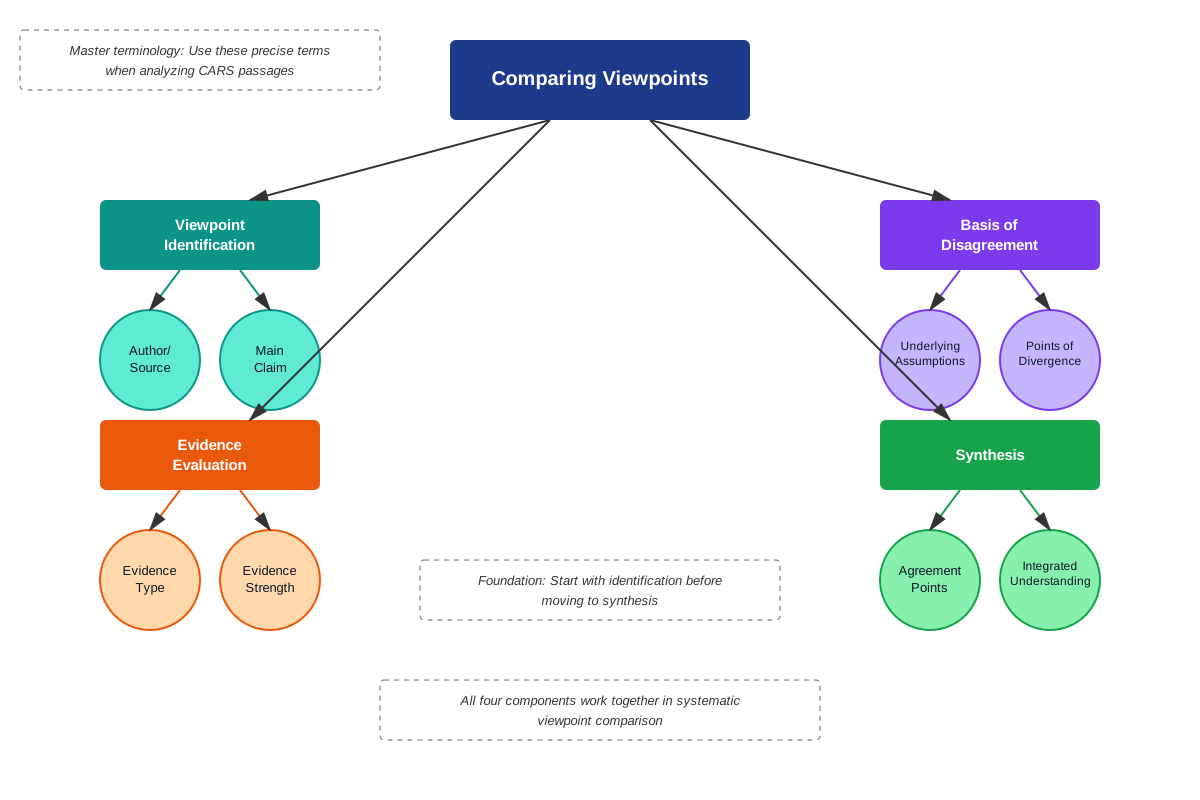
Comparing viewpoints is a fundamental skill within the Critical Analysis and Reasoning Skills (CARS) section of the MCAT that requires students to identify, analyze, and evaluate multiple perspectives presented within a single passage or across related texts. This skill extends beyond simple comprehension to demand sophisticated analytical thinking about how different authors, characters, or theoretical frameworks approach the same subject matter. On the MCAT, passages frequently present contrasting opinions, competing theories, or evolving perspectives on philosophical, cultural, historical, or social issues, and students must demonstrate their ability to distinguish between these viewpoints while understanding the nuances that separate them.
The ability to compare viewpoints is essential for success on the MCAT because approximately 30-40% of CARS questions require students to recognize differences between perspectives, understand the basis for disagreements, or synthesize information from multiple viewpoints. This skill directly assesses the critical thinking abilities necessary for medical practice, where physicians must regularly consider multiple diagnostic possibilities, weigh competing treatment approaches, and understand diverse patient perspectives. The MCAT tests this skill through various question types, including those asking students to identify points of agreement or disagreement, determine which viewpoint would support a particular claim, or predict how one author would respond to another's argument.
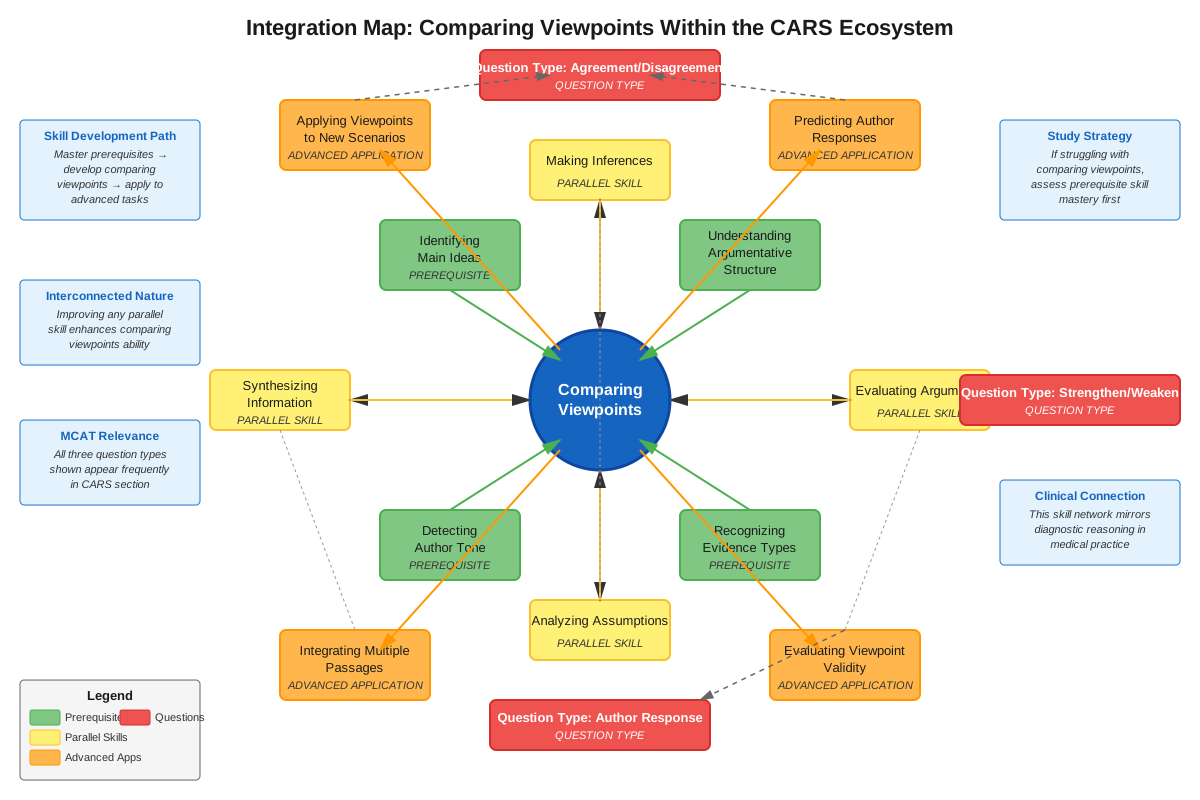
Within the broader framework of CARS Skills, comparing viewpoints connects intimately with other critical reading competencies such as identifying main ideas, understanding author purpose and tone, recognizing argumentative structure, and making inferences. This skill serves as a bridge between basic comprehension and advanced analytical reasoning, requiring students to maintain multiple conceptual frameworks simultaneously while evaluating the relationships between them. Mastery of comparing viewpoints enhances performance across all CARS question types and develops the intellectual flexibility essential for medical school and clinical practice.
Learning Objectives
- [ ] Define Comparing viewpoints using accurate Critical Analysis and Reasoning Skills terminology
- [ ] Explain why Comparing viewpoints matters for the MCAT
- [ ] Apply Comparing viewpoints to exam-style questions
- [ ] Identify common mistakes related to Comparing viewpoints
- [ ] Connect Comparing viewpoints to related Critical Analysis and Reasoning Skills concepts
- [ ] Distinguish between explicit and implicit points of agreement and disagreement between viewpoints
- [ ] Evaluate the strength and validity of evidence supporting different viewpoints
- [ ] Synthesize multiple perspectives to answer complex reasoning questions
- [ ] Recognize the underlying assumptions that differentiate competing viewpoints
Prerequisites
- Basic reading comprehension: Understanding literal meaning of text is necessary before analyzing multiple perspectives within it
- Identification of main ideas and thesis statements: Recognizing each viewpoint's central claim provides the foundation for comparison
- Understanding of argumentative structure: Knowing how authors build arguments helps identify where viewpoints diverge
- Recognition of evidence types: Distinguishing between different forms of support enables evaluation of competing claims
- Familiarity with author tone and purpose: Understanding why authors present information aids in comparing their perspectives
Why This Topic Matters
Clinical and Real-World Significance
The skill of comparing viewpoints directly translates to clinical medicine, where physicians must regularly evaluate competing diagnostic hypotheses, consider multiple treatment approaches with different risk-benefit profiles, and understand diverse patient perspectives shaped by cultural, religious, and personal values. Medical decision-making rarely involves clear-cut choices; instead, it requires weighing evidence from different sources, considering alternative interpretations of data, and synthesizing multiple expert opinions. The ability to hold multiple perspectives simultaneously while evaluating their relative merits is fundamental to evidence-based medicine and patient-centered care.
Exam Statistics and Frequency
Comparing viewpoints appears in approximately 35% of CARS passages on the MCAT, making it one of the most frequently tested skills. Questions specifically targeting this skill typically constitute 3-4 questions per passage when the passage structure involves multiple perspectives. The AAMC consistently includes passages that present:
- Two or more authors discussing the same topic with different conclusions
- An author presenting and critiquing alternative theories
- Historical evolution of thought on a subject
- Dialogue or debate between characters or schools of thought
Common Exam Appearances
This topic appears in MCAT passages through several characteristic formats:
- Explicit comparison passages: The author directly contrasts two or more viewpoints, often using transition words like "however," "in contrast," or "alternatively"
- Theory evolution passages: The text traces how thinking on a topic has changed over time, presenting earlier and later perspectives
- Critique passages: An author presents another's viewpoint before offering counterarguments or alternative interpretations
- Multi-voice passages: Different speakers or authors are quoted or paraphrased, each offering distinct perspectives
- Nuanced position passages: A single author acknowledges complexity by presenting multiple valid perspectives before synthesizing them
Core Concepts
Definition and Scope of Comparing Viewpoints
Comparing viewpoints in the context of Critical Analysis and Reasoning Skills refers to the systematic process of identifying, analyzing, and evaluating two or more distinct perspectives on a topic, issue, or phenomenon presented within MCAT passages. This skill encompasses recognizing explicit statements of disagreement, inferring implicit differences in underlying assumptions, understanding the basis for divergent conclusions, and determining points of agreement or overlap between perspectives. Unlike simple identification of different opinions, true comparison requires understanding the logical structure, evidentiary basis, and philosophical foundations that distinguish each viewpoint.
The scope of this skill extends across multiple cognitive levels. At the foundational level, students must accurately identify that multiple viewpoints exist and attribute specific claims to the correct source. At intermediate levels, students must recognize the dimensions along which viewpoints differ—whether in their factual claims, interpretive frameworks, value judgments, or methodological approaches. At advanced levels, students must evaluate the relative strength of competing viewpoints, predict how proponents of one view would respond to another, and synthesize elements from multiple perspectives to address novel questions.
Types of Viewpoint Differences
Understanding the various dimensions along which viewpoints can differ is crucial for effective comparison. The MCAT tests recognition of these distinct types of disagreement:
| Type of Difference | Description | Example Signal Words |
|---|---|---|
| Factual disagreement | Authors dispute what is actually true or what evidence shows | "contradicts," "disputes," "denies" |
| Interpretive disagreement | Authors agree on facts but interpret their meaning differently | "suggests," "implies," "indicates" |
| Methodological disagreement | Authors differ in their approach to studying or understanding a phenomenon | "approach," "method," "framework" |
| Value-based disagreement | Authors prioritize different values or goals | "should," "ought," "preferable" |
| Scope disagreement | Authors differ in how broadly they apply a concept or theory | "always," "sometimes," "limited to" |
| Causal disagreement | Authors attribute different causes to the same effect | "because," "results from," "leads to" |
Identifying Explicit vs. Implicit Viewpoint Differences
Explicit differences are directly stated in the passage through clear comparative language. Authors signal these differences with transition words and phrases such as "in contrast," "however," "on the other hand," "alternatively," or "whereas." When viewpoints are explicitly compared, the passage structure typically presents one perspective, signals a transition, and then presents the contrasting perspective. MCAT questions testing explicit differences often ask students to identify what distinguishes the viewpoints or to recognize statements that one author would accept but another would reject.
Implicit differences require inference from the logical structure and underlying assumptions of each viewpoint. These differences emerge from what each perspective emphasizes, what evidence it considers relevant, what assumptions it makes, or what conclusions it draws from shared premises. Recognizing implicit differences demands attention to:
- The types of evidence each viewpoint privileges
- The underlying philosophical or theoretical frameworks
- The scope and limitations each perspective acknowledges
- The implications each viewpoint accepts or rejects
- The questions each perspective considers important
Structural Patterns in Multi-Viewpoint Passages
MCAT passages presenting multiple viewpoints typically follow recognizable organizational patterns:
- Sequential presentation: Viewpoint A is fully explained, followed by complete explanation of Viewpoint B, with comparison occurring at the end or left implicit
- Point-by-point comparison: Each aspect of the topic is discussed by presenting both viewpoints on that specific point before moving to the next aspect
- Thesis-antithesis-synthesis: An initial viewpoint is presented, a contrasting viewpoint challenges it, and a third perspective attempts to reconcile or transcend the disagreement
- Historical progression: Earlier viewpoints are presented chronologically, showing how thinking evolved over time
- Dominant-alternative structure: A mainstream or widely-accepted view is presented, followed by alternative or minority perspectives
Analyzing the Basis for Viewpoint Differences
Understanding why viewpoints differ is as important as recognizing that they differ. The MCAT frequently asks questions that require students to identify the fundamental source of disagreement. Common bases for viewpoint differences include:
Epistemological differences: Disagreement about what counts as valid knowledge or reliable evidence. One viewpoint might privilege empirical observation while another values logical deduction or intuitive understanding.
Ontological differences: Disagreement about the fundamental nature of reality or existence. Perspectives might differ on whether phenomena are objective or socially constructed, material or ideal, deterministic or contingent.
Axiological differences: Disagreement about values, priorities, or what constitutes desirable outcomes. One viewpoint might prioritize individual freedom while another emphasizes collective welfare.
Scope and generalizability differences: Disagreement about how broadly findings or principles apply. One perspective might claim universal applicability while another emphasizes context-dependence.
Recognizing Points of Agreement
While comparing viewpoints often focuses on differences, identifying areas of agreement is equally important for MCAT success. Questions frequently ask what multiple viewpoints would accept, what common ground exists, or what shared assumptions underlie different conclusions. Points of agreement often include:
- Shared factual premises from which different conclusions are drawn
- Common recognition of a problem's importance despite disagreement about solutions
- Mutual acknowledgment of complexity or limitations in current understanding
- Agreement about what questions are worth investigating
- Shared rejection of extreme or alternative positions
Evaluating Viewpoint Strength and Validity
Advanced Comparing viewpoints MCAT questions require students to evaluate the relative strength of competing perspectives. This evaluation considers:
- Evidence quality: Which viewpoint is supported by stronger, more relevant, or more comprehensive evidence?
- Logical coherence: Which viewpoint follows more rigorously from its premises?
- Explanatory power: Which viewpoint accounts for more phenomena or resolves more puzzles?
- Consistency: Which viewpoint contains fewer internal contradictions?
- Scope: Which viewpoint applies more broadly or handles edge cases better?
Concept Relationships
The skill of comparing viewpoints integrates multiple foundational CARS competencies into a unified analytical process. At its base, comparing viewpoints requires solid reading comprehension to accurately understand each perspective individually before comparison can occur. This foundational comprehension connects directly to the skill of identifying main ideas and thesis statements—students must first recognize what each viewpoint claims before determining how those claims differ.
The relationship flows as follows: Reading comprehension → Identifying main ideas → Recognizing argumentative structure → Comparing viewpoints → Evaluating arguments → Synthesizing information. Each viewpoint typically presents an argument with premises and conclusions, so understanding argumentative structure enables recognition of where viewpoints diverge in their reasoning chains. Once viewpoints are compared, students can evaluate their relative merits, leading to synthesis questions that ask how perspectives might be reconciled or integrated.
Comparing viewpoints also connects laterally to other CARS skills. Understanding author tone and purpose helps explain why authors present multiple perspectives—whether to critique, synthesize, or demonstrate complexity. Recognition of rhetorical devices illuminates how authors signal transitions between viewpoints or emphasize differences. Inference skills enable detection of implicit disagreements not explicitly stated in the passage.
Within the comparing viewpoints skill itself, the sub-components form a hierarchy: identifying that multiple viewpoints exist → attributing specific claims to correct sources → recognizing dimensions of difference → understanding the basis for disagreement → evaluating relative strength → predicting responses → synthesizing perspectives. Mastery requires proficiency at each level, as higher-level tasks depend on accurate execution of lower-level components.
High-Yield Facts
⭐ Approximately 35% of CARS passages contain multiple viewpoints that must be compared, making this one of the most frequently tested skills
⭐ Transition words like "however," "in contrast," "alternatively," and "on the other hand" are the most reliable signals that viewpoints are being compared
⭐ Questions asking "which would Author A accept but Author B reject" test explicit viewpoint comparison and appear in nearly every CARS section
⭐ The basis for disagreement between viewpoints is more frequently tested than the specific content of each viewpoint
⭐ Points of agreement between seemingly opposing viewpoints are high-yield question topics that many students overlook
- Implicit viewpoint differences require attention to underlying assumptions, not just explicit statements
- Historical progression passages present earlier viewpoints that are typically critiqued or superseded by later perspectives
- Multi-viewpoint passages often include a synthesis or reconciliation attempt that represents the author's own position
- Questions about how one author would respond to another's claim require understanding both the logical structure and the values underlying each viewpoint
- Scope differences (universal vs. limited applicability) are a common but subtle dimension of viewpoint disagreement
- Methodological disagreements often underlie differences in conclusions even when factual premises are shared
- The strongest viewpoint in a passage is not always the one presented last or most extensively
Quick check — test yourself on Comparing viewpoints so far.
Try Flashcards →Common Misconceptions
Misconception: All differences between viewpoints are explicitly stated in the passage
Correction: Many critical differences are implicit, requiring inference from underlying assumptions, methodological choices, or the types of evidence each viewpoint considers relevant. Students must read actively to detect these unstated differences.
Misconception: If two viewpoints disagree on one point, they must disagree on everything
Correction: Viewpoints can share substantial common ground while differing on specific aspects. MCAT questions frequently test recognition of what competing perspectives would both accept, making it essential to identify areas of agreement as well as disagreement.
Misconception: The viewpoint presented last or most extensively is the correct or strongest one
Correction: Passage structure does not indicate viewpoint validity. The MCAT tests critical evaluation, not assumption that organizational prominence indicates correctness. Students must evaluate each viewpoint's merits independently of presentation order.
Misconception: Comparing viewpoints only involves identifying that perspectives differ
Correction: True comparison requires understanding the dimensions along which viewpoints differ, the basis for those differences, the relative strength of supporting evidence, and the implications of each perspective. Surface-level recognition of difference is insufficient for MCAT success.
Misconception: Personal agreement or disagreement with a viewpoint should influence answer selection
Correction: MCAT questions test comprehension and analysis of what the passage states, not personal opinions about which viewpoint is correct. Students must set aside their own beliefs and answer based solely on passage content and logical reasoning.
Misconception: Viewpoint comparison questions always use the word "viewpoint" or "perspective"
Correction: These questions appear in many forms, including "Author A would most likely respond to Author B's claim by...", "Which statement would both passages support?", "The two theories differ primarily in their...", and "Unlike the first perspective, the second emphasizes..." Students must recognize the underlying skill being tested regardless of question wording.
Misconception: All viewpoints in a passage are equally valid or important
Correction: Passages often present viewpoints with different levels of support, scope, or relevance to the main argument. Some perspectives may be introduced only to be critiqued or superseded. Students must evaluate the role and strength of each viewpoint within the passage's overall structure.
Worked Examples
Example 1: Explicit Viewpoint Comparison
Passage excerpt: "Traditional historians attribute the fall of the Roman Empire primarily to external pressures from barbarian invasions. However, revisionist scholars argue that internal economic decay and political corruption were the decisive factors. While both schools acknowledge that multiple forces contributed to Rome's decline, they differ fundamentally in their assessment of which factors were causal and which were merely symptomatic."
Question: The two schools of historical thought described in the passage would most likely agree on which of the following?
A) Barbarian invasions were the primary cause of Rome's fall
B) Multiple factors contributed to the decline of the Roman Empire
C) Economic decay was more significant than military pressure
D) Political corruption was a symptom rather than a cause
Worked Solution:
Step 1: Identify the two viewpoints clearly
- Traditional historians: External pressures (barbarian invasions) were primary
- Revisionist scholars: Internal factors (economic decay, political corruption) were decisive
Step 2: Recognize what the question asks
The question asks for a point of AGREEMENT, not difference. This requires identifying shared ground.
Step 3: Evaluate each answer choice against both viewpoints
A) Only traditional historians would accept this; revisionists explicitly disagree. Eliminate.
B) The passage explicitly states "both schools acknowledge that multiple forces contributed." This is direct textual support for agreement.
C) This represents the revisionist position but contradicts the traditional view. Eliminate.
D) The passage doesn't specify either school's view on whether corruption was causal or symptomatic; this introduces information not discussed. Eliminate.
Step 4: Confirm the answer
Choice B is explicitly stated as a point of agreement and is the only option both viewpoints would accept.
Answer: B
Connection to learning objectives: This example demonstrates how to identify explicit points of agreement between viewpoints (Learning Objective 6) and apply comparing viewpoints to exam-style questions (Learning Objective 3).
Example 2: Implicit Viewpoint Comparison
Passage excerpt: "Cognitive psychologists studying memory emphasize controlled laboratory experiments that isolate specific variables, allowing them to establish causal relationships between encoding conditions and recall performance. Their research has identified numerous principles of memory formation, including the spacing effect and levels of processing. Anthropologists studying memory in cultural contexts, meanwhile, focus on naturalistic observation of how communities preserve and transmit knowledge across generations. Their work reveals that memory is fundamentally social, shaped by cultural practices, collective rituals, and shared narratives that laboratory settings cannot capture."
Question: The two approaches to studying memory differ primarily in their:
A) Conclusions about whether memory is important
B) Beliefs about whether memory can be studied scientifically
C) Assumptions about what aspects of memory are most fundamental
D) Recognition that memory involves both encoding and retrieval
Worked Solution:
Step 1: Identify the two viewpoints and their characteristics
- Cognitive psychologists: Laboratory experiments, isolate variables, establish causation, identify principles
- Anthropologists: Naturalistic observation, cultural contexts, social nature of memory, collective practices
Step 2: Determine the dimension of difference
The viewpoints don't explicitly state their disagreement. We must infer the basis for their different approaches.
Step 3: Analyze what each approach assumes or prioritizes
- Cognitive psychologists assume that memory's fundamental nature can be understood by studying individual cognitive processes in controlled settings
- Anthropologists assume that memory's fundamental nature is social and cultural, requiring study in natural contexts
This is a difference in underlying assumptions about what aspects of memory are most important to understand.
Step 4: Evaluate answer choices
A) Neither viewpoint questions memory's importance. Eliminate.
B) Both approaches are scientific; they differ in methodology, not in whether science is applicable. Eliminate.
C) This captures the implicit difference: cognitive psychologists assume individual cognitive mechanisms are fundamental, while anthropologists assume social-cultural dimensions are fundamental. This is the basis for their different methodologies.
D) Both would likely acknowledge encoding and retrieval; this doesn't capture their fundamental difference. Eliminate.
Answer: C
Connection to learning objectives: This example illustrates identifying implicit differences in underlying assumptions (Learning Objective 6), understanding the basis for viewpoint differences, and connecting comparing viewpoints to related concepts like methodological approaches (Learning Objective 5).
Exam Strategy
Approaching Viewpoint Comparison Questions
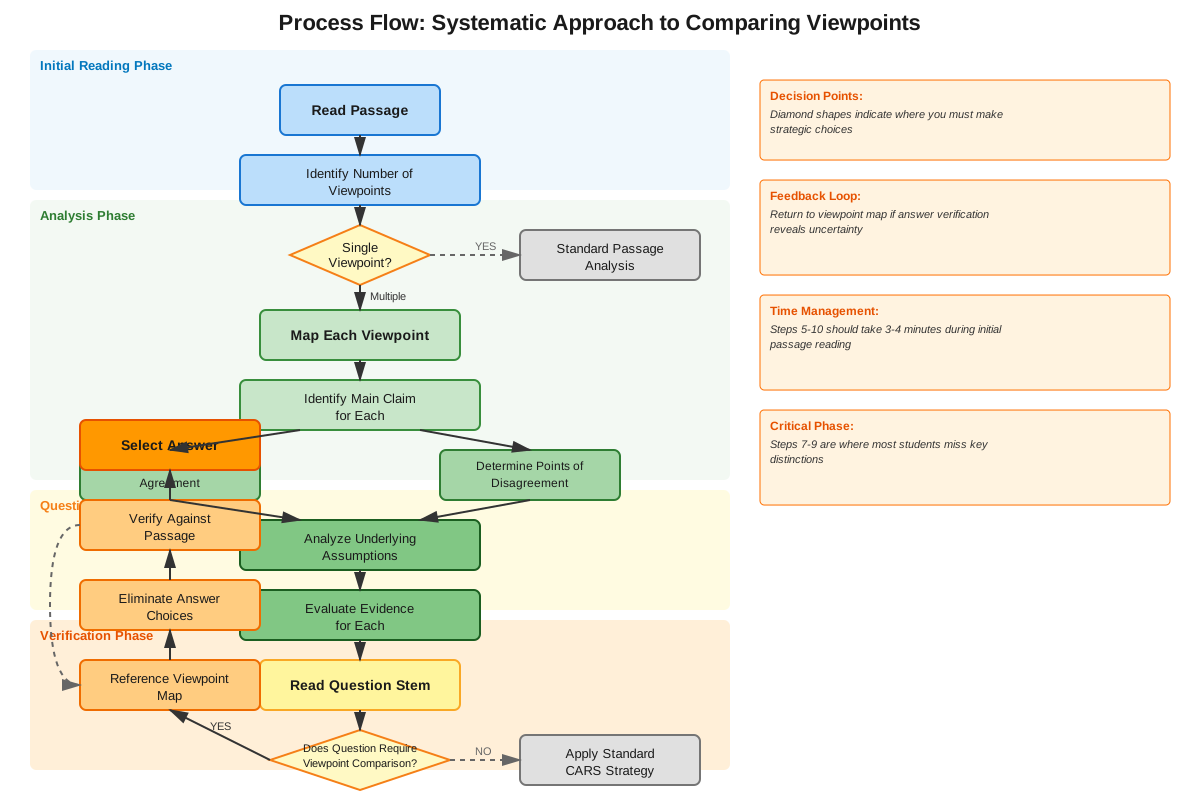
When encountering a passage with multiple viewpoints, implement this systematic approach:
- During initial reading: Mark transitions between viewpoints with notation (e.g., "V1," "V2") and briefly note each perspective's main claim
- Create a mental comparison table: As you read, actively organize information by asking "What does each viewpoint say about this aspect?"
- Identify the comparison dimension: Determine whether viewpoints differ in facts, interpretation, methodology, values, or scope
- Note both differences AND agreements: Many students focus only on disagreements and miss high-yield agreement questions
Trigger Words and Phrases
Viewpoint transition signals (indicate shift between perspectives):
- "However," "in contrast," "on the other hand," "alternatively"
- "While X argues..., Y contends..."
- "Traditional/conventional view... revisionist/modern perspective"
- "Some scholars... other researchers..."
Agreement signals (indicate shared ground):
- "Both acknowledge," "all agree," "consensus exists"
- "Similarly," "likewise," "correspondingly"
- "Common ground," "shared assumption"
Disagreement signals (indicate conflict):
- "Disputes," "contradicts," "challenges," "rejects"
- "Unlike," "whereas," "conversely"
- "Fundamental difference," "key distinction"
Question Type Recognition
Recognize these common question formats testing viewpoint comparison:
- "Author A would most likely respond to Author B's claim by..."
- "Which statement would both passages support?"
- "The two theories differ primarily in their..."
- "Unlike the first perspective, the second emphasizes..."
- "On which point would the authors agree?"
- "What assumption underlies the disagreement between..."
Process of Elimination Strategy
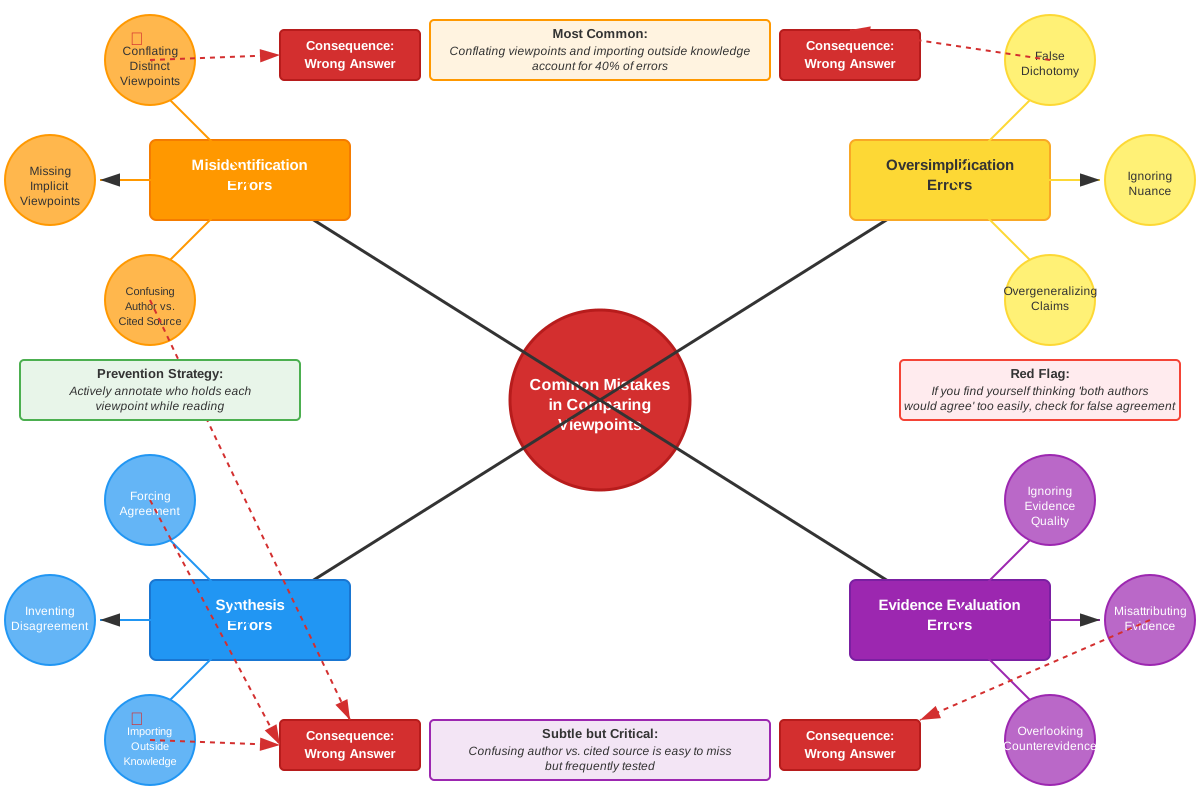
For viewpoint comparison questions, eliminate answers that:
- Attribute claims to the wrong source: Check that statements are matched to the correct viewpoint
- Overstate or understate differences: Extreme language ("completely opposite," "no common ground") is usually wrong
- Introduce outside information: Answers must be supported by passage content, not general knowledge
- Confuse explicit and implicit content: If a viewpoint doesn't address something, don't assume its position
- Ignore scope limitations: If a viewpoint applies only to specific contexts, don't select answers suggesting universal application
Time Allocation
- Initial passage reading with multiple viewpoints: Allocate 15-20 seconds extra to create clear mental separation between perspectives
- Viewpoint comparison questions: These typically require 60-75 seconds (slightly above average) because they demand checking claims against multiple sources
- If confused about viewpoint attribution: Quickly scan back to locate where each perspective is presented rather than guessing
Exam Tip: When a question asks what viewpoints would agree on, the answer is often a broad, fundamental claim that both perspectives accept as a starting point, even if they diverge in their subsequent reasoning.
Memory Techniques
DIVIDE Mnemonic for Viewpoint Analysis
Use DIVIDE to systematically analyze multiple viewpoints:
- Dimension: What dimension do they differ on? (facts, interpretation, values, methodology, scope)
- Identify: Who holds which position? (attribute claims correctly)
- Values: What does each viewpoint prioritize or consider important?
- Implications: What follows from each perspective?
- Disagreement basis: Why do they differ? (underlying assumptions)
- Evidence: What support does each viewpoint offer?
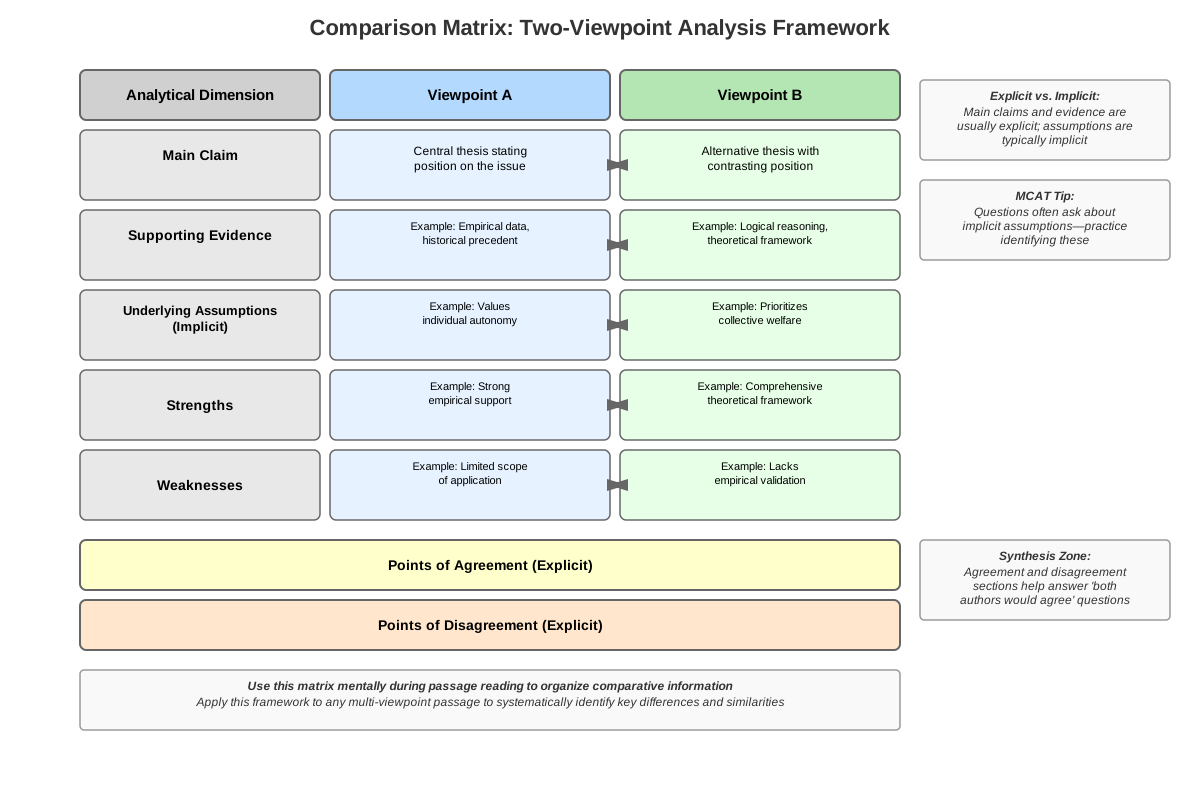
Visualization Strategy: The Comparison Matrix
Mentally construct a simple matrix while reading:
                 Viewpoint A    |    Viewpoint B
Main claim:      _________      |    _________
Evidence:        _________      |    _________
Assumption:      _________      |    _________
Scope:           _________      |    _________
This visual organization helps maintain clear separation between perspectives and facilitates quick reference when answering questions.
The "Both-But-Because" Framework
For passages with two viewpoints, remember this structure:
- Both [agree on what?] → Identifies common ground
- But [differ on what?] → Identifies the key distinction
- Because [why do they differ?] → Identifies the basis for disagreement
This framework ensures you capture the complete relationship between viewpoints, not just surface-level differences.
Acronym: COMPARE for Question Approach
When answering viewpoint comparison questions, COMPARE:
- Check the question stem carefully (agreement or disagreement?)
- Organize what you know about each viewpoint
- Match answer choices to specific viewpoints
- Process of elimination for clearly wrong answers
- Analyze remaining choices for subtle distinctions
- Review passage if uncertain about attribution
- Eliminate answers that introduce outside information
Summary
Comparing viewpoints is a critical CARS skill that requires students to identify, analyze, and evaluate multiple perspectives presented within MCAT passages. This skill extends beyond simple recognition of different opinions to encompass understanding the dimensions along which viewpoints differ (factual, interpretive, methodological, value-based, or scope-related), identifying both explicit and implicit points of agreement and disagreement, and evaluating the basis for divergent conclusions. Success requires systematic analysis using structured approaches to organize information about each perspective, careful attention to transition signals and comparative language, and the ability to maintain multiple conceptual frameworks simultaneously. Students must recognize that viewpoints can share substantial common ground while differing on specific aspects, that the basis for disagreement is often more important than the specific content of each position, and that personal beliefs must not influence answer selection. Mastery of comparing viewpoints enhances performance across all CARS question types and develops the intellectual flexibility essential for medical practice, where considering multiple diagnostic possibilities and diverse patient perspectives is fundamental to effective clinical decision-making.
Key Takeaways
- Comparing viewpoints appears in approximately 35% of CARS passages and requires identifying both explicit and implicit differences between perspectives
- Viewpoints can differ along multiple dimensions: factual claims, interpretations, methodologies, values, scope, or causal explanations
- Understanding the basis for disagreement (underlying assumptions, epistemological differences, value priorities) is more frequently tested than memorizing specific viewpoint content
- Points of agreement between seemingly opposing viewpoints are high-yield question topics that require careful attention to shared premises and common ground
- Systematic approaches like the DIVIDE mnemonic and mental comparison matrices help organize information and prevent attribution errors
- Transition words ("however," "in contrast," "alternatively") are reliable signals of viewpoint shifts and should be marked during initial reading
- Success requires setting aside personal beliefs and evaluating viewpoints solely based on passage content and logical reasoning
Related Topics
Identifying Main Ideas and Thesis Statements: Mastering viewpoint comparison builds on the ability to recognize each perspective's central claim, which is essential before comparing multiple positions. This foundational skill enables accurate attribution of specific claims to the correct viewpoint.
Understanding Argumentative Structure: Recognizing how authors construct arguments with premises, evidence, and conclusions allows students to identify where viewpoints diverge in their reasoning chains and evaluate the logical coherence of each perspective.
Making Inferences and Drawing Conclusions: Many viewpoint differences are implicit rather than explicit, requiring inference from underlying assumptions and unstated premises. Strengthening inference skills enhances ability to detect subtle disagreements.
Evaluating Arguments and Evidence: After comparing viewpoints, students must often evaluate their relative strength, which requires assessing evidence quality, logical coherence, and explanatory power—skills that build directly on viewpoint comparison.
Synthesizing Information: Advanced questions ask students to integrate elements from multiple viewpoints or predict how perspectives might be reconciled, representing the next level of complexity beyond basic comparison.
Practice CTA
Now that you have mastered the core concepts of comparing viewpoints, it's time to apply this knowledge to practice questions and flashcards. Active practice with MCAT-style passages containing multiple perspectives will solidify your ability to quickly identify viewpoint transitions, organize comparative information efficiently, and accurately answer questions about agreements, disagreements, and the basis for divergent conclusions. Remember that comparing viewpoints is not just an academic exercise—it develops the critical thinking skills you'll use throughout medical school and your career as a physician when evaluating competing diagnoses, treatment approaches, and patient perspectives. Approach each practice passage systematically, using the strategies and frameworks from this guide, and you'll see steady improvement in both accuracy and confidence. Your investment in mastering this skill will pay dividends across the entire CARS section and beyond.
Sign up free to keep reading
Create a free AnvayaPrep account to finish this MCAT guide on Comparing viewpoints — plus flashcards and practice questions.