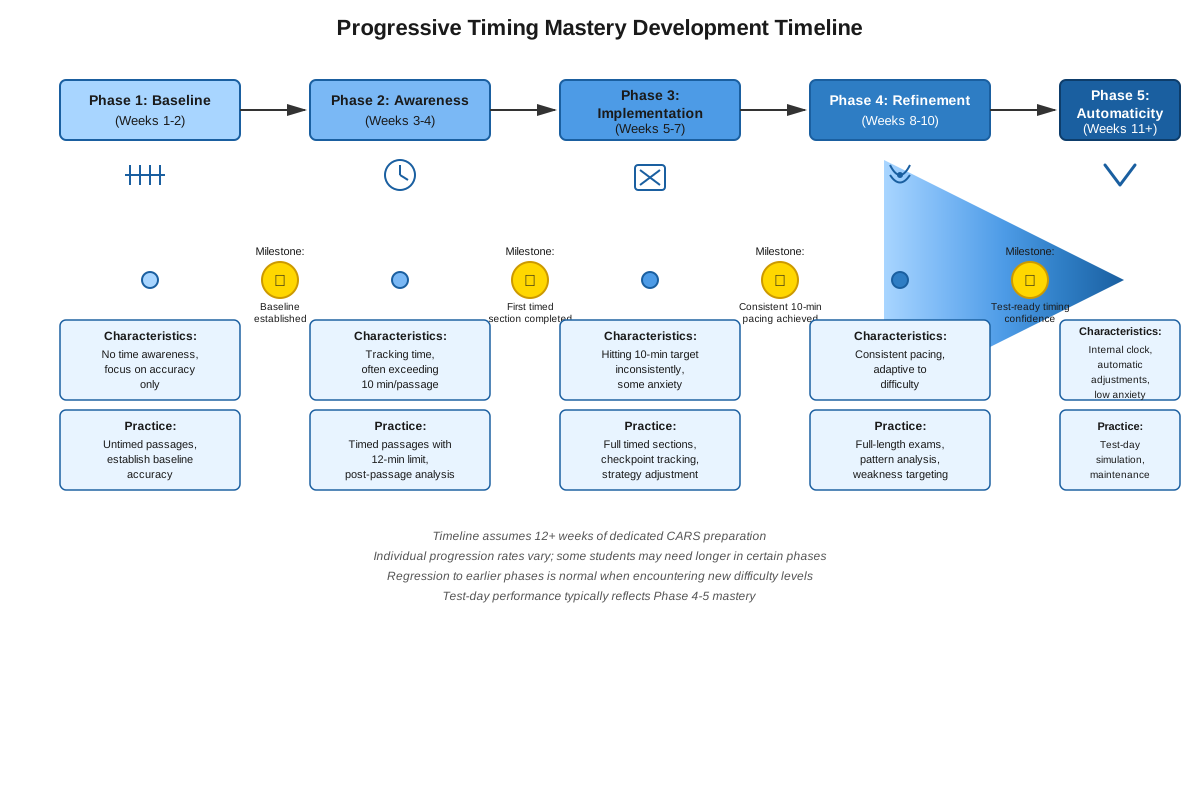
Overview
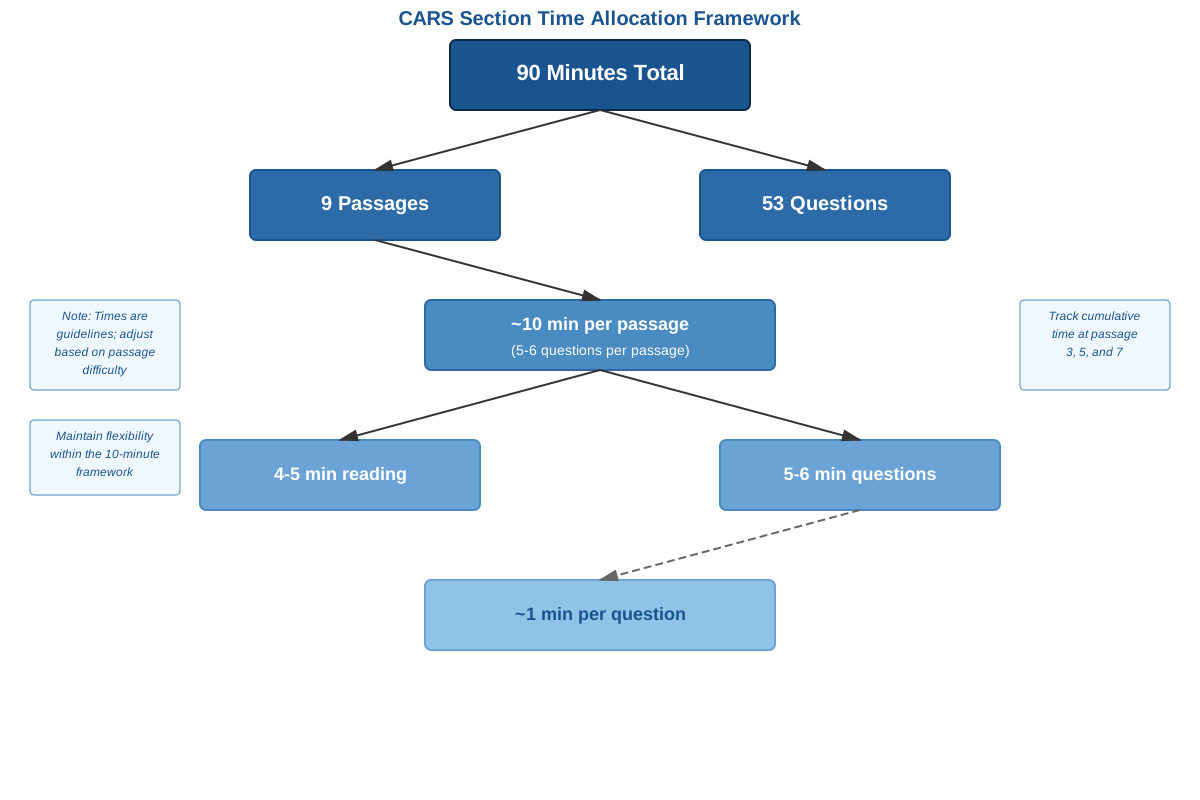
Timing strategy is one of the most critical yet often overlooked components of success on the MCAT's Critical Analysis and Reasoning Skills (CARS) section. While content mastery and analytical skills form the foundation of CARS performance, the ability to manage time effectively can mean the difference between a competitive score and an underwhelming result. The CARS section presents test-takers with 53 questions across 9 passages in just 90 minutes—an average of 10 minutes per passage including all associated questions. This demanding pace requires a deliberate, practiced approach to time allocation that balances thorough comprehension with efficient execution.
Timing strategy MCAT preparation extends beyond simply "working faster." It encompasses a sophisticated understanding of how to allocate cognitive resources, when to invest time in careful reading versus rapid question answering, and how to recognize when a question demands additional attention versus when to make an educated guess and move forward. Students who master timing strategy develop an internal clock that guides their pacing throughout the section, preventing the common pitfall of spending excessive time on early passages only to rush through later ones. This skill is particularly vital in CARS Skills because unlike the science sections where prior knowledge can sometimes compensate for incomplete passage reading, CARS demands engagement with novel texts where every question's answer must be justified by passage content.
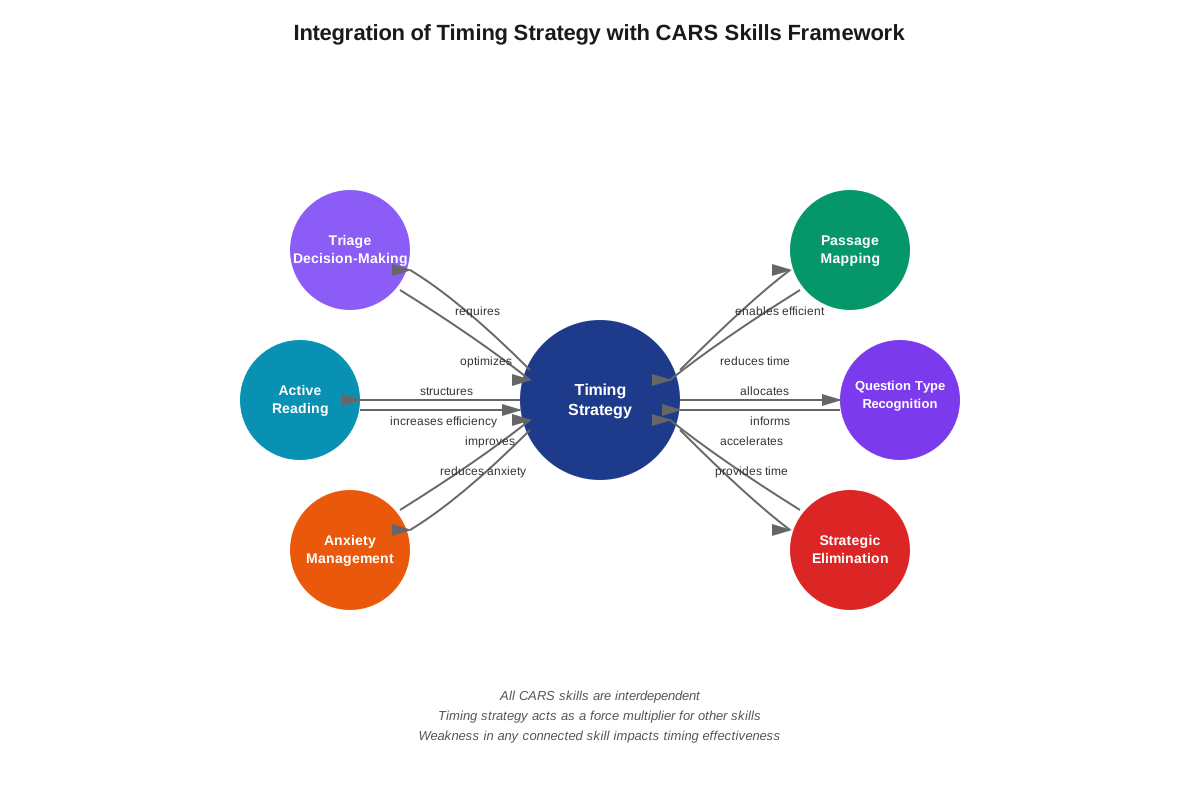
The relationship between timing strategy Critical Analysis and Reasoning Skills and other CARS competencies is symbiotic. Effective timing enables better application of critical reasoning skills by reducing anxiety and cognitive overload. When students know they're on pace, they can dedicate full attention to analyzing arguments, identifying author perspectives, and evaluating evidence. Conversely, poor timing creates a cascade of problems: rushed reading leads to missed nuances, panic interferes with logical reasoning, and the pressure to catch up forces random guessing on questions that could have been answered correctly with proper time management. Understanding timing strategy as an integrated component of CARS mastery—rather than a separate concern—is essential for achieving target scores.
Learning Objectives
- [ ] Define Timing strategy using accurate Critical Analysis and Reasoning Skills terminology
- [ ] Explain why Timing strategy matters for the MCAT
- [ ] Apply Timing strategy to exam-style questions
- [ ] Identify common mistakes related to Timing strategy
- [ ] Connect Timing strategy to related Critical Analysis and Reasoning Skills concepts
- [ ] Calculate and implement optimal time allocation for passages of varying difficulty
- [ ] Develop self-monitoring techniques to maintain appropriate pacing throughout the CARS section
- [ ] Distinguish between questions that warrant additional time investment and those requiring quick decision-making
Prerequisites
- Basic CARS passage structure understanding: Recognizing how MCAT passages are organized helps predict where key information appears, enabling more efficient reading
- Question type familiarity: Knowing the seven CARS question types allows for appropriate time allocation based on question difficulty
- Baseline reading comprehension skills: Adequate reading speed and comprehension form the foundation upon which timing strategies are built
- Test-taking stamina: The ability to maintain focus for extended periods is necessary to execute timing strategies consistently
Why This Topic Matters
In clinical practice, physicians must constantly balance thoroughness with efficiency—spending adequate time with each patient while managing a full schedule. Similarly, effective time management on the MCAT CARS section demonstrates the capacity for prioritization and decision-making under pressure, skills essential for medical training and practice. The ability to quickly assess information, determine what requires deeper analysis, and move forward decisively mirrors the clinical reasoning process physicians employ daily.
From an exam statistics perspective, timing issues represent one of the most frequently cited reasons for underperformance on CARS. Data from test-takers consistently shows that students who fail to complete all passages score significantly lower than those who finish, even when the incomplete work shows high accuracy. Approximately 30-40% of test-takers report not finishing the CARS section, and these students typically score in the 123-125 range regardless of their accuracy on completed questions. Conversely, students who implement effective timing strategies and complete all passages with even 70% accuracy typically score 127 or higher. The CARS section appears in every MCAT administration and accounts for 25% of the total score, making timing strategy a high-yield area for score improvement.
Timing challenges manifest in several common patterns on exam passages. Students frequently encounter "time trap" passages—dense philosophical or artistic texts that invite deep contemplation but yield diminishing returns beyond initial comprehension. Questions may include detail-oriented items that tempt test-takers to reread extensively, or complex reasoning questions that seem to require exhaustive analysis. Additionally, the CARS section strategically places passages of varying difficulty throughout, meaning students must continuously recalibrate their pacing rather than settling into a single rhythm. Recognizing these patterns and having predetermined strategies for each situation is essential for consistent performance.
Core Concepts
The 10-Minute Rule and Time Allocation Framework
The foundational principle of timing strategy for CARS is the 10-minute rule: allocating approximately 10 minutes per passage-question set. This breaks down into roughly 4-5 minutes for passage reading and 5-6 minutes for answering questions. However, this represents an average, not a rigid prescription. Effective timing strategy requires flexibility based on passage length, complexity, and question difficulty.
The optimal allocation follows this framework:
| Passage Length | Reading Time | Question Time | Total Time |
|---|---|---|---|
| Short (500-600 words) | 3-4 minutes | 5-6 minutes | 8-10 minutes |
| Medium (600-700 words) | 4-5 minutes | 5-6 minutes | 9-11 minutes |
| Long (700-800 words) | 5-6 minutes | 5-6 minutes | 10-12 minutes |
This framework acknowledges that reading time should scale with passage length, but question time remains relatively constant since most passages have 5-7 questions regardless of length. Students who spend equal time on all passages regardless of length inevitably fall behind or rush through longer passages, compromising comprehension.
Strategic Checkpoints and Self-Monitoring
Effective timing strategy MCAT implementation requires establishing checkpoints throughout the section. These serve as calibration points to assess whether pacing is on track:
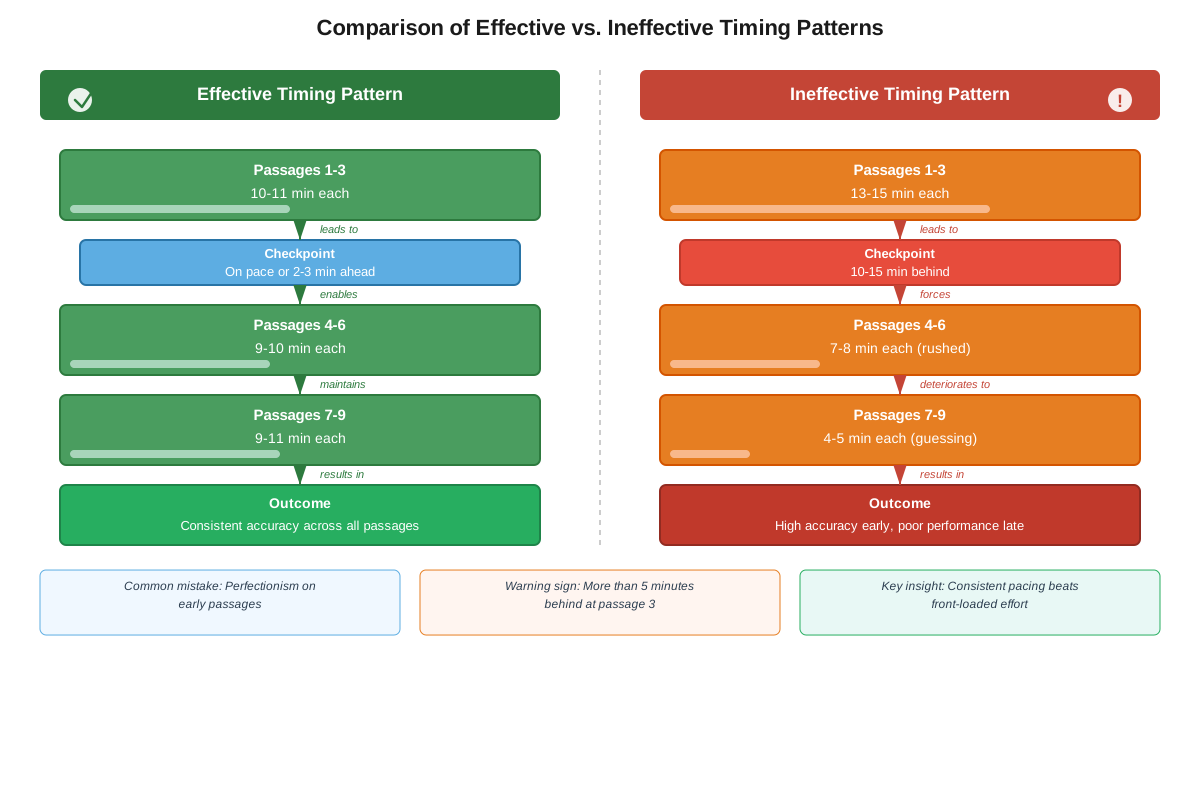
- After Passage 3 (30 minutes): Should be completed by the 30-minute mark
- After Passage 5 (50 minutes): Halfway point—should have 40 minutes remaining
- After Passage 7 (70 minutes): Should have 20 minutes for final 2 passages
- Passage 9 (85 minutes): Should begin final passage with 5 minutes remaining
These checkpoints enable real-time adjustments. If a student reaches Passage 3 at 35 minutes, they know to accelerate slightly on subsequent passages. If they reach Passage 5 at 45 minutes, they have a 5-minute buffer and can maintain their current pace. This self-monitoring prevents the common scenario where students realize they're behind only after completing Passage 7, leaving insufficient time for meaningful adjustment.
The Triage System: Passage Selection Strategy
Advanced timing strategy Critical Analysis and Reasoning Skills incorporates passage triage—the practice of quickly assessing passage difficulty and strategically choosing which passages to attempt first. The CARS section does not require sequential completion; students can navigate freely between passages. The triage approach involves:
Initial Assessment (30 seconds per passage): Quickly scan all nine passages at the section's start, noting:
- Subject matter (familiar vs. unfamiliar)
- Paragraph length and density
- Presence of lists, examples, or abstract theory
- Personal interest level
Categorization:
- High-priority passages: Familiar topics, clear structure, moderate length
- Medium-priority passages: Neutral difficulty, standard CARS content
- Low-priority passages: Dense philosophy, unfamiliar terminology, highly abstract
Execution Strategy: Complete high-priority passages first to bank points efficiently, then medium-priority, saving low-priority passages for last when time pressure is greatest. This ensures that if time runs short, the most challenging passages are affected rather than accessible ones.
Question-Level Time Management
Within each passage, CARS Skills timing strategy extends to individual questions. Not all questions deserve equal time investment:
Quick Questions (30-45 seconds):
- Main idea questions when the thesis is clear
- Tone/attitude questions with obvious textual support
- Straightforward inference questions with direct evidence
Standard Questions (60-90 seconds):
- Most reasoning within/beyond text questions
- Function questions requiring paragraph analysis
- Application questions with clear analogies
Complex Questions (2-3 minutes):
- Questions requiring extensive passage review
- Complex reasoning questions with subtle distinctions
- Questions where initial answer choice elimination is difficult
The key skill is rapidly categorizing questions upon reading them, allocating time accordingly, and avoiding the trap of spending 3 minutes on a question that should take 45 seconds simply because it appears early in the set.
The Banking and Spending Model
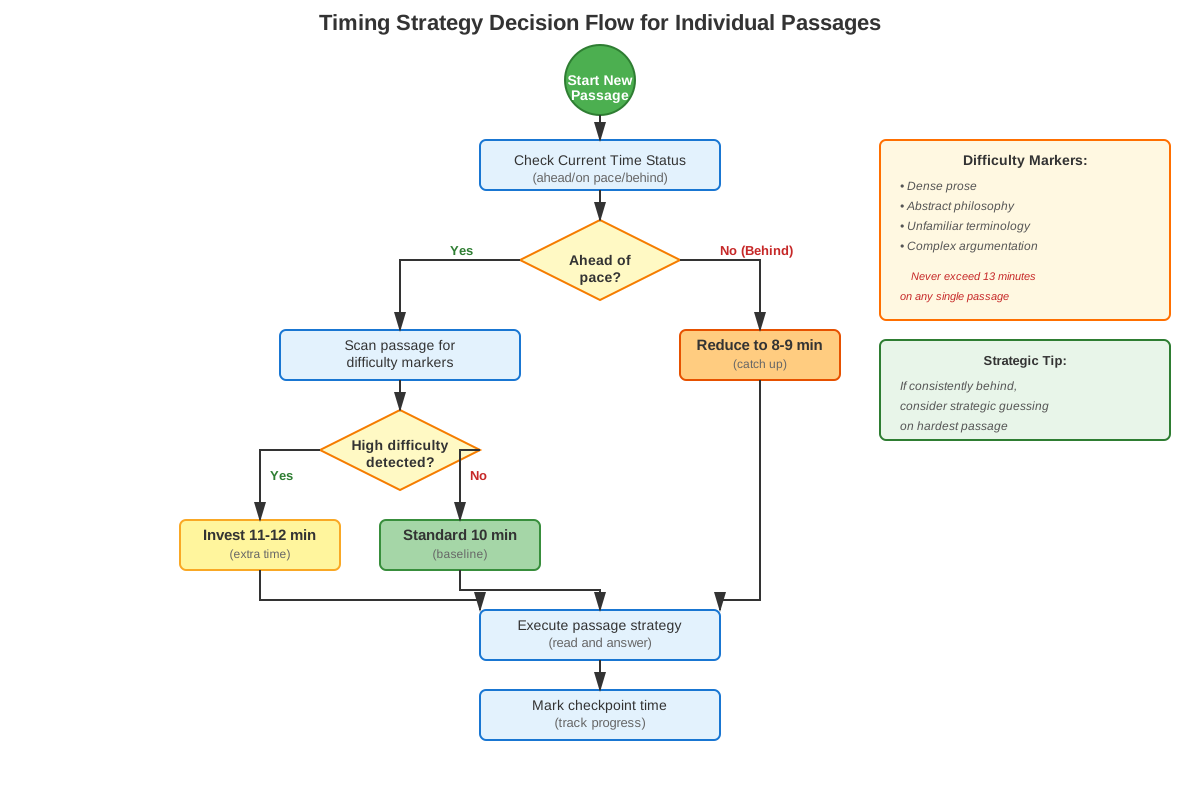
Effective timing strategy operates on a banking model: students "bank" time on easier passages and questions, then "spend" this reserve on more challenging items. A student who completes Passage 1 in 8 minutes has banked 2 minutes, which can be spent on a particularly difficult Passage 4 that requires 12 minutes. This model requires:
Awareness: Continuously tracking whether time is being banked or spent
Discipline: Resisting the urge to spend banked time prematurely
Flexibility: Willingness to spend banked time when a passage genuinely warrants it
Students who lack this framework often spend excessive time on every passage "just to be sure," leaving no buffer for genuinely difficult content and creating time pressure that undermines performance on later passages.
The Decision Point Protocol
A critical component of timing strategy is knowing when to make a decision and move forward. The decision point protocol establishes clear criteria:
After 90 seconds on a question without progress: Make the best possible guess using elimination and move forward. Continuing rarely improves accuracy and costs time needed elsewhere.
After 12 minutes on a passage: Complete remaining questions efficiently, spending no more than 60 seconds per question regardless of difficulty.
With 10 minutes remaining in the section: Ensure all remaining questions receive at least 30 seconds of consideration; random guessing should be a last resort.
This protocol prevents the paralysis that occurs when students feel stuck, providing clear decision rules that maintain forward momentum while maximizing point acquisition.
Concept Relationships
The concepts within timing strategy form an interconnected system where each element supports the others. The 10-minute rule provides the foundational framework, establishing the baseline pace. This connects directly to strategic checkpoints, which enable monitoring of whether the 10-minute average is being maintained. When checkpoints reveal pacing issues, the triage system offers a solution by allowing strategic passage selection to optimize time use. Within each passage, question-level time management ensures the 10-minute allocation is distributed effectively, while the banking and spending model provides flexibility to handle variation in passage difficulty. Finally, the decision point protocol prevents any single question or passage from derailing the entire timing strategy.
These timing concepts connect to broader CARS skills in essential ways:
Timing Strategy → Reading Strategy: Effective time management requires efficient reading techniques (skimming vs. careful reading, identifying main ideas quickly, recognizing paragraph functions). Poor reading strategy makes timing strategy impossible to execute.
Timing Strategy → Question Strategy: Knowing question types and their typical difficulty enables accurate time allocation. Students who cannot quickly identify question types cannot implement question-level timing effectively.
Timing Strategy → Test Anxiety Management: Proper pacing reduces anxiety by providing structure and preventing the panic that occurs when time runs short. Reduced anxiety improves cognitive function, creating a positive feedback loop.
Timing Strategy → Score Optimization: Completing all passages with 70% accuracy yields higher scores than completing 7 passages with 90% accuracy. Timing strategy directly impacts score potential by ensuring all questions receive consideration.
High-Yield Facts
⭐ The average CARS passage-question set should take 10 minutes, but this is an average—not every passage should take exactly 10 minutes
⭐ Students who fail to complete the CARS section typically score 4-6 points lower than their accuracy would predict
⭐ Spending more than 90 seconds on a single question rarely improves accuracy and significantly impacts overall pacing
⭐ The first 30 seconds of reading a passage should establish its main idea and structure, enabling more efficient question answering
⭐ Banking 1-2 minutes on easier passages provides essential buffer time for more challenging content
- Passage triage at the section's start takes 4-5 minutes but typically saves 8-10 minutes through strategic ordering
- Questions requiring passage review should be answered after questions answerable from memory to minimize rereading
- The final 2 passages should begin with at least 18-20 minutes remaining to ensure adequate time
- Most test-takers naturally slow down as the section progresses due to fatigue; anticipating this and starting slightly faster compensates
- Checking the timer after every passage (rather than during passages) maintains focus while ensuring awareness of pacing
Quick check — test yourself on Timing strategy so far.
Try Flashcards →Common Misconceptions
Misconception: Reading faster is the key to better timing on CARS.
Correction: Reading speed matters less than reading efficiency. Students should focus on identifying main ideas, structure, and author perspective during the initial read rather than trying to memorize details. Strategic reading that enables efficient question answering is more valuable than rapid reading that requires extensive rereading.
Misconception: Every passage deserves equal time investment to ensure accuracy.
Correction: Passages vary significantly in difficulty and point yield. Spending 15 minutes on a difficult passage to achieve 6/6 correct while rushing through two easier passages and missing 4 questions total represents poor strategy. Optimizing overall section performance requires accepting that some passages will receive less time than others.
Misconception: Checking the timer frequently helps maintain good pacing.
Correction: Excessive timer checking increases anxiety and disrupts focus. Establishing checkpoint passages (3, 5, 7) and checking time only at these points provides adequate monitoring while maintaining concentration on passage content.
Misconception: If you're running behind on time, you should skip reading the remaining passages and go straight to questions.
Correction: CARS questions require passage-based justification; attempting questions without reading the passage leads to random guessing. If behind on time, the better strategy is to read remaining passages more efficiently (focusing on main ideas and structure) while spending less time deliberating on difficult questions.
Misconception: Banking time on easier passages is unnecessary if you can complete all passages in the allotted time.
Correction: Even strong test-takers encounter unexpectedly difficult passages or questions. Banking time provides insurance against these situations and reduces anxiety by creating a buffer. Additionally, the psychological benefit of being "ahead of pace" improves performance on subsequent passages.
Misconception: You should always finish reading a paragraph before checking the time.
Correction: While you shouldn't check time mid-sentence, checking at natural transition points (between passages, after completing all questions for a passage) is appropriate and necessary. Waiting until you've completed multiple passages before checking can lead to discovering you're significantly behind with insufficient time to adjust.
Worked Examples
Example 1: Implementing the Checkpoint System
Scenario: A student begins the CARS section and completes the first three passages. After finishing Passage 3, they check the timer and see that 35 minutes have elapsed (5 minutes behind the 30-minute checkpoint).
Analysis and Strategy:
- Assess the situation: The student is 5 minutes behind pace, meaning they've averaged 11.67 minutes per passage instead of 10 minutes.
- Calculate adjustment needed: With 55 minutes remaining for 6 passages, the student needs to average 9.17 minutes per passage to finish on time.
- Implement specific adjustments:
- Reduce reading time by 30-45 seconds per passage by focusing more strictly on main ideas and paragraph functions rather than details
- Limit question deliberation to 90 seconds maximum; make a decision and move forward
- Identify 1-2 passages among the remaining 6 that appear more accessible (through quick preview) and target these for 8-minute completion to bank time
- Maintain monitoring: Check time again after Passage 5 (should be at approximately 52-53 minutes) to ensure adjustments are working.
- Avoid panic: A 5-minute deficit is recoverable through modest pace increases across multiple passages rather than requiring dramatic changes that might compromise accuracy.
Outcome: By making calculated adjustments early and monitoring progress, the student can return to appropriate pacing without sacrificing comprehension or accuracy. This demonstrates the value of checkpoint monitoring and systematic adjustment rather than continuing at an unsustainable pace.
Example 2: Question-Level Time Allocation
Scenario: A student is working through a passage's question set and encounters the following questions:
- Question 1: "Which of the following best describes the main idea of the passage?"
- Question 2: "The author's attitude toward the theory described in paragraph 3 can best be described as:"
- Question 3: "Based on the passage, which of the following scenarios would the author most likely support?"
- Question 4: "The author mentions the 1847 study primarily in order to:"
- Question 5: "Which of the following, if true, would most weaken the author's argument in the final paragraph?"
Strategic Time Allocation:
Question 1 (Target: 45 seconds)
- Main idea questions should be answerable from the initial read
- The thesis should have been identified during passage reading
- Quickly eliminate answers that are too narrow, too broad, or contradict the passage
- Select the answer that captures the central argument and move forward
Question 2 (Target: 60 seconds)
- Attitude questions require identifying tone indicators in paragraph 3
- Quickly locate paragraph 3 and scan for evaluative language
- Eliminate extreme answers (unless passage tone is genuinely extreme)
- Select the answer that matches the textual evidence
Question 3 (Target: 90 seconds)
- Application questions require understanding the author's underlying principles
- Consider what values or criteria the author has emphasized
- Evaluate each scenario against these criteria
- This question type often requires more deliberation—allocate appropriate time
Question 4 (Target: 60 seconds)
- Function questions ask why the author included specific content
- Locate the 1847 study and read the surrounding sentences
- The function is typically stated explicitly or clearly implied
- Common functions: provide evidence, offer contrast, illustrate a point
Question 5 (Target: 90-120 seconds)
- Reasoning questions requiring evaluation of argument strength are typically more complex
- Locate the final paragraph's argument
- Identify the argument's assumptions or logical connections
- Evaluate each answer choice's impact on these elements
- This question warrants additional time investment
Total time for question set: Approximately 5.5-6 minutes, leaving 4-4.5 minutes for passage reading in a 10-minute allocation.
Key lesson: Not all questions deserve equal time. Rapid categorization of question type enables appropriate time allocation, preventing the common mistake of spending 2 minutes on a straightforward main idea question while rushing through a complex reasoning question.
Exam Strategy
Approaching CARS Timing Questions
When beginning the CARS section, implement this systematic approach:
Pre-section preparation (30 seconds):
- Take a deep breath and mentally commit to your timing strategy
- Remind yourself of checkpoint passages (3, 5, 7)
- Visualize completing all 9 passages with time to spare
Initial triage (4-5 minutes):
- Quickly preview all 9 passages (30 seconds each)
- Note subject matter, length, and apparent difficulty
- Mentally number passages 1-9 in order of preference (easiest to hardest)
- Begin with your #1 passage (not necessarily Passage 1)
During each passage:
- Spend 4-5 minutes on initial read, focusing on main idea and structure
- Answer questions in order, but don't hesitate to skip and return to difficult questions
- After completing all questions, check the timer only if at a checkpoint passage
When encountering timing challenges:
- If a passage seems exceptionally difficult after 2 minutes of reading, consider marking it for later and moving to a different passage
- If a question remains unclear after 90 seconds, make your best guess, flag it if possible, and move forward
- If you reach Passage 7 with less than 20 minutes remaining, shift to a more aggressive pace: 3-minute reads, 60-second maximum per question
Trigger Words and Phrases
Certain question phrasings indicate questions that typically require more or less time:
Quick questions (45-60 seconds):
- "The main idea of the passage is..."
- "The author's primary purpose is..."
- "The passage suggests that..." (when evidence is obvious)
- "According to the passage..." (direct retrieval)
Standard questions (60-90 seconds):
- "The author would most likely agree..."
- "Which of the following best describes..."
- "The author mentions X in order to..."
- "It can reasonably be inferred..."
Complex questions (90-120+ seconds):
- "Which of the following, if true, would most weaken/strengthen..."
- "The author's argument depends on which assumption..."
- "Which of the following scenarios is most analogous..."
- "The passage suggests that the author would be most likely to support which view regarding..." (especially with complex scenarios)
Process of Elimination Tips
Time-efficient POE for CARS:
- First pass (20 seconds): Eliminate obviously wrong answers (contradict passage, too extreme, out of scope)
- Second pass (30 seconds): Between remaining answers, identify the key distinction and locate relevant passage content
- Decision point (20 seconds): Select the answer with the strongest textual support; if genuinely uncertain, make an educated guess and move forward
Avoid: Spending 2+ minutes debating between two answers that both seem reasonable. At this point, accuracy doesn't significantly improve with additional time, but pacing suffers considerably.
Time Allocation Advice
Ideal distribution for a 90-minute section:
- Passage preview/triage: 4-5 minutes
- Passages 1-3: 28-30 minutes (banking time on easier passages)
- Passages 4-6: 30-32 minutes (spending some banked time if needed)
- Passages 7-9: 28-30 minutes (maintaining pace through fatigue)
- Final review of flagged questions: 0-2 minutes (only if time permits)
Adjustment protocols:
- If 5+ minutes ahead: Maintain current pace; don't slow down significantly
- If 3-5 minutes behind: Reduce reading time by 30-45 seconds per passage
- If 5-8 minutes behind: Implement aggressive pacing (3-minute reads, 60-second questions)
- If 8+ minutes behind: Consider strategic guessing on the most difficult remaining passage to ensure all others receive adequate time
Memory Techniques
The "3-5-7" Checkpoint Mnemonic
Remember checkpoint passages with the odd number sequence: 3-5-7
- 3 passages = 30 minutes (add a zero)
- 5 passages = 50 minutes (add a zero)
- 7 passages = 70 minutes (add a zero)
This simple pattern makes checkpoint times effortless to recall during the exam.
The "BANK-SPEND" Visualization
Visualize your time as a bank account:
- Build reserves on easier passages
- Allocate wisely across all content
- Never spend recklessly on single questions
- Keep monitoring your balance
- Strategically invest in difficult content
- Protect against running out
- Ensure all passages receive minimum investment
- Never panic when spending reserves
- Decide quickly when balance is low
The "READ-ANSWER" Time Split
Roughly Equal Allocation Divides time appropriately:
- Reading: 4-5 minutes
- Answering: 5-6 minutes
This reminds students that reading and answering should take approximately equal time, preventing the common mistake of spending 7 minutes reading and rushing through questions in 3 minutes.
The "90-Second Rule" Finger Tap
Associate 90 seconds with your index finger (the "pointing" finger that points you forward):
- When you've spent 90 seconds on a question, tap your index finger on the desk
- This physical cue triggers the decision protocol: make your best choice and move forward
- The kinesthetic element reinforces the timing limit
Summary
Timing strategy represents a critical yet trainable skill that significantly impacts MCAT CARS performance. The foundation rests on the 10-minute average per passage, implemented through strategic checkpoints at passages 3, 5, and 7 that enable real-time pacing adjustments. Effective timing extends beyond simple speed to encompass passage triage (strategically ordering passages from easiest to hardest), question-level time allocation (recognizing that different question types warrant different time investments), and the banking-spending model (building time reserves on easier content to spend on more challenging material). The decision point protocol prevents paralysis by establishing clear criteria for when to make a choice and move forward: 90 seconds on a question without progress, 12 minutes maximum per passage, and ensuring all questions receive at least 30 seconds of consideration. Success requires integrating timing strategy with reading and reasoning skills, recognizing that efficient comprehension enables effective time management while proper pacing reduces anxiety and improves cognitive function. Students who master timing strategy complete all passages, optimize point acquisition across the section, and achieve scores that reflect their true analytical abilities rather than being limited by time management failures.
Key Takeaways
- The 10-minute per passage average is a flexible guideline, not a rigid rule—banking time on easier passages enables spending on harder ones
- Strategic checkpoints at passages 3, 5, and 7 enable early detection of pacing issues when adjustments can still be implemented effectively
- Passage triage (previewing and strategically ordering passages) typically saves more time than it costs and ensures easier passages are completed first
- Question-level timing requires rapid categorization: 45-60 seconds for straightforward questions, 90-120 seconds for complex reasoning questions
- The 90-second decision point for individual questions prevents time sinks while maintaining forward momentum through the section
- Completing all passages with 70% accuracy yields higher scores than completing fewer passages with 90% accuracy—finishing is essential
- Effective timing strategy reduces test anxiety, improves cognitive function, and enables full demonstration of analytical abilities
Related Topics
Reading Strategy for CARS: Mastering efficient reading techniques (identifying main ideas, recognizing structure, strategic skimming) directly enables effective timing strategy by reducing the time required for adequate comprehension.
Question Type Identification: Understanding the seven CARS question types and their typical difficulty levels allows for accurate time allocation at the question level, a key component of overall timing strategy.
Test Anxiety Management: Proper pacing reduces anxiety, while anxiety management techniques enable consistent execution of timing strategies under pressure—these skills reinforce each other.
Strategic Guessing: When timing strategy reveals insufficient time for thorough analysis, strategic guessing techniques maximize point acquisition on questions that cannot receive full consideration.
Practice Test Analysis: Reviewing practice test timing data (time per passage, questions requiring excessive time) identifies specific timing weaknesses and guides targeted improvement efforts.
Practice CTA
Now that you understand the principles and techniques of effective timing strategy for MCAT CARS, it's time to put this knowledge into practice. Attempt the practice questions and flashcards associated with this topic, paying particular attention to implementing the checkpoint system and question-level time allocation strategies. Remember that timing strategy is a skill that improves with deliberate practice—track your time on each passage, analyze where you're banking or spending time, and refine your approach based on data. Your investment in mastering timing strategy will pay dividends not just on test day, but throughout your medical career as you develop the ability to balance thoroughness with efficiency in high-stakes situations. You've got this!
Sign up free to keep reading
Create a free AnvayaPrep account to finish this MCAT guide on Timing strategy — plus flashcards and practice questions.