Overview
Gibbs free energy is one of the most powerful and frequently tested concepts in General Chemistry on the MCAT. It serves as the central thermodynamic criterion for determining whether a chemical reaction or physical process will occur spontaneously under constant temperature and pressure—conditions that mirror most biological and laboratory settings. Unlike enthalpy or entropy alone, Gibbs free energy integrates both heat exchange and disorder to provide a single, decisive metric for spontaneity. This makes it indispensable for predicting reaction direction, understanding equilibrium, and analyzing coupled reactions in biochemical pathways.
For the MCAT, Gibbs free energy appears across multiple contexts: predicting whether reactions proceed forward or reverse, calculating equilibrium constants, understanding ATP hydrolysis in metabolism, and analyzing electrochemical cells. The Gibbs free energy MCAT questions often require students to manipulate the fundamental equation, interpret sign conventions, and connect thermodynamic principles to biological systems. Mastery of this topic directly impacts performance on both the Chemical and Physical Foundations of Biological Systems section and passages involving biochemical energetics.
Within the broader framework of thermodynamics, Gibbs free energy represents the culmination of the first and second laws. It builds upon foundational concepts including enthalpy (heat content), entropy (molecular disorder), and temperature, synthesizing them into a practical tool for chemical prediction. Understanding Gibbs free energy also provides the gateway to more advanced topics such as electrochemistry, chemical equilibrium, and bioenergetics—making it a high-yield investment of study time with applications that extend throughout the MCAT curriculum.
Learning Objectives
- [ ] Define Gibbs free energy using accurate General Chemistry terminology
- [ ] Explain why Gibbs free energy matters for the MCAT
- [ ] Apply Gibbs free energy to exam-style questions
- [ ] Identify common mistakes related to Gibbs free energy
- [ ] Connect Gibbs free energy to related General Chemistry concepts
- [ ] Calculate ΔG under standard and non-standard conditions using appropriate equations
- [ ] Predict reaction spontaneity and equilibrium position from Gibbs free energy values
- [ ] Relate Gibbs free energy changes to equilibrium constants and cell potentials
Prerequisites
- Enthalpy (ΔH): Understanding heat absorbed or released in reactions is essential because enthalpy constitutes one component of the Gibbs free energy equation
- Entropy (ΔS): Knowledge of molecular disorder and the second law of thermodynamics is required to interpret the entropy term in Gibbs calculations
- First and Second Laws of Thermodynamics: These foundational principles underpin the derivation and application of Gibbs free energy
- Chemical Equilibrium Basics: Familiarity with equilibrium concepts helps connect Gibbs free energy to the equilibrium constant relationship
- Basic Algebra and Logarithms: Mathematical facility is necessary for manipulating Gibbs free energy equations and solving quantitative problems
Why This Topic Matters
Clinical and Real-World Significance
Gibbs free energy governs virtually every spontaneous process in living systems. ATP hydrolysis, the universal energy currency of cells, releases approximately -30.5 kJ/mol of free energy under cellular conditions, driving otherwise non-spontaneous biosynthetic reactions through coupling. Muscle contraction, nerve impulse transmission, protein synthesis, and active transport all depend on favorable Gibbs free energy changes. In pharmacology, drug binding affinity relates directly to the free energy change of the binding reaction—more negative ΔG values indicate stronger, more spontaneous binding. Understanding Gibbs free energy allows medical professionals to predict drug efficacy, design better therapeutics, and comprehend metabolic disorders where energy coupling fails.
Exam Statistics and Question Types
Gibbs free energy appears in approximately 15-20% of General Chemistry questions on the MCAT and frequently integrates with biochemistry passages. Common question formats include:
- Discrete questions asking students to calculate ΔG from given thermodynamic data
- Passage-based questions requiring interpretation of reaction spontaneity in metabolic pathways
- Questions connecting Gibbs free energy to equilibrium constants (K)
- Electrochemistry problems linking cell potential to free energy changes
- Experimental analysis questions where students must predict whether reactions will proceed based on conditions
Common Exam Contexts
MCAT passages frequently present Gibbs free energy in the context of:
- Coupled reactions: How ATP hydrolysis drives unfavorable biosynthetic processes
- Temperature dependence: How changing temperature affects reaction spontaneity
- Equilibrium relationships: Connecting ΔG° to K and predicting equilibrium position
- Electrochemical cells: Relating cell potential to free energy through the equation ΔG = -nFE
- Phase transitions: Analyzing melting, boiling, or dissolution using free energy criteria
Core Concepts
Definition and Fundamental Equation
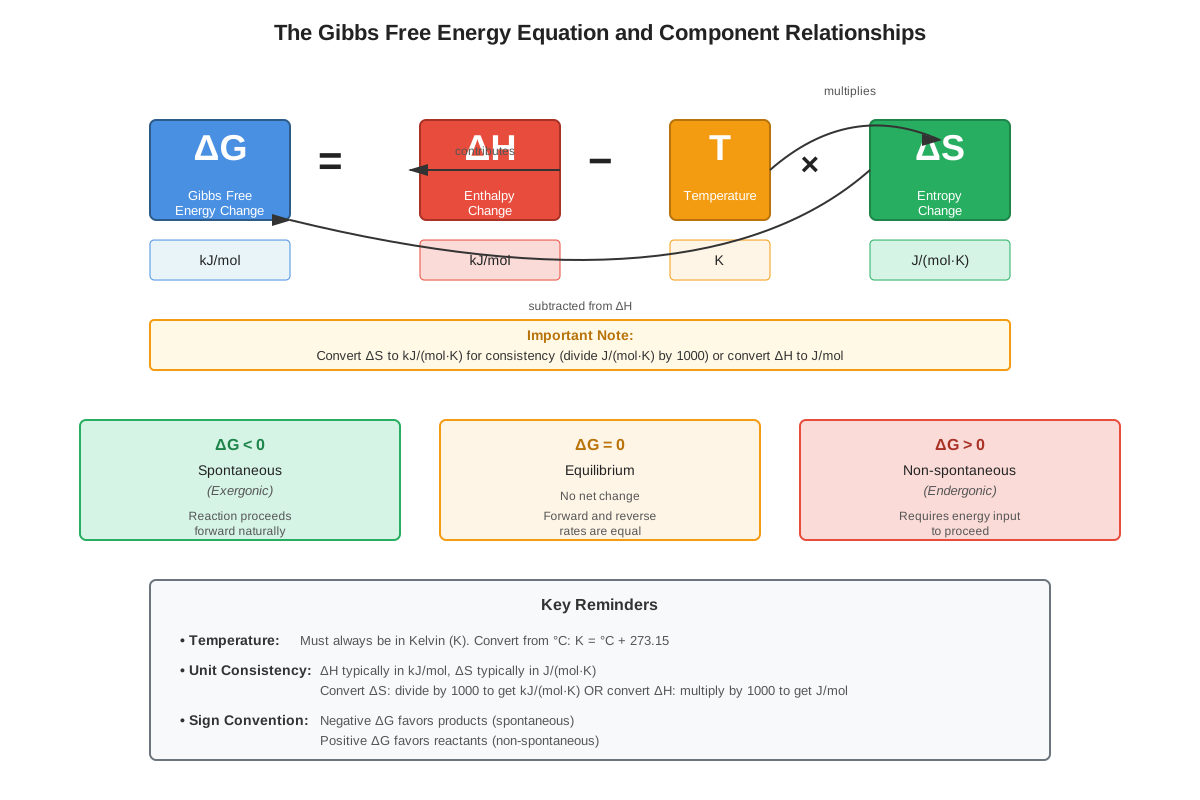
Gibbs free energy (G) represents the maximum amount of reversible work that a thermodynamic system can perform at constant temperature and pressure. More practically, it serves as the criterion for spontaneity: reactions with negative ΔG proceed spontaneously, while those with positive ΔG require energy input. The change in Gibbs free energy (ΔG) for a process is defined by the fundamental equation:
ΔG = ΔH - TΔSWhere:
- ΔG = change in Gibbs free energy (kJ/mol or J/mol)
- ΔH = change in enthalpy (heat content)
- T = absolute temperature in Kelvin
- ΔS = change in entropy (disorder)
This equation elegantly captures the competition between enthalpy (the system's tendency to minimize energy) and entropy (the universe's tendency to maximize disorder). The temperature term weights the importance of entropy—at higher temperatures, the TΔS term becomes more significant, potentially overriding unfavorable enthalpy changes.
Standard Gibbs Free Energy
Standard Gibbs free energy change (ΔG°) refers to the free energy change when all reactants and products are in their standard states: 1 M concentration for solutions, 1 atm pressure for gases, and pure substances for solids and liquids, all at 25°C (298 K). The standard free energy change can be calculated from standard enthalpies and entropies of formation:
ΔG° = ΔH° - TΔS°Alternatively, ΔG° can be calculated from standard free energies of formation (ΔG°f):
ΔG° = Σ(ΔG°f products) - Σ(ΔG°f reactants)Standard conditions provide a reference point for comparing reactions, but biological and laboratory conditions rarely match these standards, necessitating corrections for actual conditions.
Sign Conventions and Spontaneity
The sign of ΔG determines reaction spontaneity under the given conditions:
| ΔG Value | Spontaneity | Equilibrium Position | Energy Relationship |
|---|---|---|---|
| ΔG < 0 (negative) | Spontaneous (forward) | Favors products | Exergonic (releases free energy) |
| ΔG = 0 | At equilibrium | No net change | No net energy change |
| ΔG > 0 (positive) | Non-spontaneous (forward) | Favors reactants | Endergonic (requires free energy input) |
Exergonic reactions release free energy and proceed spontaneously, while endergonic reactions require free energy input and do not proceed without coupling to an exergonic process. It is crucial to note that spontaneity indicates thermodynamic favorability, not reaction rate—kinetics and thermodynamics are independent considerations.
Temperature Dependence Analysis
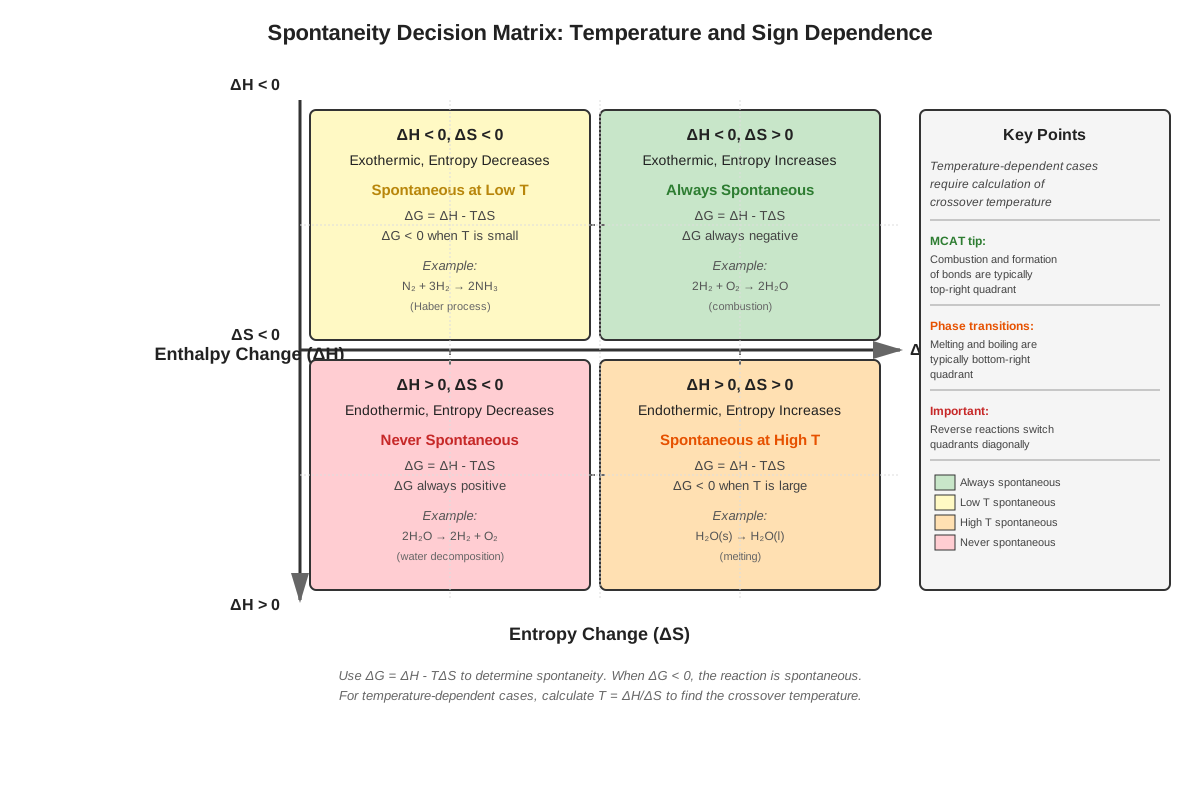
The relationship ΔG = ΔH - TΔS reveals how temperature affects spontaneity. Analyzing the signs of ΔH and ΔS yields four scenarios:
- ΔH < 0, ΔS > 0: Both terms favor spontaneity (ΔG always negative). Spontaneous at all temperatures.
- ΔH < 0, ΔS < 0: Enthalpy favors, entropy opposes. Spontaneous at low temperatures where the |ΔH| term dominates.
- ΔH > 0, ΔS > 0: Enthalpy opposes, entropy favors. Spontaneous at high temperatures where the TΔS term dominates.
- ΔH > 0, ΔS < 0: Both terms oppose spontaneity (ΔG always positive). Non-spontaneous at all temperatures.
This analysis explains why some reactions become spontaneous only above or below certain temperatures. For example, ice melting (ΔH > 0, ΔS > 0) becomes spontaneous above 0°C when TΔS exceeds ΔH.
Non-Standard Conditions and the Reaction Quotient
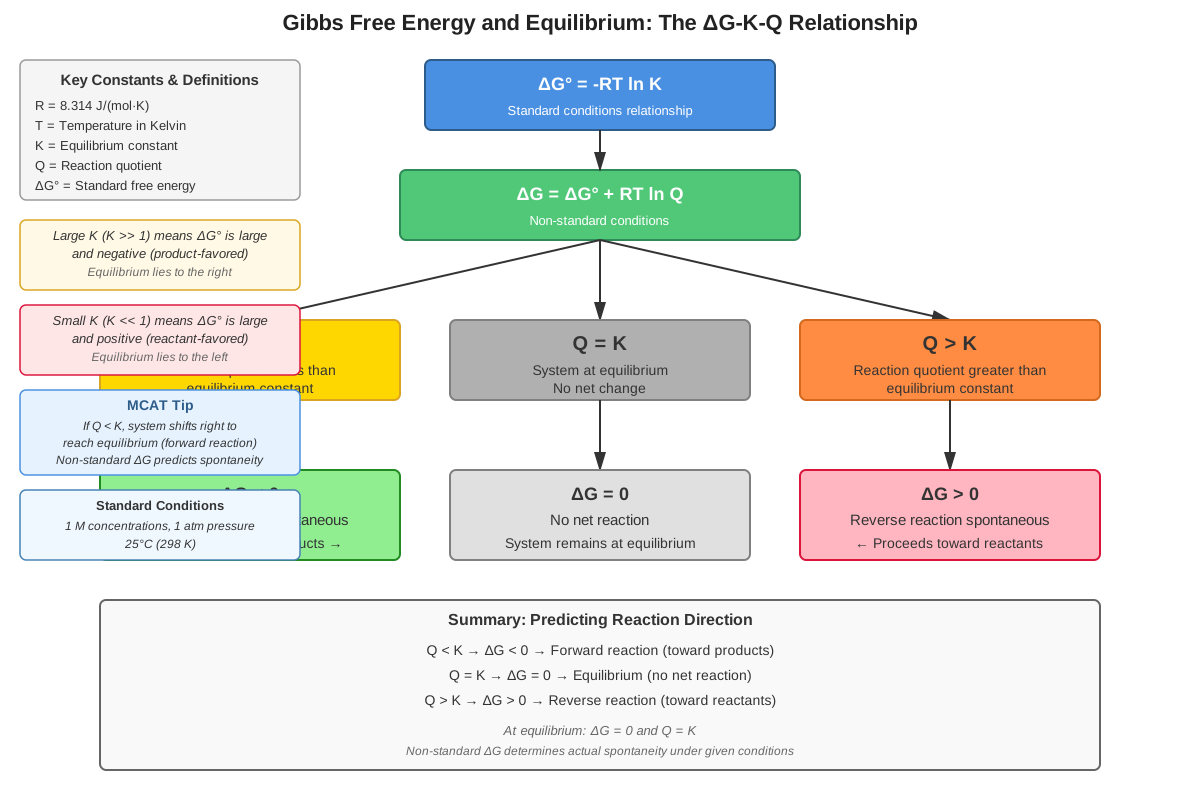
Under non-standard conditions, the actual Gibbs free energy change differs from ΔG° and is calculated using:
ΔG = ΔG° + RT ln(Q)Where:
- R = universal gas constant (8.314 J/mol·K)
- T = temperature in Kelvin
- Q = reaction quotient (same form as K, but using actual concentrations/pressures)
The reaction quotient (Q) has the same mathematical form as the equilibrium constant but uses current, non-equilibrium concentrations. This equation shows that ΔG depends on both the inherent thermodynamic favorability (ΔG°) and how far the system is from equilibrium (Q term).
Relationship to Equilibrium Constant
At equilibrium, ΔG = 0 by definition (no driving force for net change). Setting ΔG = 0 in the equation above and recognizing that Q = K at equilibrium yields:
ΔG° = -RT ln(K)Or equivalently:
K = e^(-ΔG°/RT)This fundamental relationship connects thermodynamics to equilibrium:
- ΔG° < 0: K > 1, products favored at equilibrium
- ΔG° = 0: K = 1, equal amounts of reactants and products
- ΔG° > 0: K < 1, reactants favored at equilibrium
At 298 K, the simplified relationship ΔG° ≈ -5.7 log(K) kJ/mol provides a quick estimation tool for the MCAT.
Coupled Reactions and Biochemical Applications
Coupled reactions involve linking a thermodynamically unfavorable reaction (ΔG > 0) with a favorable one (ΔG < 0) so that the overall process has negative ΔG. This principle underlies cellular metabolism. ATP hydrolysis:
ATP + H₂O → ADP + Pi ΔG° = -30.5 kJ/molThis highly exergonic reaction drives numerous endergonic biosynthetic processes. For example, glutamine synthesis from glutamate is endergonic:
Glutamate + NH₃ → Glutamine ΔG° = +14 kJ/molCoupling with ATP hydrolysis makes the overall process spontaneous:
Glutamate + NH₃ + ATP → Glutamine + ADP + Pi ΔG°total = -16.5 kJ/molThe free energy changes are additive for coupled reactions, allowing cells to drive unfavorable processes by coupling them to ATP hydrolysis or other exergonic reactions.
Gibbs Free Energy and Electrochemistry
In electrochemical cells, Gibbs free energy relates to cell potential through:
ΔG = -nFEWhere:
- n = number of moles of electrons transferred
- F = Faraday's constant (96,485 C/mol)
- E = cell potential in volts
Under standard conditions:
ΔG° = -nFE°This connection allows interconversion between thermodynamic and electrochemical data. A positive cell potential (E > 0) corresponds to negative ΔG, indicating a spontaneous redox reaction. This relationship is crucial for analyzing batteries, fuel cells, and biological electron transport chains.
Concept Relationships
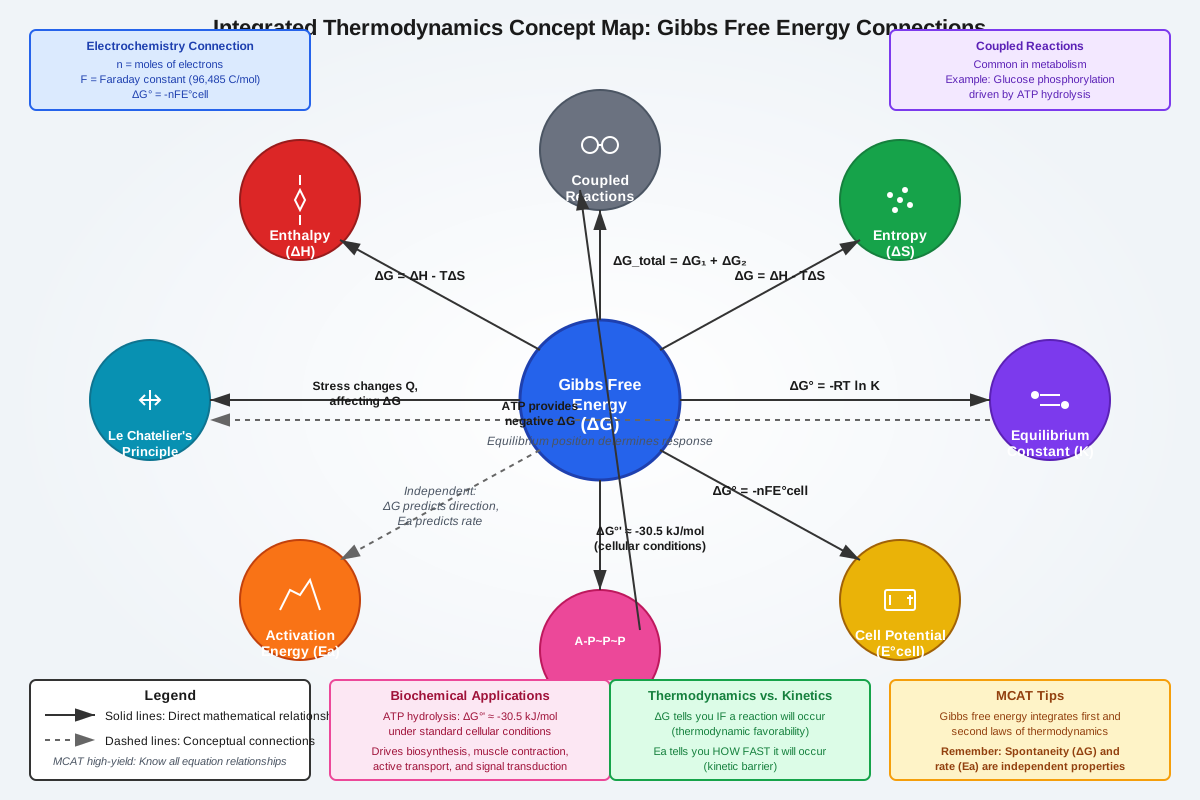
Gibbs free energy serves as the central integrating concept in thermodynamics, synthesizing multiple foundational principles. Enthalpy and entropy feed directly into the Gibbs equation (ΔG = ΔH - TΔS), with temperature serving as the weighting factor that determines their relative importance. This relationship demonstrates that spontaneity depends not just on energy minimization (enthalpy) but also on disorder maximization (entropy).
The connection flows outward to chemical equilibrium: Gibbs free energy determines the equilibrium constant through ΔG° = -RT ln(K), which in turn defines the equilibrium position. The reaction quotient Q modifies ΔG under non-standard conditions, creating a feedback loop where the system's current state (Q) and its equilibrium tendency (K) together determine the driving force (ΔG) for change.
In electrochemistry, the relationship ΔG = -nFE creates a bridge between thermodynamics and electrical work, allowing prediction of cell potentials from free energy data and vice versa. This connection extends to biochemistry, where coupled reactions use the free energy from ATP hydrolysis to drive biosynthesis, with the additivity of ΔG values enabling quantitative prediction of coupled reaction spontaneity.
Temperature acts as a control parameter throughout these relationships, affecting not only the magnitude of the TΔS term but also shifting equilibrium positions and altering reaction spontaneity. The first law (energy conservation) ensures that enthalpy changes are properly accounted for, while the second law (entropy increase in the universe) provides the fundamental justification for why negative ΔG indicates spontaneity.
Textual relationship map:
Enthalpy + Entropy → (combined via temperature) → Gibbs Free Energy → (determines) → Spontaneity and Equilibrium Constant → (connects to) → Electrochemical Cell Potential → (applies to) → Coupled Biochemical Reactions
Quick check — test yourself on Gibbs free energy so far.
Try Flashcards →High-Yield Facts
⭐ ΔG < 0 indicates a spontaneous (exergonic) reaction; ΔG > 0 indicates a non-spontaneous (endergonic) reaction; ΔG = 0 indicates equilibrium
⭐ The fundamental equation is ΔG = ΔH - TΔS, where temperature weights the entropy contribution
⭐ At equilibrium, ΔG = 0 and Q = K, leading to the relationship ΔG° = -RT ln(K)
⭐ Under non-standard conditions, ΔG = ΔG° + RT ln(Q), where Q is the reaction quotient
⭐ ATP hydrolysis has ΔG° ≈ -30.5 kJ/mol under cellular conditions, making it the primary energy currency for coupled reactions
- When ΔH < 0 and ΔS > 0, the reaction is spontaneous at all temperatures
- When ΔH > 0 and ΔS > 0, the reaction becomes spontaneous only at high temperatures (entropy-driven)
- When ΔH < 0 and ΔS < 0, the reaction is spontaneous only at low temperatures (enthalpy-driven)
- The relationship ΔG° = -nFE° connects electrochemical cell potential to standard free energy change
- For coupled reactions, the overall ΔG is the sum of individual ΔG values; if ΔG(total) < 0, the coupled process is spontaneous
- A large negative ΔG° corresponds to K >> 1, meaning products are strongly favored at equilibrium
- Spontaneity (thermodynamics) is independent of reaction rate (kinetics); a spontaneous reaction may be extremely slow
Common Misconceptions
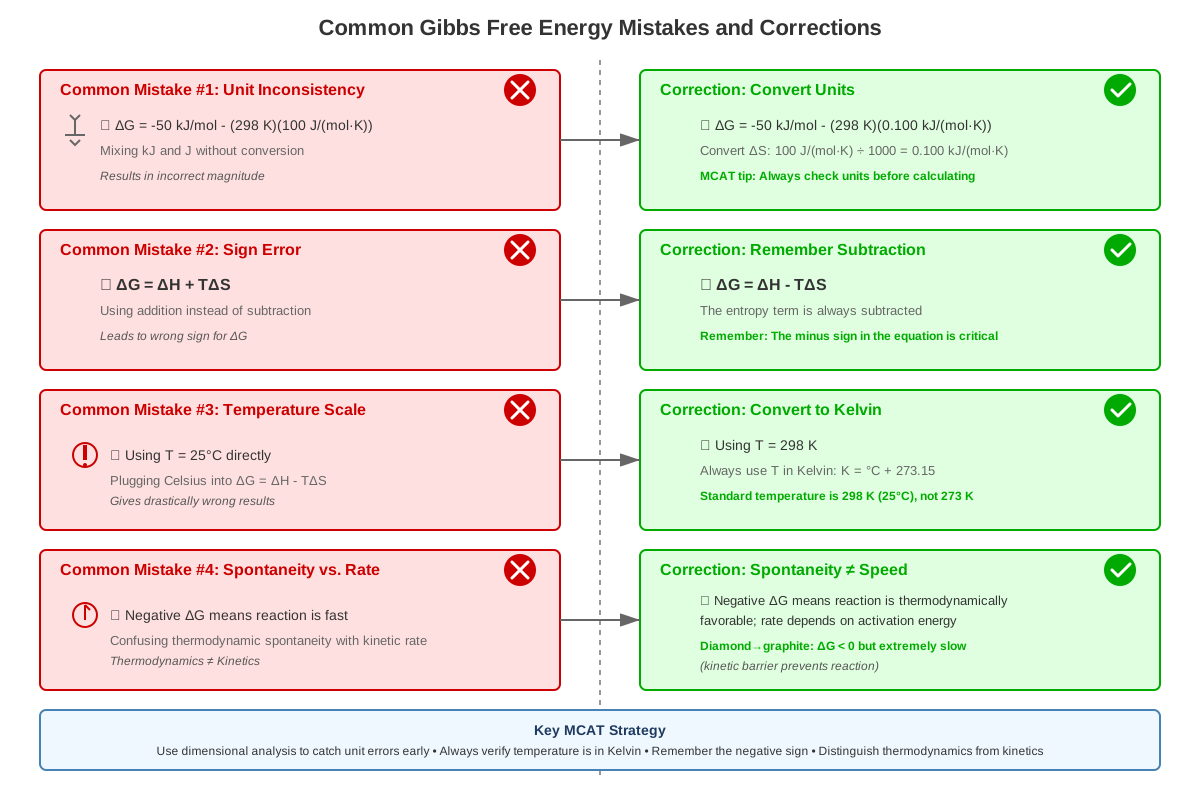
Misconception: A negative ΔG means the reaction occurs rapidly.
Correction: ΔG indicates thermodynamic spontaneity (whether a reaction is favorable), not kinetic rate (how fast it occurs). A reaction with very negative ΔG may still be extremely slow if the activation energy is high. Thermodynamics and kinetics are independent—diamond converting to graphite is spontaneous (ΔG < 0) but imperceptibly slow at room temperature.
Misconception: ΔG° and ΔG are the same thing and can be used interchangeably.
Correction: ΔG° is the standard free energy change under standard conditions (1 M, 1 atm, 25°C), while ΔG is the actual free energy change under current conditions. They are related by ΔG = ΔG° + RT ln(Q). Under non-standard conditions (which includes most biological systems), ΔG differs significantly from ΔG°.
Misconception: If ΔG° > 0, the reaction can never occur.
Correction: A positive ΔG° means the reaction is non-spontaneous under standard conditions, but it can still proceed if coupled to an exergonic reaction or if conditions shift to make ΔG negative. Additionally, even unfavorable reactions proceed to some extent—they simply favor reactants at equilibrium (K < 1) rather than being completely prevented.
Misconception: Increasing temperature always makes reactions more spontaneous.
Correction: Temperature's effect depends on the sign of ΔS. If ΔS > 0, increasing temperature makes the -TΔS term more negative, favoring spontaneity. If ΔS < 0, increasing temperature makes the -TΔS term more positive (less negative), opposing spontaneity. Temperature can either promote or inhibit spontaneity depending on entropy change.
Misconception: At equilibrium, the forward and reverse reactions have ΔG = 0 individually.
Correction: At equilibrium, the NET ΔG for the overall process is zero, meaning the forward and reverse reactions occur at equal rates with no net change. However, the standard free energy change ΔG° remains constant and typically non-zero. The condition ΔG = 0 applies to the system at equilibrium, not to ΔG° or to individual directional processes.
Misconception: Gibbs free energy is the same as the total energy of the system.
Correction: Gibbs free energy represents the energy available to do useful work at constant temperature and pressure. It is not the total energy (internal energy) but rather the portion of energy that can be harnessed for work after accounting for entropy. The relationship G = H - TS shows that some energy (TS) is unavailable due to disorder.
Worked Examples
Example 1: Calculating ΔG and Predicting Spontaneity
Problem: Consider the reaction: N₂(g) + 3H₂(g) → 2NH₃(g). Given ΔH° = -92.4 kJ/mol and ΔS° = -198.7 J/mol·K, determine whether this reaction is spontaneous at 25°C and at 500°C.
Solution:
Step 1: Convert temperature to Kelvin and ensure consistent units.
- T₁ = 25°C + 273 = 298 K
- T₂ = 500°C + 273 = 773 K
- Convert ΔS° to kJ: ΔS° = -198.7 J/mol·K × (1 kJ/1000 J) = -0.1987 kJ/mol·K
Step 2: Calculate ΔG° at 298 K using ΔG = ΔH - TΔS.
ΔG°₂₉₈ = -92.4 kJ/mol - (298 K)(-0.1987 kJ/mol·K)
ΔG°₂₉₈ = -92.4 kJ/mol + 59.2 kJ/mol
ΔG°₂₉₈ = -33.2 kJ/mol
Since ΔG° < 0 at 298 K, the reaction is spontaneous at 25°C under standard conditions.
Step 3: Calculate ΔG° at 773 K.
ΔG°₇₇₃ = -92.4 kJ/mol - (773 K)(-0.1987 kJ/mol·K)
ΔG°₇₇₃ = -92.4 kJ/mol + 153.6 kJ/mol
ΔG°₇₇₃ = +61.2 kJ/mol
Since ΔG° > 0 at 773 K, the reaction is non-spontaneous at 500°C under standard conditions.
Step 4: Interpret the results.
This reaction has ΔH < 0 (exothermic) and ΔS < 0 (decrease in disorder due to fewer gas molecules). According to temperature dependence analysis, such reactions are spontaneous at low temperatures where the favorable enthalpy term dominates, but become non-spontaneous at high temperatures where the unfavorable entropy term dominates. This explains why ammonia synthesis (Haber process) is performed at elevated temperatures despite thermodynamic unfavorability—the higher temperature increases reaction rate, and high pressure shifts equilibrium toward products.
Connection to Learning Objectives: This example demonstrates calculation of ΔG under different conditions, prediction of spontaneity, and application of temperature dependence principles—core skills for MCAT success.
Example 2: Relating ΔG° to Equilibrium Constant
Problem: A biochemical reaction has ΔG° = +12.5 kJ/mol at 37°C (body temperature). Calculate the equilibrium constant K and determine whether products or reactants are favored at equilibrium. If this reaction were coupled with ATP hydrolysis (ΔG° = -30.5 kJ/mol), would the coupled reaction be spontaneous?
Solution:
Step 1: Convert temperature and identify the relationship.
- T = 37°C + 273 = 310 K
- Use ΔG° = -RT ln(K), which rearranges to K = e^(-ΔG°/RT)
- R = 8.314 J/mol·K = 0.008314 kJ/mol·K
Step 2: Calculate K.
K = e^(-ΔG°/RT)
K = e^(-12.5 kJ/mol / (0.008314 kJ/mol·K × 310 K))
K = e^(-12.5 / 2.577)
K = e^(-4.85)
K = 0.0078
Since K < 1, reactants are strongly favored at equilibrium. Only about 0.78% of reactants convert to products at equilibrium under standard conditions.
Step 3: Analyze the coupled reaction.
For coupled reactions, ΔG values are additive:
ΔG°(coupled) = ΔG°(reaction) + ΔG°(ATP hydrolysis)
ΔG°(coupled) = +12.5 kJ/mol + (-30.5 kJ/mol)
ΔG°(coupled) = -18.0 kJ/mol
Since ΔG°(coupled) < 0, the coupled reaction is spontaneous. The favorable free energy from ATP hydrolysis more than compensates for the unfavorable reaction, driving it forward.
Step 4: Calculate K for the coupled reaction.
K(coupled) = e^(-(-18.0) / 2.577)
K(coupled) = e^(6.98)
K(coupled) ≈ 1,080
The coupled reaction has K >> 1, meaning products are now strongly favored—a dramatic shift from the uncoupled reaction.
Connection to Learning Objectives: This example illustrates the ΔG°-K relationship, demonstrates how cells use ATP coupling to drive unfavorable reactions, and shows quantitative analysis of coupled reactions—all high-yield MCAT skills.
Exam Strategy
Approaching MCAT Questions
When encountering Gibbs free energy questions, follow this systematic approach:
- Identify what is being asked: Spontaneity prediction, ΔG calculation, K determination, or coupled reaction analysis
- Determine given information: Note whether conditions are standard (ΔG°) or non-standard (ΔG), and identify provided values
- Select the appropriate equation: ΔG = ΔH - TΔS for basic calculations, ΔG = ΔG° + RT ln(Q) for non-standard conditions, or ΔG° = -RT ln(K) for equilibrium relationships
- Check units carefully: Convert temperatures to Kelvin, ensure entropy is in kJ or J consistently with other values, and verify concentration units match the context
Trigger Words and Phrases
Watch for these key phrases that signal Gibbs free energy concepts:
- "Spontaneous" or "favorable": Indicates ΔG < 0
- "At equilibrium": Signals ΔG = 0 and Q = K
- "Standard conditions": Use ΔG° equations with 1 M, 1 atm, 298 K
- "Coupled reaction" or "driven by ATP": Add ΔG values for individual processes
- "Temperature dependence": Analyze ΔH and ΔS signs to predict spontaneity changes
- "Cell potential" or "electrochemical": Use ΔG = -nFE relationship
Process of Elimination Tips
When uncertain between answer choices:
- Eliminate answers with incorrect sign: If you determine ΔG should be negative (spontaneous), immediately eliminate positive values
- Check magnitude reasonableness: At 298 K, ΔG° values for typical reactions range from -100 to +100 kJ/mol; extreme values (e.g., -1000 kJ/mol) are usually incorrect
- Verify temperature effects: If temperature increases and ΔS > 0, ΔG should become more negative; eliminate answers showing the opposite trend
- Use K relationships: If told K > 1, ΔG° must be negative; if K < 1, ΔG° must be positive
Time Allocation
For discrete Gibbs free energy questions, allocate 60-90 seconds. For passage-based questions:
- Spend 30 seconds identifying the relevant equation and given data
- Allocate 60 seconds for calculation and unit conversion
- Reserve 30 seconds for answer verification and elimination
If a calculation appears complex, estimate using simplified values (e.g., RT ≈ 2.5 kJ/mol at 298 K) to narrow answer choices before performing exact calculations.
Memory Techniques
Mnemonic for Spontaneity
"Negative Goes": Negative ΔG means the reaction goes (proceeds spontaneously)
Temperature Dependence Mnemonic
"HELP" for analyzing ΔH and ΔS combinations:
- Hot Entropy: When ΔH > 0 and ΔS > 0, high temperature helps (spontaneous at high T)
- Low Enthalpy: When ΔH < 0 and ΔS < 0, low temperature helps (spontaneous at low T)
- Perfect: When ΔH < 0 and ΔS > 0, perfect at all temperatures (always spontaneous)
Equation Recall Strategy
Visualize the Gibbs equation as a balance scale:
- Left side: Enthalpy (ΔH) represents the system's energy preference
- Right side: Temperature × Entropy (TΔS) represents disorder preference
- The difference (ΔH - TΔS) determines which side "wins"
ATP Coupling Visualization
Remember ATP as a thermodynamic battery: It stores -30.5 kJ/mol that can be "spent" to drive unfavorable reactions. Visualize adding the ΔG values like adding money to a purchase—if you have enough ATP "currency," you can "buy" the unfavorable reaction.
K and ΔG° Relationship
"Negative K is Big": When ΔG° is negative, K is big (>1, products favored)
"Positive K is Small": When ΔG° is positive, K is small (<1, reactants favored)
Summary
Gibbs free energy represents the central criterion for chemical spontaneity, integrating enthalpy and entropy through the equation ΔG = ΔH - TΔS. Negative ΔG indicates spontaneous (exergonic) reactions, positive ΔG indicates non-spontaneous (endergonic) reactions, and ΔG = 0 defines equilibrium. The standard free energy change (ΔG°) applies under standard conditions, while actual conditions require the equation ΔG = ΔG° + RT ln(Q), where Q is the reaction quotient. Temperature profoundly affects spontaneity depending on the signs of ΔH and ΔS, with entropy-driven reactions favored at high temperatures and enthalpy-driven reactions favored at low temperatures. The fundamental relationship ΔG° = -RT ln(K) connects thermodynamics to equilibrium, allowing prediction of equilibrium constants from free energy data. In biological systems, coupled reactions harness the favorable free energy of ATP hydrolysis (-30.5 kJ/mol) to drive unfavorable biosynthetic processes, with overall spontaneity determined by the sum of individual ΔG values. Mastery of Gibbs free energy enables prediction of reaction direction, calculation of equilibrium positions, and understanding of bioenergetics—making it indispensable for MCAT success.
Key Takeaways
- ΔG = ΔH - TΔS is the fundamental equation; negative ΔG means spontaneous, positive means non-spontaneous, zero means equilibrium
- Standard conditions (ΔG°) differ from actual conditions (ΔG), related by ΔG = ΔG° + RT ln(Q)
- Temperature affects spontaneity through the TΔS term; reactions with ΔS > 0 become more favorable at higher temperatures
- The equilibrium constant relates to standard free energy through ΔG° = -RT ln(K); negative ΔG° means K > 1 (products favored)
- Coupled reactions allow unfavorable processes to proceed by linking them to favorable ones; ΔG values are additive
- ATP hydrolysis provides approximately -30.5 kJ/mol to drive endergonic biological reactions
- Spontaneity (thermodynamics) is independent of reaction rate (kinetics); favorable reactions may still be slow
Related Topics
Chemical Equilibrium: Gibbs free energy provides the thermodynamic foundation for understanding equilibrium constants, Le Chatelier's principle, and equilibrium position shifts—essential for predicting how systems respond to stress.
Electrochemistry: The relationship ΔG = -nFE connects free energy to cell potentials, enabling analysis of batteries, electrolytic cells, and biological electron transport chains.
Enzyme Kinetics and Catalysis: While enzymes affect reaction rates (kinetics), they do not change ΔG or equilibrium position—understanding this distinction is crucial for biochemistry passages.
Thermochemistry and Hess's Law: Calculating ΔH° values using Hess's Law provides the enthalpy component needed for Gibbs free energy calculations.
Bioenergetics and Metabolism: Gibbs free energy governs all metabolic pathways, from glycolysis to oxidative phosphorylation, making it essential for biochemistry mastery.
Phase Equilibria: Free energy analysis explains phase transitions (melting, boiling, sublimation) and predicts conditions under which different phases are stable.
Practice CTA
Now that you have mastered the core concepts of Gibbs free energy, it is time to solidify your understanding through active practice. Attempt the practice questions and flashcards associated with this topic, focusing on applying the equations, predicting spontaneity under various conditions, and analyzing coupled reactions. Each problem you solve strengthens your ability to recognize patterns and execute calculations efficiently under timed conditions. Remember, thermodynamics is one of the highest-yield topics on the MCAT—your investment in mastering Gibbs free energy will pay dividends across multiple sections of the exam. Approach each practice question systematically, and review any mistakes to identify gaps in understanding. You have the tools; now build the confidence through deliberate practice!
Sign up free to keep reading
Create a free AnvayaPrep account to finish this MCAT guide on Gibbs free energy — plus flashcards and practice questions.