Overview
Alcohol substitution is a fundamental transformation in Organic Chemistry where the hydroxyl group (-OH) of an alcohol is replaced by another functional group, most commonly a halogen (Cl, Br, I) or other nucleophile. This reaction type represents one of the most important functional group interconversions tested on the MCAT, as it bridges multiple concepts including nucleophilic substitution mechanisms (SN1 and SN2), leaving group chemistry, and the reactivity patterns of Alcohols and Ethers. Understanding alcohol substitution reactions requires mastery of reaction conditions, reagent selection, stereochemical outcomes, and the fundamental challenge that alcohols present: the hydroxide ion is a poor leaving group that must be converted into a better leaving group before substitution can occur.
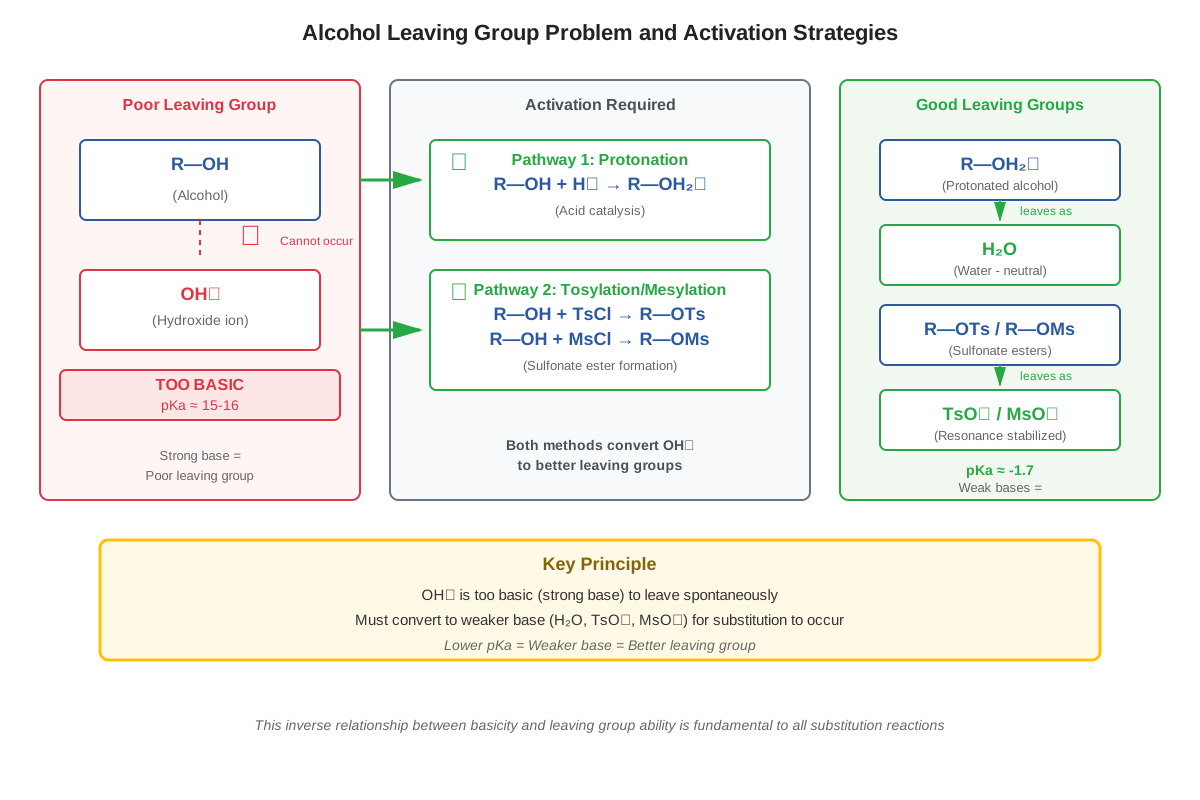
The MCAT frequently tests alcohol substitution Organic Chemistry concepts both as discrete questions and within passage-based scenarios involving synthesis pathways, pharmaceutical modifications, or biochemical transformations. Students must recognize that alcohols cannot undergo direct substitution reactions under typical SN1 or SN2 conditions because OH⁻ is too basic and therefore too poor a leaving group. Instead, the hydroxyl group must be protonated (forming OH₂⁺, water) or converted to a better leaving group such as a tosylate or mesylate. This mechanistic understanding distinguishes high-scoring students from those who merely memorize reaction products.
Within the broader context of Organic Chemistry, alcohol substitution connects directly to nucleophilic substitution mechanisms, acid-base chemistry, stereochemistry, and functional group transformations. These reactions serve as key steps in multi-step synthesis problems and appear frequently in MCAT passages discussing drug development, metabolic pathways, or laboratory synthesis procedures. Mastery of this topic enables students to predict reaction outcomes, identify appropriate reagents, and understand the stereochemical consequences of different reaction pathways—all critical skills for alcohol substitution MCAT questions.
Learning Objectives
- [ ] Define alcohol substitution using accurate Organic Chemistry terminology
- [ ] Explain why alcohol substitution matters for the MCAT
- [ ] Apply alcohol substitution to exam-style questions
- [ ] Identify common mistakes related to alcohol substitution
- [ ] Connect alcohol substitution to related Organic Chemistry concepts
- [ ] Predict the mechanism (SN1 vs. SN2) for alcohol substitution reactions based on substrate structure and reaction conditions
- [ ] Determine the stereochemical outcome of alcohol substitution reactions
- [ ] Select appropriate reagents to convert alcohols to alkyl halides with desired stereochemical control
Prerequisites
- Nucleophilic substitution mechanisms (SN1 and SN2): Essential for understanding how substitution occurs once the leaving group is activated; determines stereochemical outcomes and reaction kinetics
- Alcohol structure and classification: Primary, secondary, and tertiary alcohols react through different mechanisms; classification predicts reaction pathways
- Leaving group ability: Understanding what makes a good leaving group explains why hydroxyl groups must be activated before substitution
- Acid-base chemistry: Protonation of alcohols is the key activation step in most substitution reactions
- Stereochemistry fundamentals: Required to predict inversion, retention, or racemization in substitution products
- Carbocation stability: Critical for understanding SN1 mechanisms with secondary and tertiary alcohols
Why This Topic Matters
Alcohol substitution reactions represent a cornerstone of synthetic organic chemistry with direct applications in pharmaceutical development, where hydroxyl groups in drug candidates are frequently modified to alter solubility, bioavailability, or metabolic stability. In biochemical contexts, enzymatic substitution reactions involving alcohols occur in metabolic pathways, including the conversion of serine residues in proteins and the modification of carbohydrate hydroxyl groups. Understanding these transformations provides insight into both laboratory synthesis and biological processes.
On the MCAT, alcohol substitution appears in approximately 2-4 questions per exam, either as discrete items testing mechanism and reagent selection or embedded within passages describing synthesis sequences or metabolic transformations. The Chemical and Physical Foundations of Biological Systems section frequently includes passages where students must identify appropriate reagents for functional group interconversions, predict stereochemical outcomes, or explain why certain reaction conditions are necessary. Questions may present a multi-step synthesis where alcohol substitution is one key transformation, requiring students to recognize the need for leaving group activation.
Common MCAT question formats include: (1) reagent selection problems asking which combination converts an alcohol to an alkyl halide, (2) mechanism identification requiring students to distinguish between SN1 and SN2 pathways based on substrate structure, (3) stereochemistry predictions for substitution products, and (4) passage-based questions where alcohol substitution is embedded in a larger synthetic or biochemical context. High-yield scenarios include comparing the reactivity of primary, secondary, and tertiary alcohols, explaining why direct substitution with halide ions fails, and predicting racemization versus inversion outcomes.
Core Concepts
The Fundamental Challenge: Hydroxide as a Leaving Group
The central challenge in alcohol substitution stems from the fact that hydroxide ion (OH⁻) is an extremely poor leaving group. With a pKa of water around 15.7, hydroxide is far too basic to leave spontaneously during nucleophilic substitution. For comparison, good leaving groups like bromide (pKa of HBr ≈ -9) or tosylate are conjugate bases of strong acids. This fundamental principle explains why alcohols cannot undergo direct SN1 or SN2 reactions with nucleophiles under neutral or basic conditions—the reaction would require breaking a C-O bond and expelling a highly unstable, basic hydroxide ion.
The solution to this problem involves converting the hydroxyl group into a better leaving group through one of several strategies: (1) protonation to form an oxonium ion (ROH₂⁺), where water becomes the leaving group, (2) conversion to a sulfonate ester (tosylate or mesylate), or (3) reaction with reagents that simultaneously activate the hydroxyl and provide the nucleophile. Each strategy has specific applications depending on the alcohol structure and desired stereochemical outcome.
Protonation and SN1 Mechanisms
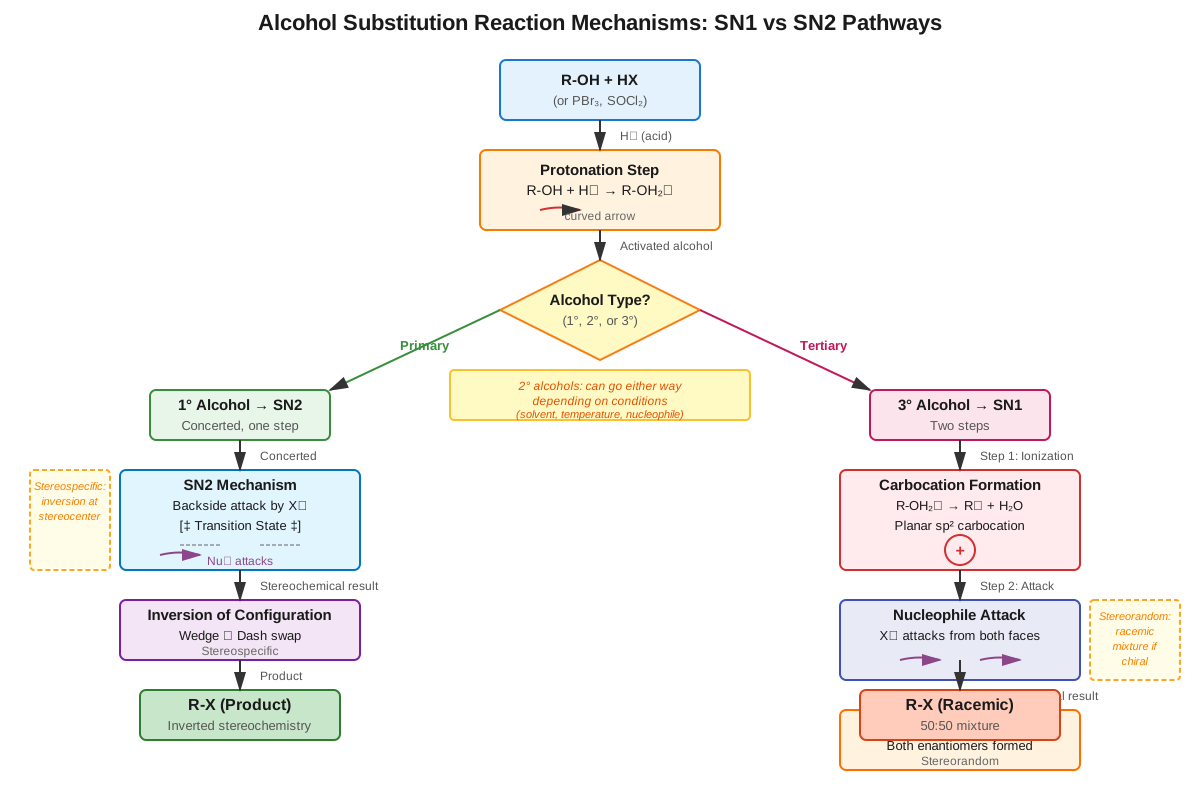
When alcohols are treated with strong acids (HCl, HBr, HI) under heating, the hydroxyl group is protonated to form an oxonium ion (ROH₂⁺). Water, with a pKa around -1.7, is an excellent leaving group and can depart to form a carbocation. This pathway is particularly favorable for tertiary alcohols, which form stable tertiary carbocations, and to a lesser extent for secondary alcohols. The reaction proceeds through an SN1 mechanism: the water leaves first (rate-determining step), forming a planar carbocation intermediate, which is then attacked by the halide nucleophile.
The stereochemical consequence of the SN1 pathway is racemization—the planar carbocation can be attacked from either face, producing a mixture of stereoisomers if the carbon was originally a stereocenter. Additionally, carbocation intermediates are prone to rearrangement through hydride or alkyl shifts if a more stable carbocation can form. For example, a secondary carbocation adjacent to a tertiary carbon may rearrange to form the more stable tertiary carbocation before nucleophilic attack occurs.
Primary alcohols generally do not proceed through SN1 mechanisms because primary carbocations are too unstable. Instead, primary alcohols undergo substitution through SN2-like mechanisms or alternative pathways depending on the reagent used.
SN2 Mechanisms with Activated Leaving Groups
To achieve substitution with primary alcohols or to maintain stereochemical control with secondary alcohols, the hydroxyl group can be converted to a sulfonate ester, most commonly tosylate (TsO⁻, p-toluenesulfonate) or mesylate (MsO⁻, methanesulfonate). These sulfonate esters are excellent leaving groups because they are conjugate bases of very strong acids (pKa ≈ -2 to -3).
The conversion is accomplished by treating the alcohol with tosyl chloride (TsCl) or mesyl chloride (MsCl) in the presence of a base like pyridine. This reaction proceeds with retention of configuration at the carbon bearing the hydroxyl group—the C-O bond is not broken during tosylate formation, only the O-H bond. Once formed, the tosylate or mesylate can undergo SN2 substitution with a wide variety of nucleophiles (halides, cyanide, azide, etc.), proceeding with inversion of configuration at the carbon center.
This two-step sequence (alcohol → tosylate → substitution product) provides excellent stereochemical control and is the method of choice when inversion of configuration is desired or when working with primary alcohols that cannot form stable carbocations.
Reagent-Specific Pathways
Several reagents accomplish alcohol substitution through specialized mechanisms:
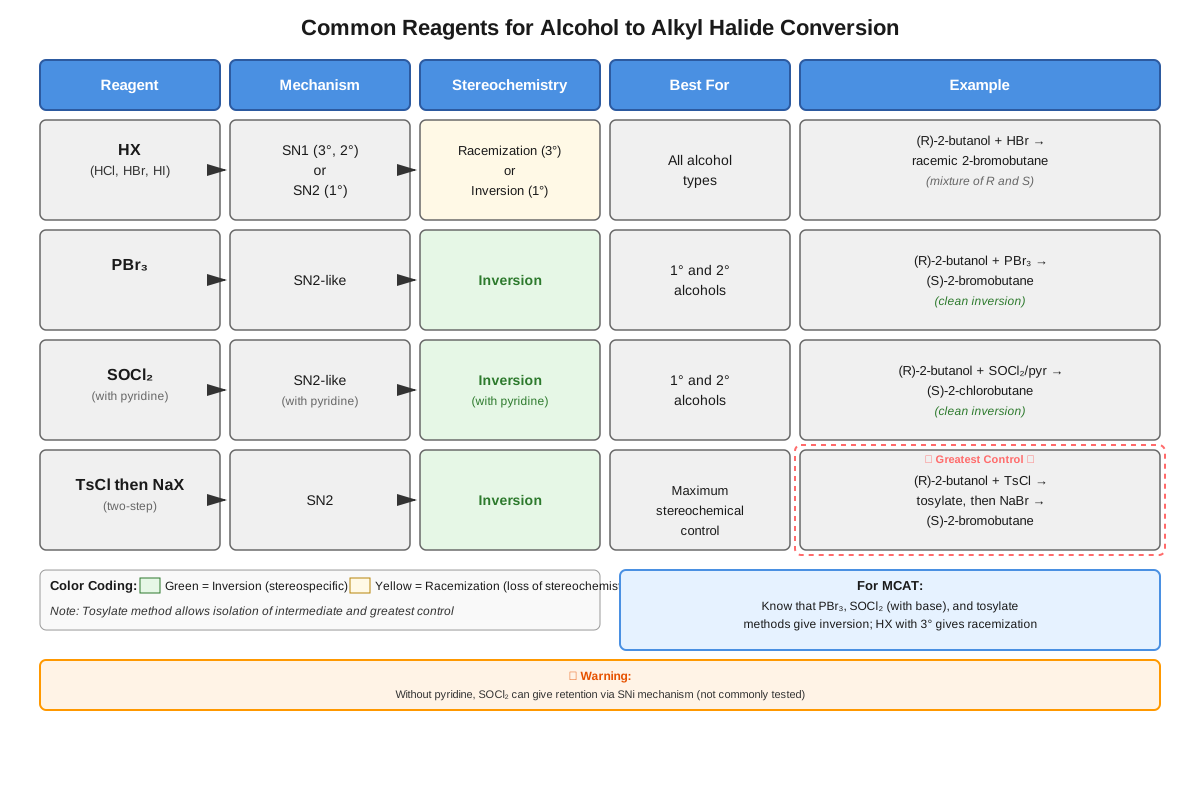
Phosphorus tribromide (PBr₃) and phosphorus trichloride (PCl₃) convert alcohols to alkyl halides through a mechanism that involves formation of an alkoxyphosphonium intermediate. The reaction proceeds with inversion of configuration and works well for primary and secondary alcohols. The mechanism involves nucleophilic attack by the alcohol oxygen on phosphorus, followed by displacement of the resulting intermediate by bromide or chloride in an SN2-like process.
Thionyl chloride (SOCl₂) converts alcohols to alkyl chlorides. Under typical conditions with pyridine, the reaction proceeds with retention of configuration through a complex mechanism involving a chlorosulfite intermediate and an internal ion pair. However, under different conditions or with different substrates, inversion can occur, making this reagent's stereochemistry somewhat condition-dependent.
Hydrogen halides (HCl, HBr, HI) react with alcohols through protonation followed by substitution. The mechanism (SN1 vs. SN2) depends on the alcohol structure: tertiary alcohols proceed through SN1 with racemization, while primary alcohols undergo SN2-like displacement with inversion. The reactivity order is HI > HBr > HCl, reflecting both the nucleophilicity of the halide and the acidity of the hydrogen halide.
Substrate Effects and Reactivity Patterns
The structure of the alcohol substrate dramatically influences the reaction pathway and conditions required:
| Alcohol Type | Preferred Mechanism | Typical Reagents | Stereochemical Outcome |
|---|---|---|---|
| Primary (1°) | SN2 | PBr₃, PCl₃, TsCl/Nu⁻ | Inversion |
| Secondary (2°) | SN1 or SN2 | HBr/heat (SN1), PBr₃ (SN2) | Racemization (SN1) or Inversion (SN2) |
| Tertiary (3°) | SN1 | HCl, HBr, HI | Racemization |
Tertiary alcohols readily undergo SN1 substitution with hydrogen halides because they form stable tertiary carbocations. They cannot undergo SN2 reactions due to steric hindrance around the carbon center. Treatment with HCl and ZnCl₂ (Lucas reagent) causes immediate cloudiness due to formation of the insoluble alkyl chloride.
Secondary alcohols represent an intermediate case and can proceed through either mechanism depending on conditions. Strong acids with heat favor SN1, while reagents like PBr₃ enforce an SN2-like pathway. The choice of conditions allows some stereochemical control.
Primary alcohols cannot form stable carbocations and therefore do not undergo SN1 reactions. They require SN2-compatible reagents like PBr₃, PCl₃, or the tosylate/nucleophile two-step sequence. With hydrogen halides, primary alcohols react slowly and may require harsh conditions.
Competition with Elimination
Under conditions that promote substitution, elimination reactions (E1 or E2) can compete, especially with secondary and tertiary alcohols. When alcohols are heated with strong acids, dehydration to form alkenes competes with substitution. The competition is influenced by:
- Temperature: Higher temperatures favor elimination (entropy-driven)
- Base strength: Strong, bulky bases favor elimination over substitution
- Substrate structure: More substituted alcohols (tertiary > secondary) favor elimination
- Nucleophile choice: Good nucleophiles that are weak bases favor substitution; strong bases favor elimination
For MCAT purposes, recognize that tertiary alcohols with strong acids at high temperatures primarily undergo elimination (dehydration), while at lower temperatures or with specific reagents, substitution can predominate.
Quick check — test yourself on Alcohol substitution so far.
Try Flashcards →Concept Relationships
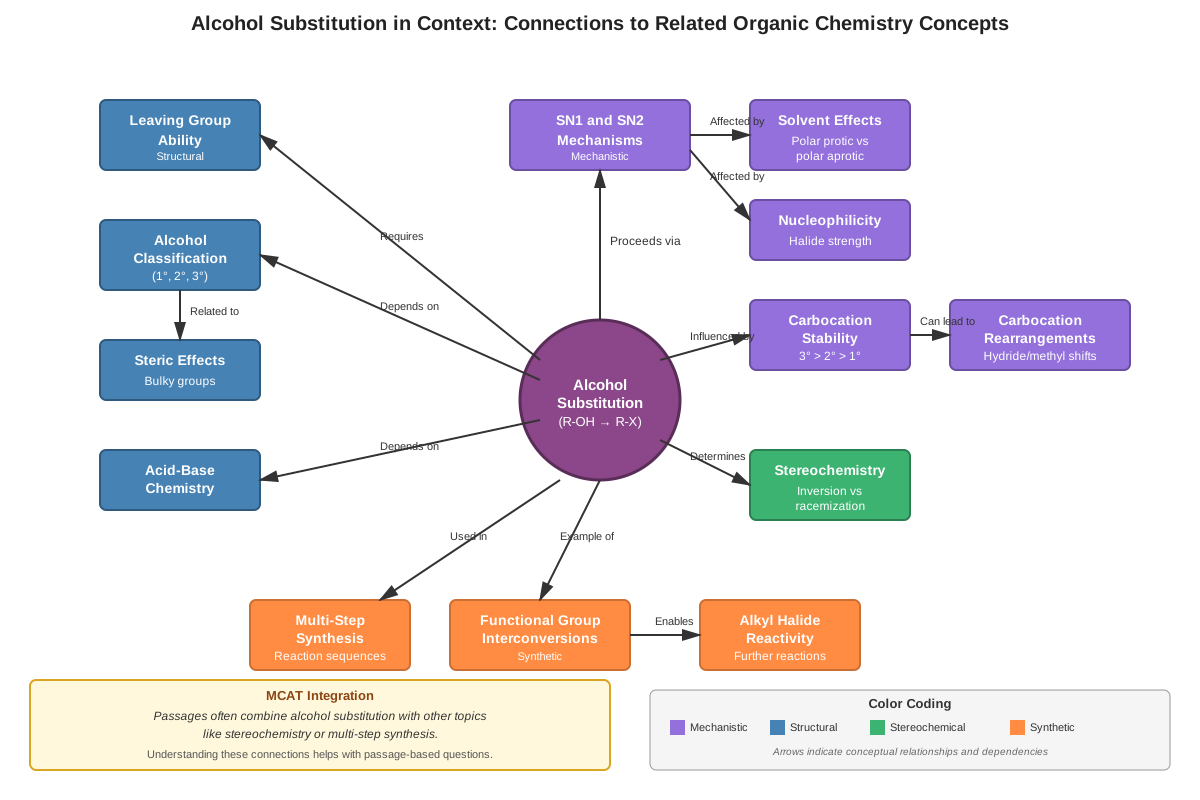
Alcohol substitution serves as a bridge between multiple fundamental organic chemistry concepts. The reaction begins with acid-base chemistry (protonation of the hydroxyl group), proceeds through nucleophilic substitution mechanisms (SN1 or SN2), and requires understanding of leaving group ability (why OH⁻ is poor but OH₂⁺ is good). The choice between SN1 and SN2 pathways depends on carbocation stability and steric effects, which are determined by alcohol classification (primary, secondary, tertiary).
The relationship map flows as follows:
Alcohol structure → determines → Mechanism type (SN1 vs. SN2) → determines → Stereochemical outcome (racemization vs. inversion)
Leaving group activation (protonation or tosylation) → enables → Nucleophilic substitution → produces → Alkyl halide or other substituted product
Reaction conditions (temperature, acid strength, nucleophile) → influence → Competition between substitution and elimination
These concepts connect backward to prerequisite knowledge of SN1/SN2 mechanisms and forward to more complex topics like multi-step synthesis, where alcohol substitution often serves as a key transformation. Understanding alcohol substitution also illuminates ether synthesis (Williamson synthesis requires an alkyl halide, often prepared from an alcohol) and organometallic reagent preparation (Grignard reagents require alkyl halides).
The stereochemical aspects connect to broader principles of reaction stereochemistry: SN2 reactions always invert, SN1 reactions racemize, and tosylate formation retains configuration. These patterns appear throughout organic chemistry and must be recognized instantly on the MCAT.
High-Yield Facts
⭐ Hydroxide (OH⁻) is a poor leaving group; alcohols require activation (protonation or conversion to tosylate/mesylate) before substitution can occur
⭐ Tertiary alcohols undergo SN1 substitution with hydrogen halides, producing racemic products if a stereocenter is involved
⭐ Primary alcohols undergo SN2 substitution with reagents like PBr₃ or via tosylate intermediates, producing inverted products
⭐ Tosylate (TsO⁻) and mesylate (MsO⁻) are excellent leaving groups formed from alcohols with retention of configuration
⭐ PBr₃ and PCl₃ convert alcohols to alkyl halides with inversion of configuration through an SN2-like mechanism
- Secondary alcohols can undergo either SN1 or SN2 depending on reaction conditions and reagent choice
- Carbocation rearrangements (hydride and alkyl shifts) can occur during SN1 substitution of alcohols
- The reactivity order for hydrogen halides is HI > HBr > HCl, reflecting both acidity and nucleophilicity
- Thionyl chloride (SOCl₂) with pyridine typically gives retention of configuration, though this is condition-dependent
- Elimination competes with substitution, especially at high temperatures and with tertiary alcohols
- The Lucas test (HCl/ZnCl₂) distinguishes alcohol types: tertiary react immediately, secondary react slowly, primary do not react at room temperature
Common Misconceptions
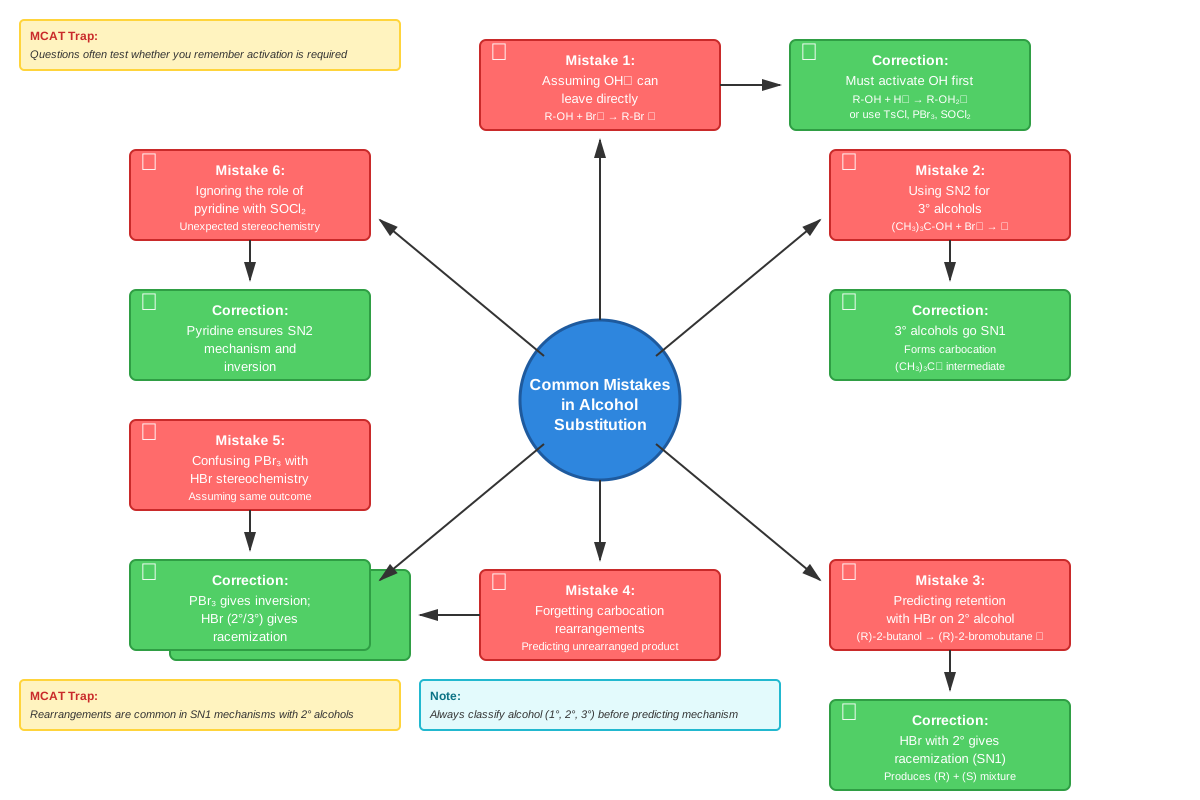
Misconception: Alcohols can undergo direct SN2 reactions with halide nucleophiles under basic conditions.
Correction: Hydroxide is far too poor a leaving group (too basic) for direct substitution. The alcohol must first be converted to a better leaving group through protonation, tosylation, or reaction with specialized reagents like PBr₃.
Misconception: All alcohol substitution reactions proceed through carbocation intermediates.
Correction: Only secondary and tertiary alcohols under acidic conditions proceed through SN1 mechanisms with carbocation intermediates. Primary alcohols and tosylate-mediated substitutions proceed through SN2 mechanisms without carbocation formation.
Misconception: Tosylate formation inverts the stereochemistry at the carbon bearing the hydroxyl group.
Correction: Tosylate formation occurs with retention of configuration because the C-O bond is not broken—only the O-H bond reacts. Inversion occurs in the subsequent SN2 displacement of the tosylate by a nucleophile.
Misconception: PBr₃ and HBr give the same stereochemical outcome when converting alcohols to bromides.
Correction: PBr₃ proceeds through an SN2-like mechanism with inversion, while HBr with tertiary or secondary alcohols often proceeds through SN1 with racemization. The mechanisms and stereochemical outcomes differ significantly.
Misconception: Primary alcohols react fastest with hydrogen halides because they are least sterically hindered.
Correction: Tertiary alcohols react fastest with hydrogen halides because they form the most stable carbocations in the SN1 mechanism. Primary alcohols react slowest because they cannot form stable carbocations and must proceed through a less favorable SN2-like pathway.
Misconception: All substitution reactions of alcohols produce only the substitution product with no side products.
Correction: Elimination (dehydration) competes with substitution, especially with secondary and tertiary alcohols at elevated temperatures. Additionally, carbocation rearrangements can produce unexpected constitutional isomers during SN1 reactions.
Worked Examples
Example 1: Predicting Products and Stereochemistry
Problem: (S)-2-butanol is treated with (a) HBr with heating, and (b) first TsCl/pyridine, then NaBr. Predict the products and stereochemistry for each reaction.
Solution:
Part (a): HBr with heating
Step 1: Identify the substrate. (S)-2-butanol is a secondary alcohol with a stereocenter at C-2.
Step 2: Determine the mechanism. Secondary alcohols with strong acids (HBr) and heat typically proceed through SN1 mechanism. The hydroxyl group is protonated to form ROH₂⁺, water leaves to form a secondary carbocation, and bromide attacks.
Step 3: Consider stereochemistry. The SN1 mechanism produces a planar carbocation intermediate that can be attacked from either face, resulting in racemization. The product is a racemic mixture of (R)- and (S)-2-bromobutane.
Step 4: Check for rearrangements. The secondary carbocation at C-2 is adjacent to C-1 (primary) and C-3 (primary), so no more stable carbocation can form. No rearrangement occurs.
Answer (a): Racemic 2-bromobutane [(R) and (S) mixture]
Part (b): TsCl/pyridine, then NaBr
Step 1: First reaction—tosylate formation. TsCl with pyridine converts the alcohol to a tosylate ester with retention of configuration. The product is (S)-2-butyl tosylate.
Step 2: Second reaction—SN2 displacement. Bromide ion (good nucleophile) displaces the tosylate (excellent leaving group) through an SN2 mechanism, which proceeds with inversion of configuration.
Step 3: Determine final stereochemistry. Starting with (S)-2-butyl tosylate and inverting gives (R)-2-bromobutane.
Answer (b): (R)-2-bromobutane (single enantiomer, inverted from starting material)
Key Learning Point: The same transformation (alcohol → alkyl bromide) can give different stereochemical outcomes depending on the reagents and mechanism. HBr gives racemization (SN1), while the tosylate route gives inversion (SN2).
Example 2: Reagent Selection for Synthesis
Problem: A synthesis requires conversion of 1-pentanol to 1-pentanamine (CH₃CH₂CH₂CH₂CH₂NH₂). Propose a two-step sequence using alcohol substitution.
Solution:
Step 1: Analyze the transformation. The hydroxyl group (-OH) must be replaced with an amino group (-NH₂). Direct substitution with ammonia will not work because OH⁻ is a poor leaving group.
Step 2: Plan the strategy. Convert the alcohol to a better leaving group, then displace with a nitrogen nucleophile. Since 1-pentanol is primary, SN2 mechanisms will work well.
Step 3: Choose the first step. Convert 1-pentanol to 1-bromopentane (or 1-chloropentane or 1-iodopentane). Options include:
- PBr₃ (gives inversion, but starting material has no stereocenter, so this is not an issue)
- TsCl/pyridine followed by NaBr
- HBr (works but is slower for primary alcohols)
Best choice for step 1: PBr₃ → 1-bromopentane
Step 4: Choose the second step. Displace the bromide with a nitrogen nucleophile. Direct reaction with ammonia (NH₃) would work but gives a mixture of products (primary, secondary, tertiary amines). A better approach uses azide ion (N₃⁻) as the nucleophile, followed by reduction.
Step 1: 1-pentanol + PBr₃ → 1-bromopentane
Step 2: 1-bromopentane + NaN₃ → 1-pentyl azide
Step 3 (bonus): 1-pentyl azide + H₂/Pd or LiAlH₄ → 1-pentanamine
Answer: The alcohol substitution portion is: (1) PBr₃ to form 1-bromopentane, (2) NaN₃ via SN2 to form 1-pentyl azide, (3) reduction to the amine. This demonstrates how alcohol substitution enables further functional group transformations.
Key Learning Point: Alcohol substitution to form alkyl halides is often the first step in multi-step syntheses, enabling subsequent reactions that require good leaving groups.
Exam Strategy
When approaching MCAT questions on alcohol substitution, first identify the alcohol type (primary, secondary, or tertiary) as this immediately narrows the possible mechanisms. Look for trigger words like "heated," "acidic conditions," or specific reagents (PBr₃, TsCl, HBr) that indicate the reaction pathway.
Trigger words and phrases to recognize:
- "Heated with HBr" or "refluxed with acid" → suggests SN1 mechanism, expect racemization
- "Tosyl chloride" or "mesyl chloride" → indicates tosylate/mesylate formation with retention, followed by SN2 with inversion
- "PBr₃" or "PCl₃" → signals SN2-like mechanism with inversion
- "Carbocation rearrangement" → only possible in SN1 mechanisms
- "Stereochemistry retained/inverted" → key to distinguishing mechanisms
Process-of-elimination strategies:
- If the question asks about primary alcohol substitution, eliminate answer choices involving carbocation intermediates or SN1 mechanisms—primary carbocations are too unstable.
- If the question specifies retention of configuration, eliminate direct SN2 mechanisms (which invert) and SN1 mechanisms (which racemize). Look for tosylate formation or specific reagents like SOCl₂/pyridine.
- If a tertiary alcohol is involved, eliminate SN2 mechanisms due to steric hindrance. Tertiary alcohols undergo SN1 or elimination.
- When stereochemistry is specified in the starting material, track it through each step: tosylate formation retains, SN2 inverts, SN1 racemizes.
Time allocation: Alcohol substitution questions typically require 60-90 seconds. Spend 15-20 seconds identifying the substrate type and mechanism, 20-30 seconds working through the stereochemistry or product prediction, and 20-30 seconds eliminating wrong answers and confirming your choice. If a question involves multi-step synthesis, allocate up to 2 minutes to trace through each transformation.
Red flags that indicate a more complex question:
- Multiple stereocenters (track each independently)
- Competing elimination pathways (consider temperature and base strength)
- Carbocation rearrangement possibilities (check for adjacent more stable carbocations)
- Passage-based questions where you must extract reaction conditions from experimental descriptions
Memory Techniques
Mnemonic for leaving group quality: "Water Wins, Hydroxide Horrible" (Water is a good leaving group after protonation; Hydroxide is horrible and needs activation)
Mnemonic for stereochemistry outcomes: "Tosylate Retains, Substitution Inverts" (Tosylate formation Retains configuration; Subsequent SN2 Inverts)
Acronym for reagents that invert: "Please Try Inverting" (PBr₃, Tosylate/Nu⁻, both Invert via SN2)
Visualization for SN1 racemization: Picture the carbocation as a flat triangle that can be attacked from above or below like a target with two sides—this mental image reinforces why racemization occurs.
Reactivity sequence: "Tertiary Sprints, Primary Plods" (Tertiary alcohols react fastest with HX via SN1; Primary alcohols react slowest)
Mechanism decision tree: Create a mental flowchart:
- Is it 1°? → SN2 pathway (PBr₃, tosylate, or slow with HX)
- Is it 3°? → SN1 pathway (HX works great, watch for elimination)
- Is it 2°? → Check conditions (acid/heat = SN1; PBr₃ = SN2)
Stereochemistry tracking: Use your hands—left hand for starting configuration, right hand for product. Flip your right hand over for inversion (SN2), keep both hands the same for retention (tosylate formation), or randomize right hand orientation for racemization (SN1).
Summary
Alcohol substitution represents a critical functional group transformation where the hydroxyl group of an alcohol is replaced by another group, typically a halogen. The fundamental challenge is that hydroxide is a poor leaving group, requiring activation through protonation (forming water as the leaving group) or conversion to excellent leaving groups like tosylates or mesylates. The mechanism—SN1 versus SN2—depends primarily on alcohol structure: tertiary alcohols undergo SN1 with racemization via carbocation intermediates, primary alcohols undergo SN2 with inversion, and secondary alcohols can follow either pathway depending on conditions. Key reagents include hydrogen halides (HCl, HBr, HI) for SN1 pathways, PBr₃ and PCl₃ for SN2 with inversion, and tosyl chloride for creating excellent leaving groups that enable controlled SN2 substitutions. Stereochemical outcomes are predictable: tosylate formation retains configuration, SN2 inverts, and SN1 racemizes. Competition with elimination must be considered, especially at elevated temperatures with secondary and tertiary alcohols. For MCAT success, students must rapidly identify alcohol type, predict mechanism, track stereochemistry, and select appropriate reagents for desired transformations.
Key Takeaways
- Alcohols require leaving group activation (protonation or tosylation) because hydroxide is too basic to leave spontaneously
- Tertiary alcohols undergo SN1 substitution with hydrogen halides, producing racemic products via carbocation intermediates
- Primary alcohols undergo SN2 substitution with reagents like PBr₃ or via tosylate intermediates, producing inverted products
- Tosylate formation occurs with retention of configuration; subsequent SN2 displacement inverts the stereochemistry
- Secondary alcohols can follow either SN1 or SN2 pathways depending on reaction conditions and reagent choice
- Carbocation rearrangements can occur during SN1 reactions if more stable carbocations are accessible
- Elimination competes with substitution, especially at high temperatures and with more substituted alcohols
Related Topics
Nucleophilic Substitution Mechanisms (SN1 and SN2): Mastering alcohol substitution requires deep understanding of these fundamental mechanisms, including their kinetics, stereochemistry, and substrate preferences. This topic provides the mechanistic foundation for predicting alcohol substitution outcomes.
Elimination Reactions (E1 and E2): These reactions compete with alcohol substitution under many conditions. Understanding when elimination predominates versus substitution is essential for predicting major products in alcohol transformations.
Ether Synthesis: The Williamson ether synthesis requires alkyl halides, which are often prepared from alcohols via substitution reactions. This topic builds directly on alcohol substitution chemistry.
Organometallic Reagents: Grignard and organolithium reagents are prepared from alkyl halides, connecting alcohol substitution to powerful carbon-carbon bond-forming reactions.
Multi-Step Synthesis: Alcohol substitution frequently appears as a key step in complex synthesis problems, where functional group interconversions must be planned strategically.
Practice CTA
Now that you have mastered the core concepts of alcohol substitution, it's time to solidify your understanding through active practice. Attempt the practice questions to test your ability to predict mechanisms, select appropriate reagents, and track stereochemistry through multi-step transformations. Use the flashcards to reinforce high-yield facts and reagent-product relationships until they become automatic. Remember: the MCAT rewards not just knowledge, but the ability to apply concepts rapidly and accurately under time pressure. Every practice question you work through builds the pattern recognition and mechanistic intuition that separates good scores from great ones. You've got this!
Sign up free to keep reading
Create a free AnvayaPrep account to finish this MCAT guide on Alcohol substitution — plus flashcards and practice questions.