Overview
Capacitance is a fundamental concept in Electricity and Magnetism that describes the ability of a system to store electrical charge and energy. At its core, capacitance quantifies how much electric charge a device called a capacitor can hold per unit of electric potential difference (voltage) applied across it. This concept bridges multiple areas of Physics, connecting electrostatics, electric fields, potential energy, and circuit behavior into a cohesive framework that appears regularly on the MCAT.
For MCAT preparation, understanding Capacitance Physics is essential because it appears in both passage-based and discrete questions, often integrated with circuits, energy storage, and biological applications like nerve signal transmission. The MCAT tests not just your ability to recall the capacitance formula, but your capacity to apply it in novel contexts—calculating energy stored in defibrillators, analyzing RC circuits in experimental setups, or understanding how membrane capacitance affects neuronal function. Questions may present capacitors in series or parallel configurations, ask about the effect of dielectric materials, or require energy calculations.
Capacitance MCAT questions typically integrate multiple physics principles simultaneously. You might encounter a passage describing a medical device that uses capacitors for energy storage, then be asked to calculate charge, voltage, or energy under various conditions. The topic connects directly to electric fields (since capacitance depends on geometry and field configuration), electric potential (the voltage across plates), circuits (where capacitors affect current flow and time constants), and energy conservation (as capacitors store electrical potential energy). Mastering capacitance provides a foundation for understanding more complex electromagnetic phenomena and prepares you for interdisciplinary questions that blend physics with biological or chemical contexts.
Learning Objectives
- [ ] Define Capacitance using accurate Physics terminology
- [ ] Explain why Capacitance matters for the MCAT
- [ ] Apply Capacitance to exam-style questions
- [ ] Identify common mistakes related to Capacitance
- [ ] Connect Capacitance to related Physics concepts
- [ ] Calculate capacitance for parallel-plate capacitors given geometric parameters
- [ ] Determine equivalent capacitance for series and parallel combinations
- [ ] Analyze the effect of dielectric materials on capacitance and stored energy
- [ ] Compute energy stored in capacitors and relate it to practical applications
Prerequisites
- Electric charge and Coulomb's Law: Understanding charge interactions is fundamental since capacitors store separated charges that create electric fields
- Electric field concepts: Capacitance depends on the electric field configuration between conductors, requiring familiarity with field strength and direction
- Electric potential and voltage: Capacitance is defined as the ratio of charge to potential difference, making voltage comprehension essential
- Basic circuit principles: Capacitors function as circuit elements, requiring knowledge of current, voltage, and resistance relationships
- Energy concepts: Calculating stored energy in capacitors requires understanding potential energy and work done by electric forces
Why This Topic Matters
Capacitance has profound clinical and technological significance that makes it relevant for future physicians. Defibrillators use large capacitors to store and rapidly discharge electrical energy to restore normal heart rhythm—a life-saving application that directly relates to the energy storage equations tested on the MCAT. Nerve cell membranes act as biological capacitors, with their capacitance affecting signal propagation speed and the time course of action potentials. Understanding membrane capacitance helps explain why myelination increases nerve conduction velocity and why certain toxins or diseases that alter membrane properties cause neurological symptoms.
On the MCAT, capacitance appears in approximately 2-4 questions per exam, representing a medium-yield topic that can significantly impact your score. Questions typically fall into three categories: (1) calculation-based problems requiring you to find capacitance, charge, voltage, or energy using formulas; (2) conceptual questions testing your understanding of how changing variables (plate separation, area, dielectric material) affects capacitance; and (3) passage-based applications where capacitors appear in experimental apparatus or medical devices, requiring you to interpret data and apply principles to novel situations.
Common exam presentations include passages describing RC circuits with time-dependent behavior, experimental setups measuring dielectric constants of biological tissues, medical imaging devices that use capacitive sensors, or neurophysiology passages discussing membrane properties. The MCAT particularly favors questions that require proportional reasoning—if you double the plate separation, what happens to capacitance and stored energy?—rather than pure numerical calculation. This emphasis on conceptual understanding and relationships between variables makes thorough comprehension more valuable than memorizing formulas alone.
Core Concepts
Definition of Capacitance
Capacitance (C) is defined as the ratio of the magnitude of charge (Q) stored on one conductor to the magnitude of the potential difference (V) between two conductors:
C = Q/VThe SI unit of capacitance is the farad (F), where 1 farad = 1 coulomb per volt (C/V). In practical applications, capacitance values typically range from picofarads (pF, 10⁻¹² F) to microfarads (μF, 10⁻⁶ F), as one farad represents an extremely large capacitance. A capacitor is a device specifically designed to store electrical charge and energy, typically consisting of two conductors (plates) separated by an insulating material or vacuum.
The capacitance of a system depends solely on the geometric configuration of the conductors and the properties of the insulating material between them—it does not depend on the charge stored or voltage applied. This geometric dependence makes capacitance an intrinsic property of the physical setup, analogous to how resistance depends on conductor geometry and material properties.
Parallel-Plate Capacitor
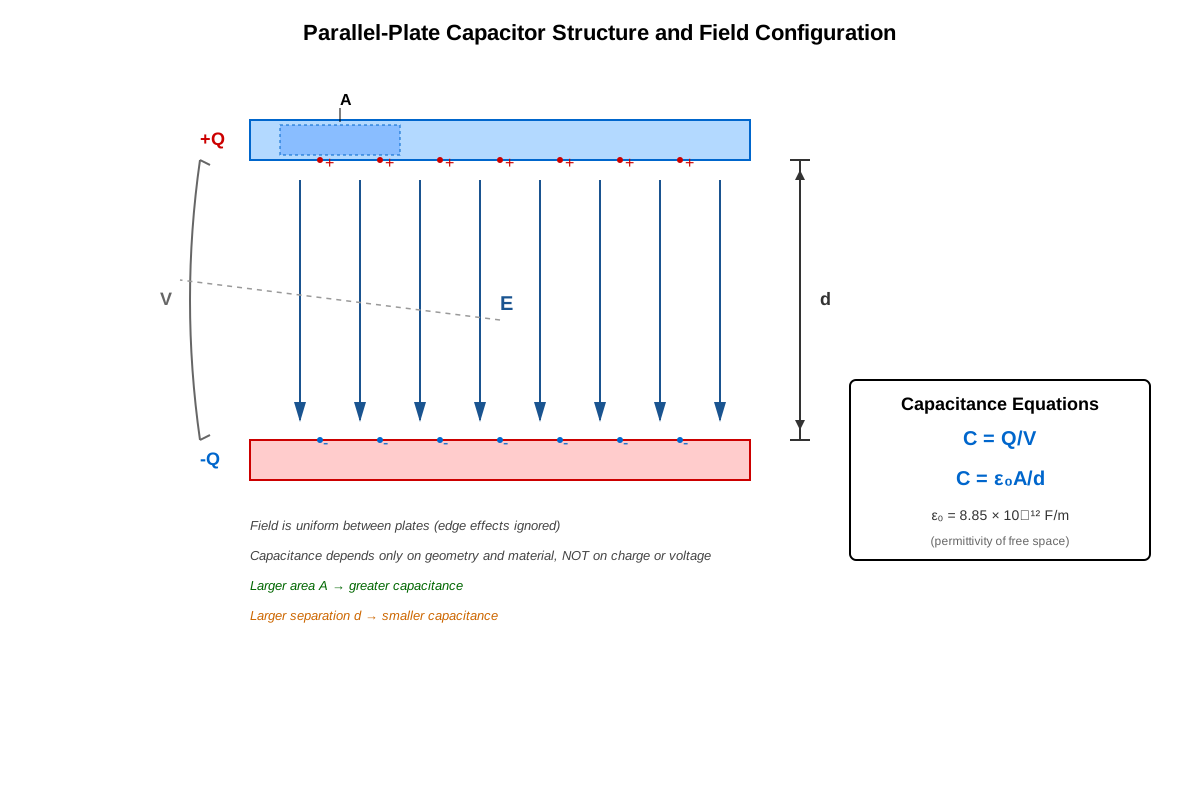
The most commonly tested capacitor configuration on the MCAT is the parallel-plate capacitor, consisting of two flat, parallel conducting plates of area A separated by distance d. For this geometry, the capacitance is:
C = ε₀A/dwhere ε₀ (epsilon-naught) is the permittivity of free space (8.85 × 10⁻¹² F/m). This equation reveals several important relationships:
- Capacitance is directly proportional to plate area (A): larger plates can store more charge at the same voltage
- Capacitance is inversely proportional to separation distance (d): closer plates create stronger electric fields and greater capacitance
- The formula assumes the plate separation is much smaller than the plate dimensions, creating a uniform electric field between plates
The electric field between parallel plates is uniform and given by E = V/d, where V is the voltage across the plates. This uniform field simplifies calculations and makes parallel-plate capacitors ideal for theoretical analysis and MCAT questions.
Dielectric Materials
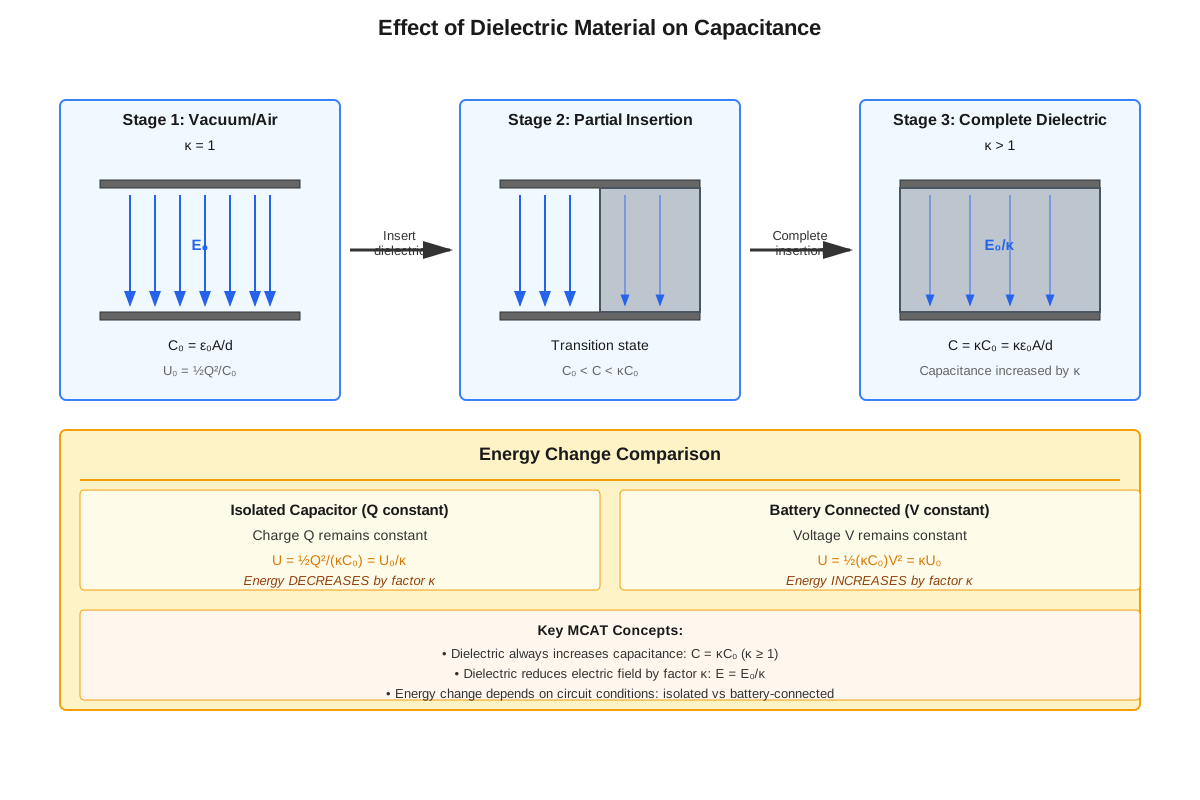
A dielectric is an insulating material placed between capacitor plates that increases capacitance by reducing the electric field strength. When a dielectric fills the space between plates, the capacitance becomes:
C = κε₀A/d = κC₀where κ (kappa) is the dielectric constant (or relative permittivity), a dimensionless number ≥ 1 that characterizes the material. For vacuum or air, κ ≈ 1; for water, κ ≈ 80; for biological membranes, κ ≈ 2-10. The dielectric constant represents how much the material increases capacitance compared to vacuum.
Dielectrics work through polarization: the electric field between plates causes slight separation of positive and negative charges within dielectric molecules, creating an induced electric field that opposes the applied field. This opposition reduces the net electric field, allowing more charge to be stored at the same voltage, thereby increasing capacitance. The relationship between fields is:
E = E₀/κwhere E₀ is the field without the dielectric and E is the reduced field with the dielectric present.
Energy Stored in Capacitors
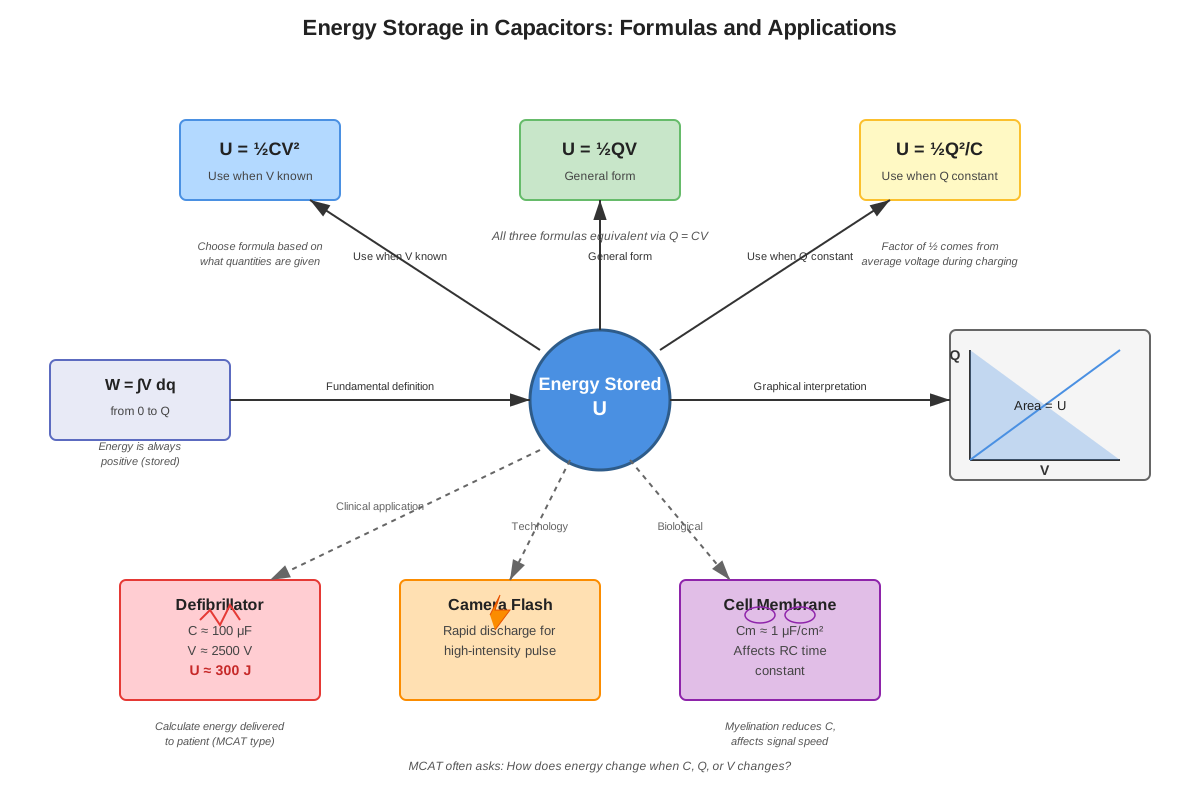
Capacitors store electrical potential energy in the electric field between their plates. The energy (U) stored in a capacitor can be expressed in three equivalent forms:
U = (1/2)QV = (1/2)CV² = Q²/(2C)These three equations are mathematically equivalent (derivable from each other using C = Q/V) but emphasize different variables. The MCAT may provide different information in different problems, so familiarity with all three forms is essential. The energy comes from the work required to separate positive and negative charges against their mutual attraction.
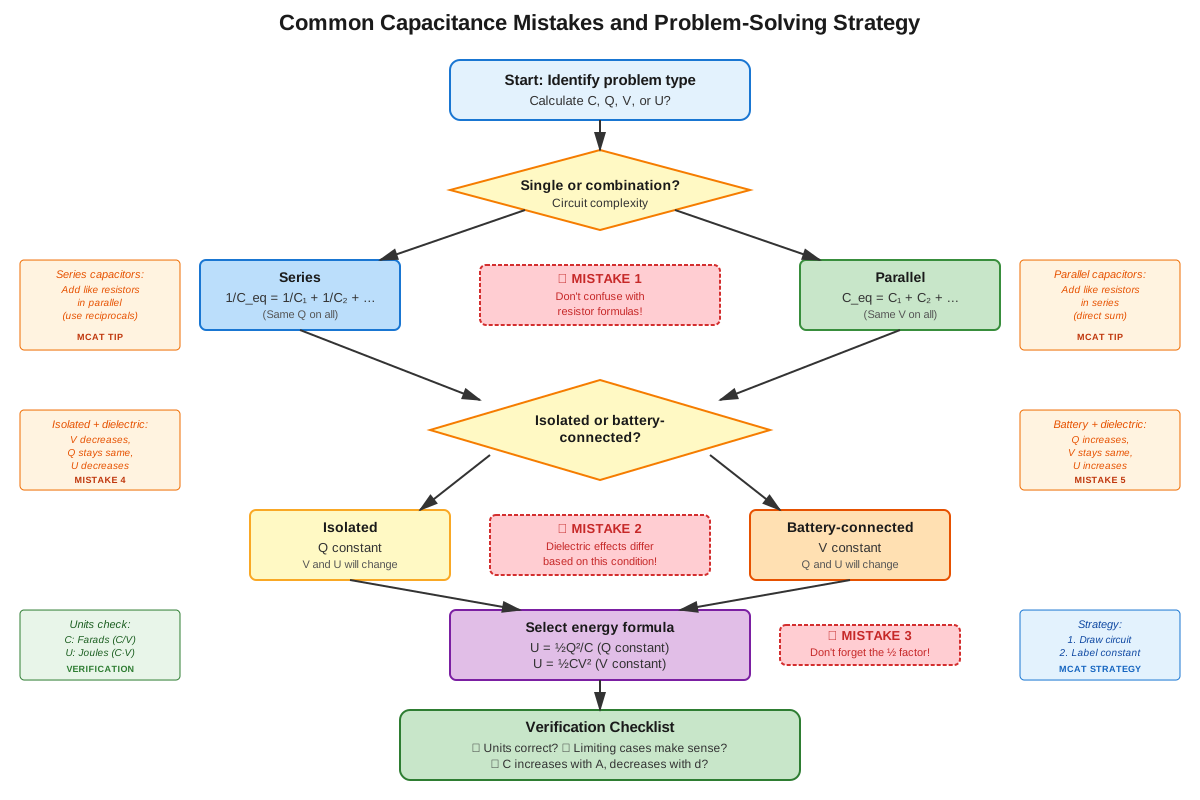
When a dielectric is inserted into a charged capacitor, the effect on stored energy depends on whether the capacitor remains connected to a battery (constant voltage) or is isolated (constant charge):
| Condition | Capacitance | Charge | Voltage | Energy |
|---|---|---|---|---|
| Isolated (constant Q) | Increases by κ | Constant | Decreases by κ | Decreases by κ |
| Connected to battery (constant V) | Increases by κ | Increases by κ | Constant | Increases by κ |
This table represents high-yield MCAT content, as questions frequently test understanding of these scenarios.
Capacitors in Series
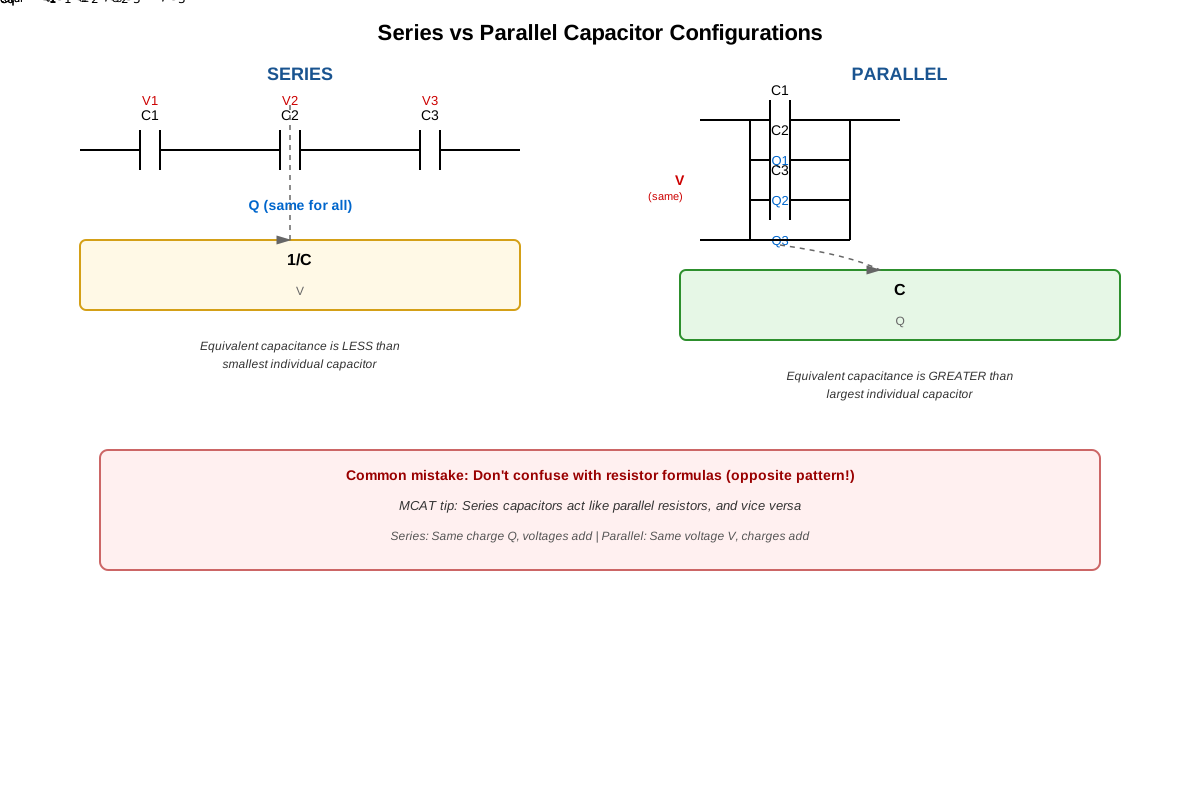
When capacitors are connected in series (one after another in a single path), they all store the same charge Q, but the total voltage divides among them. The equivalent capacitance (C_eq) for series capacitors is:
1/C_eq = 1/C₁ + 1/C₂ + 1/C₃ + ...For two capacitors in series:
C_eq = (C₁C₂)/(C₁ + C₂)Key characteristics of series capacitors:
- The equivalent capacitance is always less than the smallest individual capacitance
- All capacitors store the same charge
- Voltages add: V_total = V₁ + V₂ + V₃ + ...
- Series connection effectively increases the separation distance, reducing capacitance
Capacitors in Parallel
When capacitors are connected in parallel (sharing the same two connection points), they all experience the same voltage V, but the total charge divides among them. The equivalent capacitance for parallel capacitors is:
C_eq = C₁ + C₂ + C₃ + ...Key characteristics of parallel capacitors:
- The equivalent capacitance is the sum of individual capacitances (always greater than any single capacitor)
- All capacitors have the same voltage across them
- Charges add: Q_total = Q₁ + Q₂ + Q₃ + ...
- Parallel connection effectively increases the plate area, increasing capacitance
Note that capacitor combination rules are opposite to resistor combination rules: capacitors in series add reciprocally (like resistors in parallel), while capacitors in parallel add directly (like resistors in series).
Time-Dependent Behavior (RC Circuits)
When capacitors are combined with resistors in circuits, they exhibit time-dependent charging and discharging behavior. The time constant (τ, tau) characterizes how quickly a capacitor charges or discharges:
τ = RCwhere R is resistance in ohms and C is capacitance in farads. The time constant represents the time required for the charge (or voltage) to reach approximately 63% of its final value during charging, or to decrease to approximately 37% of its initial value during discharging.
During charging through a resistor from a battery of voltage V₀:
- Voltage across capacitor: V(t) = V₀(1 - e^(-t/RC))
- Charge on capacitor: Q(t) = Q_max(1 - e^(-t/RC))
- Current through circuit: I(t) = I₀e^(-t/RC)
During discharging through a resistor:
- Voltage across capacitor: V(t) = V₀e^(-t/RC)
- Charge on capacitor: Q(t) = Q₀e^(-t/RC)
- Current through circuit: I(t) = I₀e^(-t/RC)
While the MCAT rarely requires detailed exponential calculations, understanding that capacitors charge and discharge exponentially with a characteristic time constant is important for passage-based questions involving timing circuits or neuronal membrane dynamics.
Concept Relationships
The concepts within capacitance form an interconnected web of relationships. Capacitance definition (C = Q/V) serves as the foundation, connecting charge storage to voltage. This definition leads directly to the parallel-plate capacitor formula (C = ε₀A/d), which reveals how geometry determines capacitance. The geometric dependence connects to electric field concepts, since the field between plates (E = V/d) determines how effectively charge can be stored.
Dielectric materials modify the basic capacitance formula by introducing the dielectric constant κ, which connects to molecular polarization and field reduction. This relationship bridges microscopic material properties to macroscopic capacitance values. The dielectric concept is particularly important for biological applications, where cell membranes act as dielectric-filled capacitors.
Energy storage (U = ½CV²) connects capacitance to thermodynamics and energy conservation principles. The energy formulas link directly back to the capacitance definition through mathematical relationships, creating a self-consistent framework. Understanding how energy changes when dielectrics are inserted requires synthesizing capacitance changes with energy formulas under different boundary conditions (constant Q vs. constant V).
Series and parallel combinations extend single-capacitor concepts to networks, connecting to circuit analysis principles. These combination rules relate inversely to resistor combinations, highlighting the complementary nature of capacitive and resistive circuit elements. The combination rules ultimately derive from charge conservation (for series) and voltage equality (for parallel).
RC circuits integrate capacitance with resistance and time-dependent behavior, connecting to differential equations and exponential functions. The time constant τ = RC bridges static capacitance concepts to dynamic circuit behavior, essential for understanding biological systems like nerve signal propagation.
Externally, capacitance connects to prerequisite topics: electric fields (capacitors create and store energy in fields), electric potential (voltage defines capacitance), and circuits (capacitors are circuit elements). It also connects forward to electromagnetic oscillations (LC circuits), AC circuit analysis (capacitive reactance), and biological membranes (membrane capacitance affects signal transmission).
Quick check — test yourself on Capacitance so far.
Try Flashcards →High-Yield Facts
⭐ Capacitance is defined as C = Q/V and is measured in farads (F); it depends only on geometry and dielectric properties, not on charge or voltage
⭐ For parallel-plate capacitors, C = κε₀A/d, where capacitance increases with plate area and decreases with separation distance
⭐ Inserting a dielectric with constant κ increases capacitance by a factor of κ and decreases the electric field by a factor of κ
⭐ Energy stored in a capacitor is U = ½CV² = ½QV = Q²/(2C); all three forms are equivalent and useful in different contexts
⭐ For capacitors in series: 1/C_eq = 1/C₁ + 1/C₂ + ...; equivalent capacitance is always less than the smallest individual capacitor
- For capacitors in parallel: C_eq = C₁ + C₂ + ...; equivalent capacitance is the sum of individual capacitances
- When a dielectric is inserted into an isolated charged capacitor (constant Q), voltage and energy both decrease by factor κ
- When a dielectric is inserted into a capacitor connected to a battery (constant V), charge and energy both increase by factor κ
- The time constant for RC circuits is τ = RC, representing the characteristic time for charging or discharging
- Biological membranes typically have capacitance of approximately 1 μF/cm², making membrane capacitance important for nerve signal propagation
- Doubling the plate separation of a parallel-plate capacitor halves the capacitance and halves the stored energy (if charge is constant)
- The electric field between parallel plates is uniform and equals E = V/d = σ/ε₀, where σ is surface charge density
- Capacitors block DC current in steady state (once fully charged) but allow AC current to pass
- The permittivity of free space ε₀ ≈ 8.85 × 10⁻¹² F/m is a fundamental constant appearing in capacitance calculations
Common Misconceptions
Misconception: Capacitance changes when you change the charge or voltage on a capacitor.
Correction: Capacitance is an intrinsic property determined solely by geometry (plate area, separation distance) and dielectric material. While Q and V change together according to C = Q/V, the ratio C remains constant for a given physical configuration. Changing Q or V does not change C, just as changing the current through a resistor doesn't change its resistance.
Misconception: Capacitors in series combine like resistors in series (by adding directly).
Correction: Capacitors in series combine reciprocally: 1/C_eq = 1/C₁ + 1/C₂ + ... This is opposite to resistors. The equivalent capacitance of series capacitors is always less than the smallest individual capacitor. Think of series capacitors as effectively increasing the separation distance, which decreases capacitance.
Misconception: Inserting a dielectric always increases the energy stored in a capacitor.
Correction: The effect depends on boundary conditions. If the capacitor is isolated (constant charge), inserting a dielectric decreases stored energy by factor κ because voltage decreases. If the capacitor remains connected to a battery (constant voltage), inserting a dielectric increases stored energy by factor κ because additional charge flows onto the plates. Always identify whether Q or V is held constant.
Misconception: The three energy formulas (½QV, ½CV², Q²/2C) give different values for stored energy.
Correction: These three expressions are mathematically equivalent and always give the same numerical result for a given capacitor state. They emphasize different variables (Q, V, or C) and are useful in different problem contexts, but they represent the same physical quantity. Use whichever form contains the variables you know.
Misconception: Larger capacitance means more energy storage.
Correction: Energy storage depends on both capacitance and voltage (or charge). A larger capacitor at low voltage may store less energy than a smaller capacitor at high voltage. From U = ½CV², doubling capacitance doubles energy only if voltage remains constant. From U = Q²/(2C), doubling capacitance actually halves energy if charge remains constant.
Misconception: Dielectrics work by conducting charge between the plates.
Correction: Dielectrics are insulators that do not conduct charge. They work through polarization: the electric field causes slight charge separation within molecules, creating an induced field that opposes the applied field. This reduces the net field, allowing more charge storage at the same voltage. If the material conducted, it would short-circuit the capacitor.
Misconception: The time constant τ = RC represents the time for complete charging or discharging.
Correction: The time constant represents the time to reach approximately 63% of final charge (or decrease to 37% of initial charge). Complete charging/discharging theoretically takes infinite time due to exponential behavior, but practically, 5τ represents about 99% completion. The time constant characterizes the rate, not the endpoint.
Worked Examples
Example 1: Parallel-Plate Capacitor with Dielectric
Problem: A parallel-plate capacitor has plates of area 0.02 m² separated by 2 mm. Initially, the space between plates is vacuum. The capacitor is charged to 100 V and then disconnected from the battery. A dielectric material with κ = 4 is then inserted to completely fill the space between plates. Calculate: (a) initial capacitance, (b) initial charge, (c) initial energy, (d) final capacitance, (e) final voltage, and (f) final energy.
Solution:
(a) Initial capacitance (vacuum, κ = 1):
C₀ = ε₀A/d = (8.85 × 10⁻¹² F/m)(0.02 m²)/(0.002 m)
C₀ = 8.85 × 10⁻¹¹ F = 88.5 pF
(b) Initial charge (using Q = CV):
Q = C₀V₀ = (88.5 × 10⁻¹² F)(100 V) = 8.85 × 10⁻⁹ C = 8.85 nC(c) Initial energy (using U = ½CV²):
U₀ = ½C₀V₀² = ½(88.5 × 10⁻¹² F)(100 V)² = 4.43 × 10⁻⁷ J = 443 nJ(d) Final capacitance (with dielectric):
C = κC₀ = 4(88.5 pF) = 354 pF(e) Final voltage: Since the capacitor was disconnected, charge remains constant (Q = 8.85 nC). Using C = Q/V:
V = Q/C = (8.85 × 10⁻⁹ C)/(354 × 10⁻¹² F) = 25 VNote: Voltage decreased by factor κ = 4, from 100 V to 25 V.
(f) Final energy (using U = Q²/2C):
U = Q²/(2C) = (8.85 × 10⁻⁹ C)²/(2 × 354 × 10⁻¹² F) = 1.11 × 10⁻⁷ J = 111 nJNote: Energy decreased by factor κ = 4, from 443 nJ to 111 nJ.
Key insights: This problem demonstrates the constant-charge scenario. When a dielectric is inserted into an isolated capacitor, capacitance increases, voltage decreases, and energy decreases. The "missing" energy (332 nJ) was converted to mechanical work as the dielectric was pulled into the capacitor by attractive forces.
Example 2: Series and Parallel Capacitor Network
Problem: Three capacitors with values C₁ = 2 μF, C₂ = 4 μF, and C₃ = 6 μF are arranged as follows: C₁ and C₂ are in series, and this combination is in parallel with C₃. The entire network is connected to a 12 V battery. Calculate: (a) equivalent capacitance of the network, (b) charge on C₃, (c) voltage across C₁, and (d) total energy stored in the network.
Solution:
(a) First, find equivalent capacitance of C₁ and C₂ in series:
1/C₁₂ = 1/C₁ + 1/C₂ = 1/(2 μF) + 1/(4 μF) = 3/(4 μF)
C₁₂ = 4/3 μF ≈ 1.33 μF
Then, combine C₁₂ in parallel with C₃:
C_eq = C₁₂ + C₃ = 4/3 μF + 6 μF = 22/3 μF ≈ 7.33 μF(b) C₃ is in parallel with the battery, so it experiences the full 12 V:
Q₃ = C₃V = (6 × 10⁻⁶ F)(12 V) = 72 × 10⁻⁶ C = 72 μC(c) C₁ and C₂ are in series, so they share the same charge. The voltage across their series combination is 12 V:
Q₁₂ = C₁₂V = (4/3 × 10⁻⁶ F)(12 V) = 16 μCSince C₁ carries 16 μC:
V₁ = Q₁/C₁ = (16 × 10⁻⁶ C)/(2 × 10⁻⁶ F) = 8 V(d) Total energy stored (using U = ½C_eqV²):
U_total = ½C_eqV² = ½(22/3 × 10⁻⁶ F)(12 V)² = 528 × 10⁻⁶ J = 528 μJKey insights: This problem requires systematic application of series and parallel rules. Remember that series capacitors share charge while parallel capacitors share voltage. The voltage across C₁ (8 V) plus the voltage across C₂ (4 V) equals the total voltage (12 V), confirming our calculation. This type of network analysis is common on the MCAT.
Exam Strategy
When approaching MCAT questions on capacitance, begin by identifying the capacitor configuration: single capacitor, series, parallel, or mixed network. For single capacitors, determine whether the problem involves geometric parameters (use C = κε₀A/d), charge and voltage relationships (use C = Q/V), or energy (use appropriate energy formula). Circle or underline given values and what's being asked.
Trigger words and phrases to watch for:
- "Disconnected from battery" or "isolated" → constant charge scenario
- "Remains connected" or "battery maintains voltage" → constant voltage scenario
- "Dielectric inserted" → capacitance multiplied by κ, then determine effect on other variables
- "In series" → charges equal, voltages add, use reciprocal formula
- "In parallel" → voltages equal, charges add, capacitances add directly
- "Time constant" or "charging/discharging" → RC circuit with τ = RC
For proportional reasoning questions (common on MCAT), set up ratios rather than calculating absolute values. If asked "what happens to capacitance if plate separation doubles," recognize that C ∝ 1/d, so capacitance is halved. This approach saves time and reduces calculation errors. Create a quick reference table showing how each variable in C = κε₀A/d affects capacitance.
Process-of-elimination strategies:
- Eliminate answers that violate units (capacitance must be in farads or derived units)
- Eliminate answers that violate proportionality (if area doubles, capacitance must double)
- For series capacitors, eliminate any answer where equivalent capacitance exceeds the smallest individual capacitor
- For parallel capacitors, eliminate any answer where equivalent capacitance is less than the largest individual capacitor
- For energy questions, eliminate answers that violate energy conservation
Time allocation: Discrete capacitance questions typically require 60-90 seconds. Spend 15-20 seconds identifying the scenario and relevant formula, 30-40 seconds on calculation, and 10-15 seconds checking reasonableness. For passage-based questions, allocate 90-120 seconds, spending extra time extracting relevant information from the passage and figures. If a calculation becomes complex, check whether proportional reasoning or estimation can eliminate wrong answers without complete calculation.
Common question types and approaches:
- Calculation questions: Write down the relevant formula, substitute values carefully with units, and verify the answer makes physical sense
- Conceptual questions: Draw a quick diagram if helpful, identify which variables change and which remain constant, apply proportional reasoning
- Passage-based questions: Identify the role of capacitors in the experimental setup, connect passage information to fundamental principles, watch for non-standard applications of standard concepts
Always check limiting cases: if separation distance approaches zero, capacitance should approach infinity; if area approaches zero, capacitance should approach zero. These sanity checks catch calculation errors and conceptual misunderstandings.
Memory Techniques
Capacitance formula mnemonic - "Area Over Distance": C = ε₀A/d (Area Over Distance)
Series vs. Parallel mnemonic - "Series Same Charge, Parallel Pairs Voltage": In series, capacitors share the same charge; in parallel, capacitors share the same voltage (like a pair)
Dielectric effects mnemonic - "Isolated Decreases, Connected Climbs": When a dielectric is inserted into an isolated capacitor, energy decreases; when connected to a battery, energy climbs (increases)
Energy formula selection - Use the "Given-Variable Method":
- Given Q and V? Use U = ½QV
- Given C and V? Use U = ½CV²
- Given Q and C? Use U = Q²/(2C)
Visualization for series capacitors: Picture capacitors in series as stacked plates that effectively increase the separation distance (d increases → C decreases). This explains why series capacitance is less than individual capacitances.
Visualization for parallel capacitors: Picture capacitors in parallel as side-by-side plates that effectively increase the total plate area (A increases → C increases). This explains why parallel capacitance is the sum of individual capacitances.
RC time constant memory aid - "63-37 Rule": After one time constant (τ = RC), charging reaches 63% complete and discharging reaches 37% remaining. After 5τ, the process is essentially complete (>99%).
Acronym for capacitor properties - "GAVE":
- Geometry determines capacitance
- Area increases capacitance
- Voltage relates to charge through C = Q/V
- Energy stored is ½CV²
Summary
Capacitance represents the ability of a system to store electrical charge and energy, defined by C = Q/V and measured in farads. For parallel-plate capacitors, capacitance depends on geometric factors (plate area and separation) and material properties (dielectric constant) according to C = κε₀A/d. Inserting dielectric materials increases capacitance by factor κ through molecular polarization that reduces the electric field. Capacitors store energy in the electric field between plates, quantified by U = ½CV² = ½QV = Q²/(2C), with the effect of dielectric insertion depending on whether charge or voltage remains constant. When combining capacitors, series configurations add reciprocally (like parallel resistors) with all capacitors sharing the same charge, while parallel configurations add directly (like series resistors) with all capacitors sharing the same voltage. In RC circuits, the time constant τ = RC characterizes exponential charging and discharging behavior. MCAT questions emphasize proportional reasoning, understanding boundary conditions (constant Q vs. constant V), and applying capacitance concepts to biological systems like nerve membranes and medical devices like defibrillators. Mastery requires connecting geometric parameters to capacitance values, analyzing series-parallel networks, calculating stored energy, and recognizing how variable changes affect system behavior.
Key Takeaways
- Capacitance C = Q/V is an intrinsic geometric property independent of charge or voltage; for parallel plates, C = κε₀A/d where capacitance increases with area and dielectric constant but decreases with separation
- Dielectric materials increase capacitance by factor κ through polarization; energy effects depend on boundary conditions (decreases for isolated capacitors, increases for battery-connected capacitors)
- Energy stored in capacitors is U = ½CV² = ½QV = Q²/(2C); all three forms are equivalent but emphasize different variables for different problem contexts
- Series capacitors combine reciprocally (1/C_eq = Σ1/Cᵢ) with shared charge and added voltages; parallel capacitors combine directly (C_eq = ΣCᵢ) with shared voltage and added charges
- Capacitor combination rules are opposite to resistor rules; series capacitance is always less than the smallest individual capacitor, while parallel capacitance is always greater than the largest
- RC circuits exhibit exponential behavior with time constant τ = RC, representing the characteristic time for 63% charging or 37% discharging
- MCAT questions favor proportional reasoning and conceptual understanding over complex calculations; always identify whether charge or voltage remains constant in dielectric insertion problems
Related Topics
RC Circuits and Time Constants: Building on basic capacitance, RC circuits introduce time-dependent behavior essential for understanding neuronal action potentials, pacemaker circuits, and timing devices. Mastering capacitance provides the foundation for analyzing exponential charging and discharging.
Electric Fields and Potential: Capacitance directly relates to electric field configuration and potential difference. Deeper exploration of field theory explains why geometric factors determine capacitance and how energy is stored in fields.
AC Circuits and Capacitive Reactance: In alternating current circuits, capacitors exhibit frequency-dependent impedance called capacitive reactance. Understanding basic capacitance is prerequisite for analyzing AC circuit behavior.
Biological Membranes and Nerve Conduction: Cell membranes act as capacitors with typical capacitance of 1 μF/cm². Membrane capacitance affects action potential propagation speed and explains why myelination increases conduction velocity—a clinically relevant application.
Energy Storage Devices: Capacitors in defibrillators, camera flashes, and power supplies demonstrate practical applications. Understanding energy storage (U = ½CV²) enables analysis of these medical and technological devices.
Practice CTA
Now that you've mastered the core concepts of capacitance, it's time to solidify your understanding through active practice. Attempt the practice questions and flashcards associated with this topic to test your ability to apply these principles in exam-style scenarios. Focus particularly on problems involving dielectric insertion, series-parallel networks, and energy calculations—these represent the highest-yield question types on the MCAT. Remember that capacitance questions often integrate multiple physics concepts, so practice connecting this material to electric fields, circuits, and energy conservation. Your investment in thorough practice now will pay dividends on test day when you encounter these concepts in novel contexts. You've built a strong foundation—now strengthen it through deliberate practice!
Sign up free to keep reading
Create a free AnvayaPrep account to finish this MCAT guide on Capacitance — plus flashcards and practice questions.