Overview
The Bernoulli equation stands as one of the most powerful and frequently tested principles in MCAT Physics, particularly within the Fluids unit. This fundamental equation describes the relationship between pressure, velocity, and height in a flowing fluid, establishing that the total mechanical energy per unit volume remains constant along a streamline for an ideal fluid. Named after Swiss mathematician Daniel Bernoulli, this principle explains phenomena ranging from airplane lift to blood flow through arteries, making it both conceptually rich and clinically relevant for future physicians.
For the MCAT, the Bernoulli equation represents a high-yield topic that appears regularly in both discrete questions and passage-based scenarios. Test-makers favor this concept because it integrates multiple physics principles—conservation of energy, fluid dynamics, pressure relationships, and work-energy concepts—into a single framework. Students who master Bernoulli's principle gain a powerful tool for analyzing complex fluid systems, predicting pressure changes in flowing fluids, and understanding cardiovascular physiology. The equation's applications extend beyond pure physics into biological systems, particularly in understanding blood pressure variations, respiratory mechanics, and the function of medical devices like ventilators and IV systems.
Understanding the Bernoulli equation requires synthesizing knowledge from mechanics (energy conservation), fluid statics (pressure), and kinematics (velocity). This topic serves as a bridge between static fluid concepts (Pascal's principle, hydrostatic pressure) and dynamic fluid behavior (continuity equation, flow rates). Mastery of this principle enables students to tackle some of the most challenging interdisciplinary questions on the MCAT, where physics concepts must be applied to biological contexts. The equation's predictive power—explaining why pressure decreases when fluid velocity increases—underlies countless medical phenomena and diagnostic techniques that physicians encounter daily.
Learning Objectives
- [ ] Define Bernoulli equation using accurate Physics terminology
- [ ] Explain why Bernoulli equation matters for the MCAT
- [ ] Apply Bernoulli equation to exam-style questions
- [ ] Identify common mistakes related to Bernoulli equation
- [ ] Connect Bernoulli equation to related Physics concepts
- [ ] Derive the Bernoulli equation from conservation of energy principles
- [ ] Distinguish between conditions where Bernoulli's principle applies versus situations requiring alternative approaches
- [ ] Quantitatively solve multi-step problems involving pressure, velocity, and height changes in flowing fluids
- [ ] Predict qualitative relationships between pressure and velocity without calculation
Prerequisites
- Conservation of Energy: The Bernoulli equation fundamentally represents energy conservation applied to flowing fluids, requiring understanding of kinetic and potential energy transformations
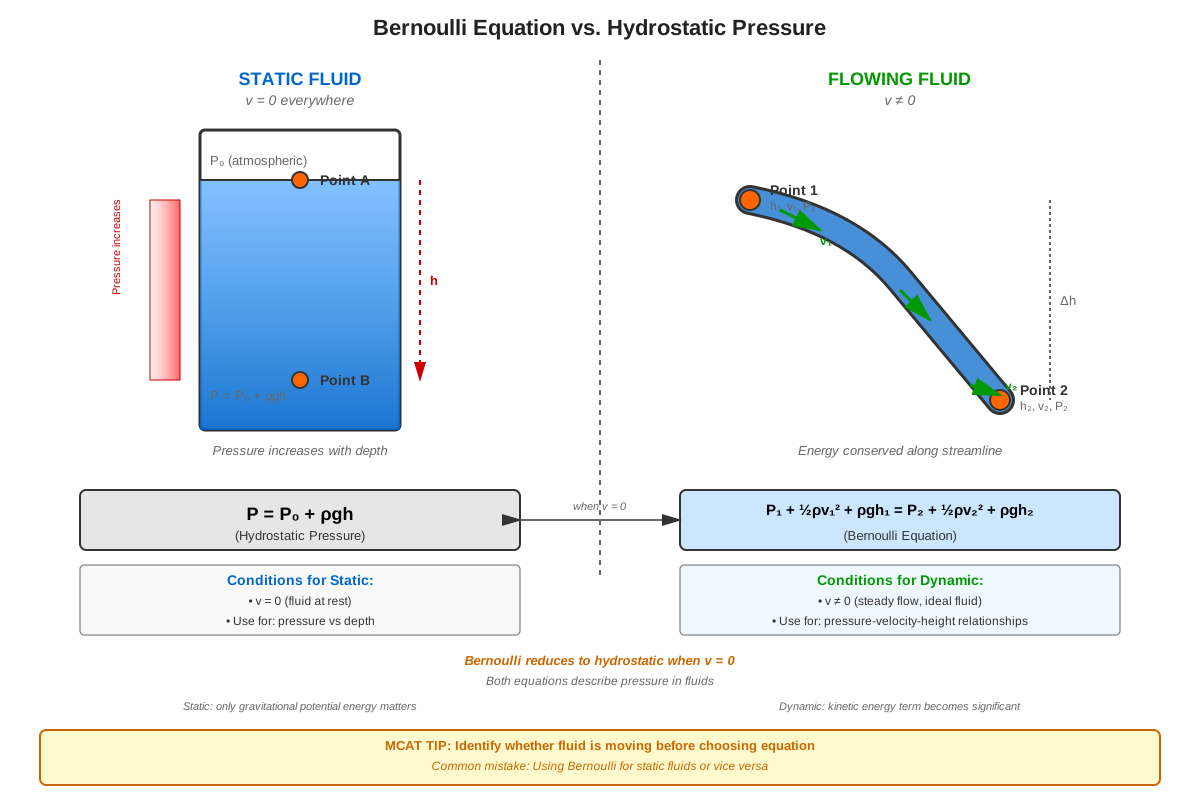
- Pressure Concepts: Students must understand pressure as force per unit area and how pressure varies with depth in static fluids (P = P₀ + ρgh)
- Fluid Properties: Familiarity with density, viscosity, and the distinction between ideal and real fluids is essential for knowing when Bernoulli's equation applies
- Continuity Equation: Understanding that A₁v₁ = A₂v₂ for incompressible fluids is necessary because velocity changes drive pressure changes in Bernoulli applications
- Work-Energy Theorem: Recognizing how work done by pressure forces relates to kinetic and potential energy changes underlies the equation's derivation
Why This Topic Matters
The Bernoulli equation holds exceptional clinical relevance for future physicians. Cardiovascular physiology relies heavily on Bernoulli principles: blood flow through stenotic (narrowed) vessels demonstrates increased velocity and decreased pressure, explaining why atherosclerotic plaques can paradoxically reduce lateral pressure on vessel walls. Aneurysms, heart murmurs, and the Venturi effect in respiratory systems all involve Bernoulli dynamics. Medical devices including nebulizers, aspirators, and certain types of ventilators operate on Bernoulli principles. Understanding these applications helps students connect abstract physics to tangible medical scenarios they'll encounter in clinical practice.
From an exam perspective, Bernoulli equation MCAT questions appear with remarkable frequency—typically 2-4 questions per exam, either as discrete items or embedded within passages about cardiovascular physiology, respiratory mechanics, or fluid dynamics. The AAMC consistently tests this topic because it requires both conceptual understanding and quantitative problem-solving skills. Questions often present scenarios involving fluid flow through pipes of varying diameter, blood flow through vessels, or applications of the Venturi effect. The MCAT particularly favors questions that combine Bernoulli's equation with the continuity equation, requiring students to recognize that cross-sectional area changes cause velocity changes, which in turn affect pressure.
Common passage contexts include: cardiovascular disease and blood flow abnormalities, respiratory physiology and airway dynamics, medical device function (IV systems, catheters), industrial or engineering applications with biological analogies, and experimental setups measuring fluid properties. Discrete questions often test the inverse relationship between pressure and velocity, the conditions under which Bernoulli's equation applies, or qualitative predictions about pressure changes in flowing systems. High-performing students recognize Bernoulli scenarios quickly and can switch between qualitative reasoning and quantitative calculation as needed.
Core Concepts
The Bernoulli Equation: Mathematical Form
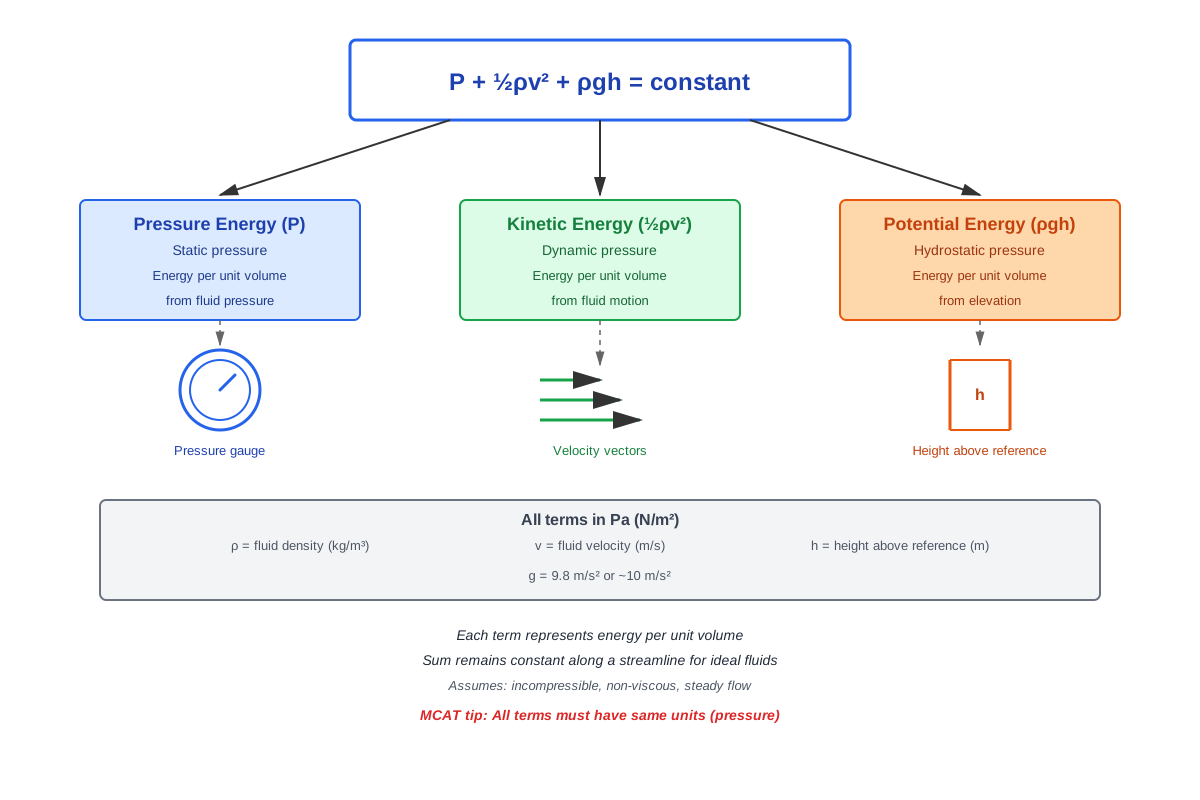
The Bernoulli equation expresses the conservation of mechanical energy for a flowing, incompressible, non-viscous fluid along a streamline:
P₁ + ½ρv₁² + ρgh₁ = P₂ + ½ρv₂² + ρgh₂Where:
- P = absolute pressure at a point (Pa or N/m²)
- ρ = fluid density (kg/m³)
- v = fluid velocity (m/s)
- h = height above a reference point (m)
- g = gravitational acceleration (9.8 m/s²)
Each term represents energy per unit volume (J/m³), which has the same dimensions as pressure. The equation states that the sum of pressure energy, kinetic energy per unit volume, and gravitational potential energy per unit volume remains constant along a streamline. This formulation allows comparison between any two points in a flowing fluid system.
An alternative form emphasizes the energy interpretation by dividing through by ρg:
P/ρg + v²/2g + h = constantHere each term has dimensions of length (meters) and represents an energy "head"—pressure head, velocity head, and elevation head respectively. This form proves particularly useful in engineering applications and helps visualize energy transformations.
Physical Interpretation and Energy Conservation
The Bernoulli equation Physics foundation rests on the work-energy theorem applied to fluid elements. As a fluid parcel moves through a system, work done by pressure forces equals the change in kinetic and potential energy. When fluid accelerates (velocity increases), this kinetic energy increase must come from somewhere—either from a decrease in pressure energy or potential energy (or both).
The three terms represent distinct energy forms:
- Pressure term (P): Represents the flow work or pressure energy—the work required to push fluid into or out of a region
- Kinetic term (½ρv²): Represents the kinetic energy per unit volume associated with fluid motion
- Potential term (ρgh): Represents gravitational potential energy per unit volume due to elevation
Energy transformations occur continuously in flowing fluids. When fluid flows from a wide pipe section into a narrow section, the continuity equation requires velocity to increase. This kinetic energy increase corresponds to a pressure decrease, assuming constant elevation. Conversely, when fluid flows upward, potential energy increases, requiring either pressure or kinetic energy (or both) to decrease.
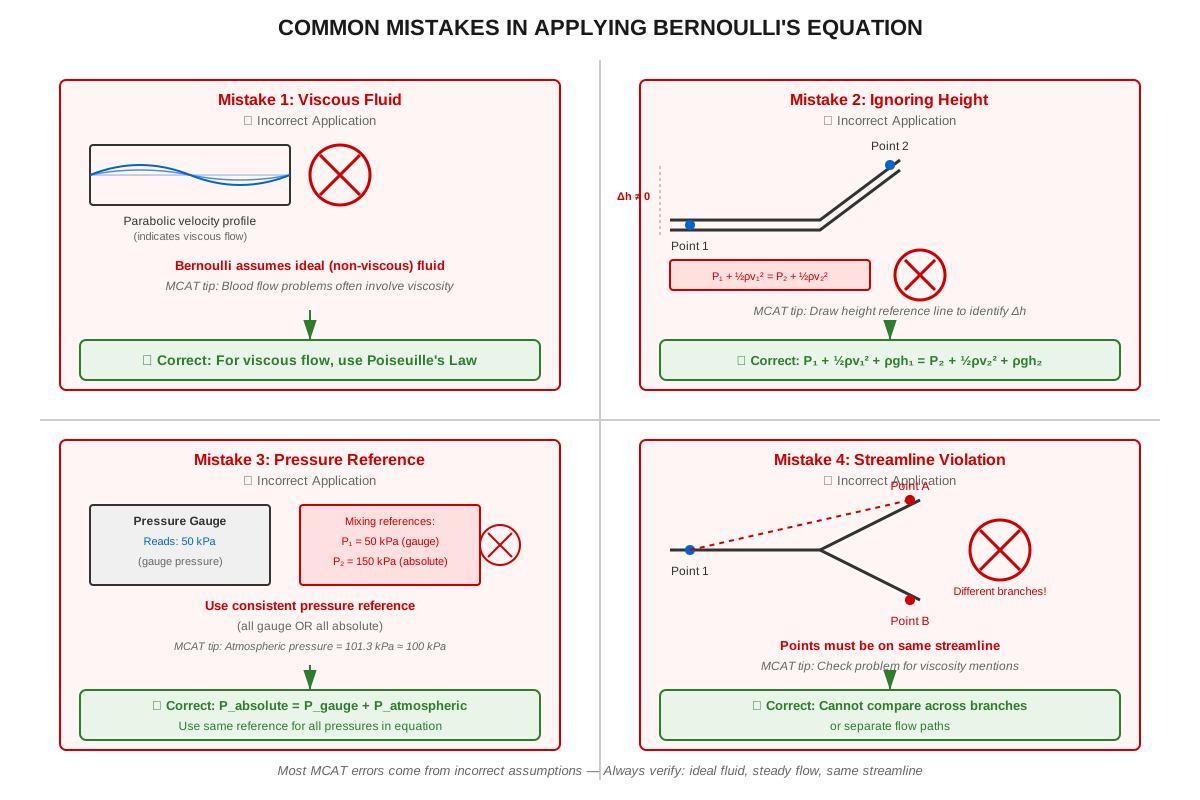
Conditions and Assumptions
The Bernoulli equation applies only under specific conditions, and recognizing these limitations is crucial for MCAT success:
| Condition | Explanation | MCAT Relevance |
|---|---|---|
| Incompressible fluid | Density remains constant (ρ₁ = ρ₂) | Valid for liquids; gases only at low speeds (v << speed of sound) |
| Non-viscous (ideal) fluid | No internal friction or energy dissipation | Real fluids have viscosity; Bernoulli gives approximate results |
| Steady flow | Velocity at each point doesn't change with time | Turbulent or pulsatile flow violates this assumption |
| Along a streamline | Comparison must be between points on the same flow path | Different streamlines may have different total energies |
| No energy added or removed | No pumps, turbines, or heat transfer between points | External work invalidates the equation |
When these conditions are violated, the Bernoulli equation may still provide qualitative insights but quantitative predictions become inaccurate. The MCAT often tests whether students can identify when Bernoulli's principle applies versus when alternative approaches are needed.
The Pressure-Velocity Relationship
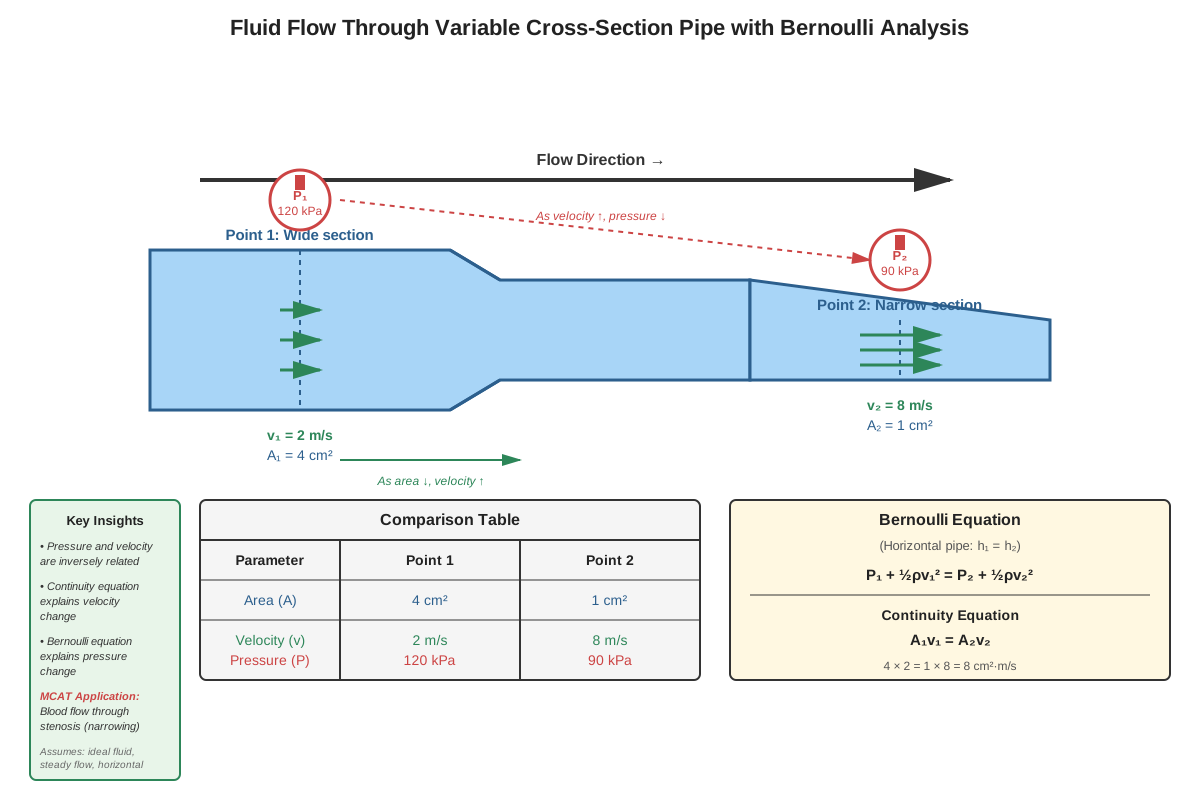
The most frequently tested aspect of Bernoulli's principle is the inverse relationship between pressure and velocity. For horizontal flow (h₁ = h₂), the equation simplifies to:
P₁ + ½ρv₁² = P₂ + ½ρv₂²Rearranging:
P₁ - P₂ = ½ρ(v₂² - v₁²)This reveals that when velocity increases (v₂ > v₁), pressure must decrease (P₁ > P₂), and vice versa. This counterintuitive result—faster-moving fluid has lower pressure—explains numerous phenomena and appears repeatedly on the MCAT.
The physical explanation: as fluid accelerates, the net force must point in the direction of motion. For horizontal flow, only pressure forces act horizontally. Therefore, pressure must be higher upstream (behind) than downstream (ahead) to produce the net force that accelerates the fluid. Once accelerated, the faster-moving fluid maintains lower pressure.
Integration with Continuity Equation
The continuity equation for incompressible fluids states that mass flow rate remains constant:
A₁v₁ = A₂v₂Where A represents cross-sectional area. This equation couples directly with Bernoulli's principle: when area decreases, velocity must increase, which (by Bernoulli) causes pressure to decrease. This combination appears in virtually every MCAT question involving fluid flow through pipes or vessels of varying diameter.
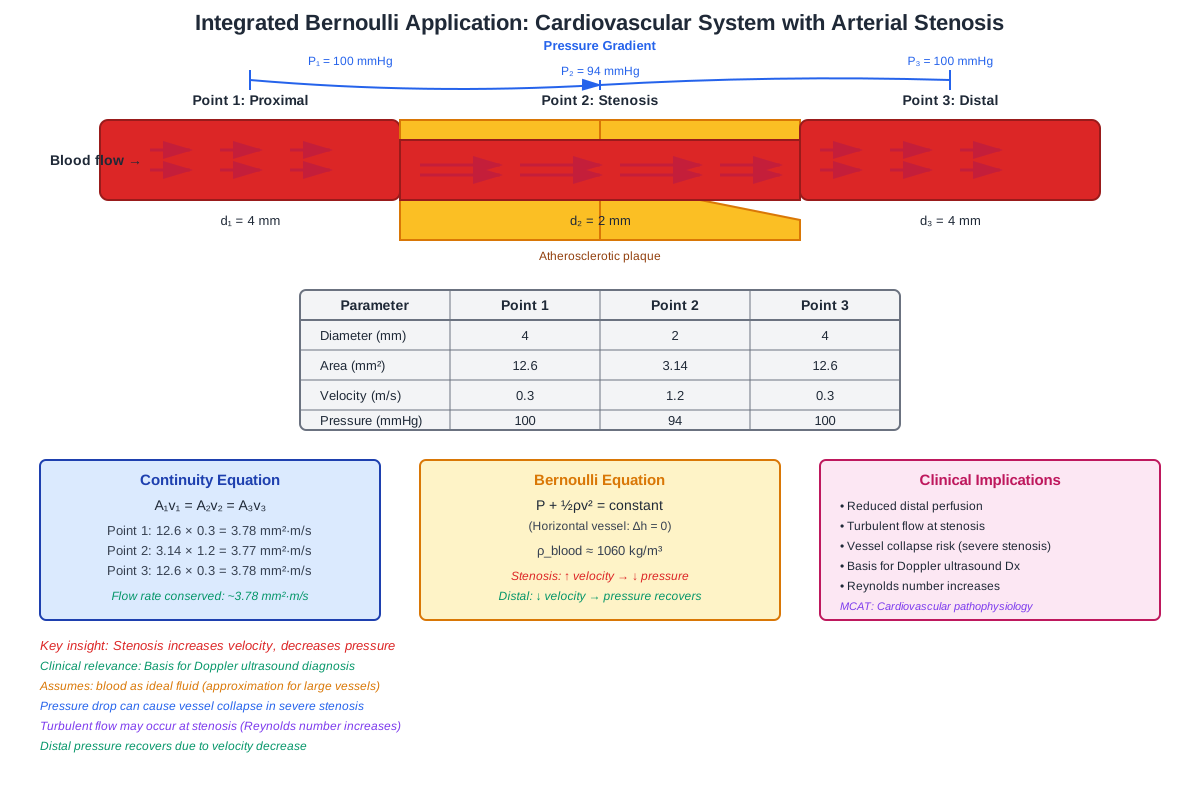
For example, blood flowing through a stenotic (narrowed) artery experiences:
- Decreased cross-sectional area (A₂ < A₁)
- Increased velocity (v₂ > v₁, from continuity)
- Decreased pressure (P₂ < P₁, from Bernoulli)
This sequence explains why arterial stenosis can reduce blood pressure downstream and why turbulent flow (and heart murmurs) often occur at constrictions where velocity is highest.
Applications: The Venturi Effect
The Venturi effect describes the pressure reduction that occurs when fluid flows through a constricted section of pipe. This principle has numerous medical applications:
- Venturi masks: Deliver controlled oxygen concentrations by using high-velocity oxygen flow through a constriction to entrain room air
- Aspirators: Create suction by flowing fluid rapidly past an opening, reducing pressure and drawing in material
- Nebulizers: Generate aerosol droplets by using the low-pressure region in a constriction to draw up liquid
- Flow measurement: Venturi meters determine flow rates by measuring pressure differences
The Venturi effect demonstrates Bernoulli's principle in action: the constriction forces velocity to increase (continuity equation), which causes pressure to decrease (Bernoulli equation), creating suction that can entrain additional fluid or gas.
Cardiovascular Applications
Blood flow through the cardiovascular system follows Bernoulli principles, though viscosity and pulsatile flow introduce complications. Key applications include:
Arterial stenosis: Atherosclerotic plaques narrow vessel lumens, increasing blood velocity and decreasing lateral pressure. Paradoxically, the reduced pressure can limit further plaque expansion, but downstream tissues may receive inadequate perfusion pressure.
Aneurysms: Vessel dilation increases cross-sectional area, decreasing velocity and increasing pressure. The elevated pressure can promote further dilation, creating a positive feedback loop that may lead to rupture.
Heart murmurs: Turbulent flow through stenotic or regurgitant valves creates audible vibrations. The high-velocity jets through narrowed valve openings represent Bernoulli dynamics in action.
Measuring cardiac output: Doppler echocardiography uses the Bernoulli equation to estimate pressure gradients across valves from velocity measurements, providing crucial diagnostic information.
Concept Relationships
The Bernoulli equation sits at the intersection of multiple physics principles, serving as a unifying framework for fluid dynamics. At its foundation lies conservation of energy, which provides the theoretical justification for why the sum of pressure, kinetic, and potential energy terms remains constant. This energy perspective connects Bernoulli's principle to mechanics concepts students learned earlier, reinforcing that physics principles apply consistently across different contexts.
The relationship flows as follows: Conservation of Energy → applied to flowing fluids → yields Bernoulli Equation → which predicts Pressure-Velocity Inverse Relationship → combined with Continuity Equation → explains Venturi Effect and Flow Through Variable Cross-Sections → applies to Cardiovascular Physiology and Medical Devices.
The continuity equation (A₁v₁ = A₂v₂) serves as Bernoulli's essential partner. Area changes drive velocity changes, which in turn drive pressure changes. Students must recognize that these equations work together: continuity tells you how velocity changes, Bernoulli tells you how pressure responds.
Connections to prerequisite topics include:
- Hydrostatic pressure (P = P₀ + ρgh): The ρgh term in Bernoulli's equation represents this static pressure contribution
- Kinetic energy (KE = ½mv²): The ½ρv² term represents kinetic energy per unit volume
- Work-energy theorem: Pressure forces do work on fluid elements, changing their kinetic and potential energy
Related advanced topics that build on Bernoulli's principle:
- Poiseuille's Law: Describes viscous flow through tubes, accounting for energy dissipation that Bernoulli neglects
- Turbulent flow: Occurs when Bernoulli's assumptions break down at high velocities or Reynolds numbers
- Compressible flow: Extends fluid dynamics to situations where density changes significantly (gases at high speeds)
High-Yield Facts
⭐ The Bernoulli equation states that P + ½ρv² + ρgh = constant along a streamline for ideal fluid flow
⭐ When fluid velocity increases, pressure decreases (inverse relationship), assuming constant elevation
⭐ The Bernoulli equation applies only to incompressible, non-viscous fluids in steady flow along a streamline
⭐ The continuity equation (A₁v₁ = A₂v₂) must be used with Bernoulli's equation to solve problems involving changing pipe diameter
⭐ Each term in Bernoulli's equation has units of pressure (Pa) or energy per unit volume (J/m³)
- The Venturi effect—pressure reduction in a constriction—explains the operation of nebulizers, aspirators, and Venturi masks
- Blood flowing through a stenotic vessel experiences increased velocity and decreased pressure at the narrowing
- For horizontal flow (h₁ = h₂), Bernoulli's equation simplifies to P₁ + ½ρv₁² = P₂ + ½ρv₂²
- The pressure term (P) represents flow work, the kinetic term (½ρv²) represents kinetic energy per volume, and the potential term (ρgh) represents gravitational potential energy per volume
- Bernoulli's equation derives from conservation of energy applied to a fluid element moving through a system
- Viscosity causes energy dissipation, making real fluid pressures lower than Bernoulli's equation predicts
- Airplane lift, atomizer function, and the curve of a spinning ball (Magnus effect) all involve Bernoulli principles
- When fluid flows upward (increasing h), either pressure or velocity (or both) must decrease to conserve energy
Quick check — test yourself on Bernoulli equation so far.
Try Flashcards →Common Misconceptions
Misconception: Higher pressure always means faster flow.
Correction: Higher pressure drives flow, but once fluid is moving, higher velocity corresponds to lower pressure (not higher) according to Bernoulli's principle. Pressure difference causes flow, but flowing fluid with high velocity has low pressure.
Misconception: The Bernoulli equation applies to all fluids in all situations.
Correction: Bernoulli's equation requires incompressible, non-viscous fluid in steady flow along a streamline. Real fluids have viscosity, gases can be compressible, and turbulent flow violates the steady-flow assumption. The equation provides approximations for real systems but exact results only for ideal fluids.
Misconception: The three terms in Bernoulli's equation have different units.
Correction: All three terms (P, ½ρv², and ρgh) have identical units of pressure (Pa) or equivalently energy per unit volume (J/m³). This dimensional consistency is essential—you cannot add quantities with different units.
Misconception: Bernoulli's equation can compare any two points in a fluid system.
Correction: The equation applies only along a streamline—a path that a fluid particle actually follows. Different streamlines may have different total energies. Additionally, if energy is added or removed (by pumps, turbines, or friction) between the two points, the equation doesn't apply.
Misconception: In a narrowed blood vessel, pressure increases because the vessel is constricted.
Correction: Although intuition suggests constriction increases pressure, the opposite occurs: velocity increases (continuity equation), so pressure decreases (Bernoulli equation). The lateral pressure on vessel walls is actually lower at the constriction, though the dynamic pressure (associated with velocity) is higher.
Misconception: The ρgh term is negligible and can always be ignored.
Correction: The gravitational term matters when there are significant height differences. For blood flow from heart to brain (vertical distance ~40 cm), the pressure difference ρgh ≈ 1000 kg/m³ × 10 m/s² × 0.4 m ≈ 4000 Pa, which is substantial compared to typical blood pressure values. Always assess whether height changes are significant before dropping this term.
Misconception: Bernoulli's equation explains why airplanes fly.
Correction: While Bernoulli's principle contributes to lift, the complete explanation involves Newton's third law (deflecting air downward produces upward force), circulation around the wing, and pressure differences. The common "equal transit time" explanation (air over the top must move faster to meet air going underneath) is actually incorrect. Bernoulli is part of the story but not the complete explanation.
Worked Examples
Example 1: Water Flow Through a Narrowing Pipe
Problem: Water flows through a horizontal pipe that narrows from a diameter of 4.0 cm to 2.0 cm. The pressure in the wider section is 200 kPa, and the velocity is 2.0 m/s. Find (a) the velocity in the narrow section and (b) the pressure in the narrow section. (Density of water = 1000 kg/m³)
Solution:
(a) Finding velocity using the continuity equation:
The continuity equation states A₁v₁ = A₂v₂
For circular pipes, A = πr² = π(d/2)² = πd²/4
Therefore: (πd₁²/4)v₁ = (πd₂²/4)v₂
Simplifying: d₁²v₁ = d₂²v₂
Solving for v₂: v₂ = v₁(d₁/d₂)²
Substituting values: v₂ = 2.0 m/s × (4.0 cm / 2.0 cm)²
v₂ = 2.0 m/s × (2)² = 2.0 m/s × 4 = 8.0 m/s
(b) Finding pressure using Bernoulli's equation:
For horizontal flow (h₁ = h₂), Bernoulli's equation becomes:
P₁ + ½ρv₁² = P₂ + ½ρv₂²
Solving for P₂: P₂ = P₁ + ½ρ(v₁² - v₂²)
Substituting values:
P₂ = 200,000 Pa + ½(1000 kg/m³)[(2.0 m/s)² - (8.0 m/s)²]
P₂ = 200,000 Pa + 500 kg/m³ × (4 - 64) m²/s²
P₂ = 200,000 Pa + 500 kg/m³ × (-60) m²/s²
P₂ = 200,000 Pa - 30,000 Pa = 170 kPa
Key insights: Notice that velocity increased by a factor of 4 (from 2.0 to 8.0 m/s) when diameter decreased by a factor of 2, because velocity scales with the square of the diameter ratio. Pressure decreased from 200 kPa to 170 kPa—a 30 kPa drop—demonstrating the inverse pressure-velocity relationship. This problem illustrates the essential coupling between continuity and Bernoulli equations.
Example 2: Blood Flow Through a Stenotic Artery
Problem: Blood flows through a healthy artery with a cross-sectional area of 0.50 cm² at a velocity of 30 cm/s and pressure of 100 mmHg. An atherosclerotic plaque reduces the cross-sectional area to 0.20 cm² at the stenosis. Assuming horizontal flow and treating blood as an ideal fluid with density 1060 kg/m³, determine: (a) the blood velocity at the stenosis, and (b) the pressure at the stenosis. (c) Explain the physiological implications.
Solution:
(a) Velocity at stenosis using continuity equation:
A₁v₁ = A₂v₂
v₂ = v₁(A₁/A₂) = 30 cm/s × (0.50 cm² / 0.20 cm²)
v₂ = 30 cm/s × 2.5 = 75 cm/s or 0.75 m/s
(b) Pressure at stenosis using Bernoulli's equation:
First convert initial pressure: 100 mmHg × 133.3 Pa/mmHg ≈ 13,330 Pa
For horizontal flow: P₁ + ½ρv₁² = P₂ + ½ρv₂²
P₂ = P₁ + ½ρ(v₁² - v₂²)
Convert velocities to m/s: v₁ = 0.30 m/s, v₂ = 0.75 m/s
P₂ = 13,330 Pa + ½(1060 kg/m³)[(0.30)² - (0.75)²] m²/s²
P₂ = 13,330 Pa + 530 kg/m³ × (0.09 - 0.5625) m²/s²
P₂ = 13,330 Pa + 530 × (-0.4725) Pa
P₂ = 13,330 Pa - 250 Pa ≈ 13,080 Pa or 98 mmHg
(c) Physiological implications:
The stenosis causes blood velocity to increase by 2.5-fold and pressure to decrease by approximately 2 mmHg. While this pressure drop seems small, several important consequences follow:
- Reduced downstream perfusion pressure: Tissues beyond the stenosis receive blood at lower pressure, potentially compromising perfusion, especially during exercise when cardiac output increases.
- Turbulent flow: The high velocity at the stenosis (75 cm/s) may exceed the threshold for laminar flow, creating turbulence that produces a bruit (audible sound) and increases the risk of platelet activation and thrombosis.
- Paradoxical pressure reduction: The lateral pressure on the vessel wall is actually lower at the stenosis despite the narrowing, which may seem counterintuitive but follows directly from Bernoulli's principle.
- Energy dissipation: Real blood has viscosity, so actual pressure drops exceed Bernoulli predictions. The stenosis creates a pressure gradient that the heart must work against, increasing cardiac workload.
This example demonstrates how Bernoulli's equation applies to cardiovascular pathophysiology, connecting physics concepts to clinical medicine—exactly the type of integration the MCAT tests.
Exam Strategy
When approaching Bernoulli equation MCAT questions, follow this systematic strategy:
1. Identify the scenario type: Recognize whether the question involves horizontal flow (ignore ρgh terms), vertical flow (include height terms), or flow through varying cross-sections (combine with continuity equation). Look for keywords like "narrowing," "constriction," "stenosis," "different heights," or "Venturi."
2. Check applicability conditions: Before applying Bernoulli's equation, verify the fluid is incompressible (liquids or low-speed gases), flow is steady (not turbulent or pulsatile), and no energy is added or removed between points. If the passage mentions viscosity, friction, or turbulence, expect modifications or qualitative rather than quantitative answers.
3. Set up the problem systematically:
- Label two points clearly (point 1 and point 2)
- Write down known values for P, v, and h at each point
- Identify what the question asks for
- Decide whether you need continuity equation first (if areas are given but velocities aren't)
4. Simplify before calculating: For horizontal flow, set h₁ = h₂ and eliminate those terms. If one point is open to atmosphere, set that pressure to P₀ (often taken as zero gauge pressure). If velocity at one point is negligible (large reservoir), set that velocity to zero.
Trigger words and phrases to watch for:
- "Narrowing," "constriction," "stenosis" → expect velocity increase and pressure decrease
- "Horizontal pipe" → ignore gravitational terms
- "Open to atmosphere" → set pressure equal to atmospheric pressure
- "Large reservoir" → assume negligible velocity at the reservoir surface
- "Ideal fluid" → confirms Bernoulli's equation applies
- "Viscous fluid" or "turbulent flow" → Bernoulli gives approximate results only
Process-of-elimination strategies:
- Eliminate answer choices that violate energy conservation (total energy increasing without external work)
- Eliminate choices showing pressure increasing when velocity increases (violates Bernoulli for constant height)
- For qualitative questions, eliminate choices that contradict the pressure-velocity inverse relationship
- Check dimensional consistency—all terms must have pressure units
Time allocation: Bernoulli problems typically require 90-120 seconds. Spend 20-30 seconds identifying the scenario and setting up equations, 40-60 seconds on calculations, and 20-30 seconds checking your answer's reasonableness. If a problem requires both continuity and Bernoulli equations, allocate up to 2 minutes. For purely qualitative questions about pressure-velocity relationships, 45-60 seconds should suffice.
Common question formats:
- Quantitative calculation: Given three of four variables (P₁, P₂, v₁, v₂), find the fourth
- Qualitative prediction: Determine whether pressure increases or decreases when velocity changes
- Application to physiology: Explain blood pressure changes in stenotic vessels or aneurysms
- Device function: Explain how Venturi masks, nebulizers, or aspirators work
- Experimental setup: Analyze a described apparatus and predict pressure or velocity measurements
Exam Tip: If you're unsure about a calculation, use the qualitative relationship as a check. If velocity increases, pressure must decrease (for constant height). If your calculation shows both increasing, you've made an error.
Memory Techniques
Mnemonic for Bernoulli's Equation Terms: "P-K-P" (Pressure, Kinetic, Potential)
- Pressure energy (P)
- Kinetic energy per volume (½ρv²)
- Potential energy per volume (ρgh)
All three sum to a constant along a streamline.
Inverse Relationship Memory Aid: "FAST fluid has LOW pressure"
- When fluid moves FAST (high velocity), it has LOW pressure
- When fluid moves SLOW (low velocity), it has HIGH pressure
Visualize a river: in narrow rapids (high velocity), the water surface is actually lower (lower pressure), while in wide, slow sections, the water level is higher (higher pressure).
Conditions Acronym: "INSANE" fluids follow Bernoulli
- Incompressible
- Non-viscous
- Steady flow
- Along a streamline
- No energy added/removed
- Energy conserved
Continuity + Bernoulli Sequence: "Small Area → Big Velocity → Low Pressure"
- Small cross-sectional Area (A↓)
- Causes Big Velocity (v↑) by continuity equation
- Results in Low Pressure (P↓) by Bernoulli equation
Visualization Strategy: Picture a garden hose with your thumb partially covering the opening. The constriction (small area) makes water shoot out fast (high velocity), and you can feel the suction (low pressure) pulling your thumb toward the opening. This everyday experience embodies both continuity and Bernoulli principles.
Unit Check Mnemonic: "All Bernoulli terms are Pressure"
Remember that P, ½ρv², and ρgh all have units of Pa (Pascals) or N/m². If you're unsure during a calculation, check that all terms have the same units—this catches many algebraic errors.
Cardiovascular Application Memory: "Stenosis = Speed up, Pressure down"
For narrowed blood vessels:
- Stenosis (narrowing) → Speed up (velocity increases) → Pressure down (pressure decreases)
This three-word chain captures the essential pathophysiology tested on the MCAT.
Summary
The Bernoulli equation represents one of the most powerful and frequently tested principles in MCAT Physics, describing how pressure, velocity, and height relate in flowing fluids through the conservation of energy. The equation P + ½ρv² + ρgh = constant establishes that the sum of pressure energy, kinetic energy per volume, and potential energy per volume remains constant along a streamline for ideal fluids. The most critical relationship for MCAT success is the inverse pressure-velocity relationship: when fluid velocity increases, pressure decreases, assuming constant elevation. This counterintuitive principle explains phenomena from airplane lift to blood flow through stenotic vessels. The Bernoulli equation must be paired with the continuity equation (A₁v₁ = A₂v₂) to solve problems involving changing cross-sectional areas, as area changes drive velocity changes, which in turn drive pressure changes. Applications span from medical devices (Venturi masks, nebulizers, aspirators) to cardiovascular pathophysiology (arterial stenosis, aneurysms, heart murmurs). Students must recognize the conditions under which Bernoulli's equation applies—incompressible, non-viscous fluids in steady flow along a streamline—and understand that real fluids with viscosity show greater pressure drops than ideal predictions. Mastery requires both quantitative problem-solving skills and qualitative reasoning about pressure-velocity relationships in biological and physical systems.
Key Takeaways
- The Bernoulli equation (P + ½ρv² + ρgh = constant) expresses energy conservation for flowing fluids, with each term representing energy per unit volume
- Pressure and velocity are inversely related: increasing velocity causes decreasing pressure for horizontal flow, a relationship that explains countless physical and biological phenomena
- The continuity equation (A₁v₁ = A₂v₂) partners with Bernoulli's equation to solve problems involving pipes or vessels of varying diameter
- Bernoulli's equation applies only to incompressible, non-viscous fluids in steady flow along a streamline; recognizing when these conditions are violated is essential
- Clinical applications include blood flow through stenotic vessels (increased velocity, decreased pressure), aneurysms (decreased velocity, increased pressure), and medical devices like Venturi masks and nebulizers
- All three terms in Bernoulli's equation have units of pressure (Pa) or energy per volume (J/m³), enabling direct addition and comparison
- For horizontal flow, the gravitational term cancels (h₁ = h₂), simplifying the equation to P₁ + ½ρv₁² = P₂ + ½ρv₂²
Related Topics
Continuity Equation and Flow Rate: The continuity equation (A₁v₁ = A₂v₂) describes mass conservation in flowing fluids and serves as Bernoulli's essential partner. Mastering the interplay between these equations enables solving complex fluid dynamics problems.
Poiseuille's Law: Describes viscous flow through cylindrical tubes, accounting for energy dissipation that Bernoulli's equation neglects. This topic extends fluid dynamics to real fluids and explains resistance in blood vessels.
Turbulent vs. Laminar Flow: Understanding flow regimes and the Reynolds number helps predict when Bernoulli's assumptions break down and turbulence emerges, particularly relevant for cardiovascular physiology.
Cardiovascular Physiology: Blood pressure regulation, cardiac output, vascular resistance, and the physics of circulation all build on Bernoulli principles, connecting physics to biological systems.
Hydrostatics and Pascal's Principle: Static fluid concepts provide the foundation for understanding the pressure term in Bernoulli's equation and how pressure varies with depth.
Work-Energy Theorem in Fluids: The theoretical foundation underlying Bernoulli's equation, showing how pressure forces do work on fluid elements to change kinetic and potential energy.
Practice CTA
Now that you've mastered the Bernoulli equation, it's time to solidify your understanding through active practice. Attempt the practice questions and flashcards associated with this topic to test your ability to apply these concepts under exam conditions. Focus on problems that combine the continuity equation with Bernoulli's principle, as these represent the highest-yield question types. Challenge yourself with both quantitative calculations and qualitative reasoning questions—the MCAT tests both skills. Pay special attention to cardiovascular applications, as these integrate physics with biological systems in ways the MCAT favors. Remember: understanding the concepts is the first step, but exam success requires practiced application. Each problem you solve strengthens your pattern recognition and builds the confidence you need to excel on test day. You've got this!
Sign up free to keep reading
Create a free AnvayaPrep account to finish this MCAT guide on Bernoulli equation — plus flashcards and practice questions.