Overview
The fluid continuity equation is a fundamental principle in Physics that describes the behavior of fluids in motion through systems of varying cross-sectional areas. This equation emerges directly from the law of conservation of mass and states that for an incompressible fluid flowing through a closed system, the product of cross-sectional area and fluid velocity remains constant at all points along the flow path. Understanding this principle is essential for analyzing blood flow through vessels, air movement through respiratory passages, and any scenario involving fluid dynamics that appears on the MCAT.
For the MCAT, the fluid continuity equation represents a high-yield topic that frequently appears in both passage-based and discrete questions within the Chemical and Physical Foundations of Biological Systems section. The equation provides the foundation for understanding more complex fluid dynamics concepts including Bernoulli's equation, flow rate calculations, and pressure-velocity relationships in physiological systems. Questions often present clinical scenarios involving blood flow through stenotic vessels, respiratory mechanics, or cardiovascular pathology where students must apply continuity principles to predict changes in flow velocity or pressure.
The fluid continuity equation MCAT questions test not only mathematical problem-solving skills but also conceptual understanding of how fluid behavior changes in response to geometric constraints. This topic connects intimately with other Physics concepts including pressure, energy conservation, laminar versus turbulent flow, and the relationship between kinetic and potential energy in moving fluids. Mastery of this equation enables students to approach complex physiological scenarios with confidence and provides a quantitative framework for understanding circulatory and respiratory physiology that appears throughout the biological sciences sections.
Learning Objectives
- [ ] Define fluid continuity equation using accurate Physics terminology
- [ ] Explain why fluid continuity equation matters for the MCAT
- [ ] Apply fluid continuity equation to exam-style questions
- [ ] Identify common mistakes related to fluid continuity equation
- [ ] Connect fluid continuity equation to related Physics concepts
- [ ] Derive the continuity equation from conservation of mass principles
- [ ] Predict quantitative changes in flow velocity when cross-sectional area changes
- [ ] Analyze physiological scenarios involving blood flow and respiratory mechanics using continuity principles
Prerequisites
- Conservation of mass: The continuity equation is a direct application of mass conservation to fluid systems
- Density and incompressibility: Understanding that incompressible fluids maintain constant density is essential for applying the simplified continuity equation
- Volume and cross-sectional area: Geometric understanding of how area relates to volume flow is fundamental
- Velocity and flow rate: Distinguishing between linear velocity and volumetric flow rate prevents common errors
- Basic algebra: Manipulating equations to solve for unknown variables is required for quantitative problems
Why This Topic Matters
Clinical and Real-World Significance
The fluid continuity equation has profound clinical applications that make it relevant beyond pure physics. Cardiovascular pathology frequently involves changes in vessel diameter—atherosclerotic plaques narrow arteries, aneurysms expand vessel walls, and valvular stenosis restricts flow through heart valves. In each case, the continuity equation predicts how blood velocity must change to maintain constant flow rate. Physicians use these principles when interpreting Doppler ultrasound studies, where increased flow velocity through a narrowed vessel indicates stenosis. Similarly, respiratory physiology depends on continuity principles as air flows through airways of varying diameter from trachea to bronchioles.
MCAT Exam Statistics
The fluid continuity equation appears in approximately 15-20% of MCAT physics passages involving fluids, making it one of the most frequently tested fluid dynamics concepts. Questions typically present in three formats: (1) direct calculation problems requiring application of A₁v₁ = A₂v₂, (2) conceptual questions about the relationship between area and velocity, and (3) passage-based questions embedded in physiological contexts such as blood flow through stenotic vessels or air flow through constricted airways. The AAMC consistently includes at least one question per exam that requires either direct application or conceptual understanding of continuity principles.
Common Exam Presentations
MCAT passages commonly present continuity equation scenarios through cardiovascular physiology (blood flow through vessels of varying diameter), respiratory mechanics (air flow through bronchial constrictions), or engineering contexts (fluid flow through pipes or tubes). Questions may provide vessel diameters and ask for velocity ratios, present flow velocities and request area calculations, or ask students to predict qualitative changes when vessel geometry changes. The equation frequently appears alongside Bernoulli's equation, requiring students to integrate multiple fluid dynamics principles to solve complex problems.
Core Concepts
The Fundamental Continuity Equation
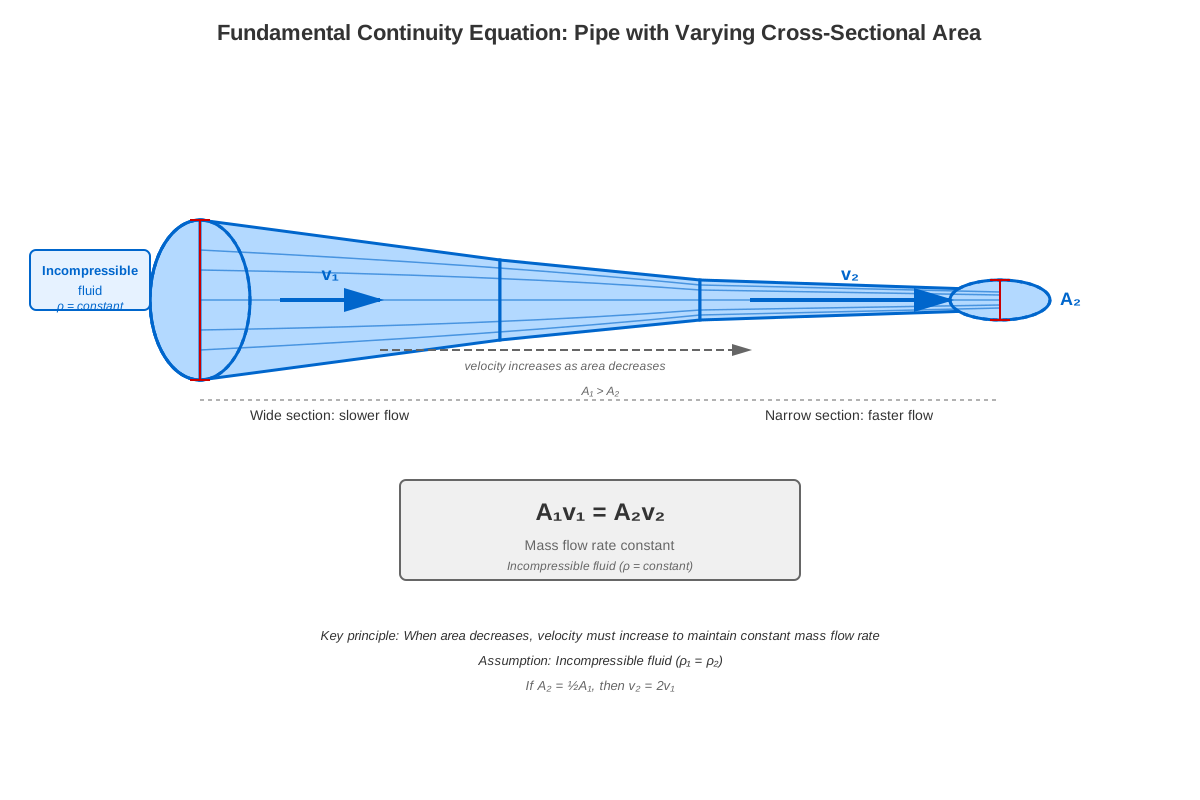
The fluid continuity equation mathematically expresses conservation of mass for fluids flowing through a closed system. For an incompressible fluid (constant density), the equation states:
A₁v₁ = A₂v₂Where:
- A₁ = cross-sectional area at point 1
- v₁ = fluid velocity at point 1
- A₂ = cross-sectional area at point 2
- v₂ = fluid velocity at point 2
This equation reveals an inverse relationship between cross-sectional area and fluid velocity: as area decreases, velocity must increase proportionally to maintain constant volumetric flow rate. The product Av represents the volumetric flow rate (Q), measured in m³/s or L/min, which remains constant throughout the system for steady, incompressible flow.
Derivation from Conservation of Mass
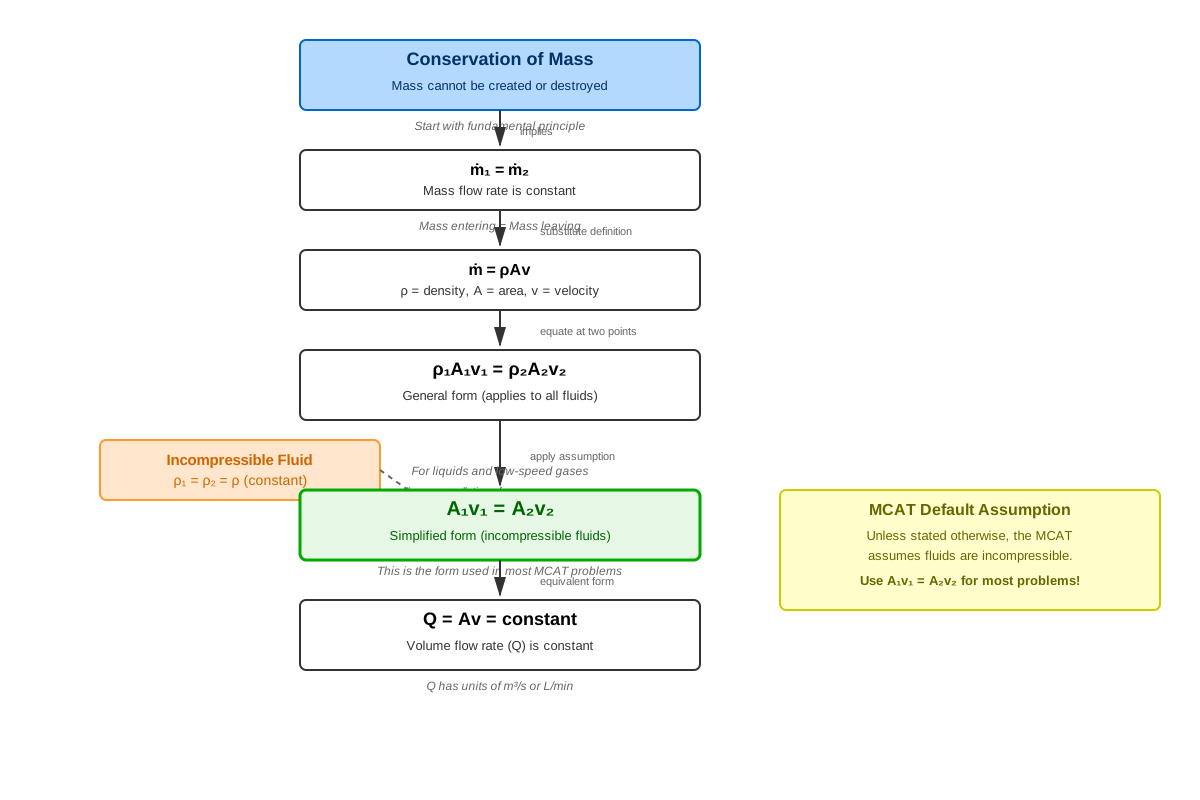
The continuity equation emerges from the principle that mass cannot be created or destroyed within a closed fluid system. Consider a fluid element flowing through a tube of varying cross-section. The mass flow rate (mass per unit time) entering any section must equal the mass flow rate leaving that section, assuming no accumulation or depletion of fluid:
ρ₁A₁v₁ = ρ₂A₂v₂Where ρ represents fluid density. For incompressible fluids (liquids and low-velocity gases), density remains constant (ρ₁ = ρ₂), simplifying to the standard continuity equation A₁v₁ = A₂v₂. This assumption holds for virtually all MCAT applications involving blood flow, water flow, and most physiological fluids.
Volumetric Flow Rate
The volumetric flow rate (Q) represents the volume of fluid passing through a cross-section per unit time:
Q = AvThe continuity equation can be restated as Q₁ = Q₂, emphasizing that flow rate remains constant throughout the system. This formulation proves particularly useful when analyzing physiological systems where maintaining adequate flow rate (cardiac output, respiratory minute ventilation) is critical regardless of vessel geometry changes.
| Parameter | Symbol | Units | Physical Meaning |
|---|---|---|---|
| Cross-sectional area | A | m² | Area perpendicular to flow direction |
| Velocity | v | m/s | Linear speed of fluid particles |
| Volumetric flow rate | Q | m³/s | Volume passing per unit time |
| Density | ρ | kg/m³ | Mass per unit volume |
Relationship Between Area and Velocity
The inverse relationship between area and velocity represents the most frequently tested aspect of the continuity equation. When a fluid flows from a wide section into a narrow section:
- Cross-sectional area decreases (A₂ < A₁)
- Velocity must increase (v₂ > v₁) to maintain constant Q
- The ratio of velocities equals the inverse ratio of areas: v₂/v₁ = A₁/A₂
This relationship explains why water from a garden hose flows faster when you partially cover the opening with your thumb—reducing the exit area forces the same volumetric flow rate through a smaller opening, increasing velocity proportionally.
Application to Circular Cross-Sections
Most physiological applications involve cylindrical vessels (arteries, veins, airways) with circular cross-sections. For circular tubes, area relates to radius or diameter:
A = πr² = π(d/2)² = πd²/4The continuity equation for circular vessels becomes:
πr₁²v₁ = πr₂²v₂Or simplified:
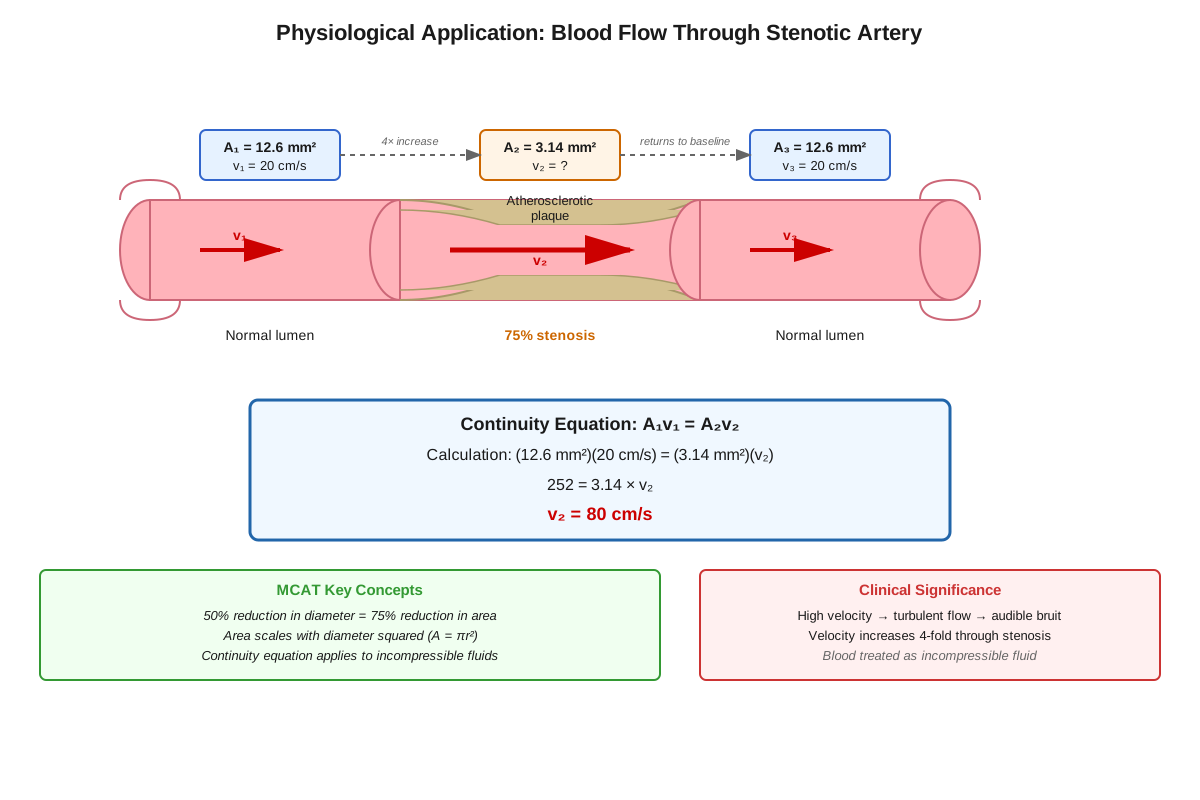
r₁²v₁ = r₂²v₂This reveals that velocity changes with the square of the radius ratio. If vessel radius decreases by half, velocity increases by a factor of four (2²). This quadratic relationship makes even small changes in vessel diameter clinically significant—a 50% reduction in radius causes a 400% increase in flow velocity.
Steady Flow Assumption
The continuity equation applies to steady flow conditions where fluid properties at any given point do not change with time. In physiological systems, blood flow is pulsatile (varying with cardiac cycle), but the continuity equation provides a useful approximation when considering average flow rates over complete cardiac cycles. For MCAT purposes, assume steady flow unless the question explicitly indicates time-varying conditions.
Incompressibility Assumption
The simplified continuity equation (A₁v₁ = A₂v₂) requires fluid incompressibility. Liquids are essentially incompressible under physiological pressures, making this assumption valid for blood flow, cerebrospinal fluid circulation, and other liquid systems. Gases are compressible, but at low velocities (much less than the speed of sound), density changes remain negligible, allowing application of the incompressible continuity equation to respiratory gas flow. For high-velocity gas flow or situations involving significant pressure changes, the full compressible form (ρ₁A₁v₁ = ρ₂A₂v₂) becomes necessary, though this rarely appears on the MCAT.
Concept Relationships
The fluid continuity equation serves as a central hub connecting multiple fluid dynamics and physiological concepts. The equation derives directly from conservation of mass, demonstrating how fundamental physical laws manifest in specific contexts. Understanding this derivation reinforces that continuity is not an arbitrary formula but an inevitable consequence of mass conservation.
The continuity equation connects intimately with Bernoulli's equation, which describes energy conservation in flowing fluids. Together, these equations form a powerful analytical framework: continuity predicts how velocity changes with area, while Bernoulli's equation predicts how pressure changes with velocity. This relationship explains why narrowed vessels experience both increased velocity (continuity) and decreased pressure (Bernoulli), a counterintuitive result that frequently appears in MCAT questions.
Within cardiovascular physiology, continuity principles explain the relationship between cardiac output, vessel cross-sectional area, and blood velocity. As blood flows from the aorta through progressively smaller arteries and arterioles into the vast capillary network, total cross-sectional area increases dramatically, causing blood velocity to decrease. This velocity reduction in capillaries facilitates gas and nutrient exchange. The relationship flows: cardiac output (constant) → total cross-sectional area (varies by vessel type) → blood velocity (inversely proportional to area).
The continuity equation also connects to pressure-flow relationships and resistance. While continuity itself doesn't directly involve pressure, changes in velocity predicted by continuity affect kinetic energy and thus pressure (via Bernoulli). Additionally, narrowed vessels that increase velocity also increase resistance to flow, linking continuity to Poiseuille's law and vascular resistance concepts.
In respiratory physiology, continuity principles explain airflow through the bronchial tree, where air velocity changes as airways branch and total cross-sectional area increases. This connects to concepts of airway resistance and the work of breathing, as velocity changes affect the pressure gradients required to maintain adequate ventilation.
High-Yield Facts
⭐ The continuity equation A₁v₁ = A₂v₂ applies to incompressible fluids in steady flow through closed systems
⭐ Velocity is inversely proportional to cross-sectional area: when area decreases, velocity increases proportionally
⭐ For circular vessels, velocity changes with the square of the radius ratio: v₂/v₁ = (r₁/r₂)²
⭐ Volumetric flow rate Q = Av remains constant throughout the system
⭐ Blood velocity is highest in the aorta and lowest in the capillaries due to differences in total cross-sectional area
- The continuity equation assumes no fluid accumulation or depletion within the system
- Stenotic (narrowed) vessels exhibit increased blood velocity at the stenosis site
- The continuity equation applies to both laminar and turbulent flow
- Branching vessels require summing the flow rates of all branches to equal the flow rate in the parent vessel
- Aneurysms (vessel dilations) cause decreased blood velocity in the dilated region
- The continuity equation is independent of fluid viscosity and vessel wall properties
- For gases at low velocities (<
Quick check — test yourself on Fluid continuity equation so far.
Try Flashcards →Common Misconceptions
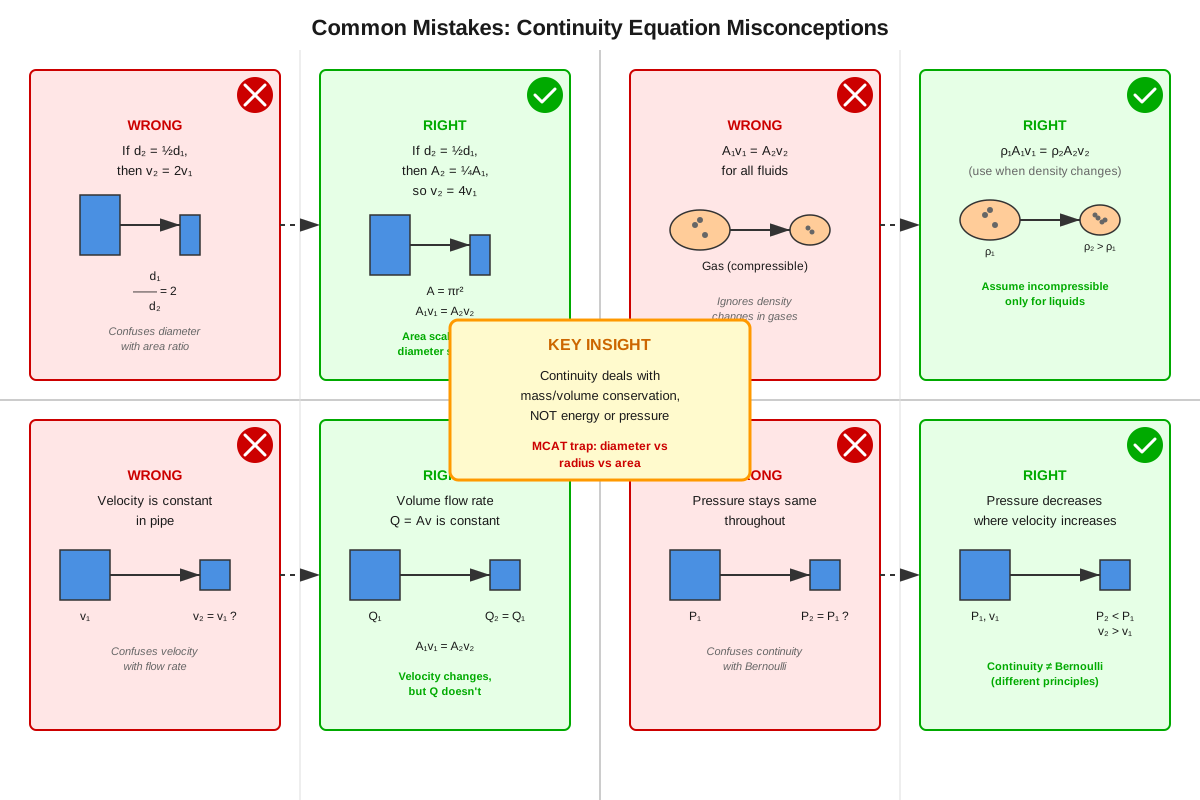
Misconception: The continuity equation only applies to horizontal flow or requires consideration of gravitational effects.
Correction: The continuity equation derives from mass conservation and applies regardless of orientation. Gravity affects pressure distribution (hydrostatic pressure) but does not alter the fundamental relationship between area and velocity for mass conservation.
Misconception: Increased velocity in narrowed vessels means increased flow rate through those vessels.
Correction: Flow rate (Q = Av) remains constant throughout the system. Narrowed vessels exhibit increased velocity precisely because the same flow rate must pass through a smaller area. Velocity and flow rate are distinct quantities—velocity increases while flow rate stays constant.
Misconception: The continuity equation can be used to calculate pressure changes in flowing fluids.
Correction: The continuity equation relates area and velocity but contains no pressure terms. Pressure changes require Bernoulli's equation, which incorporates both velocity (from continuity) and elevation. Students must use continuity to find velocities, then apply Bernoulli to determine pressures.
Misconception: When a vessel branches into multiple smaller vessels, velocity in each branch equals velocity in the parent vessel.
Correction: The continuity equation for branching requires that the flow rate in the parent vessel equals the sum of flow rates in all branches: A₀v₀ = A₁v₁ + A₂v₂ + ... Velocity in each branch depends on that branch's cross-sectional area relative to its flow rate allocation.
Misconception: The continuity equation applies to compressible fluids without modification.
Correction: For compressible fluids, the full continuity equation includes density: ρ₁A₁v₁ = ρ₂A₂v₂. When density changes significantly (high-velocity gas flow, large pressure changes), the simplified form A₁v₁ = A₂v₂ produces incorrect results. However, for MCAT purposes, most gas flow scenarios involve low velocities where density changes are negligible.
Misconception: Larger vessels always have higher blood velocity than smaller vessels.
Correction: Velocity depends on the ratio of flow rate to cross-sectional area, not absolute vessel size. While individual capillaries are tiny, the total cross-sectional area of all capillaries combined vastly exceeds aortic area, resulting in much lower capillary blood velocity despite smaller individual vessel diameters.
Misconception: The continuity equation accounts for energy losses due to friction or viscosity.
Correction: The continuity equation expresses mass conservation only and assumes no energy considerations. Viscous energy losses affect pressure distribution (requiring modified Bernoulli equations) but do not alter the mass conservation relationship between area and velocity.
Worked Examples
Example 1: Blood Flow Through Stenotic Artery
Problem: A patient has atherosclerotic plaque that reduces an artery's diameter from 8.0 mm to 4.0 mm at the stenosis site. If blood velocity in the normal section is 0.30 m/s, what is the blood velocity through the stenotic region?
Solution:
Step 1: Identify known values
- d₁ = 8.0 mm = 8.0 × 10⁻³ m (normal section)
- d₂ = 4.0 mm = 4.0 × 10⁻³ m (stenotic section)
- v₁ = 0.30 m/s
- v₂ = ? (to find)
Step 2: Recognize that circular cross-sections require area calculation
- A = πr² = π(d/2)² = πd²/4
Step 3: Apply continuity equation
A₁v₁ = A₂v₂
(πd₁²/4)v₁ = (πd₂²/4)v₂
Step 4: Simplify (π/4 cancels)
d₁²v₁ = d₂²v₂Step 5: Solve for v₂
v₂ = v₁(d₁²/d₂²) = v₁(d₁/d₂)²
v₂ = 0.30 m/s × (8.0 mm / 4.0 mm)²
v₂ = 0.30 m/s × (2)²
v₂ = 0.30 m/s × 4
v₂ = 1.2 m/sAnswer: Blood velocity through the stenotic region is 1.2 m/s, four times the velocity in the normal section.
Key Insight: This example demonstrates the quadratic relationship between diameter and velocity. A 50% reduction in diameter (factor of 2) causes a 400% increase in velocity (factor of 4). This dramatic velocity increase explains why stenotic vessels produce audible bruits (turbulent flow sounds) and why even moderate stenosis significantly affects hemodynamics.
Example 2: Branching Vessel System
Problem: Blood flows through an artery (diameter 6.0 mm, velocity 0.40 m/s) that branches into two equal-diameter vessels (each 4.0 mm diameter). What is the blood velocity in each branch vessel?
Solution:
Step 1: Identify known values
- Parent vessel: d₀ = 6.0 mm, v₀ = 0.40 m/s
- Branch vessels: d₁ = d₂ = 4.0 mm, v₁ = v₂ = ? (equal by symmetry)
Step 2: Apply continuity to branching system
The flow rate in the parent equals the sum of flow rates in branches:
Q₀ = Q₁ + Q₂
A₀v₀ = A₁v₁ + A₂v₂
Step 3: Use symmetry (equal branch diameters and flow rates)
A₀v₀ = 2A₁v₁Step 4: Express areas in terms of diameters
(πd₀²/4)v₀ = 2(πd₁²/4)v₁
d₀²v₀ = 2d₁²v₁
Step 5: Solve for v₁
v₁ = v₀(d₀²)/(2d₁²)
v₁ = 0.40 m/s × (6.0 mm)² / [2 × (4.0 mm)²]
v₁ = 0.40 m/s × 36 / (2 × 16)
v₁ = 0.40 m/s × 36/32
v₁ = 0.40 m/s × 1.125
v₁ = 0.45 m/sAnswer: Blood velocity in each branch vessel is 0.45 m/s.
Key Insight: Despite branching into smaller vessels, velocity actually increases because the total cross-sectional area of the two branches (2 × π × 2² = 8π mm²) is less than the parent vessel area (π × 3² = 9π mm²). This counterintuitive result emphasizes that velocity depends on total cross-sectional area, not individual vessel size. Students must carefully account for all branches when applying continuity to branching systems.
Exam Strategy
Question Recognition
MCAT questions testing the continuity equation typically include trigger phrases such as "blood flows through a narrowed vessel," "air passes through a constriction," "fluid velocity changes," or "diameter decreases." Questions may present vessel dimensions (diameter, radius, or area) along with velocity information, asking students to calculate unknown velocities or flow rates. Passage-based questions often embed continuity principles within cardiovascular or respiratory physiology contexts.
Systematic Approach
- Identify the system: Determine what fluid is flowing and through what geometry
- Locate the two points: Find the two locations where conditions are specified or requested
- Extract given information: List all known areas, diameters, radii, and velocities
- Check for circular cross-sections: If diameters or radii are given, remember A = πr²
- Apply continuity: Write A₁v₁ = A₂v₂ and solve for the unknown
- Verify units: Ensure consistent units throughout (convert mm to m if necessary)
- Check reasonableness: Smaller area should yield larger velocity
Process of Elimination Tips
When facing conceptual questions about continuity:
- Eliminate choices suggesting flow rate changes within a single continuous vessel (flow rate remains constant)
- Eliminate choices showing direct proportionality between area and velocity (relationship is inverse)
- Eliminate choices ignoring the quadratic relationship for diameter/radius (velocity changes with r², not r)
- Eliminate choices claiming pressure directly from continuity (pressure requires Bernoulli's equation)
Time Management
Continuity equation problems typically require 60-90 seconds for straightforward calculations. Allocate time as follows:
- 15 seconds: Read and identify the problem type
- 30 seconds: Extract information and set up the equation
- 30 seconds: Perform calculations
- 15 seconds: Verify answer reasonableness
For passage-based questions, first skim the passage for vessel dimensions and flow information, then tackle continuity-related questions before moving to more complex Bernoulli or resistance calculations.
Common Trap Answers
MCAT test writers frequently include trap answers that result from:
- Forgetting to square the diameter ratio: Using v₂ = v₁(d₁/d₂) instead of v₂ = v₁(d₁/d₂)²
- Confusing velocity with flow rate: Selecting answers where both increase or both decrease
- Inverting the area ratio: Using v₂ = v₁(A₂/A₁) instead of v₂ = v₁(A₁/A₂)
- Applying continuity to compressible flow: Ignoring density changes when significant
Memory Techniques
Primary Mnemonic: "SAVE"
Smaller area
Accelerates
Velocity
Enormously
This reminds students that decreased area causes increased velocity, and the effect is dramatic (especially for diameter changes due to the quadratic relationship).
Visualization Strategy: The Garden Hose
Picture water flowing from a garden hose. When you partially cover the opening with your thumb (reducing area), water shoots out faster (increased velocity). The total amount of water flowing per second (flow rate) doesn't change—it just exits faster through the smaller opening. This everyday experience provides an intuitive anchor for the continuity equation.
Equation Memory: "A-V-A-V"
Remember the continuity equation structure as "A-V equals A-V": A₁v₁ = A₂v₂. The alternating pattern of area and velocity helps recall the correct form.
Relationship Reminder: "Area Down, Velocity Up"
This simple phrase captures the inverse relationship. When area goes down, velocity must go up (and vice versa) to maintain constant flow rate.
Quadratic Relationship: "Diameter Squared Matters"
For circular vessels, remember that velocity changes with the square of the diameter ratio. Halving diameter quadruples velocity; doubling diameter quarters velocity. The word "squared" in the phrase prompts students to square the ratio.
Summary
The fluid continuity equation represents a fundamental application of mass conservation to flowing fluids, establishing that the product of cross-sectional area and velocity remains constant throughout a closed system carrying incompressible fluid in steady flow. Mathematically expressed as A₁v₁ = A₂v₂, this equation reveals an inverse relationship between area and velocity: as cross-sectional area decreases, fluid velocity must increase proportionally to maintain constant volumetric flow rate. For circular vessels common in physiological systems, this relationship becomes particularly significant because velocity changes with the square of the radius or diameter ratio, making even modest changes in vessel geometry produce dramatic velocity changes. The continuity equation provides essential groundwork for understanding cardiovascular hemodynamics, respiratory mechanics, and fluid dynamics scenarios that frequently appear on the MCAT. Mastery requires not only computational facility with the equation but also conceptual understanding of the physical principles underlying mass conservation, the distinction between velocity and flow rate, and the integration of continuity principles with related concepts such as Bernoulli's equation and vascular resistance.
Key Takeaways
- The continuity equation A₁v₁ = A₂v₂ expresses mass conservation for incompressible fluids in steady flow
- Velocity and cross-sectional area are inversely proportional: decreased area causes increased velocity
- Volumetric flow rate Q = Av remains constant throughout the system
- For circular vessels, velocity changes with the square of the diameter ratio: v₂/v₁ = (d₁/d₂)²
- The continuity equation applies independently of pressure, viscosity, or flow pattern (laminar vs. turbulent)
- Clinical applications include blood flow through stenotic vessels, aneurysms, and respiratory airflow through constricted airways
- The continuity equation must be combined with Bernoulli's equation to analyze pressure changes in flowing fluids
Related Topics
Bernoulli's Equation: Describes energy conservation in flowing fluids, relating pressure, velocity, and elevation. Mastering continuity enables students to calculate velocities needed for Bernoulli pressure calculations, as the two equations work synergistically to solve complex fluid dynamics problems.
Poiseuille's Law: Quantifies the relationship between pressure gradient, flow rate, vessel dimensions, and fluid viscosity for laminar flow. Understanding continuity provides the foundation for analyzing how vessel radius affects both velocity (continuity) and resistance (Poiseuille).
Cardiovascular Physiology: Applies continuity principles to blood flow through the circulatory system, explaining velocity variations from aorta to capillaries to vena cava. Continuity mastery enables quantitative analysis of cardiac output, vascular resistance, and hemodynamic changes in disease states.
Respiratory Mechanics: Uses continuity to analyze airflow through the bronchial tree and understand how airway constriction affects breathing mechanics. The principles learned here extend to understanding work of breathing and obstructive lung diseases.
Turbulent Flow and Reynolds Number: Examines conditions under which laminar flow transitions to turbulent flow, often occurring at high velocities in narrowed vessels. Continuity equation predictions of increased velocity in stenotic vessels connect to understanding when turbulence develops.
Practice CTA
Now that you've mastered the fluid continuity equation, reinforce your understanding by working through the practice questions and flashcards. Focus on problems involving vessel diameter changes, branching systems, and physiological applications to build the pattern recognition essential for rapid problem-solving on test day. Remember that continuity equation mastery forms the foundation for more advanced fluid dynamics topics—investing time now will pay dividends throughout your MCAT preparation. Challenge yourself with increasingly complex scenarios, and don't hesitate to revisit the worked examples when you encounter difficulty. Your ability to quickly recognize continuity equation applications and execute calculations accurately will significantly boost your physics score!
Sign up free to keep reading
Create a free AnvayaPrep account to finish this MCAT guide on Fluid continuity equation — plus flashcards and practice questions.