Overview
Memory retrieval is the cognitive process by which stored information is accessed and brought back into conscious awareness. This fundamental mechanism allows individuals to recall facts, recognize familiar stimuli, and reconstruct past experiences. Within the broader context of Learning and Memory, retrieval represents the final stage of the memory process, following encoding and storage. Understanding memory retrieval is essential for comprehending how information moves from long-term storage back into working memory, where it can be used for problem-solving, decision-making, and behavioral responses.
For the MCAT, memory retrieval is a high-yield topic that appears frequently in the Psychology and Sociology section. Test-makers commonly present experimental passages examining retrieval phenomena, clinical vignettes involving memory disorders, or theoretical questions about the mechanisms underlying successful recall. The topic integrates seamlessly with other psychological concepts including attention, consciousness, cognitive development, and neurological function. Questions may require students to distinguish between different types of retrieval, identify factors that enhance or impair memory access, or apply retrieval principles to real-world scenarios.
The significance of memory retrieval extends beyond academic testing into clinical practice and everyday functioning. Retrieval failures underlie many memory complaints, from the benign "tip-of-the-tongue" phenomenon to the devastating impairments seen in dementia. Understanding retrieval processes helps explain why context matters for remembering, why some memories feel vivid while others remain elusive, and how therapeutic interventions can improve memory function. For MCAT success, students must master not only the theoretical frameworks of retrieval but also the practical ability to analyze experimental designs, interpret data about memory performance, and apply retrieval concepts to novel situations presented in test passages.
Learning Objectives
- [ ] Define Memory retrieval using accurate Psychology terminology
- [ ] Explain why Memory retrieval matters for the MCAT
- [ ] Apply Memory retrieval to exam-style questions
- [ ] Identify common mistakes related to Memory retrieval
- [ ] Connect Memory retrieval to related Psychology concepts
- [ ] Distinguish between recall, recognition, and relearning as distinct retrieval methods
- [ ] Analyze how retrieval cues and context influence memory accessibility
- [ ] Evaluate the role of retrieval in memory consolidation and the testing effect
- [ ] Predict how interference and retrieval failure affect memory performance
Prerequisites
- Memory encoding: Understanding how information initially enters memory systems is essential because retrieval can only access what has been successfully encoded
- Memory storage: Knowledge of how information is maintained over time provides the foundation for understanding what retrieval accesses and how storage quality affects retrieval success
- Long-term memory types: Familiarity with declarative (explicit) and non-declarative (implicit) memory systems is necessary because different retrieval mechanisms apply to different memory types
- Working memory: Understanding the temporary workspace where retrieved information becomes conscious is critical for comprehending the retrieval process
- Brain structures involved in memory: Basic knowledge of the hippocampus, prefrontal cortex, and temporal lobes helps explain the neural basis of retrieval processes
Why This Topic Matters
Memory retrieval has profound clinical significance across multiple medical specialties. Neurologists assess retrieval deficits to diagnose conditions ranging from mild cognitive impairment to Alzheimer's disease. Psychiatrists recognize that retrieval problems contribute to depression, anxiety disorders, and post-traumatic stress disorder. Rehabilitation specialists design interventions that leverage retrieval principles to help patients recover cognitive function after brain injury. Understanding retrieval mechanisms also informs educational strategies, legal considerations about eyewitness testimony, and therapeutic approaches for memory enhancement.
On the MCAT, memory retrieval appears in approximately 3-5% of Psychology and Sociology questions, making it a high-yield topic that warrants thorough preparation. Questions typically fall into several categories: experimental passage analysis requiring interpretation of retrieval paradigms, standalone questions testing conceptual understanding of retrieval phenomena, and clinical vignettes asking students to identify retrieval failures or predict memory performance. The topic frequently appears alongside related concepts such as forgetting, interference, and memory distortion, requiring integrated knowledge across the Learning and Memory unit.
Common MCAT presentations include passages describing retrieval experiments with varying cue conditions, questions about the serial position effect and its retrieval explanations, scenarios involving context-dependent memory, and clinical cases requiring differentiation between encoding versus retrieval deficits. Test-makers favor questions that require application rather than simple recall, such as predicting how changing retrieval conditions would affect performance or explaining why certain retrieval strategies succeed while others fail. Students must be prepared to analyze graphs showing retrieval performance, interpret experimental manipulations of retrieval cues, and apply theoretical frameworks to novel situations.
Core Concepts
Definition and Basic Mechanisms
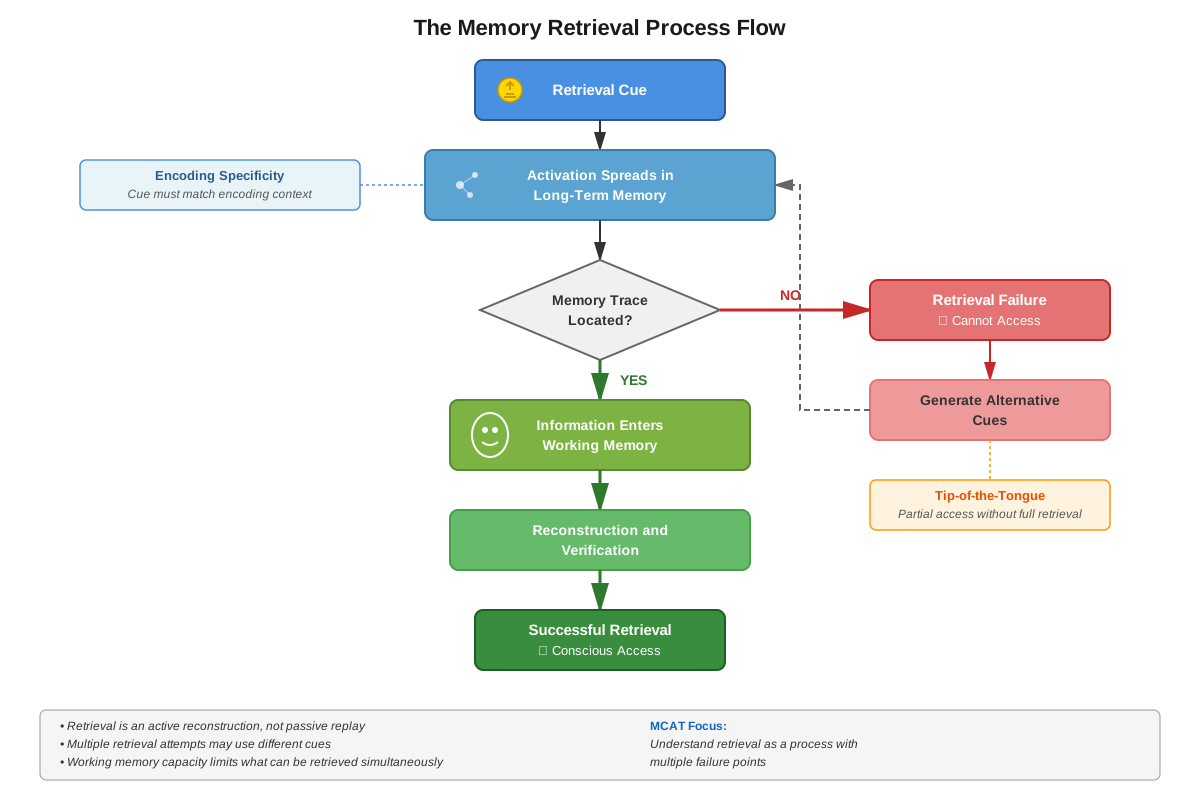
Memory retrieval is the process of accessing stored information and bringing it into conscious awareness or behavioral expression. Retrieval represents the third stage of memory processing, following encoding (initial learning) and storage (maintenance over time). The retrieval process involves activating neural representations that were established during encoding and maintained during storage. Successful retrieval requires that the memory trace exists in storage, that appropriate retrieval cues are present, and that the retrieval process can successfully access the stored information.
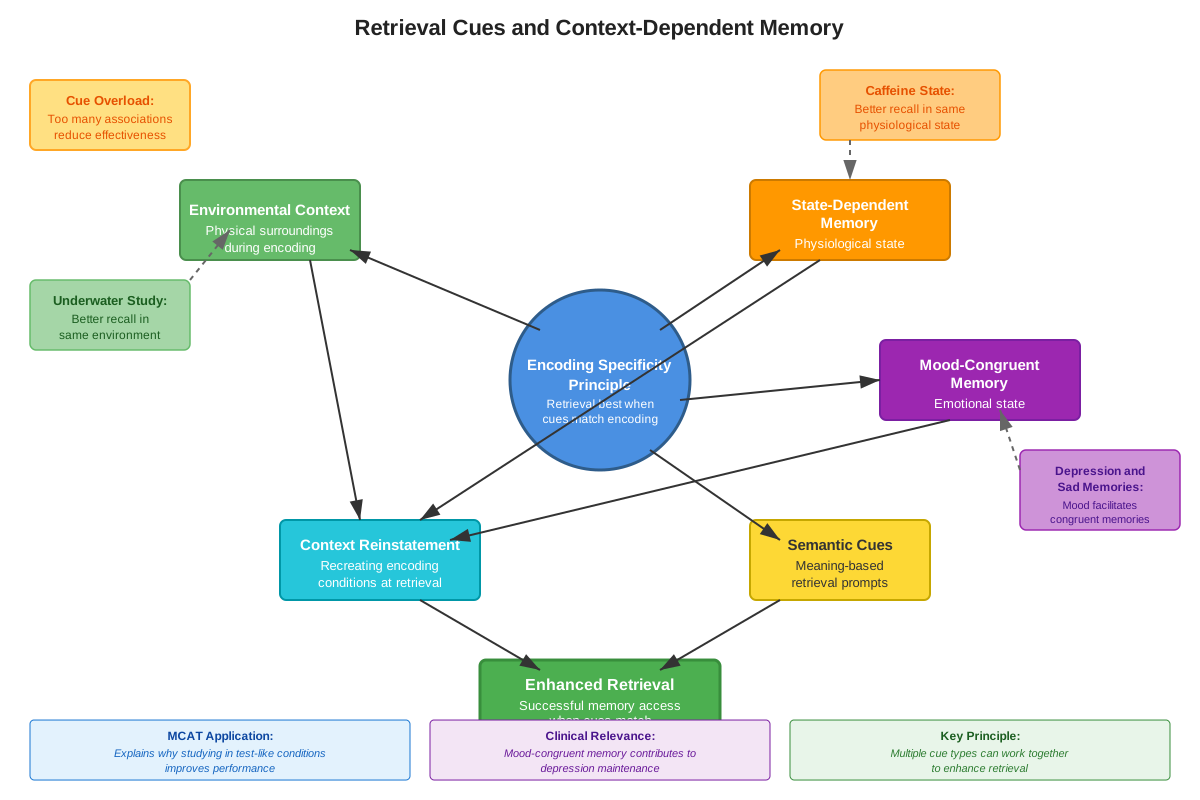
The retrieval cue serves as a stimulus that triggers access to stored memories. These cues can be external (environmental stimuli, questions, sensory input) or internal (thoughts, emotional states, physiological conditions). The effectiveness of a retrieval cue depends on its similarity to the conditions present during encoding, a principle known as encoding specificity. When retrieval conditions match encoding conditions, memory performance improves significantly.
Types of Retrieval
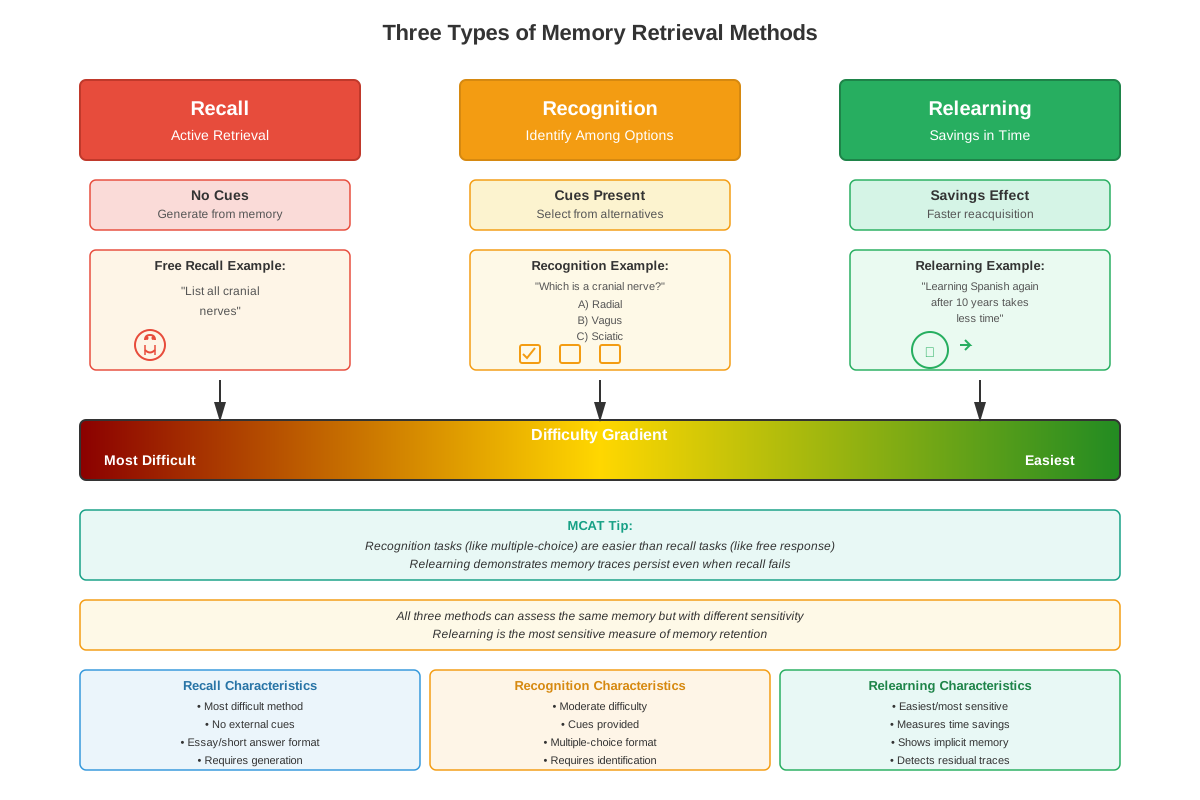
Memory retrieval manifests through three primary methods, each with distinct characteristics and difficulty levels:
Recall requires generating information from memory without explicit cues beyond the general category or context. This represents the most demanding form of retrieval because it requires self-initiated search through memory stores. Free recall involves retrieving information in any order (e.g., "List all the cranial nerves you can remember"), while cued recall provides specific prompts (e.g., "What cranial nerve controls eye movement?"). Serial recall requires retrieving information in a specific sequence. Recall heavily depends on retrieval cues and organizational strategies used during encoding.
Recognition involves identifying previously encountered information when presented with it again. This method provides the actual target information along with distractors, requiring only a judgment of familiarity or prior exposure. Recognition is generally easier than recall because the target item itself serves as a powerful retrieval cue. Multiple-choice questions exemplify recognition tasks. Recognition can occur through two processes: familiarity (a general sense of having encountered the stimulus before) and recollection (retrieving specific contextual details about the prior encounter).
Relearning (also called savings) measures memory by assessing how much faster or more efficiently material can be learned the second time compared to initial learning. Even when recall and recognition fail, relearning often demonstrates that some memory trace persists. The savings score quantifies this: (original learning time - relearning time) / original learning time × 100%. Relearning represents the most sensitive measure of memory retention.
| Retrieval Type | Definition | Difficulty Level | Example | Cue Availability |
|---|---|---|---|---|
| Free Recall | Generate information without specific cues | Highest | Essay questions | Minimal |
| Cued Recall | Generate information with specific prompts | Moderate-High | Fill-in-the-blank | Moderate |
| Recognition | Identify previously learned information | Lower | Multiple-choice | High |
| Relearning | Re-acquire previously learned information | Lowest (most sensitive) | Studying material again | Variable |
Retrieval Cues and Context Effects
The encoding specificity principle states that memory retrieval is most effective when conditions at retrieval match conditions at encoding. This principle explains numerous context effects on memory performance. Context-dependent memory refers to improved retrieval when the physical or environmental context matches between encoding and retrieval. Classic studies demonstrate that divers remember information better when tested in the same environment (underwater vs. on land) where they learned it.
State-dependent memory describes enhanced retrieval when the internal physiological or psychological state matches between learning and testing. This includes mood states (mood-congruent memory), drug states, and arousal levels. For example, information learned while caffeinated may be better retrieved in a caffeinated state. However, state-dependent effects are generally weaker than context-dependent effects.
Transfer-appropriate processing extends these principles by proposing that retrieval succeeds when the cognitive processes used during retrieval match those used during encoding. If material is encoded semantically (focusing on meaning), semantic retrieval cues work better than phonological cues. If material is encoded through visual imagery, visual cues enhance retrieval more than verbal cues.
Retrieval Failure and Interference
Not all retrieval attempts succeed, and understanding retrieval failure is crucial for the MCAT. Retrieval failure occurs when information exists in storage but cannot be accessed. This differs from forgetting due to decay or loss of the memory trace. The tip-of-the-tongue phenomenon exemplifies retrieval failure—the person knows the information exists and can often recall partial features (first letter, number of syllables) but cannot fully retrieve it.
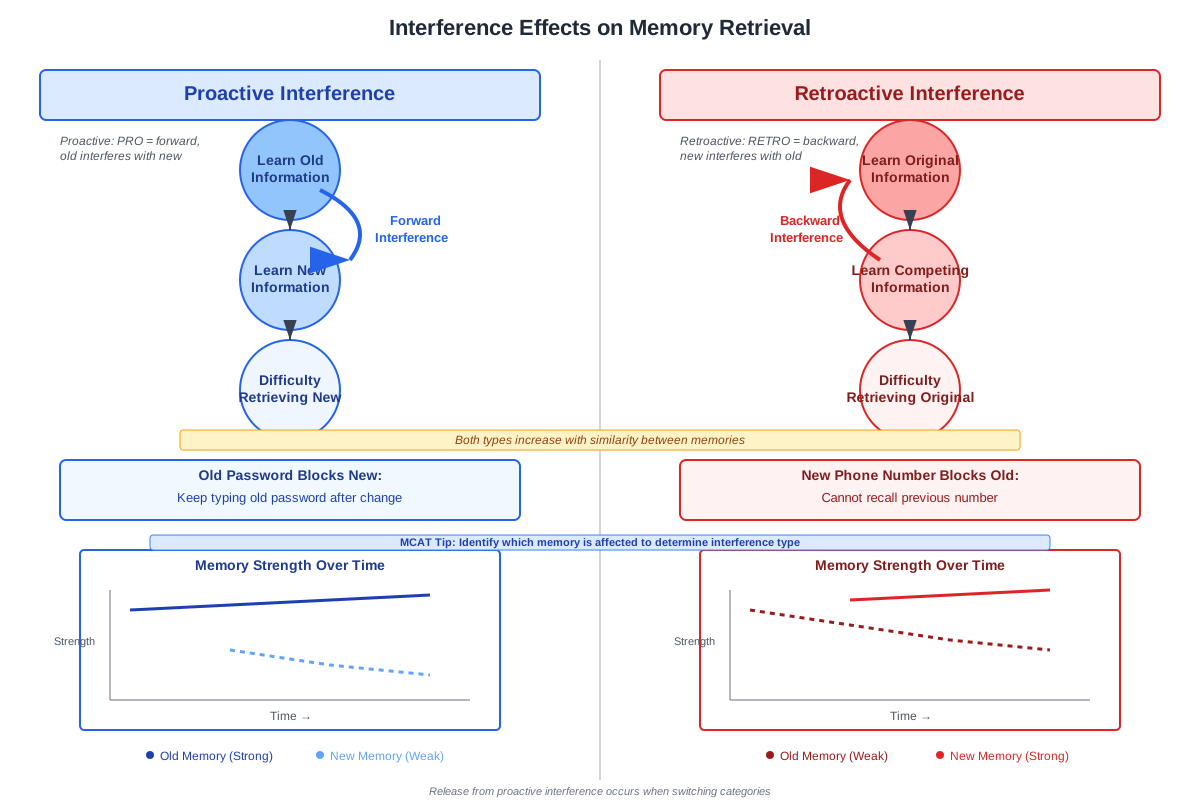
Interference represents a major cause of retrieval failure. Proactive interference occurs when old information interferes with retrieving new information (e.g., calling a new partner by an ex's name). Retroactive interference occurs when new information interferes with retrieving old information (e.g., difficulty remembering an old phone number after learning a new one). Both types of interference affect retrieval rather than storage—the information remains in memory but becomes harder to access due to competition from interfering material.
Retrieval-induced forgetting demonstrates that the act of retrieving some information can impair subsequent retrieval of related information. When repeatedly retrieving specific items from a category, non-retrieved items from that same category become harder to access later. This phenomenon shows that retrieval is not a neutral process but actively shapes future memory accessibility.
Serial Position Effects
The serial position effect describes the U-shaped pattern of recall for items in a list, with superior memory for items at the beginning (primacy effect) and end (recency effect) compared to middle items. While encoding and storage factors contribute to these effects, retrieval processes play a crucial role.
The primacy effect occurs because early items receive more rehearsal and transfer to long-term memory more effectively. These items benefit from fewer proactive interference effects and establish stronger retrieval pathways. The recency effect reflects retrieval from working memory or short-term memory—the last items remain accessible in temporary storage. Introducing a delay or distractor task before retrieval eliminates the recency effect but preserves the primacy effect, demonstrating their different underlying mechanisms.
Retrieval and Memory Modification
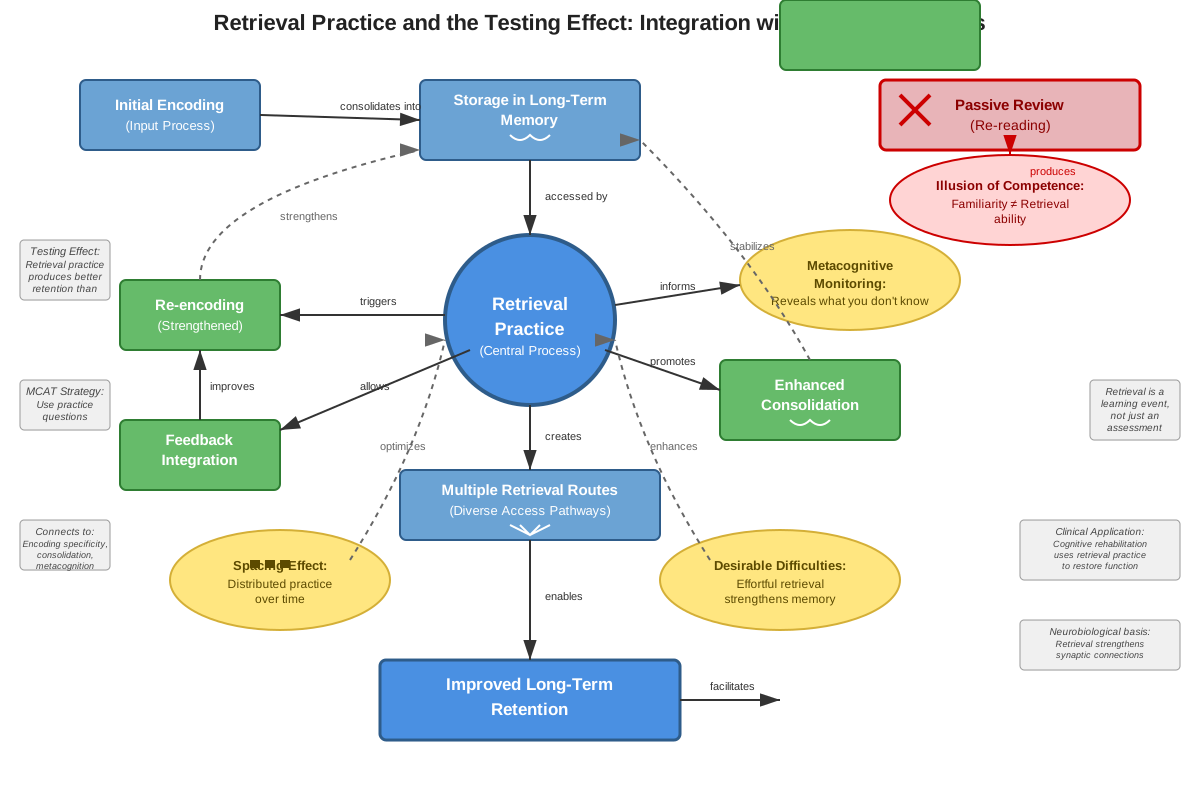
Retrieval is not a passive playback of stored information but an active reconstructive process that can modify memories. Each retrieval episode can strengthen, weaken, or alter the memory trace. The testing effect (also called retrieval practice effect) demonstrates that retrieving information enhances long-term retention more effectively than additional study sessions. This occurs because retrieval strengthens retrieval pathways and promotes consolidation.
Reconsolidation refers to the process by which retrieved memories become temporarily labile and susceptible to modification before being stored again. During the reconsolidation window, memories can be strengthened, updated with new information, or even disrupted. This has implications for treating traumatic memories and understanding how memories change over time.
Retrieval-enhanced suggestibility shows that memories become more vulnerable to distortion after retrieval. Misleading information presented after retrieval can be incorporated into the memory trace more easily than if no retrieval had occurred. This has important implications for eyewitness testimony and therapeutic memory work.
Concept Relationships
Memory retrieval connects intimately with encoding and storage as the three stages of memory processing. Strong encoding creates distinctive memory traces with multiple retrieval pathways, making subsequent retrieval more likely to succeed. The quality of storage—including consolidation processes and resistance to decay—determines what information remains available for retrieval. These three processes form a continuous cycle: encoding → storage → retrieval → reconsolidation → storage.
Within retrieval itself, the concepts form a hierarchical relationship. Retrieval cues activate spreading activation through semantic networks, with context and state effects modulating this activation. When activation reaches threshold, retrieval succeeds; when interference or weak cues prevent sufficient activation, retrieval fails. The type of retrieval task (recall vs. recognition) determines the threshold and cue requirements for successful retrieval.
Retrieval connects to attention and working memory because retrieved information must enter conscious awareness through the working memory system. The prefrontal cortex orchestrates strategic retrieval efforts, while the hippocampus reconstructs episodic memories from distributed cortical storage sites. Retrieval also links to metacognition—people monitor their retrieval success and adjust strategies based on feelings of knowing and judgments of learning.
The relationship map flows as follows: Encoding specificity → determines → Retrieval cue effectiveness → influences → Retrieval success/failure → affected by → Interference → leads to → Retrieval-induced forgetting → while → Successful retrieval → triggers → Reconsolidation → strengthens → Future retrieval → enhanced by → Testing effect → improves → Long-term retention.
Quick check — test yourself on Memory retrieval so far.
Try Flashcards →High-Yield Facts
⭐ Retrieval is generally easier with recognition tasks than recall tasks because the target item serves as its own retrieval cue
⭐ The encoding specificity principle states that retrieval succeeds best when retrieval conditions match encoding conditions
⭐ Proactive interference occurs when old information interferes with new information retrieval; retroactive interference occurs when new information interferes with old information retrieval
⭐ The serial position effect shows superior recall for first items (primacy effect) and last items (recency effect) compared to middle items
⭐ The testing effect demonstrates that retrieval practice enhances long-term retention more effectively than repeated studying
- Context-dependent memory improves when the physical environment matches between encoding and retrieval
- State-dependent memory improves when the internal physiological or psychological state matches between encoding and retrieval
- The tip-of-the-tongue phenomenon exemplifies retrieval failure where information exists in storage but cannot be accessed
- Retrieval-induced forgetting shows that retrieving some items from a category impairs subsequent retrieval of related non-retrieved items
- Reconsolidation makes retrieved memories temporarily labile and susceptible to modification before being stored again
- Transfer-appropriate processing predicts that retrieval succeeds when cognitive processes match between encoding and retrieval
- The recency effect disappears with a delay or distractor task, while the primacy effect persists, indicating different underlying mechanisms
Common Misconceptions
Misconception: Retrieval is simply playing back a stored memory like a video recording → Correction: Retrieval is an active reconstructive process that can modify, strengthen, or distort memories. Each retrieval episode potentially changes the memory trace through reconsolidation, and memories are reconstructed from distributed components rather than played back intact.
Misconception: If you cannot recall information, it must have been forgotten or never stored → Correction: Retrieval failure often occurs even when information remains in storage. The tip-of-the-tongue phenomenon, successful recognition after failed recall, and improved performance with better retrieval cues all demonstrate that inaccessible memories may still exist in storage.
Misconception: Recognition is just easier recall → Correction: Recognition and recall involve partially distinct cognitive processes and neural mechanisms. Recognition can succeed through familiarity without recollection of specific details, while recall requires self-initiated search and reconstruction. Recognition provides the target as a retrieval cue, fundamentally changing the task demands.
Misconception: Interference causes memories to be erased or overwritten → Correction: Interference primarily affects retrieval rather than storage. Interfering information creates competition during retrieval attempts, making target memories harder to access, but the original memories typically remain in storage. With appropriate cues or techniques, interfered-with memories can often still be retrieved.
Misconception: The best way to study is to repeatedly read material → Correction: The testing effect demonstrates that retrieval practice (self-testing, practice questions) produces superior long-term retention compared to repeated studying. Active retrieval strengthens memory traces and retrieval pathways more effectively than passive review.
Misconception: Context effects on memory are weak and unreliable → Correction: Context-dependent memory effects are robust and well-documented, though their magnitude varies with the distinctiveness of the context and the type of material. Environmental context reinstatement significantly improves retrieval, particularly for episodic memories, and this principle has practical applications in education and legal settings.
Worked Examples
Example 1: Experimental Design Analysis
Scenario: Researchers conduct an experiment where participants learn a list of 40 words in a quiet library. Group A is tested in the same quiet library, Group B is tested in a noisy cafeteria, and Group C is tested in the noisy cafeteria but is asked to mentally visualize the quiet library before testing. Group A recalls an average of 28 words, Group B recalls 19 words, and Group C recalls 25 words.
Question: Which memory principle best explains these results, and what do the Group C results specifically demonstrate?
Analysis:
Step 1: Identify the independent variable—testing environment (same vs. different from encoding environment, with or without mental context reinstatement).
Step 2: Identify the dependent variable—number of words recalled (a recall task).
Step 3: Compare Group A and Group B—Group A performs better when tested in the same environment where encoding occurred. This demonstrates context-dependent memory and supports the encoding specificity principle. The physical environmental context serves as a retrieval cue.
Step 4: Analyze Group C—Despite being tested in a different physical environment (like Group B), Group C performs better than Group B by mentally reinstating the encoding context. This demonstrates that mental context reinstatement can partially compensate for physical context mismatch.
Step 5: Note that Group C still performs worse than Group A, indicating that mental context reinstatement is helpful but not as effective as actual physical context matching.
Answer: The encoding specificity principle and context-dependent memory best explain these results. The Group C results specifically demonstrate that mental reinstatement of encoding context can serve as an effective retrieval cue, partially overcoming the disadvantage of physical context mismatch. This has practical implications for exam preparation—students can benefit from mentally recreating their study environment during tests.
Example 2: Clinical Vignette Application
Scenario: A 68-year-old patient complains to her physician that her memory is failing. She reports frequently being unable to remember people's names even though she recognizes their faces immediately and can describe details about them. She can usually remember the first letter of the name and feels frustrated that the name is "right on the tip of her tongue." When given multiple-choice options, she correctly identifies names with high accuracy. Neurological examination and brain imaging are normal.
Question: What type of memory retrieval difficulty is this patient experiencing, and what does her preserved recognition ability suggest about her memory system?
Analysis:
Step 1: Identify the retrieval problem—difficulty with recall (generating names spontaneously) but preserved recognition (identifying correct names from options).
Step 2: Recognize the tip-of-the-tongue phenomenon—the patient knows the information exists (can recall first letter, feels it's accessible) but cannot fully retrieve it. This is a classic retrieval failure rather than a storage problem.
Step 3: Analyze the recognition performance—high accuracy on recognition tasks indicates that the name information is successfully stored in long-term memory. If storage were impaired, recognition would also be affected.
Step 4: Consider the clinical implications—the dissociation between impaired recall and preserved recognition suggests a retrieval deficit rather than encoding or storage problems. This pattern is common in normal aging and does not necessarily indicate pathological memory decline.
Step 5: Note the normal neurological findings—this supports a functional retrieval difficulty rather than structural brain damage.
Answer: The patient is experiencing retrieval failure specifically affecting recall while recognition remains intact. The preserved recognition ability strongly suggests that information is successfully encoded and stored in long-term memory but that retrieval pathways or cues are insufficient for spontaneous recall. This dissociation between recall and recognition is common in normal aging and reflects the greater difficulty of recall tasks compared to recognition tasks. The tip-of-the-tongue phenomenon indicates that partial information can be accessed, further supporting a retrieval rather than storage deficit. This pattern does not suggest pathological memory impairment given the normal neurological findings.
Exam Strategy
When approaching MCAT questions on memory retrieval, first identify what type of retrieval is being tested or described—recall, recognition, or relearning. Questions often hinge on understanding the relative difficulty and cue requirements of these different retrieval types. Watch for trigger words like "generate," "identify," "recognize," or "re-learn" that signal the retrieval type.
For experimental passage questions, carefully track the encoding conditions and retrieval conditions. Look for matches or mismatches that would predict performance based on encoding specificity. Pay attention to whether the passage manipulates context (physical environment), state (mood, drug state, arousal), or cue type (semantic vs. phonological). Draw a simple table comparing groups if needed to visualize the experimental design.
When questions involve interference, determine the temporal relationship between the interfering information and the target information. If old information interferes with new, it's proactive interference; if new interferes with old, it's retroactive interference. Remember that interference affects retrieval, not storage—this distinction often appears in answer choices.
For serial position effect questions, consider whether a delay or distractor task is present. If so, the recency effect should be eliminated while the primacy effect persists. Questions may ask you to predict performance patterns or explain underlying mechanisms—primacy reflects long-term memory and rehearsal, while recency reflects working memory or short-term storage.
Process of elimination works well for retrieval questions. Eliminate answers that confuse encoding with retrieval, that suggest memories are erased rather than inaccessible, or that ignore context effects. Be suspicious of extreme answers that claim retrieval is purely passive or that context never matters. Look for answers that acknowledge retrieval as an active, reconstructive process.
Time allocation should favor careful reading of experimental designs and clinical vignettes. These questions reward systematic analysis more than quick intuition. Spend 60-90 seconds on complex passage-based questions, ensuring you understand the manipulation and can predict outcomes based on retrieval principles. Standalone questions typically require 30-45 seconds.
Exam Tip: When a question describes someone who "knows" information but cannot access it, think retrieval failure and tip-of-the-tongue phenomenon. When recognition succeeds but recall fails, the memory is stored but retrieval cues are insufficient.
Memory Techniques
CRISP for major retrieval concepts:
- Context-dependent (environment matters)
- Recognition easier than recall
- Interference (proactive and retroactive)
- Serial position (primacy and recency)
- Practice retrieval (testing effect)
"Recall Requires Real Effort" reminds you that recall is the most difficult retrieval type, requiring self-generated cues and effortful search, while recognition provides the target as a cue.
"Old Blocks New = Proactive; New Blocks Old = Retroactive" helps distinguish interference types. Proactive interference means old information blocks (interferes with) new information retrieval. Retroactive interference means new information blocks old information retrieval.
"First and Last, Not the Middle" captures the serial position effect—first items (primacy) and last items (recency) are recalled better than middle items.
For encoding specificity, visualize a key and lock: the retrieval cue (key) must match the encoding conditions (lock) for successful retrieval. The better the match, the easier the lock opens.
To remember that retrieval modifies memory, think "Every time you remember, you re-member"—you're putting the memory back together, potentially changing it through reconsolidation.
Summary
Memory retrieval is the active process of accessing stored information and bringing it into conscious awareness. The three primary retrieval methods—recall, recognition, and relearning—differ in difficulty and cue availability, with recall being most demanding and relearning most sensitive. The encoding specificity principle explains that retrieval succeeds best when retrieval conditions match encoding conditions, accounting for context-dependent and state-dependent memory effects. Retrieval failure occurs when stored information cannot be accessed, often due to insufficient cues or interference from competing information. Proactive interference involves old information disrupting new information retrieval, while retroactive interference involves new information disrupting old information retrieval. The serial position effect demonstrates superior recall for first and last items in a list, reflecting primacy and recency effects with distinct underlying mechanisms. Importantly, retrieval is not passive playback but an active reconstructive process that can modify memories through reconsolidation. The testing effect shows that retrieval practice enhances long-term retention more effectively than repeated studying, highlighting retrieval's role in strengthening memory. For MCAT success, students must distinguish retrieval types, apply encoding specificity principles, analyze interference patterns, and recognize that retrieval actively shapes memory rather than simply accessing static stored information.
Key Takeaways
- Memory retrieval involves recall (most difficult), recognition (easier), and relearning (most sensitive), each requiring different levels of cue support
- The encoding specificity principle states that retrieval succeeds best when retrieval conditions match encoding conditions, explaining context and state-dependent memory effects
- Interference affects retrieval rather than storage: proactive interference (old disrupts new) and retroactive interference (new disrupts old) make memories harder to access but don't erase them
- The serial position effect shows superior recall for first items (primacy effect from long-term memory) and last items (recency effect from working memory) compared to middle items
- Retrieval is an active reconstructive process that can modify memories through reconsolidation, not passive playback of stored information
- The testing effect demonstrates that retrieval practice produces better long-term retention than repeated studying, making self-testing a superior study strategy
- Retrieval failure (tip-of-the-tongue phenomenon) occurs when information exists in storage but cannot be accessed, often due to insufficient retrieval cues
Related Topics
Forgetting and Memory Decay: Understanding retrieval failure naturally leads to studying forgetting mechanisms, including decay theory, interference theory, and motivated forgetting. Distinguishing between retrieval failure and actual memory loss is crucial for comprehensive memory knowledge.
Memory Consolidation: Retrieval interacts with consolidation processes, particularly through reconsolidation and the testing effect. Understanding how memories stabilize over time complements knowledge of how retrieval affects memory strength.
Eyewitness Testimony and Memory Distortion: Retrieval's reconstructive nature has profound implications for legal contexts. Studying how retrieval can introduce errors and how suggestibility affects memory connects retrieval to social psychology and real-world applications.
Neuroanatomy of Memory: The neural substrates of retrieval, including hippocampal pattern completion, prefrontal cortex strategic retrieval, and temporal lobe semantic memory access, provide biological grounding for retrieval concepts.
Metacognition and Memory Monitoring: Understanding how people assess their own retrieval success through feelings of knowing, judgments of learning, and confidence ratings connects retrieval to higher-order cognitive processes.
Practice CTA
Now that you've mastered the core concepts of memory retrieval, it's time to solidify your understanding through active practice. Complete the practice questions and flashcards for this topic, focusing on applying retrieval principles to novel scenarios rather than simply recognizing definitions. Remember the testing effect—retrieval practice is your most powerful study tool! Challenge yourself with questions that require distinguishing between retrieval types, predicting performance based on encoding specificity, and analyzing interference patterns. Each practice question you work through strengthens your retrieval pathways for test day, making this high-yield topic one of your strongest areas on the MCAT Psychology section.
Sign up free to keep reading
Create a free AnvayaPrep account to finish this MCAT guide on Memory retrieval — plus flashcards and practice questions.