Overview
Altruism represents one of the most fascinating and frequently tested concepts within the Sociology section of the MCAT, particularly under the broader umbrella of Social Interaction and Identity. At its core, altruism refers to selfless behavior performed for the benefit of others without expectation of personal reward or gain. This concept challenges fundamental assumptions about human motivation and self-interest, making it a rich area for MCAT passages that explore the complex interplay between individual behavior, social norms, evolutionary pressures, and cultural values. Understanding altruism requires students to navigate multiple theoretical perspectives, from evolutionary biology to social psychology, and to recognize how seemingly selfless acts may serve various functions within social systems.
For the MCAT, Altruism Sociology extends beyond simple definitions to encompass competing explanations for why individuals engage in costly helping behavior. The exam frequently presents scenarios requiring students to distinguish between true altruism and behaviors that appear altruistic but serve hidden self-interests. Questions may explore the biological basis of altruistic behavior (kin selection, reciprocal altruism), social-psychological mechanisms (empathy-altruism hypothesis, social exchange theory), or cultural variations in helping behavior. Students must be prepared to analyze research studies, interpret experimental designs testing altruistic motivations, and apply theoretical frameworks to novel situations.
The significance of Altruism MCAT content extends to numerous related concepts within sociology and psychology, including prosocial behavior, social responsibility, bystander effect, social capital, and group dynamics. Mastering altruism provides a foundation for understanding how individuals balance self-interest with collective welfare, how social structures encourage or discourage helping behavior, and how evolutionary pressures shape contemporary social interactions. This topic frequently appears in passages discussing healthcare disparities, organ donation, volunteerism, charitable giving, and ethical decision-making—all highly relevant to future physicians who must navigate complex situations involving patient welfare, resource allocation, and professional obligations.
Learning Objectives
- [ ] Define Altruism using accurate Sociology terminology
- [ ] Explain why Altruism matters for the MCAT
- [ ] Apply Altruism to exam-style questions
- [ ] Identify common mistakes related to Altruism
- [ ] Connect Altruism to related Sociology concepts
- [ ] Distinguish between true altruism and behaviors motivated by indirect benefits
- [ ] Compare and contrast major theoretical explanations for altruistic behavior (evolutionary, social exchange, empathy-altruism)
- [ ] Analyze experimental designs used to test altruistic motivations and predict outcomes
Prerequisites
- Prosocial behavior: Understanding the broader category of positive social actions provides context for altruism as a specific subset of helping behaviors
- Social norms: Knowledge of normative influences helps explain how cultural expectations shape altruistic behavior
- Evolutionary theory basics: Familiarity with natural selection and fitness concepts is essential for understanding evolutionary explanations of altruism
- Basic psychology of motivation: Understanding intrinsic versus extrinsic motivation helps distinguish altruistic from self-interested behavior
- Social identity theory: Recognizing how group membership influences behavior provides context for in-group favoritism in helping behavior
Why This Topic Matters
Clinical and Real-World Significance: Altruism directly relates to healthcare contexts where physicians must balance self-interest (time, resources, personal risk) against patient welfare. Understanding altruistic motivation helps explain why healthcare professionals work long hours, volunteer in underserved communities, or donate organs to strangers. The concept also illuminates patient behavior, including organ donation decisions, participation in clinical trials without direct benefit, and caregiving for family members. Medical ethics frequently grapples with questions of altruism versus self-interest in resource allocation, triage decisions, and professional obligations.
Exam Statistics and Frequency: Altruism appears in approximately 3-5% of MCAT Psychological, Social, and Biological Foundations of Behavior questions, making it a moderate-to-high-yield topic. Questions typically appear in two formats: (1) passage-based questions analyzing research studies on helping behavior, often requiring students to identify independent/dependent variables, confounding factors, or theoretical frameworks; and (2) discrete questions testing conceptual understanding of different types of altruism or theoretical perspectives. The topic frequently integrates with other high-yield concepts like social psychology, evolutionary biology, and research methods.
Common Exam Appearances: MCAT passages featuring altruism often present experimental studies manipulating variables that influence helping behavior (e.g., presence of others, relationship to recipient, cost of helping). Students may encounter scenarios involving organ donation, bystander intervention, charitable giving, or animal behavior studies demonstrating kin selection. Questions frequently require distinguishing between competing explanations for observed behavior or predicting how manipulating specific variables would affect helping rates. The exam particularly favors questions that challenge students to identify whether behavior is truly altruistic or serves hidden self-interests.
Core Concepts
Defining Altruism
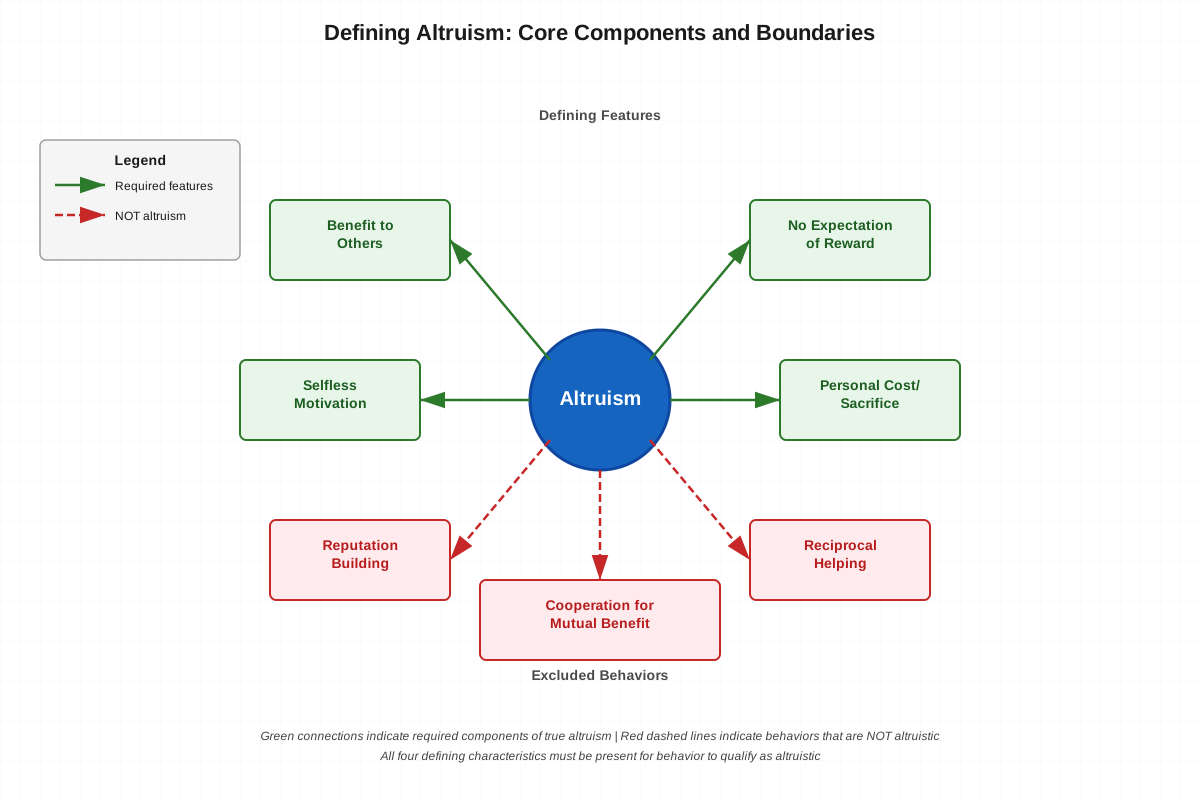
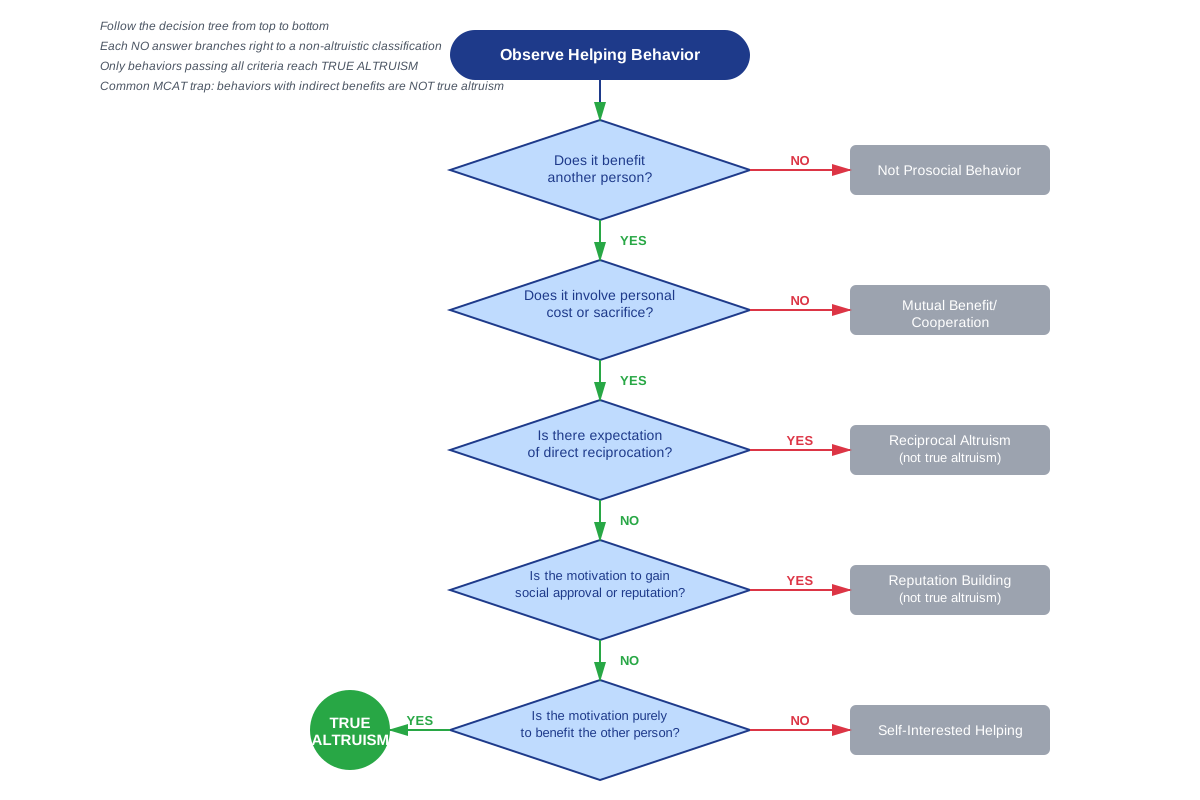
Altruism refers to behavior that benefits another individual at a cost to oneself, performed without expectation of external reward or reciprocation. The defining features include: (1) intentional action to help another, (2) personal cost or sacrifice to the helper, and (3) absence of expectation for direct compensation or benefit. This definition distinguishes altruism from other prosocial behaviors that may involve helping but also provide clear benefits to the helper.
The concept of "pure" or "true" altruism remains controversial in sociology and psychology. Some theorists argue that all apparently altruistic behavior ultimately serves self-interest, whether through genetic benefits (kin selection), future reciprocation, reputation enhancement, or psychological rewards (feeling good about helping). Others maintain that genuine altruism exists when the primary motivation is to reduce another's suffering, regardless of secondary benefits that may accrue.
Evolutionary Perspectives on Altruism
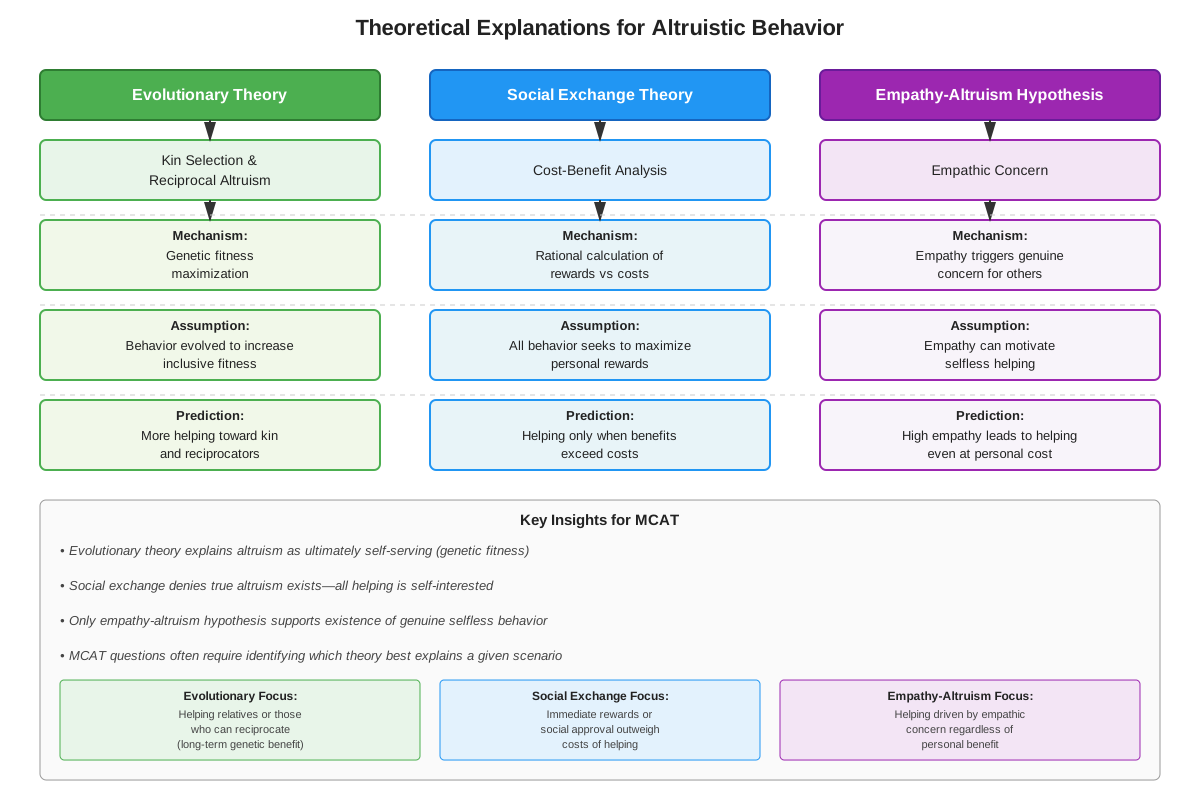
Kin selection theory, developed by W.D. Hamilton, explains altruistic behavior toward genetic relatives through the concept of inclusive fitness. According to this theory, genes promoting altruistic behavior toward kin can spread through populations because helping relatives survive and reproduce increases the likelihood that copies of the helper's genes (shared through common ancestry) persist in future generations. The degree of altruism predicted by kin selection correlates with genetic relatedness (coefficient of relatedness, r): individuals share 50% of genes with parents, siblings, and offspring (r = 0.5), 25% with grandparents, aunts/uncles, and half-siblings (r = 0.25), and 12.5% with first cousins (r = 0.125). Hamilton's rule states that altruistic behavior will be favored when rB > C, where r is genetic relatedness, B is benefit to recipient, and C is cost to helper.
Reciprocal altruism, proposed by Robert Trivers, explains helping behavior among non-relatives through the expectation of future reciprocation. This mechanism can evolve when individuals interact repeatedly, can recognize each other, and remember past interactions. Reciprocal altruism requires: (1) opportunities for repeated interactions, (2) ability to identify cheaters (those who receive help but don't reciprocate), and (3) mechanisms to punish non-reciprocators. This theory explains cooperation among unrelated individuals in stable social groups where "you scratch my back, I'll scratch yours" relationships develop over time.
Group selection theory proposes that altruistic behavior can evolve when it benefits the group, even at cost to individuals, if groups with more altruists outcompete groups with fewer altruists. While controversial and less widely accepted than kin selection or reciprocal altruism, group selection may explain extreme self-sacrifice in warfare or other contexts where group survival depends on individual sacrifice.
Social-Psychological Perspectives
The empathy-altruism hypothesis, developed by C. Daniel Batson, proposes that empathic concern for another person produces genuinely altruistic motivation to reduce that person's suffering. According to this theory, when we empathize with someone in need, we experience empathic concern (feelings of compassion, sympathy, tenderness) that motivates helping primarily to reduce the other person's distress, not our own. This contrasts with the egoistic motivation explanation, which argues that helping is ultimately self-serving—we help to reduce our own distress at witnessing another's suffering, to avoid guilt or shame, to gain social approval, or to feel good about ourselves.
Batson's research tested these competing hypotheses through experiments manipulating empathy and the ease of escaping the helping situation. Key findings showed that high-empathy participants helped even when escape was easy (suggesting genuine altruistic motivation), while low-empathy participants helped primarily when escape was difficult (suggesting egoistic motivation to reduce personal distress).
Social exchange theory provides an alternative framework, proposing that social behavior represents an exchange of resources where individuals seek to maximize rewards and minimize costs. From this perspective, apparently altruistic behavior reflects calculations (often unconscious) about costs and benefits, including tangible rewards (money, favors), social rewards (approval, status, reputation), and psychological rewards (positive feelings, reduced guilt). The theory predicts that helping increases when benefits exceed costs and decreases when costs exceed benefits.
Types of Altruism
| Type | Definition | Example | Motivation |
|---|---|---|---|
| Pure Altruism | Helping motivated solely by concern for recipient's welfare | Anonymously donating kidney to stranger | Empathic concern |
| Kin Altruism | Helping genetic relatives | Parent sacrificing for child | Inclusive fitness |
| Reciprocal Altruism | Helping with expectation of future reciprocation | Helping neighbor expecting future help | Delayed self-interest |
| Competitive Altruism | Helping to enhance reputation or status | Publicized charitable donations | Social status/reputation |
| Moral Altruism | Helping based on internalized moral principles | Helping due to religious/ethical beliefs | Adherence to values |
Factors Influencing Altruistic Behavior
Situational factors significantly impact helping behavior. The bystander effect demonstrates that individuals are less likely to help when others are present, due to diffusion of responsibility (assuming others will help) and pluralistic ignorance (interpreting others' inaction as indicating no help is needed). Proximity increases helping—we're more likely to help those physically or psychologically close to us. Perceived need and clarity of emergency also matter; ambiguous situations reduce helping because people are uncertain whether help is needed.
Individual characteristics affecting altruism include empathy (ability to understand and share others' feelings), mood (positive moods generally increase helping, though negative moods can increase or decrease helping depending on whether helping alleviates the bad mood), personality traits (agreeableness, social responsibility), and cultural background (individualistic versus collectivistic cultures show different patterns of helping behavior).
Cost-benefit considerations influence helping decisions. Costs include time, effort, resources, physical danger, and psychological distress. Benefits include feeling good, social approval, reciprocation, and reduced guilt. The arousal: cost-reward model proposes that witnessing someone in need creates physiological arousal, and individuals choose responses that reduce this arousal at lowest cost—helping when costs are low, but potentially ignoring or reinterpreting the situation when costs are high.
Measuring and Testing Altruism
Researchers use various methods to study altruistic motivation. Behavioral measures include observing actual helping behavior in naturalistic or laboratory settings. Self-report measures assess stated willingness to help or motivations for helping, though these may not reflect actual behavior. Experimental manipulations test causal relationships by varying factors hypothesized to influence altruism (empathy, cost, relationship to recipient) and measuring effects on helping.
A key methodological challenge involves distinguishing genuine altruism from egoistic motivation. Researchers address this by: (1) manipulating ease of escape (if helping persists when escape is easy, suggests altruistic motivation), (2) assessing whether helping reduces helper's distress or recipient's distress (altruistic motivation focuses on recipient), (3) examining helping when no one will know (eliminates reputation benefits), and (4) measuring physiological and neural correlates of empathic concern versus personal distress.
Concept Relationships
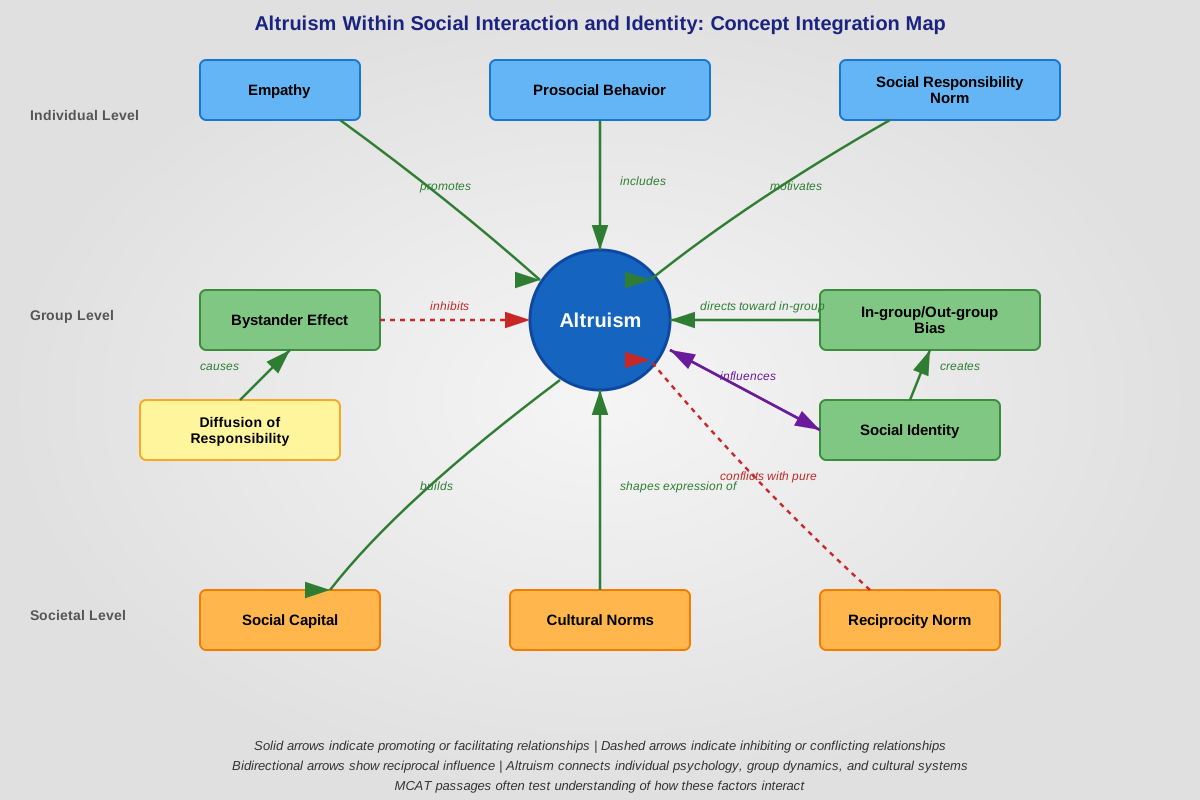
Altruism connects to multiple concepts within Social Interaction and Identity. The relationship flows as follows: Social norms (particularly norms of social responsibility and reciprocity) → shape expectations about altruistic behavior → which represents one form of prosocial behavior → influenced by group identity and in-group favoritism → mediated by empathy and perspective-taking → affected by social context (bystander effect, diffusion of responsibility).
Evolutionary explanations link altruism to kin selection → which operates through inclusive fitness → explaining why genetic relatedness predicts helping behavior. Separately, reciprocal altruism → requires repeated interactions → within stable social groups → where reputation matters → connecting to social capital and social networks.
The empathy-altruism hypothesis connects empathic concern → to altruistic motivation → distinguishing it from egoistic motivation → which relates to social exchange theory → where behavior reflects cost-benefit analysis → influenced by rewards and punishments → within social structures.
Understanding altruism also requires recognizing its relationship to moral development (Kohlberg's stages), cultural values (individualism versus collectivism), social identity theory (helping in-group versus out-group members), and attribution theory (how we explain others' helping or non-helping behavior).
Quick check — test yourself on Altruism so far.
Try Flashcards →High-Yield Facts
⭐ Altruism is defined as behavior benefiting another at cost to oneself, without expectation of external reward or reciprocation
⭐ Kin selection explains altruism toward genetic relatives through inclusive fitness; Hamilton's rule (rB > C) predicts when altruistic behavior will be favored
⭐ Reciprocal altruism explains helping among non-relatives through expectation of future reciprocation, requiring repeated interactions and ability to identify cheaters
⭐ The empathy-altruism hypothesis proposes that empathic concern produces genuinely altruistic motivation, while egoistic alternatives suggest helping ultimately serves self-interest
⭐ The bystander effect demonstrates that helping decreases as the number of bystanders increases, due to diffusion of responsibility and pluralistic ignorance
- Social exchange theory views helping as cost-benefit calculation where individuals maximize rewards and minimize costs
- Inclusive fitness refers to an individual's genetic success measured by personal reproduction plus effects on relatives' reproduction, weighted by genetic relatedness
- Competitive altruism involves helping to enhance reputation or social status, representing a form of indirect self-interest
- Genetic relatedness (coefficient of relatedness, r) predicts degree of altruism: r = 0.5 for siblings/parents/offspring, r = 0.25 for grandparents/aunts/uncles, r = 0.125 for first cousins
- The arousal: cost-reward model proposes that witnessing need creates arousal, and individuals choose responses minimizing costs while reducing arousal
Common Misconceptions
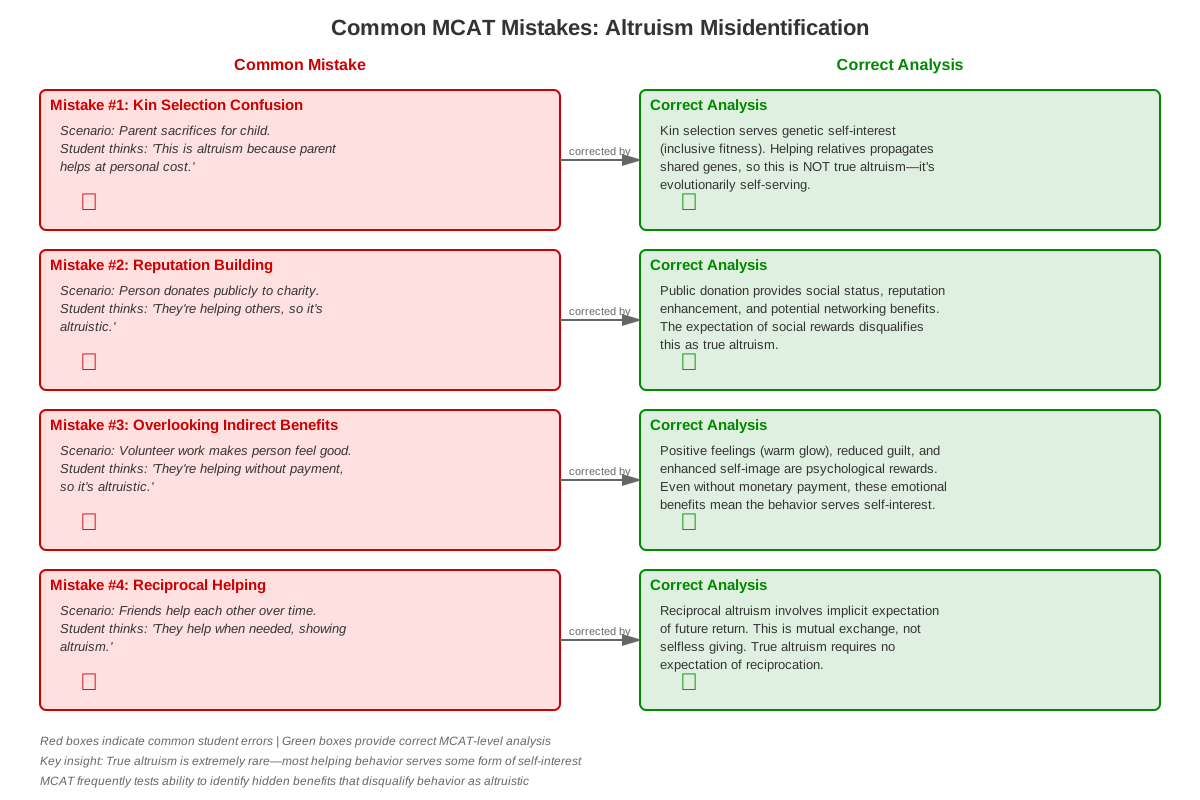
Misconception: Altruism always means completely selfless behavior with no benefits to the helper whatsoever. → Correction: Even genuine altruism may produce secondary benefits (feeling good, social approval), but these are not the primary motivation. The key distinction is whether the primary goal is reducing the recipient's need or obtaining personal benefits.
Misconception: Kin selection means organisms consciously calculate genetic relatedness before helping relatives. → Correction: Kin selection operates through evolved psychological mechanisms (attachment, recognition of kin) that promote helping behavior toward relatives without conscious genetic calculations. The evolutionary process favors genes promoting such mechanisms, not conscious awareness of genetic theory.
Misconception: Reciprocal altruism is not "true" altruism because it involves expectation of future benefit. → Correction: This is actually correct—reciprocal altruism is not pure altruism by strict definitions, but rather represents delayed self-interest. The term "reciprocal altruism" is somewhat misleading; it describes cooperation among non-relatives, not genuinely selfless behavior.
Misconception: The bystander effect means people don't care about others when in groups. → Correction: The bystander effect results from diffusion of responsibility and pluralistic ignorance, not lack of concern. Individuals in groups often want to help but assume others will act or misinterpret others' inaction as indicating no help is needed.
Misconception: Empathy always leads to helping behavior. → Correction: While empathy increases likelihood of helping, other factors (cost, ability to help, competing demands) also influence behavior. High empathy with high cost may lead to avoiding the situation rather than helping. Additionally, personal distress (feeling upset by another's suffering) differs from empathic concern and may motivate escape rather than helping.
Misconception: Altruistic behavior is unique to humans. → Correction: Many species exhibit altruistic behavior, particularly toward kin. Examples include alarm calls in ground squirrels (warning relatives of predators at cost to caller), cooperative breeding in birds, and food sharing in vampire bats. These behaviors are explained by kin selection and reciprocal altruism.
Worked Examples
Example 1: Distinguishing Altruistic Motivation
Scenario: Researchers conduct an experiment where participants watch a video of a student (Carol) struggling with coursework. Participants are randomly assigned to high-empathy (told to imagine Carol's feelings) or low-empathy (told to remain objective) conditions. Half of each group is told they can leave after the video (easy escape), while half is told they'll watch Carol continue struggling (difficult escape). The dependent variable is percentage agreeing to help Carol with coursework.
Results:
- High empathy/easy escape: 83% help
- High empathy/difficult escape: 87% help
- Low empathy/easy escape: 33% help
- Low empathy/difficult escape: 72% help
Question: What do these results suggest about altruistic versus egoistic motivation?
Analysis:
Step 1: Identify the theoretical predictions. The empathy-altruism hypothesis predicts that high empathy produces genuinely altruistic motivation focused on reducing Carol's need, so helping should remain high regardless of escape difficulty. Egoistic motivation predicts that helping primarily serves to reduce the helper's distress, so helping should decrease when escape is easy (can avoid distress by leaving).
Step 2: Examine high-empathy conditions. Helping remains consistently high (83% vs. 87%) whether escape is easy or difficult. This supports the empathy-altruism hypothesis—participants help to reduce Carol's need, not primarily to reduce their own distress (otherwise easy escape would substantially reduce helping).
Step 3: Examine low-empathy conditions. Helping is much lower with easy escape (33%) than difficult escape (72%). This pattern suggests egoistic motivation—when empathy is low, participants help primarily when they can't easily escape the situation, consistent with helping to reduce personal distress rather than genuine concern for Carol.
Step 4: Compare conditions. The interaction between empathy and escape difficulty supports the empathy-altruism hypothesis. High empathy produces helping regardless of escape (altruistic motivation), while low empathy produces helping primarily when escape is difficult (egoistic motivation).
Conclusion: These results support the empathy-altruism hypothesis by demonstrating that empathic concern produces helping even when escape is easy, suggesting genuinely altruistic motivation rather than egoistic motivation to reduce personal distress.
Example 2: Applying Evolutionary Theory
Scenario: A researcher observes helping behavior in a community and records: (1) genetic relationship between helper and recipient, (2) cost to helper (low/medium/high), and (3) whether helping occurred. Results show:
- Siblings: 90% help at low cost, 70% at medium cost, 40% at high cost
- First cousins: 60% help at low cost, 35% at medium cost, 15% at high cost
- Unrelated neighbors: 50% help at low cost, 20% at medium cost, 5% at high cost
Question: How do these results relate to kin selection theory and Hamilton's rule?
Analysis:
Step 1: Review Hamilton's rule (rB > C). Altruistic behavior is favored when the benefit to recipient (B), weighted by genetic relatedness (r), exceeds cost to helper (C). This predicts: (1) more helping toward closer relatives (higher r), and (2) less helping as cost increases (higher C).
Step 2: Examine effect of genetic relatedness. At each cost level, helping is highest for siblings (r = 0.5), intermediate for first cousins (r = 0.125), and lowest for unrelated neighbors (r = 0). This pattern strongly supports kin selection—helping increases with genetic relatedness as predicted.
Step 3: Examine effect of cost. For each relationship category, helping decreases as cost increases. For siblings: 90% → 70% → 40%; for first cousins: 60% → 35% → 15%; for unrelated neighbors: 50% → 20% → 5%. This supports Hamilton's rule—as C increases, the inequality rB > C becomes harder to satisfy, reducing helping.
Step 4: Note helping toward unrelated neighbors. Even unrelated individuals receive some help, especially at low cost (50%). This cannot be explained by kin selection but may reflect reciprocal altruism (expectation of future reciprocation from neighbors), social norms, or empathy-based altruism.
Step 5: Examine interaction effects. The decline in helping as cost increases is steepest for unrelated neighbors (50% → 5%, a 45-point drop) and shallowest for siblings (90% → 40%, a 50-point drop, but still 40% help at high cost). This suggests that genetic relatedness buffers against cost—people are more willing to incur high costs for close relatives.
Conclusion: The data strongly support kin selection theory, showing that helping increases with genetic relatedness and decreases with cost, consistent with Hamilton's rule. The presence of helping toward unrelated neighbors, particularly at low cost, suggests additional mechanisms (reciprocal altruism, social norms) operate alongside kin selection.
Exam Strategy
Approaching Altruism Questions: First, identify whether the question asks about (1) definitions and distinctions (what is/isn't altruism), (2) theoretical explanations (why altruism occurs), or (3) factors influencing helping behavior (when altruism occurs). For definition questions, focus on the presence/absence of expectation for reward. For theoretical questions, distinguish evolutionary (kin selection, reciprocal altruism) from social-psychological (empathy-altruism, social exchange) explanations. For factor questions, consider situational variables (bystander effect, cost) and individual differences (empathy, relationship).
Trigger Words and Phrases: Watch for "selfless," "no expectation of reward," "genetic relatedness," "coefficient of relatedness," "inclusive fitness," "reciprocal," "empathic concern," "personal distress," "cost-benefit," "bystander effect," "diffusion of responsibility," and "prosocial behavior." The phrase "genuinely altruistic" or "true altruism" signals questions about motivation (empathy-altruism vs. egoistic alternatives). "Evolutionary perspective" or "adaptive value" indicates kin selection or reciprocal altruism. "Why do people help" questions typically require distinguishing competing theoretical explanations.
Process of Elimination: Eliminate answers suggesting altruism requires expectation of reward (contradicts definition). Eliminate answers confusing kin selection (helping relatives) with reciprocal altruism (helping non-relatives expecting reciprocation). For empathy-altruism questions, eliminate answers suggesting empathy produces helping only when escape is difficult (that's egoistic motivation). For bystander effect questions, eliminate answers attributing non-helping to apathy rather than diffusion of responsibility or pluralistic ignorance.
Time Allocation: Altruism questions typically require 60-90 seconds. Definition questions (30-45 seconds) are fastest—identify key features and eliminate wrong answers. Theoretical questions (60-75 seconds) require comparing explanations and matching to scenarios. Research-based passage questions (90+ seconds) demand analyzing experimental design, identifying variables, and connecting results to theory. Don't overthink—MCAT favors straightforward applications of core concepts over subtle philosophical debates about "true" altruism.
Exam Tip: When passages present research on helping behavior, immediately identify: (1) What's being manipulated (independent variable)? (2) What's being measured (dependent variable)? (3) Which theory predicts these results? Common manipulations include empathy level, ease of escape, relationship to recipient, cost of helping, and number of bystanders.
Memory Techniques
Mnemonic for Hamilton's Rule: "Relatives Benefit Costs" → rB > C (genetic relatedness × benefit > cost)
Mnemonic for Genetic Relatedness Values: "Parents, Siblings, Offspring = ½; Grandparents, Aunts, Uncles = ¼; Cousins = ⅛" → "PSO at half, GAU at quarter, C at eighth"
Mnemonic for Bystander Effect Mechanisms: "Diffusion and Pluralistic" → DP (Diffusion of responsibility + Pluralistic ignorance)
Visualization for Empathy-Altruism: Picture a heart (empathic concern) pointing toward another person (focus on their need) versus a mirror (personal distress) reflecting back to self (focus on own discomfort). Heart = altruistic motivation; Mirror = egoistic motivation.
Acronym for Types of Altruism: "Kin, Reciprocal, Competitive, Moral" → KRCM ("Kirk-um")
Memory Aid for Factors Increasing Helping: "Close, Clear, Capable, Cheap" → Four C's (Close relationship/proximity, Clear need, Capable of helping, Cheap/low cost)
Summary
Altruism represents selfless behavior benefiting others at personal cost without expectation of reward, though debate continues about whether genuinely selfless motivation exists. Evolutionary perspectives explain altruism through kin selection (helping relatives increases inclusive fitness according to Hamilton's rule: rB > C) and reciprocal altruism (helping non-relatives expecting future reciprocation). Social-psychological perspectives include the empathy-altruism hypothesis (empathic concern produces genuine altruistic motivation) and social exchange theory (helping reflects cost-benefit calculations). The bystander effect demonstrates that helping decreases with more observers due to diffusion of responsibility and pluralistic ignorance. Factors influencing altruism include genetic relatedness, cost-benefit considerations, empathy, proximity, clarity of need, and cultural norms. For the MCAT, students must distinguish true altruism from behaviors serving indirect self-interest, apply theoretical frameworks to experimental scenarios, and analyze factors affecting helping behavior in various contexts.
Key Takeaways
- Altruism is behavior benefiting others at personal cost without expectation of external reward, though whether genuinely selfless motivation exists remains debated
- Kin selection explains helping genetic relatives through inclusive fitness; Hamilton's rule (rB > C) predicts altruism increases with genetic relatedness and decreases with cost
- Reciprocal altruism explains cooperation among non-relatives through expectation of future reciprocation, requiring repeated interactions and ability to identify cheaters
- The empathy-altruism hypothesis proposes empathic concern produces genuinely altruistic motivation (helping even when escape is easy), contrasting with egoistic explanations
- The bystander effect shows helping decreases as number of observers increases due to diffusion of responsibility and pluralistic ignorance
- MCAT questions frequently require distinguishing competing explanations for helping behavior and analyzing experimental designs testing altruistic motivation
- Understanding altruism requires integrating evolutionary biology, social psychology, and research methods to explain when, why, and toward whom helping occurs
Related Topics
Prosocial Behavior: The broader category of positive social actions including altruism, cooperation, sharing, and comforting. Mastering altruism provides foundation for understanding various forms of prosocial behavior and factors promoting positive social interactions.
Social Exchange Theory: Framework viewing social behavior as exchange of resources where individuals maximize rewards and minimize costs. Understanding this theory helps explain helping behavior from cost-benefit perspective and contrasts with empathy-altruism hypothesis.
Bystander Effect and Diffusion of Responsibility: Phenomena where helping decreases with more observers. These concepts extend altruism by explaining situational factors that inhibit helping despite altruistic motivation.
Empathy and Perspective-Taking: Psychological processes involving understanding and sharing others' feelings. These concepts underlie the empathy-altruism hypothesis and explain individual differences in helping behavior.
Social Identity and In-Group Favoritism: Tendency to favor members of one's own group. Understanding these concepts explains patterns of helping behavior showing preferential treatment of in-group members beyond genetic relatedness.
Moral Development: Kohlberg's stages of moral reasoning and development of ethical principles. This topic connects to moral altruism and explains how internalized values motivate helping behavior.
Practice CTA
Now that you've mastered the core concepts of altruism, test your understanding with practice questions and flashcards. Focus on distinguishing between theoretical explanations, analyzing experimental designs, and applying concepts to novel scenarios. Remember that altruism frequently appears in MCAT passages requiring integration of evolutionary biology, social psychology, and research methods—practice identifying which framework best explains observed helping behavior. Your ability to quickly recognize trigger words and apply the appropriate theoretical lens will significantly improve your performance on exam day. Stay motivated—understanding altruism not only helps you succeed on the MCAT but also provides insight into the prosocial behaviors essential to effective medical practice!
Sign up free to keep reading
Create a free AnvayaPrep account to finish this MCAT guide on Altruism — plus flashcards and practice questions.