Overview
The area of parallelograms is a fundamental geometric concept that appears regularly on the SAT math section, making it a high-yield topic for test preparation. A parallelogram is a quadrilateral with two pairs of parallel sides, and calculating its area requires understanding the relationship between base, height, and the angles formed by its sides. Unlike rectangles where any side can serve as both base and height, parallelograms require careful identification of the perpendicular height, which is the key distinguishing feature that makes this topic both testable and prone to student errors.
This topic bridges multiple mathematical domains tested on the SAT. It connects basic geometric principles with coordinate geometry, algebraic manipulation, and spatial reasoning. Students must not only memorize the area formula but also recognize when and how to apply it in various contexts—from straightforward calculation problems to complex multi-step questions involving coordinate planes, composite figures, or real-world applications. The SAT frequently embeds parallelogram area questions within larger problems, requiring students to extract relevant information and apply the correct formula under time pressure.
Mastering the sat area of parallelograms provides a foundation for understanding more complex geometric concepts including areas of other polygons, three-dimensional figures, and coordinate geometry transformations. The skills developed here—identifying perpendicular distances, working with oblique angles, and visualizing geometric relationships—transfer directly to other high-value SAT topics such as triangle areas, trapezoid calculations, and volume problems. This interconnectedness makes parallelogram area calculations an essential building block in the comprehensive geometry knowledge required for SAT success.
Learning Objectives
- [ ] Identify key features of area of parallelograms including base, height, and side lengths
- [ ] Explain how area of parallelograms appears on the SAT in various question formats
- [ ] Apply area of parallelograms formulas to answer SAT-style questions accurately
- [ ] Distinguish between slant height and perpendicular height in parallelogram problems
- [ ] Calculate parallelogram areas using coordinate geometry methods
- [ ] Solve multi-step problems involving parallelograms combined with other geometric figures
- [ ] Recognize and correct common errors in parallelogram area calculations
Prerequisites
- Basic area concepts: Understanding that area measures two-dimensional space in square units is essential for applying any area formula correctly
- Properties of parallel lines: Recognizing parallel sides and understanding their geometric implications helps identify parallelograms and their features
- Right triangle trigonometry: Basic sine and cosine functions may be needed when height must be calculated from side lengths and angles
- Coordinate plane fundamentals: Plotting points and calculating distances between coordinates is necessary for coordinate geometry parallelogram problems
- Algebraic manipulation: Solving equations and working with variables appears frequently in SAT parallelogram questions
Why This Topic Matters
Understanding parallelogram area calculations has practical applications in architecture, engineering, design, and construction. Professionals regularly work with non-rectangular shapes when designing roofs, calculating material needs for angled surfaces, or determining land areas on sloped terrain. The ability to decompose complex shapes into manageable components—a skill developed through parallelogram problems—is valuable across STEM fields and everyday problem-solving situations.
On the SAT, parallelogram area questions appear in approximately 2-4 questions per test, either as standalone geometry problems or embedded within larger multi-step questions. These questions typically appear in both the calculator and no-calculator sections, with difficulty ranging from straightforward formula application to complex coordinate geometry problems. The College Board frequently tests this concept because it assesses multiple skills simultaneously: geometric reasoning, formula application, spatial visualization, and careful attention to the distinction between different measurements.
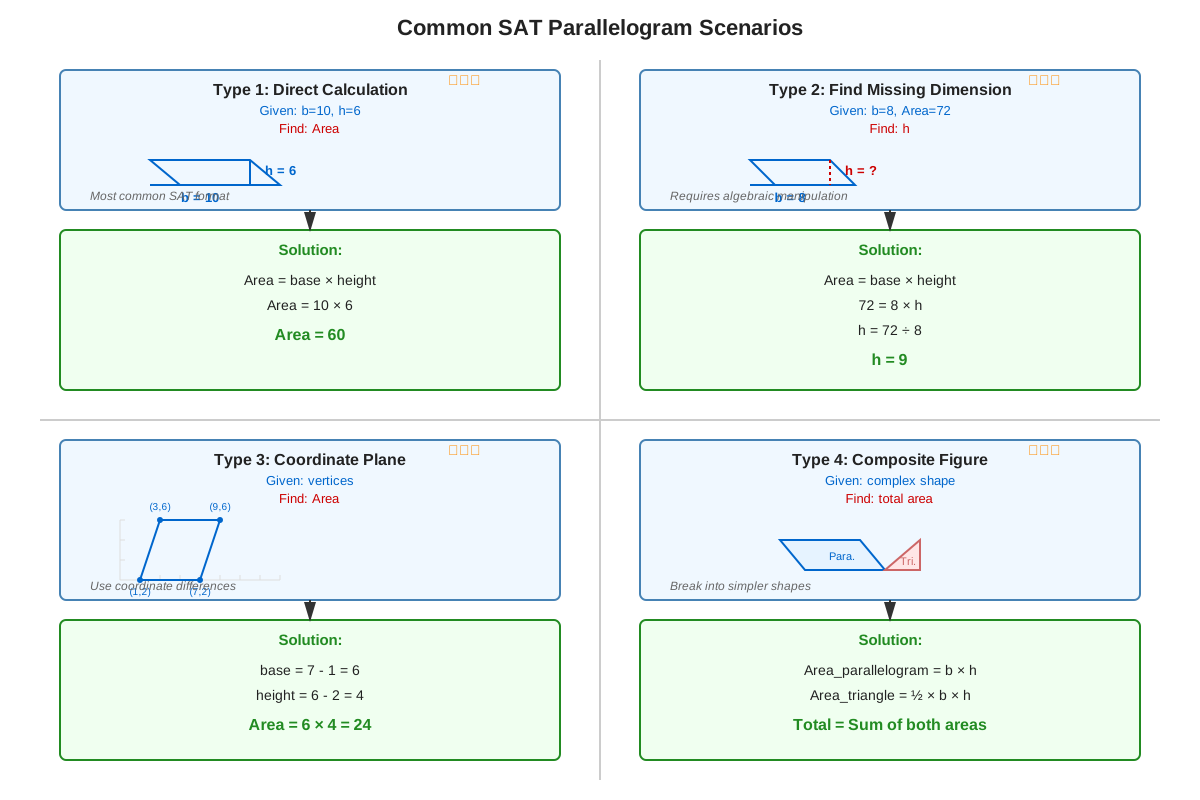
Common SAT question formats include: direct area calculations given base and height; problems requiring students to find missing dimensions when area is provided; coordinate geometry questions where students must determine parallelogram vertices and calculate area; composite figure problems where parallelograms combine with triangles or other shapes; and word problems requiring translation of real-world scenarios into geometric calculations. The topic also appears in questions testing proportional reasoning, where students must determine how area changes when dimensions are scaled.
Core Concepts
The Parallelogram Area Formula
The fundamental formula for calculating the area of parallelograms is:
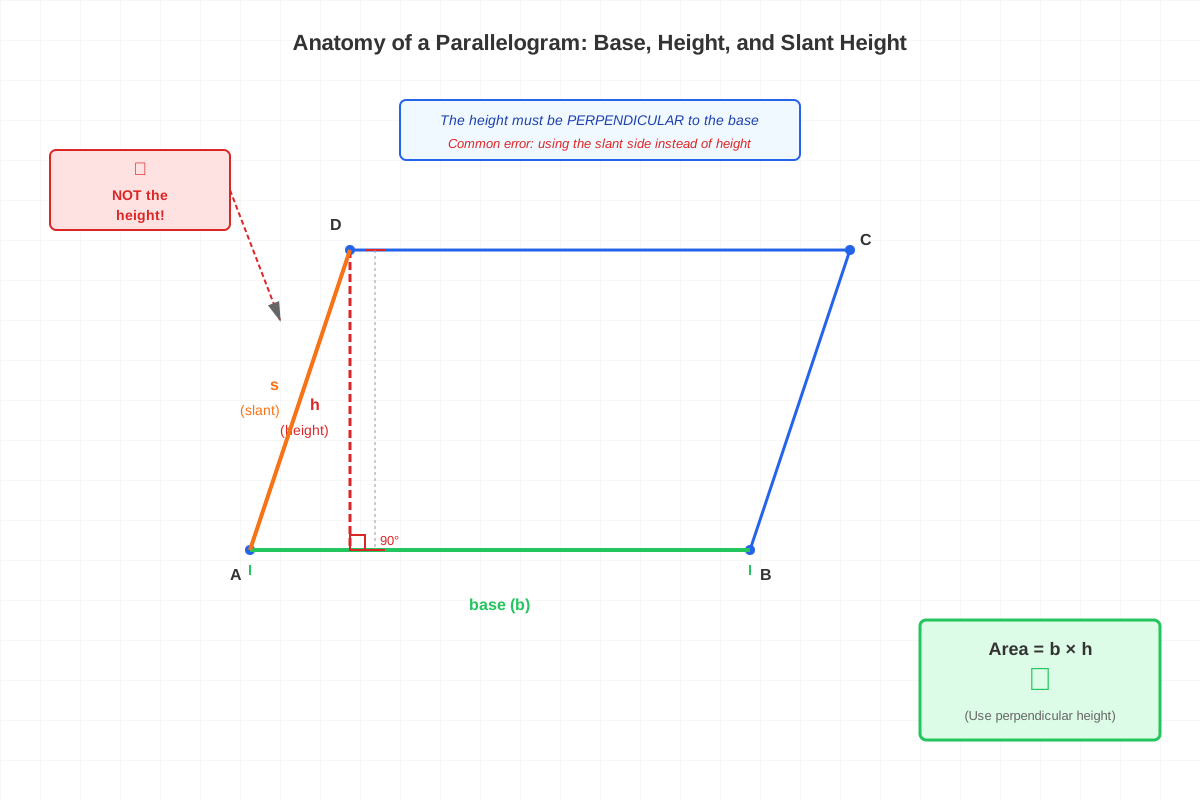
Area = base × heightThis formula appears deceptively simple but contains a critical nuance that distinguishes it from rectangle area calculations. The base can be any side of the parallelogram, but the height must be the perpendicular distance from that base to the opposite parallel side. This perpendicular requirement is the most frequently tested aspect of parallelogram problems on the SAT.
The height is NOT the slant side length unless the parallelogram happens to be a rectangle. Many students incorrectly multiply two adjacent sides together, which yields an incorrect result. The height forms a right angle with the base, creating a right triangle when drawn from the opposite side. This perpendicular height may fall inside the parallelogram (for acute angles) or outside it (for obtuse angles), but it always represents the shortest distance between the parallel sides.
Key Features of Parallelograms
Understanding the defining properties of parallelograms helps identify when to apply area formulas and how to extract necessary information from problems:
| Property | Description | SAT Relevance |
|---|---|---|
| Opposite sides parallel | Two pairs of parallel sides define the shape | Helps identify parallelograms in coordinate geometry |
| Opposite sides equal | Parallel sides have equal length | Useful for finding missing dimensions |
| Opposite angles equal | Angles across from each other are congruent | Important for trigonometric height calculations |
| Consecutive angles supplementary | Adjacent angles sum to 180° | Helps find angles needed for height calculations |
| Diagonals bisect each other | Diagonals cut each other in half | Relevant for coordinate geometry problems |
Calculating Height from Given Information
SAT questions rarely provide height directly; instead, they require students to determine it from other given information. Three common scenarios appear:
Scenario 1: Height Given Explicitly
The simplest case where the problem states the perpendicular height or shows it clearly in a diagram. Students simply apply the formula directly.
Scenario 2: Height Calculated Using Trigonometry
When given a side length and an angle, use trigonometric functions:
height = side × sin(angle)For example, if a parallelogram has a side of 10 units and forms a 30° angle with the base, the height equals 10 × sin(30°) = 10 × 0.5 = 5 units.
Scenario 3: Height Determined from Coordinate Geometry
When parallelogram vertices are given as coordinates, the height can be calculated as the perpendicular distance between parallel sides. This often involves finding the distance from a point to a line using the point-to-line distance formula or by recognizing that horizontal or vertical distances represent the height.
Coordinate Geometry Approach
For parallelograms on the coordinate plane, two methods calculate area:
Method 1: Base-Height Method
- Identify two parallel sides (often horizontal or vertical for simplicity)
- Calculate the length of one side as the base
- Find the perpendicular distance to the opposite parallel side as height
- Multiply base × height
Method 2: Shoelace Formula
For vertices (x₁, y₁), (x₂, y₂), (x₃, y₃), (x₄, y₄) in order:
Area = ½|x₁y₂ + x₂y₃ + x₃y₄ + x₄y₁ - (y₁x₂ + y₂x₃ + y₃x₄ + y₄x₁)|While this formula works, the base-height method is typically faster and less error-prone for SAT questions.
Special Cases: Rectangles and Rhombi
Two special types of parallelograms appear frequently:
Rectangles: All angles are 90°, so any side can serve as both base and height. The area formula simplifies to length × width, and the perpendicular height equals the adjacent side length.
Rhombi: All sides are equal length. Area can be calculated using base × height, but also using the alternative formula involving diagonals:
Area = (diagonal₁ × diagonal₂) / 2The SAT may test whether students recognize when to use alternative formulas for these special cases.
Composite Figures Involving Parallelograms
SAT questions frequently embed parallelograms within larger figures or combine them with other shapes. Common scenarios include:
- A parallelogram with a triangle removed or added
- Multiple parallelograms forming a larger shape
- A parallelogram inscribed in or circumscribed around other figures
- Real-world objects modeled as parallelograms
For these problems, the strategy involves:
- Identifying individual shapes and their dimensions
- Calculating each area separately
- Adding or subtracting areas as appropriate
- Checking that the final answer makes logical sense
Concept Relationships
The area of parallelograms concept builds directly on fundamental area understanding, where students first learn that area measures two-dimensional space. This foundation → extends to → parallelograms by maintaining the base × height structure while adding the critical requirement of perpendicular height.
Within parallelogram problems themselves, several concepts interconnect: identifying the base → requires → recognizing parallel sides, which → leads to → determining the perpendicular height, which → may require → trigonometric calculations or coordinate geometry methods. These skills combine in multi-step problems where students must first establish the parallelogram's dimensions before calculating area.
The parallelogram area concept connects upward to more complex topics: understanding parallelogram area → enables → calculating areas of trapezoids (which can be decomposed into parallelograms and triangles), and → supports → three-dimensional volume calculations for prisms with parallelogram bases. Additionally, the coordinate geometry methods used for parallelograms → transfer directly to → calculating areas of any polygon using coordinate-based approaches.
Horizontally, parallelogram area relates to triangle area through the relationship that a parallelogram can be divided into two congruent triangles. This connection means that triangle area = ½ × base × height directly parallels the parallelogram formula, and students who understand one concept can leverage that knowledge for the other.
Quick check — test yourself on Area of parallelograms so far.
Try Flashcards →High-Yield Facts
⭐ The area of a parallelogram equals base times perpendicular height, where height must form a 90° angle with the base
⭐ The height is NOT the slant side length unless the parallelogram is a rectangle
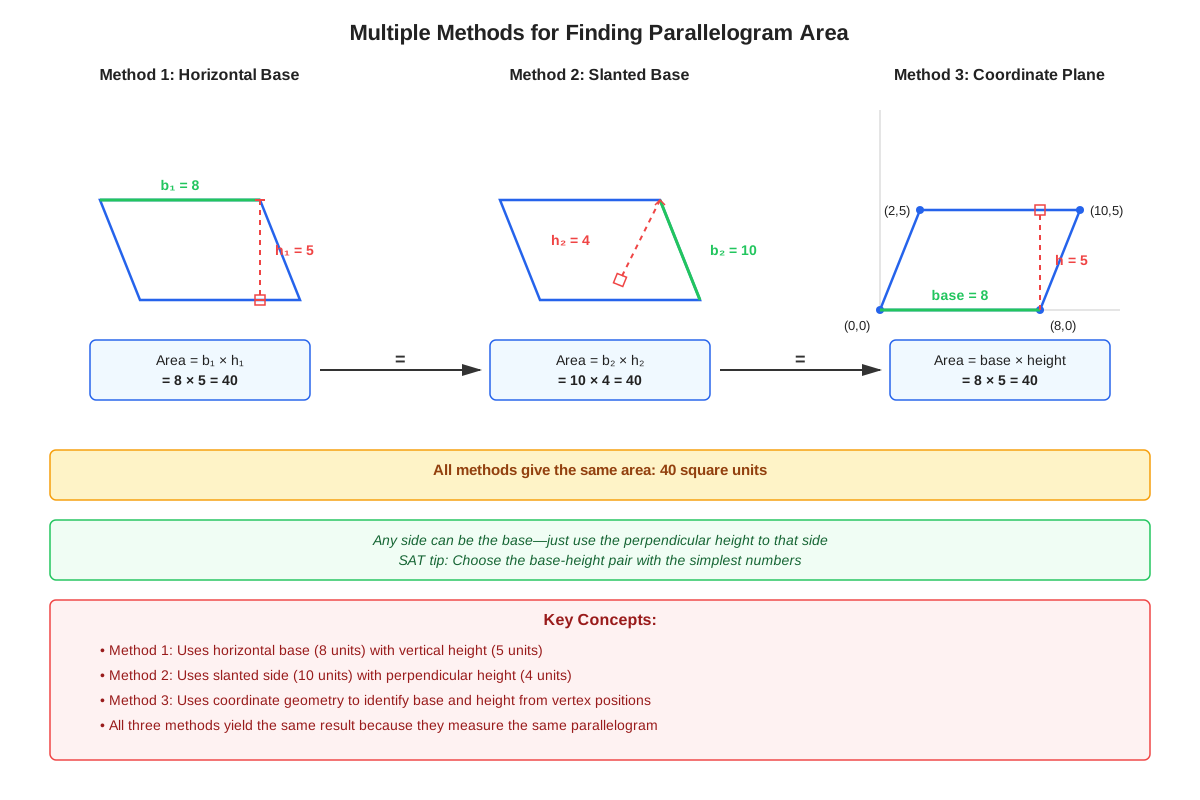
⭐ Any side can serve as the base, but the height must be perpendicular to that chosen base
⭐ When given a side length and angle, calculate height using: height = side × sin(angle)
⭐ Opposite sides of a parallelogram are equal in length and parallel to each other
- Consecutive angles in a parallelogram are supplementary (sum to 180°)
- A parallelogram with all right angles is a rectangle; with all equal sides is a rhombus
- The diagonals of a parallelogram bisect each other but are not necessarily equal in length
- For coordinate geometry problems, identify parallel sides by equal slopes
- A parallelogram can be divided into two congruent triangles by drawing a diagonal
- The area of a parallelogram equals twice the area of a triangle with the same base and height
- If a parallelogram's dimensions are scaled by factor k, its area scales by k²
- The altitude (height) of a parallelogram may fall outside the figure when angles are obtuse
Common Misconceptions
Misconception: The area of a parallelogram equals the product of two adjacent sides.
Correction: Area equals base times perpendicular height, not base times slant side. The slant side is only the height when the parallelogram is a rectangle with 90° angles.
Misconception: The height always falls inside the parallelogram.
Correction: When a parallelogram has obtuse angles, the perpendicular height line extends outside the figure. The height is still the perpendicular distance between parallel sides, regardless of where that perpendicular line falls.
Misconception: All parallelograms are rectangles.
Correction: Rectangles are a special type of parallelogram with four right angles. Most parallelograms have oblique angles and require careful height identification separate from side lengths.
Misconception: The diagonals of a parallelogram are always equal.
Correction: Diagonals are equal only in rectangles and squares. In general parallelograms, diagonals bisect each other but have different lengths.
Misconception: When coordinates are given, the distance between any two vertices can serve as the height.
Correction: Height must be the perpendicular distance between parallel sides. In coordinate geometry, this often means finding the vertical or horizontal distance between parallel sides, not the diagonal distance between vertices.
Misconception: Doubling the base and height doubles the area.
Correction: Doubling both dimensions quadruples the area because area depends on both dimensions multiplicatively. If base and height both double, area increases by a factor of 2 × 2 = 4.
Worked Examples
Example 1: Basic Application with Trigonometry
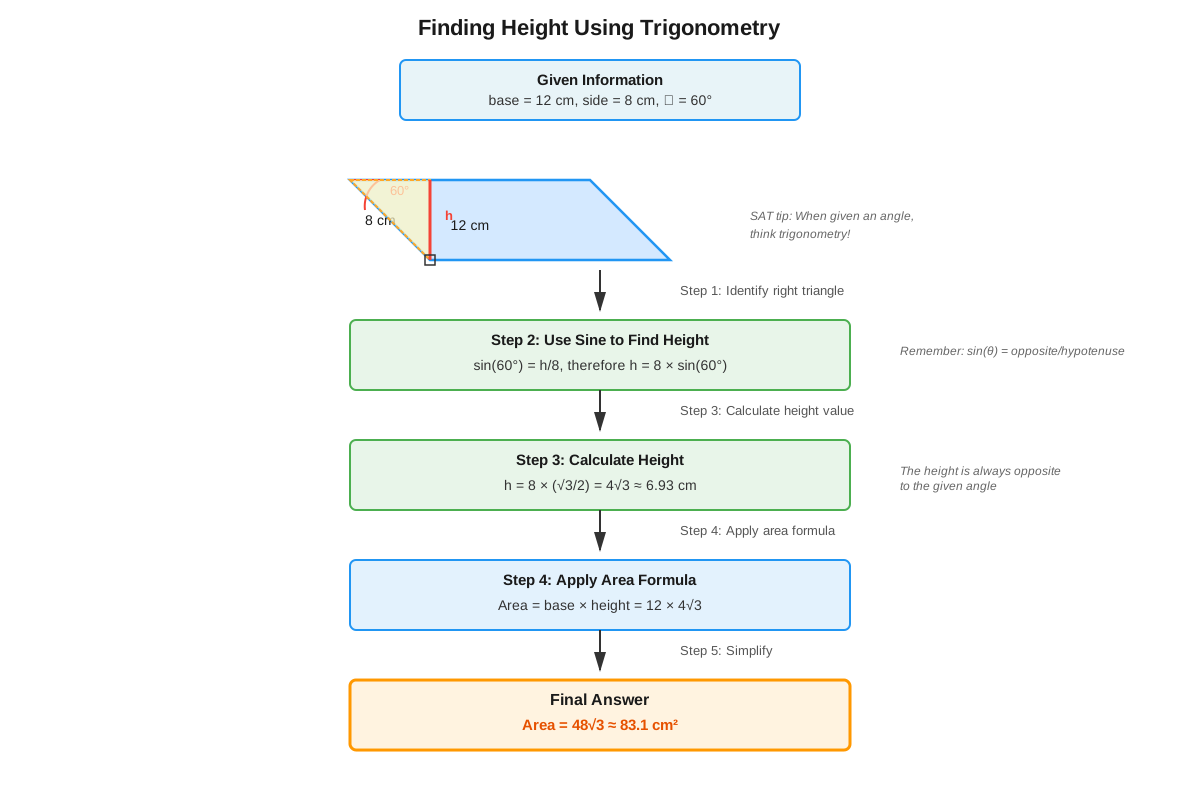
Problem: A parallelogram has a base of 12 cm and a side of 8 cm that forms a 60° angle with the base. What is the area of the parallelogram?
Solution:
Step 1: Identify what we know and what we need.
- Base = 12 cm
- Side = 8 cm
- Angle between base and side = 60°
- We need the perpendicular height to use the area formula
Step 2: Calculate the height using trigonometry.
The height forms a right triangle with the side, where the side is the hypotenuse and the height is opposite the 60° angle.
height = side × sin(angle)
height = 8 × sin(60°)
height = 8 × (√3/2)
height = 4√3 cm
height ≈ 6.93 cm
Step 3: Apply the area formula.
Area = base × height
Area = 12 × 4√3
Area = 48√3 cm²
Area ≈ 83.1 cm²
Key Insight: This problem tests whether students recognize that the 8 cm side is NOT the height. The perpendicular height must be calculated using the sine function because we have an angle and the hypotenuse of the right triangle formed by the height.
Example 2: Coordinate Geometry Application
Problem: A parallelogram has vertices at A(1, 2), B(5, 2), C(7, 6), and D(3, 6). Find the area of the parallelogram.
Solution:
Step 1: Plot or visualize the points to understand the parallelogram's orientation.
- Points A and B both have y-coordinate 2 (horizontal line)
- Points C and D both have y-coordinate 6 (horizontal line)
- These form the two parallel horizontal sides
Step 2: Identify the base.
The base can be either AB or CD. Let's use AB:
Base = distance from A to B = 5 - 1 = 4 unitsStep 3: Identify the height.
Since AB and CD are horizontal lines, the height is the vertical distance between them:
Height = 6 - 2 = 4 unitsStep 4: Calculate the area.
Area = base × height
Area = 4 × 4 = 16 square unitsVerification: We can verify this is a parallelogram by checking that opposite sides are parallel and equal:
- AB is horizontal with length 4
- DC is horizontal with length 4 (from x = 7 to x = 3)
- AD has slope (6-2)/(3-1) = 4/2 = 2
- BC has slope (6-2)/(7-5) = 4/2 = 2
Key Insight: When parallelogram sides align with coordinate axes, finding base and height becomes straightforward. The horizontal distance provides the base, and the vertical distance provides the height. This problem reinforces that recognizing the orientation of the figure simplifies calculations significantly.
Exam Strategy
When approaching SAT area of parallelograms questions, begin by carefully reading the problem to identify what information is provided and what is being asked. Look for explicit statements about height versus side length—the SAT deliberately includes both to test whether students understand the distinction. If a diagram is provided, mark the perpendicular height with a clear notation to avoid confusing it with slant sides.
Trigger words and phrases to watch for include:
- "perpendicular distance" or "altitude" → indicates the height is being specified
- "side length" without "height" → requires calculation of height from other information
- "forms an angle of" → signals trigonometry will be needed to find height
- "vertices at" or "coordinates" → indicates a coordinate geometry approach
- "base" → can be any side, but height must be perpendicular to it
For process of elimination, recognize that incorrect answer choices often result from common errors:
- Multiplying two adjacent sides (too large unless it's a rectangle)
- Using the slant side as height (typically too large)
- Forgetting to multiply base and height (too small)
- Confusing perimeter with area (completely different magnitude)
When multiple answer choices seem plausible, check units and reasonableness. Area must be in square units, and the numerical value should be less than the product of the two longest sides but more than half that product (since a parallelogram's area is less than a rectangle with the same side lengths but more than a triangle).
Time allocation: Straightforward parallelogram area problems should take 30-60 seconds. Problems requiring trigonometric calculations or coordinate geometry may take 90-120 seconds. If a problem takes longer, mark it and return after completing easier questions. The SAT rewards efficient time management, and parallelogram problems should not consume disproportionate time.
For multi-step problems, write down the area formula first, then identify what information you need to complete it. This structured approach prevents errors and helps you recognize when additional calculations (like finding height from an angle) are necessary before applying the main formula.
Memory Techniques
Mnemonic for the area formula: "Base times Height Perpendicular" → BHP → "Be Highly Precise" reminds students that precision in identifying perpendicular height is crucial.
Visualization strategy: Picture a parallelogram as a "pushed over rectangle." Imagine pushing the top of a rectangle sideways—the base stays the same, the height (vertical distance) stays the same, so the area remains unchanged. This mental image reinforces that area depends on perpendicular height, not slant side length.
The "Right Angle Rule": Before calculating any parallelogram area, draw or visualize the height line and verify it forms a 90° angle with the base. This habit prevents the most common error of using slant side length.
Acronym for problem-solving steps: BHAT
- Base: Identify which side is the base
- Height: Find the perpendicular height
- Apply: Use the formula Area = base × height
- Test: Check if the answer is reasonable
Coordinate geometry memory aid: "Horizontal Height, Vertical Value" → When sides are horizontal, height is the vertical distance between them. When sides are vertical, height is the horizontal distance. This helps quickly identify height in coordinate problems.
Summary
The area of parallelograms is a high-yield SAT topic that tests students' understanding of the fundamental relationship between base, perpendicular height, and area. The essential formula—Area = base × height—appears simple but requires careful attention to the critical distinction between perpendicular height and slant side length. SAT questions test this concept through direct calculations, trigonometric applications where height must be derived from angles and side lengths, and coordinate geometry problems requiring identification of parallel sides and perpendicular distances. Success on these questions demands recognition that any side can serve as the base, but height must always be the perpendicular distance to the opposite parallel side. Students must also understand how parallelograms relate to other geometric figures, particularly rectangles (where height equals side length) and triangles (where parallelogram area equals twice triangle area for the same base and height). Mastery requires not just formula memorization but the ability to extract relevant information from various problem formats and apply geometric reasoning under time pressure.
Key Takeaways
- The area of a parallelogram equals base times perpendicular height, where height must form a 90° angle with the base
- Height is NOT the slant side length except in rectangles; this distinction is the most commonly tested aspect
- When given a side and angle, calculate height using: height = side × sin(angle)
- In coordinate geometry, identify parallel sides first, then find the perpendicular distance between them as height
- Any side can be chosen as the base, but the height must be perpendicular to that specific base
- Parallelogram area problems appear in multiple formats on the SAT: direct calculation, trigonometry, coordinate geometry, and composite figures
- Always verify that your calculated area is reasonable by comparing it to the product of the sides (should be less than that product unless the figure is a rectangle)
Related Topics
Triangle Area: Understanding parallelogram area directly supports triangle area calculations, since a diagonal divides a parallelogram into two congruent triangles. The formula for triangle area (½ × base × height) derives from the parallelogram formula.
Trapezoid Area: Trapezoids can be analyzed as combinations of parallelograms and triangles, making parallelogram area knowledge essential for more complex quadrilateral problems.
Coordinate Geometry: Advanced coordinate geometry problems often involve calculating areas of polygons, and the methods learned for parallelograms transfer to other shapes.
Three-Dimensional Geometry: Prisms with parallelogram bases require calculating the base area before determining volume, making this two-dimensional concept essential for three-dimensional problems.
Trigonometry Applications: The use of sine functions to find height from angles and side lengths connects geometric and trigonometric reasoning, a skill tested across multiple SAT question types.
Practice CTA
Now that you've mastered the core concepts of parallelogram area, it's time to solidify your understanding through practice. Work through the practice questions to apply these concepts in SAT-style problems, and use the flashcards to reinforce the key formulas and distinctions between height and side length. Remember, the difference between knowing the formula and scoring points is the ability to recognize when and how to apply it correctly under test conditions. Each practice problem you complete builds the pattern recognition and confidence needed for test day success. Start practicing now to transform this knowledge into points on your SAT!
Sign up free to keep reading
Create a free AnvayaPrep account to finish this SAT guide on Area of parallelograms — plus flashcards and practice questions.