Overview
The area of trapezoids is a fundamental geometric concept that appears regularly on the SAT Math section, testing students' ability to work with quadrilaterals that have exactly one pair of parallel sides. Understanding how to calculate trapezoid area requires synthesizing knowledge of parallel lines, perpendicular height, and the relationship between bases. This topic bridges basic geometry with more complex problem-solving scenarios, as trapezoid problems often appear disguised within coordinate geometry questions, composite figure calculations, or real-world application problems.
Mastering trapezoid area calculations is essential for SAT success because these questions frequently combine multiple mathematical concepts in a single problem. Students may need to find missing dimensions using the Pythagorean theorem, work with similar figures, or decompose complex shapes into trapezoids and other polygons. The College Board consistently includes 1-2 questions per test that either directly ask for trapezoid area or require it as an intermediate step in solving more complex problems. These questions typically appear in both the calculator and no-calculator sections, making fluency with the formula and its applications crucial.
The area of trapezoids connects directly to broader mathematical concepts including coordinate geometry, function graphs, and optimization problems. Understanding trapezoids strengthens spatial reasoning skills and provides a foundation for calculus concepts like Riemann sums, where trapezoids approximate areas under curves. On the SAT, trapezoid problems test not just formula memorization but also the ability to identify when a trapezoid exists within a larger figure, determine appropriate measurements, and apply algebraic reasoning to solve for unknown variables.
Learning Objectives
- [ ] Identify key features of Area of trapezoids, including parallel bases, height, and legs
- [ ] Explain how Area of trapezoids appears on the SAT in various question formats
- [ ] Apply Area of trapezoids to answer SAT-style questions efficiently and accurately
- [ ] Derive the trapezoid area formula from the area of triangles and rectangles
- [ ] Solve multi-step problems involving trapezoids in coordinate plane settings
- [ ] Recognize trapezoids embedded within composite figures and complex diagrams
- [ ] Calculate missing dimensions when given the area and some measurements
Prerequisites
- Area of rectangles and triangles: Trapezoid area formulas build directly on these foundational shapes, and trapezoids can be decomposed into these components
- Properties of parallel lines: Understanding which sides are parallel (the bases) is essential for correctly identifying trapezoid dimensions
- Pythagorean theorem: Often needed to find the height of a trapezoid when given the legs and bases
- Coordinate geometry basics: Many SAT trapezoid problems place the figure on a coordinate plane, requiring distance formula knowledge
- Algebraic manipulation: Solving for unknown variables when given area and partial dimensions requires equation-solving skills
Why This Topic Matters
Trapezoids appear throughout real-world applications in architecture, engineering, and design. Bridge supports, building cross-sections, and land parcels frequently take trapezoidal shapes. Understanding trapezoid area calculations enables professionals to estimate materials, calculate costs, and optimize designs. In physics, trapezoids model velocity-time graphs where acceleration changes, making the area under the curve (representing distance) a trapezoid calculation.
On the SAT, trapezoid area questions appear in approximately 15-20% of tests, with the concept tested either directly or as part of composite figure problems. The College Board favors trapezoid questions because they efficiently assess multiple skills: geometric reasoning, formula application, algebraic manipulation, and spatial visualization. These questions typically carry medium difficulty ratings but can reach high difficulty when combined with coordinate geometry or when requiring students to recognize a trapezoid within a more complex figure.
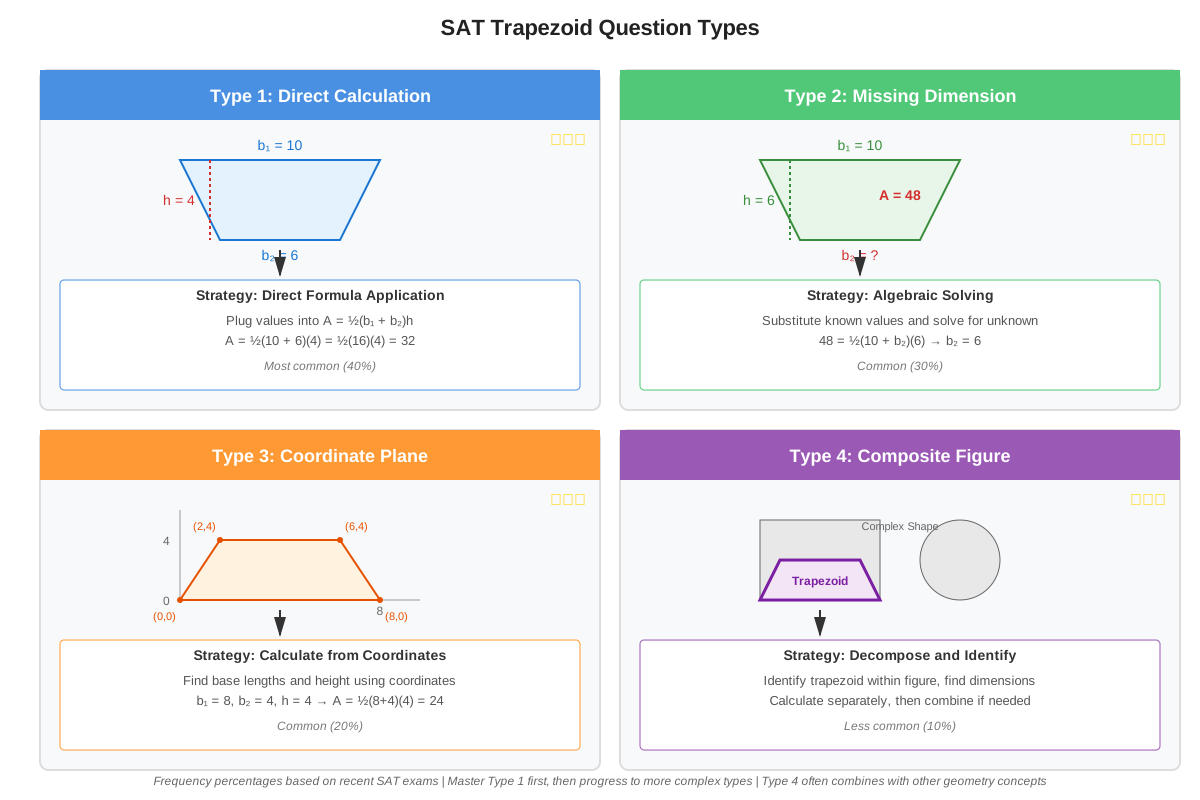
Common SAT question formats include: (1) direct area calculation given all dimensions, (2) finding a missing dimension when given the area, (3) trapezoids on the coordinate plane requiring distance calculations, (4) composite figures where students must identify and calculate trapezoid components, and (5) word problems involving real-world trapezoidal shapes. The topic frequently appears in Student-Produced Response (grid-in) questions where partial credit is not available, making accuracy paramount.
Core Concepts
Definition and Key Features
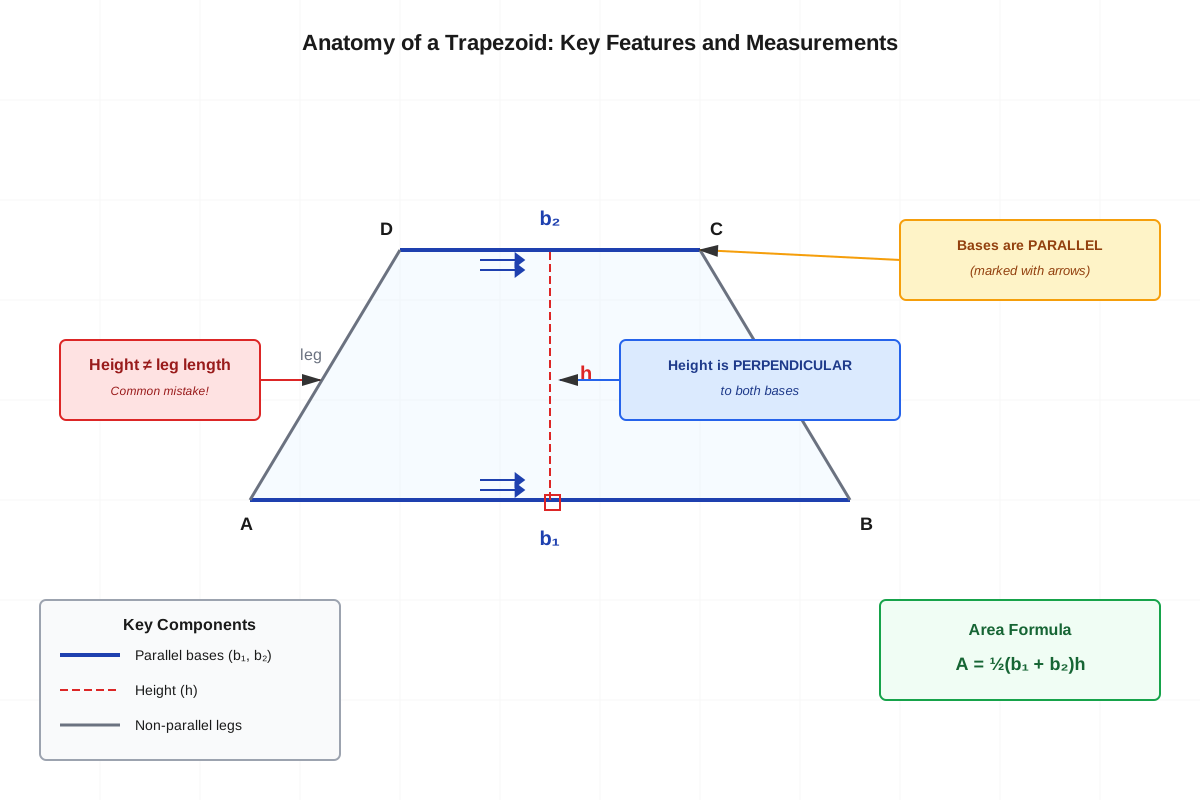
A trapezoid (also called a trapezium in some countries) is a quadrilateral with exactly one pair of parallel sides. These parallel sides are called bases, typically labeled as base₁ (b₁) and base₂ (b₂), or simply as the "top base" and "bottom base." The non-parallel sides are called legs. The perpendicular distance between the two parallel bases is the height (h), which is crucial for area calculations.
Key identifying features include:
- Four sides forming a closed figure
- Exactly two sides that are parallel to each other
- The bases can be of different lengths (if equal, the trapezoid becomes a parallelogram)
- The height must be measured perpendicular to both bases
The Trapezoid Area Formula
The area of trapezoids is calculated using the formula:
A = ½ × (b₁ + b₂) × hWhere:
- A = area
- b₁ = length of the first base
- b₂ = length of the second base
- h = perpendicular height between the bases
This formula can be understood as finding the average of the two base lengths, then multiplying by the height. Alternatively, it can be written as:
A = ((b₁ + b₂)/2) × hThe expression (b₁ + b₂)/2 represents the average base length, making the formula conceptually similar to finding the area of a rectangle with width equal to the average base and height h.
Derivation of the Formula
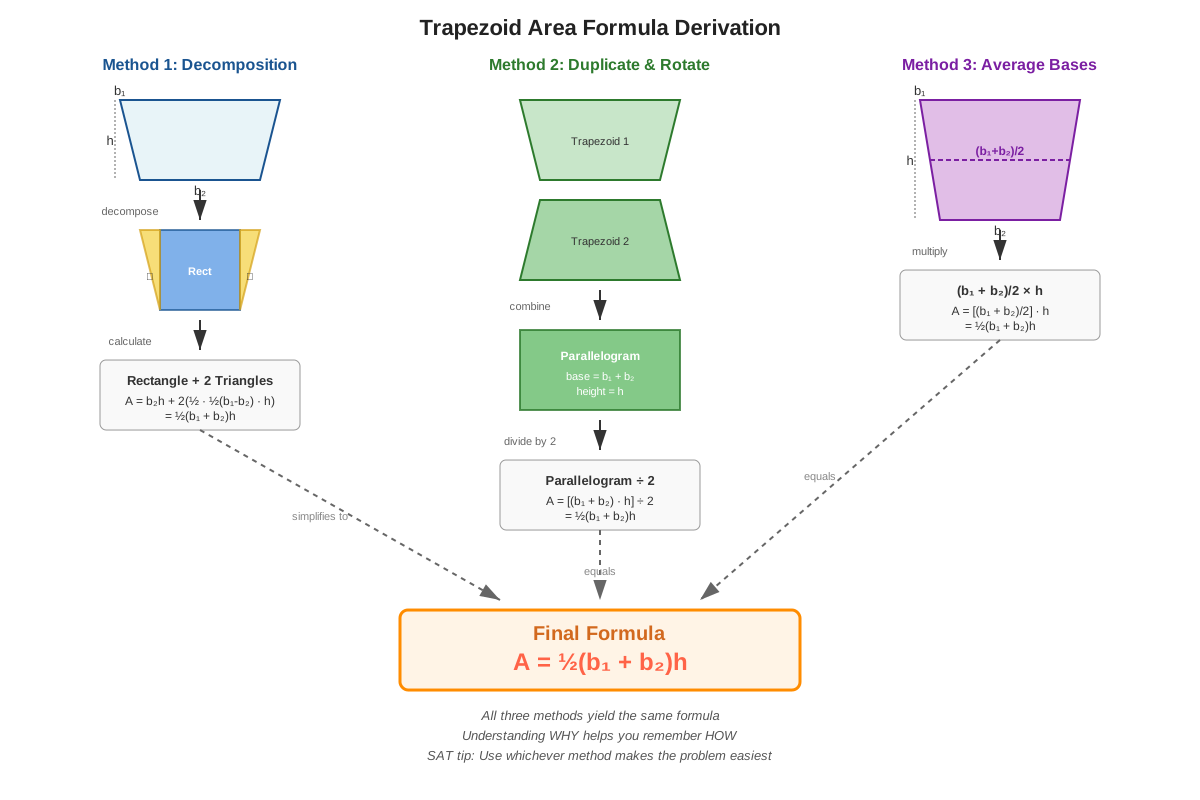
Understanding where the trapezoid area formula comes from strengthens retention and problem-solving ability. A trapezoid can be decomposed into simpler shapes in multiple ways:
Method 1: Two Triangles
Draw a diagonal connecting opposite vertices. This divides the trapezoid into two triangles sharing the same height h. One triangle has base b₁, the other has base b₂. The sum of their areas equals:
- Area = ½(b₁)(h) + ½(b₂)(h) = ½h(b₁ + b₂)
Method 2: Rectangle and Triangles
Drop perpendiculars from the ends of the shorter base to the longer base, creating a rectangle in the middle and two right triangles on the sides. The combined areas equal the trapezoid area.
Method 3: Parallelogram Transformation
Place two identical trapezoids together (one rotated 180°) to form a parallelogram with base (b₁ + b₂) and height h. The parallelogram area is (b₁ + b₂) × h, so one trapezoid is half that amount.
Special Types of Trapezoids
| Type | Definition | Special Properties |
|---|---|---|
| Isosceles Trapezoid | Both legs are equal in length | Base angles are equal; diagonals are equal; symmetric across perpendicular bisector of bases |
| Right Trapezoid | At least one leg is perpendicular to both bases | One leg serves as the height; simplifies calculations |
| Obtuse Trapezoid | Contains at least one obtuse angle | May require additional steps to find height |
| Acute Trapezoid | All angles are acute | Less common on SAT; height may fall outside the figure |
Finding the Height
The height is always perpendicular to both bases. On the SAT, height-finding scenarios include:
- Height given directly: Simplest case—use the formula immediately
- Right trapezoid: One leg is perpendicular to the bases and serves as the height
- Coordinate plane: Calculate height as the vertical distance between horizontal bases, or use the distance formula for non-horizontal bases
- Using Pythagorean theorem: When given leg length and base projections, form a right triangle to find h
- Using trigonometry: When given angles and side lengths (less common on SAT)
Trapezoids on the Coordinate Plane
SAT questions frequently place trapezoids on coordinate grids. Key strategies include:
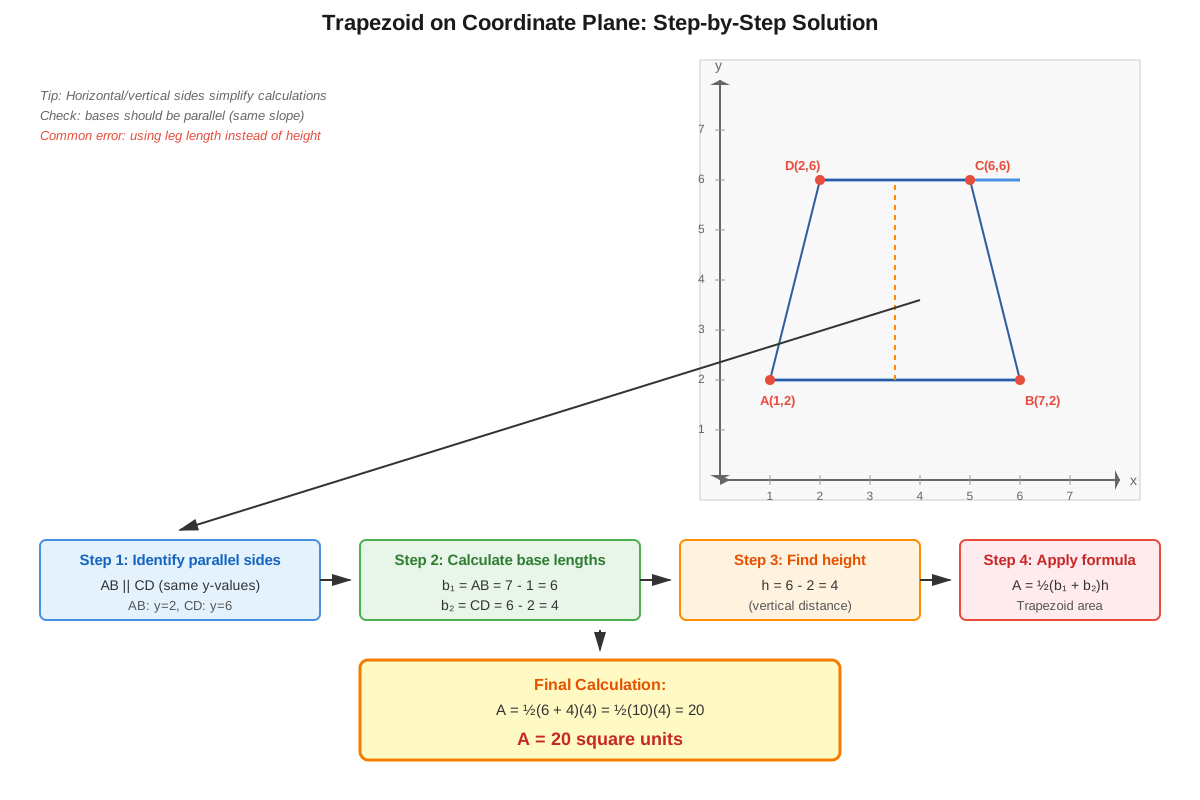
- Identify parallel sides: Check if two sides have the same slope (parallel lines have equal slopes)
- Calculate base lengths: Use the distance formula: d = √[(x₂-x₁)² + (y₂-y₁)²]
- Find height: For horizontal bases, height equals the difference in y-coordinates; for vertical bases, use x-coordinates
- Use the Shoelace formula: Alternative method for any polygon on a coordinate plane
For trapezoids with horizontal bases (most common SAT scenario), the height is simply |y₂ - y₁| where y₁ and y₂ are the y-coordinates of the parallel sides.
Composite Figures Involving Trapezoids
Many SAT problems embed trapezoids within larger figures. Recognition strategies:
- Irregular quadrilaterals: Check if any pair of opposite sides is parallel
- Regions between parallel lines: Areas bounded by two parallel lines and two non-parallel segments form trapezoids
- Shaded regions: The difference between a larger shape and a smaller shape may create a trapezoid
- Three-dimensional cross-sections: Slicing pyramids or prisms can create trapezoidal faces
Concept Relationships
The area of trapezoids connects to multiple geometric concepts in a hierarchical structure. At the foundation, rectangle area (length × width) and triangle area (½ × base × height) serve as building blocks, since trapezoids can be decomposed into these shapes. This decomposition relationship flows directly into the trapezoid formula derivation.
Moving upward in complexity, trapezoid area knowledge enables understanding of composite figures → where multiple shapes combine to form complex regions. This relationship is bidirectional: students must both recognize trapezoids within composite figures and combine trapezoids with other shapes to find total areas.
Horizontally, trapezoids connect to parallelograms (a special case where both pairs of opposite sides are parallel) and coordinate geometry (where trapezoids are defined by vertex coordinates rather than side lengths). The coordinate geometry connection leads to slope calculations → parallel line identification → distance formula applications → trapezoid area on the coordinate plane.
The formula structure (average of bases × height) creates a conceptual link to arithmetic means and weighted averages, reinforcing algebraic thinking. Additionally, the height-finding process connects to right triangle trigonometry and the Pythagorean theorem, creating a web of interconnected problem-solving tools.
Quick check — test yourself on Area of trapezoids so far.
Try Flashcards →High-Yield Facts
⭐ The trapezoid area formula is A = ½(b₁ + b₂)h, where b₁ and b₂ are the parallel bases and h is the perpendicular height
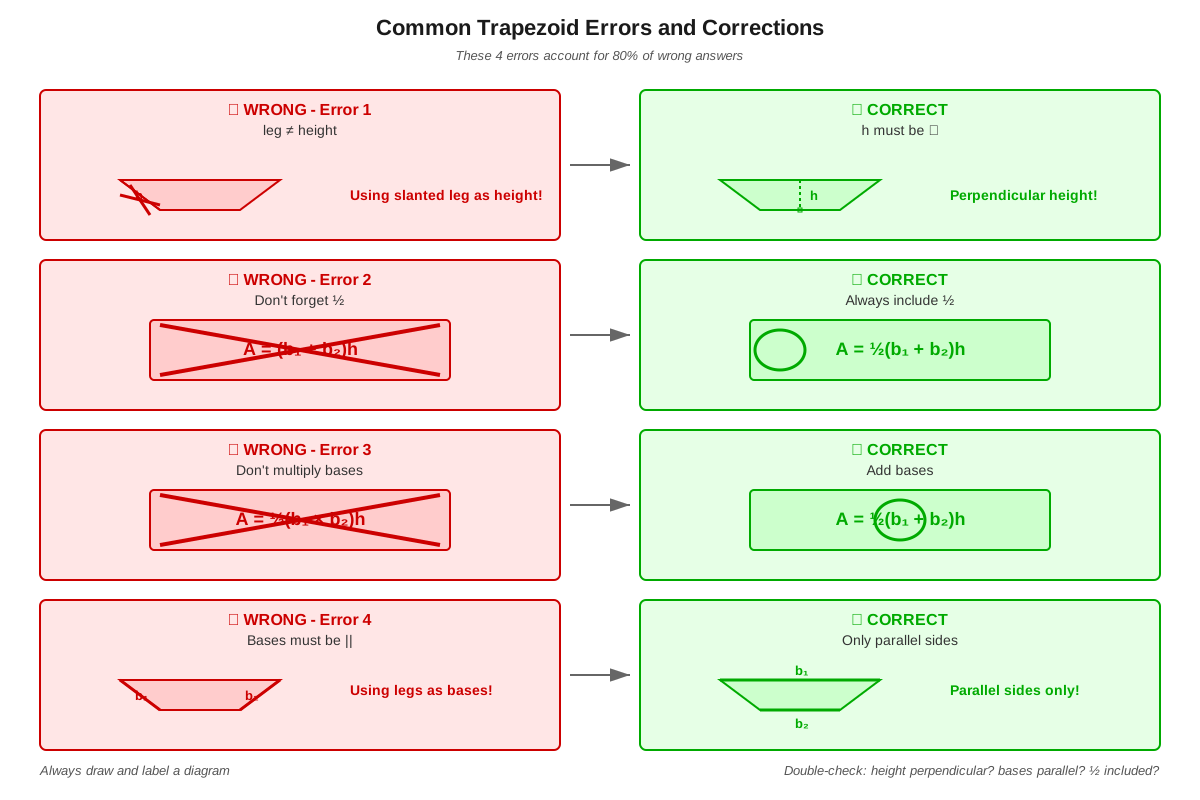
⭐ The height must always be perpendicular to both bases; slant height or leg length is NOT the height
⭐ On the coordinate plane, if bases are horizontal, the height equals the absolute difference in y-coordinates
⭐ A trapezoid has exactly one pair of parallel sides; if both pairs are parallel, it's a parallelogram, not a trapezoid
⭐ The formula can be rewritten as A = (average of bases) × height, which helps with conceptual understanding
- In an isosceles trapezoid, the legs are equal, base angles are equal, and diagonals are equal in length
- A right trapezoid has one leg perpendicular to both bases, making that leg the height
- To find a missing base when given area and height: solve b₁ + b₂ = 2A/h, then subtract the known base
- Trapezoids can be decomposed into a rectangle and two triangles, or into two triangles sharing the same height
- The median (midsegment) of a trapezoid is parallel to the bases and equals the average of the base lengths: m = (b₁ + b₂)/2
- When a trapezoid appears in a composite figure, look for parallel lines and perpendicular heights to identify it
- The area formula works regardless of which base is labeled b₁ or b₂ since addition is commutative
- If coordinates are given, verify parallelism by checking if two sides have equal slopes before assuming a trapezoid exists
Common Misconceptions
Misconception: The legs of a trapezoid can be used as the height in the area formula.
Correction: Only the perpendicular distance between the parallel bases is the height. Legs are typically slanted and longer than the actual height. Using leg length instead of height will produce an incorrect, inflated area.
Misconception: Any quadrilateral with two sides of different lengths is a trapezoid.
Correction: A trapezoid specifically requires exactly one pair of parallel sides. The sides must be parallel, not just different lengths. Always verify parallelism by checking slopes (on coordinate plane) or using given information about parallel sides.
Misconception: The formula is ½ × b₁ × b₂ × h (multiplying the bases together).
Correction: The formula adds the bases first, then multiplies by height and ½. The correct formula is ½(b₁ + b₂)h. Multiplying bases together would give an incorrect unit (length⁴ instead of length²) and wrong numerical result.
Misconception: In a coordinate plane problem, the distance between any two vertices gives the height.
Correction: Height must be the perpendicular distance between the parallel bases. On a coordinate plane with horizontal bases, use the difference in y-coordinates. For non-horizontal bases, you may need to use the point-to-line distance formula or create a perpendicular segment.
Misconception: A trapezoid with equal bases is impossible or has zero area.
Correction: While unusual, if b₁ = b₂, the formula still works: A = ½(b + b)h = bh. However, a quadrilateral with two pairs of equal parallel sides is technically a parallelogram, not a trapezoid. The SAT typically presents trapezoids with unequal bases to avoid this edge case.
Misconception: The area of a trapezoid is always less than the area of a rectangle with the same height.
Correction: This depends on the base lengths. If the sum of the trapezoid's bases exceeds twice the rectangle's base, the trapezoid will have greater area. Area comparisons require specific numerical values.
Misconception: All trapezoids are symmetric.
Correction: Only isosceles trapezoids have reflective symmetry. General trapezoids can be asymmetric with legs of different lengths and no line of symmetry.
Worked Examples
Example 1: Direct Application with Missing Dimension
Problem: A trapezoid has an area of 84 square centimeters. The height is 7 cm, and one base measures 10 cm. Find the length of the other base.
Solution:
Step 1: Write down the known information.
- Area (A) = 84 cm²
- Height (h) = 7 cm
- Base₁ (b₁) = 10 cm
- Base₂ (b₂) = unknown
Step 2: Write the trapezoid area formula.
A = ½(b₁ + b₂)hStep 3: Substitute known values.
84 = ½(10 + b₂)(7)Step 4: Solve for b₂.
84 = ½(10 + b₂)(7)
84 = 3.5(10 + b₂)
84 = 35 + 3.5b₂
49 = 3.5b₂
b₂ = 14
Step 5: Verify the answer.
A = ½(10 + 14)(7) = ½(24)(7) = 12(7) = 84 ✓Answer: The other base measures 14 cm.
Connection to Learning Objectives: This problem demonstrates applying the area formula and using algebraic manipulation to find missing dimensions, a common SAT question type that tests both geometric and algebraic reasoning.
Example 2: Trapezoid on the Coordinate Plane
Problem: A trapezoid has vertices at A(2, 3), B(8, 3), C(7, 8), and D(3, 8). Find the area of the trapezoid.
Solution:
Step 1: Plot or visualize the points to identify the trapezoid structure.
- Points A and B both have y-coordinate 3 (they lie on the horizontal line y = 3)
- Points C and D both have y-coordinate 8 (they lie on the horizontal line y = 8)
- Therefore, AB and CD are the parallel bases (both horizontal)
Step 2: Calculate the length of each base using the distance formula or by counting units.
- Base₁ (AB): distance from (2, 3) to (8, 3) = |8 - 2| = 6 units
- Base₂ (CD): distance from (3, 8) to (7, 8) = |7 - 3| = 4 units
Step 3: Calculate the height (perpendicular distance between the parallel bases).
- Since both bases are horizontal, height = |8 - 3| = 5 units
Step 4: Apply the trapezoid area formula.
A = ½(b₁ + b₂)h
A = ½(6 + 4)(5)
A = ½(10)(5)
A = 25Answer: The area of the trapezoid is 25 square units.
Connection to Learning Objectives: This problem demonstrates how trapezoids appear on the coordinate plane in SAT questions, requiring students to identify parallel sides through equal coordinates, calculate distances, and apply the area formula—integrating coordinate geometry with geometric formulas.
Exam Strategy
When approaching SAT area of trapezoids questions, begin by identifying whether the problem explicitly states "trapezoid" or requires recognizing one within a diagram. Look for trigger words such as "parallel sides," "bases," "quadrilateral with one pair of parallel sides," or visual cues showing two horizontal or vertical parallel segments.
Step-by-step approach:
- Identify the parallel bases: Mark them clearly on your diagram. On coordinate planes, check for equal slopes or equal x/y coordinates.
- Locate or calculate the height: Remember that height must be perpendicular to both bases. If not given directly, determine if you need the Pythagorean theorem, coordinate subtraction, or another method.
- Verify units: Ensure all measurements use the same units before calculating.
- Apply the formula carefully: Write out A = ½(b₁ + b₂)h and substitute values. The most common error is forgetting the ½ or adding bases incorrectly.
- Check reasonableness: Does your answer make sense given the dimensions? A trapezoid's area should be between the areas of triangles and rectangles with similar dimensions.
Process of elimination tips:
- Eliminate answers that would result from using leg length instead of height (these will be too large)
- Eliminate answers that result from multiplying bases together instead of adding them
- Eliminate answers that forget the ½ factor (these will be exactly double the correct answer)
- For coordinate plane problems, eliminate answers that use diagonal distances instead of perpendicular height
Time allocation: Budget 1-2 minutes for straightforward trapezoid area problems. If the problem requires finding the height using the Pythagorean theorem or involves composite figures, allow 2-3 minutes. Don't spend more than 3 minutes on any single problem—mark it and return if needed.
Calculator usage: For calculator-permitted sections, use your calculator for arithmetic but write out the formula first to avoid input errors. For no-calculator sections, look for opportunities to simplify before multiplying (e.g., cancel the 2 in the denominator with an even sum of bases).
Memory Techniques
Formula Mnemonic: "Two Bases Added, Halved, Height" (TBAHH)
- Trapezoid formula uses
- Bases (both of them)
- Added together
- Halved (multiplied by ½)
- Height (perpendicular distance)
Visual Memory Aid: Picture a trapezoid as a "table with uneven legs." The tabletop and floor are the bases (parallel), and the height is how tall the table stands (perpendicular measurement from floor to top).
Acronym for Problem-Solving: BHHH (Bases, Height, Half, Horizontal)
- Bases: Identify both parallel sides
- Height: Find perpendicular distance
- Half: Remember the ½ in the formula
- Horizontal: On coordinate planes, horizontal bases make height calculation easiest
Conceptual Memory: Think "average base times height" — the formula finds the average length of the two bases, then multiplies by height, just like finding the area of a rectangle with width equal to the average base.
Common Error Prevention: "Legs are LIES" (Legs are Length, Ignore for Elevation/height Substitution)
- Reminds students that leg measurements cannot substitute for height in the formula
Summary
The area of trapezoids is a high-yield SAT Math topic requiring mastery of the formula A = ½(b₁ + b₂)h, where b₁ and b₂ represent the parallel bases and h represents the perpendicular height between them. Success on trapezoid problems demands the ability to identify parallel sides, distinguish between leg length and perpendicular height, and apply the formula accurately in various contexts including coordinate plane settings and composite figures. The formula derives from decomposing trapezoids into triangles or rectangles, reinforcing that the area equals the average of the bases multiplied by the height. SAT questions test this concept through direct calculation, finding missing dimensions given the area, recognizing trapezoids within complex figures, and applying coordinate geometry skills to determine base lengths and heights. Students must avoid common errors such as using leg length as height, multiplying bases instead of adding them, or forgetting the ½ factor. Proficiency with trapezoid area calculations connects to broader geometric reasoning skills and frequently appears in medium-to-high difficulty questions worth valuable points on test day.
Key Takeaways
- The trapezoid area formula is A = ½(b₁ + b₂)h, where bases are parallel sides and height is the perpendicular distance between them
- Height must always be perpendicular to both bases; leg length is not height unless the trapezoid is a right trapezoid
- On coordinate planes with horizontal bases, height equals the absolute difference in y-coordinates of the parallel sides
- The formula can be conceptualized as (average of bases) × height, making it similar to rectangle area with averaged width
- Trapezoids appear on the SAT in direct calculation problems, composite figures, coordinate geometry questions, and problems requiring algebraic manipulation to find missing dimensions
- Always verify that a quadrilateral has exactly one pair of parallel sides before applying the trapezoid formula
- Common errors include forgetting the ½ factor, adding bases incorrectly, or using slant height instead of perpendicular height
Related Topics
Parallelograms and Special Quadrilaterals: Understanding trapezoids provides foundation for studying parallelograms (where both pairs of opposite sides are parallel), rhombuses, and other quadrilaterals. Mastering trapezoid area enables comparison of formulas across quadrilateral types.
Composite Figure Area: Many SAT problems combine trapezoids with triangles, rectangles, and circles. Proficiency with trapezoid area is essential for decomposing complex figures and calculating total or shaded regions.
Coordinate Geometry and Polygons: Trapezoid problems on coordinate planes extend to more complex polygons. The skills developed here—identifying parallel sides through slope, calculating distances, and finding perpendicular heights—transfer to general polygon area problems.
Three-Dimensional Geometry: Trapezoidal prisms and pyramids with trapezoidal bases require understanding two-dimensional trapezoid area before calculating volume and surface area.
Optimization Problems: Advanced problems may ask for maximum or minimum trapezoid areas given constraints, connecting geometric formulas to algebraic optimization techniques.
Practice CTA
Now that you've mastered the core concepts of trapezoid area, it's time to solidify your understanding through active practice. Attempt the practice questions designed specifically for this topic, working through each problem methodically and checking your reasoning at every step. Use the flashcards to reinforce the formula, key definitions, and common problem-solving strategies until they become automatic. Remember, SAT Math success comes not just from understanding concepts but from applying them accurately under timed conditions. Each practice problem you complete builds the confidence and speed you'll need on test day. You've got this—start practicing now and watch your geometric reasoning skills soar!
Sign up free to keep reading
Create a free AnvayaPrep account to finish this SAT guide on Area of trapezoids — plus flashcards and practice questions.