Overview
Slope in geometry is one of the most fundamental and frequently tested concepts in the SAT math section, appearing in multiple questions across nearly every test administration. Understanding slope goes far beyond memorizing the formula—it requires recognizing how lines behave in the coordinate plane, interpreting rate of change, and connecting algebraic representations to geometric visualizations. The SAT tests slope through direct calculation problems, interpretation of graphs, analysis of parallel and perpendicular lines, and real-world application scenarios involving rates and trends.
Mastery of slope is essential because it serves as a bridge between algebra and geometry, two major domains of SAT mathematics. Questions involving slope often integrate multiple concepts simultaneously: students might need to find the slope from two points, then use that information to write an equation, determine whether lines are parallel, or solve a system of equations. The College Board consistently includes slope-related questions in both the calculator and no-calculator sections, making this topic unavoidable for test-takers aiming for competitive scores.
The concept of slope connects directly to linear equations, coordinate geometry, functions, and even data interpretation. A solid understanding of slope enables students to tackle problems involving linear modeling, interpret scatterplots with trend lines, analyze distance-time graphs in physics contexts, and solve optimization problems. Because slope questions can be presented in various formats—from pure computation to contextual word problems—developing fluency with this topic significantly improves overall test performance and confidence.
Learning Objectives
- [ ] Identify key features of slope in geometry, including positive, negative, zero, and undefined slopes
- [ ] Explain how slope in geometry appears on the SAT in various question formats and contexts
- [ ] Apply slope in geometry to answer SAT-style questions involving calculation, interpretation, and analysis
- [ ] Calculate slope using multiple methods: two points, from equations, and from graphs
- [ ] Determine relationships between lines using slope (parallel and perpendicular lines)
- [ ] Interpret slope as rate of change in real-world contexts and word problems
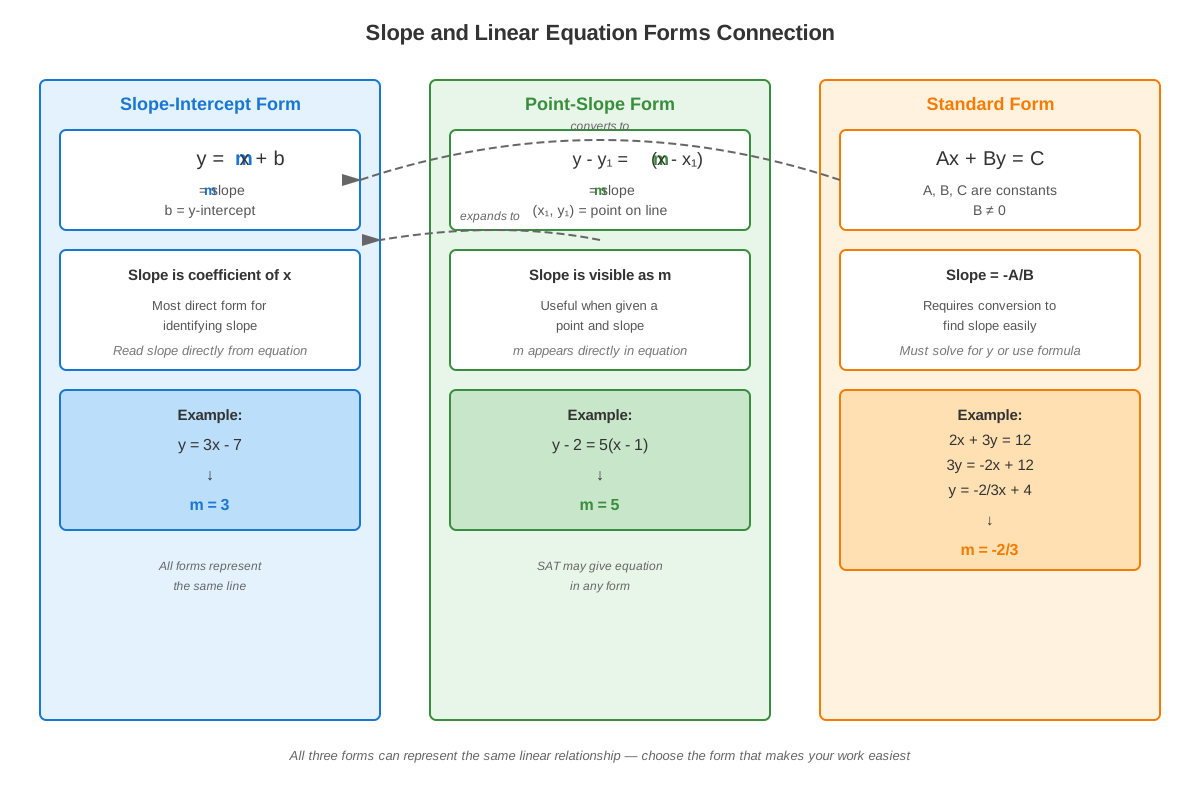
- [ ] Connect slope to linear equations in various forms (slope-intercept, point-slope, standard)
Prerequisites
- Basic coordinate plane understanding: Ability to plot points using (x, y) coordinates is essential for visualizing slope and working with graphs
- Algebraic manipulation skills: Solving for variables and rearranging equations enables conversion between different linear equation forms
- Fraction operations: Slope calculations frequently produce fractional results requiring simplification and comparison
- Negative number arithmetic: Understanding how negative values affect slope direction and calculations prevents common errors
- Basic graphing skills: Reading and interpreting line graphs provides the foundation for visual slope analysis
Why This Topic Matters
Slope represents one of the most practical mathematical concepts students encounter, with applications extending far beyond the classroom. In real-world contexts, slope describes rates of change everywhere: the steepness of a road grade, the rate at which temperature changes over time, the relationship between supply and demand in economics, or the velocity of a moving object. Engineers use slope to design drainage systems and wheelchair ramps, architects incorporate slope calculations in roof designs, and data scientists interpret slopes of regression lines to identify trends and make predictions.
On the SAT, slope-related questions appear with remarkable consistency, typically comprising 3-5 questions per test administration. These questions account for approximately 8-12% of the total math section, making slope one of the highest-yield topics for focused study. The College Board tests slope through multiple question types: direct calculation from coordinates, interpretation of graphs, analysis of linear equations, real-world modeling scenarios, and questions requiring understanding of parallel and perpendicular line relationships. Questions range from straightforward computational problems worth quick points to complex multi-step problems that integrate slope with other algebraic concepts.
The SAT frequently embeds slope within contextual scenarios: a line representing the relationship between hours worked and money earned, a graph showing distance traveled over time, or a scatterplot with a line of best fit. These applications test whether students truly understand slope as a rate of change rather than merely as a formula to memorize. Additionally, the test often presents slope indirectly—students might need to extract information from a table, interpret a graph without explicit coordinates, or work backward from an equation to determine slope characteristics.
Core Concepts
Definition and Formula
Slope represents the steepness and direction of a line in the coordinate plane, quantifying how much the line rises or falls as it moves horizontally. Mathematically, slope measures the ratio of vertical change to horizontal change between any two points on a line. The standard slope formula for a line passing through points (x₁, y₁) and (x₂, y₂) is:
m = (y₂ - y₁)/(x₂ - x₁)The variable m traditionally represents slope, and this formula is often verbalized as "rise over run" or "change in y over change in x." The numerator (y₂ - y₁) represents the vertical change, while the denominator (x₂ - x₁) represents the horizontal change. The order of subtraction must remain consistent—if you subtract the first point's y-coordinate from the second point's y-coordinate in the numerator, you must subtract the first point's x-coordinate from the second point's x-coordinate in the denominator.
Types of Slope
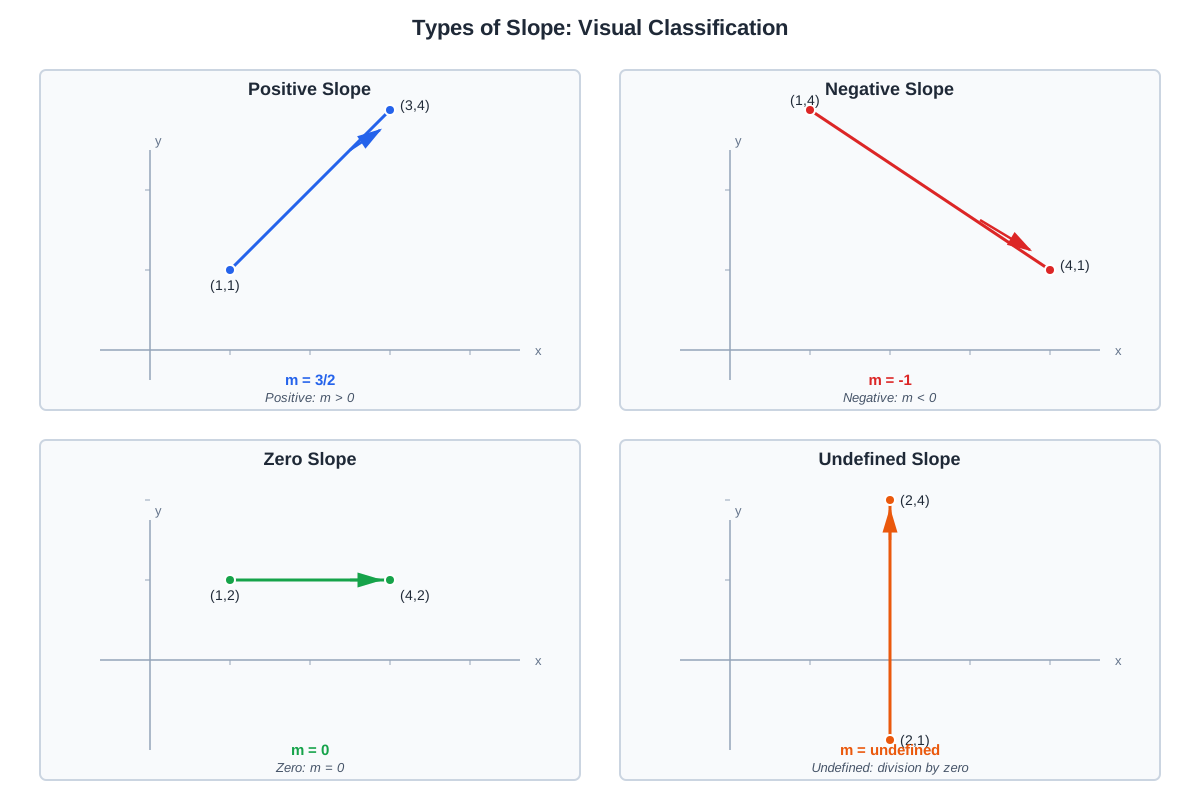
Understanding the four distinct types of slope is crucial for both calculation and interpretation:
| Slope Type | Numerical Value | Visual Appearance | Direction |
|---|---|---|---|
| Positive slope | m > 0 | Line rises from left to right | Upward |
| Negative slope | m < 0 | Line falls from left to right | Downward |
| Zero slope | m = 0 | Horizontal line | Neither rises nor falls |
| Undefined slope | No numerical value | Vertical line | Straight up and down |
A positive slope indicates that as x-values increase, y-values also increase. The line ascends when moving from left to right across the graph. For example, a line through points (1, 2) and (3, 6) has slope m = (6-2)/(3-1) = 4/2 = 2, which is positive.
A negative slope indicates an inverse relationship: as x-values increase, y-values decrease. The line descends when moving from left to right. A line through points (2, 5) and (4, 1) has slope m = (1-5)/(4-2) = -4/2 = -2, which is negative.
A zero slope occurs when the line is perfectly horizontal, meaning all points on the line share the same y-coordinate. The vertical change is zero regardless of horizontal movement. For instance, a line through (1, 3) and (5, 3) has slope m = (3-3)/(5-1) = 0/4 = 0.
An undefined slope occurs when the line is perfectly vertical, meaning all points share the same x-coordinate. This creates division by zero in the slope formula, which is mathematically undefined. A line through (2, 1) and (2, 7) would have m = (7-1)/(2-2) = 6/0, which is undefined.
Calculating Slope from Different Representations
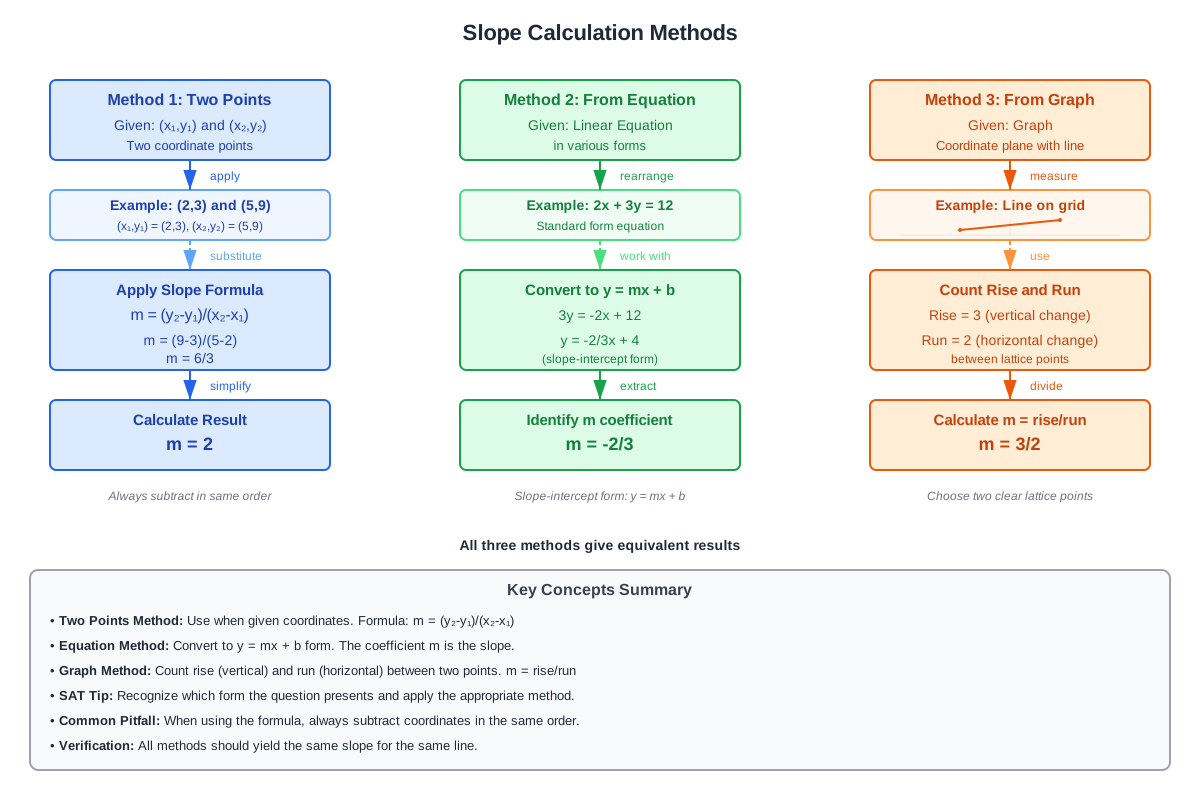
From Two Points: Apply the slope formula directly. Given points (3, 7) and (5, 13), calculate m = (13-7)/(5-3) = 6/2 = 3. Always simplify the resulting fraction to lowest terms.
From a Graph: Identify two clear points where the line crosses grid intersections. Count the vertical change (rise) and horizontal change (run) between these points, being careful about direction. Moving upward represents positive rise; moving downward represents negative rise. Moving right represents positive run; moving left represents negative run.
From Slope-Intercept Form (y = mx + b): The coefficient of x is the slope. In the equation y = -3x + 7, the slope is -3. In y = (2/3)x - 4, the slope is 2/3.
From Point-Slope Form (y - y₁ = m(x - x₁)): The value of m is explicitly stated as the slope. In y - 5 = 4(x - 2), the slope is 4.
From Standard Form (Ax + By = C): Rearrange to slope-intercept form by solving for y, or use the formula m = -A/B. For 3x + 2y = 12, the slope is m = -3/2.
From a Table of Values: Select any two points from the table and apply the slope formula. Verify consistency by checking additional point pairs—if the slope varies, the relationship is not linear.
Parallel and Perpendicular Lines
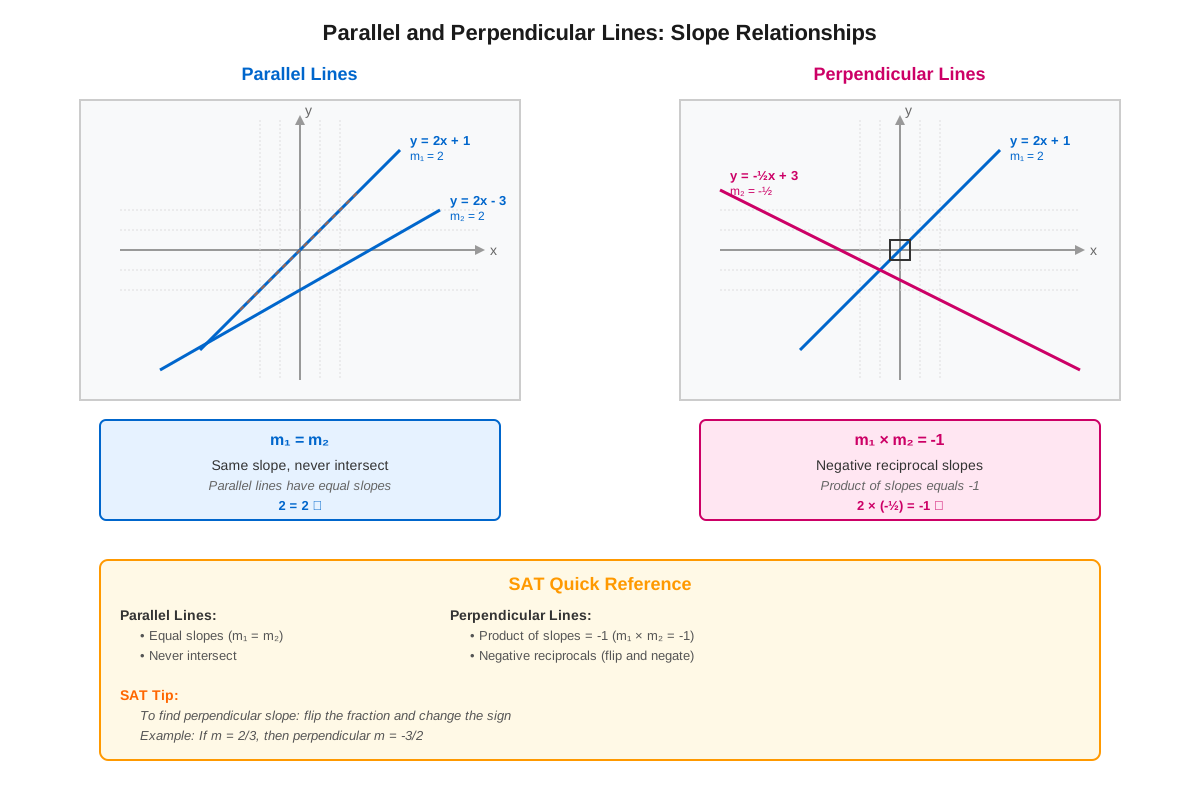
Parallel lines never intersect and maintain constant distance from each other. The defining characteristic of parallel lines is that they have identical slopes. If line 1 has slope m₁ = 3 and line 2 has slope m₂ = 3, these lines are parallel. This property allows quick identification: any line parallel to y = 2x + 5 must have slope 2, regardless of its y-intercept.
Perpendicular lines intersect at right angles (90 degrees). The slopes of perpendicular lines are negative reciprocals of each other. If line 1 has slope m₁, then any line perpendicular to it has slope m₂ = -1/m₁. For example:
- A line with slope 4 is perpendicular to a line with slope -1/4
- A line with slope -2/3 is perpendicular to a line with slope 3/2
- A line with slope 5 (or 5/1) is perpendicular to a line with slope -1/5
Special cases require attention: horizontal lines (slope = 0) are perpendicular to vertical lines (undefined slope), even though the negative reciprocal rule cannot be applied algebraically in this case.
Slope as Rate of Change
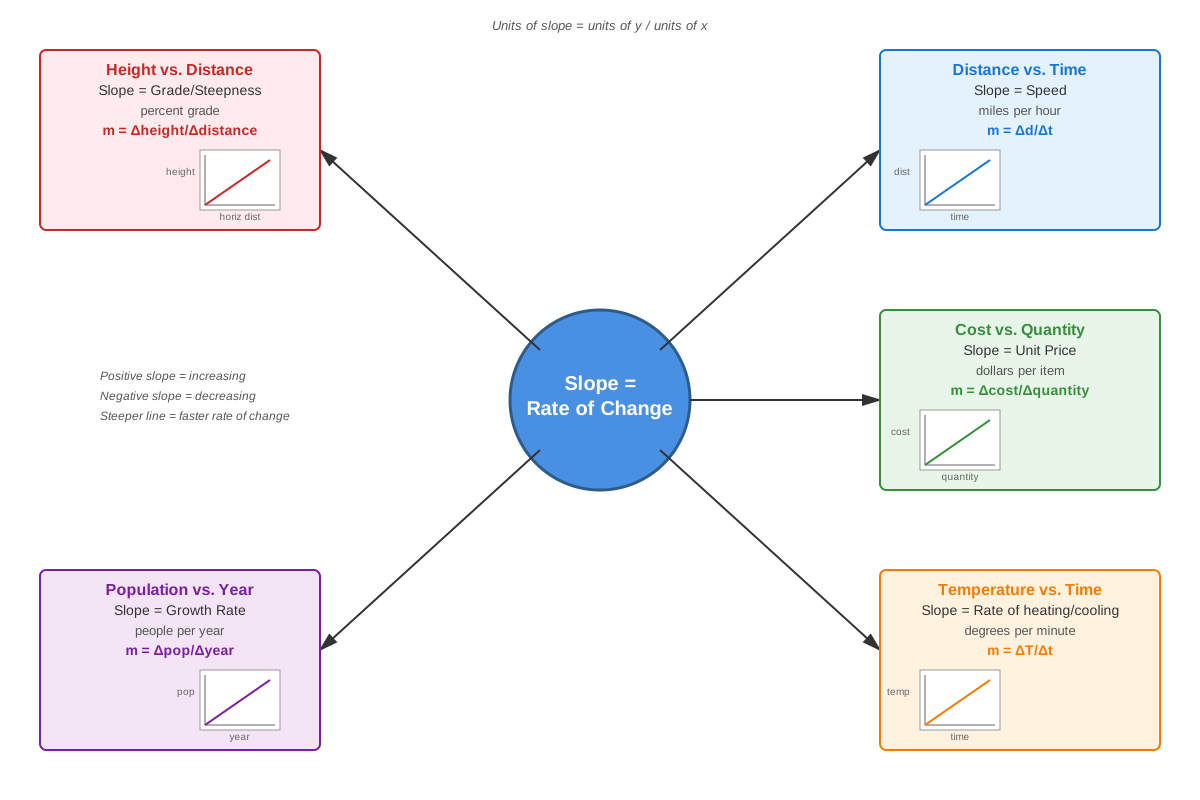
In contextual problems, slope represents the rate at which one quantity changes relative to another. The SAT frequently presents scenarios where slope has real-world meaning:
- Speed/Velocity: In a distance-time graph, slope represents speed (miles per hour, meters per second)
- Cost Rate: In a cost-quantity graph, slope represents unit price (dollars per item)
- Wage Rate: In an earnings-time graph, slope represents hourly wage (dollars per hour)
- Growth Rate: In a population-time graph, slope represents rate of population change
When interpreting slope in context, pay careful attention to units. If the y-axis represents dollars and the x-axis represents hours, the slope has units of dollars per hour. The numerical value of the slope tells you how much the y-quantity changes for each one-unit increase in the x-quantity.
Concept Relationships
The concepts within slope form an interconnected web of understanding. Basic slope calculation serves as the foundation, enabling all other applications. From this foundation, slope types (positive, negative, zero, undefined) provide classification and interpretation skills. These classifications directly connect to visual recognition of line behavior in graphs, which in turn supports equation analysis where slope appears as a coefficient.
The relationship flows as: Two Points → Slope Calculation → Line Classification → Equation Formation → Parallel/Perpendicular Analysis → Real-World Application
Understanding parallel lines requires recognizing that equal slopes create parallel relationships, while perpendicular lines demand the additional concept of negative reciprocals. Both relationships depend on accurate slope calculation and connect to broader topics of linear equations and systems of equations.
Slope as rate of change bridges the gap between pure mathematics and applied problem-solving, connecting to linear modeling, data interpretation, and function analysis. This concept links slope to the prerequisite knowledge of coordinate planes and algebraic manipulation, while also preparing students for advanced topics like derivatives in calculus (which generalize the concept of slope to curves).
The progression from concrete to abstract follows this path: plotting points → calculating slope → recognizing patterns → writing equations → solving systems → modeling real situations. Each stage builds upon previous understanding while adding layers of complexity and application.
Quick check — test yourself on Slope in geometry so far.
Try Flashcards →High-Yield Facts
⭐ The slope formula is m = (y₂ - y₁)/(x₂ - x₁), and the order of subtraction must be consistent between numerator and denominator
⭐ Parallel lines have equal slopes; perpendicular lines have slopes that are negative reciprocals
⭐ In the equation y = mx + b, the value m represents the slope
⭐ A positive slope indicates a line rising from left to right; a negative slope indicates a line falling from left to right
⭐ Horizontal lines have slope of zero; vertical lines have undefined slope
- The slope of a line remains constant between any two points on that line
- To find the negative reciprocal, flip the fraction and change the sign (3/4 becomes -4/3)
- Slope represents rate of change in contextual problems, with units derived from y-units per x-unit
- When converting from standard form (Ax + By = C) to find slope, use m = -A/B
- A steeper line has a greater absolute value of slope than a less steep line
- If two lines have the same slope but different y-intercepts, they are parallel and will never intersect
- The slope between points (a, b) and (c, d) equals the slope between (c, d) and (a, b)
- In a table of values, if the change in y divided by change in x is constant, the relationship is linear
Common Misconceptions
Misconception: The slope formula can be applied in any order without consequence → Correction: While you can choose which point is "first" and which is "second," you must maintain consistency. If you calculate (y₂ - y₁) in the numerator, you must calculate (x₂ - x₁) in the denominator, not (x₁ - x₂). Mixing the order produces the wrong sign.
Misconception: A steeper line always has a larger slope value → Correction: Steepness relates to the absolute value of slope. A line with slope -5 is steeper than a line with slope 2, even though -5 < 2. When comparing steepness, consider |m|, not just m.
Misconception: Perpendicular lines have slopes that are opposite signs of each other → Correction: Perpendicular slopes are negative reciprocals, not just opposite signs. Lines with slopes 3 and -3 are not perpendicular; lines with slopes 3 and -1/3 are perpendicular.
Misconception: A vertical line has a slope of zero → Correction: Vertical lines have undefined slope (division by zero), while horizontal lines have zero slope. These are fundamentally different: zero is a number, while undefined means no numerical value exists.
Misconception: The slope between two points depends on which point you plot first → Correction: Slope is a property of the line itself, not the order of points. Whether you calculate from (1,2) to (3,6) or from (3,6) to (1,2), the slope is the same: 2.
Misconception: In standard form Ax + By = C, the slope is A/B → Correction: The slope is -A/B (negative A divided by B). The negative sign is crucial and frequently forgotten, leading to incorrect answers about parallel and perpendicular lines.
Misconception: If a line passes through the origin, its slope must be 1 → Correction: A line through the origin can have any slope value. The line y = 3x passes through (0,0) with slope 3; the line y = -2x passes through (0,0) with slope -2.
Worked Examples
Example 1: Multi-Step Slope Problem with Parallel Lines
Problem: Line k passes through points (-2, 5) and (4, 17). Line j is parallel to line k and passes through point (3, 8). What is the y-coordinate of the point where line j crosses the y-axis?
Solution:
Step 1: Find the slope of line k
Using the slope formula with points (-2, 5) and (4, 17):
m = (17 - 5)/(4 - (-2)) = 12/6 = 2
The slope of line k is 2.
Step 2: Determine the slope of line j
Since line j is parallel to line k, and parallel lines have equal slopes, line j also has slope 2.
Step 3: Write the equation for line j
Using point-slope form with point (3, 8) and slope 2:
y - 8 = 2(x - 3)
Step 4: Convert to slope-intercept form
y - 8 = 2x - 6
y = 2x - 6 + 8
y = 2x + 2
Step 5: Find the y-intercept
The y-intercept occurs where x = 0. From the equation y = 2x + 2, when x = 0, y = 2.
Alternatively, recognize that in slope-intercept form y = mx + b, the constant b represents the y-intercept.
Answer: The y-coordinate where line j crosses the y-axis is 2.
Connection to Learning Objectives: This problem requires identifying slope from two points, applying the parallel lines property (equal slopes), and using slope to write and manipulate linear equations—demonstrating comprehensive mastery of slope concepts.
Example 2: Real-World Rate of Change Problem
Problem: A water tank contains 450 gallons of water. Water is being drained at a constant rate. After 15 minutes, the tank contains 300 gallons. After 30 minutes, the tank contains 150 gallons. What is the rate of change in gallons per minute, and what does the slope represent in this context?
Solution:
Step 1: Identify two points
Let x represent time in minutes and y represent gallons of water.
Point 1: (15, 300) — after 15 minutes, 300 gallons remain
Point 2: (30, 150) — after 30 minutes, 150 gallons remain
Step 2: Calculate the slope
m = (150 - 300)/(30 - 15) = -150/15 = -10
Step 3: Interpret the slope
The slope is -10 gallons per minute. The negative value indicates the amount of water is decreasing. The absolute value tells us the rate: 10 gallons are drained each minute.
Step 4: Verify with the initial condition
If the tank starts with 450 gallons at time 0, and drains at 10 gallons per minute, after 15 minutes: 450 - (10 × 15) = 450 - 150 = 300 gallons ✓
After 30 minutes: 450 - (10 × 30) = 450 - 300 = 150 gallons ✓
Answer: The rate of change is -10 gallons per minute. The slope represents the drainage rate—the tank loses 10 gallons of water every minute.
Connection to Learning Objectives: This problem demonstrates slope as rate of change in a real-world context, requiring calculation from data points and interpretation of the meaning of negative slope in a practical scenario.
Exam Strategy
When approaching SAT slope in geometry questions, begin by identifying what information is provided and what is being asked. The SAT presents slope problems in various disguises, so recognizing the underlying concept is crucial.
Trigger words and phrases that signal slope questions include:
- "Rate of change"
- "Steepness"
- "Parallel to"
- "Perpendicular to"
- "Line passes through"
- "Per unit" (miles per hour, dollars per item)
- "Constant rate"
- "Linear relationship"
Strategic approach sequence:
- Identify the representation: Is slope given directly, must it be calculated from points, extracted from an equation, or determined from a graph?
- Choose the most efficient method: If the equation is in slope-intercept form, read the slope directly rather than converting to standard form first. If a graph is provided with clear grid points, counting rise over run may be faster than reading coordinates and using the formula.
- Watch for indirect questions: The SAT often asks about parallel or perpendicular lines without explicitly mentioning slope. Recognize that these questions fundamentally test slope relationships.
- Check reasonableness: After calculating, verify that your slope matches the visual appearance. If the graph shows a line rising steeply from left to right, a small positive slope or negative slope indicates an error.
Process of elimination tips:
- Eliminate answer choices with the wrong sign first (positive vs. negative)
- For parallel/perpendicular questions, eliminate any answer that doesn't match the required slope relationship
- If the question provides a graph, eliminate slopes that don't match the visual steepness
- For word problems, eliminate answers with incorrect or missing units
Time allocation: Straightforward slope calculation problems should take 30-45 seconds. Multi-step problems involving parallel/perpendicular lines or real-world contexts may require 90-120 seconds. If a problem requires more than 2 minutes, mark it for review and move forward—you can return with fresh perspective.
Calculator usage: For the calculator section, use your calculator to perform arithmetic but write down intermediate steps to avoid errors. For the no-calculator section, look for opportunities to simplify before calculating—many SAT problems use numbers designed to simplify cleanly.
Memory Techniques
Slope Formula Mnemonic: "You Yell X-tra X-citing" reminds you of the order: y₂ - y₁ over x₂ - x₁
Rise Over Run: Visualize climbing stairs—you rise vertically before running horizontally. This physical metaphor helps remember that vertical change goes in the numerator.
Parallel vs. Perpendicular:
- Parallel = Perfectly Paired (same slopes)
- Perpendicular = Product is Negative one (slopes multiply to -1, which is equivalent to being negative reciprocals)
Slope Type Memory Device: "Positive People Rise" (positive slope rises), "Negative Nancy Falls" (negative slope falls), "Zero Zips Horizontally" (zero slope is horizontal), "Undefined Upright Vertical" (undefined slope is vertical)
Negative Reciprocal Process: "Flip and Switch" — Flip the fraction, Switch the sign
Visualization Strategy: When memorizing slope types, draw a simple coordinate plane and sketch one line of each type. Label each with its slope characteristic. This visual reference can be mentally recalled during the exam.
Acronym for Slope Forms: SIP your slope:
- Slope-intercept: y = mx + b (slope is m)
- Identify from points: use the formula
- Point-slope: y - y₁ = m(x - x₁) (slope is m)
Summary
Slope in geometry represents the steepness and direction of a line, calculated as the ratio of vertical change to horizontal change between any two points. Mastery of slope requires understanding four distinct types (positive, negative, zero, and undefined), calculating slope from various representations (points, equations, graphs, and tables), and applying slope concepts to determine parallel and perpendicular line relationships. The slope formula m = (y₂ - y₁)/(x₂ - x₁) serves as the computational foundation, while recognizing slope as rate of change enables interpretation of real-world scenarios. Parallel lines share identical slopes, while perpendicular lines have slopes that are negative reciprocals of each other. On the SAT, slope appears in direct calculation problems, equation analysis, graph interpretation, and contextual word problems involving rates and linear relationships. Success requires both computational accuracy and conceptual understanding—knowing not just how to calculate slope, but what it means and how it behaves in different situations.
Key Takeaways
- The slope formula m = (y₂ - y₁)/(x₂ - x₁) must maintain consistent subtraction order to produce the correct sign
- Positive slopes rise left to right, negative slopes fall left to right, zero slopes are horizontal, and undefined slopes are vertical
- Parallel lines have equal slopes; perpendicular lines have slopes that are negative reciprocals (multiply to -1)
- In y = mx + b form, the coefficient m is the slope and can be read directly without calculation
- Slope represents rate of change in real-world contexts, with units determined by y-units per x-unit
- Visual verification helps catch calculation errors—computed slope should match the line's appearance on a graph
- Converting between equation forms (standard, slope-intercept, point-slope) provides multiple pathways to identify slope
Related Topics
Linear Equations and Functions: Slope forms the foundation for understanding linear equations in all forms. Mastering slope enables quick analysis of function behavior, intercepts, and transformations.
Systems of Linear Equations: Determining whether systems have one solution, no solution, or infinitely many solutions depends on analyzing slopes. Parallel lines (equal slopes) create inconsistent systems with no solution.
Coordinate Geometry: Slope connects to distance formula, midpoint formula, and equation of circles. Understanding how lines behave in the coordinate plane supports more complex geometric analysis.
Linear Modeling and Data Analysis: Real-world applications of slope extend to interpreting scatterplots, lines of best fit, and trend analysis—all frequent SAT topics in the Problem Solving and Data Analysis domain.
Inequalities and Linear Programming: Graphing linear inequalities requires understanding slope to correctly draw boundary lines and determine solution regions.
Practice CTA
Now that you've mastered the core concepts of slope in geometry, it's time to solidify your understanding through active practice. Attempt the practice questions designed specifically to mirror SAT question formats and difficulty levels. Work through each problem systematically, applying the strategies and techniques covered in this guide. Use the flashcards to reinforce key formulas, relationships, and concepts until they become automatic. Remember: understanding the theory is essential, but exam success comes from repeated application. Each practice problem you solve builds the pattern recognition and confidence needed to tackle any slope question the SAT presents. You've invested the time to learn—now invest the time to practice, and watch your accuracy and speed improve dramatically!
Sign up free to keep reading
Create a free AnvayaPrep account to finish this SAT guide on Slope in geometry — plus flashcards and practice questions.