Overview
Transformations represent one of the most visually intuitive yet mathematically rigorous topics tested on the SAT math section. At its core, transformations describe how geometric figures move, flip, rotate, or resize within the coordinate plane while maintaining specific properties. Understanding sat transformations requires both conceptual knowledge of how shapes change position and orientation, as well as the algebraic skills to express these changes through coordinate notation and function manipulation.
The SAT frequently tests transformations in multiple contexts: pure coordinate geometry problems, function transformations, and applied scenarios involving symmetry and congruence. Questions may ask students to identify the coordinates of a transformed point, determine which transformation was applied to a figure, or predict how a function's graph shifts based on algebraic modifications. Mastery of this topic is essential because transformation questions often integrate multiple mathematical concepts—combining coordinate geometry, function notation, and algebraic manipulation—making them high-value problems that separate top scorers from average performers.
Transformations serve as a bridge between algebra and geometry, demonstrating how algebraic operations on coordinates correspond to geometric movements in space. This topic connects directly to function behavior, symmetry properties, and congruence relationships—all fundamental concepts that appear throughout the SAT Math section. Students who develop strong transformation skills gain powerful problem-solving tools applicable to questions about parabolas, absolute value functions, circles, and polygon properties.
Learning Objectives
- [ ] Identify key features of Transformations
- [ ] Explain how Transformations appears on the SAT
- [ ] Apply Transformations to answer SAT-style questions
- [ ] Determine the coordinates of points after applying single or multiple transformations
- [ ] Recognize transformation types from coordinate changes or visual representations
- [ ] Predict how algebraic modifications to functions affect their graphs through transformations
- [ ] Solve multi-step problems combining different transformation types
Prerequisites
- Coordinate plane fundamentals: Understanding x and y axes, quadrants, and plotting points is essential since all transformations occur within this framework
- Basic function notation: Familiarity with f(x) notation enables comprehension of how transformations affect function graphs
- Distance and midpoint formulas: These concepts help verify that transformations preserve or change distances appropriately
- Properties of geometric figures: Knowledge of triangles, quadrilaterals, and circles allows recognition of how transformations affect shape properties
Why This Topic Matters
Transformations appear in real-world applications ranging from computer graphics and animation to architectural design and navigation systems. GPS technology relies on coordinate transformations to convert satellite data into map positions. Video game developers use transformation matrices to move characters through virtual environments. Architects apply reflection and rotation principles when designing symmetric buildings or planning room layouts.
On the SAT, transformation questions appear with high frequency—typically 2-4 questions per test across both the calculator and no-calculator sections. These questions account for approximately 5-8% of the total Math score, making them a high-yield study area. The College Board particularly favors questions that combine transformations with function analysis, asking students to predict how modifications like f(x+2) or -f(x) affect a graph's position or orientation.
Common SAT question formats include: identifying coordinates after a reflection across a specific line, determining which transformation maps one triangle onto another, predicting how a parabola shifts when its equation changes from y = x² to y = (x-3)² + 2, and analyzing symmetry properties of functions. Questions often present visual diagrams requiring students to apply transformation rules mentally or algebraically, testing both conceptual understanding and computational accuracy.
Core Concepts
The Four Basic Transformations
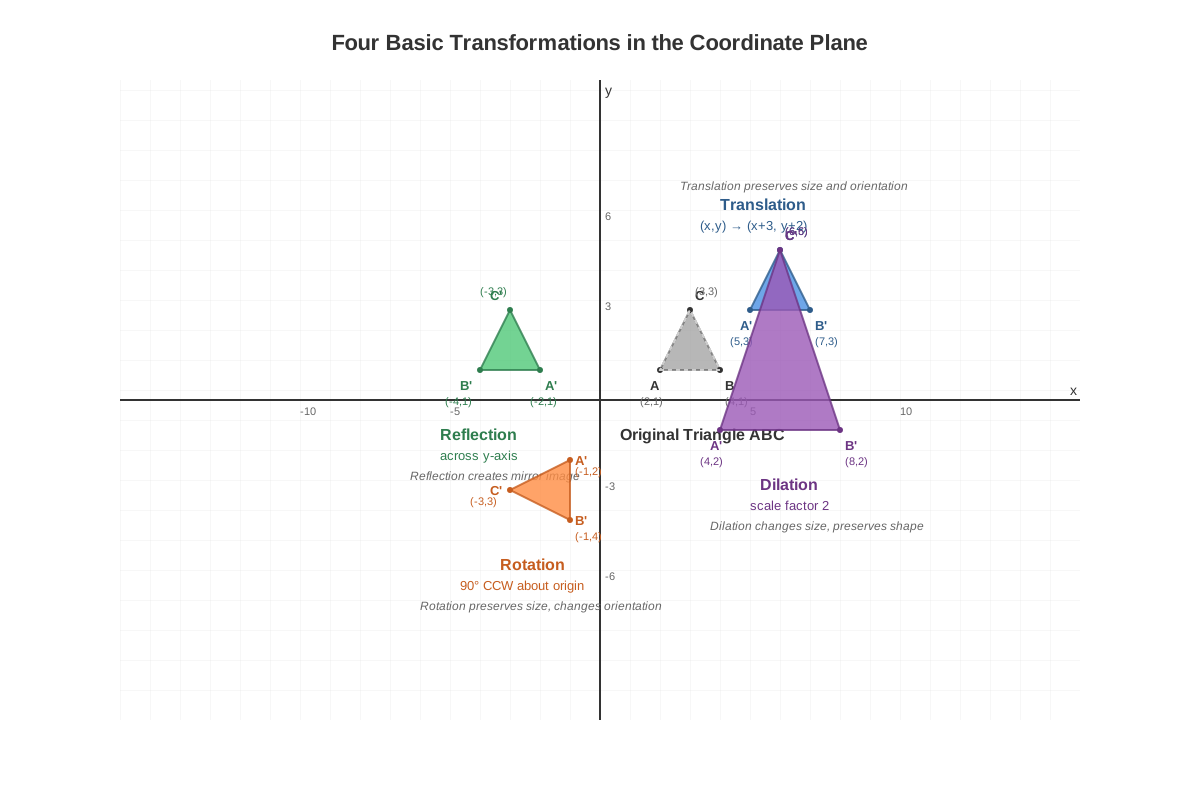
Transformations are operations that change the position, orientation, or size of geometric figures in the coordinate plane. The four fundamental types are translations, reflections, rotations, and dilations. Each transformation follows specific rules that determine how coordinates change.
Translations (also called slides) move every point of a figure the same distance in the same direction. A translation is defined by a horizontal shift and a vertical shift. If point (x, y) undergoes a translation of h units horizontally and k units vertically, the new coordinates become (x + h, y + k). Positive h values shift right, negative h values shift left; positive k values shift up, negative k values shift down. Translations preserve both size and orientation—the figure remains congruent to its original form and faces the same direction.
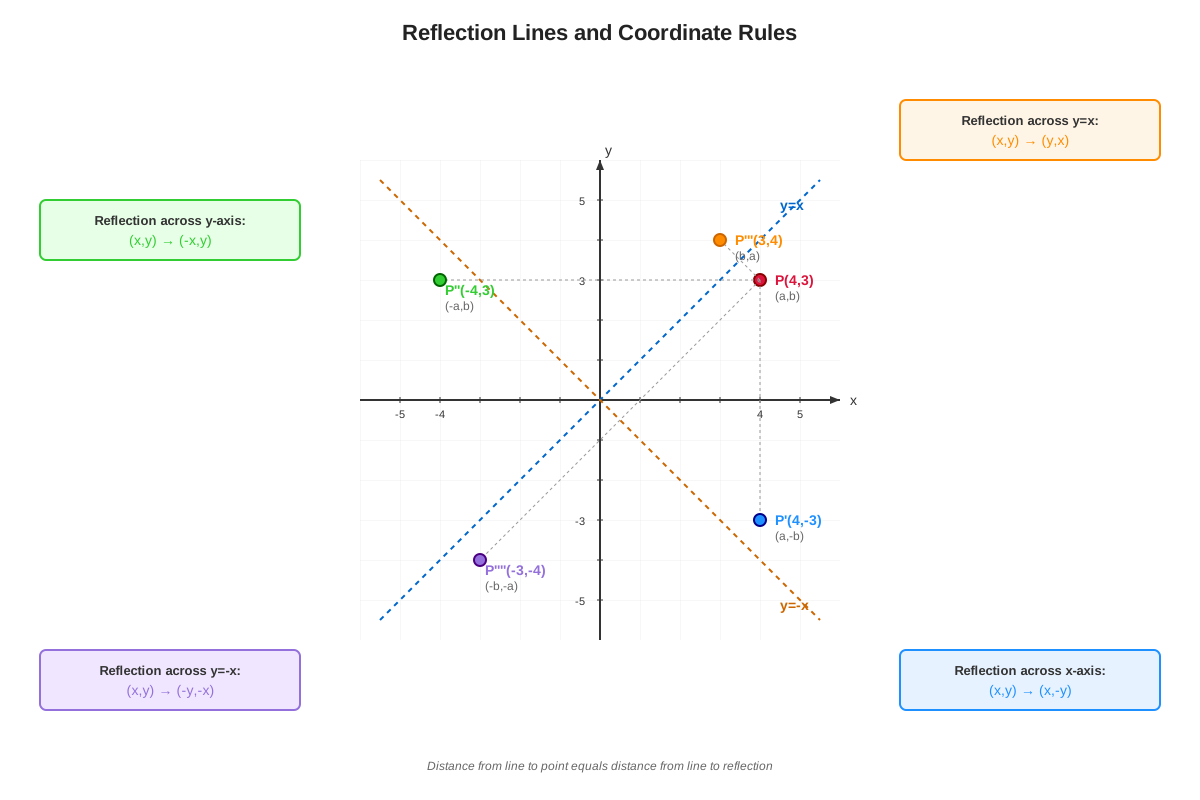
Reflections (flips) create mirror images of figures across a line of reflection. The most common reflection lines on the SAT are the x-axis, y-axis, and the line y = x. Each follows a specific coordinate rule:
| Reflection Line | Coordinate Rule | Effect |
|---|---|---|
| x-axis | (x, y) → (x, -y) | Flips vertically; y-coordinates change sign |
| y-axis | (x, y) → (-x, y) | Flips horizontally; x-coordinates change sign |
| y = x | (x, y) → (y, x) | Swaps coordinates; diagonal flip |
| y = -x | (x, y) → (-y, -x) | Swaps and negates both coordinates |
Reflections preserve size but reverse orientation—the figure becomes a mirror image.
Rotations turn figures around a fixed point (usually the origin) by a specified angle. The most frequently tested rotations on the SAT are 90°, 180°, and 270° counterclockwise around the origin:
- 90° counterclockwise: (x, y) → (-y, x)
- 180° rotation: (x, y) → (-x, -y)
- 270° counterclockwise (equivalent to 90° clockwise): (x, y) → (y, -x)
Rotations preserve size and shape but change orientation. A 180° rotation is equivalent to reflecting across both axes sequentially.
Dilations change the size of figures by a scale factor k, centered at a point (usually the origin). The rule is (x, y) → (kx, ky). When k > 1, the figure enlarges; when 0 < k < 1, it shrinks; when k < 0, the figure dilates and reflects across the center point. Unlike the other three transformations, dilations do not preserve size—they create similar but not congruent figures.
Rigid vs. Non-Rigid Transformations
Transformations are classified as either rigid (isometric) or non-rigid. Rigid transformations preserve both distance and angle measures, maintaining congruence between the original and transformed figures. Translations, reflections, and rotations are all rigid transformations. Non-rigid transformations change size or shape. Dilations are the primary non-rigid transformation tested on the SAT.
This distinction is crucial for SAT questions asking whether two figures are congruent or merely similar. If only rigid transformations map one figure onto another, they are congruent. If a dilation is required, they are similar but not congruent.
Function Transformations
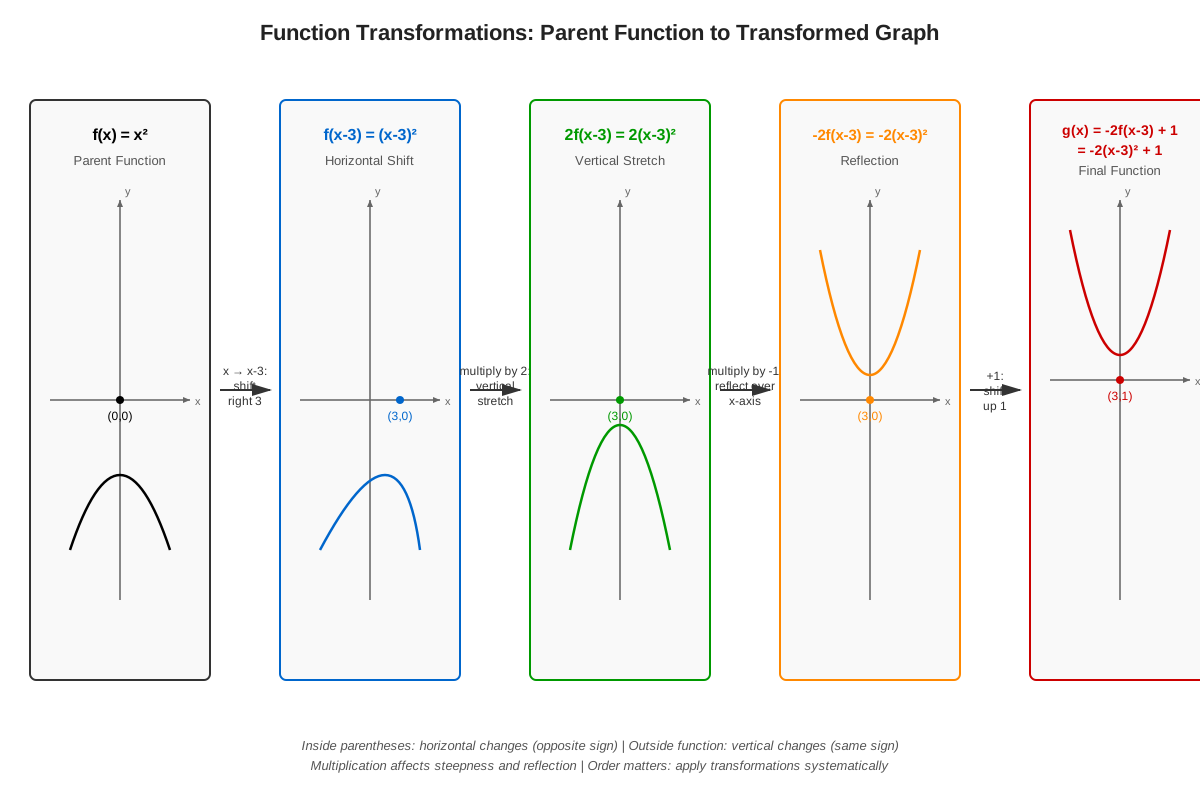
The SAT extensively tests how algebraic modifications to function notation affect graphs. Understanding these transformations requires recognizing patterns in function notation:
Vertical transformations affect the output (y-values):
- f(x) + k: Shifts the graph up k units (k > 0) or down |k| units (k < 0)
- -f(x): Reflects the graph across the x-axis (flips vertically)
- a·f(x): Vertically stretches by factor a if |a| > 1, compresses if 0 < |a| < 1; reflects across x-axis if a < 0
Horizontal transformations affect the input (x-values) and work counterintuitively:
- f(x - h): Shifts the graph right h units (h > 0) or left |h| units (h < 0)—note the opposite direction
- f(-x): Reflects the graph across the y-axis (flips horizontally)
- f(bx): Horizontally compresses by factor b if |b| > 1, stretches if 0 < |b| < 1; reflects across y-axis if b < 0
Exam Tip: Horizontal transformations work opposite to intuition. f(x - 3) shifts RIGHT 3 units, not left. Think: "What x-value makes the expression inside equal zero?"
Composition of Transformations
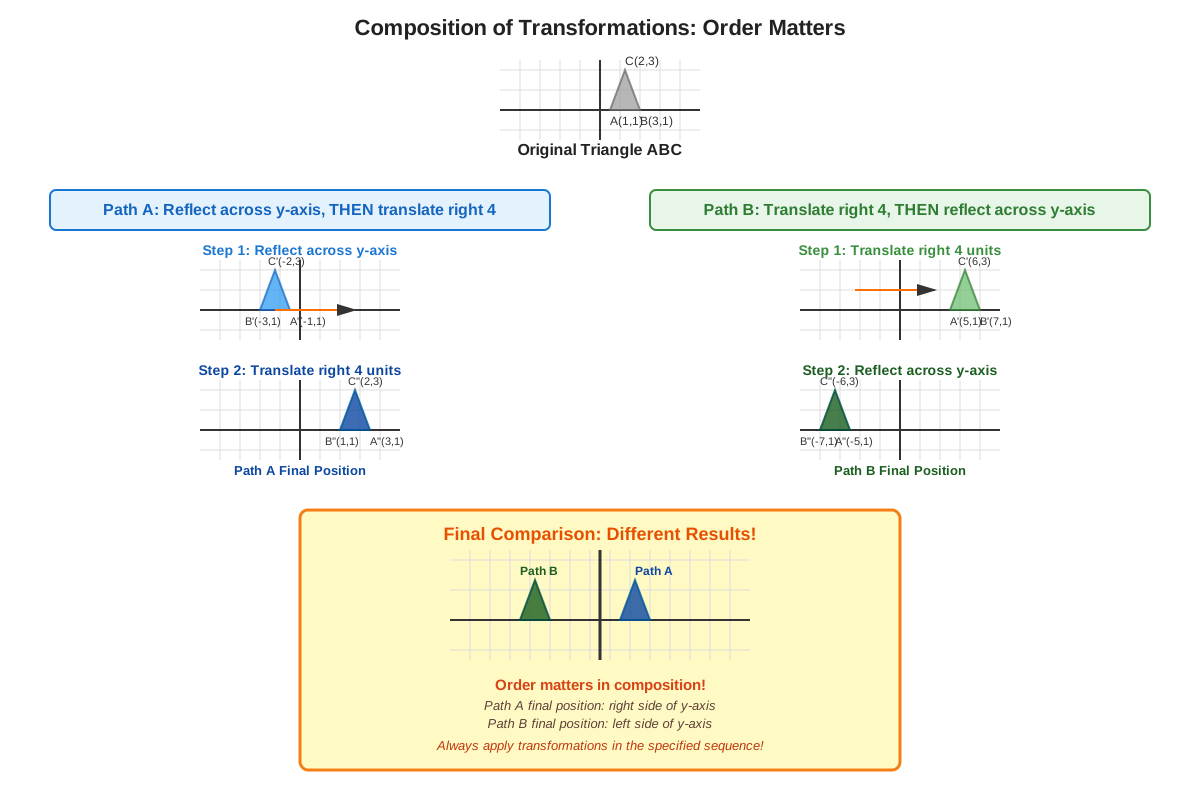
Many SAT problems require applying multiple transformations sequentially. The order matters for most combinations. When performing a composition of transformations, apply them from right to left in function notation, or in the order specified in word problems.
For example, if a point undergoes a reflection across the x-axis followed by a translation 3 units right, first apply the reflection rule (x, y) → (x, -y), then add 3 to the x-coordinate: (x, -y) → (x + 3, -y). The final transformation is (x, y) → (x + 3, -y).
Certain transformation combinations are commutative (order doesn't matter), such as two translations or a 180° rotation followed by any reflection. However, most combinations are non-commutative—a reflection followed by a translation produces different results than the same translation followed by the same reflection.
Concept Relationships
The four basic transformations form a hierarchy based on what properties they preserve. Translations, reflections, and rotations (rigid transformations) → preserve distance and angle measures → maintain congruence. Dilations (non-rigid) → preserve angle measures only → maintain similarity but not congruence.
Function transformations connect directly to coordinate transformations through the relationship between algebraic notation and geometric movement. Vertical shifts (f(x) + k) correspond to translations along the y-axis, while horizontal shifts (f(x - h)) correspond to translations along the x-axis. Reflections across axes in coordinate geometry mirror the effects of -f(x) and f(-x) in function notation.
Transformations build upon coordinate plane fundamentals by providing systematic rules for moving points. They extend to function analysis by showing how algebraic manipulations affect graphs. The concept of symmetry emerges from reflections and rotations—a figure has line symmetry if a reflection maps it onto itself, and rotational symmetry if a rotation less than 360° does so.
Composition of transformations demonstrates that complex movements can be decomposed into simpler operations, connecting to the mathematical principle of breaking problems into manageable steps. This relationship appears in SAT questions requiring students to work backward from a final position to determine what transformations occurred.
Quick check — test yourself on Transformations so far.
Try Flashcards →High-Yield Facts
⭐ Translation rule: (x, y) → (x + h, y + k) where h is horizontal shift and k is vertical shift
⭐ Reflection across x-axis: (x, y) → (x, -y); only the y-coordinate changes sign
⭐ Reflection across y-axis: (x, y) → (-x, y); only the x-coordinate changes sign
⭐ 90° counterclockwise rotation about origin: (x, y) → (-y, x); coordinates swap and first becomes negative
⭐ Function horizontal shift: f(x - h) shifts the graph RIGHT h units (counterintuitive direction)
- 180° rotation about origin: (x, y) → (-x, -y); both coordinates change sign
- Reflection across y = x: (x, y) → (y, x); coordinates swap positions
- Dilation from origin: (x, y) → (kx, ky) where k is the scale factor
- Vertical stretch: a·f(x) stretches by factor a when |a| > 1, compresses when 0 < |a| < 1
- Function vertical shift: f(x) + k shifts the graph UP k units (intuitive direction)
- Rigid transformations (translations, reflections, rotations) preserve congruence; dilations preserve only similarity
- Composition order matters: performing transformation A then B usually differs from B then A
- A negative scale factor in dilation combines enlargement/reduction with reflection across the center point
Common Misconceptions
Misconception: Reflecting across the x-axis changes the x-coordinate.
Correction: Reflection across the x-axis only affects the y-coordinate, changing its sign: (x, y) → (x, -y). The point moves vertically to the opposite side of the x-axis while maintaining the same horizontal position.
Misconception: f(x - 3) shifts a function's graph left 3 units.
Correction: f(x - 3) shifts the graph RIGHT 3 units. Horizontal transformations work opposite to intuition because you must consider what x-value makes the expression equal the original input. If f(x - 3) = f(0), then x = 3, indicating a rightward shift.
Misconception: All transformations preserve the size and shape of figures.
Correction: Only rigid transformations (translations, reflections, rotations) preserve both size and shape, maintaining congruence. Dilations change size, creating similar but not congruent figures. This distinction is critical when determining whether two figures are congruent or merely similar.
Misconception: A 90° clockwise rotation uses the same rule as a 90° counterclockwise rotation.
Correction: These rotations are opposites. A 90° counterclockwise rotation follows (x, y) → (-y, x), while a 90° clockwise rotation (equivalent to 270° counterclockwise) follows (x, y) → (y, -x). The coordinates swap in both cases, but which becomes negative differs.
Misconception: The order of transformations doesn't matter when combining multiple operations.
Correction: Order is crucial for most transformation combinations. A reflection followed by a translation produces different results than the same translation followed by the same reflection. Only certain special combinations (like two translations or two reflections across parallel lines) are commutative.
Misconception: Dilations always make figures larger.
Correction: Dilations enlarge figures only when the scale factor k > 1. When 0 < k < 1, dilations reduce size. When k = 1, the figure remains unchanged. When k < 0, the figure changes size AND reflects across the center point.
Worked Examples
Example 1: Multiple Transformations on a Point
Problem: Point A has coordinates (4, -2). Point A is first reflected across the y-axis, then translated 3 units up and 5 units left. What are the final coordinates of point A?
Solution:
Step 1: Apply the reflection across the y-axis.
The rule for y-axis reflection is (x, y) → (-x, y).
Starting point: (4, -2)
After reflection: (-4, -2)
Step 2: Apply the translation.
Translation 3 units up means adding 3 to the y-coordinate.
Translation 5 units left means subtracting 5 from the x-coordinate.
After reflection: (-4, -2)
After translation: (-4 - 5, -2 + 3) = (-9, 1)
Final Answer: The coordinates of point A after both transformations are (-9, 1).
Connection to Learning Objectives: This problem demonstrates applying transformations to answer SAT-style questions by requiring sequential application of multiple transformation rules and careful tracking of coordinate changes.
Example 2: Function Transformation Analysis
Problem: The graph of y = f(x) passes through the point (2, 5). Through which point must the graph of y = -f(x + 3) - 1 pass?
Solution:
Step 1: Identify the transformations in order.
The function y = -f(x + 3) - 1 contains three transformations:
- f(x + 3): horizontal shift left 3 units (opposite of the sign)
- -f(x + 3): reflection across the x-axis (negative outside)
- -f(x + 3) - 1: vertical shift down 1 unit (subtract 1 outside)
Step 2: Apply transformations to the point (2, 5).
Horizontal shift left 3: The x-coordinate decreases by 3.
(2, 5) → (2 - 3, 5) = (-1, 5)
Reflection across x-axis: The y-coordinate changes sign.
(-1, 5) → (-1, -5)
Vertical shift down 1: The y-coordinate decreases by 1.
(-1, -5) → (-1, -5 - 1) = (-1, -6)
Final Answer: The graph of y = -f(x + 3) - 1 must pass through the point (-1, -6).
Connection to Learning Objectives: This problem illustrates how transformations appear on the SAT through function notation, requiring students to identify transformation types from algebraic form and apply them systematically to determine new point locations.
Exam Strategy
When approaching SAT transformation questions, first identify what type of transformation is involved by looking for key indicators: coordinate changes suggest geometric transformations, while function notation modifications indicate function transformations. Read carefully to determine whether the question asks for a single transformation or a composition of multiple operations.
Trigger words and phrases to watch for include:
- "Reflected across" or "reflection over" → apply reflection rules
- "Shifted," "translated," or "moved" → apply translation rules
- "Rotated" with an angle measure → apply rotation rules
- "Dilated" or "scale factor" → apply dilation rules
- Function notation like f(x + h), f(x) + k, -f(x), or f(-x) → apply function transformation rules
For geometric transformations, sketch a quick coordinate plane if one isn't provided. Plot the original point or figure, then apply transformation rules systematically. For function transformations, remember that horizontal changes work opposite to intuition—f(x - 3) shifts right, not left.
Process-of-elimination strategies: If answer choices give coordinates, test each by working backward—apply the inverse transformation to see if you return to the original point. For function transformation questions, eliminate answers that shift in the wrong direction or by the wrong magnitude. If a question asks which transformation maps figure A onto figure B, eliminate any transformation type that would change properties not shown in the figures (e.g., eliminate dilations if the figures are the same size).
Time allocation: Most transformation questions should take 60-90 seconds. If a problem requires multiple transformations, budget 90-120 seconds. Don't spend excessive time visualizing complex rotations—trust the coordinate rules and apply them algebraically. If stuck, mark the question and return after completing easier problems.
Exam Tip: For function transformations, write out the transformation sequence before applying it. This prevents errors from applying operations in the wrong order or confusing horizontal and vertical shifts.
Memory Techniques
Mnemonic for reflection rules: "X-axis flips Y, Y-axis flips X"—when reflecting across the x-axis, only the y-coordinate changes; when reflecting across the y-axis, only the x-coordinate changes.
Mnemonic for rotation direction: "Counter-Clockwise = Coordinates Swap, First Negative" (90° counterclockwise: (x, y) → (-y, x)). For clockwise, remember it's the opposite: coordinates swap, second negative.
Visualization for horizontal shifts: Think of the function as asking a question. f(x - 3) asks "What was my value 3 units ago?" To answer that question, you must look 3 units to the RIGHT of where you currently are. This mental model helps remember that f(x - h) shifts right.
Acronym for transformation properties: "TRRD" = Translations, Reflections, and Rotations are Rigid; Dilations are not. This helps remember which transformations preserve congruence.
Memory aid for function transformations: "Outside affects Y, Inside affects X"—changes outside the function notation (like +k or multiplying the entire function) affect vertical position/stretch, while changes inside the parentheses (like x - h or multiplying x) affect horizontal position/stretch.
Summary
Transformations describe systematic ways that geometric figures and functions change position, orientation, or size in the coordinate plane. The four fundamental types—translations, reflections, rotations, and dilations—each follow specific coordinate rules that determine how points move. Translations shift all points the same distance in the same direction using the rule (x, y) → (x + h, y + k). Reflections create mirror images across lines, with the most common being across the x-axis (x, y) → (x, -y), y-axis (x, y) → (-x, y), and line y = x (x, y) → (y, x). Rotations turn figures around a point, typically the origin, with 90° counterclockwise following (x, y) → (-y, x) and 180° following (x, y) → (-x, -y). Dilations resize figures using (x, y) → (kx, ky) where k is the scale factor. Rigid transformations (translations, reflections, rotations) preserve congruence, while dilations preserve only similarity. Function transformations connect algebraic notation to geometric movement: f(x) + k shifts vertically, f(x - h) shifts horizontally (opposite direction), -f(x) reflects across the x-axis, and f(-x) reflects across the y-axis. Mastering these rules and recognizing transformation patterns in both coordinate and function contexts enables students to solve the diverse transformation questions that appear regularly on the SAT.
Key Takeaways
- The four basic transformations are translations (slides), reflections (flips), rotations (turns), and dilations (size changes), each with specific coordinate rules
- Rigid transformations (translations, reflections, rotations) preserve both size and shape, maintaining congruence between original and transformed figures
- Reflection across the x-axis changes only the y-coordinate sign; reflection across the y-axis changes only the x-coordinate sign
- Function horizontal transformations work counterintuitively: f(x - h) shifts RIGHT h units, not left
- When combining multiple transformations, order matters—apply them sequentially and track coordinate changes carefully
- Dilations with scale factor k > 1 enlarge, 0 < k < 1 shrink, and k < 0 both resize and reflect across the center point
- Recognizing transformation trigger words in SAT questions (reflected, shifted, rotated, dilated) helps identify which rules to apply
Related Topics
Symmetry and Congruence: Understanding transformations provides the foundation for analyzing symmetric figures and proving congruence. Figures with line symmetry can be mapped onto themselves through reflections, while rotationally symmetric figures map onto themselves through rotations less than 360°.
Function Analysis and Graphing: Transformation knowledge extends to analyzing how modifications to function equations affect their graphs, including parabolas, absolute value functions, and trigonometric functions. This skill is essential for advanced function problems on the SAT.
Vectors and Matrices: In advanced mathematics, transformations are represented using vectors (for translations) and matrices (for rotations, reflections, and dilations). Mastering basic transformations prepares students for these more sophisticated representations.
Geometric Proofs: Transformations provide powerful tools for proving geometric relationships, particularly congruence and similarity. Understanding which transformations preserve which properties enables logical reasoning about figure relationships.
Practice CTA
Now that you've mastered the core concepts of transformations, it's time to solidify your understanding through active practice. Work through the practice questions to test your ability to apply transformation rules under timed conditions, and use the flashcards to reinforce the specific coordinate rules and function transformation patterns that appear most frequently on the SAT. Remember, transformation questions reward systematic thinking and careful attention to detail—skills that improve dramatically with focused practice. Each problem you solve strengthens your pattern recognition and builds the confidence needed to tackle these high-yield questions efficiently on test day!
Sign up free to keep reading
Create a free AnvayaPrep account to finish this SAT guide on Transformations — plus flashcards and practice questions.