Overview
Radians represent one of the most fundamental yet frequently misunderstood concepts in circle geometry on the SAT math section. Unlike degrees, which divide a circle into 360 arbitrary units, radians provide a natural measurement system based on the relationship between arc length and radius. Understanding radians is not merely an academic exercise—it forms the bridge between geometric circle properties and trigonometric functions, both of which appear regularly on the SAT.
The SAT consistently tests radian concepts in multiple contexts: converting between degrees and radians, calculating arc lengths using radian measures, determining sector areas, and interpreting trigonometric functions expressed in radians. Questions involving sat radians typically appear 2-3 times per test, making this a high-yield topic that directly impacts your score. These questions often integrate multiple concepts, requiring students to move fluidly between angle measurements, circle properties, and algebraic manipulation.
Mastering radians connects directly to broader mathematical reasoning tested on the SAT. The concept reinforces proportional thinking, strengthens understanding of π as more than just a number, and provides essential preparation for any future STEM coursework. Students who develop comfort with radian measure gain a significant advantage not only on direct radian questions but also on complex problems involving periodic functions, unit circle applications, and advanced geometry scenarios that appear in the calculator and no-calculator sections alike.
Learning Objectives
- [ ] Identify key features of radians including definition, relationship to radius and arc length, and fundamental properties
- [ ] Explain how radians appears on the SAT in various question formats and difficulty levels
- [ ] Apply radians to answer SAT-style questions involving conversions, arc length, and sector area
- [ ] Convert fluently between degree and radian measures without hesitation
- [ ] Calculate arc lengths and sector areas using radian angle measures
- [ ] Interpret and evaluate trigonometric expressions written in radian form
- [ ] Recognize when radian measure simplifies problem-solving compared to degree measure
Prerequisites
- Circle basics (radius, diameter, circumference): Radians are defined using the relationship between radius and arc length, requiring solid understanding of these fundamental circle components
- Proportional reasoning: Converting between radians and degrees relies on setting up and solving proportions based on the relationship between 2π radians and 360 degrees
- Basic algebra: Manipulating equations involving π and solving for unknown angles requires comfort with algebraic operations
- Understanding of π: Recognizing π as the ratio of circumference to diameter (approximately 3.14159) is essential for working with radian measures
Why This Topic Matters
Radians appear throughout higher mathematics, physics, and engineering because they create elegant relationships that degrees cannot match. In calculus, derivatives of trigonometric functions only work correctly when angles are measured in radians. In physics, angular velocity and rotational motion equations require radian measure. Even in everyday applications like computer graphics, animation, and GPS navigation systems, radians provide the computational foundation.
On the SAT specifically, radian questions appear with remarkable consistency. Approximately 2-3 questions per test directly involve radian concepts, and several additional questions incorporate radians indirectly through trigonometric functions or circle geometry. These questions typically fall into the medium-to-hard difficulty range, making them excellent opportunities for score differentiation. The College Board particularly favors questions that combine radian measure with arc length calculations, sector area problems, and unit circle applications.
Common SAT question formats include: direct degree-to-radian conversions (often involving special angles like 30°, 45°, 60°, 90°), arc length problems where the central angle is given in radians, sector area calculations requiring radian measures, and trigonometric function evaluations where angles are expressed in radians rather than degrees. Understanding radians also enables efficient problem-solving on questions involving periodic functions, rotational symmetry, and coordinate geometry on circles.
Core Concepts
Definition of a Radian
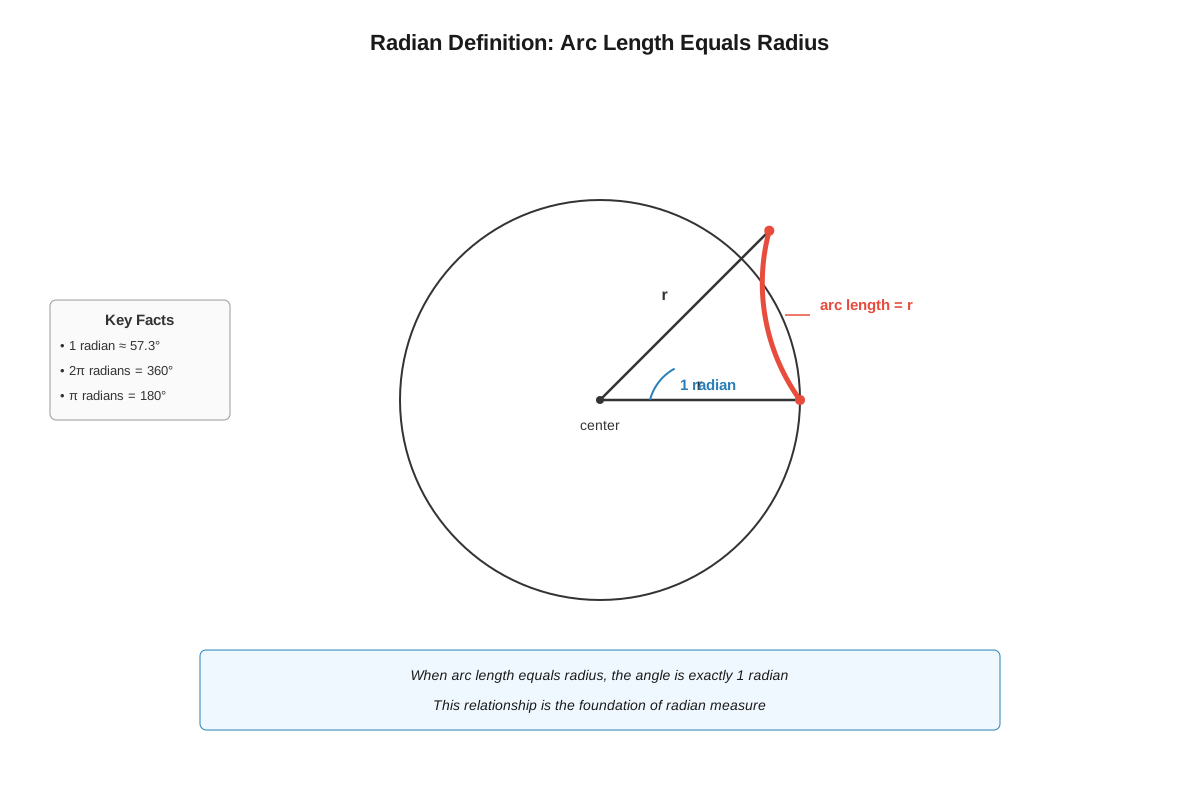
A radian is defined as the measure of a central angle that intercepts an arc equal in length to the radius of the circle. This definition makes radians a "natural" unit of angle measurement because it directly relates the angle to the circle's fundamental property—its radius. If you take any circle and mark off an arc length exactly equal to one radius, the central angle formed measures exactly one radian.
This definition leads to a crucial relationship: since the circumference of a circle equals 2πr (where r is the radius), wrapping the entire circumference around the circle requires 2π radius lengths. Therefore, a complete revolution around a circle equals 2π radians. This fundamental fact—that 360° = 2π radians—forms the basis for all conversions between degree and radian measures.
Converting Between Degrees and Radians
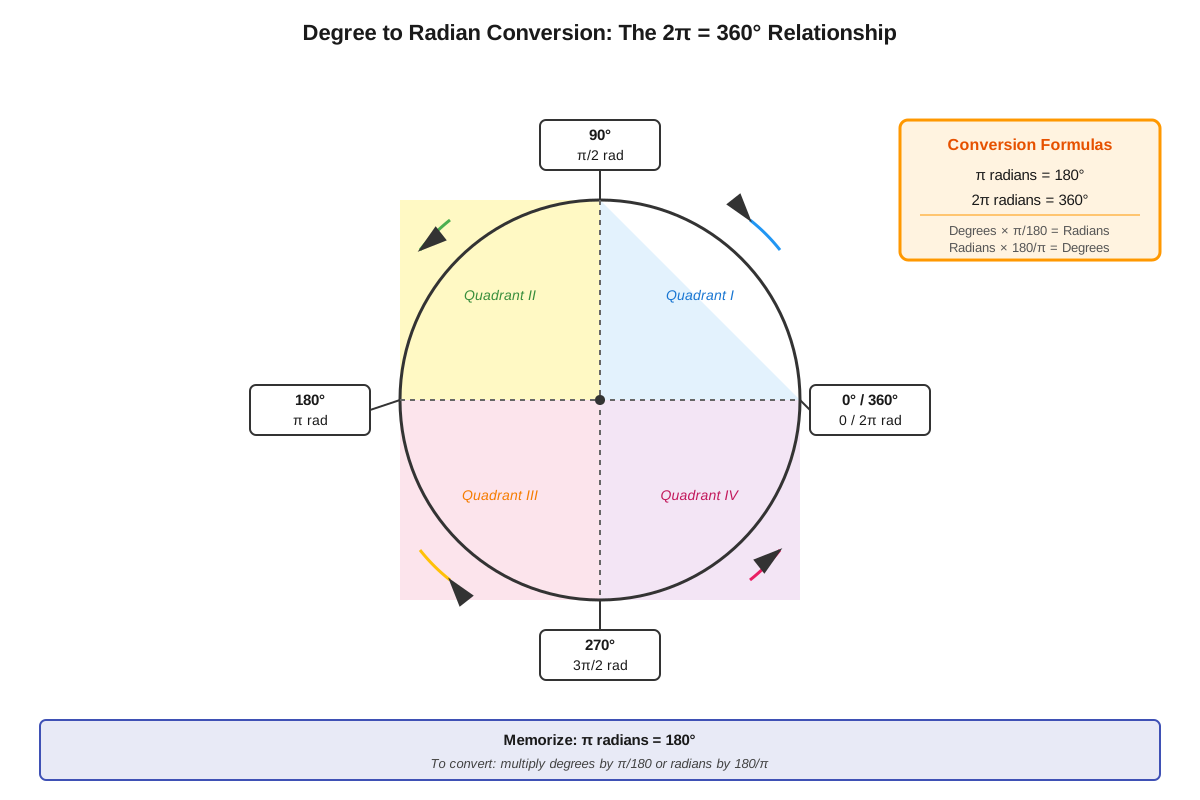
The conversion between degrees and radians relies on the equivalence: 360° = 2π radians (or simplified: 180° = π radians). This creates two conversion factors that students must memorize and apply fluently:
Conversion formulas:
- To convert from degrees to radians: multiply by π/180
- To convert from radians to degrees: multiply by 180/π
Degrees to Radians: angle_radians = angle_degrees × (π/180)
Radians to Degrees: angle_degrees = angle_radians × (180/π)| Degrees | Radians (exact) | Radians (decimal) |
|---|---|---|
| 0° | 0 | 0 |
| 30° | π/6 | ≈0.524 |
| 45° | π/4 | ≈0.785 |
| 60° | π/3 | ≈1.047 |
| 90° | π/2 | ≈1.571 |
| 120° | 2π/3 | ≈2.094 |
| 135° | 3π/4 | ≈2.356 |
| 150° | 5π/6 | ≈2.618 |
| 180° | π | ≈3.142 |
| 270° | 3π/2 | ≈4.712 |
| 360° | 2π | ≈6.283 |
Memorizing the exact radian values for common angles (30°, 45°, 60°, 90°, 180°) eliminates calculation time on the SAT and reduces error potential.
Arc Length Using Radians
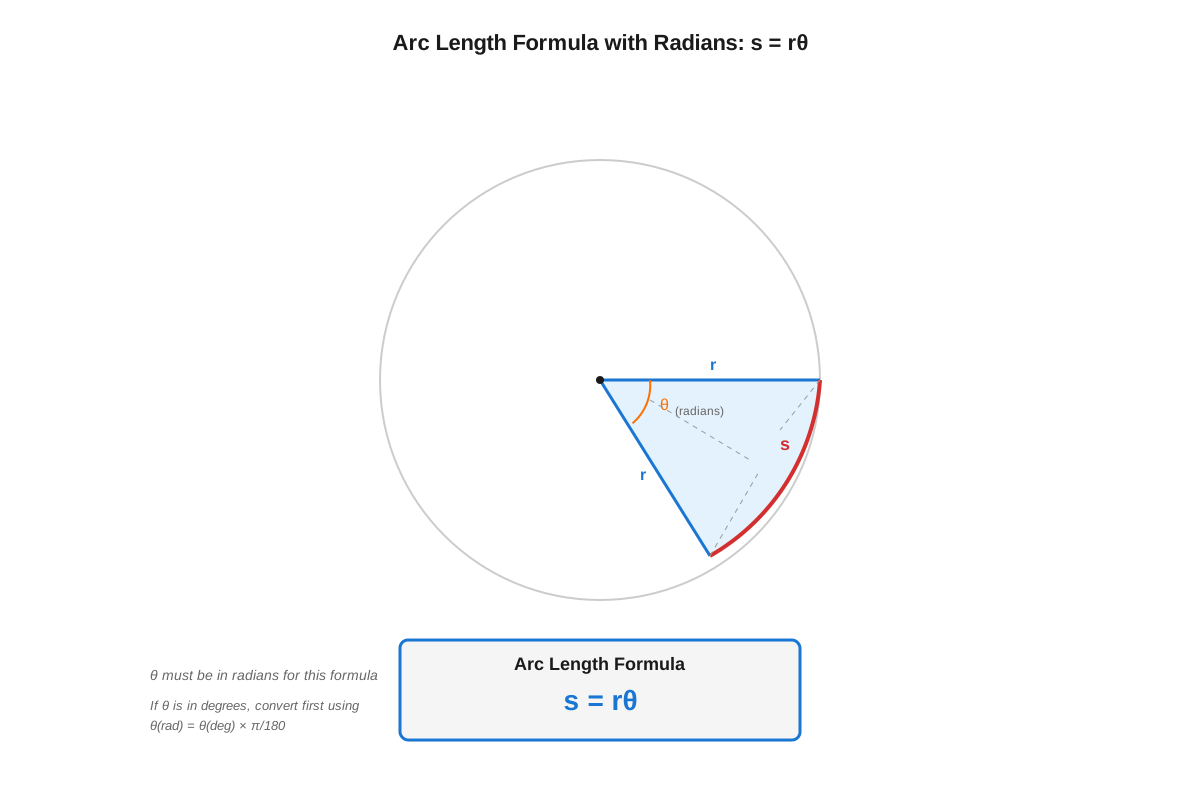
One of the most powerful applications of radian measure is the simplified arc length formula. When the central angle θ is measured in radians, the arc length s is simply:
s = rθwhere r is the radius and θ is the central angle in radians. This elegant formula directly reflects the definition of a radian—when θ = 1 radian, the arc length equals the radius (s = r × 1 = r).
Compare this to the degree-based formula: s = (θ/360) × 2πr, which requires more steps and greater chance for computational error. The radian formula's simplicity makes it vastly superior for problem-solving.
Sector Area Using Radians
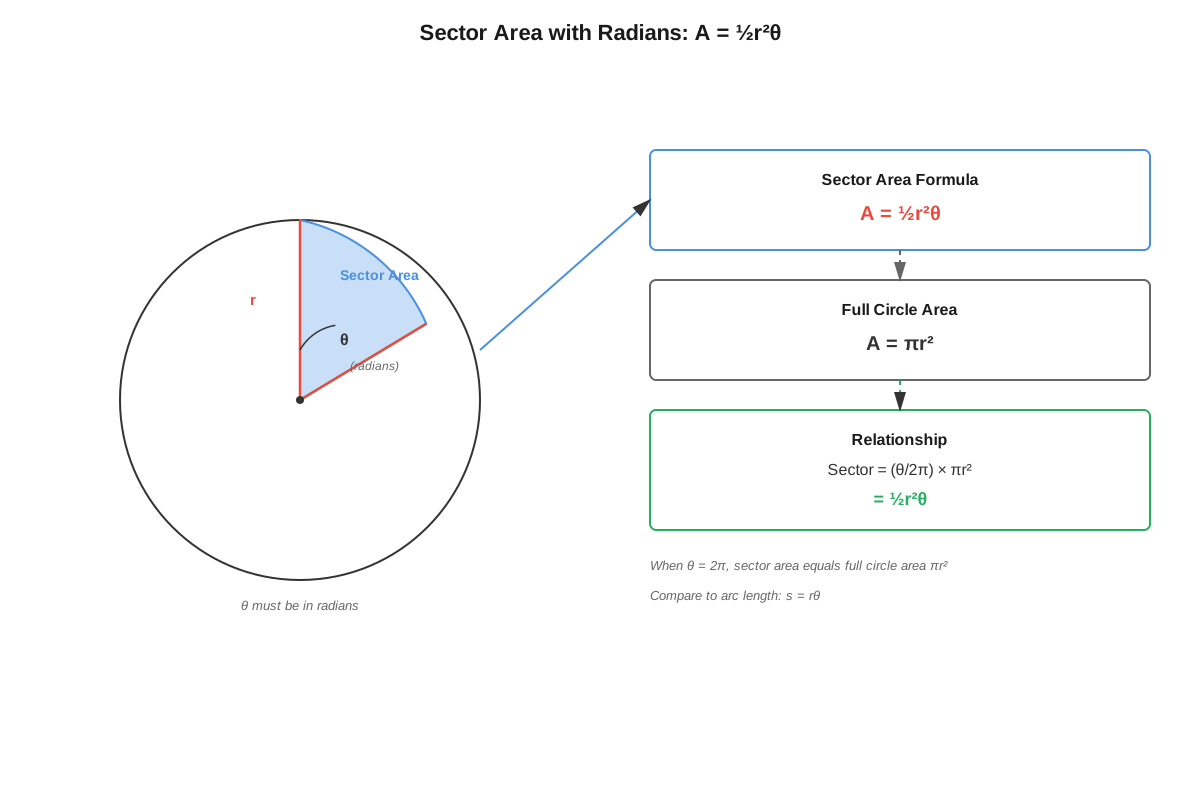
A sector is a "slice" of a circle bounded by two radii and an arc. When the central angle θ is measured in radians, the sector area A follows a similarly elegant formula:
A = (1/2)r²θThis formula parallels the arc length formula and can be understood through proportional reasoning: a sector with angle θ represents θ/(2π) of the entire circle, so its area equals θ/(2π) × πr² = (1/2)r²θ.
The degree-based equivalent, A = (θ/360) × πr², requires more calculation and provides more opportunities for error. Recognizing when to use the radian-based formula saves valuable time on the SAT.
Radians and the Unit Circle
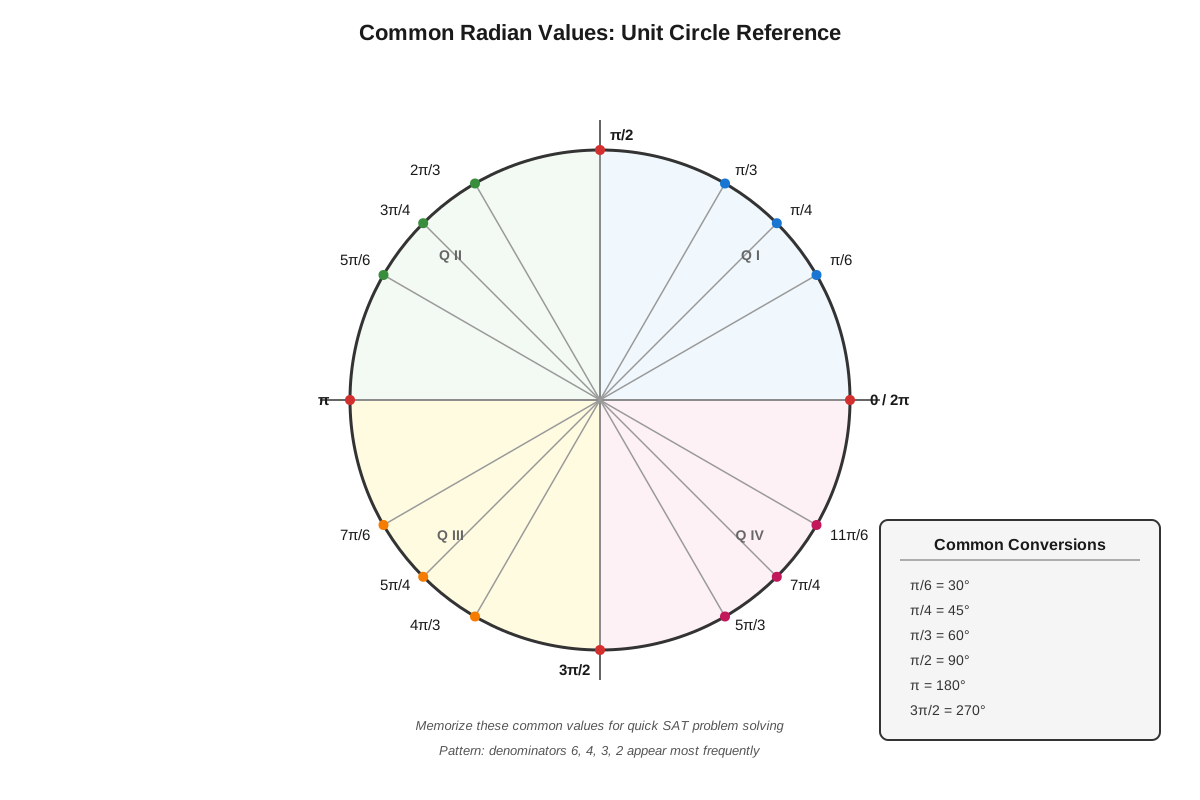
The unit circle (a circle with radius 1 centered at the origin) provides the foundation for understanding trigonometric functions in terms of radians. On the unit circle, any angle θ measured in radians from the positive x-axis corresponds to a point (cos θ, sin θ). This relationship makes radians essential for trigonometry.
Key unit circle angles in radians that appear frequently on the SAT:
- 0, π/6, π/4, π/3, π/2 (first quadrant)
- 2π/3, 3π/4, 5π/6, π (second quadrant)
- 7π/6, 5π/4, 4π/3, 3π/2 (third and fourth quadrants)
- 2π (full rotation)
Understanding these standard positions enables quick evaluation of trigonometric expressions without a calculator.
Concept Relationships
The definition of a radian → leads to → the fundamental equivalence (2π radians = 360°) → which enables → conversion between degree and radian measures. This conversion ability → supports → working with trigonometric functions expressed in radians, which → connects to → unit circle applications.
Simultaneously, the radian definition → directly produces → the simplified arc length formula (s = rθ) → which relates to → the sector area formula (A = ½r²θ) through proportional reasoning. Both formulas → demonstrate → why radians are the "natural" angle measure for circle calculations.
These circle-based applications → extend to → periodic function analysis, rotational motion problems, and coordinate geometry scenarios that integrate multiple SAT math concepts. The prerequisite knowledge of circle properties (radius, circumference, area) → provides the foundation → for understanding why radian measure creates such elegant mathematical relationships.
Mastery of radians → enables progression to → more advanced topics including trigonometric identities, inverse trigonometric functions, and calculus-based concepts that appear in college-level mathematics. Even within the SAT scope, radian fluency → improves performance on → complex multi-step problems that combine geometry, algebra, and trigonometry.
High-Yield Facts
⭐ One radian is the angle that intercepts an arc length equal to the radius of the circle
⭐ 360° = 2π radians, or equivalently, 180° = π radians
⭐ To convert degrees to radians, multiply by π/180; to convert radians to degrees, multiply by 180/π
⭐ Arc length formula with radians: s = rθ (where θ is in radians)
⭐ Sector area formula with radians: A = (1/2)r²θ (where θ is in radians)
- A complete circle contains 2π radians (approximately 6.28 radians)
- Common angle conversions: 90° = π/2, 60° = π/3, 45° = π/4, 30° = π/6
- One radian equals approximately 57.3 degrees (180/π ≈ 57.3)
- When working with radians, π should typically remain in symbolic form rather than decimal approximation
- The radian measure of an angle is dimensionless (it's a ratio of two lengths)
- Negative radian measures indicate clockwise rotation from the positive x-axis
- Radian measures greater than 2π indicate multiple complete rotations
- On the unit circle (radius = 1), the arc length numerically equals the angle in radians
Quick check — test yourself on Radians so far.
Try Flashcards →Common Misconceptions
Misconception: Radians and degrees can be used interchangeably in formulas without conversion → Correction: Formulas like s = rθ and A = (1/2)r²θ only work when θ is measured in radians. Using degrees in these formulas produces incorrect results. Always verify the angle unit before applying a formula.
Misconception: π radians equals 360° → Correction: π radians equals 180°, not 360°. A full circle is 2π radians. This is one of the most common errors on SAT questions and leads to answers that are off by a factor of 2.
Misconception: Radian measures must always be expressed as decimals → Correction: On the SAT, radian measures should typically remain in exact form using π (like π/4 or 2π/3) rather than decimal approximations. This maintains precision and often matches answer choice formats.
Misconception: The formula s = rθ works for any angle measurement → Correction: This simplified arc length formula only works when θ is in radians. If θ is in degrees, you must either convert to radians first or use the degree-based formula s = (θ/360) × 2πr.
Misconception: Larger radian measures always correspond to larger angles than smaller degree measures → Correction: The numerical value alone doesn't determine size—the unit matters. For example, π/6 radians (30°) is smaller than 45°, even though π/6 ≈ 0.524 is less than 45 numerically. Always compare angles in the same unit.
Misconception: Radians are only used in advanced mathematics and won't appear on the SAT → Correction: Radians appear regularly on the SAT, typically in 2-3 questions per test. The College Board expects students to work comfortably with radian measure, especially for arc length, sector area, and trigonometric function problems.
Worked Examples
Example 1: Converting and Calculating Arc Length
Problem: A circle has a radius of 12 cm. What is the length of an arc that subtends a central angle of 150°?
Solution:
Step 1: Identify what's given and what's needed.
- Given: radius r = 12 cm, central angle = 150°
- Need: arc length s
Step 2: Recognize that the arc length formula s = rθ requires θ in radians.
- Current angle: 150°
- Must convert to radians
Step 3: Convert 150° to radians.
- Use the conversion: multiply by π/180
- 150° × (π/180) = 150π/180 = 5π/6 radians
Step 4: Apply the arc length formula.
- s = rθ
- s = 12 × (5π/6)
- s = (12 × 5π)/6
- s = 60π/6
- s = 10π cm
Step 5: Verify the answer makes sense.
- 150° is less than half a circle (180°), so the arc should be less than half the circumference
- Full circumference = 2πr = 2π(12) = 24π cm
- Half circumference = 12π cm
- Our answer of 10π cm is indeed less than 12π cm ✓
Answer: 10π cm (or approximately 31.4 cm if a decimal answer is required)
Connection to Learning Objectives: This problem demonstrates the application of radians to SAT-style questions by requiring degree-to-radian conversion followed by arc length calculation using the radian-based formula.
Example 2: Sector Area with Radian Measure
Problem: A sector of a circle has a central angle of 2π/3 radians and an area of 24π square inches. What is the radius of the circle?
Solution:
Step 1: Identify what's given and what's needed.
- Given: central angle θ = 2π/3 radians, sector area A = 24π square inches
- Need: radius r
Step 2: Recognize the sector area formula with radians.
- A = (1/2)r²θ
- The angle is already in radians, so we can use this formula directly
Step 3: Substitute known values and solve for r.
- 24π = (1/2)r²(2π/3)
- 24π = (2π/6)r²
- 24π = (π/3)r²
Step 4: Isolate r².
- Multiply both sides by 3: 72π = πr²
- Divide both sides by π: 72 = r²
Step 5: Solve for r.
- r = √72
- r = √(36 × 2)
- r = 6√2 inches
Step 6: Verify the answer makes sense.
- 2π/3 radians = 120°, which is one-third of a circle
- Full circle area with r = 6√2: A = π(6√2)² = π(72) = 72π
- One-third of this: 72π/3 = 24π ✓
Answer: 6√2 inches (or approximately 8.49 inches)
Connection to Learning Objectives: This problem demonstrates identifying key features of radians (recognizing when an angle is already in radian form) and applying the sector area formula to solve for an unknown radius, a common SAT problem type.
Exam Strategy
When approaching sat radians questions, first identify whether angles are given in degrees or radians—this determines which formulas to use. Look for the degree symbol (°) or the presence of π in the angle measure. If you see π without a degree symbol, the angle is in radians. If you see a number with a degree symbol, convert to radians before using simplified formulas.
Trigger words and phrases that signal radian problems include: "arc length," "sector area," "central angle," "subtends," "measured in radians," and any trigonometric function notation like sin(π/4) where the angle is expressed with π. Questions asking you to "express your answer in terms of π" almost always involve radian measure.
For process-of-elimination on multiple-choice questions, use these strategies:
- If converting from degrees to radians, eliminate any answer without π (unless the angle is 0° or a multiple of 180°)
- If calculating arc length or sector area, eliminate answers that don't include the radius in the expected way (linearly for arc length, squared for area)
- Check whether your answer is reasonable in magnitude: arc lengths should be less than the full circumference (2πr), and sector areas should be less than the full circle area (πr²)
Time allocation: Straightforward conversion problems should take 30-45 seconds. Arc length and sector area problems typically require 60-90 seconds. Multi-step problems combining radians with other concepts may need 2-3 minutes. If a problem requires more than 3 minutes, mark it and return later—don't let one difficult radian question consume excessive time.
Calculator considerations: For the calculator-permitted section, you can verify conversions and compute decimal approximations, but remember that SAT answers often require exact values in terms of π. Use your calculator to check reasonableness, not as a substitute for understanding the concepts.
Memory Techniques
Conversion Mnemonic: "Please Divide Radians Meaningfully"
- Pi over 180 for Degrees to radians
- 180 over pi for Radians to degrees Multiply
Common Angle Memory Device: Create a visual of a clock face:
- 3 o'clock (90°) = π/2 radians
- 6 o'clock (180°) = π radians
- 9 o'clock (270°) = 3π/2 radians
- 12 o'clock (360°/0°) = 2π/0 radians
Formula Visualization: Remember "Radians Simplify Really Tough problems"
- Radians: s = rθ (arc length)
- Sector: A = (1/2)r²θ
- Remember: both formulas need radians
- Theta must be in radians for these to work
The "Radius Rule": One radian is "Radius Around" the circle—when you wrap one radius length around the circumference, you've traced one radian. This visual helps remember the fundamental definition.
Pi Proportion: Think "Pi Is Half" the circle in radians (π radians = 180°), so 2π completes the circle. This prevents the common error of thinking π = 360°.
Summary
Radians provide a natural, elegant system for measuring angles based on the fundamental relationship between a circle's radius and arc length. Defined as the angle that intercepts an arc equal to the radius, one radian represents a universal constant that simplifies circle calculations dramatically. The key equivalence—2π radians equals 360 degrees—enables conversion between measurement systems using the factors π/180 (degrees to radians) and 180/π (radians to degrees). The SAT consistently tests radian concepts through arc length problems (s = rθ), sector area calculations (A = ½r²θ), and trigonometric function evaluations, making fluency with radian measure essential for achieving high scores. Students must memorize common angle conversions (especially π/6, π/4, π/3, and π/2), recognize when angles are expressed in radians versus degrees, and apply the appropriate formulas confidently. Success with radians requires understanding both the conceptual foundation (why radians exist and what they represent) and the procedural skills (converting units and calculating arc lengths and areas efficiently).
Key Takeaways
- A radian is defined as the central angle that intercepts an arc length equal to the circle's radius, making it a natural unit of angle measurement
- The fundamental conversion relationship is 180° = π radians; multiply by π/180 to convert degrees to radians, and by 180/π to convert radians to degrees
- Arc length and sector area formulas become elegantly simple with radians: s = rθ and A = (1/2)r²θ, but these only work when θ is measured in radians
- Memorize exact radian values for common angles (30°, 45°, 60°, 90°) to save time and reduce errors on the SAT
- Always verify whether an angle is given in degrees or radians before applying formulas—this is the most common source of errors on radian problems
- Radian questions appear 2-3 times per SAT test and often combine with other concepts like trigonometry and coordinate geometry
- Keep answers in exact form using π rather than decimal approximations unless specifically instructed otherwise
Related Topics
Trigonometric Functions and the Unit Circle: Understanding radians enables deeper comprehension of sine, cosine, and tangent functions defined on the unit circle, where angles measured in radians correspond directly to arc lengths. Mastering radians is prerequisite to evaluating trigonometric expressions efficiently.
Angular Velocity and Rotational Motion: Physics applications involving rotating objects use radians per second as the standard unit for angular velocity. This connects circle geometry to real-world motion problems that occasionally appear in SAT word problems.
Periodic Functions and Graphing: Functions like y = sin(x) and y = cos(x) are conventionally graphed with x-values in radians. Understanding radian measure enables interpretation of period, amplitude, and phase shift in trigonometric graphs.
Advanced Circle Theorems: Inscribed angles, central angles, and arc relationships become more elegant when expressed in radians, providing foundation for competition mathematics and advanced geometry.
Polar Coordinates: This coordinate system uses radians to specify angular position, connecting radian measure to coordinate geometry and providing an alternative to Cartesian coordinates for certain problem types.
Practice CTA
Now that you've mastered the core concepts of radians, it's time to solidify your understanding through active practice. Work through the practice questions to test your ability to convert between degrees and radians, calculate arc lengths and sector areas, and solve multi-step problems that integrate radian concepts with other SAT math topics. Use the flashcards to drill common angle conversions until they become automatic—this fluency will save you valuable time on test day and boost your confidence when radian questions appear. Remember, radians are a high-yield topic that appears consistently on every SAT, so the time you invest in practice now will directly translate to points on your exam. You've got this!
Sign up free to keep reading
Create a free AnvayaPrep account to finish this SAT guide on Radians — plus flashcards and practice questions.