Overview
The unit circle is a fundamental concept in trigonometry that serves as a powerful tool for understanding the relationships between angles and trigonometric functions. A unit circle is defined as a circle with a radius of exactly 1 unit, centered at the origin (0, 0) of a coordinate plane. This seemingly simple geometric figure provides the foundation for understanding sine, cosine, and tangent values for any angle, making it an essential component of SAT math problems involving trigonometry, coordinate geometry, and periodic functions.
Understanding unit circle basics is crucial for SAT success because these concepts appear regularly in both calculator and no-calculator sections of the exam. Questions may directly test knowledge of coordinate values at specific angles, or they may embed unit circle concepts within more complex problems involving triangles, periodic functions, or coordinate geometry. The SAT frequently presents scenarios where recognizing unit circle relationships can transform a seemingly difficult problem into a straightforward calculation.
The unit circle connects multiple mathematical domains that appear throughout the SAT curriculum. It bridges geometry (circles and triangles), algebra (coordinate systems and function values), and trigonometry (sine, cosine, and tangent relationships). Mastering unit circle basics enables students to quickly evaluate trigonometric expressions, understand angle relationships, and solve problems involving periodic phenomena—all skills that contribute to higher scores on the quantitative sections of the SAT.
Learning Objectives
- [ ] Identify key features of unit circle basics, including radius, center, and coordinate relationships
- [ ] Explain how unit circle basics appears on the SAT in various question formats
- [ ] Apply unit circle basics to answer SAT-style questions involving angles and coordinates
- [ ] Calculate exact trigonometric values for common angles using the unit circle
- [ ] Convert between degree and radian measures for standard unit circle angles
- [ ] Determine coordinates of points on the unit circle for any given angle
- [ ] Recognize and apply symmetry properties of the unit circle to solve problems efficiently
Prerequisites
- Basic coordinate geometry: Understanding the Cartesian plane is essential because the unit circle is positioned with its center at the origin, and all points are described using (x, y) coordinates
- Right triangle trigonometry: Knowledge of sine, cosine, and tangent as ratios in right triangles provides the foundation for understanding how these functions relate to unit circle coordinates
- Pythagorean theorem: This theorem (a² + b² = c²) is fundamental to understanding why x² + y² = 1 for all points on the unit circle
- Special right triangles (30-60-90 and 45-45-90): These triangles generate the exact coordinate values for the most commonly tested unit circle angles
- Basic angle measurement: Familiarity with degrees and the concept of angles measured counterclockwise from the positive x-axis
Why This Topic Matters
The unit circle represents one of the most elegant unifications in mathematics, connecting geometry, algebra, and trigonometry into a single visual framework. In real-world applications, unit circle concepts underpin everything from engineering calculations involving rotational motion to computer graphics programming, where circular motion and periodic functions are essential. Navigation systems, wave mechanics in physics, and even music theory all rely on the mathematical relationships encoded in the unit circle.
On the SAT, unit circle questions appear with moderate frequency, typically 1-3 questions per exam. These questions most commonly test coordinate identification at standard angles (multiples of 30°, 45°, 60°, and 90°), evaluation of trigonometric expressions, and understanding of angle relationships. The College Board particularly favors questions that combine unit circle knowledge with other concepts, such as using trigonometric values to solve equations or applying unit circle coordinates to geometric problems.
Unit circle concepts appear in several distinct question formats on the SAT: direct evaluation problems asking for sine or cosine of specific angles, coordinate geometry problems involving points on circles, questions about periodic function properties, and multi-step problems where recognizing a unit circle relationship provides a crucial shortcut. The ability to quickly recall or derive unit circle values can save valuable time and reduce calculation errors, making this a high-yield topic for focused study.
Core Concepts
Definition and Structure of the Unit Circle
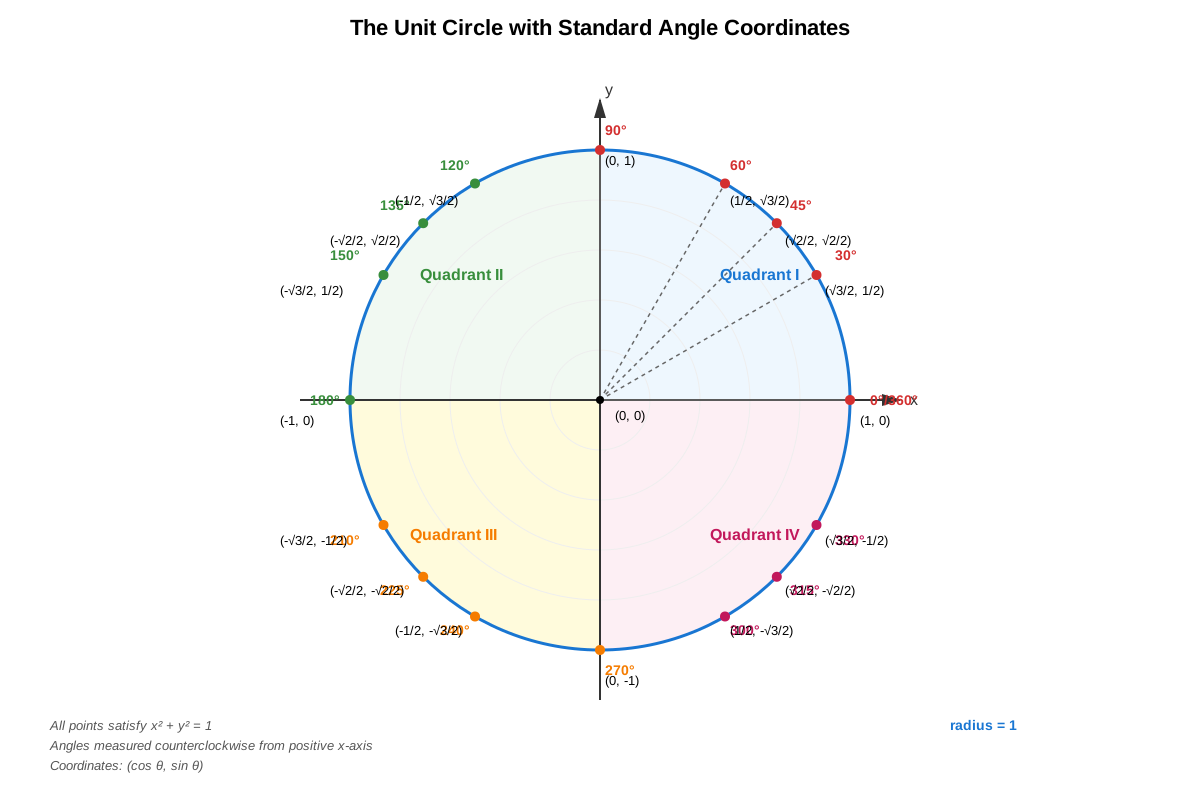
The unit circle is a circle with radius r = 1, centered at the origin (0, 0) of the coordinate plane. The equation of the unit circle is x² + y² = 1, which comes directly from the Pythagorean theorem applied to the distance formula. Every point (x, y) on the unit circle satisfies this equation, meaning the distance from the origin to any point on the circle is exactly 1 unit.
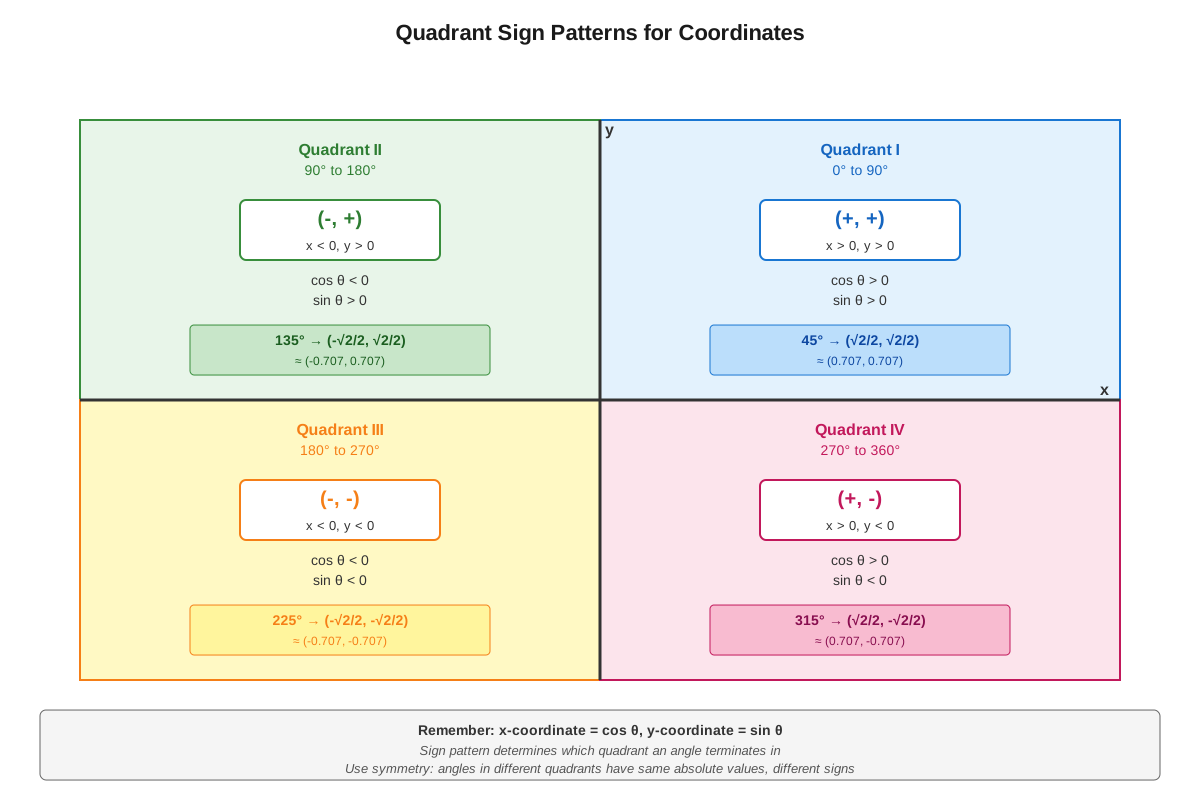
The unit circle is divided into four quadrants, just like the standard coordinate plane. Quadrant I contains angles from 0° to 90° (or 0 to π/2 radians), where both x and y coordinates are positive. Quadrant II spans 90° to 180° (π/2 to π), with negative x and positive y values. Quadrant III covers 180° to 270° (π to 3π/2), where both coordinates are negative. Quadrant IV extends from 270° to 360° (3π/2 to 2π), with positive x and negative y values.
Angle Measurement and Position
Angles on the unit circle are measured from the positive x-axis (the 3 o'clock position) and proceed counterclockwise for positive angles. A ray from the origin forms an angle θ with the positive x-axis, and where this ray intersects the unit circle determines a unique point with coordinates (x, y). This point's coordinates have special significance: the x-coordinate equals cos(θ) and the y-coordinate equals sin(θ).
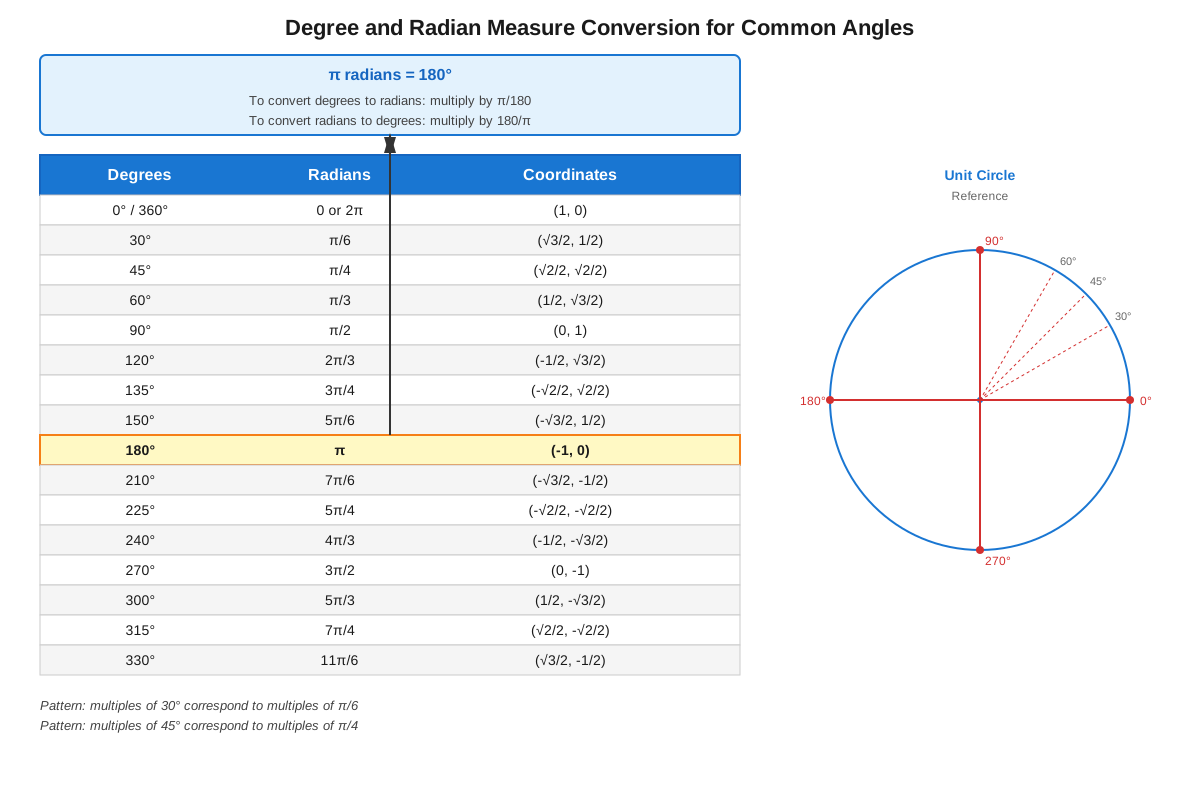
The SAT uses both degree and radian measures, though radians appear more frequently in advanced problems. Key conversions include: 180° = π radians, 90° = π/2 radians, 60° = π/3 radians, 45° = π/4 radians, and 30° = π/6 radians. Understanding these conversions is essential because SAT questions may present angles in either format.
Standard Angle Coordinates
The most frequently tested angles on the SAT are the standard angles: 0°, 30°, 45°, 60°, 90°, and their multiples in all four quadrants. These angles produce exact coordinate values that can be derived from special right triangles.
| Angle (degrees) | Angle (radians) | Coordinates (x, y) | cos(θ) | sin(θ) |
|---|---|---|---|---|
| 0° | 0 | (1, 0) | 1 | 0 |
| 30° | π/6 | (√3/2, 1/2) | √3/2 | 1/2 |
| 45° | π/4 | (√2/2, √2/2) | √2/2 | √2/2 |
| 60° | π/3 | (1/2, √3/2) | 1/2 | √3/2 |
| 90° | π/2 | (0, 1) | 0 | 1 |
Deriving Coordinates from Special Triangles
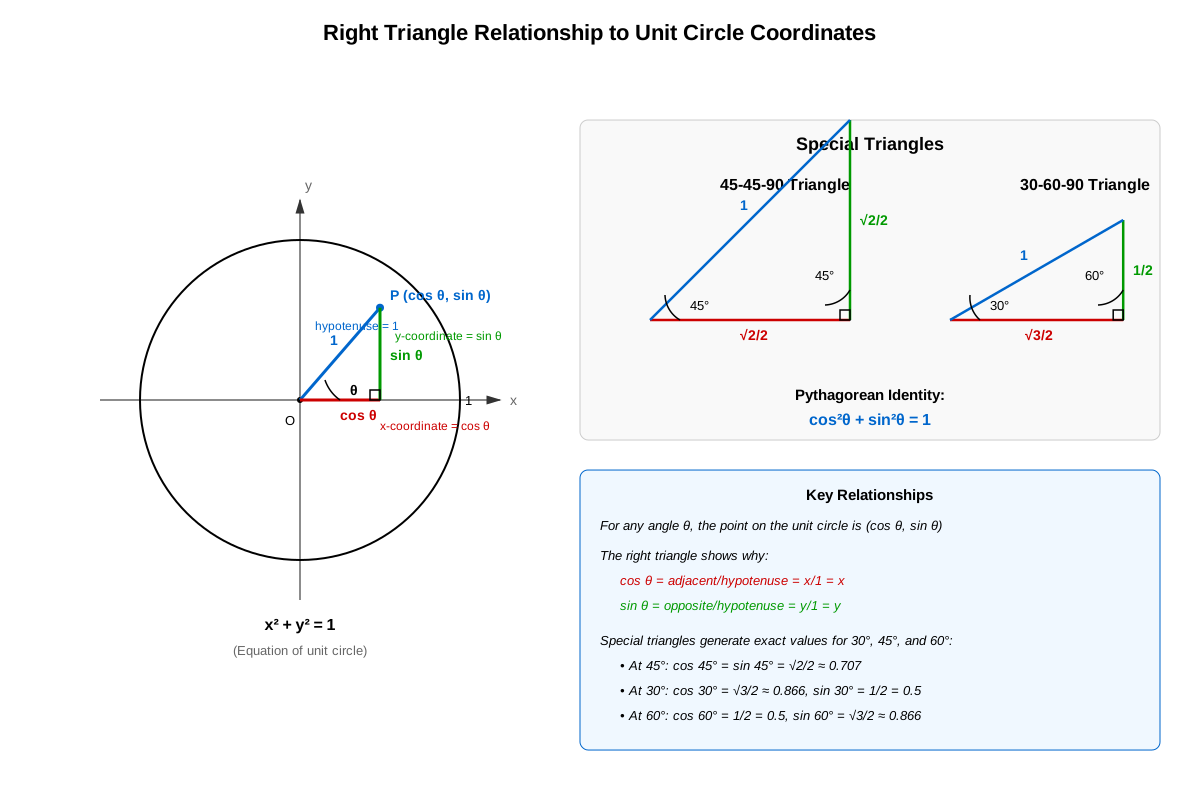
The 45-45-90 triangle has sides in the ratio 1:1:√2. When scaled so the hypotenuse equals 1 (the unit circle radius), the legs each have length 1/√2 = √2/2. This explains why the coordinates at 45° are (√2/2, √2/2).
The 30-60-90 triangle has sides in the ratio 1:√3:2. When scaled so the hypotenuse equals 1, the short leg (opposite the 30° angle) has length 1/2, and the long leg (opposite the 60° angle) has length √3/2. At 30°, the point is (√3/2, 1/2), while at 60°, the point is (1/2, √3/2).
Symmetry Properties
The unit circle exhibits multiple symmetry properties that allow quick determination of coordinates in all quadrants once the first quadrant values are known:
- Reflection across the y-axis: The point at angle θ and the point at angle (180° - θ) have y-coordinates that are equal and x-coordinates that are opposites
- Reflection across the x-axis: The point at angle θ and the point at angle (360° - θ) have x-coordinates that are equal and y-coordinates that are opposites
- Reflection through the origin: The point at angle θ and the point at angle (180° + θ) have both coordinates opposite in sign
These symmetries mean that if you know cos(30°) = √3/2 and sin(30°) = 1/2, you can immediately determine that cos(150°) = -√3/2 and sin(150°) = 1/2, or that cos(210°) = -√3/2 and sin(210°) = -1/2.
Trigonometric Function Relationships
On the unit circle, the cosine function always equals the x-coordinate of the point, and the sine function always equals the y-coordinate. This provides an intuitive geometric interpretation: cosine measures horizontal displacement from the origin, while sine measures vertical displacement.
The tangent function equals sin(θ)/cos(θ), which geometrically represents the slope of the line from the origin through the point on the circle. Tangent is undefined when cos(θ) = 0 (at 90° and 270°) because division by zero is undefined.
Reference Angles
A reference angle is the acute angle formed between the terminal side of an angle and the x-axis. Reference angles allow calculation of trigonometric values for any angle by using the known values from the first quadrant and adjusting signs based on the quadrant. For example, the reference angle for 150° is 30°, so sin(150°) has the same absolute value as sin(30°) but the sign is determined by the fact that 150° is in Quadrant II, where sine is positive.
Concept Relationships
The unit circle serves as the central organizing principle that connects multiple mathematical concepts. The equation x² + y² = 1 derives from the Pythagorean theorem, demonstrating how geometric distance relationships translate into algebraic equations. This equation → defines all valid coordinate pairs → which represent (cos θ, sin θ) for various angles.
Special right triangles (30-60-90 and 45-45-90) → provide the exact coordinate values → which populate the unit circle at standard angles. These triangle relationships → enable quick calculation of trigonometric values → which appear in SAT problems requiring exact answers rather than decimal approximations.
The symmetry properties of the unit circle → connect to transformations in coordinate geometry → allowing efficient calculation of values in all four quadrants from first-quadrant knowledge. Understanding that cos(-θ) = cos(θ) and sin(-θ) = -sin(θ) → relates to even and odd function properties → which appear in more advanced SAT function problems.
Angle measurement in degrees and radians → connects to arc length and sector area formulas → which appear in SAT circle geometry problems. The relationship that arc length = radius × angle (in radians) → becomes particularly simple on the unit circle where radius = 1 → making arc length numerically equal to the radian measure.
The unit circle → extends to circles of any radius through scaling → connecting to general circle equations and trigonometric applications in non-unit contexts. This scaling relationship → appears in SAT problems involving circular motion, periodic functions, and coordinate geometry.
High-Yield Facts
⭐ The unit circle has radius 1 and is centered at the origin, with equation x² + y² = 1
⭐ For any angle θ on the unit circle, the coordinates are (cos θ, sin θ)
⭐ The standard angles 30°, 45°, and 60° have exact coordinate values derived from special right triangles
⭐ cos(45°) = sin(45°) = √2/2, which is the only angle where sine and cosine are equal in the first quadrant
⭐ At 0°: (1, 0); at 90°: (0, 1); at 180°: (-1, 0); at 270°: (0, -1)
- The coordinates at 30° are (√3/2, 1/2) and at 60° are (1/2, √3/2)—notice the values swap
- Angles in Quadrant I have both positive coordinates; Quadrant II has negative x, positive y; Quadrant III has both negative; Quadrant IV has positive x, negative y
- The reference angle for any angle is the acute angle to the nearest x-axis
- Tangent equals sin/cos, which is the y-coordinate divided by the x-coordinate, representing slope
- Converting between degrees and radians: multiply degrees by π/180 to get radians, or multiply radians by 180/π to get degrees
- All points on the unit circle are exactly 1 unit from the origin, which is why the Pythagorean theorem gives x² + y² = 1
- Complementary angles (angles that sum to 90°) have the property that sin(θ) = cos(90° - θ)
Quick check — test yourself on Unit circle basics so far.
Try Flashcards →Common Misconceptions
Misconception: The unit circle only works for angles between 0° and 90°.
Correction: The unit circle represents all possible angles, including negative angles (measured clockwise) and angles greater than 360° (multiple rotations). The circle repeats every 360° (or 2π radians), so sin(30°) = sin(390°) = sin(750°).
Misconception: The x-coordinate on the unit circle represents sine and the y-coordinate represents cosine.
Correction: This is backwards. The x-coordinate always equals cosine, and the y-coordinate always equals sine. Remember "x is cos" by thinking of the starting point (1, 0) at 0°, where cos(0°) = 1 and sin(0°) = 0.
Misconception: The values √2/2 and √3/2 can be simplified to √1 = 1 and √(3/2).
Correction: The expression √2/2 means (√2)/2, not √(2/2). This equals approximately 0.707, not 1. Similarly, √3/2 means (√3)/2 ≈ 0.866. These are already in simplified form and cannot be reduced further.
Misconception: Tangent can be read directly from the unit circle coordinates like sine and cosine.
Correction: Tangent must be calculated as sin(θ)/cos(θ), which equals y/x for the point on the unit circle. Tangent is not directly represented by a single coordinate but by the ratio of the two coordinates.
Misconception: All angles on the SAT will be standard angles with exact values.
Correction: While the SAT favors standard angles, some problems involve non-standard angles where you may need to use a calculator or apply trigonometric identities. However, if a problem asks for an exact answer (not a decimal approximation), it will almost certainly involve standard angles.
Misconception: Radian measure is more complicated than degree measure and should be avoided.
Correction: Radians are actually more natural for many mathematical applications and often simplify calculations. On the unit circle, the radian measure of an angle equals the arc length from (1, 0) to the point, making many formulas simpler. SAT problems frequently use radians, so comfort with both systems is essential.
Misconception: The reference angle is always the given angle minus 180°.
Correction: The reference angle is the acute angle to the nearest x-axis, which varies by quadrant. In Quadrant II, subtract the angle from 180°; in Quadrant III, subtract 180° from the angle; in Quadrant IV, subtract the angle from 360°. The reference angle is always between 0° and 90°.
Worked Examples
Example 1: Finding Coordinates and Trigonometric Values
Problem: Point P lies on the unit circle at an angle of 5π/6 radians from the positive x-axis. What are the coordinates of point P, and what are the values of sin(5π/6) and cos(5π/6)?
Solution:
Step 1: Convert the angle to degrees to visualize it better (optional but helpful).
- 5π/6 × (180°/π) = 5 × 180°/6 = 900°/6 = 150°
Step 2: Determine which quadrant contains this angle.
- 150° is between 90° and 180°, so it's in Quadrant II
- In Quadrant II, x-coordinates are negative and y-coordinates are positive
Step 3: Find the reference angle.
- Reference angle = 180° - 150° = 30°
- Or in radians: π - 5π/6 = 6π/6 - 5π/6 = π/6
Step 4: Recall the coordinates for the reference angle (30° or π/6).
- At 30°, the coordinates are (√3/2, 1/2)
Step 5: Adjust signs based on the quadrant.
- In Quadrant II, x is negative and y is positive
- Therefore, at 150° (or 5π/6), the coordinates are (-√3/2, 1/2)
Step 6: Identify the trigonometric values.
- cos(5π/6) = x-coordinate = -√3/2
- sin(5π/6) = y-coordinate = 1/2
Answer: The coordinates of point P are (-√3/2, 1/2), cos(5π/6) = -√3/2, and sin(5π/6) = 1/2.
This problem demonstrates the application of reference angles and quadrant analysis, both essential skills for SAT unit circle questions.
Example 2: Solving an Equation Using Unit Circle Knowledge
Problem: If cos(θ) = 1/2 and 0 ≤ θ ≤ π, what is the value of sin(θ)?
Solution:
Step 1: Identify where cos(θ) = 1/2 on the unit circle.
- From the standard angles, cos(60°) = cos(π/3) = 1/2
- The constraint 0 ≤ θ ≤ π means θ is in Quadrant I or II
Step 2: Determine which angle(s) in the given range have cos(θ) = 1/2.
- In Quadrant I: θ = 60° = π/3, where cos(π/3) = 1/2
- In Quadrant II: We need an angle with the same x-coordinate (1/2) but in Quadrant II
- However, in Quadrant II, cosine is negative, so there's no angle in Quadrant II with cos(θ) = 1/2
- Therefore, θ = π/3 is the only solution in the given range
Step 3: Find sin(θ) for this angle.
- At θ = π/3 (60°), the coordinates are (1/2, √3/2)
- Therefore, sin(π/3) = √3/2
Step 4: Verify using the Pythagorean identity (optional check).
- sin²(θ) + cos²(θ) = 1
- sin²(θ) + (1/2)² = 1
- sin²(θ) + 1/4 = 1
- sin²(θ) = 3/4
- sin(θ) = √(3/4) = √3/2 (taking the positive root since θ is in Quadrant I)
Answer: sin(θ) = √3/2
This problem illustrates how unit circle knowledge combines with algebraic constraints to solve trigonometric equations, a common SAT question type.
Exam Strategy
When approaching SAT questions involving unit circle basics, begin by identifying whether the problem asks for coordinates, trigonometric values, or angle measures. Trigger words include "unit circle," "sine," "cosine," "tangent," specific angle measures (especially multiples of 30°, 45°, 60°, or their radian equivalents), and phrases like "point on a circle with radius 1."
For coordinate identification problems, immediately determine the quadrant and reference angle. Draw a quick sketch if needed—the SAT provides space for calculations, and a visual reference prevents sign errors. Remember that quadrant determines sign: Quadrant I (both positive), Quadrant II (negative x, positive y), Quadrant III (both negative), Quadrant IV (positive x, negative y). The mnemonic "All Students Take Calculus" helps remember where functions are positive: All (Quadrant I), Sine (Quadrant II), Tangent (Quadrant III), Cosine (Quadrant IV).
When exact values are required (the answer choices contain radicals rather than decimals), you're almost certainly dealing with standard angles. Quickly scan for 30°, 45°, 60°, or their multiples. If you don't immediately recall the exact value, derive it from special right triangles—this takes only seconds with practice and is more reliable than memorization under test pressure.
For process of elimination, remember that sine and cosine values on the unit circle must be between -1 and 1 (inclusive). Any answer choice outside this range is automatically incorrect. Additionally, if you know the quadrant, you can eliminate choices with incorrect signs. For example, if an angle is in Quadrant III and the question asks for cos(θ), eliminate any positive answer choices.
Time allocation for unit circle questions should be approximately 45-60 seconds for straightforward coordinate or value identification, and up to 90 seconds for multi-step problems involving equations or applications. If you find yourself spending more than 2 minutes on a unit circle question, mark it for review and move on—these problems should be among the quicker trigonometry questions if you have solid foundational knowledge.
When problems combine unit circle concepts with other topics (such as using trigonometric values in equations or geometric contexts), tackle the unit circle component first to establish known values, then proceed with the algebraic or geometric manipulation. This sequential approach prevents errors and clarifies the solution path.
Memory Techniques
For standard angle coordinates, use the pattern that values involve 0, 1/2, √2/2, √3/2, and 1. The mnemonic "0, 1, 2, 3, 4" helps: these numbers under square roots, divided by 2, give sine values for 0°, 30°, 45°, 60°, and 90°:
- sin(0°) = √0/2 = 0
- sin(30°) = √1/2 = 1/2
- sin(45°) = √2/2
- sin(60°) = √3/2
- sin(90°) = √4/2 = 2/2 = 1
For cosine, the pattern reverses: cos(0°) = 1, cos(30°) = √3/2, cos(45°) = √2/2, cos(60°) = 1/2, cos(90°) = 0.
For quadrant signs, remember "All Students Take Calculus":
- All functions positive in Quadrant I
- Sine positive in Quadrant II
- Tangent positive in Quadrant III
- Cosine positive in Quadrant IV
For the unit circle equation, visualize a right triangle from the origin to any point (x, y) on the circle. The legs are x and y, the hypotenuse is the radius (1), so by Pythagorean theorem: x² + y² = 1².
For radian conversions, remember "π radians = 180°" and that common angles are simple fractions of π: π/6 = 30°, π/4 = 45°, π/3 = 60°, π/2 = 90°. Notice the denominators 6, 4, 3, 2 decrease as the angles increase.
For reference angles, visualize the unit circle divided into eight equal sections (every 45°) or twelve equal sections (every 30°). The reference angle is always the shortest angular distance to the x-axis, making it automatically acute.
Summary
The unit circle is a circle with radius 1 centered at the origin, providing a geometric framework for understanding trigonometric functions. Every point on the unit circle has coordinates (cos θ, sin θ) for some angle θ measured counterclockwise from the positive x-axis. The most important angles for SAT purposes are the standard angles—multiples of 30°, 45°, and 60°—whose exact coordinate values derive from special right triangles. The 45-45-90 triangle yields coordinates involving √2/2, while the 30-60-90 triangle produces coordinates with 1/2 and √3/2. Symmetry properties allow determination of coordinates in all four quadrants from first-quadrant knowledge by adjusting signs appropriately. Understanding which trigonometric functions are positive in each quadrant, how to find reference angles, and how to convert between degrees and radians enables efficient solution of SAT problems involving trigonometric evaluation, equation solving, and coordinate geometry applications.
Key Takeaways
- The unit circle has equation x² + y² = 1, and every point on it represents (cos θ, sin θ) for some angle θ
- Standard angles (30°, 45°, 60° and their multiples) have exact coordinate values derived from special right triangles that must be memorized or quickly derivable
- Quadrant determines the signs of coordinates: I (+,+), II (-,+), III (-,-), IV (+,-)
- Reference angles enable calculation of trigonometric values for any angle by using first-quadrant values with appropriate sign adjustments
- The relationship between degrees and radians (180° = π radians) is essential for converting angle measures
- Sine and cosine values always fall between -1 and 1, providing a quick check for answer reasonableness
- Tangent equals sin/cos, which geometrically represents the slope of the line from the origin through the point on the circle
Related Topics
Trigonometric Identities: Mastering unit circle basics provides the foundation for understanding fundamental identities like sin²θ + cos²θ = 1 (the Pythagorean identity), which derives directly from the unit circle equation. These identities appear frequently in SAT problems requiring algebraic manipulation of trigonometric expressions.
Graphing Trigonometric Functions: The unit circle explains the periodic nature of sine and cosine graphs, showing why these functions repeat every 360° (2π radians) and why their ranges are [-1, 1]. Understanding unit circle coordinates at various angles directly translates to understanding key points on sine and cosine curves.
Polar Coordinates: The unit circle provides the transition from rectangular (x, y) coordinates to polar (r, θ) coordinates, where r represents distance from the origin and θ represents angle. This coordinate system appears in advanced SAT problems and is essential for calculus.
Complex Numbers: The unit circle in the complex plane (where points represent complex numbers of the form cos θ + i sin θ) extends trigonometric concepts to complex analysis, though this typically exceeds SAT scope.
Vectors and Dot Products: Unit circle concepts extend to understanding vector components and the geometric interpretation of dot products, which occasionally appear in advanced SAT coordinate geometry problems.
Practice CTA
Now that you've mastered the fundamentals of unit circle basics, it's time to solidify your understanding through active practice. Attempt the practice questions to test your ability to identify coordinates, evaluate trigonometric functions, and apply unit circle concepts to SAT-style problems. Use the flashcards to drill the standard angle values until recall becomes automatic—this fluency will save valuable time on test day and boost your confidence when facing trigonometry questions. Remember, the unit circle is one of the most testable topics in SAT math, and investing time now in mastering these concepts will pay dividends across multiple question types. You've got this!
Sign up free to keep reading
Create a free AnvayaPrep account to finish this SAT guide on Unit circle basics — plus flashcards and practice questions.