Overview
Regression interpretation is a critical data analysis skill tested on the SAT Math section that involves understanding and extracting meaningful information from linear regression models. When the SAT presents a regression equation or scatter plot with a line of best fit, students must be able to interpret the slope, y-intercept, and predictions made by the model in the context of real-world scenarios. This topic bridges algebraic thinking with statistical reasoning, requiring students to translate mathematical relationships into practical meanings.
On the SAT, regression interpretation questions typically provide a linear equation (often in the form y = mx + b or ŷ = a + bx) that models a relationship between two variables, such as the relationship between study hours and test scores, or years since a certain date and population size. Students must demonstrate their ability to understand what each component of the equation represents, make predictions using the model, and recognize the limitations of extrapolation. These questions frequently appear in both the calculator and no-calculator sections, often embedded within word problems that require careful reading and contextual understanding.
Mastering regression interpretation connects directly to broader math concepts including linear functions, coordinate geometry, and data analysis. The skills developed here—translating between algebraic and verbal representations, understanding rates of change, and making data-driven predictions—form the foundation for more advanced statistical thinking and appear across multiple SAT question types. Strong performance on regression questions can significantly boost overall Math scores, as these problems test both computational skills and conceptual understanding simultaneously.
Learning Objectives
- [ ] Identify key features of regression interpretation including slope, y-intercept, and correlation
- [ ] Explain how regression interpretation appears on the SAT through word problems and data contexts
- [ ] Apply regression interpretation to answer SAT-style questions involving predictions and model analysis
- [ ] Determine the meaning of slope and y-intercept in context-specific scenarios
- [ ] Evaluate whether predictions made by a regression model are reasonable or represent extrapolation
- [ ] Distinguish between correlation and causation in regression contexts
- [ ] Calculate and interpret predicted values using a given regression equation
Prerequisites
- Linear equations and functions: Understanding y = mx + b form is essential because regression equations use this same structure with contextual meaning
- Coordinate plane and graphing: Regression models are visual representations of data relationships plotted on coordinate systems
- Rate of change and slope: The slope in regression represents how one variable changes relative to another
- Basic statistics concepts: Familiarity with data sets, averages, and variability helps contextualize what regression models represent
- Word problem interpretation: Translating verbal descriptions into mathematical relationships is crucial for regression contexts
Why This Topic Matters
Regression interpretation represents one of the most practical applications of mathematics that students encounter on the SAT. In real-world contexts, regression analysis helps scientists predict climate patterns, economists forecast market trends, medical researchers identify health risk factors, and businesses optimize pricing strategies. The ability to interpret these models critically is an essential skill for informed citizenship and professional success across virtually every field that uses data.
On the SAT, regression interpretation questions appear with high frequency—typically 2-4 questions per test—making this a high-yield topic for score improvement. These questions appear in both the calculator-permitted and no-calculator sections, often worth the same point value as simpler computational problems despite requiring more sophisticated reasoning. The College Board consistently includes regression problems because they assess multiple skills simultaneously: algebraic manipulation, contextual reasoning, and data literacy.
Common SAT presentations include: scatter plots with lines of best fit accompanied by regression equations; word problems describing relationships between variables with given regression models; questions asking students to interpret the meaning of specific coefficients; and problems requiring predictions for given input values. Questions may also ask students to identify what the slope or y-intercept represents in context, determine whether a prediction is reliable, or compare multiple regression models. Understanding these patterns allows students to quickly recognize and efficiently solve regression problems under timed conditions.
Core Concepts
The Linear Regression Equation
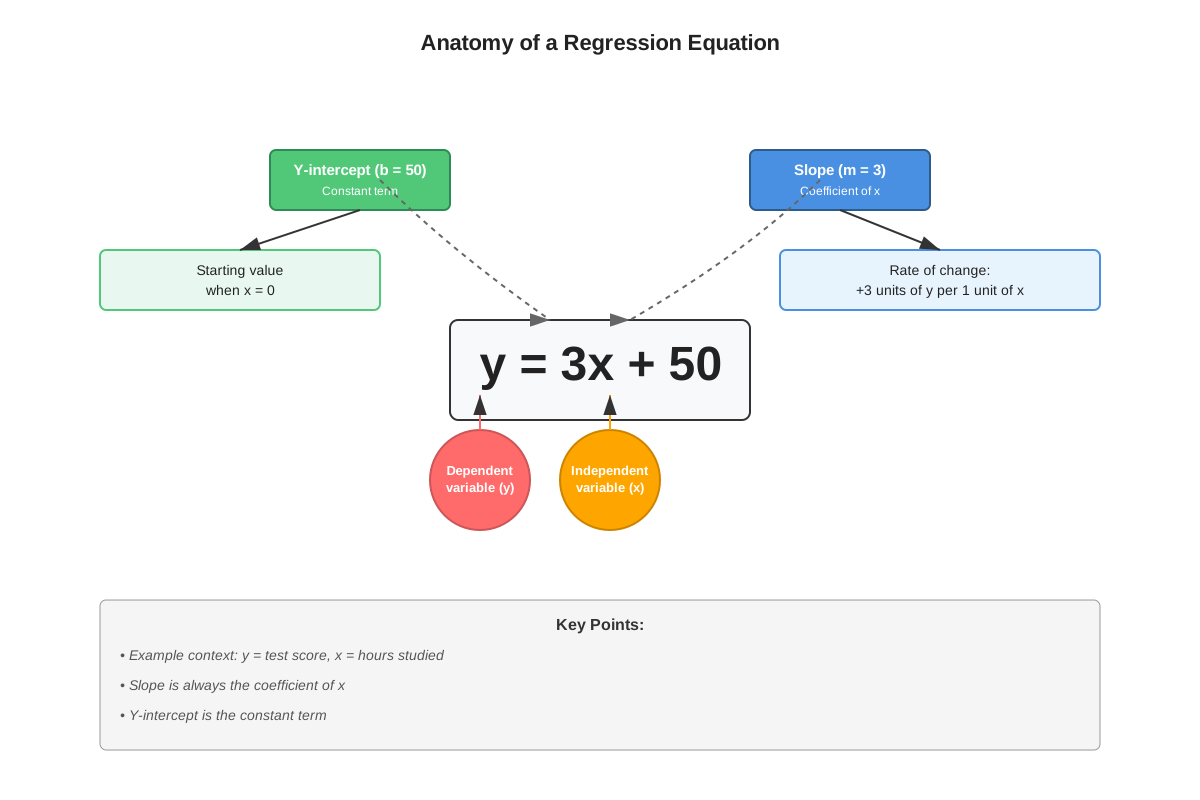
A linear regression equation models the relationship between two variables using a straight line. The standard form is:
y = mx + bor alternatively written as:
ŷ = a + bxwhere:
- y (or ŷ) represents the predicted or dependent variable
- x represents the independent or explanatory variable
- m (or b in the alternative notation) represents the slope
- b (or a in the alternative notation) represents the y-intercept
The SAT uses both notations interchangeably, so students must recognize either form. The "hat" notation (ŷ) emphasizes that the equation produces predicted values rather than exact values from the data set.
Slope Interpretation in Context
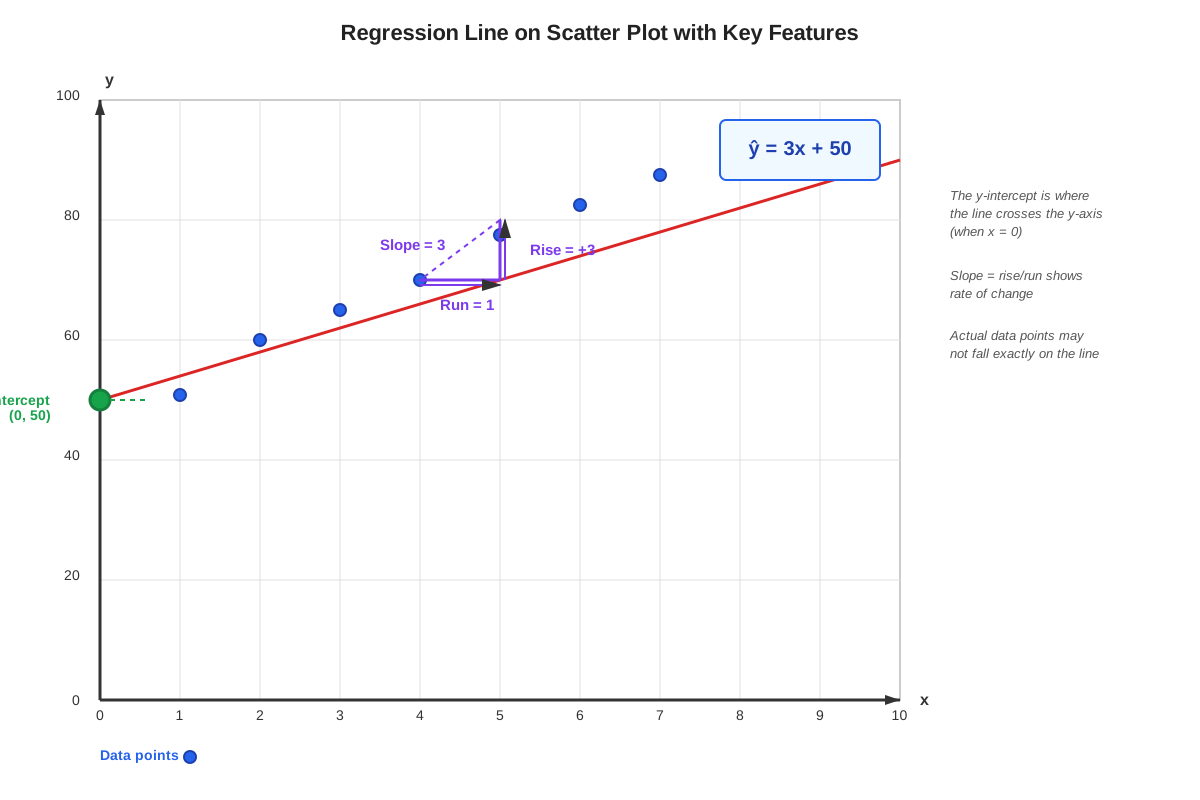
The slope is the most frequently tested component of regression equations on the SAT. In context, the slope represents the rate of change—specifically, how much the dependent variable changes for each one-unit increase in the independent variable.
For example, in the equation P = 5000 + 250t, where P represents population and t represents years since 2000:
- The slope is 250
- Interpretation: "The population increases by 250 people per year" or "For each additional year, the population increases by 250"
Key principles for slope interpretation:
- Always include units in your interpretation (e.g., "dollars per hour," "points per study session")
- The slope indicates direction: positive slopes show increasing relationships, negative slopes show decreasing relationships
- The magnitude of the slope indicates the strength of the rate of change
- Slope interpretation must reference both variables in the relationship
Y-Intercept Interpretation in Context
The y-intercept represents the predicted value of the dependent variable when the independent variable equals zero. This component requires careful contextual interpretation because x = 0 may or may not have practical meaning.
Using the previous example P = 5000 + 250t:
- The y-intercept is 5000
- Interpretation: "In the year 2000 (when t = 0), the population was 5000 people"
Important considerations for y-intercept interpretation:
- The y-intercept only has practical meaning if x = 0 is within the reasonable domain of the data
- When x = 0 represents a meaningful starting point (like a base year), the y-intercept is the initial value
- In some contexts, x = 0 may be impossible or outside the data range, making the y-intercept a mathematical artifact rather than a meaningful value
- SAT questions often ask whether the y-intercept has practical significance
Making Predictions with Regression Models
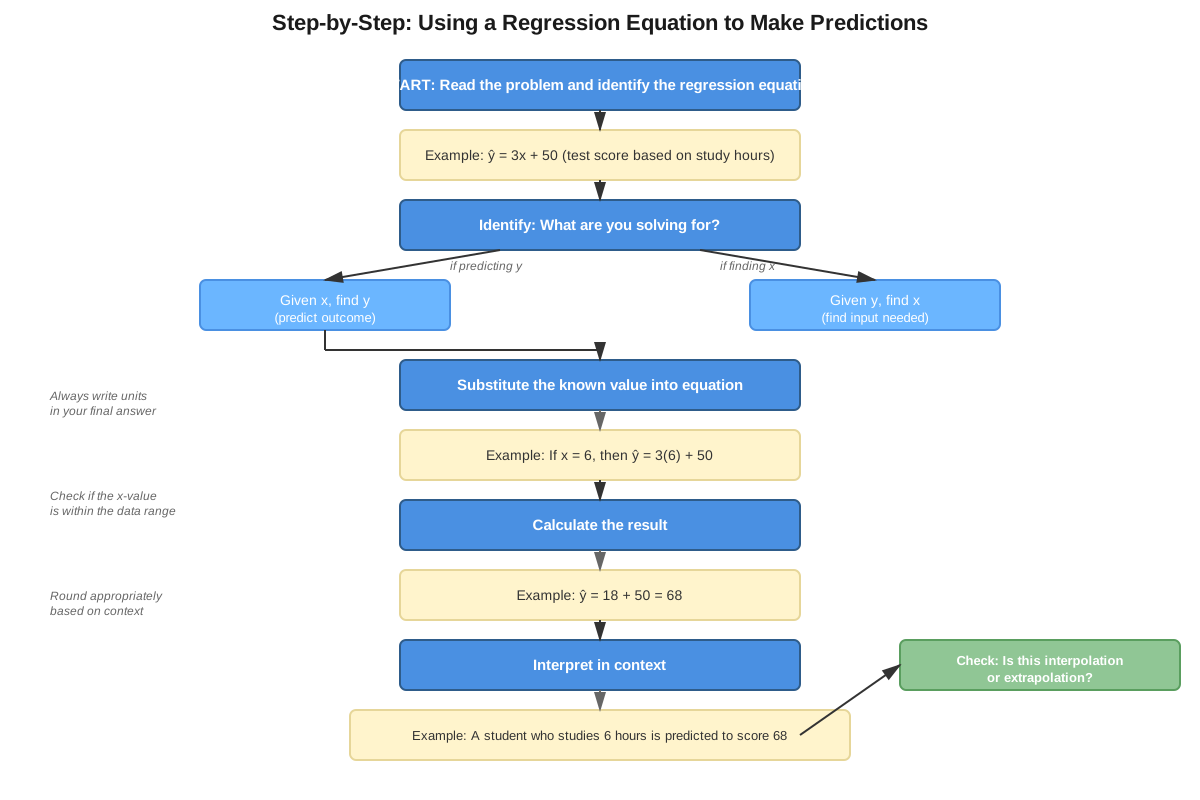
Regression models allow us to predict values of the dependent variable for given values of the independent variable. This involves substituting the x-value into the equation and solving for y.
Process for making predictions:
- Identify the given value of the independent variable (x)
- Substitute this value into the regression equation
- Perform the calculation to find the predicted value (y)
- Include appropriate units in the answer
- Consider whether the prediction represents interpolation or extrapolation
For example, using S = 65 + 8h (where S is test score and h is hours studied):
- To predict the score for someone who studied 5 hours: S = 65 + 8(5) = 65 + 40 = 105
Interpolation vs. Extrapolation
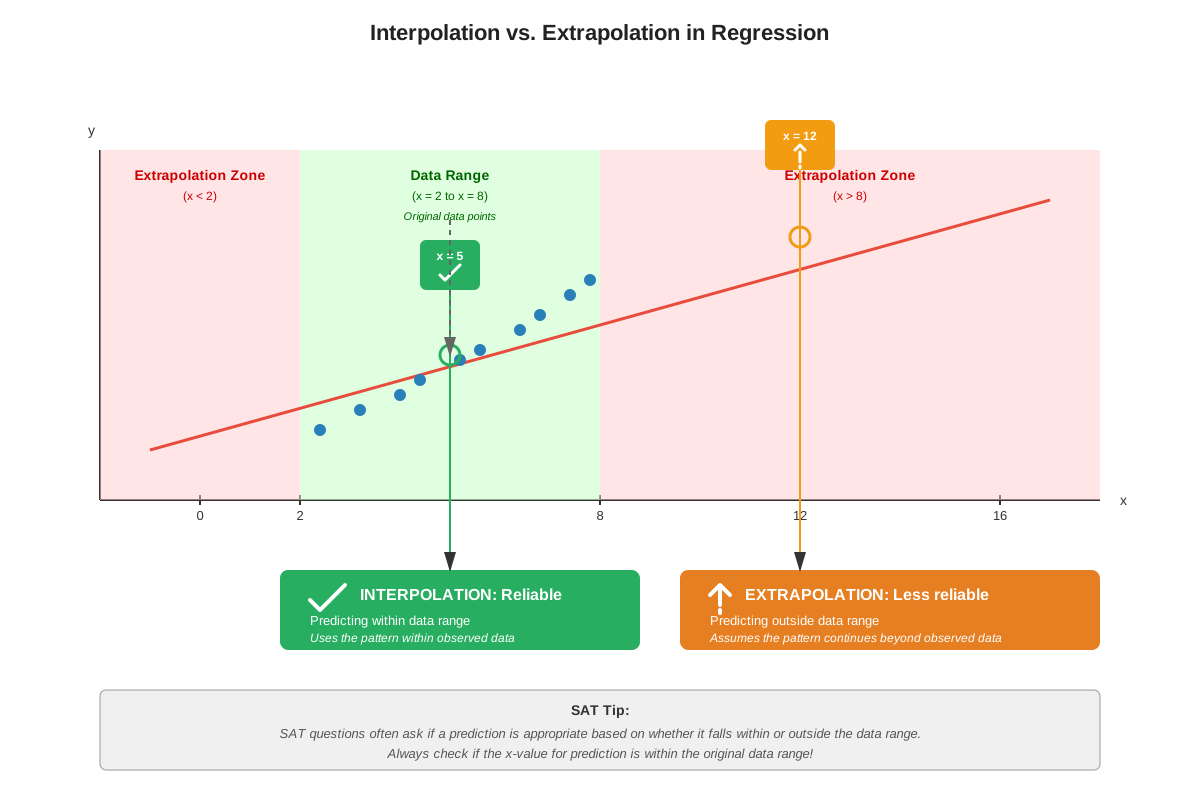
Understanding the difference between interpolation and extrapolation is crucial for evaluating the reliability of predictions.
| Concept | Definition | Reliability | SAT Relevance |
|---|---|---|---|
| Interpolation | Making predictions within the range of observed data | Generally reliable | Predictions are considered valid |
| Extrapolation | Making predictions outside the range of observed data | Less reliable, potentially inaccurate | SAT may ask if a prediction is reasonable |
For instance, if data was collected for study times between 1 and 10 hours:
- Predicting the score for 6 hours of study is interpolation (reliable)
- Predicting the score for 20 hours of study is extrapolation (less reliable)
The SAT frequently tests whether students recognize that extrapolation can lead to unrealistic predictions, especially when the relationship might not remain linear outside the observed range.
Correlation and Causation
A fundamental principle in regression interpretation is distinguishing between correlation and causation. Just because two variables have a linear relationship does not mean one causes the other.
Key distinctions:
- Correlation: A statistical relationship exists between two variables (they tend to change together)
- Causation: Changes in one variable directly cause changes in the other variable
The SAT may present regression models and ask students to identify appropriate conclusions. Valid conclusions focus on association and prediction, while invalid conclusions claim causation without justification. For example, a regression showing that ice cream sales and drowning incidents both increase together does not mean ice cream causes drowning—both are likely influenced by a third variable (warm weather).
Residuals and Model Fit
While less commonly tested, understanding residuals helps interpret how well a regression model fits the data. A residual is the difference between an observed value and the predicted value from the regression equation:
Residual = Observed value - Predicted valuePositive residuals indicate the model underpredicted the actual value, while negative residuals indicate overprediction. The SAT may present scatter plots with regression lines and ask students to identify points with large residuals or to understand that smaller residuals indicate better model fit.
Concept Relationships
The concepts within regression interpretation form an interconnected framework. The regression equation serves as the central structure, with the slope and y-intercept as its fundamental components. Understanding these components enables making predictions, which then requires evaluating whether those predictions represent interpolation or extrapolation. Throughout this process, students must maintain awareness of the correlation vs. causation distinction to avoid overinterpreting the model's implications.
This topic connects directly to prerequisite knowledge of linear functions, where students first learned about slope and y-intercept in purely mathematical contexts. Regression interpretation extends this foundation by adding real-world context and statistical meaning. The concept also relates to coordinate geometry through the visual representation of data as scatter plots with lines of best fit.
Relationship map:
Linear Functions → Regression Equations → Slope Interpretation + Y-intercept Interpretation → Making Predictions → Evaluating Interpolation/Extrapolation → Understanding Model Limitations (Correlation ≠ Causation)
Additionally, regression interpretation connects forward to more advanced statistical concepts like correlation coefficients, multiple regression, and hypothesis testing, though these topics extend beyond SAT scope. Mastering regression interpretation also strengthens skills in data analysis, problem-solving with functions, and quantitative reasoning—all high-value competencies across the entire SAT Math section.
Quick check — test yourself on Regression interpretation so far.
Try Flashcards →High-Yield Facts
⭐ The slope in a regression equation represents the rate of change: how much y changes for each one-unit increase in x
⭐ The y-intercept represents the predicted value of y when x equals zero
⭐ To make a prediction using a regression model, substitute the given x-value into the equation and solve for y
⭐ Interpolation (predicting within the data range) is more reliable than extrapolation (predicting outside the data range)
⭐ Correlation does not imply causation—a regression model shows association, not necessarily a cause-and-effect relationship
- Regression equations on the SAT typically appear in the form y = mx + b or ŷ = a + bx
- Both variables in a regression interpretation must be clearly identified with their units
- A positive slope indicates that as x increases, y increases; a negative slope indicates that as x increases, y decreases
- The y-intercept may not always have practical meaning if x = 0 is outside the reasonable domain
- Residuals measure the difference between observed and predicted values
- A line of best fit minimizes the sum of squared residuals
- The SAT never requires calculating a regression equation from data—only interpreting given equations
- Context is crucial: the same equation y = 5 + 2x has different meanings depending on what x and y represent
Common Misconceptions
Misconception: The slope tells you the total change in y over the entire data set.
Correction: The slope represents the rate of change per one unit of x, not the total change. To find total change, multiply the slope by the change in x.
Misconception: A regression equation with a strong relationship means one variable causes the other.
Correction: Regression shows correlation (association) between variables, but causation requires additional evidence beyond the statistical relationship. Confounding variables may explain the association.
Misconception: The y-intercept always represents a meaningful starting value.
Correction: The y-intercept only has practical meaning if x = 0 is within the reasonable domain of the data and represents a meaningful scenario. For example, in a model relating height to shoe size, x = 0 (zero height) is meaningless.
Misconception: Predictions made using regression equations are always accurate.
Correction: Regression models provide estimates based on the linear relationship in the data. Predictions are more reliable for interpolation than extrapolation, and all models have some degree of error (residuals).
Misconception: A steeper slope always means a stronger relationship.
Correction: The steepness of the slope indicates the rate of change, not the strength of the relationship. Strength of relationship is measured by correlation coefficient (r) or coefficient of determination (r²), which are separate from slope magnitude.
Misconception: You can use any x-value in a regression equation to get a valid prediction.
Correction: While you can mathematically substitute any x-value, predictions far outside the range of the original data (extrapolation) may be unreliable because the linear relationship may not hold beyond the observed range.
Misconception: The regression line passes through all data points.
Correction: The regression line is the line of best fit that minimizes overall distance to all points, but typically does not pass through most individual data points. The differences are the residuals.
Worked Examples
Example 1: Interpreting Slope and Y-intercept
Problem: A researcher studying the relationship between hours of sleep and test performance develops the following regression model:
S = 42 + 6.5h
where S represents the predicted test score (out of 100) and h represents hours of sleep the night before the test.
a) Interpret the meaning of the slope in context.
b) Interpret the meaning of the y-intercept in context.
c) Is the y-intercept meaningful in this scenario?
Solution:
a) Slope interpretation: The slope is 6.5. This means that for each additional hour of sleep, the predicted test score increases by 6.5 points. We can also say that test scores increase at a rate of 6.5 points per hour of sleep.
Key reasoning: The slope always represents the change in the dependent variable (test score) per one-unit change in the independent variable (hours of sleep). Always include both variables and their units.
b) Y-intercept interpretation: The y-intercept is 42. This means that when h = 0 (zero hours of sleep), the predicted test score is 42 points.
Key reasoning: The y-intercept is found by setting the independent variable to zero and identifying the resulting value of the dependent variable.
c) Meaningfulness of y-intercept: The y-intercept has limited practical meaning in this context. While mathematically it predicts a score of 42 for zero hours of sleep, this scenario is unrealistic—students who get no sleep would likely perform much worse than the model predicts, and zero hours of sleep is probably outside the range of data collected. The y-intercept is a mathematical artifact rather than a meaningful prediction.
Key reasoning: Always evaluate whether x = 0 represents a realistic scenario within the context and data range. The SAT frequently asks students to recognize when y-intercepts lack practical significance.
Example 2: Making Predictions and Evaluating Reliability
Problem: A coffee shop tracks the relationship between outdoor temperature and iced coffee sales. The regression equation is:
C = 45 + 3.2T
where C represents the number of iced coffees sold per day and T represents the temperature in degrees Fahrenheit. The data was collected for temperatures ranging from 60°F to 95°F.
a) Predict the number of iced coffees sold when the temperature is 75°F.
b) Predict the number of iced coffees sold when the temperature is 110°F.
c) Which prediction is more reliable, and why?
Solution:
a) Prediction for 75°F:
- Substitute T = 75 into the equation
- C = 45 + 3.2(75)
- C = 45 + 240
- C = 285
- The model predicts 285 iced coffees will be sold when the temperature is 75°F.
Key reasoning: Direct substitution into the regression equation. Always show your work step-by-step and include units in the final answer.
b) Prediction for 110°F:
- Substitute T = 110 into the equation
- C = 45 + 3.2(110)
- C = 45 + 352
- C = 397
- The model predicts 397 iced coffees will be sold when the temperature is 110°F.
Key reasoning: The mathematical process is the same, but we must evaluate the reliability separately.
c) Reliability comparison: The prediction for 75°F is more reliable because 75°F falls within the range of observed data (60°F to 95°F), making it an interpolation. The prediction for 110°F is less reliable because 110°F is well outside the observed data range, making it an extrapolation. The linear relationship observed between 60°F and 95°F may not continue at extreme temperatures—there might be a maximum capacity for coffee production, or the relationship might change at very high temperatures.
Key reasoning: Always compare the x-value used for prediction against the range of data collected. Interpolation (within the range) is reliable; extrapolation (outside the range) is questionable. The SAT frequently tests this distinction.
Exam Strategy
When approaching SAT regression interpretation questions, begin by carefully identifying what each variable represents and noting their units. Many students lose points by correctly performing calculations but failing to interpret results in context. Read the problem twice: once for overall understanding and once to identify specifically what the question asks.
Trigger words and phrases to watch for include:
- "Interpret the meaning of..." (requires contextual explanation, not just numerical identification)
- "According to the model..." (signals you should use the regression equation)
- "Best interpretation" (multiple choices may be partially correct; choose the most complete and accurate)
- "Predicted value" or "estimated value" (substitute into the equation)
- "For each additional..." (describes the slope)
- "When x equals zero..." (describes the y-intercept)
- "Within the range" vs. "outside the range" (interpolation vs. extrapolation)
Process-of-elimination strategies specific to regression:
- Eliminate answer choices that confuse slope and y-intercept
- Eliminate interpretations that reverse the dependent and independent variables
- Eliminate choices that claim causation when only correlation is shown
- Eliminate predictions that ignore whether extrapolation is occurring
- Eliminate interpretations that omit units or use incorrect units
Time allocation advice: Regression interpretation questions typically require 60-90 seconds. Spend 20 seconds reading and identifying variables, 30 seconds performing calculations or reasoning through interpretations, and 10-20 seconds checking that your answer matches what the question asks. If a question asks for interpretation "in context," budget extra time to formulate a complete sentence rather than just a number.
Exam Tip: When interpreting slope, use the phrase "for each additional [unit of x], [y] increases/decreases by [slope value] [units of y]." This structure ensures you include all necessary components.
Memory Techniques
Slope Interpretation Mnemonic: RICE
- Rate of change
- Increase or decrease
- Context (include both variables)
- Every one unit (per unit change in x)
Y-intercept Check: ZERO
- Zero value of x
- Evaluate if meaningful
- Range of data
- Outside range = questionable meaning
Interpolation vs. Extrapolation: IN vs. EX
- INterpolation = INside the data range = INcredibly reliable
- EXtrapolation = EXternal to data range = EXtra caution needed
Correlation vs. Causation: Remember "Ice cream doesn't cause drowning"—this classic example reminds you that correlated variables may both be influenced by a third factor (temperature/summer) rather than one causing the other.
Visualization strategy: When reading a regression problem, quickly sketch a rough coordinate plane in your test booklet margin. Mark the y-intercept on the y-axis and draw a line with positive or negative slope as appropriate. This visual reference helps prevent errors in interpretation.
Summary
Regression interpretation is a high-yield SAT Math topic that requires students to extract meaningful information from linear models relating two variables. The core skills involve understanding that the slope represents the rate of change (how much y changes per unit increase in x) and the y-intercept represents the predicted y-value when x equals zero. Students must be able to make predictions by substituting values into regression equations, recognize the difference between reliable interpolation (within data range) and questionable extrapolation (outside data range), and avoid the common error of assuming correlation implies causation. Success on these questions demands careful attention to context, including proper identification of variables and units, as well as the ability to translate between mathematical notation and verbal interpretation. The SAT tests regression interpretation through word problems that require both computational accuracy and conceptual understanding, making this topic essential for achieving high scores in the Data Analysis and Statistics domain.
Key Takeaways
- The slope in a regression equation represents the rate of change: how much the dependent variable changes for each one-unit increase in the independent variable
- The y-intercept represents the predicted value when the independent variable equals zero, but may not always have practical meaning
- Making predictions requires substituting the given x-value into the regression equation and solving for y, always considering whether the prediction is interpolation or extrapolation
- Interpolation (predicting within the observed data range) is reliable, while extrapolation (predicting outside the range) is less trustworthy
- Regression models show correlation between variables, not causation—additional evidence is needed to establish cause-and-effect relationships
- Always interpret regression components in context, including appropriate units and references to both variables
- SAT regression questions test both computational skills and conceptual understanding, requiring careful reading and complete interpretations
Related Topics
Scatter Plots and Data Visualization: Understanding how to read and interpret scatter plots provides the visual foundation for regression analysis, showing how data points relate to lines of best fit and helping identify outliers and patterns.
Linear Functions and Equations: Deeper exploration of linear relationships, including parallel and perpendicular lines, systems of equations, and transformations, builds on the algebraic foundation used in regression interpretation.
Correlation Coefficients: Advanced study of the correlation coefficient (r) and coefficient of determination (r²) quantifies the strength of linear relationships, extending beyond the basic interpretation covered in regression.
Exponential and Quadratic Models: Not all relationships are linear; understanding when exponential or quadratic models better fit data represents the next level of statistical modeling beyond linear regression.
Statistical Inference: Moving from descriptive statistics (like regression) to inferential statistics involves hypothesis testing and confidence intervals, allowing conclusions about populations based on sample data.
Practice CTA
Now that you've mastered the core concepts of regression interpretation, it's time to solidify your understanding through active practice. Work through the practice questions to apply these concepts to SAT-style problems, and use the flashcards to reinforce key definitions and interpretations. Remember, regression interpretation appears on virtually every SAT, making your investment in this topic highly valuable for score improvement. Approach each practice problem methodically: identify variables, interpret components in context, and always check whether predictions involve interpolation or extrapolation. Your ability to confidently tackle these questions will significantly boost your performance on test day!
Sign up free to keep reading
Create a free AnvayaPrep account to finish this SAT guide on Regression interpretation — plus flashcards and practice questions.