Overview
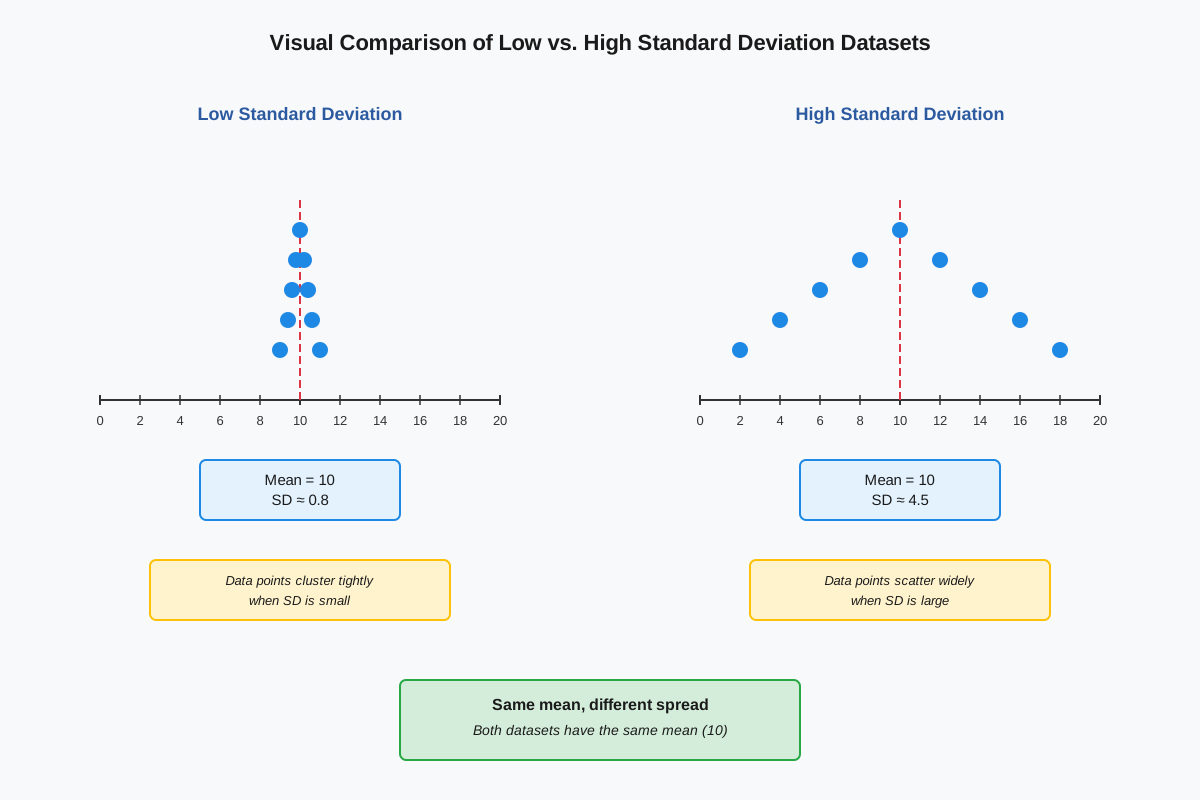
Standard deviation is a fundamental statistical measure that quantifies the amount of variation or dispersion in a dataset. On the SAT math section, understanding standard deviation basics is crucial for success in Data Analysis and Statistics questions, which comprise approximately 15% of the total math score. Standard deviation tells us how spread out numbers are from their mean (average), providing insight into data consistency and variability. A small standard deviation indicates that data points cluster closely around the mean, while a large standard deviation reveals that data points are scattered across a wider range of values.
The SAT frequently tests sat standard deviation basics through both conceptual questions and calculation-based problems. Students must understand not only how to interpret standard deviation values but also how changes to a dataset affect this measure. Questions may ask students to compare the spread of two datasets, predict how adding or removing data points influences standard deviation, or identify which dataset has greater variability based on visual representations like dot plots or histograms.
Mastering standard deviation connects directly to broader mathematical concepts including mean, median, range, and data distribution. This topic serves as a bridge between basic descriptive statistics and more advanced statistical reasoning. Understanding standard deviation enhances comprehension of normal distributions, outliers, and data analysis—skills that appear throughout the SAT math section and prove invaluable in college-level coursework across multiple disciplines.
Learning Objectives
- [ ] Identify key features of Standard deviation basics
- [ ] Explain how Standard deviation basics appears on the SAT
- [ ] Apply Standard deviation basics to answer SAT-style questions
- [ ] Calculate the effect of adding, removing, or changing data points on standard deviation
- [ ] Compare standard deviations of multiple datasets using visual and numerical information
- [ ] Distinguish between situations requiring standard deviation versus other measures of spread
- [ ] Interpret standard deviation values in context to make data-driven conclusions
Prerequisites
- Mean (average) calculation: Standard deviation measures spread around the mean, making mean calculation foundational to understanding this concept
- Basic arithmetic operations: Computing standard deviation requires addition, subtraction, multiplication, division, and square roots
- Understanding of data sets: Familiarity with how data is organized and represented enables interpretation of variability
- Concept of distance: Standard deviation essentially measures average distance from the mean, requiring spatial reasoning about numerical differences
Why This Topic Matters
Standard deviation appears in real-world applications across numerous fields. Medical researchers use it to determine whether treatment effects are consistent across patients. Financial analysts rely on standard deviation to assess investment risk—higher standard deviation in stock returns indicates greater volatility and uncertainty. Quality control engineers in manufacturing use standard deviation to ensure products meet consistency standards. Climate scientists analyze temperature standard deviations to identify unusual weather patterns and climate change indicators.
On the SAT, standard deviation questions appear in approximately 2-4 questions per test, making this a high-yield topic for score improvement. These questions typically fall into three categories: conceptual understanding (40% of standard deviation questions), comparative analysis (35%), and calculation or estimation (25%). The SAT emphasizes conceptual understanding over complex calculations, meaning students who grasp the underlying principles can answer questions quickly without extensive computation.
Standard deviation questions commonly appear alongside visual data representations including histograms, dot plots, box plots, and tables. The exam may present two datasets and ask which has greater variability, or describe a scenario where data points are added or removed and ask how standard deviation changes. Questions often embed standard deviation within real-world contexts such as test scores, athletic performance, temperature readings, or survey results, requiring students to interpret statistical measures within practical situations.
Core Concepts
Definition and Meaning of Standard Deviation
Standard deviation is a numerical measure that quantifies how much individual data points in a dataset deviate from the mean of that dataset. More specifically, it represents the typical or average distance between each data point and the mean. When standard deviation is small (close to zero), data points cluster tightly around the mean, indicating consistency and low variability. When standard deviation is large, data points are scattered widely, indicating high variability and inconsistency.
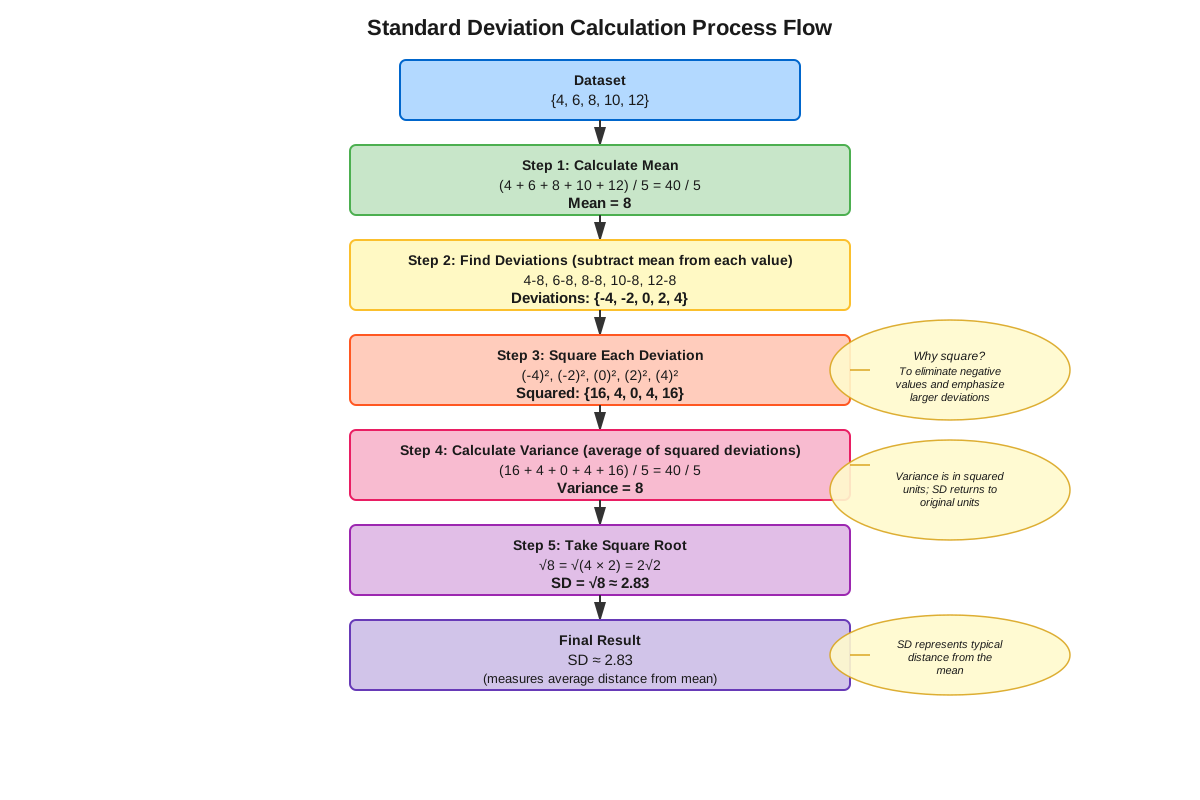
The formula for standard deviation involves several steps, though the SAT rarely requires manual calculation of the complete formula. Understanding the process, however, illuminates why standard deviation behaves as it does:
s = √[Σ(x - x̄)² / (n - 1)]Where:
- s = standard deviation
- x = each individual data point
- x̄ = mean of the dataset
- n = number of data points
- Σ = sum of all values
The Calculation Process (Conceptual Understanding)
While the SAT doesn't typically require students to calculate standard deviation from scratch, understanding the conceptual steps helps answer questions about how changes affect standard deviation:
- Calculate the mean of all data points
- Find each deviation by subtracting the mean from each data point (x - x̄)
- Square each deviation to eliminate negative values and emphasize larger deviations
- Average the squared deviations (technically divide by n-1 for sample standard deviation)
- Take the square root to return to the original units of measurement
This process reveals why certain changes affect standard deviation. Squaring the deviations means that data points farther from the mean contribute disproportionately more to standard deviation than points close to the mean.
Interpreting Standard Deviation Values
Standard deviation must always be interpreted in context with the data's scale and units. A standard deviation of 5 might be large for test scores ranging from 0-100 but small for annual incomes ranging from $20,000-$200,000. Key interpretation principles include:
- Zero standard deviation: All data points are identical; no variation exists
- Small standard deviation: Data points are consistent and predictable
- Large standard deviation: Data points are diverse and spread out
- Comparison: Standard deviation only becomes meaningful when comparing datasets or evaluating against the mean
How Changes to Data Affect Standard Deviation
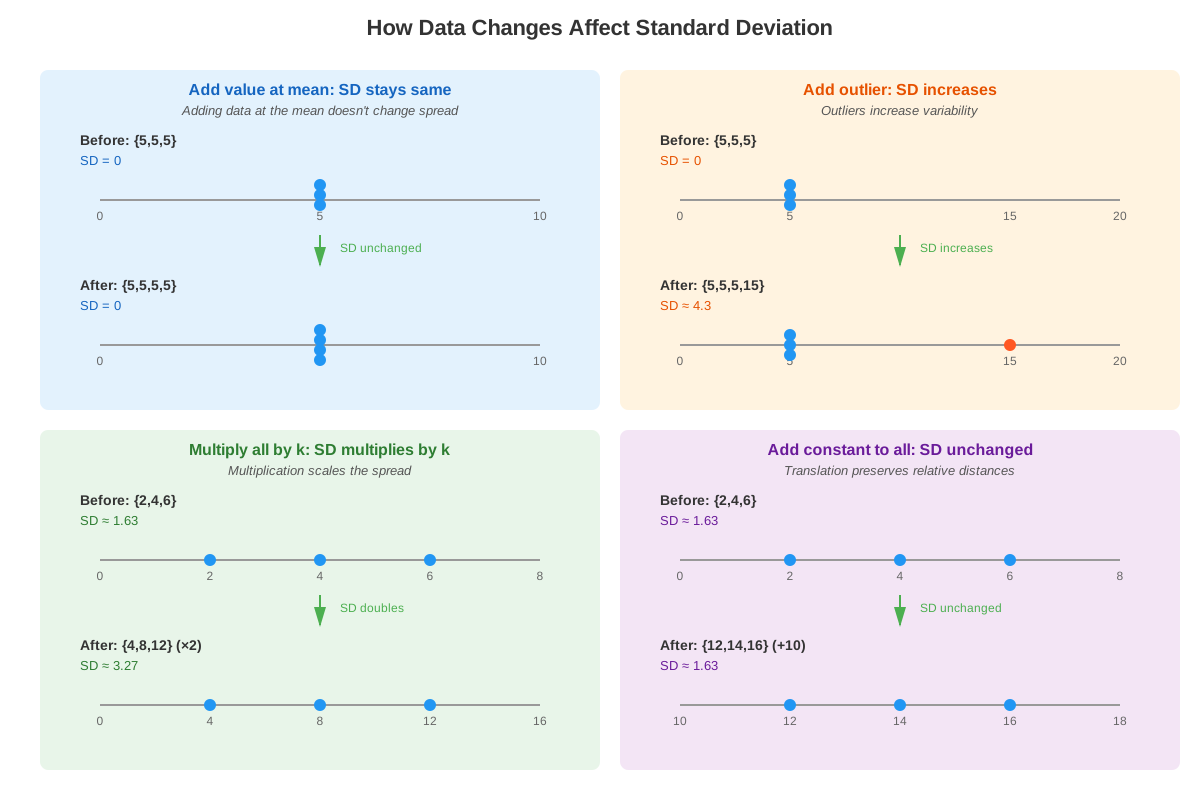
Understanding how modifications to a dataset impact standard deviation is crucial for SAT success:
| Change to Dataset | Effect on Standard Deviation | Explanation |
|---|---|---|
| Add a value equal to the mean | Decreases | Adds a point with zero deviation, reducing average distance |
| Add a value far from the mean | Increases | Adds a large deviation, increasing average distance |
| Remove an outlier | Usually decreases | Eliminates an extreme deviation |
| Add the same constant to all values | No change | Shifts all points equally; relative distances unchanged |
| Multiply all values by a constant | Multiplies by that constant | Scales all distances proportionally |
| Add identical values at both extremes | May increase or stay same | Depends on current distribution |
Visual Recognition of Standard Deviation
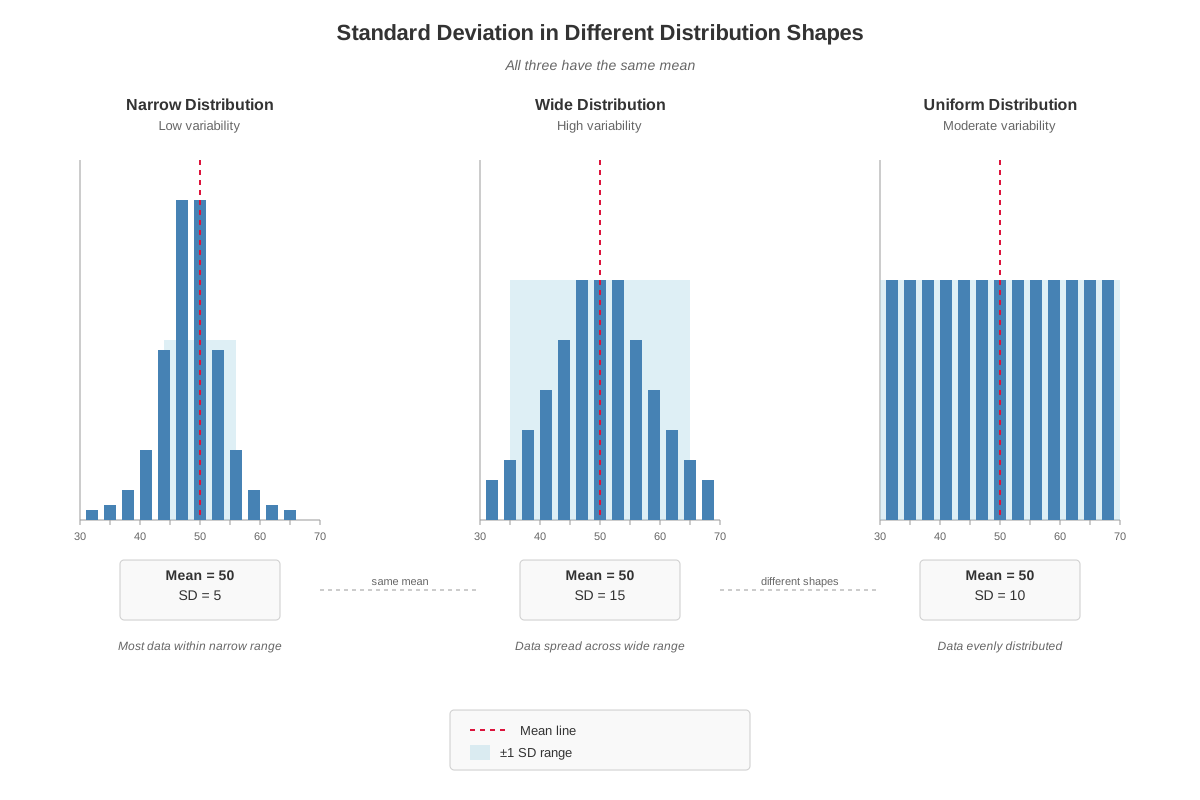
The SAT frequently presents data visually and asks students to compare standard deviations. Key visual indicators include:
Dot plots and histograms:
- Narrow, tall distributions indicate small standard deviation
- Wide, flat distributions indicate large standard deviation
- Symmetric distributions with most data near the center suggest moderate standard deviation
Comparing two datasets visually:
- The dataset with data points more spread out has larger standard deviation
- If two datasets have the same mean but different spreads, the wider one has larger standard deviation
- Outliers significantly increase standard deviation
Standard Deviation vs. Other Measures of Spread
Understanding when to use standard deviation versus alternative measures is important:
Range: The difference between maximum and minimum values. Range is simpler but affected dramatically by outliers and ignores the distribution of middle values.
Interquartile Range (IQR): The range of the middle 50% of data. IQR is resistant to outliers but provides less information about overall spread.
Standard Deviation: Considers every data point and provides a precise measure of typical deviation. Most useful for symmetric distributions without extreme outliers.
The Empirical Rule (68-95-99.7 Rule)
For approximately normal (bell-shaped) distributions, the empirical rule provides a powerful interpretation tool:
- Approximately 68% of data falls within 1 standard deviation of the mean
- Approximately 95% of data falls within 2 standard deviations of the mean
- Approximately 99.7% of data falls within 3 standard deviations of the mean
While the SAT doesn't explicitly test this rule frequently, understanding it helps interpret standard deviation values in context and estimate whether data points are unusual.
Concept Relationships
Standard deviation builds directly upon the concept of mean, as it measures spread around this central value. Without understanding mean, standard deviation lacks context and meaning. The calculation process inherently requires computing the mean first, establishing mean as the foundational prerequisite.
Range serves as a simpler precursor to standard deviation—both measure spread, but standard deviation provides more nuanced information by considering all data points rather than just extremes. Students often learn range first, then progress to standard deviation as a more sophisticated measure.
The relationship flows as: Individual data points → Mean (central tendency) → Deviations from mean → Standard deviation (typical deviation)
Standard deviation connects to data distribution concepts. Symmetric, bell-shaped distributions have predictable relationships between mean and standard deviation (the empirical rule), while skewed distributions require more careful interpretation. Understanding distribution shape helps predict whether standard deviation will be large or small.
Outliers have an amplified effect on standard deviation due to the squaring step in calculation. This connects standard deviation to data cleaning and quality assessment—unusually large standard deviations may signal data entry errors or genuinely unusual observations requiring investigation.
Standard deviation enables comparison between datasets, connecting to comparative statistics. Two datasets might have identical means but vastly different standard deviations, revealing that one is more consistent or predictable than the other. This relationship appears frequently in SAT questions asking students to compare variability.
Quick check — test yourself on Standard deviation basics so far.
Try Flashcards →High-Yield Facts
⭐ Standard deviation measures the typical distance of data points from the mean—it quantifies spread or variability in a dataset.
⭐ Adding or subtracting the same constant to every data point does not change standard deviation—it shifts the distribution but doesn't affect spread.
⭐ Multiplying or dividing every data point by a constant multiplies or divides the standard deviation by that same constant—this scales the spread proportionally.
⭐ A dataset with all identical values has a standard deviation of zero—no variation means no deviation from the mean.
⭐ Outliers increase standard deviation significantly because deviations are squared in the calculation, amplifying the effect of extreme values.
- Standard deviation is always non-negative (zero or positive)—negative standard deviation is impossible.
- Two datasets can have the same mean but different standard deviations, indicating different levels of consistency.
- In visual representations, wider spreads indicate larger standard deviations while narrower spreads indicate smaller standard deviations.
- Adding a value equal to the mean decreases standard deviation by bringing the average deviation closer to zero.
- Standard deviation uses the same units as the original data (if data is in inches, standard deviation is in inches).
- Removing an outlier typically decreases standard deviation by eliminating an extreme deviation.
- For normal distributions, approximately 68% of data falls within one standard deviation of the mean.
Common Misconceptions
Misconception: Standard deviation and range are interchangeable measures of spread.
Correction: While both measure spread, standard deviation considers all data points and their distances from the mean, providing more complete information than range, which only considers the two extreme values. Standard deviation is more sensitive to the distribution of all values.
Misconception: A larger standard deviation always means the data is "worse" or less desirable.
Correction: Standard deviation is a neutral descriptive statistic. Whether large or small standard deviation is preferable depends entirely on context. In quality control, small standard deviation indicates desirable consistency. In investment portfolios, some investors seek higher standard deviation (higher risk/reward), while others prefer lower standard deviation (stability).
Misconception: Adding any new data point to a dataset always increases standard deviation.
Correction: Adding a data point equal to or very close to the mean actually decreases standard deviation because it adds a small deviation, reducing the average distance. Only adding values far from the mean increases standard deviation.
Misconception: If two datasets have the same standard deviation, they must have similar distributions.
Correction: Datasets can have identical standard deviations but completely different shapes, means, and ranges. Standard deviation only measures one aspect of distribution—the typical spread around the mean—and doesn't capture other distributional features.
Misconception: Standard deviation can be negative if data points are below the mean.
Correction: Standard deviation is always zero or positive because the calculation squares all deviations (eliminating negative signs) before averaging and taking the square root. Negative standard deviation is mathematically impossible.
Misconception: Doubling all values in a dataset doubles the standard deviation.
Correction: This is actually correct! However, students often mistakenly think that doubling values would quadruple standard deviation (confusing it with variance, which is standard deviation squared). When all values are multiplied by a constant k, standard deviation is multiplied by |k|.
Worked Examples
Example 1: Comparing Standard Deviations from Visual Data
Problem: Two classes took the same exam. Class A's scores are: 70, 75, 80, 85, 90. Class B's scores are: 60, 70, 80, 90, 100. Both classes have a mean score of 80. Which class has a larger standard deviation, and why?
Solution:
Step 1: Identify the mean for both classes (given as 80).
Step 2: Examine the deviations from the mean for Class A:
- 70 is 10 points below the mean
- 75 is 5 points below the mean
- 80 is 0 points from the mean
- 85 is 5 points above the mean
- 90 is 10 points above the mean
Step 3: Examine the deviations from the mean for Class B:
- 60 is 20 points below the mean
- 70 is 10 points below the mean
- 80 is 0 points from the mean
- 90 is 10 points above the mean
- 100 is 20 points above the mean
Step 4: Compare the typical deviations. Class A's scores deviate by 0, 5, 5, 10, and 10 points. Class B's scores deviate by 0, 10, 10, 20, and 20 points.
Step 5: Conclusion—Class B has larger deviations from the mean, so Class B has a larger standard deviation. The scores in Class B are more spread out, indicating greater variability in student performance.
Connection to Learning Objectives: This example demonstrates how to compare standard deviations by analyzing the spread of data points around the mean, a key skill for SAT questions that present multiple datasets.
Example 2: Effect of Data Transformation
Problem: A dataset has a mean of 50 and a standard deviation of 8. If 10 is added to every value in the dataset, what are the new mean and standard deviation?
Solution:
Step 1: Understand what happens when a constant is added to all values. This shifts the entire distribution but doesn't change the spread.
Step 2: Calculate the new mean. Since 10 is added to every value, the mean increases by 10:
- New mean = 50 + 10 = 60
Step 3: Determine the new standard deviation. Adding the same constant to all values doesn't change the distances between points or their distances from the mean—it just shifts everything equally.
- New standard deviation = 8 (unchanged)
Step 4: Verify conceptually. If the original data was {42, 50, 58}, the deviations from the mean (50) are {-8, 0, +8}. After adding 10, the data becomes {52, 60, 68}, and the deviations from the new mean (60) are still {-8, 0, +8}. The spread hasn't changed.
Answer: New mean = 60, New standard deviation = 8
Alternative scenario: If instead every value was multiplied by 2, the new mean would be 50 × 2 = 100, and the new standard deviation would be 8 × 2 = 16, because multiplying scales both the center and the spread.
Connection to Learning Objectives: This example applies understanding of how data transformations affect standard deviation, a common SAT question type that tests conceptual understanding rather than calculation.
Exam Strategy
When approaching SAT questions on standard deviation, begin by identifying whether the question asks for conceptual understanding, comparison, or calculation. Most SAT standard deviation questions emphasize concepts over computation, so avoid immediately reaching for complex formulas.
Trigger words and phrases to recognize:
- "Variability," "spread," "consistency," or "dispersion" signal standard deviation concepts
- "More consistent" indicates smaller standard deviation
- "Greater variability" indicates larger standard deviation
- "Add/remove/change values" suggests analyzing how modifications affect standard deviation
- "Compare the datasets" often requires visual analysis of spread
Process-of-elimination strategies:
- Eliminate answer choices that claim standard deviation can be negative
- Rule out options suggesting that adding a constant changes standard deviation
- Eliminate choices that confuse standard deviation with range or mean
- When comparing datasets visually, eliminate options that contradict the visible spread
Efficient approach sequence:
- Read the question carefully to determine what aspect of standard deviation is being tested
- If given visual data, quickly assess which dataset appears more spread out
- For transformation questions, recall the rules: adding constants doesn't change SD, multiplying constants scales SD
- For comparison questions, focus on spread around the mean rather than the range
- Check your answer against common sense—does a larger spread correspond to your choice of larger standard deviation?
Time allocation advice: Standard deviation questions typically require 45-90 seconds. Conceptual questions should take closer to 45 seconds, while questions requiring analysis of multiple datasets or transformations may take up to 90 seconds. If a question appears to require extensive calculation, reconsider whether there's a conceptual shortcut—the SAT rarely requires computing standard deviation from scratch.
Exam Tip: When comparing two datasets visually, look at the "width" of the distribution. The dataset that looks more "spread out" or "wider" has the larger standard deviation, regardless of where the center is located.
Memory Techniques
SPREAD Acronym for remembering what standard deviation measures:
- Spread of data
- Points' distance from mean
- Reflects variability
- Each value contributes
- Average deviation
- Dispersion indicator
The Constant Rules Mnemonic: "Add shifts, multiply scales"
- Adding a constant to all values shifts the distribution (changes mean, not SD)
- Multiplying all values by a constant scales the distribution (changes both mean and SD)
Visual Memory Aid: Picture a dartboard. Darts clustered tightly around the bullseye represent small standard deviation (high consistency). Darts scattered all over the board represent large standard deviation (high variability). This image helps quickly assess standard deviation from visual data representations.
The Outlier Effect: Remember "Outliers are LOUD"—they have an outsized effect on standard deviation because deviations are squared. One extreme value can dramatically increase standard deviation, just as one loud person can dominate a conversation.
Zero SD Reminder: "All the same, zero game"—if all values are identical, there's no variation, so standard deviation equals zero.
Summary
Standard deviation is a fundamental statistical measure quantifying the typical distance of data points from their mean, serving as the primary indicator of data variability and spread. On the SAT, understanding standard deviation requires both conceptual knowledge and the ability to analyze how changes to datasets affect this measure. Key principles include recognizing that adding constants to all values shifts distributions without changing standard deviation, while multiplying by constants scales both the mean and standard deviation proportionally. Visual analysis skills are crucial—wider, more spread-out distributions indicate larger standard deviations, while narrow, clustered distributions indicate smaller standard deviations. The SAT emphasizes conceptual understanding over calculation, testing whether students can compare datasets, predict the effects of data transformations, and interpret standard deviation values in context. Mastering standard deviation enables students to answer high-yield questions efficiently and builds foundational skills for more advanced statistical reasoning.
Key Takeaways
- Standard deviation measures the typical distance of data points from the mean, quantifying spread and variability in a dataset
- Adding or subtracting the same constant to all values changes the mean but leaves standard deviation unchanged
- Multiplying or dividing all values by a constant scales both the mean and standard deviation by that constant
- Visually, datasets with wider spreads have larger standard deviations; narrower, more clustered datasets have smaller standard deviations
- Outliers significantly increase standard deviation because deviations are squared in the calculation
- Standard deviation is always zero or positive—zero indicates no variation (all values identical), while larger values indicate greater spread
- Comparing standard deviations between datasets reveals which has more consistent or more variable data, independent of their means
Related Topics
Variance: The square of standard deviation, variance is another measure of spread that appears occasionally on advanced statistics questions. Understanding standard deviation makes variance immediately accessible, as variance simply represents standard deviation before taking the final square root.
Normal Distribution and Z-Scores: Standard deviation becomes the foundation for understanding normal distributions and calculating z-scores, which measure how many standard deviations a value is from the mean. This topic extends standard deviation concepts to probability and standardized testing.
Confidence Intervals: In advanced statistics, standard deviation helps construct confidence intervals that estimate population parameters from sample data. Mastering standard deviation basics enables progression to inferential statistics.
Correlation and Regression: Understanding variability through standard deviation prepares students for analyzing relationships between variables, where standard deviation helps measure the strength and reliability of correlations.
Practice CTA
Now that you've mastered the fundamentals of standard deviation, it's time to solidify your understanding through practice! Attempt the practice questions to test your ability to compare datasets, analyze transformations, and interpret standard deviation in various contexts. Use the flashcards to reinforce key concepts and ensure you can quickly recall the essential principles during the exam. Remember, standard deviation questions are high-yield on the SAT—investing time to master this topic will directly improve your math score. You've built a strong conceptual foundation; now apply it with confidence!
Sign up free to keep reading
Create a free AnvayaPrep account to finish this SAT guide on Standard deviation basics — plus flashcards and practice questions.