Overview
Exponential functions represent one of the most powerful and frequently tested concepts in SAT math. These functions model situations where quantities grow or decay at rates proportional to their current value, making them essential for understanding everything from population growth to radioactive decay, compound interest to viral spread. On the SAT, exponential functions appear in multiple contexts: as algebraic expressions to manipulate, as graphs to interpret, and as real-world models to analyze.
Understanding exponential functions is crucial for SAT success because they bridge multiple mathematical domains. They connect algebraic manipulation with graphical interpretation, require facility with exponent rules, and demand the ability to translate between different representations of the same relationship. The College Board consistently includes 2-4 questions directly testing exponential functions on each SAT, with additional questions incorporating exponential concepts within broader problem-solving contexts.
Mastery of exponential functions also provides the foundation for understanding logarithmic functions, which are their inverse operations, and connects deeply to linear functions through comparison and contrast. The ability to distinguish exponential growth from linear growth, recognize exponential patterns in tables and graphs, and manipulate exponential expressions using exponent properties represents essential mathematical literacy that the SAT rewards consistently.
Learning Objectives
- [ ] Identify key features of exponential functions including base, growth/decay factor, initial value, and asymptotes
- [ ] Explain how exponential functions appear on the SAT in algebraic, graphical, and contextual formats
- [ ] Apply exponential functions to answer SAT-style questions involving real-world scenarios
- [ ] Distinguish between exponential growth and exponential decay based on the base value
- [ ] Convert between different forms of exponential expressions using exponent properties
- [ ] Interpret parameters in exponential models within context-based problems
- [ ] Compare exponential and linear functions to determine which model fits given data
Prerequisites
- Exponent rules and properties: Essential for manipulating exponential expressions and simplifying complex terms
- Function notation and evaluation: Required to understand f(x) notation and substitute values into exponential functions
- Coordinate plane and graphing basics: Necessary for interpreting exponential function graphs and identifying key features
- Algebraic manipulation: Needed to solve equations involving exponential expressions and isolate variables
- Percent increase and decrease: Foundational for understanding growth and decay rates in context problems
Why This Topic Matters
Exponential functions model countless real-world phenomena that appear regularly in science, finance, and social sciences. Population dynamics, bacterial growth, radioactive decay, compound interest calculations, medication concentration in the bloodstream, and viral content spread all follow exponential patterns. Understanding these functions enables students to make informed decisions about investments, interpret scientific data, and comprehend news reports about epidemics or environmental changes.
On the SAT, exponential functions appear with remarkable consistency. Approximately 10-15% of the Math section involves exponential concepts, translating to 5-8 questions per test. These questions appear in both the calculator and no-calculator sections, testing students' ability to work with exponential expressions algebraically, interpret exponential graphs, and apply exponential models to word problems. The College Board particularly favors questions that require students to identify growth or decay rates from context, determine initial values, and make predictions using exponential models.
Common SAT question formats include: identifying the correct exponential model from a verbal description, determining the meaning of constants in an exponential equation within context, comparing exponential and linear growth rates, solving exponential equations for specific variables, and interpreting graphs of exponential functions to answer questions about real-world scenarios. The ability to move fluidly between algebraic, graphical, and contextual representations of exponential functions distinguishes high-scoring students from average performers.
Core Concepts
Definition and Standard Form
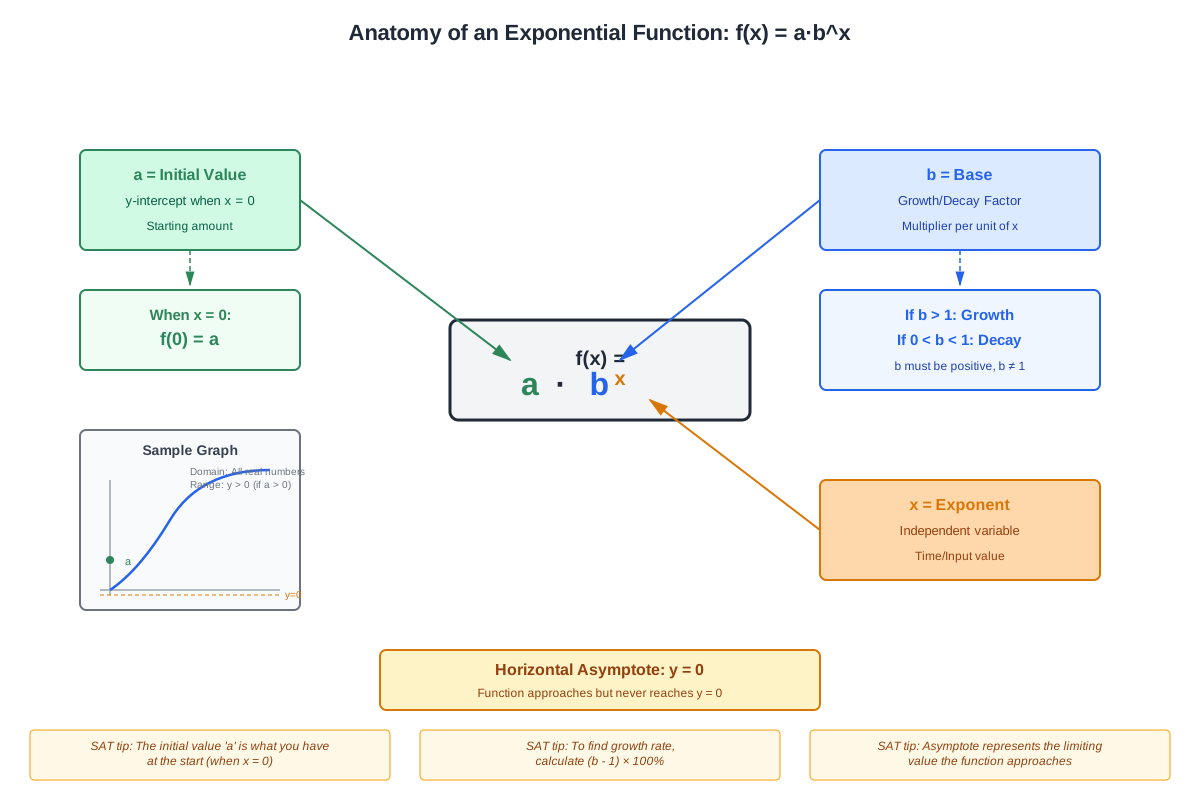
An exponential function is a function of the form f(x) = a · b^x, where a represents the initial value (the y-intercept when x = 0), b represents the base (the growth or decay factor), and x is the exponent (typically representing time or another independent variable). The base b must be positive and cannot equal 1, as b = 1 would produce a constant function rather than exponential behavior.
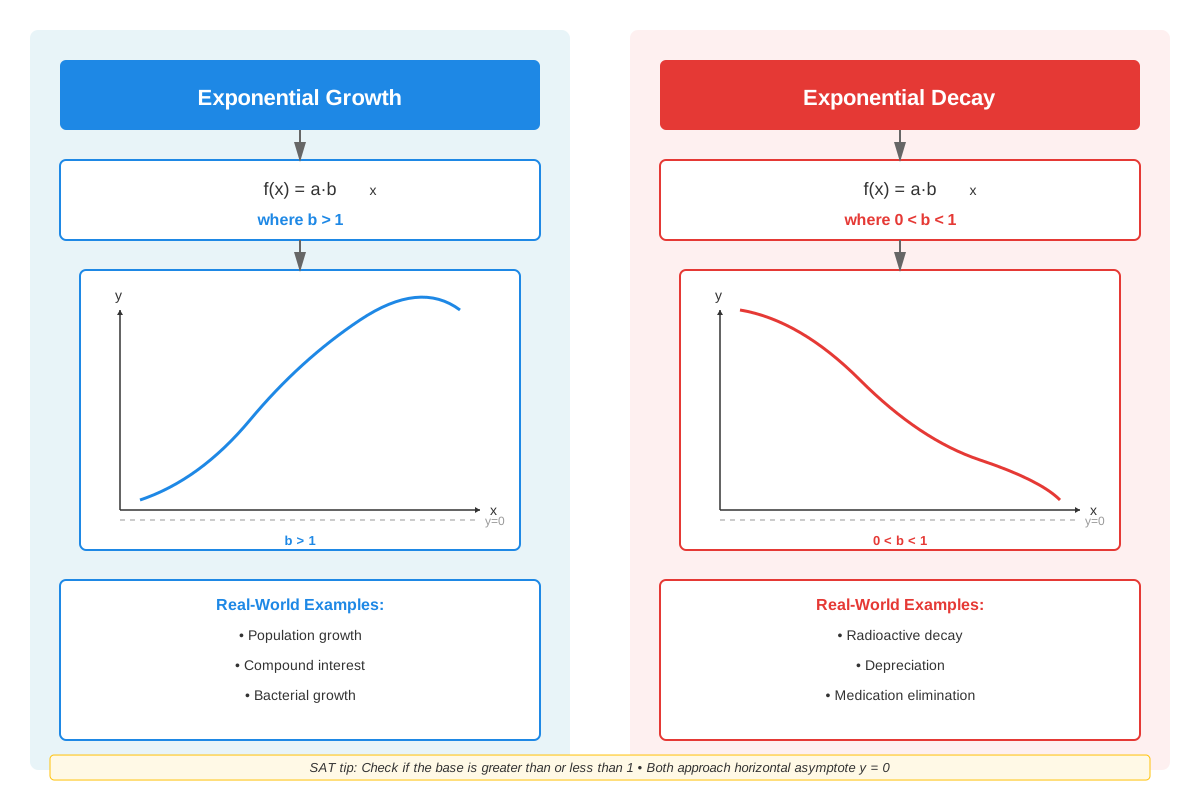
The standard form reveals critical information immediately: when b > 1, the function exhibits exponential growth, with values increasing as x increases. When 0 < b < 1, the function demonstrates exponential decay, with values decreasing as x increases. The initial value a determines where the function intersects the y-axis and scales the entire function vertically.
Growth and Decay Factors
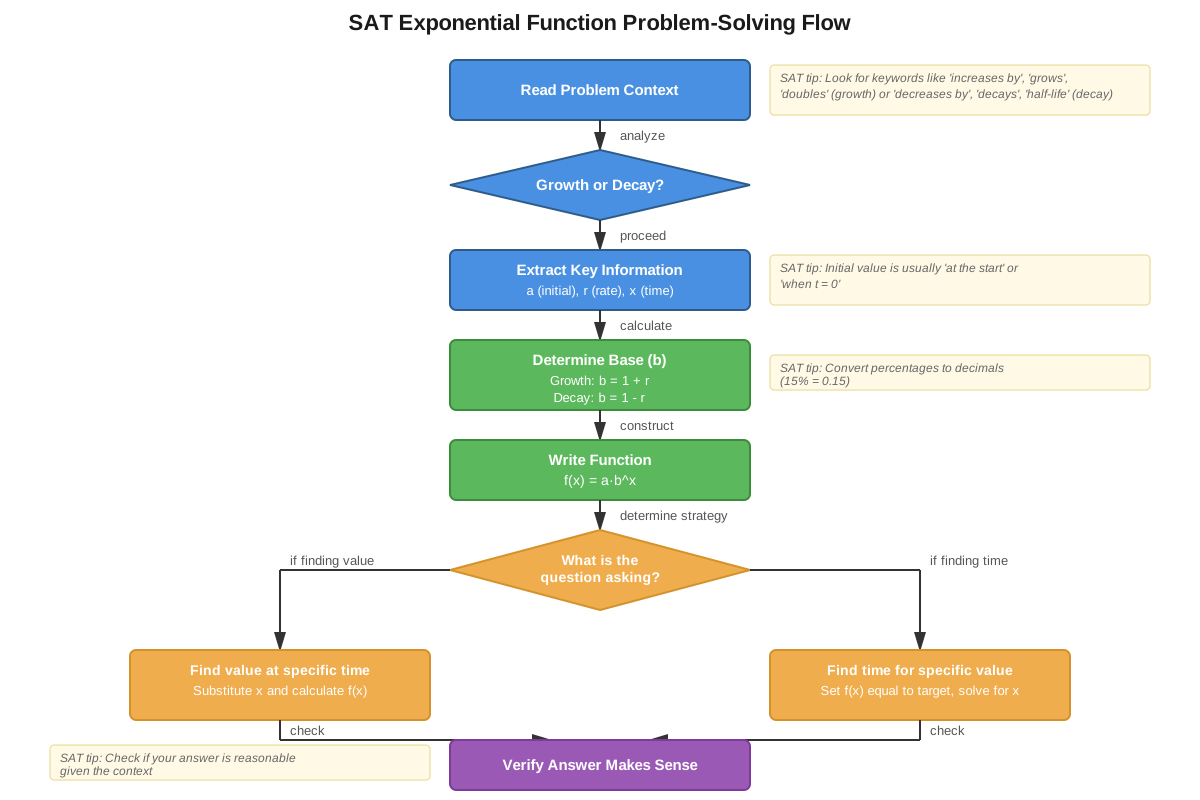
Understanding the relationship between percentage change and the base b is essential for SAT success. If a quantity increases by r% per time period, the base equals b = 1 + r (where r is expressed as a decimal). For example, a 15% increase per year corresponds to b = 1.15. Conversely, if a quantity decreases by r% per time period, the base equals b = 1 - r. A 20% decrease per year corresponds to b = 0.80.
This relationship allows students to construct exponential models from verbal descriptions. The phrase "increases by 8% annually" translates to b = 1.08, while "decreases by 12% each month" translates to b = 0.88. The SAT frequently tests whether students can correctly identify these growth and decay factors from context.
Key Features of Exponential Graphs
Exponential function graphs possess distinctive characteristics that make them recognizable:
| Feature | Exponential Growth (b > 1) | Exponential Decay (0 < b < 1) |
|---|---|---|
| Direction | Increases from left to right | Decreases from left to right |
| Y-intercept | (0, a) | (0, a) |
| Horizontal asymptote | y = 0 (x-axis) as x → -∞ | y = 0 (x-axis) as x → +∞ |
| Domain | All real numbers | All real numbers |
| Range | y > 0 (if a > 0) | y > 0 (if a > 0) |
| Rate of change | Increases exponentially | Decreases exponentially |
The horizontal asymptote at y = 0 means the function approaches but never reaches zero (for positive initial values). This reflects real-world situations where quantities diminish but never completely disappear, or grow from small but non-zero starting points.
Exponential vs. Linear Growth
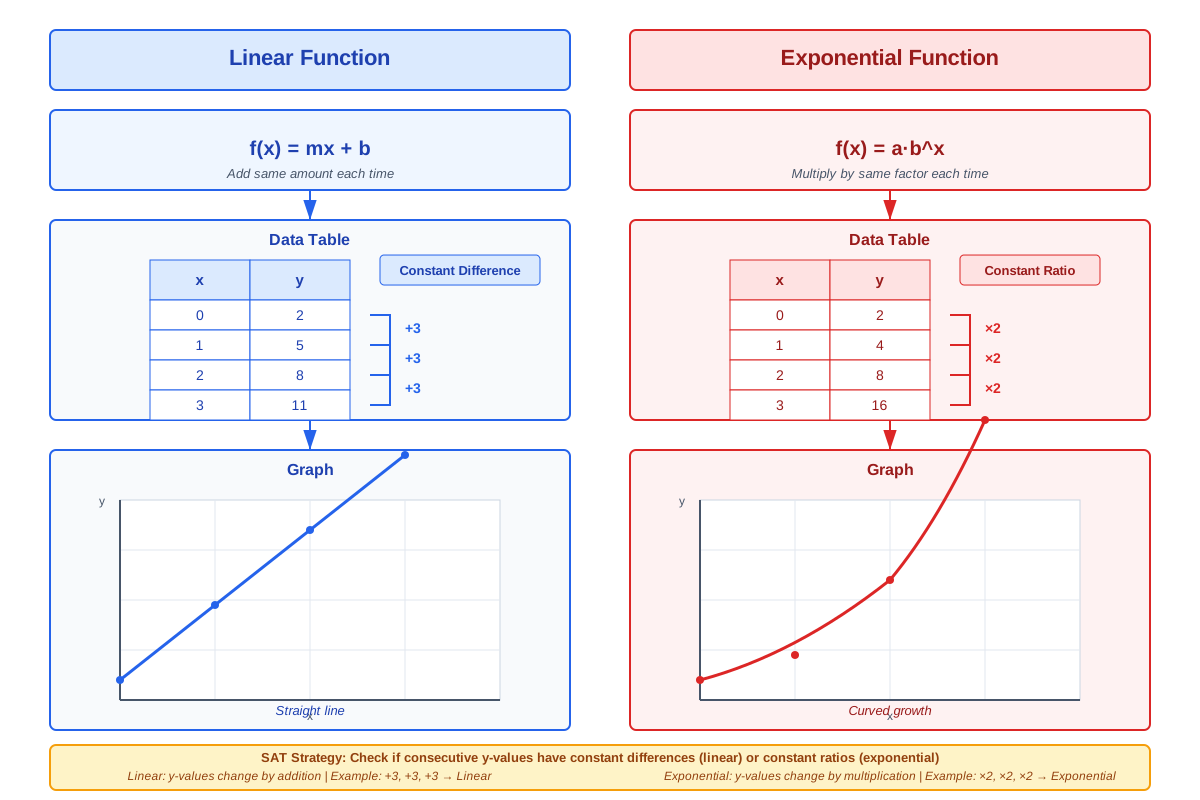
A critical SAT skill involves distinguishing exponential from linear patterns. Linear functions change by a constant absolute amount per unit (additive change), while exponential functions change by a constant percentage per unit (multiplicative change).
Consider a table of values:
Linear Pattern: x = 0, 1, 2, 3; y = 5, 8, 11, 14 (constant difference of +3)
Exponential Pattern: x = 0, 1, 2, 3; y = 5, 10, 20, 40 (constant ratio of ×2)
To identify exponential patterns in tables, calculate consecutive ratios (divide each term by the previous term). If these ratios are constant, the relationship is exponential with that ratio as the base.
Transformations of Exponential Functions
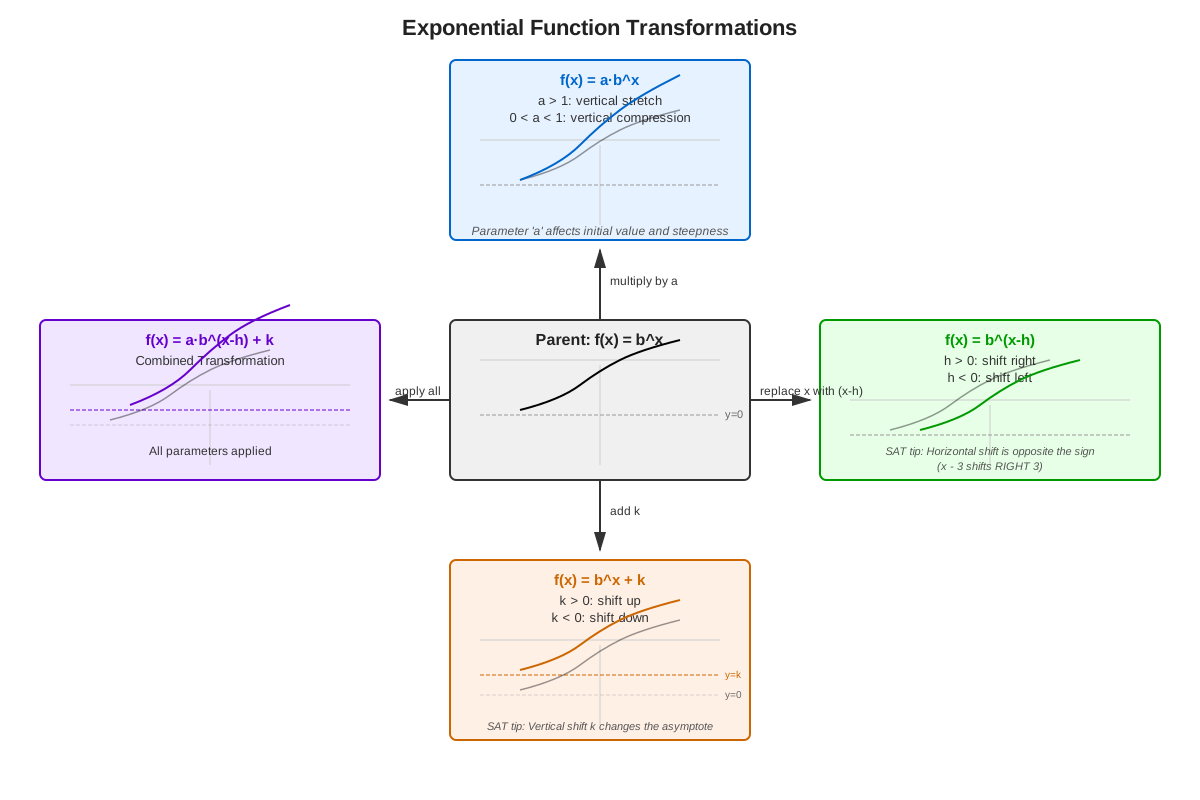
Exponential functions can be transformed through vertical shifts, horizontal shifts, reflections, and stretches:
- f(x) = a · b^x + k: Vertical shift by k units (moves the horizontal asymptote to y = k)
- f(x) = a · b^(x-h): Horizontal shift by h units right
- f(x) = -a · b^x: Reflection across the x-axis
- f(x) = a · b^(-x): Reflection across the y-axis (converts growth to decay or vice versa)
The SAT may present transformed exponential functions and ask students to identify the asymptote, which shifts from y = 0 to y = k when a vertical translation occurs.
Solving Exponential Equations
SAT questions often require solving equations where the variable appears in the exponent. Basic strategies include:
- Isolating the exponential expression: Move all terms without the variable to one side
- Using equal bases: If both sides can be expressed with the same base, set exponents equal
- Substitution: For equations like (b^x)^2 - 5(b^x) + 6 = 0, substitute u = b^x to create a quadratic
For example, to solve 3 · 2^x = 96:
- Divide both sides by 3: 2^x = 32
- Express 32 as a power of 2: 2^x = 2^5
- Set exponents equal: x = 5
Compound Interest and Continuous Growth
While less common, the SAT occasionally tests the compound interest formula: A = P(1 + r/n)^(nt), where P is principal, r is annual interest rate, n is compounding frequency per year, and t is time in years. This represents exponential growth with a modified base that accounts for compounding periods.
The continuous growth formula A = Pe^(rt) uses the natural base e ≈ 2.718, though SAT questions involving e are rare and typically provide necessary context.
Concept Relationships
The core concepts of exponential functions form an interconnected web of understanding. The standard form f(x) = a · b^x serves as the foundation, with the initial value a and base b determining all other characteristics. The base directly determines whether the function exhibits growth or decay, which in turn affects the graph's direction and the location of the horizontal asymptote.
Growth and decay factors connect to percentage change through the relationship b = 1 ± r, bridging the gap between algebraic representation and real-world context. This connection enables students to construct exponential models from verbal descriptions, a skill that feeds directly into solving context-based SAT problems.
The distinction between exponential and linear patterns relies on understanding that exponential functions have constant ratios between consecutive terms, while linear functions have constant differences. This concept connects back to the multiplicative nature of the base b, reinforcing why exponential functions grow or decay at increasing rates rather than constant rates.
Transformations build upon the standard form by adding or modifying parameters, shifting the graph's position while preserving its exponential character. Understanding transformations requires solid grasp of the standard form and how each parameter affects the graph's appearance.
Solving exponential equations synthesizes multiple concepts: exponent properties (prerequisite knowledge), the standard form, and the principle that equal bases allow setting exponents equal. This problem-solving skill represents the culmination of conceptual understanding applied to algebraic manipulation.
Relationship map: Standard Form → determines → Growth/Decay → affects → Graph Characteristics → inform → Real-World Modeling → requires → Solving Equations → applies → Exponent Properties
Quick check — test yourself on Exponential functions so far.
Try Flashcards →High-Yield Facts
⭐ The base b in f(x) = a · b^x determines growth (b > 1) or decay (0 < b < 1)
⭐ For r% increase per period, the base equals b = 1 + r (r as decimal); for r% decrease, b = 1 - r
⭐ All exponential functions f(x) = a · b^x (with a > 0) have a horizontal asymptote at y = 0
⭐ The y-intercept of f(x) = a · b^x is always (0, a), representing the initial value
⭐ Exponential functions have constant ratios between consecutive y-values for equally-spaced x-values
- The domain of exponential functions is all real numbers, while the range is y > 0 (for positive a)
- Exponential growth eventually surpasses any linear growth, no matter how steep the linear function
- When solving b^x = b^k, you can set x = k only when the bases are equal and positive (b ≠ 1)
- A vertical shift by k units moves the horizontal asymptote from y = 0 to y = k
- Exponential decay functions approach but never reach zero, modeling situations like radioactive half-life
- The expression b^(x/n) represents exponential change occurring every n units rather than every unit
- Doubling time and half-life problems involve finding when f(x) = 2a or f(x) = a/2 respectively
Common Misconceptions
Misconception: Exponential functions can have negative bases like f(x) = (-2)^x
Correction: The base b must be positive (b > 0) to ensure the function is defined for all real x-values. Negative bases create undefined values for fractional exponents.
Misconception: A 50% decrease followed by a 50% increase returns to the original value
Correction: These changes are multiplicative, not additive. Starting with 100, a 50% decrease gives 50, then a 50% increase of 50 gives 75, not 100. The decay factor is 0.5 and growth factor is 1.5, so the combined effect is 0.5 × 1.5 = 0.75 of the original.
Misconception: Exponential functions eventually become linear when they "level off"
Correction: Exponential functions never become linear. Exponential decay approaches the horizontal asymptote but maintains its exponential character, continuing to decrease at a rate proportional to its current value, just at increasingly smaller absolute amounts.
Misconception: The initial value a must equal 1 in exponential functions
Correction: The initial value a can be any non-zero real number. It represents the y-intercept and scales the entire function. When a = 1, the function passes through (0, 1), but this is not required.
Misconception: If b = 2, the function doubles every unit; therefore, if b = 3, it triples every unit
Correction: This is actually correct! When b = 3, the function does triple every unit increase in x. The misconception often involves thinking this relationship doesn't hold, but it does: the base represents the multiplicative factor per unit change in x.
Misconception: Exponential growth and exponential decay are completely different types of functions
Correction: They are the same type of function (exponential) with different base values. Growth occurs when b > 1, decay when 0 < b < 1. They share the same form f(x) = a · b^x and similar properties, just with opposite directional behavior.
Worked Examples
Example 1: Identifying Exponential Models from Context
Problem: A population of bacteria doubles every 3 hours. If the initial population is 500 bacteria, which function models the population P after t hours?
A) P(t) = 500 · 2^t
B) P(t) = 500 · 2^(t/3)
C) P(t) = 500 · 3^(t/2)
D) P(t) = 1000 · 2^t
Solution:
Step 1: Identify the initial value. At t = 0, the population is 500, so a = 500. This eliminates choice D.
Step 2: Determine the base and time relationship. The population doubles (multiplies by 2) every 3 hours, not every hour.
Step 3: Set up the exponent. If the population doubles every 3 hours, then after t hours, there have been t/3 doubling periods. Therefore, the population has been multiplied by 2 a total of t/3 times.
Step 4: Write the function. P(t) = 500 · 2^(t/3)
Step 5: Verify. At t = 0: P(0) = 500 · 2^0 = 500 ✓
At t = 3: P(3) = 500 · 2^1 = 1000 (doubled) ✓
At t = 6: P(6) = 500 · 2^2 = 2000 (doubled again) ✓
Answer: B
This problem tests the learning objective of applying exponential functions to SAT-style questions by requiring students to translate a verbal description into the correct mathematical model, paying careful attention to the time period over which the change occurs.
Example 2: Comparing Exponential and Linear Growth
Problem: Function f is defined by f(x) = 100 · 1.5^x and function g is defined by g(x) = 100 + 50x. For which positive integer value of x does f(x) first exceed g(x)?
Solution:
Step 1: Understand the functions. f(x) is exponential growth with initial value 100 and base 1.5 (50% growth per unit). g(x) is linear with initial value 100 and slope 50 (increases by 50 per unit).
Step 2: Calculate values for small positive integers:
For x = 1:
- f(1) = 100 · 1.5^1 = 150
- g(1) = 100 + 50(1) = 150
- f(1) = g(1), so f doesn't exceed g yet
For x = 2:
- f(2) = 100 · 1.5^2 = 100 · 2.25 = 225
- g(2) = 100 + 50(2) = 200
- f(2) > g(2) ✓
Step 3: Verify this is the first time. Since f(1) = g(1) and f(2) > g(2), x = 2 is the first positive integer where f exceeds g.
Step 4: Understand why. Exponential functions start slower than steep linear functions but eventually surpass them because the rate of increase itself increases exponentially.
Answer: x = 2
This example addresses the learning objective of distinguishing between exponential and linear growth patterns, demonstrating that exponential functions eventually dominate linear functions despite potentially slower initial growth.
Exam Strategy
When approaching sat exponential functions questions, begin by identifying the question type: algebraic manipulation, graph interpretation, or context-based modeling. Each type requires a different initial approach but draws on the same core concepts.
Trigger words and phrases to watch for include: "doubles every," "triples each," "increases by [percent]," "decreases by [percent]," "half-life," "decay rate," "growth rate," "initial amount," and "after t [time units]." These phrases signal exponential relationships and help you determine whether you're dealing with growth (b > 1) or decay (0 < b < 1).
For algebraic questions, immediately identify the form of the exponential expression and determine what the question asks you to find. If solving for x when x is in the exponent, try to express both sides with the same base. If the question asks about the meaning of a parameter, substitute x = 0 to find the initial value, or examine how the function changes as x increases by 1 to understand the base.
For graph interpretation questions, locate the y-intercept first (this gives you the initial value a), then determine whether the function increases or decreases (this tells you if b > 1 or 0 < b < 1). Check for horizontal asymptotes, which typically occur at y = 0 for standard exponential functions but may shift if the function includes a vertical translation.
For context-based problems, translate the verbal description into mathematical notation before attempting to answer the question. Identify the initial value (what happens at time zero or the starting amount), the growth or decay rate (convert percentages to decimals and add or subtract from 1), and the time variable. Write out the function explicitly, even if the question doesn't ask for it, as this clarifies your thinking.
Process of elimination works particularly well on exponential function questions. If a question asks which function models exponential decay, immediately eliminate any choice with b ≥ 1. If the initial value is stated as 200, eliminate any function that doesn't equal 200 when x = 0. If the problem states "doubles every 4 hours," eliminate any function where the exponent isn't t/4 (or equivalent).
Time allocation: Most exponential function questions should take 60-90 seconds. If you find yourself spending more than 2 minutes, you may be overcomplicating the problem. Step back, reread the question, and look for a simpler approach. Often, the SAT rewards conceptual understanding over complex calculations.
Memory Techniques
BASE mnemonic for remembering exponential function properties:
- Bigger than 1 = growth
- Asymptote at y = 0 (standard form)
- Smaller than 1 (but positive) = decay
- Exponent determines the power of change
"PERCENT to BASE" conversion:
- Plus for increase: 1 + r
- Minus for decrease: 1 - r
- Remember: "Add one, then add or subtract the rate"
Visualization strategy: Picture exponential growth as a hockey stick lying on its side (flat then sharply upward) and exponential decay as a slide (steep then flattening out). This mental image helps distinguish them from linear functions (straight lines) and helps you sketch rough graphs quickly.
"Initial value at Initial time": When x = 0 (initial time), f(0) = a · b^0 = a · 1 = a. The initial value is always what you get when you plug in zero for x. This works because any number to the zero power equals 1.
Ratio Check acronym (RACE): To identify exponential patterns in tables:
- Ratio of consecutive terms
- Are they constant?
- Constant ratio = exponential
- Exponential base = that ratio
Summary
Exponential functions, expressed in the standard form f(x) = a · b^x, model situations where quantities change by constant percentages rather than constant amounts. The initial value a determines the y-intercept and starting point, while the base b determines whether the function exhibits growth (b > 1) or decay (0 < b < 1). These functions appear consistently on the SAT in algebraic, graphical, and contextual formats, requiring students to translate between representations, identify key features, and apply exponential models to real-world scenarios. Critical skills include converting percentage changes to bases using b = 1 ± r, distinguishing exponential from linear patterns by checking for constant ratios versus constant differences, recognizing the horizontal asymptote at y = 0, and solving exponential equations by expressing both sides with equal bases. Success on SAT exponential function questions demands both conceptual understanding of how these functions behave and procedural fluency in manipulating exponential expressions using exponent properties.
Key Takeaways
- Exponential functions have the form f(x) = a · b^x, where a is the initial value and b is the base determining growth or decay
- Growth occurs when b > 1, decay when 0 < b < 1; convert percentages using b = 1 + r (increase) or b = 1 - r (decrease)
- All standard exponential functions have a horizontal asymptote at y = 0 and pass through (0, a)
- Exponential patterns show constant ratios between consecutive terms, while linear patterns show constant differences
- The SAT tests exponential functions through algebraic manipulation, graph interpretation, and real-world modeling contexts
- To solve exponential equations, isolate the exponential term and express both sides with the same base when possible
- Exponential growth always eventually exceeds linear growth, regardless of initial rates
Related Topics
Logarithmic Functions: The inverse of exponential functions, logarithms allow you to solve for variables in exponents when equal bases aren't possible. Mastering exponential functions provides the foundation for understanding logarithmic relationships and properties.
Polynomial Functions: While exponential functions have variables in the exponent, polynomial functions have variables in the base. Comparing these function families helps clarify their distinct behaviors and growth rates.
Sequences and Series: Geometric sequences are discrete versions of exponential functions, with each term multiplied by a constant ratio. Understanding exponential functions deepens comprehension of geometric sequences.
Systems of Equations: SAT questions sometimes ask students to find intersection points between exponential and linear functions, requiring both exponential function knowledge and systems-solving skills.
Data Analysis and Modeling: Determining whether data follows an exponential or linear pattern is a key data analysis skill that builds directly on exponential function concepts.
Practice CTA
Now that you've mastered the core concepts of exponential functions, it's time to solidify your understanding through practice. Attempt the practice questions to test your ability to identify, manipulate, and apply exponential functions in various SAT-style contexts. Use the flashcards to reinforce key definitions, formulas, and properties until they become automatic. Remember: exponential functions appear on every SAT, and the time you invest in mastering them now will pay dividends in points on test day. You've built the foundation—now build the confidence through deliberate practice!
Sign up free to keep reading
Create a free AnvayaPrep account to finish this SAT guide on Exponential functions — plus flashcards and practice questions.