Overview
Angle basics form the foundation of geometry questions on the SAT math section, appearing in approximately 10-15% of all math questions. Understanding angles is not merely about memorizing definitions—it requires recognizing relationships between angles, applying properties to solve multi-step problems, and connecting angle concepts to other geometric figures like triangles, circles, and parallel lines. The SAT tests angle basics both as standalone questions and as components of more complex geometry problems involving polygons, coordinate geometry, and even trigonometry.
Mastery of angle basics is essential because these concepts serve as building blocks for virtually every geometry question on the exam. Whether calculating missing angle measures, identifying angle relationships in diagrams, or applying angle properties to prove geometric relationships, students must demonstrate fluency with fundamental angle concepts. The SAT frequently embeds angle questions within real-world contexts, requiring students to translate verbal descriptions into geometric relationships and then apply angle properties to find solutions.
The relationship between sat angle basics and other math concepts extends throughout the entire geometry domain. Angle relationships directly connect to triangle properties (since triangle angles sum to 180°), parallel line theorems (alternate interior angles, corresponding angles), circle geometry (inscribed angles, central angles), and coordinate geometry (slopes and perpendicular lines). Strong command of angle basics enables students to approach complex, multi-concept questions with confidence and accuracy, making this topic one of the highest-yield areas for focused study.
Learning Objectives
- [ ] Identify key features of angle basics including angle types, measurement units, and classification systems
- [ ] Explain how angle basics appears on the SAT in both direct measurement questions and multi-step geometry problems
- [ ] Apply angle basics to answer SAT-style questions involving angle relationships, complementary and supplementary angles, and vertical angles
- [ ] Calculate unknown angle measures using angle addition, subtraction, and relationship properties
- [ ] Recognize and apply angle relationships formed by intersecting lines and transversals
- [ ] Solve real-world problems requiring angle reasoning and algebraic manipulation
Prerequisites
- Basic arithmetic operations: Essential for calculating angle measures through addition, subtraction, multiplication, and division
- Algebraic equation solving: Required when angle measures are expressed as variables or algebraic expressions
- Understanding of geometric notation: Necessary to interpret angle symbols, degree notation, and geometric diagrams
- Number sense with decimals and fractions: Helpful when working with non-integer angle measures or fractional relationships
Why This Topic Matters
Angles appear everywhere in the physical world—from the pitch of a roof to the trajectory of a basketball, from the design of bridges to the angles of smartphone screens. Architects use angle relationships to ensure structural stability, engineers apply angle principles in mechanical design, and navigation systems rely on angular measurements for GPS accuracy. Understanding angles develops spatial reasoning skills that extend far beyond mathematics into fields like computer graphics, robotics, and physics.
On the SAT, angle questions appear with remarkable consistency. Approximately 3-5 questions per test directly assess angle knowledge, while another 5-8 questions incorporate angle concepts as part of broader geometry problems. The College Board reports that geometry questions, heavily featuring angles, comprise roughly 10% of the total math section. These questions typically appear in both multiple-choice and student-produced response formats, with difficulty ranging from straightforward angle identification to complex multi-step problems requiring multiple geometric principles.
Common SAT question formats include: finding missing angles in diagrams with intersecting lines; calculating angles formed by parallel lines cut by a transversal; determining angle measures in polygons; solving for variables when angle measures are expressed algebraically; and applying angle relationships in coordinate geometry contexts. The exam frequently presents angles within real-world scenarios, such as determining the angle of a ramp, calculating viewing angles, or analyzing geometric patterns in design contexts.
Core Concepts
Angle Definition and Measurement
An angle is formed by two rays (called sides) that share a common endpoint (called the vertex). Angles measure the amount of rotation between these two rays, quantifying how "open" or "closed" the space between them appears. The standard unit of angle measurement is the degree (°), where a complete rotation around a point equals 360°.
Angles are typically named using three points: a point on one ray, the vertex, and a point on the other ray. For example, ∠ABC indicates an angle with vertex at point B, with rays extending through points A and C. When no confusion exists, angles may be named simply by their vertex (∠B) or by a number or lowercase letter placed inside the angle.
Angle Classification by Measure
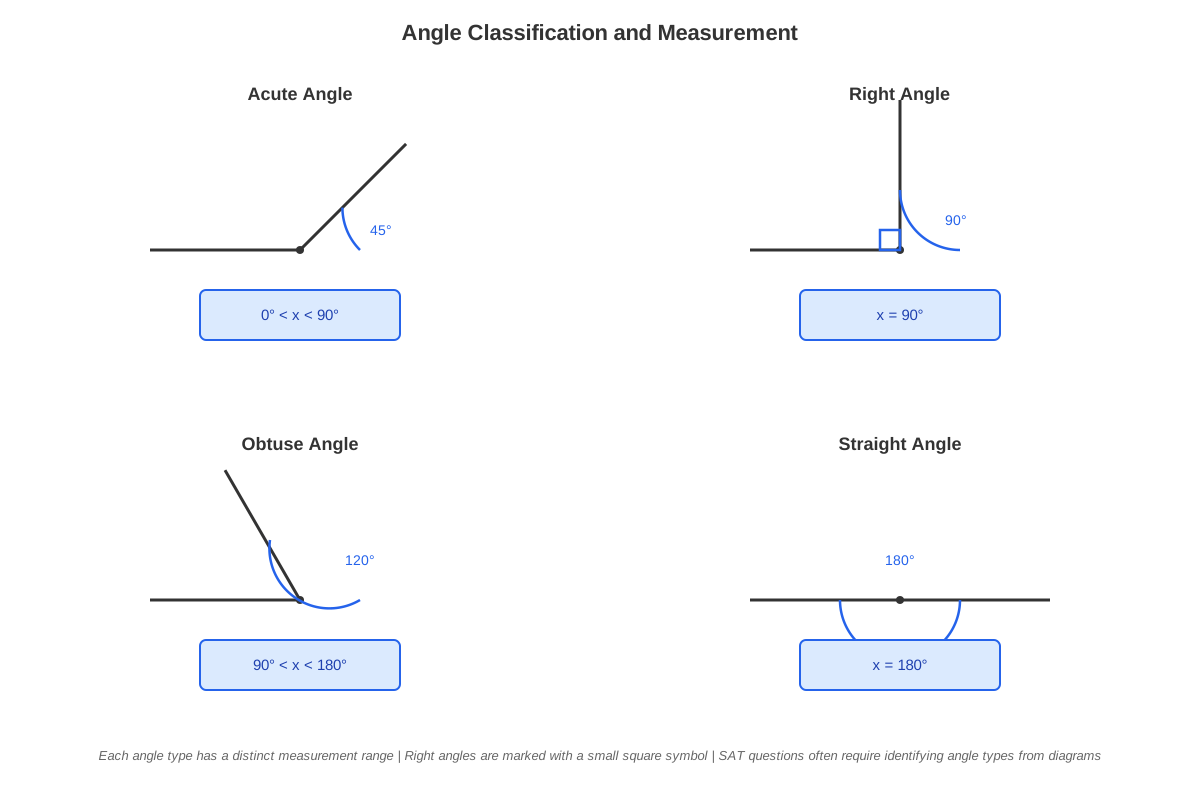
Angles are classified into distinct categories based on their measure:
| Angle Type | Measure Range | Key Characteristics |
|---|---|---|
| Acute angle | 0° < x < 90° | Smaller than a right angle; appears "sharp" |
| Right angle | Exactly 90° | Forms a perfect corner; indicated by a small square symbol |
| Obtuse angle | 90° < x < 180° | Larger than a right angle but less than a straight line |
| Straight angle | Exactly 180° | Forms a straight line; rays point in opposite directions |
| Reflex angle | 180° < x < 360° | Greater than a straight angle; "bends back" on itself |
The SAT most frequently tests acute, right, and obtuse angles, though understanding straight angles is crucial for solving problems involving supplementary angles and linear pairs.
Complementary and Supplementary Angles
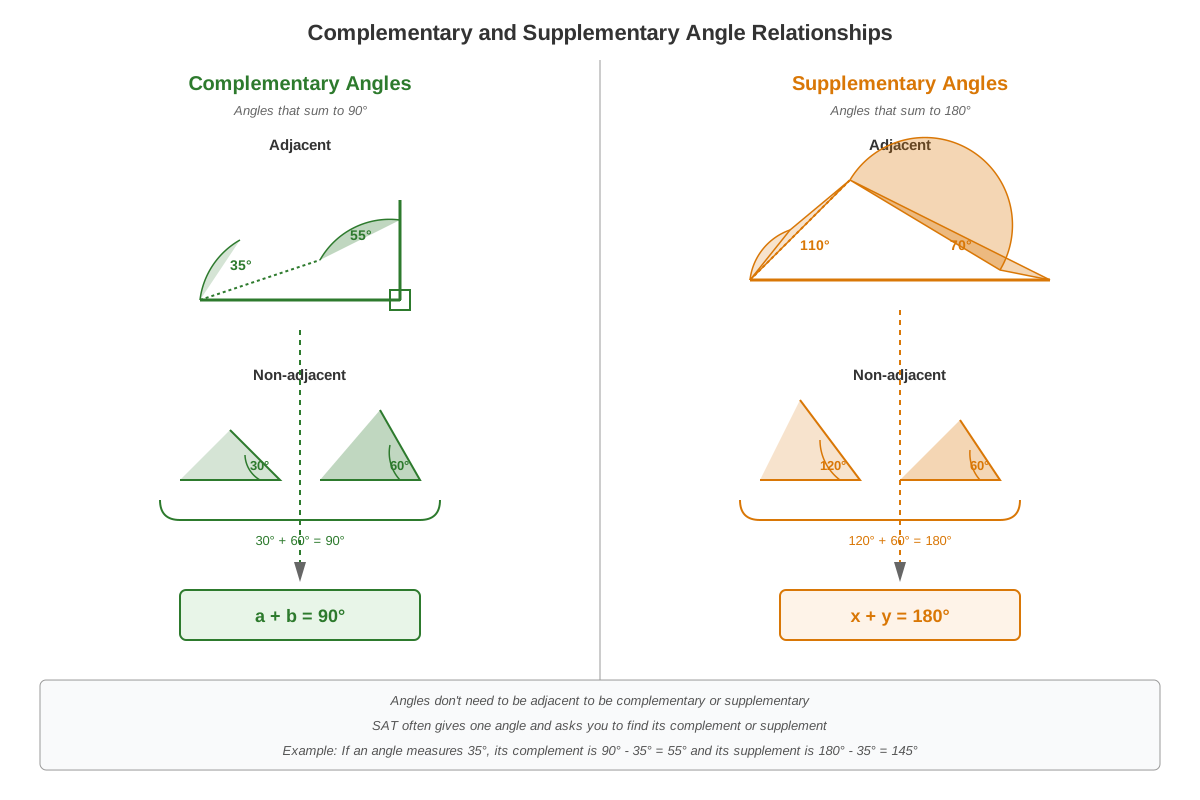
Complementary angles are two angles whose measures sum to 90°. These angles "complete" a right angle when placed adjacent to each other. For example, if one angle measures 35°, its complement measures 55° (since 35° + 55° = 90°). Complementary angles need not be adjacent; the relationship depends solely on their sum.
Supplementary angles are two angles whose measures sum to 180°. These angles form a straight line when placed adjacent to each other. If one angle measures 110°, its supplement measures 70° (since 110° + 70° = 180°). The SAT frequently presents supplementary angle problems algebraically, requiring students to set up and solve equations.
Key formulas:
- If angle A and angle B are complementary: A + B = 90°
- If angle A and angle B are supplementary: A + B = 180°
- The complement of angle x is (90 - x)°
- The supplement of angle x is (180 - x)°
Vertical Angles
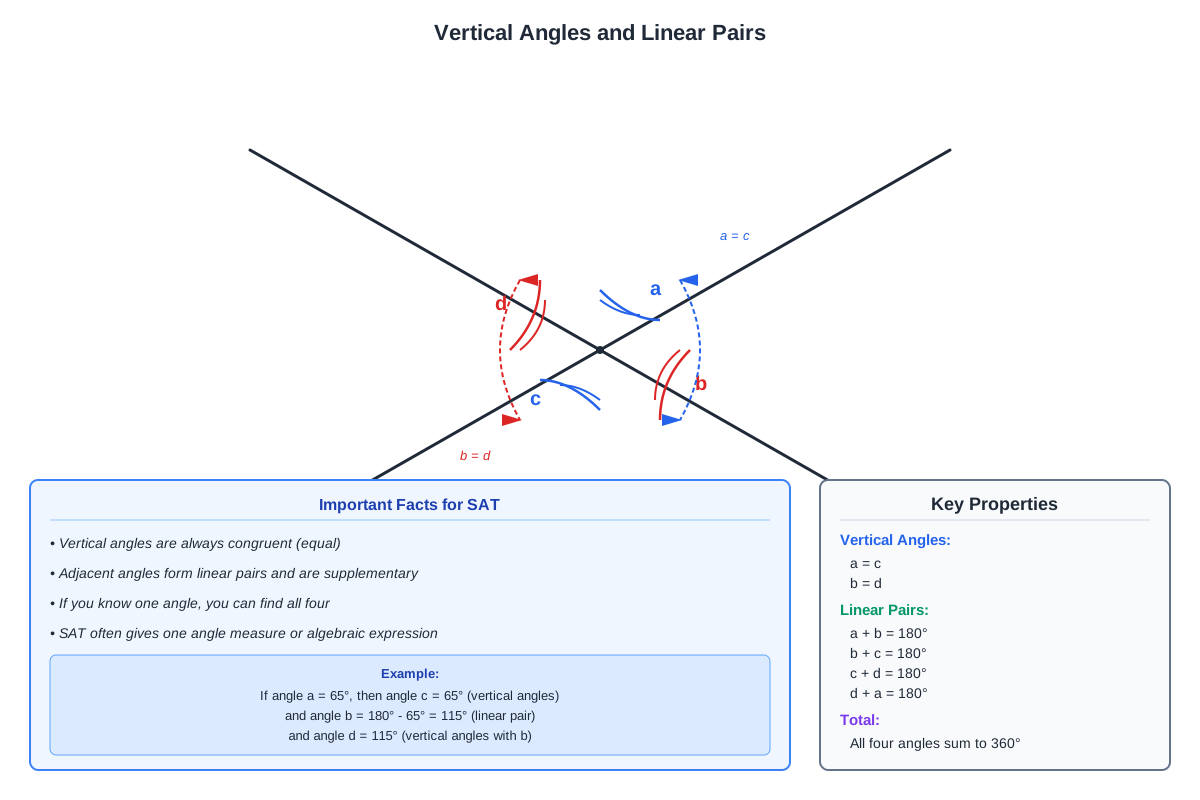
When two lines intersect, they form four angles at the point of intersection. Vertical angles are the pairs of non-adjacent angles formed by intersecting lines. A fundamental theorem states that vertical angles are always congruent (equal in measure). This property provides a powerful tool for solving SAT problems.
For example, if two lines intersect forming angles of 40°, 140°, 40°, and 140° (going around the intersection point), the two 40° angles are vertical angles (and therefore congruent), and the two 140° angles are also vertical angles (and congruent to each other). Additionally, any two adjacent angles at an intersection are supplementary, summing to 180°.
Adjacent Angles and Linear Pairs
Adjacent angles share a common vertex and a common side but do not overlap. When adjacent angles are formed by two opposite rays (creating a straight line), they form a linear pair. Linear pairs are always supplementary, meaning their measures sum to 180°.
This concept frequently appears on the SAT when a line is divided by a ray extending from a point on the line, creating two adjacent angles that must sum to 180°. Students must recognize that any angles forming a linear pair are supplementary, even when the problem doesn't explicitly state this relationship.
Angle Addition Postulate
The Angle Addition Postulate states that if point D lies in the interior of ∠ABC, then m∠ABD + m∠DBC = m∠ABC. In simpler terms, when a larger angle is divided into two smaller angles, the sum of the smaller angles equals the measure of the larger angle.
This postulate is essential for multi-step SAT problems where a complex angle is broken into component parts. Students must identify when angles can be added together and when algebraic expressions representing angle measures should be combined.
Angles Formed by Parallel Lines and Transversals
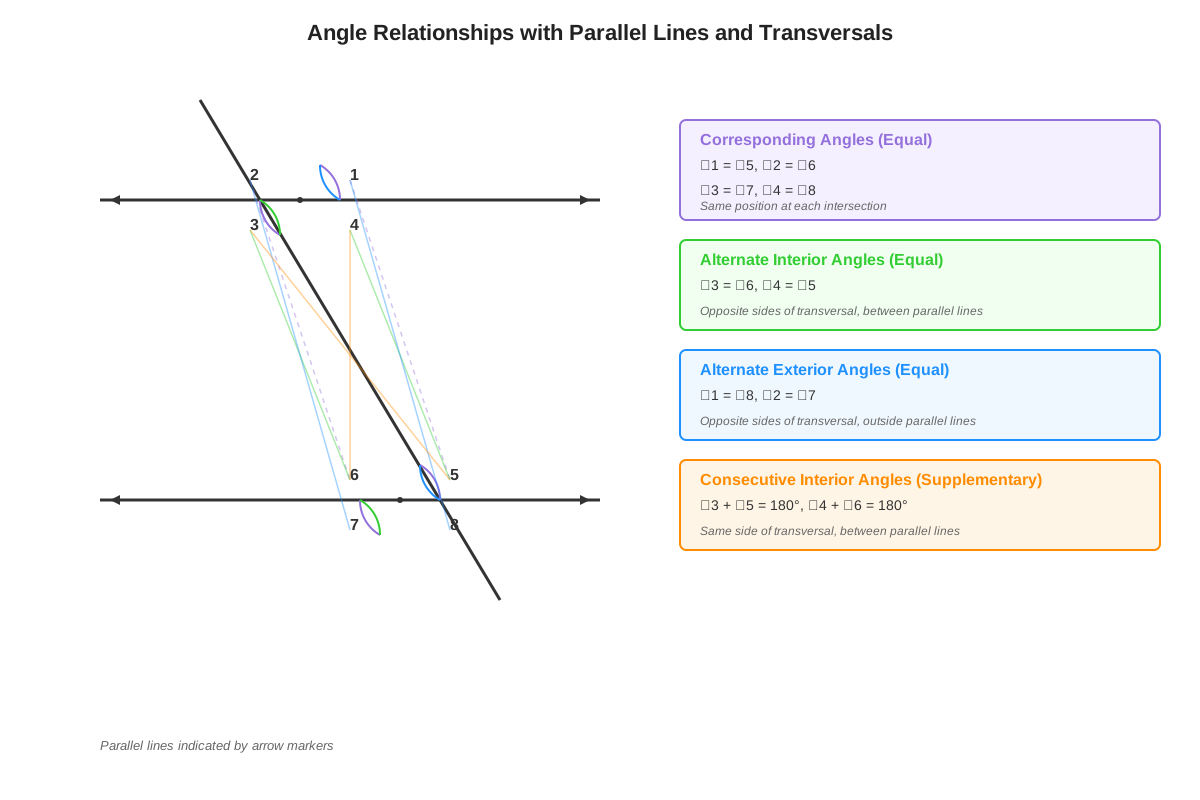
When a transversal (a line that intersects two or more lines) crosses parallel lines, eight angles are formed, creating several important relationships:
- Corresponding angles occupy the same relative position at each intersection and are congruent
- Alternate interior angles lie between the parallel lines on opposite sides of the transversal and are congruent
- Alternate exterior angles lie outside the parallel lines on opposite sides of the transversal and are congruent
- Consecutive interior angles (also called co-interior or same-side interior angles) lie between the parallel lines on the same side of the transversal and are supplementary
These relationships only hold when the lines are parallel. The SAT often tests whether students can identify these angle pairs and apply the appropriate relationship to solve for unknown measures.
Concept Relationships
The concepts within angle basics form an interconnected web of relationships. Angle measurement serves as the foundation → enabling angle classification (acute, right, obtuse) → which connects to complementary and supplementary relationships (since complementary angles must both be acute, while supplementary angles include various combinations).
Vertical angles and linear pairs both emerge from the fundamental concept of intersecting lines → with vertical angles being congruent and linear pairs being supplementary → these relationships then extend to parallel lines cut by transversals, where the same intersection principles apply at multiple points simultaneously.
The Angle Addition Postulate acts as a bridge concept → connecting simple angle measurement to complex multi-angle problems → and enabling algebraic approaches where angle measures are expressed as variables. This postulate underlies many SAT problems involving angle relationships in polygons and composite figures.
These angle basics concepts connect to prerequisite knowledge of algebraic equation solving (when setting up equations like x + 2x = 90° for complementary angles) and geometric notation (for interpreting diagrams). They also lead forward to more advanced topics like triangle angle theorems (where angles sum to 180°), polygon angle formulas, and circle angle relationships.
Quick check — test yourself on Angle basics so far.
Try Flashcards →High-Yield Facts
⭐ Vertical angles formed by intersecting lines are always congruent (equal in measure)
⭐ Complementary angles sum to exactly 90 degrees
⭐ Supplementary angles sum to exactly 180 degrees
⭐ A linear pair of angles is always supplementary
⭐ When parallel lines are cut by a transversal, corresponding angles are congruent
- Alternate interior angles formed by parallel lines and a transversal are congruent
- Consecutive interior angles formed by parallel lines and a transversal are supplementary
- A straight angle measures exactly 180° and forms a straight line
- A right angle measures exactly 90° and is indicated by a small square symbol in diagrams
- The Angle Addition Postulate states that the measure of a larger angle equals the sum of its component parts
- Acute angles measure between 0° and 90°, while obtuse angles measure between 90° and 180°
- The complement of an angle x is (90 - x)°, and the supplement is (180 - x)°
- All four angles formed by two intersecting lines sum to 360°
Common Misconceptions
Misconception: Complementary angles must be adjacent to each other.
Correction: Complementary angles only need to sum to 90°; they can be located anywhere in a diagram and need not share a vertex or side. The relationship is purely numerical.
Misconception: Vertical angles are angles that appear "vertical" or "up and down" in a diagram.
Correction: Vertical angles are non-adjacent angles formed by two intersecting lines, regardless of their orientation. The term "vertical" refers to the vertex they share, not their visual orientation.
Misconception: All adjacent angles are supplementary.
Correction: Only adjacent angles that form a linear pair (with their non-common sides forming a straight line) are supplementary. Other adjacent angles may sum to any value depending on their configuration.
Misconception: When two lines intersect, all four angles formed are equal.
Correction: Only vertical angles (opposite angles) are equal. Adjacent angles at an intersection are supplementary, not congruent, unless all four angles are right angles (90°).
Misconception: Corresponding angles are always congruent when any two lines are cut by a transversal.
Correction: Corresponding angles are congruent only when the two lines are parallel. If the lines are not parallel, corresponding angles will have different measures.
Misconception: The supplement of an obtuse angle is another obtuse angle.
Correction: The supplement of an obtuse angle (greater than 90°) must be an acute angle (less than 90°), since their sum must equal 180°. For example, the supplement of 120° is 60°.
Misconception: Angle measures can exceed 360°.
Correction: While rotations can exceed 360° in trigonometry, standard angle measures in SAT geometry range from 0° to 360°, with most problems focusing on angles less than 180°.
Worked Examples
Example 1: Complementary Angles with Algebraic Expressions
Problem: Two complementary angles are in the ratio 2:3. Find the measure of each angle.
Solution:
Step 1: Set up the relationship. Let the angles be 2x and 3x, where x is a common factor.
Step 2: Apply the complementary angle relationship. Since complementary angles sum to 90°:
2x + 3x = 90°Step 3: Solve for x:
5x = 90°
x = 18°
Step 4: Find each angle measure:
- First angle: 2x = 2(18°) = 36°
- Second angle: 3x = 3(18°) = 54°
Step 5: Verify the solution:
36° + 54° = 90° ✓Connection to Learning Objectives: This problem demonstrates applying angle basics to solve SAT-style questions by combining the definition of complementary angles with algebraic reasoning, a common SAT approach.
Example 2: Parallel Lines and Transversal
Problem: In the diagram below, lines l and m are parallel, and line t is a transversal. If angle 1 measures (3x + 20)° and angle 5 measures (5x - 40)°, where angles 1 and 5 are corresponding angles, find the value of x and the measure of angle 1.
Solution:
Step 1: Identify the angle relationship. Angles 1 and 5 are corresponding angles formed by parallel lines and a transversal.
Step 2: Apply the corresponding angles theorem. Corresponding angles are congruent when lines are parallel:
angle 1 = angle 5
3x + 20 = 5x - 40
Step 3: Solve for x:
3x + 20 = 5x - 40
20 + 40 = 5x - 3x
60 = 2x
x = 30
Step 4: Find the measure of angle 1:
angle 1 = 3x + 20
angle 1 = 3(30) + 20
angle 1 = 90 + 20
angle 1 = 110°
Step 5: Verify by checking angle 5:
angle 5 = 5x - 40
angle 5 = 5(30) - 40
angle 5 = 150 - 40
angle 5 = 110° ✓
Connection to Learning Objectives: This example demonstrates how to identify key features of angle basics (corresponding angles), explain how the concept appears on the SAT (through algebraic expressions), and apply the concept to solve a multi-step problem.
Exam Strategy
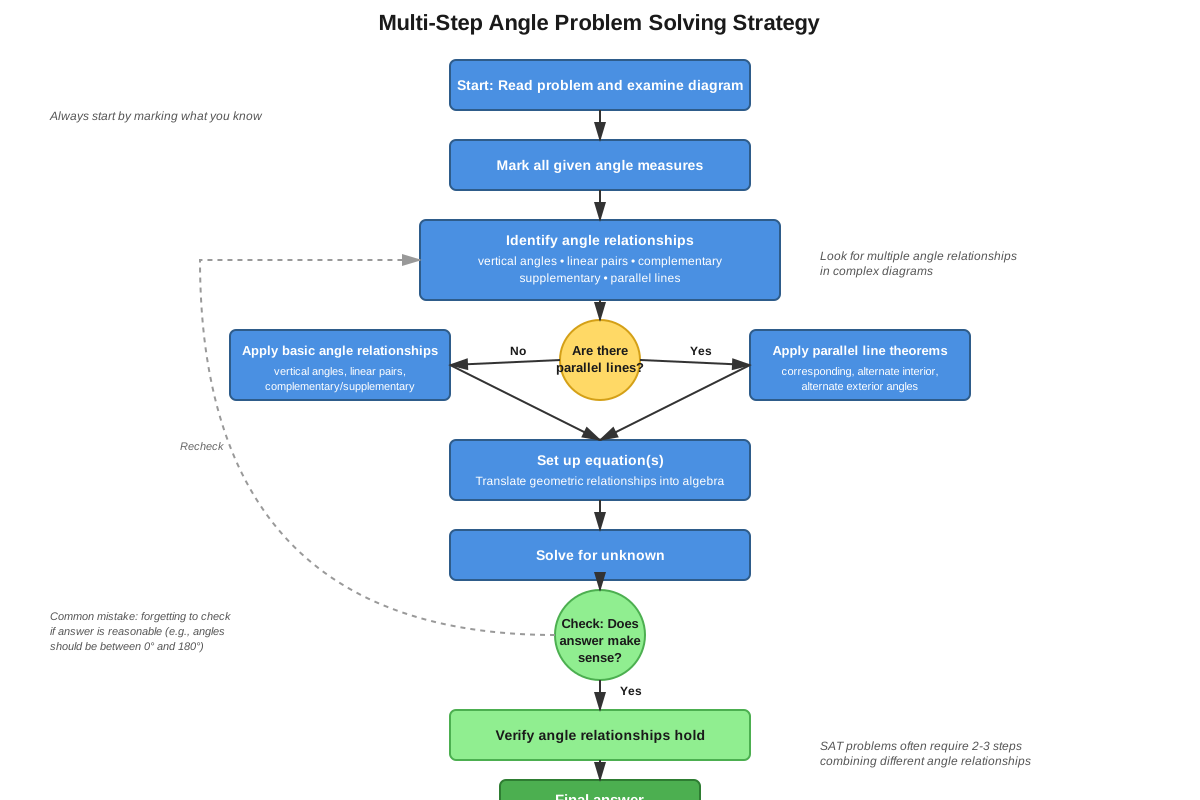
Approach SAT angle questions systematically: First, identify all given information and mark it on the diagram. Second, determine which angle relationships apply (vertical, complementary, supplementary, parallel line theorems). Third, set up equations if variables are involved. Fourth, solve and verify your answer makes geometric sense.
Trigger words and phrases that signal specific angle concepts:
- "Complementary" or "complement of" → angles sum to 90°
- "Supplementary" or "supplement of" → angles sum to 180°
- "Vertical angles" → angles are congruent
- "Linear pair" → angles are supplementary (sum to 180°)
- "Parallel lines" with "transversal" → look for corresponding, alternate interior, or consecutive interior angles
- "Intersecting lines" → consider vertical angles and linear pairs
- "Right angle" → measure is exactly 90°
Process-of-elimination strategies:
- Eliminate answer choices that violate basic angle properties (e.g., if two angles are complementary, eliminate any answer where their sum isn't 90°)
- Check whether answer choices produce valid angle measures (angles in standard SAT problems should be between 0° and 180° unless otherwise specified)
- Use estimation: if an angle appears acute in a diagram, eliminate obtuse angle measures
- Verify that algebraic solutions produce positive angle measures
Time allocation advice:
Straightforward angle identification questions should take 30-45 seconds. Multi-step problems involving algebraic expressions typically require 60-90 seconds. If a problem involves parallel lines with multiple angle relationships, allocate up to 2 minutes. Always mark diagrams with known information—this visual organization saves time and prevents errors.
Memory Techniques
Complementary vs. Supplementary Mnemonic:
- Complementary = Corner (right angle = 90°)
- Supplementary = Straight line (180°)
Parallel Lines Angle Relationships:
- CAC: Corresponding Angles are Congruent
- AIA: Alternate Interior Angles are congruent
- AEA: Alternate Exterior Angles are congruent
- CIA-S: Consecutive Interior Angles are Supplementary
Vertical Angles Visualization:
Picture an "X" formed by two intersecting lines. The angles that are "across" from each other (opposite corners of the X) are vertical angles and therefore equal.
Linear Pair Memory Aid:
"Linear" contains "line"—linear pairs form a straight line and therefore sum to 180° (a straight angle).
Angle Classification Acronym (AROS):
- Acute: less than 90°
- Right: exactly 90°
- Obtuse: more than 90° but less than 180°
- Straight: exactly 180°
Summary
Angle basics constitute essential foundational knowledge for SAT geometry, encompassing angle measurement, classification, and relationships. Angles are measured in degrees, with key classifications including acute (less than 90°), right (exactly 90°), obtuse (between 90° and 180°), and straight (exactly 180°). Critical angle relationships include complementary angles (summing to 90°), supplementary angles (summing to 180°), vertical angles (congruent angles formed by intersecting lines), and linear pairs (adjacent supplementary angles). When parallel lines are cut by a transversal, corresponding angles are congruent, alternate interior angles are congruent, and consecutive interior angles are supplementary. The Angle Addition Postulate enables breaking complex angles into component parts. Success on SAT angle questions requires identifying angle relationships in diagrams, setting up appropriate equations when variables are present, and applying geometric properties systematically to solve for unknown measures.
Key Takeaways
- Complementary angles always sum to 90°, while supplementary angles always sum to 180°
- Vertical angles formed by intersecting lines are congruent, and linear pairs are supplementary
- When parallel lines are cut by a transversal, corresponding angles and alternate interior angles are congruent
- The Angle Addition Postulate allows combining smaller angles to find larger angle measures
- SAT angle problems frequently combine geometric relationships with algebraic expressions requiring equation-solving skills
- Always mark known information on diagrams and identify applicable angle relationships before attempting calculations
- Angle classification (acute, right, obtuse, straight) helps verify that calculated answers are geometrically reasonable
Related Topics
Triangle Angle Theorems: Building on angle basics, triangle angle relationships explore how the three interior angles of any triangle sum to 180°, exterior angle theorems, and special angle relationships in isosceles and equilateral triangles. Mastering angle basics provides the foundation for understanding these more complex relationships.
Polygon Angle Formulas: Extends angle concepts to figures with more than three sides, including formulas for interior and exterior angle sums. The principles of supplementary angles and angle addition directly apply to polygon problems.
Circle Angle Relationships: Explores inscribed angles, central angles, and angles formed by chords, secants, and tangents. These advanced concepts build on the fundamental angle measurement and relationship skills developed in angle basics.
Coordinate Geometry and Slopes: Connects angle concepts to the coordinate plane, where perpendicular lines form right angles and slope relationships determine angle measures. Understanding supplementary and complementary angles aids in analyzing perpendicular and parallel line relationships.
Practice CTA
Now that you've mastered the core concepts of angle basics, it's time to solidify your understanding through active practice. Complete the practice questions to test your ability to identify angle relationships, solve for unknown measures, and apply these concepts in SAT-style contexts. Use the flashcards to reinforce key definitions and theorems until they become automatic. Remember: geometry success on the SAT comes from recognizing patterns quickly and applying relationships confidently. Every practice problem you complete builds the pattern recognition skills that will save you valuable time on test day. You've got this!
Sign up free to keep reading
Create a free AnvayaPrep account to finish this SAT guide on Angle basics — plus flashcards and practice questions.