Overview
Consecutive integer problems are a fundamental category of algebraic word problems that appear regularly on the SAT math section. These problems involve finding unknown integers that follow one another in sequence—whether standard consecutive integers (like 5, 6, 7), consecutive even integers (like 8, 10, 12), or consecutive odd integers (like 11, 13, 15). The beauty of these problems lies in their predictable structure: once you understand how to represent consecutive integers algebraically, you can translate complex word problems into straightforward linear equations.
Mastering sat consecutive integer problems is essential because they test multiple skills simultaneously: reading comprehension, algebraic translation, equation-solving, and logical reasoning. These problems frequently appear in both the calculator and no-calculator sections of the SAT, typically worth 1-2 questions per test. More importantly, the algebraic thinking required for consecutive integer problems forms the foundation for more complex topics including systems of equations, quadratic applications, and function analysis.
The relationship between consecutive integer problems and broader mathematical concepts is significant. These problems serve as a bridge between basic arithmetic and advanced algebra, requiring students to move from concrete numerical thinking to abstract variable manipulation. They reinforce the critical skill of translating English statements into mathematical expressions—a competency that extends far beyond this single topic into virtually every word problem type on the SAT. Understanding how to set up and solve these problems builds confidence in algebraic reasoning that students will apply throughout the entire math section.
Learning Objectives
- [ ] Identify key features of consecutive integer problems
- [ ] Explain how consecutive integer problems appears on the SAT
- [ ] Apply consecutive integer problems to answer SAT-style questions
- [ ] Translate word problem statements into algebraic expressions representing consecutive integers
- [ ] Distinguish between consecutive integers, consecutive even integers, and consecutive odd integers
- [ ] Solve multi-step consecutive integer problems involving sums, products, and differences
- [ ] Verify solutions by checking whether answers satisfy the original problem constraints
Prerequisites
- Basic algebraic manipulation: Ability to solve linear equations in one variable is essential for isolating the unknown integer after setting up the equation
- Understanding of integer properties: Knowledge of what defines integers, even numbers, and odd numbers ensures correct problem setup
- Translating words to equations: Experience converting verbal statements into mathematical expressions is the foundation of all word problems
- Order of operations: Proper application of PEMDAS is necessary when simplifying expressions involving consecutive integers
Why This Topic Matters
Consecutive integer problems represent one of the most practical applications of algebra in everyday reasoning. In real-world contexts, these problems model situations involving sequential numbering systems (house addresses, page numbers, seat assignments), time intervals, and resource allocation. The logical framework developed through these problems enhances critical thinking skills applicable to computer science, engineering, and data analysis.
On the SAT, consecutive integer problems appear with notable frequency—typically 1-2 questions per test administration, representing approximately 2-4% of the total math section. These questions can appear in multiple-choice format, grid-in format, or as part of more complex multi-step problems. The College Board values these problems because they efficiently assess whether students can bridge the gap between verbal reasoning and mathematical formulation.
Common SAT presentations include: finding three consecutive integers whose sum equals a given value; determining consecutive even or odd integers that satisfy a specific relationship; identifying the largest or smallest integer in a sequence; and problems where consecutive integers are embedded within more complex scenarios (such as geometry problems involving sequential measurements or data analysis questions involving sequential time periods). The predictable structure of these problems makes them high-yield study material—students who master the underlying patterns can quickly earn points that other test-takers struggle with.
Core Concepts
Defining Consecutive Integers
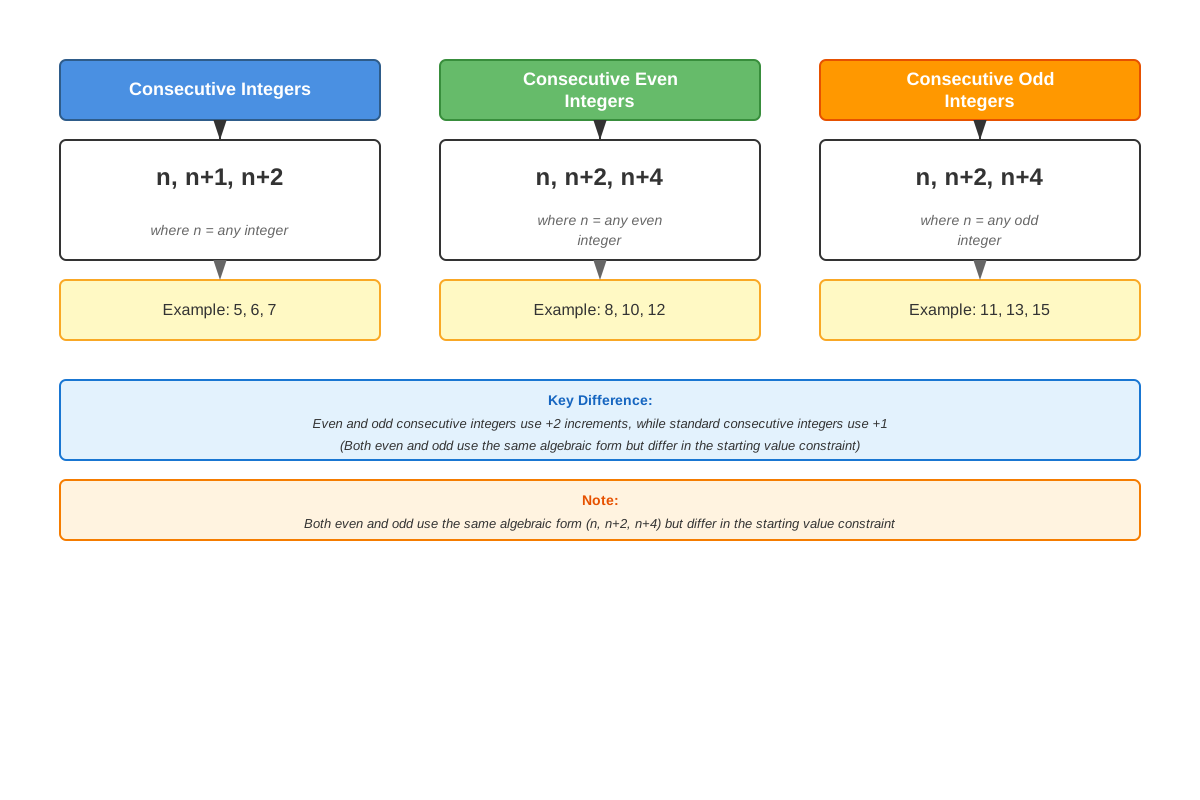
Consecutive integers are whole numbers that follow one another in order without gaps. If we let n represent any integer, then consecutive integers can be expressed as n, n + 1, n + 2, and so forth. For example, the numbers 14, 15, and 16 are three consecutive integers. The key insight is that each subsequent integer is exactly one unit larger than the previous integer.
This algebraic representation is powerful because it allows us to work with unknown integers systematically. Rather than guessing values, we can set up equations that capture the relationships described in word problems. The variable n serves as our anchor point—once we solve for n, we can immediately determine all the consecutive integers in the sequence.
Consecutive Even and Odd Integers
Consecutive even integers are even numbers that follow one another in sequence. Since even numbers differ by 2 (not 1), we represent consecutive even integers as n, n + 2, n + 4, where n is any even integer. Examples include 20, 22, 24 or -6, -4, -2. The spacing of 2 units is critical—this is the most common error students make when setting up these problems.
Consecutive odd integers follow the identical pattern: n, n + 2, n + 4, where n is any odd integer. Examples include 7, 9, 11 or -15, -13, -11. Notice that consecutive odd integers use the same algebraic form as consecutive even integers; the difference lies only in whether n is initially even or odd.
| Type | Algebraic Form | Example Set |
|---|---|---|
| Consecutive integers | n, n+1, n+2 | 5, 6, 7 |
| Consecutive even integers | n, n+2, n+4 | 8, 10, 12 |
| Consecutive odd integers | n, n+2, n+4 | 13, 15, 17 |
Setting Up Equations from Word Problems
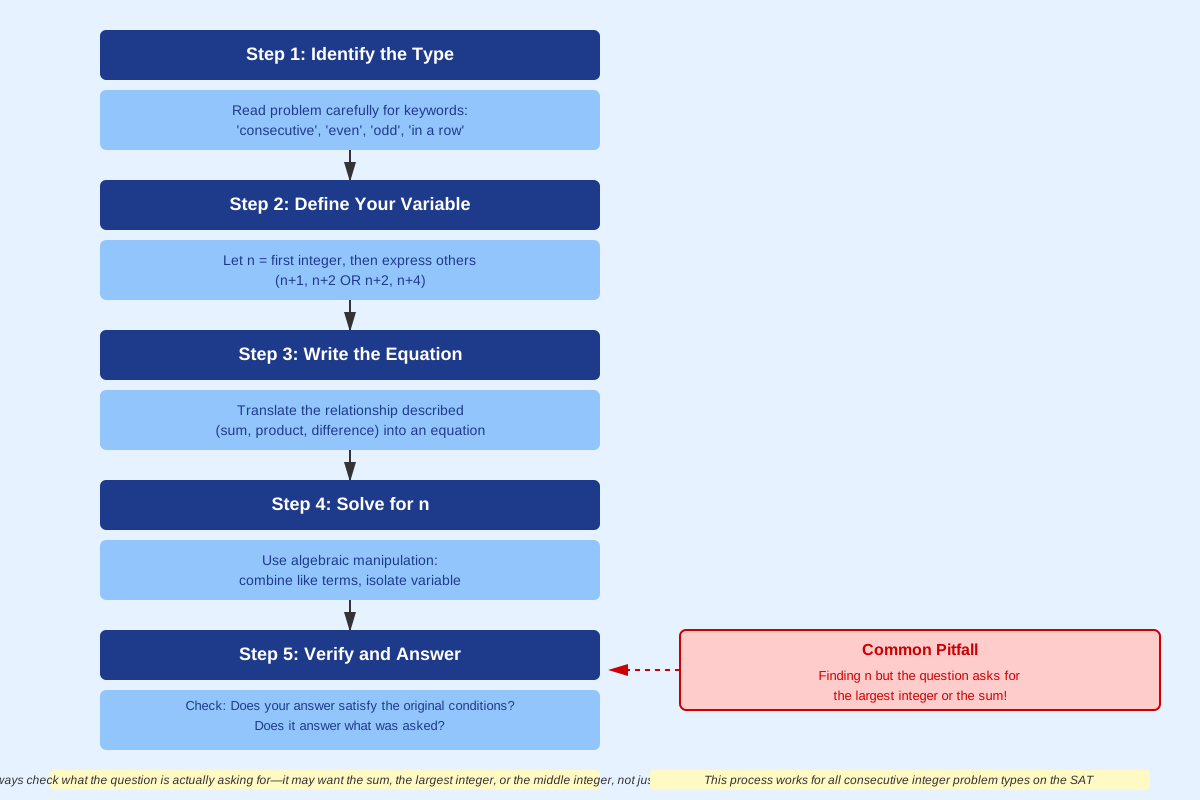
The translation process follows a systematic approach:
- Identify what you're looking for: Determine how many consecutive integers are involved and what type (standard, even, or odd)
- Choose your variable: Let n represent the first (smallest) integer in the sequence
- Express all integers algebraically: Write expressions for each consecutive integer based on the type
- Translate the relationship: Convert the word problem's condition (sum, product, difference) into an equation
- Solve the equation: Use algebraic techniques to find n
- Answer the specific question: The problem may ask for the first integer, the last integer, the sum, or another specific value
Common Problem Types
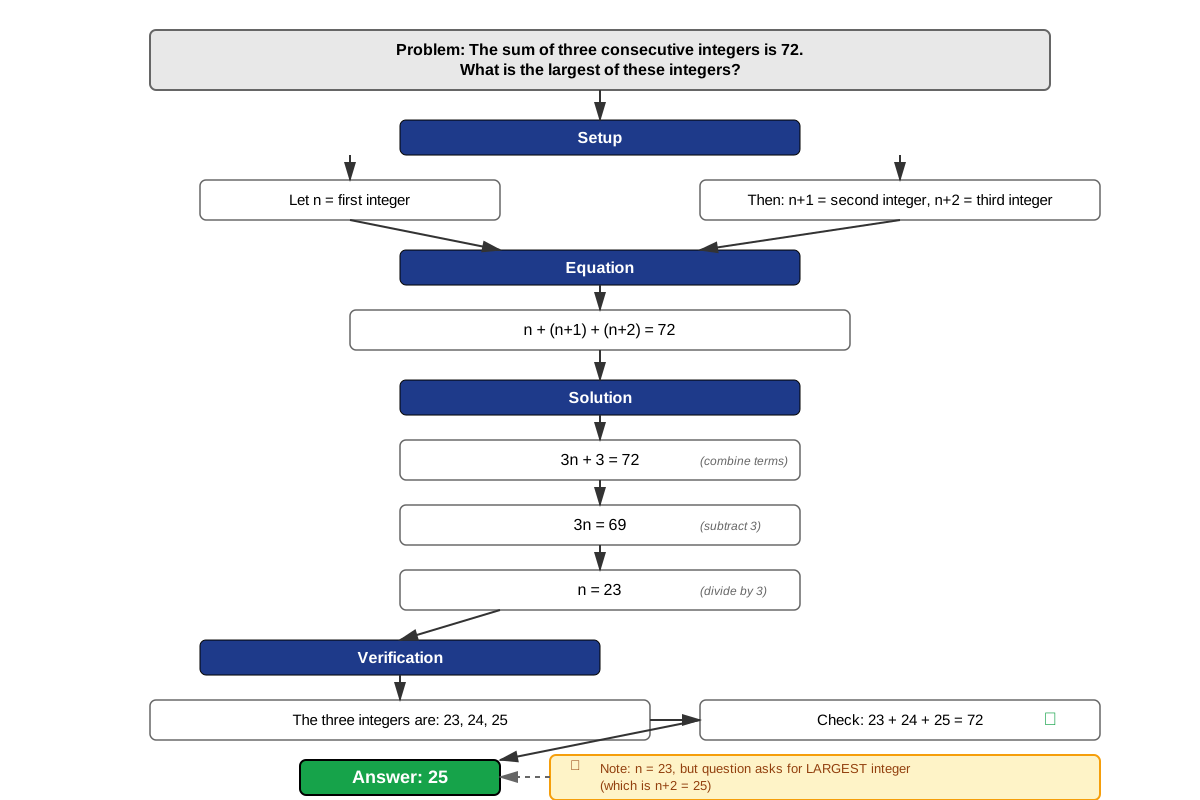
Sum problems are the most frequent type, asking students to find consecutive integers whose sum equals a specific value. For example: "The sum of three consecutive integers is 72. Find the integers." The setup would be: n + (n+1) + (n+2) = 72.
Relationship problems describe how consecutive integers relate to each other through operations. For example: "The sum of two consecutive even integers is 14 more than the smaller integer." This translates to: n + (n+2) = n + 14.
Product and quotient problems involve multiplication or division: "The product of two consecutive integers is 132." This becomes: n(n+1) = 132. While this creates a quadratic equation, the SAT typically designs these problems so that simple factoring or logical reasoning suffices.
Multi-step problems embed consecutive integers within larger contexts, such as geometry (consecutive integers as side lengths) or data analysis (consecutive years or measurements).
Solving Strategies
Once the equation is established, solving follows standard algebraic procedures:
- Combine like terms: Simplify the equation by collecting all terms with the variable
- Isolate the variable: Use inverse operations to solve for n
- Check for reasonableness: Verify that your answer makes sense in context (integers should be whole numbers)
- Find all requested values: If the problem asks for the largest integer or the sum, calculate that specific value from your solution for n
For equations involving products (quadratic equations), students can often use logical reasoning or factoring. For instance, if two consecutive integers multiply to 132, students might recognize that 11 × 12 = 132 without formal quadratic solving.
Concept Relationships
The concepts within consecutive integer problems form a hierarchical structure. Understanding basic consecutive integers (n, n+1, n+2) serves as the foundation → which extends to consecutive even/odd integers (n, n+2, n+4) → both of which require algebraic translation skills to convert word problems into equations → leading to equation-solving techniques → culminating in verification and interpretation of solutions.
These problems connect directly to prerequisite knowledge of linear equations in one variable, as nearly all consecutive integer problems reduce to solving such equations. The translation skills developed here transfer immediately to other word problem types including age problems, distance-rate-time problems, and mixture problems—all of which require converting verbal descriptions into algebraic expressions.
Looking forward, consecutive integer problems provide essential practice for systems of equations (where multiple variables represent related quantities), quadratic applications (when products of consecutive integers are involved), and function modeling (where sequences of integers can be represented as functions). The logical reasoning developed through these problems also supports data analysis and problem-solving questions throughout the SAT.
Quick check — test yourself on Consecutive integer problems so far.
Try Flashcards →High-Yield Facts
- ⭐ Consecutive integers are represented as n, n+1, n+2, where n is the first integer in the sequence
- ⭐ Consecutive even integers and consecutive odd integers both use the form n, n+2, n+4 (the difference is whether n starts as even or odd)
- ⭐ The sum of any three consecutive integers equals 3 times the middle integer: n + (n+1) + (n+2) = 3(n+1)
- ⭐ When a problem asks for "the largest" or "the greatest" consecutive integer, solve for n first, then calculate the last term in your sequence
- ⭐ Always verify your solution by substituting back into the original problem statement, not just the equation
- The sum of two consecutive integers is always odd (even + odd = odd)
- The sum of two consecutive even integers or two consecutive odd integers is always even
- The product of two consecutive integers is always even (one must be even)
- If three consecutive integers sum to S, the middle integer equals S/3
- Negative consecutive integers follow the same patterns: -5, -4, -3 are consecutive integers
- The difference between any two consecutive integers is always 1; between consecutive even/odd integers is always 2
Common Misconceptions
Misconception: Consecutive even integers are represented as n, n+1, n+2 where n is even.
Correction: Consecutive even integers must be represented as n, n+2, n+4 because even numbers are separated by 2 units, not 1. Using n+1 would give you an odd number if n is even.
Misconception: The smallest consecutive integer must always be positive.
Correction: Consecutive integers can be negative, zero, or positive. If solving yields n = -5, then the consecutive integers might be -5, -4, -3, which is perfectly valid.
Misconception: When asked to find "the integers," you only need to solve for n.
Correction: Solving for n gives you the first integer, but you must calculate all integers in the sequence and often verify which specific value the question requests (first, last, sum, etc.).
Misconception: Consecutive odd integers starting with an even number (like 2, 4, 6) are correct.
Correction: The numbers 2, 4, 6 are consecutive even integers, not odd integers. Consecutive odd integers must all be odd numbers (like 1, 3, 5 or 7, 9, 11).
Misconception: The equation n + n+2 = 50 can be simplified to 2n+2 = 50 by adding the n's and the 2's separately.
Correction: While this happens to give the correct simplification, the proper reasoning is: n + (n+2) = n + n + 2 = 2n + 2 = 50. Understanding the parenthetical grouping prevents errors in more complex problems.
Misconception: If the sum of consecutive integers is odd, there must be an odd number of integers in the sequence.
Correction: The parity of the sum depends on both the number of integers and their individual parities. Two consecutive integers (one even, one odd) always sum to an odd number.
Worked Examples
Example 1: Standard Consecutive Integer Sum
Problem: The sum of four consecutive integers is 86. What is the largest of these integers?
Solution:
Step 1: Define the consecutive integers algebraically.
Let n = the first (smallest) consecutive integer
Then the four consecutive integers are: n, n+1, n+2, n+3
Step 2: Set up the equation based on the given condition.
The sum equals 86: n + (n+1) + (n+2) + (n+3) = 86
Step 3: Simplify and solve for n.
n + n + 1 + n + 2 + n + 3 = 86
4n + 6 = 86
4n = 80
n = 20
Step 4: Identify the specific value requested.
The four consecutive integers are: 20, 21, 22, 23
The problem asks for the largest: 23
Step 5: Verify the solution.
Check: 20 + 21 + 22 + 23 = 86 ✓
Connection to Learning Objectives: This example demonstrates identifying key features (four consecutive integers), translating the word problem into an algebraic equation, and solving to answer the specific question asked.
Example 2: Consecutive Even Integers with a Relationship
Problem: The sum of three consecutive even integers is 18 more than twice the smallest integer. Find the three integers.
Solution:
Step 1: Define the consecutive even integers.
Let n = the smallest consecutive even integer
Then the three consecutive even integers are: n, n+2, n+4
Step 2: Translate the relationship into an equation.
"The sum of three consecutive even integers" = n + (n+2) + (n+4)
"is 18 more than twice the smallest integer" = 2n + 18
Equation: n + (n+2) + (n+4) = 2n + 18
Step 3: Simplify and solve.
n + n + 2 + n + 4 = 2n + 18
3n + 6 = 2n + 18
3n - 2n = 18 - 6
n = 12
Step 4: Find all three integers.
The three consecutive even integers are: 12, 14, 16
Step 5: Verify the solution.
Sum of the three integers: 12 + 14 + 16 = 42
Twice the smallest plus 18: 2(12) + 18 = 24 + 18 = 42 ✓
Connection to Learning Objectives: This example shows how to distinguish between types of consecutive integers (even vs. standard), translate complex verbal relationships into equations, and verify solutions against original constraints.
Exam Strategy
When approaching SAT consecutive integer problems, begin by carefully reading the problem to identify three critical pieces of information: (1) how many integers are involved, (2) what type of integers (standard, even, or odd), and (3) what relationship or condition is given. Underline or circle these details to prevent setup errors.
Trigger words and phrases to watch for include:
- "consecutive integers" → use n, n+1, n+2
- "consecutive even integers" or "consecutive odd integers" → use n, n+2, n+4
- "the sum of" → add the algebraic expressions
- "the product of" → multiply the expressions
- "the largest," "the greatest," "the smallest" → solve for n, then identify which term is requested
- "more than," "less than," "exceeds" → set up inequality relationships correctly
For process of elimination on multiple-choice questions, test the answer choices by working backward. If asked for the largest of three consecutive integers whose sum is 72, and the choices are 22, 23, 24, 25, you can quickly test: if the largest is 24, the three integers are 22, 23, 24, which sum to 69 (too small); if the largest is 25, the integers are 23, 24, 25, which sum to 72 (correct).
Time allocation: These problems typically require 60-90 seconds. Spend 15-20 seconds reading and setting up the equation, 30-40 seconds solving, and 15-20 seconds verifying and identifying the requested value. If a problem takes longer than 90 seconds, mark it and return later—you may have made a setup error that's easier to spot with fresh eyes.
Common traps: The SAT often includes the value of n among the answer choices when the question asks for the largest integer or the sum. Always read the final question carefully. Also, watch for problems that describe consecutive integers but then ask for something else entirely (like the average or the difference between the largest and smallest).
Memory Techniques
Mnemonic for setup: "NICE" - Name your variable, Identify the type, Create expressions, Equate to the condition.
Visualization strategy: Picture consecutive integers as steps on a staircase. Standard consecutive integers are steps with height 1, while consecutive even/odd integers are steps with height 2. This visual helps remember the spacing between terms.
The "Plus Two Rule": For consecutive even or odd integers, remember "plus two" by associating it with the fact that even and odd numbers alternate—you must skip over one number to get to the next even or next odd number.
Acronym for verification: "SAVE" - Substitute your answer, Add or perform the operation, Verify it matches the condition, Ensure you answered what was asked.
Pattern recognition: Remember that the sum of three consecutive integers always equals 3 times the middle number. This shortcut can save time: if three consecutive integers sum to 72, the middle one is 72÷3 = 24, making the integers 23, 24, 25.
Summary
Consecutive integer problems are high-yield SAT questions that test algebraic translation and equation-solving skills. The fundamental approach involves representing unknown consecutive integers using a variable n, with standard consecutive integers expressed as n, n+1, n+2, and consecutive even or odd integers expressed as n, n+2, n+4. Success requires careful reading to identify the number and type of integers involved, accurate translation of verbal conditions into algebraic equations, systematic solving using linear equation techniques, and verification that the solution satisfies the original problem. The most common errors involve incorrect spacing between terms (using +1 instead of +2 for even/odd integers) and solving for n but failing to identify the specific value requested by the question. Mastering these problems builds essential skills in algebraic reasoning that transfer to numerous other SAT math topics, making them worthy of focused practice and review.
Key Takeaways
- Consecutive integers use the form n, n+1, n+2; consecutive even/odd integers use n, n+2, n+4
- Always define your variable clearly before setting up the equation
- The spacing between consecutive even or odd integers is 2, not 1—this is the most common setup error
- After solving for n, verify your answer by substituting back into the original problem statement
- Read the final question carefully: the problem may ask for the largest integer, the sum, or another specific value rather than just n
- The sum of three consecutive integers equals 3 times the middle integer—a useful shortcut for quick verification
- These problems appear 1-2 times per SAT test and are highly predictable once you master the setup patterns
Related Topics
Systems of Linear Equations: Consecutive integer problems with multiple conditions can extend into systems of equations, where two or more variables represent different sequences or related quantities. Mastering single-variable consecutive integer problems provides the foundation for these more complex scenarios.
Quadratic Equations and Applications: When consecutive integer problems involve products (like "the product of two consecutive integers is 156"), they create quadratic equations. The algebraic setup skills learned here transfer directly to quadratic applications.
Arithmetic Sequences: Consecutive integers represent the simplest form of arithmetic sequences (sequences with constant differences). Understanding consecutive integers provides intuition for the general arithmetic sequence formula and series summation.
Number Theory and Divisibility: Properties of consecutive integers (such as "the product of two consecutive integers is always even") connect to deeper number theory concepts tested in advanced SAT problems.
Practice CTA
Now that you've mastered the core concepts and strategies for consecutive integer problems, it's time to solidify your understanding through active practice. Work through the practice questions to apply these techniques under test-like conditions, and use the flashcards to reinforce the key formulas and patterns. Remember: consecutive integer problems are among the most predictable question types on the SAT—consistent practice will transform them from challenging puzzles into quick points. Every problem you solve correctly builds the pattern recognition and confidence you need for test day success!
Sign up free to keep reading
Create a free AnvayaPrep account to finish this SAT guide on Consecutive integer problems — plus flashcards and practice questions.