Overview
The distributive property equations form a cornerstone of algebraic manipulation and appear frequently throughout the SAT Math section. This property allows students to multiply a single term across terms within parentheses, transforming expressions like 3(x + 4) into 3x + 12. While the concept itself is straightforward, the SAT tests this skill in increasingly sophisticated ways—embedding it within multi-step linear equations, word problems, and systems of equations. Mastering distributive property equations is not merely about mechanical computation; it requires recognizing when to apply the property, executing it flawlessly under time pressure, and combining it with other algebraic techniques to isolate variables and solve complex problems.
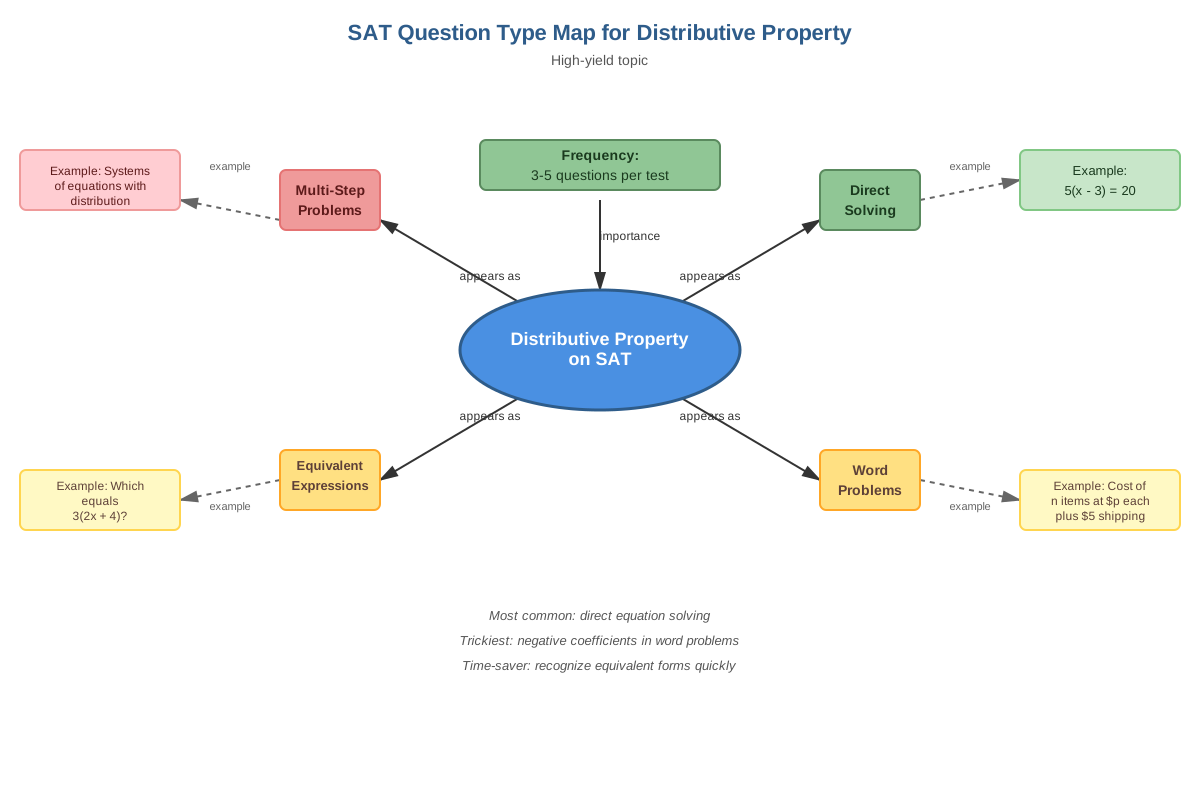
On the SAT, distributive property equations typically appear in 3-5 questions per test, making them a high-yield topic that directly impacts your score. These questions range from straightforward applications where you distribute and solve for a variable, to more complex scenarios involving multiple distribution steps, negative coefficients, or fractional multipliers. The College Board specifically designs these problems to test whether students can maintain accuracy when working with signed numbers and can recognize equivalent expressions—skills that separate high scorers from average performers.
Understanding distributive property equations connects directly to broader math concepts tested on the SAT, including simplifying algebraic expressions, solving linear equations in one variable, factoring, and even working with quadratic expressions. This topic serves as a gateway skill: students who struggle with distribution often find themselves unable to progress through more advanced algebraic problems, while those who master it gain confidence and speed across multiple question types. The distributive property also appears implicitly in geometry problems involving perimeter and area, making it one of the most versatile tools in your SAT math arsenal.
Learning Objectives
- [ ] Identify key features of distributive property equations
- [ ] Explain how distributive property equations appears on the SAT
- [ ] Apply distributive property equations to answer SAT-style questions
- [ ] Execute the distributive property accurately with positive, negative, and fractional coefficients
- [ ] Combine distribution with inverse operations to solve multi-step linear equations
- [ ] Recognize when distribution is necessary versus when factoring is more efficient
- [ ] Identify and avoid common calculation errors involving signs and order of operations
Prerequisites
- Basic arithmetic operations: Multiplication and addition/subtraction with integers, fractions, and decimals are essential for executing distribution correctly
- Understanding of variables and algebraic expressions: Students must recognize that letters represent unknown quantities and can be manipulated using arithmetic rules
- Order of operations (PEMDAS): The distributive property is fundamentally about when and how to handle parentheses in expressions
- Combining like terms: After distribution, students must consolidate similar variable terms to simplify equations
- Inverse operations for equation solving: Isolating variables requires understanding that addition/subtraction and multiplication/division are inverse operations
Why This Topic Matters
The distributive property is not merely an academic exercise—it models real-world situations where a common factor applies to multiple components. When calculating the total cost of purchasing multiple items at different prices with a uniform discount, or determining the total area of a composite figure, distribution provides the mathematical framework. In fields ranging from engineering to economics, the ability to expand and factor expressions efficiently is fundamental to problem-solving.
On the SAT, distributive property questions appear with remarkable consistency. Based on analysis of released College Board exams, approximately 12-15% of algebra questions involve distribution as a primary or secondary skill. These questions appear in both the calculator and no-calculator sections, with the no-calculator section often featuring problems designed to test mental math and algebraic fluency. The SAT presents distribution in several formats: straightforward "solve for x" equations, word problems requiring equation setup, questions asking students to identify equivalent expressions, and problems where distribution is one step in a longer solution pathway.
Common SAT question types include: (1) equations with distribution on one or both sides requiring students to solve for a variable, (2) questions asking which expression is equivalent to a given distributed form, (3) word problems where students must set up an equation involving distribution, and (4) problems where students must work backwards, factoring a distributed expression to identify the original form. The College Board particularly favors questions involving negative distributors (like -2(x - 5)) because these reliably reveal whether students truly understand signed number operations.
Core Concepts
The Distributive Property Defined
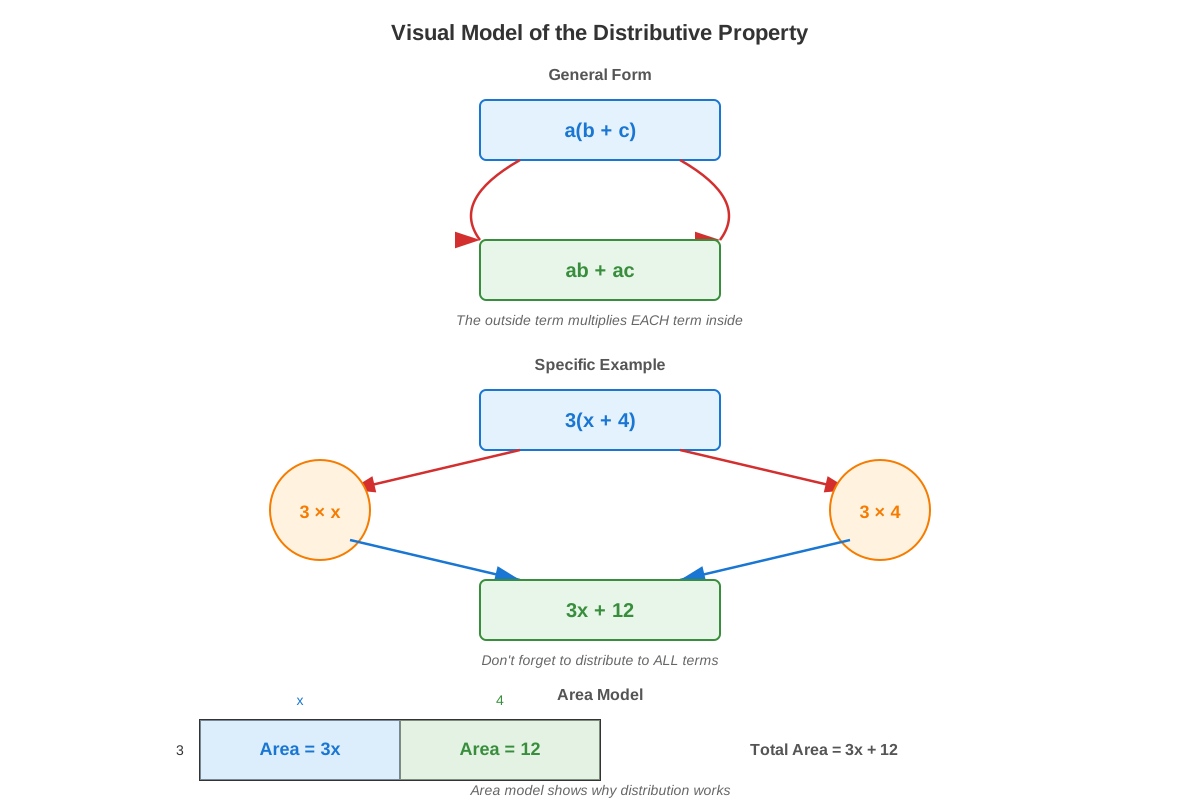
The distributive property states that for any numbers a, b, and c:
a(b + c) = ab + acThis property allows multiplication to be "distributed" across addition or subtraction within parentheses. The term outside the parentheses multiplies each term inside individually. This works identically with subtraction:
a(b - c) = ab - acThe property is bidirectional—it works both for expanding (distributing) and for factoring (reverse distribution). On the SAT, you'll primarily use the expanding direction, though recognizing factored forms can save time on certain problems.
Basic Distribution with Positive Coefficients
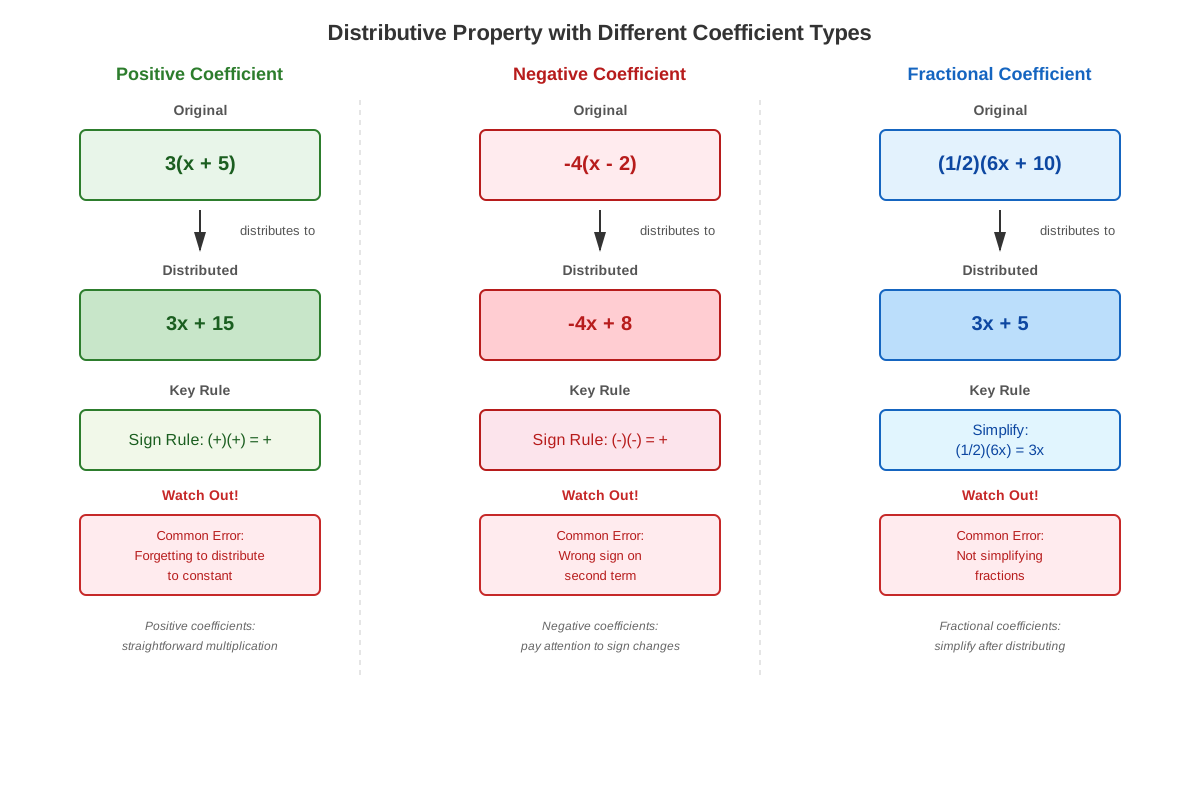
When distributing a positive number across terms in parentheses, multiply the outside term by each inside term separately:
Example: 5(x + 3) = 5·x + 5·3 = 5x + 15
Example: 4(2y + 7) = 4·2y + 4·7 = 8y + 28
The key is systematic execution: multiply the outside term by the first inside term, then by the second inside term, maintaining the operation sign between them. Students must remember that the coefficient multiplies both the variable and any constants.
Distribution with Negative Coefficients
Distribution with negative numbers requires careful attention to signs. When a negative number distributes across parentheses, it multiplies each term inside, changing signs according to multiplication rules:
Example: -3(x + 5) = -3·x + (-3)·5 = -3x - 15
Example: -2(4y - 6) = -2·4y + (-2)·(-6) = -8y + 12
Notice in the second example that distributing -2 across -6 yields +12 (negative times negative equals positive). This is where many students make errors. A helpful approach is to rewrite subtraction as addition of a negative: -2(4y - 6) = -2(4y + (-6)), making the sign changes more explicit.
Distribution with Fractions and Decimals
The SAT frequently tests distribution with fractional or decimal coefficients to assess computational fluency:
Example: (1/2)(6x + 8) = (1/2)·6x + (1/2)·8 = 3x + 4
Example: 0.5(10y - 4) = 0.5·10y - 0.5·4 = 5y - 2
When distributing fractions, multiply the numerator by each term and keep the denominator, then simplify. With decimals, apply standard decimal multiplication rules. These problems often appear in the no-calculator section, testing whether students can perform these operations mentally or with minimal written work.
Solving Equations Using Distribution
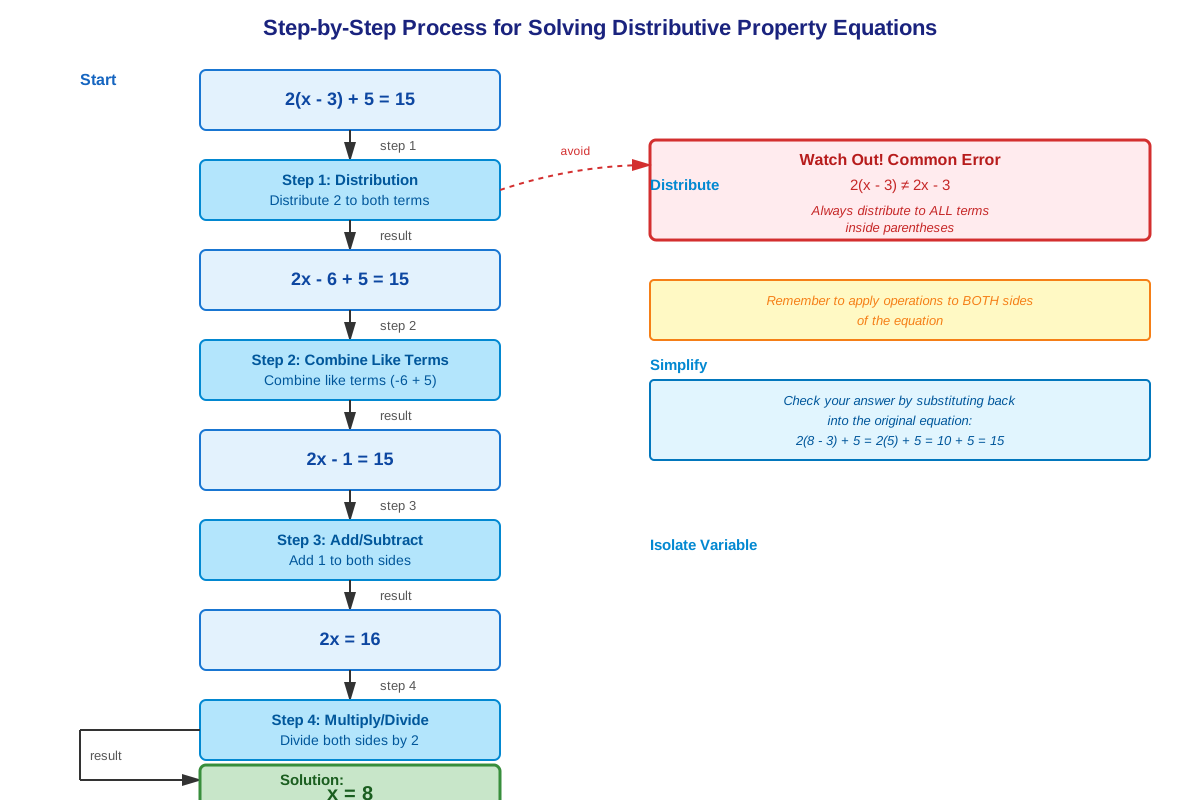
Most SAT questions don't simply ask students to distribute—they require distribution as part of solving an equation. The standard process follows these steps:
- Distribute all terms outside parentheses
- Combine like terms on each side of the equation
- Move variable terms to one side using inverse operations
- Move constant terms to the opposite side
- Isolate the variable by dividing or multiplying
Example: Solve 3(x + 4) = 21
Step 1: Distribute → 3x + 12 = 21
Step 2: Subtract 12 from both sides → 3x = 9
Step 3: Divide both sides by 3 → x = 3
Distribution on Both Sides
More challenging SAT problems involve distribution on both sides of an equation:
Example: Solve 2(x + 5) = 3(x - 2)
Step 1: Distribute left side → 2x + 10 = 3(x - 2)
Step 2: Distribute right side → 2x + 10 = 3x - 6
Step 3: Subtract 2x from both sides → 10 = x - 6
Step 4: Add 6 to both sides → 16 = x
These problems require careful organization and systematic work. Students should distribute completely before attempting to move terms across the equals sign.
Distribution with Multiple Terms
Some SAT problems involve distributing across expressions with more than two terms:
Example: 2(3x + 4y - 5) = 2·3x + 2·4y + 2·(-5) = 6x + 8y - 10
The principle remains the same: the outside term multiplies every term inside the parentheses. Maintaining accuracy across multiple terms requires focus and systematic execution.
Recognizing When NOT to Distribute
Interestingly, some SAT problems are designed to test whether students recognize when distribution is unnecessary or inefficient. If both sides of an equation have the same factor, dividing both sides by that factor is faster than distributing:
Example: 5(x + 3) = 5(12)
Rather than distributing the 5, simply divide both sides by 5: x + 3 = 12, then x = 9.
This strategic thinking—recognizing the most efficient path—distinguishes high scorers from students who mechanically apply procedures without considering alternatives.
Concept Relationships
The distributive property serves as a foundational bridge between basic arithmetic and advanced algebra. Basic multiplication skills → enable → distributive property execution → which enables → solving linear equations → which enables → systems of equations and quadratic expressions.
Within the topic itself, concepts build hierarchically: understanding basic distribution with positive coefficients is prerequisite to distribution with negative coefficients, which in turn prepares students for distribution on both sides of equations. The ability to combine like terms works synergistically with distribution—after distributing, students must consolidate similar terms to simplify expressions before solving.
The distributive property connects backward to prerequisite topics like order of operations (distribution is essentially a rule about when to handle parentheses) and integer operations (particularly multiplication of signed numbers). It connects forward to factoring (the reverse process), solving quadratic equations (which often requires distribution to expand or factor), and polynomial operations (where distribution extends to multiple terms and higher powers).
A useful mental model: Distribution → Simplification → Isolation → Solution. Each step depends on the previous one, and distribution is almost always the first step when parentheses are present in an equation.
Quick check — test yourself on Distributive property equations so far.
Try Flashcards →High-Yield Facts
⭐ The distributive property states that a(b + c) = ab + ac, allowing multiplication to distribute across addition or subtraction within parentheses
⭐ When distributing a negative number, the sign of every term inside the parentheses changes according to multiplication rules (negative × positive = negative; negative × negative = positive)
⭐ Distribution must be completed before combining like terms or moving terms across the equals sign in an equation
⭐ The distributive property works with any real numbers, including fractions, decimals, and negative numbers
⭐ When the same factor appears on both sides of an equation, dividing both sides by that factor is often more efficient than distributing
- Distribution applies to subtraction the same way as addition: a(b - c) = ab - ac
- Every term inside the parentheses must be multiplied by the outside term—forgetting to distribute to all terms is a common error
- The distributive property is bidirectional: it can expand expressions (distribute) or factor them (reverse distribution)
- When distributing fractions, multiply the numerator by each term inside and simplify the resulting fractions
- Distribution problems on the SAT often involve multiple steps, combining distribution with inverse operations to solve for variables
- Negative signs immediately before parentheses act as -1 being distributed: -(x + 3) = -1(x + 3) = -x - 3
- The order of terms doesn't matter due to the commutative property, but maintaining consistent order reduces errors
Common Misconceptions
Misconception: Only the first term inside the parentheses gets multiplied by the outside term → Correction: The outside term must multiply every single term inside the parentheses. For 3(x + 5), both x and 5 must be multiplied by 3, yielding 3x + 15, not 3x + 5.
Misconception: Distributing a negative number only changes the sign of the first term → Correction: A negative distributor changes the sign of every term inside according to multiplication rules. For -2(x - 4), the result is -2x + 8, not -2x - 4. The negative times negative yields positive.
Misconception: Distribution and combining like terms can happen in any order → Correction: Distribution must occur first. You cannot combine terms that are inside and outside parentheses until after distributing. In 2(x + 3) + 5x, you must distribute first to get 2x + 6 + 5x, then combine to get 7x + 6.
Misconception: When both sides have parentheses, you can "cancel" them → Correction: Each side must be distributed independently. In 2(x + 1) = 3(x - 2), you cannot eliminate the parentheses without distributing; you must expand both sides completely.
Misconception: Distributing fractions means multiplying only the numerator → Correction: When distributing a fraction like (1/3)(6x + 9), multiply the entire fraction by each term: (1/3)·6x + (1/3)·9 = 2x + 3. The denominator stays constant while the numerator multiplies each term.
Misconception: A negative sign before parentheses can be ignored if you're careful with signs inside → Correction: A negative sign before parentheses represents -1 being distributed and must be explicitly handled. The expression -(2x - 5) equals -2x + 5, not 2x - 5.
Worked Examples
Example 1: Multi-Step Equation with Distribution
Problem: Solve for x: 4(2x - 3) + 5 = 3(x + 2) + 10
Solution:
Step 1: Distribute on the left side
4(2x - 3) + 5 = 3(x + 2) + 10
8x - 12 + 5 = 3(x + 2) + 10
Step 2: Distribute on the right side
8x - 12 + 5 = 3x + 6 + 10Step 3: Combine like terms on each side
8x - 7 = 3x + 16Step 4: Subtract 3x from both sides to collect variable terms
5x - 7 = 16Step 5: Add 7 to both sides to isolate the variable term
5x = 23Step 6: Divide both sides by 5
x = 23/5 or 4.6Connection to Learning Objectives: This problem demonstrates the application of distributive property equations to SAT-style questions, requiring distribution on both sides, combining like terms, and using inverse operations—all essential skills for the exam.
Example 2: Word Problem Requiring Distribution
Problem: A gym charges a one-time registration fee plus a monthly membership cost. The total cost for 6 months can be represented by the expression 50 + 6(35), where 50 is the registration fee and 35 is the monthly cost. If the gym offers a promotion where both the registration fee and monthly cost are reduced by 20%, which expression represents the new total cost for 6 months?
A) 0.8(50 + 6(35))
B) 0.8(50) + 6(35)
C) 50 + 6(0.8(35))
D) 0.2(50 + 6(35))
Solution:
Step 1: Understand what "both costs reduced by 20%" means
- A 20% reduction means paying 80% of the original cost
- This applies to both the registration fee (50) and the monthly cost (35)
Step 2: Recognize that the 80% reduction applies to the entire cost
- The entire expression 50 + 6(35) represents the total cost
- Reducing everything by 20% means multiplying the entire expression by 0.8
Step 3: Set up the expression
0.8(50 + 6(35))Step 4: Verify by distributing (though not required to answer)
0.8(50 + 210) = 0.8(260) = 208Alternatively, if we incorrectly chose B:
0.8(50) + 6(35) = 40 + 210 = 250This only reduces the registration fee, not the monthly costs.
Answer: A
Connection to Learning Objectives: This problem tests the ability to identify when distribution is needed in a real-world context and to recognize equivalent expressions—both key SAT skills involving distributive property equations.
Exam Strategy
When approaching sat distributive property equations on the exam, follow this systematic process:
Step 1: Identify distribution opportunities immediately. Scan the equation for parentheses with a coefficient or negative sign in front. These are your distribution triggers. Mark them mentally or with a light pencil notation.
Step 2: Distribute completely before doing anything else. Resist the urge to combine terms or move things across the equals sign until all distribution is complete. This prevents errors and keeps work organized.
Step 3: Watch for negative distributors. When you see a negative sign or negative number before parentheses, slow down and carefully apply sign rules. This is where the SAT expects errors. Double-check that negative × negative = positive.
Step 4: Organize your work vertically. Write each step on a new line, maintaining alignment of equals signs. This makes it easier to spot errors and shows clear work if you need to review.
Trigger words and phrases to watch for:
- "Equivalent expression" → suggests you may need to distribute or factor
- "Solve for x" with parentheses present → distribution is almost certainly required
- "Simplify" → distribute, then combine like terms
- Problems involving "total cost," "perimeter," or "combined" → often require distribution in setup
Process-of-elimination tips:
- If answer choices are expressions, substitute a simple number (like x = 1) into both the original and each answer choice to eliminate incorrect options
- Eliminate answers that have different numbers of variable terms than what you'd get after proper distribution
- Watch for answer choices that differ only in signs—these test whether you correctly handled negative distribution
Time allocation:
- Simple distribution problems (one side, positive coefficients): 30-45 seconds
- Complex problems (both sides, negative coefficients): 60-90 seconds
- Word problems requiring distribution setup: 90-120 seconds
If a problem seems to require extensive distribution and calculation, check whether there's a shortcut (like dividing both sides by a common factor). The SAT rewards strategic thinking, not just computational endurance.
Memory Techniques
Mnemonic for distribution steps: "DISCO"
- Distribute all terms
- Identify like terms
- Simplify by combining
- Collect variables on one side
- Operate to isolate the variable
Visualization for negative distribution: Picture a negative sign as a "sign flipper" that walks through the parentheses changing every sign it touches. When -3 distributes across (x - 4), imagine the -3 flipping the positive x to negative (-3x) and flipping the negative 4 to positive (+12).
Acronym for common errors: "FEND"
- Forgetting to distribute to all terms
- Errors with negative signs
- Not combining like terms after distributing
- Distributing when dividing would be simpler
Rhyme for remembering the property: "Multiply outside by each term within, that's how distribution problems begin."
Hand technique: When distributing, point to each term inside the parentheses as you multiply it by the outside term. This physical action helps ensure you don't skip any terms, especially in expressions with three or more terms inside parentheses.
Color coding (if allowed on scratch paper): Use one color for positive terms and another for negative terms after distribution. This visual distinction helps prevent sign errors when combining like terms.
Summary
The distributive property is a fundamental algebraic tool that allows multiplication to be distributed across addition or subtraction within parentheses, following the pattern a(b + c) = ab + ac. On the SAT, this concept appears in 12-15% of algebra questions, making it a high-yield topic that directly impacts scores. Mastery requires not just mechanical execution but strategic thinking about when to distribute versus when alternative approaches are more efficient. The most critical skills include accurate distribution with negative coefficients (where sign errors are common), systematic multi-step problem solving that combines distribution with inverse operations, and recognition of equivalent expressions. Students must practice distributing across multiple terms, handling fractional and decimal coefficients, and working with distribution on both sides of equations. Success on SAT distributive property questions comes from careful attention to signs, organized work habits, and the ability to verify answers through substitution or alternative methods. The distributive property connects to virtually every other algebra topic on the SAT, making it an essential foundation for achieving a high math score.
Key Takeaways
- The distributive property a(b + c) = ab + ac is essential for solving linear equations and appears on every SAT exam
- Always distribute completely before combining like terms or moving terms across the equals sign
- Negative distributors change signs according to multiplication rules: negative × positive = negative, negative × negative = positive
- Distribution must be applied to every term inside the parentheses without exception
- When the same factor appears on both sides of an equation, consider dividing both sides rather than distributing
- Organize work systematically, writing each step clearly to minimize errors under time pressure
- The most common errors involve sign mistakes with negative distributors and forgetting to distribute to all terms
Related Topics
Combining Like Terms: After distributing, students must consolidate similar variable terms (like 3x and 5x) to simplify expressions. This skill works hand-in-hand with distribution in virtually every algebra problem.
Solving Multi-Step Linear Equations: Distribution is typically the first step in solving complex linear equations. Mastering distribution enables progression to equations involving multiple operations and variables on both sides.
Factoring Expressions: The reverse of distribution, factoring involves recognizing common factors and rewriting expressions in factored form. Understanding distribution deeply makes factoring more intuitive.
Systems of Equations: Many systems require distribution when setting up or solving equations, particularly in word problems involving multiple variables.
Quadratic Expressions: Distributing binomials (like (x + 3)(x + 5)) extends the distributive property to more complex expressions, a skill tested in higher-level SAT problems.
Practice CTA
Now that you've mastered the core concepts of distributive property equations, it's time to cement your understanding through active practice. The practice questions and flashcards are specifically designed to mirror SAT question formats and difficulty levels, giving you the repetition needed to build speed and accuracy. Remember, understanding the concept is just the first step—true mastery comes from applying these skills under test-like conditions. Challenge yourself to work through the practice problems without looking back at the guide, then review any mistakes carefully to identify patterns in your errors. Each problem you solve correctly builds the confidence and automaticity you need to excel on test day. You've got this!
Sign up free to keep reading
Create a free AnvayaPrep account to finish this SAT guide on Distributive property equations — plus flashcards and practice questions.