Overview
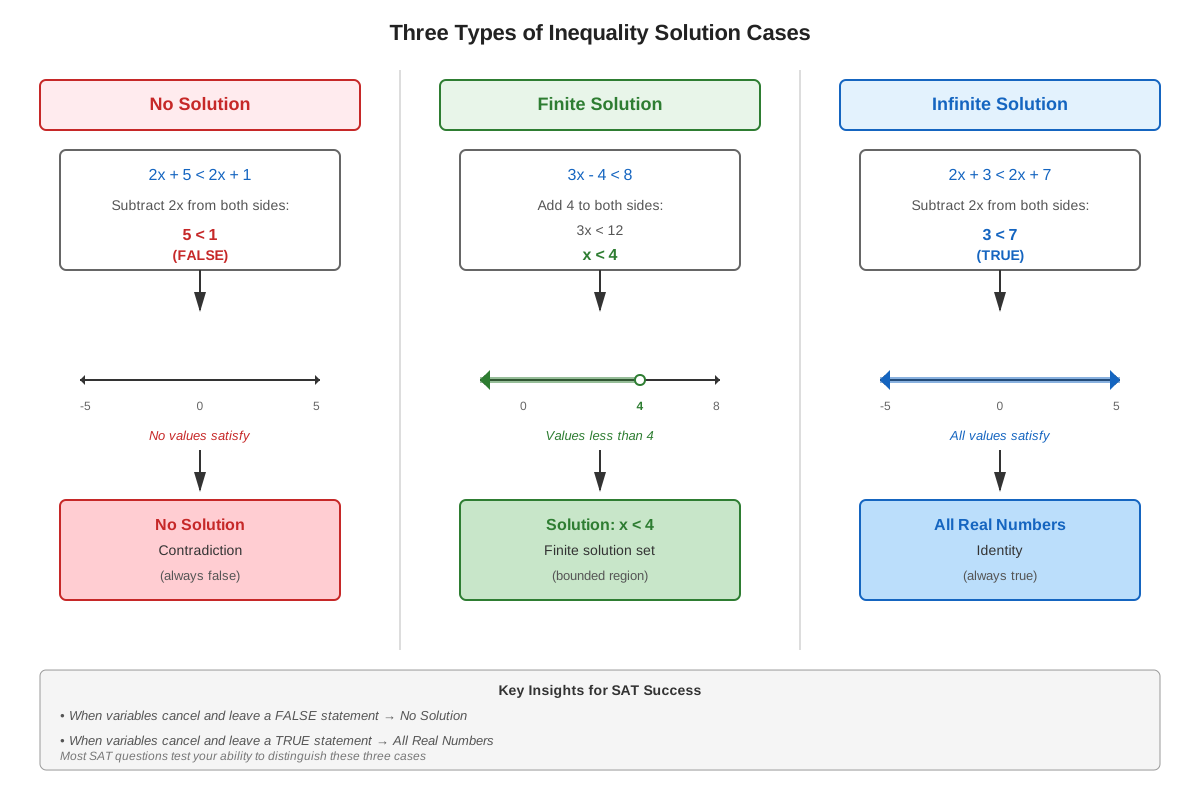
No-solution inequalities represent a critical concept in SAT math that tests students' understanding of algebraic manipulation and logical reasoning. These special cases occur when an inequality simplifies to a statement that is always false, meaning no value of the variable can satisfy the condition. For example, when solving an inequality leads to a contradiction like "5 < 2" or "0 > 3," the inequality has no solution. Understanding these situations requires students to recognize when algebraic operations reveal an impossible condition rather than a range of valid values.
This topic is essential for the SAT because it appears regularly in both multiple-choice and student-produced response questions, often testing whether students can distinguish between no-solution cases, infinite-solution cases, and standard solution sets. The College Board frequently uses no-solution inequalities to assess deeper conceptual understanding rather than mere computational ability. Students who master this topic demonstrate they can think critically about what inequality solutions mean, not just mechanically solve them.
No-solution inequalities connect to broader mathematical concepts including linear equations, systems of inequalities, and absolute value inequalities. They require solid understanding of inequality properties, particularly how operations like multiplication by negative numbers affect inequality direction. This topic also reinforces the fundamental difference between equations and inequalities, preparing students for more advanced algebraic reasoning tested throughout the SAT Math section.
Learning Objectives
- [ ] Identify key features of no-solution inequalities
- [ ] Explain how no-solution inequalities appears on the SAT
- [ ] Apply no-solution inequalities to answer SAT-style questions
- [ ] Distinguish between no-solution, one-solution, and infinite-solution inequality cases
- [ ] Recognize algebraic manipulations that lead to contradictory statements
- [ ] Analyze compound inequalities to determine when no values satisfy all conditions simultaneously
Prerequisites
- Basic inequality notation and symbols: Understanding <, >, ≤, ≥ is essential for interpreting what "no solution" means in context
- Properties of inequality operations: Knowing how to add, subtract, multiply, and divide inequalities (especially with negative numbers) is necessary to simplify expressions correctly
- Solving linear equations: The process of isolating variables in inequalities mirrors equation-solving techniques
- Number line representation: Visualizing solution sets helps students recognize when no region satisfies the inequality
- Combining like terms: Simplifying algebraic expressions is the first step in revealing contradictions
Why This Topic Matters
In real-world applications, no-solution inequalities represent impossible constraints or conflicting requirements. For instance, if a business needs to price a product above $50 to cover costs but below $40 to remain competitive, this creates a no-solution scenario that signals the business model is not viable. Engineers encounter similar situations when design specifications conflict, and recognizing these impossibilities early prevents wasted resources.
On the SAT, no-solution inequalities appear in approximately 2-4 questions per test, making them a high-yield topic for focused study. These questions typically appear in the calculator and no-calculator sections, often as part of the Heart of Algebra domain. The College Board uses this concept to test analytical thinking, as students must recognize when algebraic manipulation reveals a logical impossibility rather than simply computing an answer.
Common SAT question formats include: asking students to identify which inequality has no solution from a list of options; providing an inequality with a parameter and asking for which parameter value the inequality has no solution; presenting word problems where constraints conflict; and combining inequalities in systems where no overlap exists. These questions often serve as medium-to-hard difficulty items that differentiate high-scoring students from average performers.
Core Concepts
Definition of No-Solution Inequalities
A no-solution inequality is an inequality that, when simplified through valid algebraic operations, reduces to a statement that is always false regardless of the variable's value. Unlike equations that might have no solution, inequalities with no solution reveal fundamental contradictions in the constraints being imposed. When solving an inequality leads to statements like "3 < -1" or "7 ≤ 5," these false statements indicate that the original inequality cannot be satisfied by any real number.
The key distinction lies in understanding that we're not looking for a specific value or range of values—we're recognizing that the inequality's conditions are inherently contradictory. This differs fundamentally from inequalities with empty solution sets due to domain restrictions, which involve different mathematical reasoning.
Algebraic Manipulation Leading to Contradictions
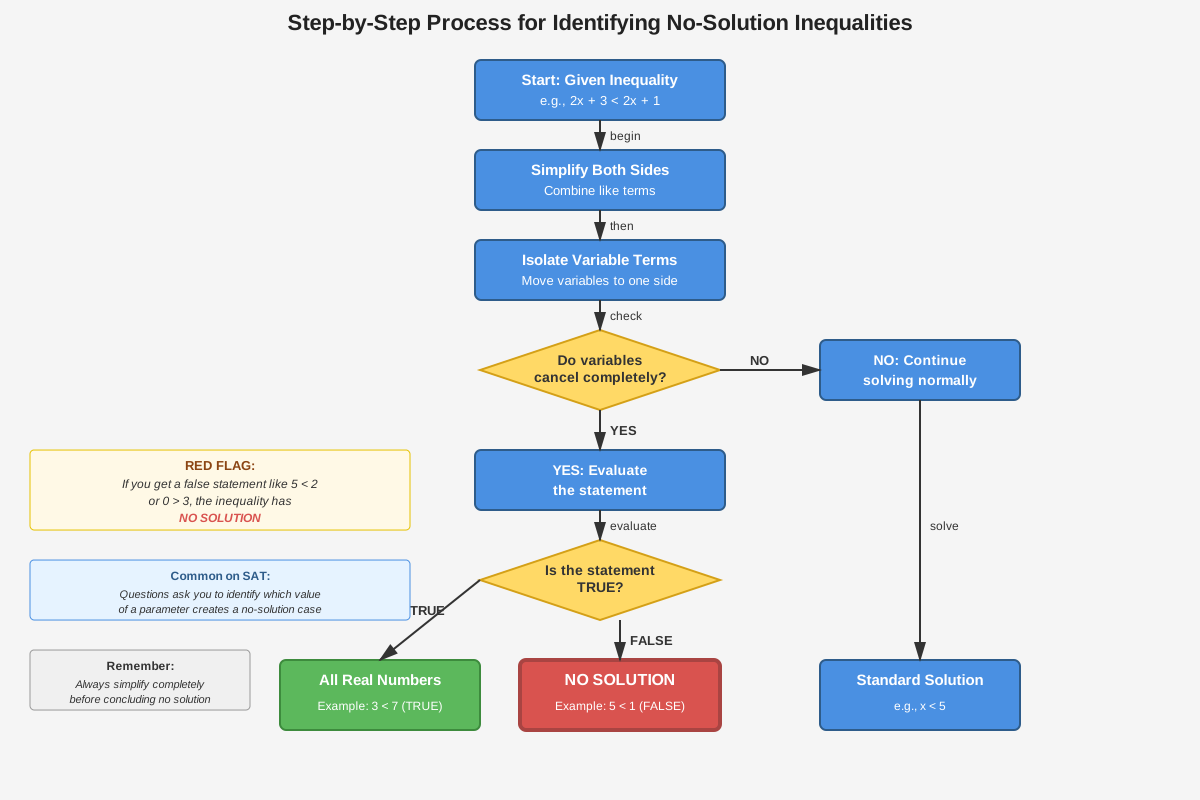
To identify no-solution inequalities, students must systematically simplify the inequality using standard algebraic operations:
- Distribute any coefficients across parentheses
- Combine like terms on each side of the inequality
- Isolate variable terms on one side by adding or subtracting
- Simplify to see if variables cancel completely
- Evaluate the resulting numerical statement
When variables cancel during this process, students are left with a pure numerical comparison. If this comparison is false (like 4 > 10 or -2 ≥ 5), the original inequality has no solution. If the comparison is true (like 5 < 8 or 3 ≤ 7), the inequality has infinitely many solutions.
Types of No-Solution Scenarios
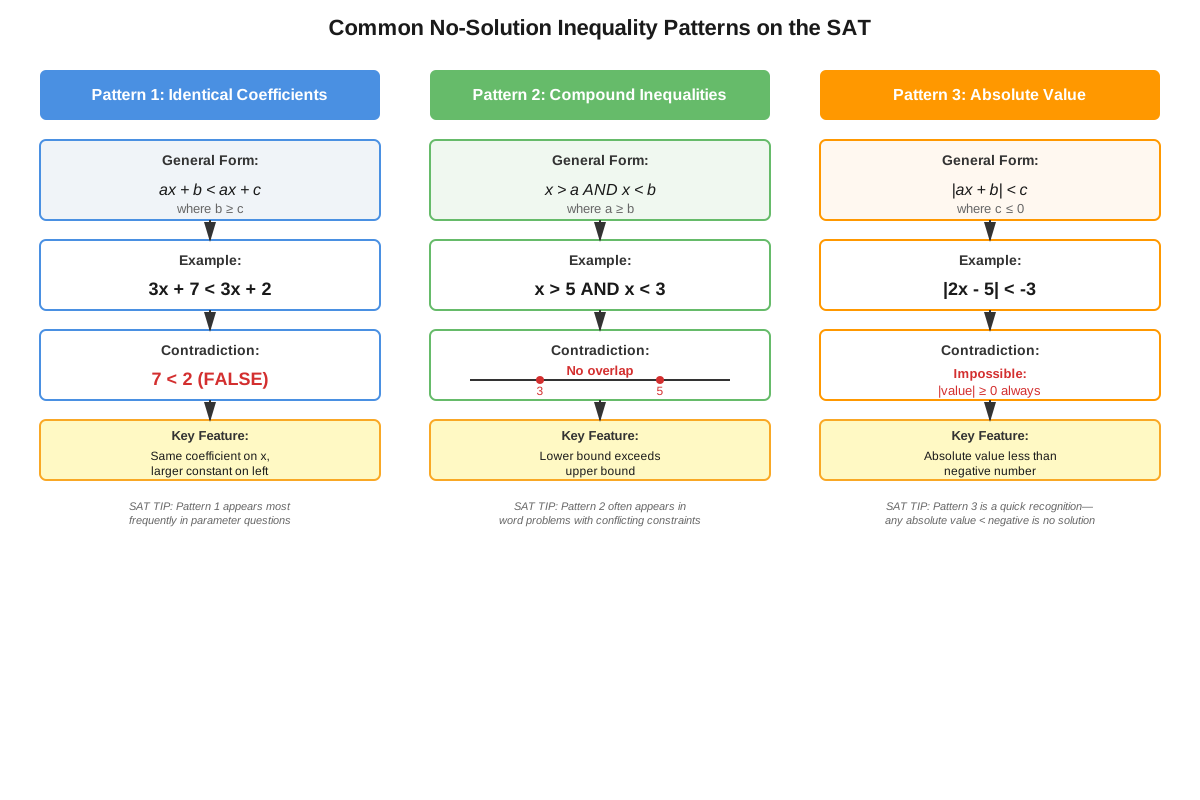
| Scenario Type | Example | After Simplification | Interpretation | ||
|---|---|---|---|---|---|
| Identical coefficients, impossible constant | 2x + 5 < 2x + 1 | 5 < 1 | No value of x makes this true | ||
| Opposite coefficients, wrong direction | 3x + 7 > -3x + 20 becomes 6x > 13 | Actually has solutions; not this type | Must check carefully | ||
| Compound inequality with no overlap | x < 3 AND x > 5 | No number is both | Conflicting constraints | ||
| Absolute value with negative bound | \ | x + 2\ | < -3 | Absolute values are non-negative | Impossible condition |
Compound Inequalities and No-Solution Cases
Compound inequalities combine two or more inequality statements using "AND" or "OR" logic. For "AND" compound inequalities (often written as a < x < b), no solution exists when the constraints conflict. The classic example is x < 3 AND x > 5, which requires x to simultaneously be less than 3 and greater than 5—a logical impossibility.
For "OR" compound inequalities, no-solution cases are extremely rare because the union of solution sets typically includes at least some values. However, if both component inequalities individually have no solution, the compound inequality also has no solution.
Absolute Value Inequalities with No Solution
Absolute value inequalities of the form |expression| < negative number always have no solution because absolute values represent distance and cannot be negative. For example, |2x - 5| < -4 has no solution because the left side is always greater than or equal to zero, making it impossible to be less than -4.
Similarly, |expression| ≤ negative number has no solution for the same reason. However, |expression| > negative number always has infinitely many solutions (all real numbers) because absolute values are always non-negative and thus always greater than any negative number.
Parameter-Based No-Solution Problems
SAT no-solution inequalities frequently involve parameters (constants represented by letters like k, a, or c) where students must determine which parameter value creates a no-solution scenario. For example: "For what value of k does the inequality 3x + k < 3x + 7 have no solution?" The answer is any k ≥ 7, because when simplified to k < 7, values of k that make this false create the no-solution condition.
These problems test whether students understand that no-solution occurs when the simplified inequality is false, requiring them to work backwards from the contradiction to the parameter value.
Concept Relationships
No-solution inequalities build directly on understanding of basic inequality solving → which requires knowledge of inequality properties → particularly how operations affect inequality direction. The concept connects to linear equations with no solution (parallel lines in systems) through the shared idea of contradictory constraints.
Within this topic, recognizing contradictory statements → enables identification of no-solution cases → which contrasts with infinite-solution cases (always-true statements) → both of which differ from standard solution sets (ranges of values). Understanding compound inequalities → provides context for how multiple constraints interact → revealing when no overlap exists between solution regions.
The relationship to absolute value inequalities → demonstrates how domain restrictions (non-negativity) → create special no-solution scenarios → that don't require algebraic simplification to identify. Parameter problems → synthesize all these concepts → requiring students to manipulate inequalities symbolically → while reasoning about when contradictions emerge.
Quick check — test yourself on No-solution inequalities so far.
Try Flashcards →High-Yield Facts
⭐ An inequality has no solution when it simplifies to a false numerical statement (e.g., 5 < 2 or 8 ≤ 3)
⭐ When solving an inequality, if the variable terms cancel and leave a false statement, there is no solution
⭐ Compound inequalities with "AND" have no solution when the constraints conflict (e.g., x < 3 AND x > 5)
⭐ Absolute value inequalities of the form |expression| < negative number always have no solution
⭐ No-solution inequalities differ from infinite-solution inequalities, which simplify to true statements (e.g., 3 < 7)
- Multiplying or dividing by negative numbers reverses inequality direction but doesn't create no-solution cases by itself
- The inequality 0·x < -5 has no solution because 0 is never less than -5
- Parallel constraints that don't overlap create no-solution scenarios in systems of inequalities
- Parameter problems often ask for values that make the simplified inequality false
- Recognizing no-solution cases requires completing the simplification process, not stopping early
Common Misconceptions
Misconception: If an inequality is difficult to solve, it must have no solution. → Correction: Difficulty in solving doesn't indicate no solution; only a false statement after complete simplification indicates no solution. Complex inequalities may still have valid solution ranges.
Misconception: When variables cancel during solving, the inequality always has no solution. → Correction: When variables cancel, examine the remaining numerical statement. If it's true (like 2 < 5), the inequality has infinitely many solutions. Only false statements indicate no solution.
Misconception: The inequality x < 3 OR x > 5 has no solution because there's a gap between 3 and 5. → Correction: "OR" means the solution includes all values satisfying either condition. This inequality's solution is all numbers except those between 3 and 5 (inclusive). "AND" compound inequalities with gaps have no solution.
Misconception: Absolute value inequalities like |x| > -2 have no solution because of the negative number. → Correction: This inequality has infinitely many solutions (all real numbers) because absolute values are always non-negative, thus always greater than -2. Only |x| < negative number has no solution.
Misconception: No-solution inequalities and no-solution equations are identified the same way. → Correction: While both involve contradictions, equations yield statements like 5 = 3 (false equality), while inequalities yield false comparisons like 5 < 3. The logical structure is similar but the notation differs.
Worked Examples
Example 1: Standard No-Solution Inequality
Problem: Solve the inequality 4(x - 3) + 7 ≤ 4x - 8 and determine if it has no solution, one solution, or infinitely many solutions.
Solution:
Step 1: Distribute the 4 on the left side
4x - 12 + 7 ≤ 4x - 8Step 2: Combine like terms on the left side
4x - 5 ≤ 4x - 8Step 3: Subtract 4x from both sides to isolate constants
4x - 5 - 4x ≤ 4x - 8 - 4x
-5 ≤ -8
Step 4: Evaluate the numerical statement
The statement "-5 ≤ -8" is false because -5 is greater than -8.
Answer: This inequality has no solution because it simplifies to a false statement. No value of x can make the original inequality true.
Connection to Learning Objectives: This example demonstrates identifying key features (variable cancellation leading to false statement) and applying the concept to solve an SAT-style problem.
Example 2: Parameter-Based No-Solution Problem
Problem: For what value of k does the inequality 5x + 2k < 5x + 14 have no solution?
Solution:
Step 1: Subtract 5x from both sides
5x + 2k - 5x < 5x + 14 - 5x
2k < 14
Step 2: Understand what creates no solution
For the original inequality to have no solution, the simplified statement "2k < 14" must be false.
Step 3: Determine when 2k < 14 is false
The statement 2k < 14 is false when 2k ≥ 14
Step 4: Solve for k
2k ≥ 14
k ≥ 7Answer: The inequality has no solution when k ≥ 7. For example, if k = 7, the inequality simplifies to 14 < 14 (false). If k = 10, it simplifies to 20 < 14 (false).
Connection to Learning Objectives: This example shows how to analyze parameter problems and explain how no-solution inequalities appear on the SAT, requiring backwards reasoning from the contradiction condition.
Exam Strategy
When approaching SAT no-solution inequalities questions, follow this systematic process:
Trigger Words: Watch for phrases like "has no solution," "cannot be satisfied," "no value of x," or "for what value of [parameter] does the inequality have no solution."
Step-by-step approach:
- Simplify completely before making any conclusions—partial simplification can be misleading
- Check if variables cancel—this is the most common pathway to no-solution cases
- Evaluate the numerical statement that remains after cancellation
- For compound inequalities, sketch quick number lines to visualize overlap
- For absolute value inequalities, immediately check if the bound is negative
Process of elimination tips:
- If answer choices include "all real numbers" or "infinitely many solutions," the question likely involves distinguishing between no solution and infinite solutions
- Eliminate any answer choice that provides a specific number or range when the question asks about no-solution conditions
- For parameter problems, test extreme values (very large or very small) to see which creates contradictions
Time allocation: Spend 45-60 seconds on straightforward no-solution identification problems, but allow 90-120 seconds for parameter-based problems that require backwards reasoning. Don't rush the simplification process—one sign error can lead to incorrect conclusions.
Memory Techniques
Mnemonic for No-Solution Identification: "CANCEL-FALSE"
- Combine like terms first
- Add or subtract to isolate variables
- Notice when variables cancel
- Check the remaining statement
- Evaluate if it's true or false
- Logically conclude: false = no solution
Visualization Strategy: Picture a number line with two arrows pointing away from each other (← →) for compound inequalities with no solution, representing impossible simultaneous conditions. For infinite solutions, picture arrows pointing toward each other or overlapping completely.
Acronym for Absolute Value: "NEGATIVE = NO"
- Negative bounds on absolute value inequalities (with < or ≤)
- Equal
- NO solution
Memory Hook: "When variables vanish and leave a lie, no solution is the reason why." This rhyme helps students remember that variable cancellation leading to a false statement indicates no solution.
Summary
No-solution inequalities represent a fundamental concept in SAT math where algebraic simplification reveals contradictory constraints that cannot be satisfied by any real number. These special cases occur when variables cancel during solving, leaving false numerical statements like 5 < 2, or when compound inequalities impose conflicting conditions like x < 3 AND x > 5. Absolute value inequalities with negative bounds (|expression| < negative) also always have no solution due to the non-negative nature of absolute values. The SAT frequently tests this concept through direct identification problems, parameter-based questions requiring backwards reasoning, and compound inequality analysis. Mastering no-solution inequalities requires completing full algebraic simplification, distinguishing false statements from true ones (which indicate infinite solutions), and understanding the logical impossibility underlying these mathematical contradictions. Success on these problems demonstrates conceptual understanding beyond mechanical computation, making this a high-value topic for score improvement.
Key Takeaways
- No-solution inequalities simplify to false numerical statements after variables cancel through valid algebraic operations
- The key distinction is between false statements (no solution), true statements (infinite solutions), and variable-containing results (standard solution sets)
- Compound inequalities with "AND" have no solution when constraints conflict; "OR" compound inequalities rarely have no solution
- Absolute value inequalities of the form |expression| < negative number always have no solution
- Parameter problems require working backwards: determine what makes the simplified inequality false, then solve for the parameter
- Complete simplification is essential—stopping early prevents accurate identification of no-solution cases
- SAT questions on this topic test logical reasoning and conceptual understanding, not just computational skills
Related Topics
Infinite-Solution Inequalities: Understanding when inequalities simplify to always-true statements (like 3 < 7) complements no-solution cases, as both involve variable cancellation but opposite logical outcomes. Mastering no-solution inequalities makes infinite-solution recognition immediate.
Systems of Linear Inequalities: Graphical approaches to systems build on no-solution concepts by showing when shaded regions don't overlap, providing visual confirmation of algebraic conclusions about conflicting constraints.
Absolute Value Equations and Inequalities: Deeper study of absolute value properties explains why negative bounds create no-solution scenarios and connects to distance interpretation on number lines.
Linear Equations with No Solution: Parallel lines in systems of equations share the conceptual foundation of contradictory constraints, extending no-solution reasoning to equation systems.
Parametric Analysis in Algebra: Advanced parameter problems across various algebraic topics build on the backwards-reasoning skills developed through no-solution parameter questions.
Practice CTA
Now that you've mastered the core concepts of no-solution inequalities, it's time to solidify your understanding through active practice. Attempt the practice questions designed specifically for this topic, focusing on identifying contradictory statements quickly and accurately. Use the flashcards to reinforce key definitions and recognition patterns—repetition builds the automaticity needed for test-day success. Remember, no-solution problems are high-yield SAT content that can differentiate your score. Each practice problem you solve strengthens your analytical skills and builds confidence for exam day. You've got this!
Sign up free to keep reading
Create a free AnvayaPrep account to finish this SAT guide on No-solution inequalities — plus flashcards and practice questions.