Overview
Optimization with inequalities is a critical topic in SAT math that combines algebraic reasoning with practical problem-solving skills. This concept involves finding maximum or minimum values of a quantity while satisfying one or more constraint conditions expressed as inequalities. On the SAT, these problems typically appear in the context of real-world scenarios such as budgeting, production planning, resource allocation, or geometric constraints. Students must translate verbal descriptions into mathematical inequalities, identify feasible regions or solution sets, and determine optimal values that satisfy all given conditions.
Understanding sat optimization with inequalities is essential because it represents a higher-order thinking skill that the College Board specifically targets in the Problem Solving and Data Analysis domain, as well as in the Heart of Algebra and Passport to Advanced Math sections. These questions test not only computational ability but also conceptual understanding of how constraints limit possibilities and how to systematically find the best solution within those limits. Mastery of this topic demonstrates mathematical maturity and the ability to apply algebraic concepts to practical situations—skills that colleges value highly.
This topic builds directly on foundational knowledge of linear inequalities, graphing on the coordinate plane, and systems of equations. It extends these concepts by adding an objective function—a quantity to maximize or minimize—creating a bridge between pure algebra and applied mathematics. Students who master optimization with inequalities develop problem-solving frameworks applicable to numerous SAT question types, including word problems, data interpretation, and multi-step reasoning challenges. The skills learned here also connect to more advanced topics like quadratic optimization and function analysis.
Learning Objectives
- [ ] Identify key features of optimization with inequalities
- [ ] Explain how optimization with inequalities appears on the SAT
- [ ] Apply optimization with inequalities to answer SAT-style questions
- [ ] Translate real-world constraint problems into systems of inequalities
- [ ] Determine feasible solution sets that satisfy multiple inequality constraints
- [ ] Evaluate objective functions at critical points to find optimal values
- [ ] Distinguish between bounded and unbounded optimization problems
Prerequisites
- Linear inequalities in one and two variables: Understanding how to solve, graph, and interpret inequalities is fundamental to setting up optimization problems
- Graphing on the coordinate plane: Visualizing solution regions requires comfort with plotting lines and shading appropriate regions
- Systems of linear equations: Many optimization problems involve multiple constraints that must be satisfied simultaneously
- Substitution and evaluation: Finding optimal values requires substituting coordinates into expressions and comparing results
- Word problem translation: Converting verbal descriptions into mathematical expressions is essential for setting up optimization scenarios
Why This Topic Matters
Optimization with inequalities represents one of the most practical applications of algebra that students encounter on the SAT. In real-world contexts, individuals and organizations constantly face decisions about how to allocate limited resources to achieve the best possible outcome—whether maximizing profit, minimizing cost, or achieving the most efficient use of time and materials. The mathematical framework of optimization with inequalities provides a systematic approach to these ubiquitous decision-making scenarios.
On the SAT, optimization problems appear with moderate frequency, typically 1-3 questions per test, but they carry significant weight because they often appear as multi-step problems worth multiple points or as grid-in questions that require precise answers. These questions most commonly appear in the calculator-permitted section and frequently integrate multiple mathematical concepts, making them high-value targets for score improvement. The College Board uses optimization problems to assess students' ability to model real-world situations mathematically, reason abstractly, and apply multiple problem-solving strategies in sequence.
Common SAT presentations of this topic include: business scenarios involving production constraints and profit maximization; budgeting problems with spending limits across multiple categories; geometric problems finding maximum area or perimeter under specific conditions; mixture problems with composition requirements; and scheduling scenarios with time or resource constraints. Questions may ask students to identify which inequality system correctly models a situation, determine the maximum or minimum value of a quantity, or find specific values that optimize an outcome while satisfying all constraints.
Core Concepts
Understanding Optimization Problems
An optimization problem consists of three essential components: an objective function (the quantity to maximize or minimize), constraint inequalities (conditions that must be satisfied), and decision variables (the quantities that can be adjusted). The objective function is typically a linear expression like "profit = 5x + 3y" or "cost = 2a + 4b," where the goal is to find values of the variables that make this expression as large (maximization) or as small (minimization) as possible. The constraints are inequalities that limit the possible values of the variables, such as "x + y ≤ 100" (total cannot exceed 100) or "x ≥ 0" (quantity cannot be negative).
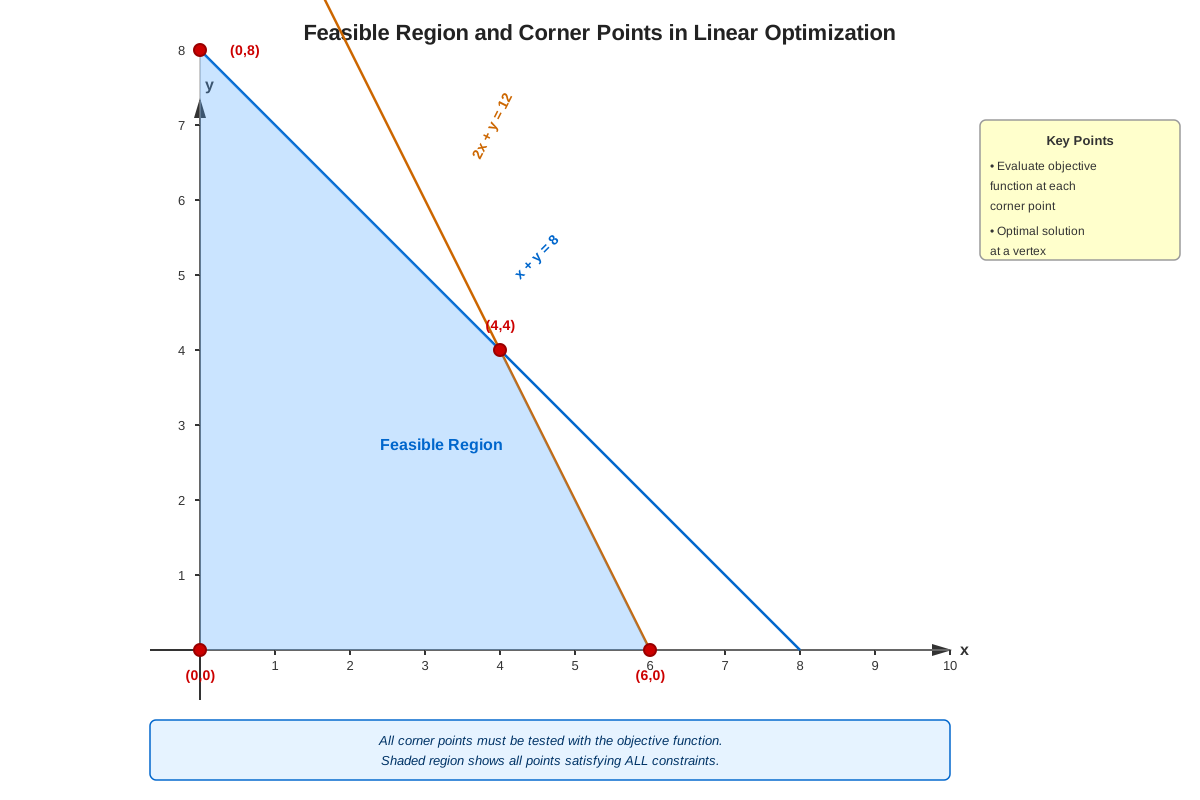
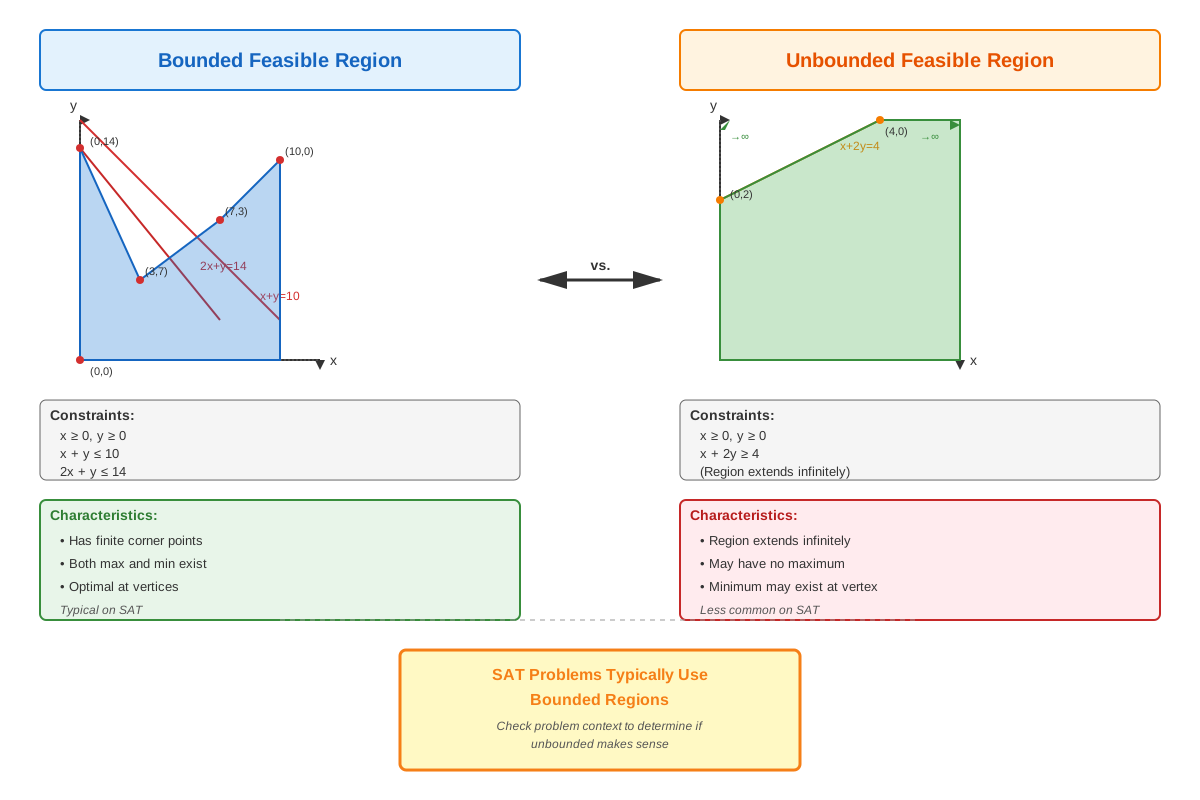
The feasible region or solution set consists of all points (combinations of variable values) that satisfy every constraint simultaneously. In two-variable problems, this region can be visualized on a coordinate plane as the intersection of all constraint regions. The feasible region may be bounded (enclosed on all sides) or unbounded (extending infinitely in one or more directions). For SAT problems, bounded regions are more common and typically form polygonal shapes.
Setting Up Optimization Problems
The first critical skill is translating verbal descriptions into mathematical expressions. This process follows a systematic approach:
- Identify the decision variables: Determine what quantities can vary and assign them variable names (typically x and y for two-variable problems)
- Write the objective function: Express the quantity to optimize as an equation in terms of the decision variables
- List all constraints: Convert each limitation or requirement into an inequality
- Include non-negativity constraints: Unless otherwise stated, real-world quantities like production amounts, time, or money cannot be negative, so add x ≥ 0 and y ≥ 0
For example, if a problem states "A bakery makes cookies and brownies, earning $3 per cookie and $4 per brownie, with at most 100 total items and at least twice as many cookies as brownies," the setup would be:
- Variables: x = number of cookies, y = number of brownies
- Objective: Maximize profit P = 3x + 4y
- Constraints: x + y ≤ 100, x ≥ 2y, x ≥ 0, y ≥ 0
Finding Optimal Solutions
For linear optimization problems with linear constraints (the type appearing on the SAT), a fundamental theorem states that if an optimal solution exists, it occurs at a vertex (corner point) of the feasible region. This principle dramatically simplifies the solution process: rather than testing infinitely many points in the feasible region, students need only evaluate the objective function at the finite number of corner points.
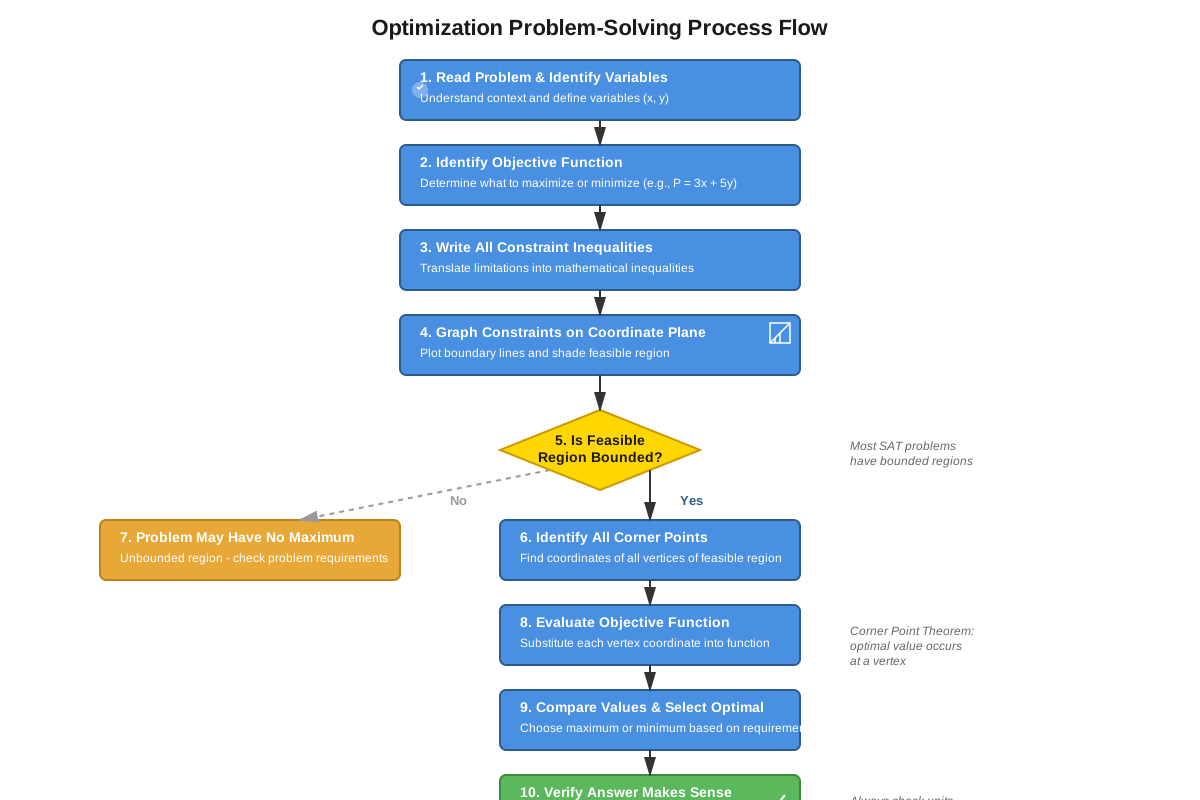
The solution process follows these steps:
- Graph all constraint inequalities on the same coordinate plane
- Identify the feasible region where all constraints overlap
- Find the coordinates of all vertices (corner points) of the feasible region by solving systems of equations where constraint boundaries intersect
- Evaluate the objective function at each vertex
- Compare values to determine which vertex gives the maximum or minimum value
Types of Constraints
SAT optimization problems feature several common constraint patterns:
| Constraint Type | Example | Interpretation |
|---|---|---|
| Resource limit | x + y ≤ 100 | Total of both quantities cannot exceed 100 |
| Minimum requirement | x ≥ 20 | Must have at least 20 of item x |
| Ratio constraint | x ≥ 2y | Quantity x must be at least twice quantity y |
| Budget constraint | 5x + 3y ≤ 200 | Total cost cannot exceed $200 |
| Non-negativity | x ≥ 0, y ≥ 0 | Quantities cannot be negative |
| Exact requirement | x + y = 50 | Total must equal exactly 50 (equality constraint) |
Special Cases and Considerations
Some optimization problems have no solution if the constraints are contradictory (the feasible region is empty). For example, requiring x + y ≤ 10 and x + y ≥ 20 simultaneously creates an impossible situation. Other problems have unbounded solutions where the objective function can increase or decrease without limit. On the SAT, such problems typically ask students to recognize that no maximum exists or to identify why constraints are insufficient.
When constraints include equality conditions (like x + y = 50), these represent lines rather than regions, and the feasible region becomes one-dimensional. The optimization then reduces to finding the maximum or minimum along that line segment, which still occurs at endpoints (vertices where the equality constraint intersects other constraint boundaries).
Graphical Interpretation
Visualizing optimization problems graphically provides powerful insights. Each inequality constraint divides the plane into two half-planes; the feasible region is where all appropriate half-planes intersect. The boundary lines of constraints are found by temporarily replacing the inequality symbol with an equals sign. The direction of shading (which side of the boundary line satisfies the inequality) can be determined by testing a point (often the origin if it's not on the boundary line).
The objective function can be visualized as a family of parallel lines (for a given objective function value, the equation represents a line). As the objective function value changes, these lines shift parallel to themselves. The optimal solution occurs where an objective function line last touches the feasible region while moving in the direction of improvement (upward for maximization, downward for minimization).
Concept Relationships
The core concepts within optimization with inequalities form a logical progression: problem setup (identifying variables, objective, and constraints) → mathematical modeling (writing inequalities and objective function) → graphical representation (plotting feasible region) → vertex identification (finding corner points) → evaluation and comparison (testing objective function at vertices) → optimal solution (selecting maximum or minimum value).
This topic directly builds on linear inequalities, extending single-inequality problems to systems of multiple constraints. It connects to systems of linear equations through the process of finding vertex coordinates by solving pairs of boundary equations simultaneously. The graphical aspects rely on coordinate plane skills including plotting lines, understanding slope and intercepts, and interpreting regions.
Optimization with inequalities also relates forward to more advanced topics: quadratic optimization (where objective functions or constraints involve squared terms), function analysis (finding maxima and minima using calculus concepts), and data analysis (interpreting optimization results in context). The problem-solving framework developed here—defining variables, setting up relationships, and systematically testing possibilities—transfers to numerous other SAT math topics including systems of equations, function problems, and complex word problems.
High-Yield Facts
⭐ The optimal solution to a linear optimization problem with linear constraints always occurs at a vertex (corner point) of the feasible region
⭐ To find the maximum or minimum value, evaluate the objective function at every vertex and compare the results
⭐ The feasible region is the intersection of all constraint regions—every point in this region satisfies all constraints simultaneously
⭐ Non-negativity constraints (x ≥ 0, y ≥ 0) are implied in real-world problems involving quantities that cannot be negative
⭐ When graphing an inequality like ax + by ≤ c, first graph the boundary line ax + by = c, then shade the appropriate side
- Vertices of the feasible region are found by solving systems of equations formed by pairs of constraint boundaries
- A bounded feasible region (enclosed on all sides) guarantees that both maximum and minimum values exist
- An unbounded feasible region may have no maximum value (if the objective function can increase without limit)
- If constraints are contradictory, the feasible region is empty and no solution exists
- The objective function value increases in one direction and decreases in the opposite direction across its family of parallel lines
- Constraint boundaries that don't intersect the feasible region don't affect the optimal solution (they're non-binding constraints)
- When two vertices give the same optimal value, all points on the edge connecting them are also optimal solutions
Quick check — test yourself on Optimization with inequalities so far.
Try Flashcards →Common Misconceptions
Misconception: The optimal solution must satisfy all constraints with equality (using all available resources).
Correction: The optimal solution must satisfy all constraints (meeting the inequality conditions), but some constraints may not be "tight" at the optimum. For example, if a constraint is x + y ≤ 100 and the optimal solution is (30, 40), the constraint is satisfied but not with equality (70 < 100).
Misconception: Testing one or two points in the feasible region is sufficient to find the optimal solution.
Correction: The optimal solution for linear problems always occurs at a vertex, so all vertices must be tested. Interior points of the feasible region will never give optimal values for linear objective functions.
Misconception: When graphing y ≤ mx + b, always shade below the line.
Correction: The direction of shading depends on the inequality symbol and the form of the inequality. For y ≤ mx + b, shade below; for y ≥ mx + b, shade above. For inequalities in standard form like ax + by ≤ c, test a point to determine the correct side.
Misconception: Maximizing profit means maximizing both products equally.
Correction: Optimization finds the best combination of variables, which often means producing different amounts of different items. The optimal mix depends on the relative profitability (coefficients in the objective function) and the constraints.
Misconception: If a problem asks for maximum profit and the answer is negative, there must be an error.
Correction: In some scenarios, all feasible solutions result in losses (negative profit). The "maximum" profit is then the smallest loss. However, SAT problems typically avoid this confusing situation.
Misconception: More constraints always make the feasible region smaller.
Correction: While additional constraints typically reduce the feasible region, a new constraint that's already satisfied by the existing feasible region (a redundant constraint) doesn't change the region at all.
Worked Examples
Example 1: Production Optimization
Problem: A company produces two types of widgets: standard and deluxe. Each standard widget requires 2 hours of labor and earns $15 profit. Each deluxe widget requires 3 hours of labor and earns $25 profit. The company has at most 120 hours of labor available per week and must produce at least 10 standard widgets to meet a contract. If the company produces x standard widgets and y deluxe widgets, what is the maximum weekly profit?
Solution:
Step 1: Set up the problem
- Variables: x = number of standard widgets, y = number of deluxe widgets
- Objective function: Maximize P = 15x + 25y
- Constraints:
- Labor constraint: 2x + 3y ≤ 120 (total labor hours)
- Contract requirement: x ≥ 10 (minimum standard widgets)
- Non-negativity: x ≥ 0, y ≥ 0
Step 2: Find the vertices of the feasible region
The constraint boundaries are:
- 2x + 3y = 120
- x = 10
- y = 0
Finding intersection points:
- Intersection of x = 10 and y = 0: (10, 0)
- Intersection of x = 10 and 2x + 3y = 120:
- 2(10) + 3y = 120
- 20 + 3y = 120
- 3y = 100
- y = 100/3 ≈ 33.33
- Point: (10, 33.33)
- Intersection of y = 0 and 2x + 3y = 120:
- 2x + 3(0) = 120
- x = 60
- Point: (60, 0)
Step 3: Evaluate the objective function at each vertex
- At (10, 0): P = 15(10) + 25(0) = $150
- At (10, 33.33): P = 15(10) + 25(33.33) = 150 + 833.25 = $983.25
- At (60, 0): P = 15(60) + 25(0) = $900
Step 4: Identify the maximum
The maximum profit is $983.25, achieved by producing 10 standard widgets and approximately 33.33 deluxe widgets. (In practice, the company would produce 33 deluxe widgets for a profit of $975, since partial widgets aren't possible, but SAT problems typically use scenarios where fractional answers make sense or ask for the theoretical maximum.)
This problem demonstrates the key learning objectives: identifying the optimization structure, setting up constraints from verbal descriptions, and systematically finding the optimal solution.
Example 2: Budget Allocation
Problem: A student has $200 to spend on SAT prep materials. Practice books cost $20 each and provide 50 practice questions. Online modules cost $25 each and provide 75 practice questions. The student wants at least 300 practice questions total and wants to maximize the number of items purchased. How many of each type should the student buy?
Solution:
Step 1: Set up the problem
- Variables: x = number of practice books, y = number of online modules
- Objective function: Maximize N = x + y (total number of items)
- Constraints:
- Budget: 20x + 25y ≤ 200
- Question requirement: 50x + 75y ≥ 300
- Non-negativity: x ≥ 0, y ≥ 0
Step 2: Find vertices
Boundary equations:
- 20x + 25y = 200 → 4x + 5y = 40 (simplified)
- 50x + 75y = 300 → 2x + 3y = 12 (simplified)
- x = 0, y = 0
Finding intersections:
- Intersection of 4x + 5y = 40 and 2x + 3y = 12:
- From second equation: x = (12 - 3y)/2
- Substitute: 4[(12 - 3y)/2] + 5y = 40
- 2(12 - 3y) + 5y = 40
- 24 - 6y + 5y = 40
- -y = 16
- y = -16 (not feasible—negative value)
Let's reconsider. Solving the system properly:
- Multiply second equation by 2: 4x + 6y = 24
- Subtract from first: 4x + 5y - (4x + 6y) = 40 - 24
- -y = 16, so y = -16 (impossible)
This indicates these two boundaries don't intersect in the feasible region. Let's find valid vertices:
- Intersection of 2x + 3y = 12 and x = 0: y = 4, giving (0, 4)
- Intersection of 2x + 3y = 12 and y = 0: x = 6, giving (6, 0)
- Intersection of 4x + 5y = 40 and x = 0: y = 8, giving (0, 8)
- Intersection of 4x + 5y = 40 and y = 0: x = 10, giving (10, 0)
We need points that satisfy BOTH constraints. Testing:
- (0, 4): Budget: 20(0) + 25(4) = 100 ≤ 200 ✓; Questions: 50(0) + 75(4) = 300 ≥ 300 ✓
- (6, 0): Budget: 20(6) + 25(0) = 120 ≤ 200 ✓; Questions: 50(6) + 75(0) = 300 ≥ 300 ✓
- (0, 8): Budget: 20(0) + 25(8) = 200 ≤ 200 ✓; Questions: 50(0) + 75(8) = 600 ≥ 300 ✓
Step 3: Evaluate objective function
- At (0, 4): N = 0 + 4 = 4 items
- At (6, 0): N = 6 + 0 = 6 items
- At (0, 8): N = 0 + 8 = 8 items
Answer: The student should buy 0 practice books and 8 online modules to maximize the number of items (8 total) while meeting all requirements.
Exam Strategy
When approaching SAT optimization problems, begin by carefully reading the entire problem to identify what quantity needs to be maximized or minimized—this becomes your objective function. Look for phrases like "greatest possible," "maximum profit," "minimize cost," or "least amount." Circle or underline this target quantity.
Next, identify all constraints by looking for limiting phrases: "at most," "no more than," "at least," "minimum," "cannot exceed," "must have," or "requires." Create a list of these constraints before writing any mathematics. Pay special attention to implicit constraints—real-world quantities that cannot be negative even if the problem doesn't explicitly state this.
Trigger words and phrases to watch for:
- "Maximize" or "minimize" → signals optimization problem
- "Subject to" or "given that" → introduces constraints
- "At least" → translates to ≥
- "At most" or "no more than" → translates to ≤
- "Exactly" → translates to = (equality constraint)
- "Per unit" or "each" → indicates coefficients in objective function or constraints
For process of elimination on multiple-choice questions, test extreme cases. If a problem asks which inequality system models a situation, try boundary values (like zero or maximum values) and see which system gives sensible results. Eliminate options that allow impossible situations (like negative quantities where they don't make sense) or that don't capture all stated requirements.
Time allocation: Optimization problems typically require 2-3 minutes. Spend 30-45 seconds setting up the problem (identifying variables, objective, and constraints), 60-90 seconds finding vertices or testing values, and 30-45 seconds evaluating and selecting the answer. If a problem requires extensive graphing and you're running short on time, look for answer choices that can be eliminated through logical reasoning or by testing just one or two strategic points.
For grid-in optimization questions, double-check that your answer makes sense in context. If maximizing profit, the answer should be positive and reasonable given the constraints. If finding an optimal quantity, verify it satisfies all constraints by substituting back into each inequality.
Memory Techniques
VOC-FEV mnemonic for the optimization process:
- Variables: Define what can change
- Objective: Write what to maximize/minimize
- Constraints: List all limitations
- Feasible region: Identify valid solutions
- Evaluate: Test objective at vertices
- Verify: Check answer makes sense
"Corners Count" - Remember that optimal solutions occur at corner points (vertices) of the feasible region. Visualize a diamond shape (feasible region) with a ruler (objective function line) sliding across it—the last point touched before leaving the diamond is a corner.
"At least means greater, at most means less" - For translating constraint language:
- "At least" → ≥ (greater than or equal)
- "At most" → ≤ (less than or equal)
SHADE for graphing inequalities:
- Solve for y (if possible)
- Hatch the boundary line (solid for ≤ or ≥, dashed for < or >)
- Assess a test point
- Determine which side satisfies the inequality
- Extend shading across that region
"Profit = Revenue - Cost" - When setting up business optimization problems, remember this fundamental relationship. Revenue comes from selling (price × quantity), and costs come from production (cost per unit × quantity).
Summary
Optimization with inequalities combines algebraic modeling, graphical reasoning, and systematic problem-solving to find maximum or minimum values subject to constraints. The fundamental approach involves defining decision variables, writing an objective function to optimize, expressing all constraints as inequalities, identifying the feasible region where all constraints are satisfied, and evaluating the objective function at vertex points to find the optimal solution. This topic appears regularly on the SAT in real-world contexts like business decisions, resource allocation, and budgeting problems. Success requires translating verbal descriptions into mathematical expressions, understanding that optimal solutions occur at vertices of the feasible region, and systematically testing all corner points. The skills developed through optimization problems—careful problem setup, constraint identification, and methodical evaluation—transfer broadly to other SAT math topics and represent the type of applied mathematical reasoning that colleges value. Mastery of this topic provides a significant advantage on test day, as these problems often carry multiple points and integrate several mathematical concepts simultaneously.
Key Takeaways
- Optimization problems have three components: decision variables, an objective function to maximize or minimize, and constraint inequalities that limit possible solutions
- The feasible region contains all points satisfying every constraint simultaneously; for linear problems, optimal solutions always occur at vertices of this region
- Translate "at least" to ≥ and "at most" to ≤; include non-negativity constraints (x ≥ 0, y ≥ 0) for real-world quantities
- To solve: set up the problem, find all vertex coordinates by solving systems of boundary equations, evaluate the objective function at each vertex, and compare to find the maximum or minimum
- Common SAT contexts include profit maximization, cost minimization, budget allocation, and production planning with resource constraints
- Test answer choices by checking extreme cases and verifying that solutions satisfy all constraints
- Graphical visualization helps understand the problem structure, but systematic vertex evaluation is essential for finding the exact optimal value
Related Topics
Systems of Linear Inequalities: Understanding how to graph and interpret multiple inequalities simultaneously provides the foundation for identifying feasible regions in optimization problems. Mastering this topic enables progression to more complex constraint systems.
Linear Programming: The formal mathematical framework for optimization with linear objective functions and linear constraints. This advanced topic extends SAT-level optimization to problems with more variables and constraints, commonly used in operations research and business analytics.
Quadratic Optimization: Problems involving maximizing or minimizing quadratic expressions (like area or revenue functions with squared terms) subject to linear or quadratic constraints. This builds on linear optimization by introducing curved boundaries and interior optimal points.
Function Analysis and Extrema: Finding maximum and minimum values of functions using algebraic and calculus techniques. Optimization with inequalities provides intuition for constrained optimization that connects to calculus concepts of critical points and boundary analysis.
Modeling with Systems of Equations: Translating complex real-world scenarios into mathematical systems. The problem-setup skills from optimization transfer directly to modeling situations with exact relationships rather than inequality constraints.
Practice CTA
Now that you've mastered the concepts of optimization with inequalities, it's time to solidify your understanding through practice! Attempt the practice questions to apply these strategies to SAT-style problems, and use the flashcards to reinforce key definitions and procedures. Remember, optimization problems reward systematic thinking and careful setup—skills that improve dramatically with deliberate practice. Each problem you solve strengthens your ability to recognize patterns, translate verbal descriptions into mathematics, and efficiently find optimal solutions. You've built a powerful problem-solving framework that will serve you well across multiple SAT math topics. Keep practicing, and watch your confidence and accuracy soar!
Sign up free to keep reading
Create a free AnvayaPrep account to finish this SAT guide on Optimization with inequalities — plus flashcards and practice questions.