Overview
Factoring by grouping is a powerful algebraic technique that allows students to factor polynomials with four or more terms by strategically pairing terms and extracting common factors. This method is particularly valuable when dealing with expressions that don't fit the standard patterns of difference of squares, perfect square trinomials, or simple trinomial factoring. On the SAT math section, factoring by grouping appears regularly in both multiple-choice and grid-in questions, often embedded within larger algebraic problems involving polynomial equations, rational expressions, or systems of equations.
Understanding sat factoring by grouping is essential because it serves as a bridge between basic factoring techniques and more complex algebraic manipulations. The SAT frequently tests this skill in questions worth 1-2 points each, and mastery of this technique can significantly reduce solving time on problems that might otherwise require lengthy algebraic expansion or guess-and-check methods. Students who can quickly recognize when to apply factoring by grouping gain a substantial advantage, particularly on questions involving polynomial division, finding zeros of functions, or simplifying complex rational expressions.
This topic connects directly to fundamental concepts in polynomial algebra, including the distributive property, greatest common factor (GCF) extraction, and the zero product property. Factoring by grouping also serves as foundational knowledge for more advanced topics such as polynomial long division, partial fraction decomposition, and solving higher-degree polynomial equations. The technique demonstrates the importance of pattern recognition and strategic thinking in mathematics—skills that extend beyond this specific topic to benefit overall problem-solving ability on the SAT.
Learning Objectives
- [ ] Identify key features of factoring by grouping and recognize when this method is appropriate
- [ ] Explain how factoring by grouping appears on the SAT and in what contexts
- [ ] Apply factoring by grouping to answer SAT-style questions accurately and efficiently
- [ ] Determine the optimal grouping strategy for polynomials with four or more terms
- [ ] Verify factored expressions by expanding and comparing to the original polynomial
- [ ] Combine factoring by grouping with other factoring techniques to solve complex problems
- [ ] Recognize and correct common errors in the grouping and factoring process
Prerequisites
- Greatest Common Factor (GCF) extraction: Essential for identifying common factors within each group of terms
- Distributive property and factoring basics: Required to factor out common expressions and reverse the distribution process
- Polynomial terminology: Understanding terms, coefficients, and degree helps identify grouping opportunities
- Basic algebraic manipulation: Necessary for rearranging terms and simplifying expressions throughout the factoring process
- Zero product property: Needed to solve equations after successfully factoring by grouping
Why This Topic Matters
Factoring by grouping represents a critical skill in the SAT math toolkit because it enables students to solve problems that would otherwise be computationally intensive or seemingly impossible with basic techniques. In real-world applications, this method appears in engineering calculations, computer science algorithms, physics formulas, and economic modeling where complex polynomial relationships must be simplified or solved. The ability to recognize patterns and strategically reorganize information—the core skills developed through factoring by grouping—transfers to numerous professional fields requiring analytical thinking.
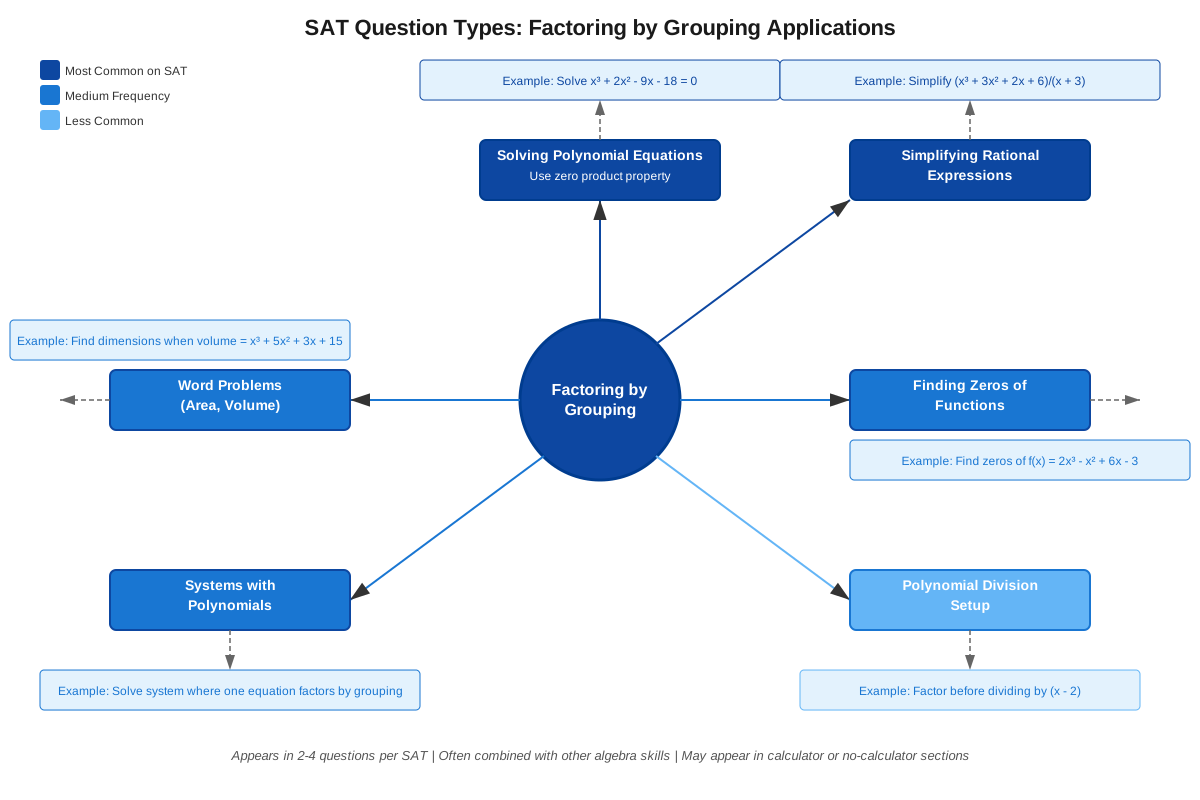
On the SAT, factoring by grouping appears in approximately 2-4 questions per test, representing roughly 3-7% of the total math score. These questions typically appear in the calculator and no-calculator sections, with difficulty ratings ranging from medium to hard. The College Board frequently embeds factoring by grouping within multi-step problems where students must first recognize that factoring is necessary, then apply the technique correctly, and finally use the factored form to answer the actual question being asked.
Common SAT question formats involving this topic include: solving polynomial equations where factoring by grouping reveals the zeros; simplifying rational expressions where both numerator and denominator require factoring; finding equivalent algebraic expressions; and word problems where polynomial relationships model real-world scenarios. The technique also appears in questions testing function behavior, where factoring reveals important features like x-intercepts or asymptotes. Students who master factoring by grouping can often solve these questions in 30-60 seconds, while those lacking this skill may spend several minutes or abandon the question entirely.
Core Concepts
The Fundamental Principle of Factoring by Grouping
Factoring by grouping relies on the strategic application of the distributive property in reverse. The core idea involves dividing a polynomial with four or more terms into smaller groups (typically pairs), factoring out the GCF from each group, and then recognizing a common binomial factor that can be extracted from the resulting expression. This method transforms a seemingly unfactorable polynomial into a product of two or more factors.
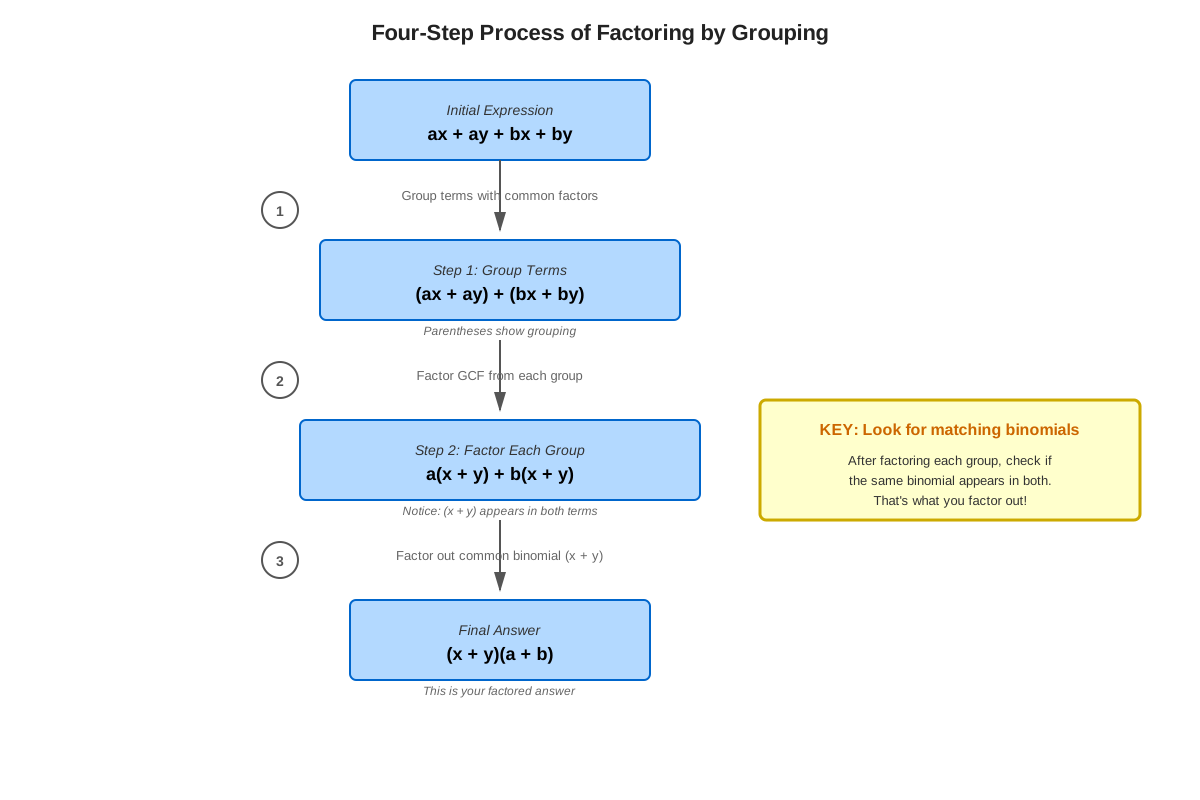
The general process follows this pattern: given a four-term polynomial like ax + ay + bx + by, group the terms as (ax + ay) + (bx + by), factor each group to get a(x + y) + b(x + y), and then recognize that (x + y) is a common factor, yielding the final factored form (x + y)(a + b). This technique works because it leverages the associative and commutative properties of addition to reorganize the polynomial into a form where common factors become visible.
Step-by-Step Factoring Process
The systematic approach to factoring by grouping involves these numbered steps:
- Verify the polynomial has four or more terms: Factoring by grouping is specifically designed for polynomials that don't fit simpler factoring patterns
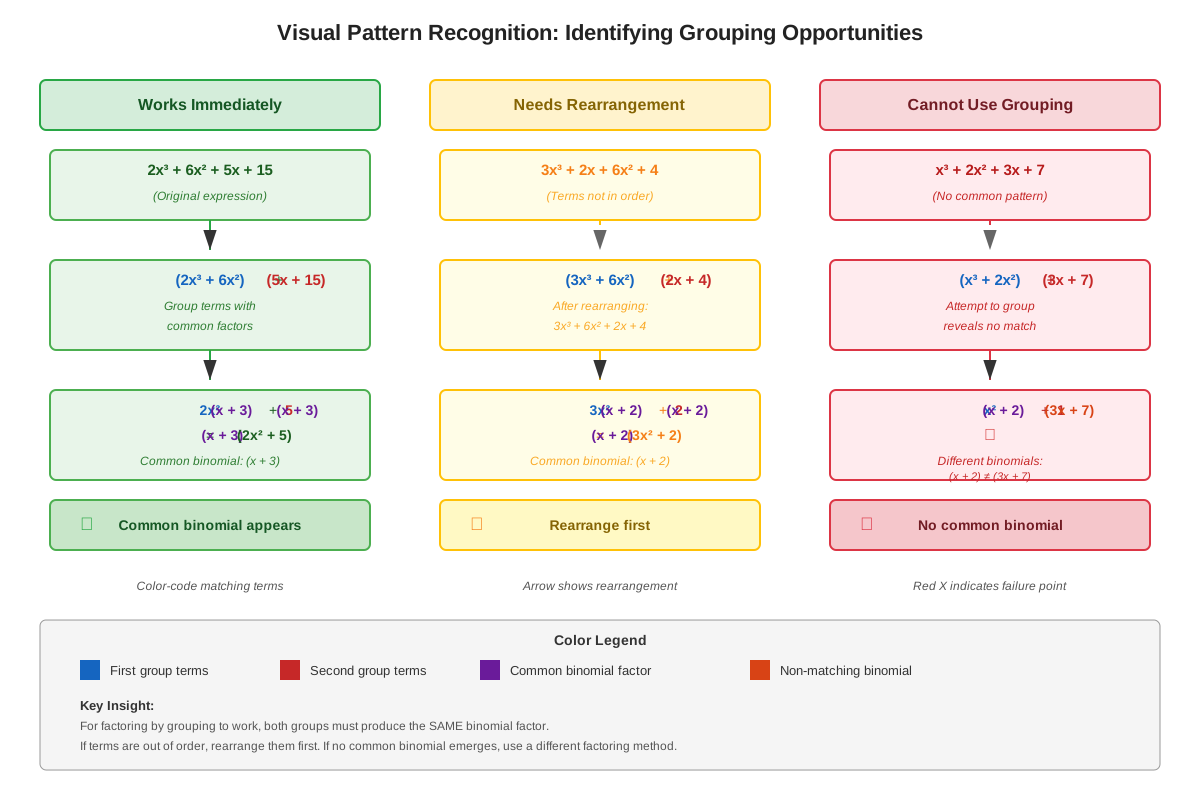
- Arrange terms strategically: Sometimes rearranging terms creates better grouping opportunities
- Group terms in pairs: Typically group the first two terms and the last two terms, though other groupings may work
- Factor out the GCF from each group: Extract the greatest common factor from each pair, including negative factors when beneficial
- Identify the common binomial factor: After factoring each group, a common binomial expression should appear
- Factor out the common binomial: Extract the common binomial factor, leaving the remaining factors in parentheses
- Verify by expanding: Multiply the factors to confirm they produce the original polynomial
Recognizing When to Apply Factoring by Grouping
Several indicators signal that factoring by grouping is the appropriate technique:
- The polynomial contains exactly four terms with no obvious common factor across all terms
- The polynomial has more than four terms but can be rearranged into groups with common factors
- Standard trinomial factoring methods don't apply due to the number of terms
- The coefficients and variables suggest natural pairings (e.g., two terms share one variable, two terms share another)
- The polynomial appears in a context requiring factorization (solving equations, simplifying expressions)
Handling Negative Signs and Coefficient Challenges
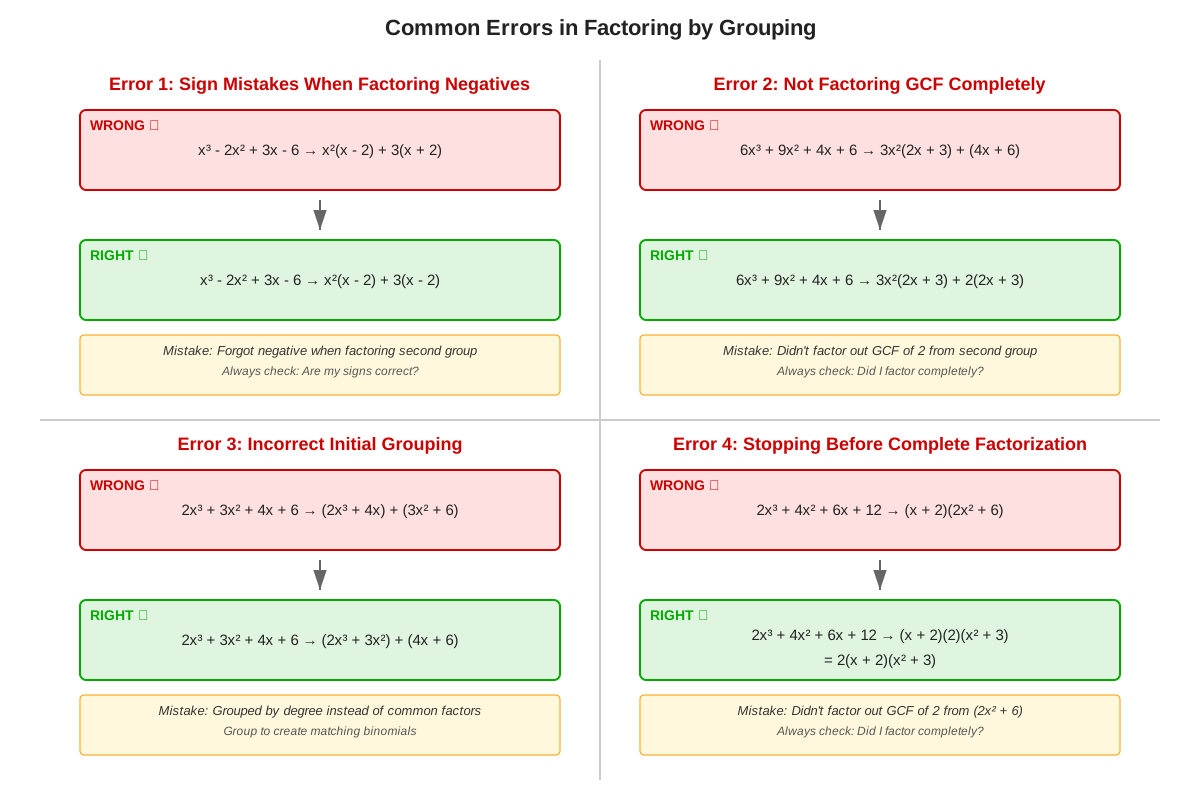
One of the most challenging aspects of factoring by grouping involves managing negative coefficients. When the second group's GCF is negative, factoring out the negative sign often reveals the common binomial factor. For example, in the expression x³ - 2x² + 3x - 6, grouping gives (x³ - 2x²) + (3x - 6). Factoring yields x²(x - 2) + 3(x - 2), where the common factor (x - 2) is now visible.
Sometimes the initial grouping doesn't reveal a common binomial factor. In such cases, try:
- Rearranging the terms in a different order
- Factoring out a negative from the second group
- Checking for arithmetic errors in GCF extraction
- Considering whether the polynomial is prime (cannot be factored)
Advanced Applications and Variations
Beyond basic four-term polynomials, factoring by grouping extends to more complex scenarios:
Six-term polynomials: Group into three pairs or two groups of three terms, depending on which reveals common factors
Polynomials requiring preliminary factoring: Sometimes extracting a common factor from all terms first makes grouping more effective
Nested factoring: After factoring by grouping, the resulting factors may themselves be factorable using other techniques
Reverse engineering: Some SAT questions provide factored forms and ask students to identify the original polynomial, requiring understanding of how grouping works in both directions
Connection to Solving Equations
Factoring by grouping becomes particularly powerful when solving polynomial equations. After factoring an expression completely, the zero product property allows setting each factor equal to zero and solving for the variable. For example, if x³ + 2x² - 9x - 18 = 0 factors to (x + 2)(x² - 9) = 0, which further factors to (x + 2)(x + 3)(x - 3) = 0, yielding solutions x = -2, x = -3, and x = 3.
Concept Relationships
Factoring by grouping sits at the intersection of several fundamental algebraic concepts. The technique directly builds upon GCF extraction, as each group requires identifying and factoring out common factors. This connection means that students weak in finding GCFs will struggle with grouping, while those proficient in GCF work will find grouping more intuitive.
The distributive property serves as both the foundation and the reverse operation for factoring by grouping. Understanding that a(b + c) = ab + ac allows students to recognize that ab + ac can be rewritten as a(b + c). This bidirectional thinking—expanding and factoring—is essential for both executing the technique and verifying results.
Factoring by grouping connects forward to polynomial division and rational expression simplification. Many complex fractions require factoring both numerator and denominator, often using grouping, before canceling common factors. Similarly, polynomial long division problems sometimes become simpler when the dividend or divisor can be factored first.
The relationship map flows as follows: Basic factoring skills → GCF extraction → Factoring by grouping → Complete factorization → Solving polynomial equations → Analyzing polynomial functions. Each step builds on the previous, with factoring by grouping serving as the crucial middle technique that handles cases too complex for basic methods but not requiring advanced techniques.
Within the topic itself, concepts connect sequentially: recognizing appropriate polynomials → strategic grouping → extracting GCFs → identifying common binomials → complete factorization → verification. Each step depends on successful completion of the previous step, making the process both systematic and diagnostic—errors at any stage indicate where understanding needs reinforcement.
Quick check — test yourself on Factoring by grouping so far.
Try Flashcards →High-Yield Facts
⭐ Factoring by grouping works best on polynomials with exactly four terms where no single GCF exists across all terms
⭐ After factoring each group, the common binomial factor must be identical for the technique to work
⭐ Factoring out a negative from the second group often reveals the common binomial factor
⭐ The final factored form should always be verified by expanding back to the original polynomial
⭐ On the SAT, factoring by grouping most commonly appears in equations that need solving or expressions requiring simplification
- Rearranging terms before grouping can sometimes make the common factor more apparent
- If no common binomial appears after factoring each group, try different grouping combinations
- Polynomials with six terms may require grouping into three pairs or two groups of three
- The technique can be combined with other factoring methods like difference of squares or trinomial factoring
- Coefficient patterns like (a, b, ac, bc) strongly suggest factoring by grouping will work
- When solving equations, factoring by grouping often reveals multiple solutions through the zero product property
- The SAT rarely asks students to factor by grouping in isolation; it's usually embedded in larger problems
- Time spent verifying the factorization prevents costly errors on subsequent steps
Common Misconceptions
Misconception: All four-term polynomials can be factored by grouping → Correction: Some four-term polynomials are prime and cannot be factored using real numbers. If no common binomial factor emerges after trying different groupings, the polynomial may not be factorable by this method.
Misconception: The terms must always be grouped as (first two) and (last two) → Correction: While this is the most common grouping, sometimes pairing the first and third terms with the second and fourth terms, or other combinations, reveals the common factor. Strategic rearrangement is often necessary.
Misconception: The common factor must be a binomial → Correction: While binomials are most common, the common factor can sometimes be a monomial or even a trinomial in more complex expressions. The key is identifying whatever expression appears in both groups after initial factoring.
Misconception: If the signs don't match, factoring by grouping won't work → Correction: Factoring out a negative from one or more groups often makes the common factor visible. The expression x² - 3x - 2x + 6 becomes x(x - 3) - 2(x - 3) when a negative is factored from the second group.
Misconception: Factoring by grouping is complete once the common binomial is factored out → Correction: After factoring by grouping, each resulting factor should be examined to see if it can be factored further using other techniques. Complete factorization may require multiple methods.
Misconception: The GCF of each group must include variables → Correction: The GCF can be purely numerical. In 6x + 9 + 2xy + 3y, the first group's GCF is 3 and the second group's GCF is y, yielding 3(2x + 3) + y(2x + 3).
Misconception: Factoring by grouping only works with addition → Correction: The technique works equally well with subtraction, though careful attention to signs is crucial. Subtraction can be rewritten as addition of a negative, making the grouping process consistent.
Worked Examples
Example 1: Standard Four-Term Polynomial
Problem: Factor completely: 2x³ + 6x² + 5x + 15
Solution:
Step 1: Identify that this is a four-term polynomial with no common factor across all terms, making factoring by grouping appropriate.
Step 2: Group the first two terms and the last two terms:
(2x³ + 6x²) + (5x + 15)
Step 3: Factor out the GCF from each group:
- First group: GCF is 2x², so 2x³ + 6x² = 2x²(x + 3)
- Second group: GCF is 5, so 5x + 15 = 5(x + 3)
Step 4: Write the expression with factored groups:
2x²(x + 3) + 5(x + 3)
Step 5: Notice that (x + 3) is the common binomial factor. Factor it out:
(x + 3)(2x² + 5)
Step 6: Check if either factor can be factored further. The expression 2x² + 5 cannot be factored using real numbers (it's a sum of squares with no common factor).
Step 7: Verify by expanding: (x + 3)(2x² + 5) = 2x³ + 5x + 6x² + 15 = 2x³ + 6x² + 5x + 15 ✓
Answer: (x + 3)(2x² + 5)
This example demonstrates the standard application of factoring by grouping and connects to the learning objective of applying the technique to SAT-style questions.
Example 2: Equation Solving with Negative Coefficients
Problem: Solve for x: x³ - 4x² - 9x + 36 = 0
Solution:
Step 1: Recognize this requires factoring by grouping to solve efficiently.
Step 2: Group the terms:
(x³ - 4x²) + (-9x + 36) = 0
Step 3: Factor each group:
- First group: x²(x - 4)
- Second group: Factor out -9 to reveal the common factor: -9(x - 4)
Step 4: Write with factored groups:
x²(x - 4) - 9(x - 4) = 0
Step 5: Factor out the common binomial (x - 4):
(x - 4)(x² - 9) = 0
Step 6: Recognize that x² - 9 is a difference of squares and factor further:
(x - 4)(x + 3)(x - 3) = 0
Step 7: Apply the zero product property:
- x - 4 = 0 → x = 4
- x + 3 = 0 → x = -3
- x - 3 = 0 → x = 3
Step 8: Verify by substituting one solution back into the original equation:
For x = 4: (4)³ - 4(4)² - 9(4) + 36 = 64 - 64 - 36 + 36 = 0 ✓
Answer: x = -3, 3, or 4
This example illustrates how factoring by grouping integrates with other factoring techniques and the zero product property to solve equations—a common SAT application that addresses multiple learning objectives.
Exam Strategy
When approaching SAT questions involving factoring by grouping, begin by quickly scanning the problem to determine whether factoring is actually required. Look for trigger phrases like "solve for x," "factor completely," "which expression is equivalent to," or "find the zeros." These indicate that factoring may be the intended solution path.
Time management is crucial: if a four-term polynomial appears and standard factoring methods don't immediately apply, factoring by grouping should be attempted within 30-45 seconds. If no common binomial emerges after one or two grouping attempts, consider whether the problem might be solved through alternative methods like substitution or using the answer choices.
Process-of-elimination strategies specific to this topic include:
- If answer choices are given in factored form, expand them mentally or on paper to see which matches the original expression
- Eliminate answer choices where the degree of the polynomial doesn't match the original
- Check the constant term: when factors are multiplied, their constant terms must multiply to give the original constant
- Verify the leading coefficient: the product of the leading coefficients in the factors must equal the original leading coefficient
Trigger words and phrases that signal factoring by grouping may be needed:
- "Factor completely" or "factor the expression"
- "Solve the equation" (when the equation is a polynomial set equal to zero)
- "Which of the following is equivalent to"
- "Find all values of x that satisfy"
- "Simplify the rational expression" (often requires factoring numerator and denominator)
Common SAT traps to avoid:
- Forgetting to factor completely—always check if factors can be factored further
- Sign errors when factoring out negatives from groups
- Stopping after factoring by grouping without applying the zero product property in equation-solving problems
- Not verifying the answer, leading to undetected errors that propagate through multi-step problems
Strategic approach sequence:
- Identify the problem type (factoring, solving, simplifying)
- Count terms and check for overall GCF first
- Group strategically and factor each group
- Extract common binomial factor
- Factor further if possible
- Apply to the specific question being asked
- Verify if time permits
Memory Techniques
The "GFCB" Mnemonic: Group terms, Factor each group, find Common Binomial—this acronym captures the essential steps of factoring by grouping in order.
The "Matching Parentheses" Visualization: Imagine the common binomial factor as a matching pair of parentheses that must appear in both groups. If the parentheses don't match exactly (same terms, same signs), the technique won't work. This mental image helps students verify they've factored correctly.
The "Negative Flip" Reminder: When stuck, remember "flip the sign, find the match"—factoring out a negative from the second group often reveals the common factor. Visualize flipping a coin to remember to try the negative.
The "Four-Square" Pattern: Draw a 2×2 grid mentally with the four terms in the corners. Terms in the same row get grouped together. This spatial organization helps prevent grouping errors.
The "Factor Family" Analogy: Think of the common binomial as the family name that both groups share. Just as siblings share a last name but have different first names, the groups share a common binomial but have different coefficients or terms factored out.
Acronym for Verification - "VIBE": Verify by expanding, Inspect for further factoring, Back-substitute if solving, Evaluate the answer. This ensures complete and accurate solutions.
Summary
Factoring by grouping is an essential algebraic technique for the SAT that enables students to factor polynomials with four or more terms by strategically pairing terms, extracting common factors from each group, and then factoring out a common binomial expression. The method requires systematic application of the distributive property in reverse, careful attention to signs (particularly when factoring out negatives), and verification through expansion. On the SAT, this technique appears in 2-4 questions per test, typically embedded within equation-solving problems, expression simplification tasks, or function analysis questions. Mastery requires recognizing when the technique applies, executing the grouping and factoring steps accurately, combining it with other factoring methods for complete factorization, and applying the results to solve the specific problem at hand. Success with factoring by grouping depends on strong foundational skills in GCF extraction and the distributive property, while also serving as a gateway to more advanced polynomial manipulation techniques essential for higher-level mathematics.
Key Takeaways
- Factoring by grouping is the primary method for factoring four-term polynomials that lack a common factor across all terms
- The technique requires grouping terms strategically, factoring each group's GCF, and extracting the common binomial factor
- Factoring out a negative from one group often reveals the common binomial when it's not immediately apparent
- Always verify factored expressions by expanding and check whether factors can be factored further
- On the SAT, factoring by grouping typically appears within larger problems requiring equation solving or expression simplification
- The method connects directly to the zero product property for solving polynomial equations
- Systematic application of the GFCB process (Group, Factor, Common Binomial) ensures consistent success
Related Topics
Polynomial Long Division: After mastering factoring by grouping, students can tackle polynomial division more effectively, as factoring often simplifies division problems or reveals factors that make division unnecessary.
Rational Expression Simplification: Factoring by grouping is frequently required to factor numerators and denominators of complex fractions before canceling common factors—a common SAT topic.
Solving Higher-Degree Polynomial Equations: This topic extends factoring by grouping to equations of degree four and higher, combining multiple factoring techniques to find all solutions.
Graphing Polynomial Functions: Understanding factored forms obtained through grouping helps identify x-intercepts, end behavior, and other key features of polynomial graphs.
Partial Fraction Decomposition: In advanced algebra and calculus, factoring by grouping serves as a preliminary step in breaking complex rational expressions into simpler components.
Practice CTA
Now that you've mastered the concepts, strategies, and techniques of factoring by grouping, it's time to solidify your understanding through practice. Attempt the practice questions designed specifically for this topic, focusing on applying the systematic GFCB approach and recognizing the various contexts in which factoring by grouping appears on the SAT. Use the flashcards to reinforce key facts and common patterns. Remember, consistent practice with immediate feedback is the most effective way to build the speed and accuracy needed for test day success. Each problem you solve strengthens your pattern recognition and deepens your mathematical intuition—skills that will serve you well beyond this single topic!
Sign up free to keep reading
Create a free AnvayaPrep account to finish this SAT guide on Factoring by grouping — plus flashcards and practice questions.