Overview
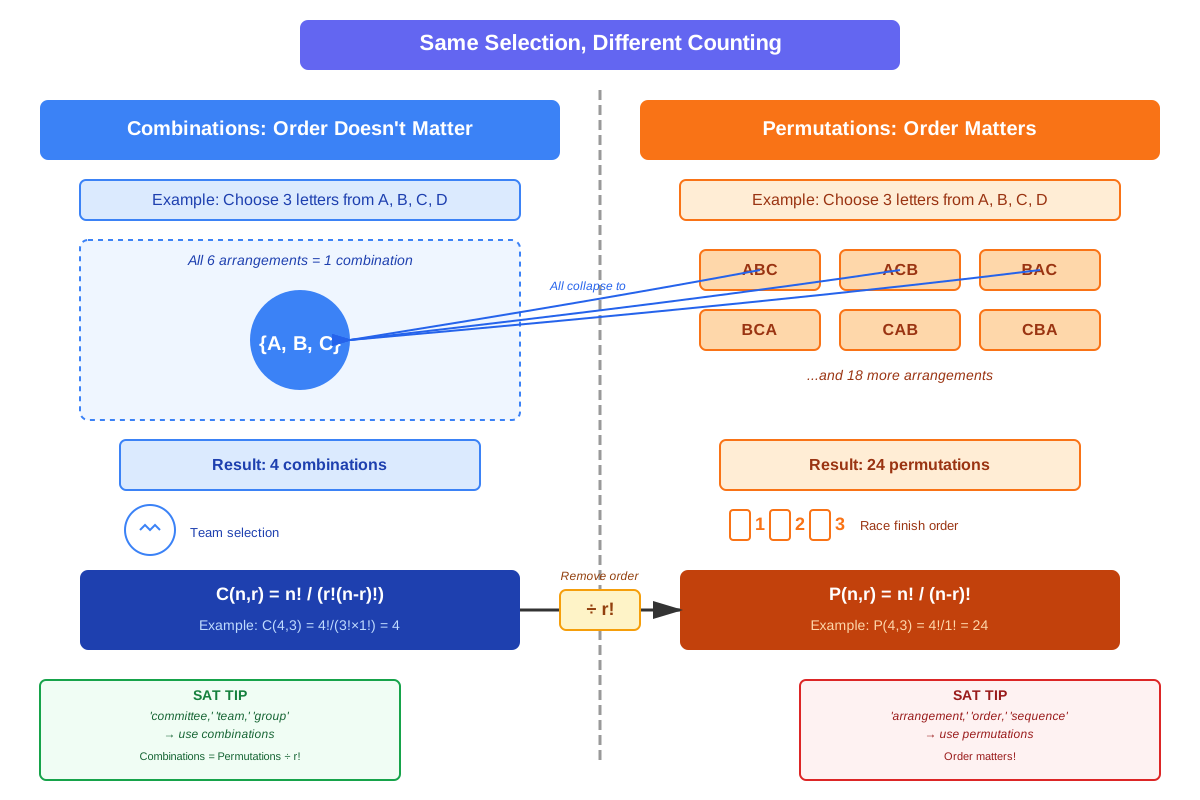
Combinations basics form a critical component of the probability and counting principles tested on the SAT Math section. At its core, combinations address the fundamental question: "In how many ways can we select a group of items when the order doesn't matter?" This concept differs from permutations, where order is significant, and understanding this distinction is essential for SAT success.
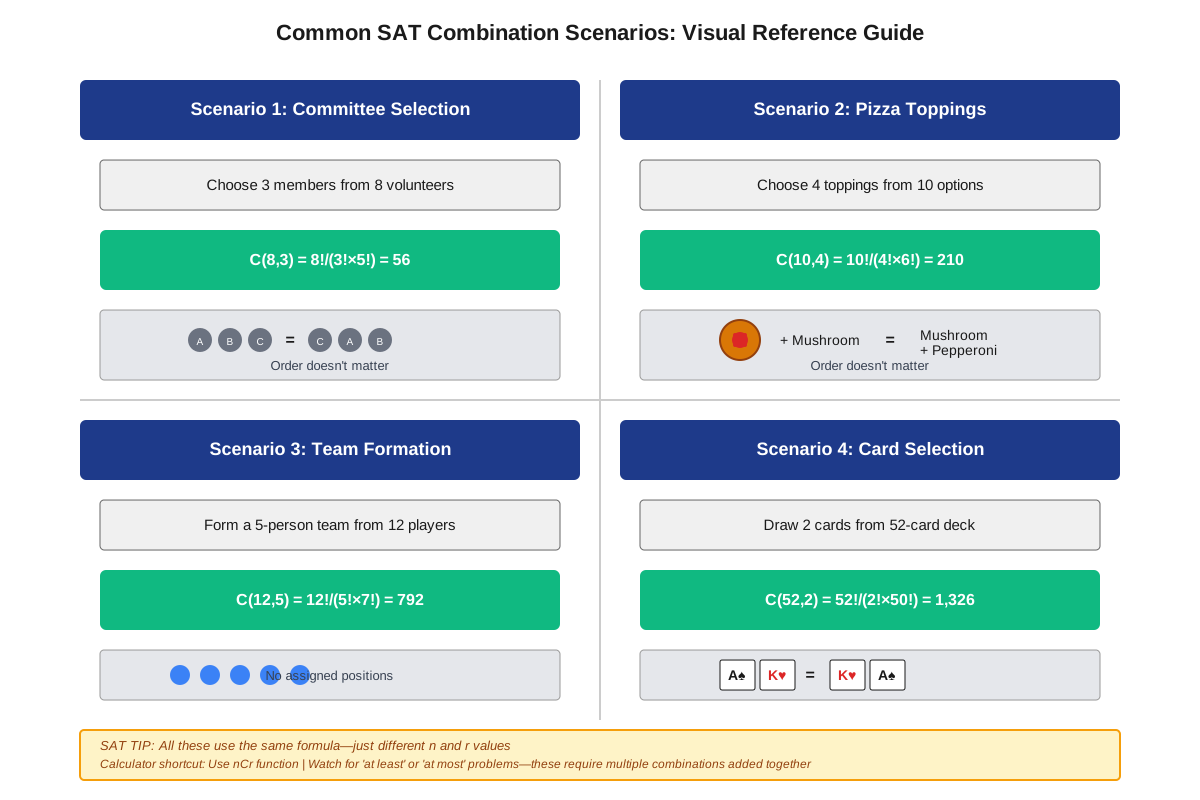
The SAT combinations basics questions typically appear 1-2 times per test, often embedded within word problems that require students to recognize when order is irrelevant. These problems might ask about selecting committee members from a group, choosing toppings for a pizza, or determining how many different teams can be formed. The math behind combinations relies on the combination formula, which systematically accounts for all possible selections while eliminating duplicate arrangements that represent the same group.
Mastering combinations is essential not only for direct combination questions but also for more complex probability problems where combinations serve as the foundation for calculating favorable outcomes. This topic connects directly to fundamental counting principles, factorial notation, and probability calculations—all high-yield areas on the SAT. Students who develop fluency with combinations gain a significant advantage in the Problem Solving and Data Analysis domain, where these concepts frequently intersect with real-world scenarios that the SAT favors.
Learning Objectives
- [ ] Identify key features of Combinations basics
- [ ] Explain how Combinations basics appears on the SAT
- [ ] Apply Combinations basics to answer SAT-style questions
- [ ] Distinguish between situations requiring combinations versus permutations
- [ ] Calculate combinations using both the formula and logical reasoning
- [ ] Solve multi-step problems that combine combinations with other probability concepts
- [ ] Recognize common SAT question patterns involving selection without replacement
Prerequisites
- Factorial notation (n!): Understanding that n! = n × (n-1) × (n-2) × ... × 1 is essential because the combination formula uses factorials in both numerator and denominator
- Basic multiplication principle: The fundamental counting principle provides the foundation for understanding why the combination formula works
- Fraction simplification: Combination calculations often require canceling common factors in complex fractions to arrive at simplified answers
- Basic probability concepts: Many combination problems appear within probability contexts where combinations count favorable or total outcomes
Why This Topic Matters
In real-world applications, combinations appear constantly in decision-making scenarios: forming project teams, selecting investment portfolios, choosing menu items, organizing tournament brackets, and conducting scientific experiments where sample selection matters. Understanding combinations enables students to quantify choices systematically rather than attempting exhaustive enumeration, which becomes impractical with larger numbers.
On the SAT, combination questions appear with moderate frequency—typically 1-2 questions per test—but carry significant weight because they often appear as medium-to-hard difficulty problems worth the same points as easier questions. According to College Board data, approximately 8-12% of SAT Math questions involve counting principles, with combinations representing a substantial portion of these. Students who master combinations can confidently tackle these high-value questions while others struggle or skip them entirely.
The SAT presents combinations in various formats: direct calculation problems ("How many ways can 3 students be chosen from 8?"), word problems requiring recognition of combination scenarios ("A committee of 4 must be formed from 10 volunteers"), and multi-step problems combining combinations with probability ("What is the probability that exactly 2 red marbles are selected when choosing 5 marbles from a bag?"). The test particularly favors scenarios involving selection of people for groups, choosing items from menus, and forming teams—contexts that feel natural and relatable to test-takers.
Core Concepts
The Fundamental Definition of Combinations
A combination is a selection of items from a larger set where the order of selection does not matter. This distinguishes combinations from permutations, where order is significant. When selecting 3 students from a group of 5 to form a study group, choosing Alice, Bob, and Carol produces the same study group regardless of the selection order—this is a combination problem.
The key insight is that combinations count unique groups, not unique arrangements. If we were assigning specific roles (president, vice president, secretary), order would matter and we'd use permutations instead. The SAT frequently tests whether students can recognize this distinction through careful reading of problem contexts.
The Combination Formula
The combination formula calculates the number of ways to choose r items from n total items:
C(n,r) = nCr = (n choose r) = n! / (r!(n-r)!)Where:
- n = total number of items available
- r = number of items being selected
- ! denotes factorial (n! = n × (n-1) × (n-2) × ... × 1)
This formula can also be written as C(n,r), nCr, or using binomial coefficient notation. Most scientific calculators have a built-in nCr function, which is permitted and encouraged on the SAT.
Why the Formula Works
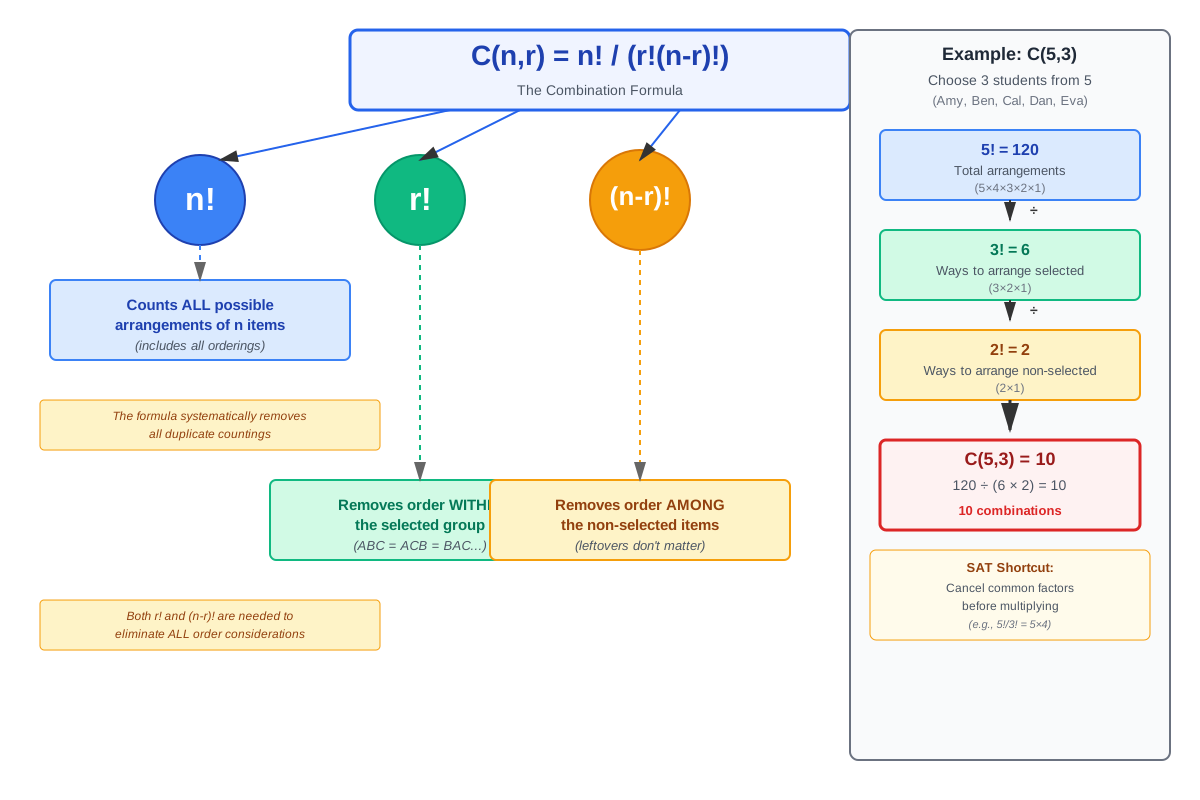
Understanding the logic behind the formula helps prevent errors and builds mathematical intuition. Consider selecting 3 items from 5 total items (A, B, C, D, E):
- Start with permutations: If order mattered, we'd have 5 × 4 × 3 = 60 different arrangements (5 choices for first position, 4 for second, 3 for third)
- Account for overcounting: Each unique group of 3 items appears multiple times in those 60 arrangements. Specifically, each group appears 3! = 6 times (the number of ways to arrange 3 items)
- Divide to eliminate duplicates: 60 ÷ 6 = 10 unique combinations
This reasoning translates directly to the formula: n!/(n-r)! gives us the permutation count, then dividing by r! removes the duplicate arrangements of each group.
Calculating Combinations Efficiently
For SAT purposes, three calculation methods prove useful:
Method 1: Direct Formula Application
C(8,3) = 8! / (3! × 5!) = (8 × 7 × 6 × 5!) / (3! × 5!) = (8 × 7 × 6) / (3 × 2 × 1) = 336/6 = 56Method 2: Calculator Function
Most scientific calculators have an nCr button. Enter 8, press nCr, enter 3, press equals to get 56.
Method 3: Simplified Calculation
Write out only the necessary factors:
C(8,3) = (8 × 7 × 6) / (3 × 2 × 1)Cancel common factors before multiplying: 8/2 = 4, 6/3 = 2, leaving 4 × 7 × 2 / 1 = 56
Important Properties of Combinations
Several mathematical properties help solve problems more efficiently:
| Property | Formula | Example |
|---|---|---|
| Symmetry | C(n,r) = C(n,n-r) | C(10,3) = C(10,7) = 120 |
| Boundary cases | C(n,0) = C(n,n) = 1 | C(5,0) = C(5,5) = 1 |
| Single selection | C(n,1) = n | C(12,1) = 12 |
| Sum property | C(n,r) = C(n-1,r-1) + C(n-1,r) | C(5,2) = C(4,1) + C(4,2) |
The symmetry property is particularly useful on the SAT: choosing 3 items from 10 is equivalent to choosing which 7 items to leave behind, so C(10,3) = C(10,7). This can simplify calculations significantly.
Recognizing Combination Scenarios
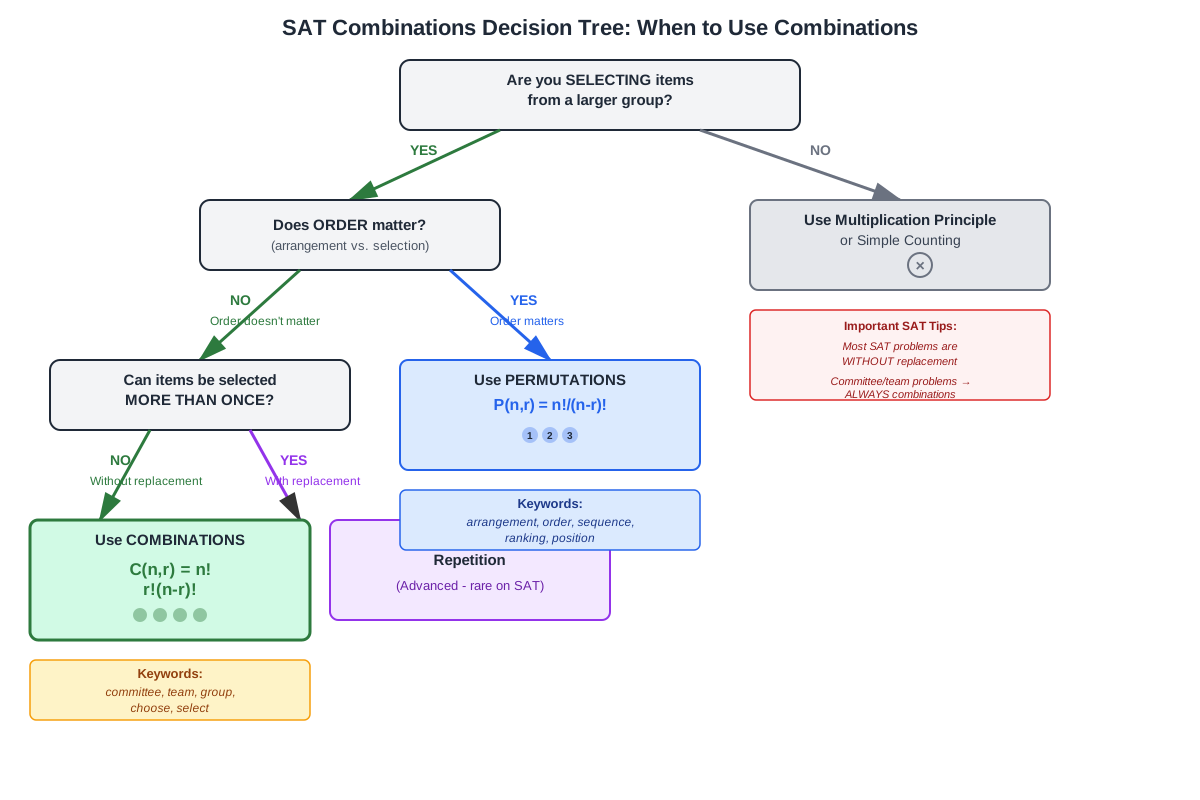
The SAT tests whether students can identify when combinations apply. Key indicators include:
- Selection language: "choose," "select," "pick," "form a group"
- Unordered groups: committees, teams, sets, collections
- No role differentiation: when selected items have equal status
- Simultaneous selection: choosing multiple items at once
Contrast this with permutation indicators: "arrange," "order," "first, second, third," "assign positions," or "sequence."
Combinations with Restrictions
Advanced SAT problems often include restrictions or multiple groups:
Type 1: Must-include scenarios
"A committee of 4 must be formed from 10 people, and must include person A."
Solution: Since A is guaranteed, choose 3 more from the remaining 9: C(9,3)
Type 2: Must-exclude scenarios
"How many 5-person teams can be formed from 12 people if person B cannot be included?"
Solution: Choose all 5 from the 11 people excluding B: C(11,5)
Type 3: Multiple group selections
"Choose 2 appetizers from 5 options and 3 entrees from 8 options."
Solution: Multiply independent choices: C(5,2) × C(8,3)
Concept Relationships
The foundation of combinations rests on factorial notation, which provides the mathematical machinery for the formula. Factorials connect to the fundamental counting principle, which states that independent choices multiply—this principle explains why we multiply combinations when making selections from multiple categories.
Combinations relate directly to permutations through the relationship: Permutations = Combinations × (arrangements per group). Understanding this connection helps students choose the correct approach: if a problem asks for arrangements, use permutations; if it asks for selections, use combinations.
Within probability problems, combinations often serve as the counting mechanism: Probability = (favorable combinations) / (total combinations). For example, finding the probability of drawing 2 aces from a deck requires calculating C(4,2) for favorable outcomes and C(52,2) for total outcomes.
The relationship flow: Counting Principle → Factorials → Permutations → Combinations → Probability Applications. Each concept builds on the previous, with combinations representing a refinement of permutations that accounts for order irrelevance.
Combinations also connect to binomial expansion in advanced mathematics, where C(n,r) represents the coefficients in (a+b)^n, though this connection rarely appears explicitly on the SAT.
Quick check — test yourself on Combinations basics so far.
Try Flashcards →High-Yield Facts
⭐ The combination formula is C(n,r) = n! / (r!(n-r)!), where n is the total items and r is the number selected
⭐ Combinations apply when order doesn't matter; permutations apply when order matters
⭐ C(n,r) = C(n,n-r), so choosing 3 from 10 equals choosing 7 from 10
⭐ Most calculators have an nCr function that directly computes combinations
⭐ When a problem mentions "committee," "team," or "group," it almost always requires combinations
- C(n,0) = 1 and C(n,n) = 1 for any value of n (there's exactly one way to choose nothing or everything)
- C(n,1) = n (choosing one item from n items gives n possibilities)
- When calculating by hand, cancel common factors before multiplying to avoid large numbers
- Multiple independent selections multiply: choosing from group A AND group B means C(A,x) × C(B,y)
- If someone must be included, reduce both n and r by 1 for the remaining selection
- If someone must be excluded, reduce n by 1 and keep r the same
- The sum of all combinations from a set equals 2^n: C(n,0) + C(n,1) + ... + C(n,n) = 2^n
- Combinations with replacement follow different rules and rarely appear on the SAT
- When a problem asks "at least" or "at most," consider using complementary counting
Common Misconceptions
Misconception: Combinations and permutations are interchangeable terms for the same concept.
Correction: Combinations count unordered selections (groups where ABC = BAC = CAB), while permutations count ordered arrangements (where ABC ≠ BAC ≠ CAB). The combination formula divides the permutation formula by r! to eliminate duplicate orderings.
Misconception: C(10,3) means "10 divided by 3" or some simple arithmetic operation.
Correction: C(10,3) represents a specific calculation using factorials: 10!/(3!×7!) = 120. It's not division but rather a formula that counts unique selections.
Misconception: When selecting from multiple groups, add the combinations together.
Correction: When making selections from multiple independent groups (choose appetizers AND entrees), multiply the combinations: C(5,2) × C(8,3). Addition applies when considering alternatives (choose appetizers OR entrees).
Misconception: The order of n and r in C(n,r) doesn't matter.
Correction: The order is critical: n must be the total available items and r must be the number selected. C(3,10) is mathematically undefined (cannot choose 10 items from only 3), while C(10,3) = 120.
Misconception: If a problem involves people, it must use combinations.
Correction: Context determines the approach. Selecting 3 people for a committee uses combinations (order doesn't matter), but assigning 3 people to ranked positions (1st, 2nd, 3rd place) uses permutations (order matters).
Misconception: Combinations always produce smaller numbers than permutations.
Correction: While C(n,r) ≤ P(n,r) for the same n and r values, combinations can still produce very large numbers. C(50,25) exceeds 126 trillion, demonstrating that "smaller than permutations" doesn't mean "small."
Misconception: When someone must be included, use C(n-1,r-1) without understanding why.
Correction: The logic is: if person A must be included, they occupy one of the r spots, leaving r-1 spots to fill from the remaining n-1 people. Understanding this reasoning prevents formula misapplication.
Worked Examples
Example 1: Basic Committee Selection
Problem: A school club has 12 members. The club needs to select 4 members to attend a conference. How many different groups of 4 members can be selected?
Solution:
Step 1: Identify the problem type
The problem asks for "groups" of members with no mention of specific roles or order. The phrase "select 4 members" indicates combinations, not permutations.
Step 2: Identify n and r
- n = 12 (total members available)
- r = 4 (members being selected)
Step 3: Apply the combination formula
C(12,4) = 12! / (4! × 8!)Step 4: Simplify the calculation
Rather than calculating full factorials, expand only necessary terms:
C(12,4) = (12 × 11 × 10 × 9) / (4 × 3 × 2 × 1)Step 5: Cancel common factors
- 12 ÷ 4 = 3
- 9 ÷ 3 = 3
- 10 ÷ 2 = 5
This gives us: 3 × 11 × 5 × 3 / 1 = 495
Step 6: Verify with calculator (if available)
Using the nCr function: 12 nCr 4 = 495 ✓
Answer: 495 different groups can be selected.
Connection to learning objectives: This example demonstrates identifying combination features (unordered selection), recognizing SAT presentation style (word problem context), and applying the formula correctly.
Example 2: Multi-Step Problem with Restrictions
Problem: A pizza restaurant offers 8 different toppings. Sarah wants to order a pizza with exactly 3 toppings, but she is allergic to mushrooms and cannot have them on her pizza. How many different 3-topping pizzas can Sarah order?
Solution:
Step 1: Analyze the restriction
Sarah must exclude mushrooms, so we're selecting from only 7 available toppings (8 total minus 1 excluded).
Step 2: Recognize this as a combination problem
Pizza toppings have no order—pepperoni, olives, and peppers is the same pizza as peppers, pepperoni, and olives. This confirms we need combinations.
Step 3: Identify n and r with the restriction
- n = 7 (available toppings after excluding mushrooms)
- r = 3 (toppings being selected)
Step 4: Calculate C(7,3)
C(7,3) = 7! / (3! × 4!) = (7 × 6 × 5) / (3 × 2 × 1)Step 5: Simplify
- 6 ÷ 3 = 2
- Remaining: 7 × 2 × 5 / 2 = 7 × 5 = 35
Answer: Sarah can order 35 different 3-topping pizzas.
Alternative approach verification: We could also think of this as C(8,3) - (combinations that include mushrooms). Combinations including mushrooms = C(7,2) = 21 (choose mushrooms plus 2 others from remaining 7). Total without restriction: C(8,3) = 56. Therefore: 56 - 21 = 35 ✓
Connection to learning objectives: This problem requires recognizing combinations in a real-world context (SAT favorite: food ordering), handling restrictions (must-exclude scenario), and applying multi-step reasoning.
Exam Strategy
Approach SAT combination questions systematically:
- Read carefully for order clues: Words like "group," "committee," "team," "select," or "choose" signal combinations. Words like "arrange," "order," "first/second/third," or "assign" signal permutations.
- Identify n and r explicitly: Before calculating, write down "n = ?" and "r = ?" to avoid mixing up the values. This simple step prevents the most common error.
- Check for restrictions: Look for phrases like "must include," "cannot include," "at least," or "at most." These require modified approaches before applying the formula.
- Use calculator functions: The SAT allows calculators, and using nCr saves time and reduces arithmetic errors. Practice finding this function on your specific calculator before test day.
- Verify reasonableness: If choosing 3 items from 10 gives you 720, something's wrong (that's actually P(10,3)). Combinations should be smaller than permutations for the same n and r.
Trigger words and phrases to watch for:
- Combination indicators: "how many ways to select," "how many different groups," "how many committees," "how many teams"
- Restriction flags: "must include," "must contain," "cannot include," "excluding," "at least," "at most"
- Multiple selection signals: "and" (multiply combinations), "or" (add combinations)
Process-of-elimination tips:
- Eliminate answers larger than P(n,r) for the same values—combinations cannot exceed permutations
- Eliminate answers that don't match the symmetry property: if asked for C(10,7), eliminate any answer that wouldn't also equal C(10,3)
- For small values, consider listing possibilities to verify: if choosing 2 from 4, you can list all 6 combinations to check your answer
Time allocation advice:
Combination problems typically require 60-90 seconds. Spend 20 seconds reading and identifying the problem type, 30 seconds setting up and calculating, and 10 seconds verifying. If a problem seems to require more than 2 minutes, mark it and return later—you may be overcomplicating the approach.
Memory Techniques
Mnemonic for Combinations vs. Permutations: "Combinations don't Care about order" (both start with C)
Formula memory device: "Numerator has N factorial; denominator has R factorial and (N-R) factorial"—the letters match their positions.
Visual memory aid: Picture a pizza (combination) where toppings can be added in any order versus a podium (permutation) where position matters—1st, 2nd, 3rd place are different.
Acronym for problem-solving steps: RICE
- Read for order clues
- Identify n and r
- Check for restrictions
- Evaluate using formula or calculator
Symmetry reminder: Hold up both hands—choosing 3 fingers to raise is the same as choosing 7 fingers to lower. This physical reminder reinforces C(10,3) = C(10,7).
Restriction memory: "Must include = Minus one from both" (must and minus both start with M). If someone must be included, subtract 1 from both n and r.
Summary
Combinations basics represent a fundamental counting principle where order doesn't matter in selection. The combination formula C(n,r) = n!/(r!(n-r)!) calculates the number of ways to choose r items from n total items, accounting for the fact that different orderings of the same group represent identical selections. On the SAT, combinations appear in word problems involving team formation, committee selection, menu choices, and probability calculations. Success requires distinguishing combinations from permutations, correctly identifying n and r values, handling restrictions like must-include or must-exclude scenarios, and efficiently calculating using either the formula or calculator functions. The symmetry property C(n,r) = C(n,n-r) provides both a calculation shortcut and a verification tool. Students must recognize combination contexts through trigger words like "select," "group," and "committee," while avoiding common misconceptions about when to add versus multiply combinations or confusing combinations with permutations.
Key Takeaways
- Combinations count unordered selections; use them when the problem involves groups, teams, or committees where member order doesn't matter
- The formula C(n,r) = n!/(r!(n-r)!) requires n = total items and r = items selected; never reverse these values
- Calculator nCr functions are permitted on the SAT and significantly reduce calculation time and errors
- Restrictions modify the approach: must-include means reduce both n and r by 1; must-exclude means reduce only n by 1
- Multiple independent selections multiply: choosing from group A and group B means C(A,x) × C(B,y)
- Symmetry property C(n,r) = C(n,n-r) allows choosing the easier calculation and provides answer verification
- Distinguish from permutations by checking whether order matters in the problem context
Related Topics
Permutations: While combinations count unordered selections, permutations count ordered arrangements. Mastering combinations provides the foundation for understanding permutations, as P(n,r) = C(n,r) × r!. This relationship appears in advanced counting problems.
Probability with combinations: Many SAT probability problems use combinations to count favorable and total outcomes. For example, calculating the probability of drawing specific cards from a deck requires C(favorable,selected)/C(total,selected).
Binomial probability: Advanced problems combine combinations with probability to find the likelihood of exactly k successes in n trials, using the formula P(X=k) = C(n,k) × p^k × (1-p)^(n-k).
Pascal's Triangle: This triangular array of numbers contains all combination values, where each entry equals C(row,position). Understanding combinations deepens appreciation of Pascal's Triangle patterns.
Set theory: Combinations relate to subset counting—C(n,r) counts the number of r-element subsets of an n-element set, connecting discrete math concepts.
Practice CTA
Now that you've mastered the core concepts of combinations basics, it's time to solidify your understanding through active practice. Attempt the practice questions to apply these principles to SAT-style problems, and use the flashcards to reinforce key formulas and concepts. Remember, combinations appear on virtually every SAT, and the time you invest in mastering this topic will pay dividends on test day. Each practice problem you solve builds the pattern recognition and calculation fluency that separates good scores from great scores. You've got this!
Sign up free to keep reading
Create a free AnvayaPrep account to finish this SAT guide on Combinations basics — plus flashcards and practice questions.