Overview
The counting principle, also known as the fundamental counting principle or multiplication principle, is a cornerstone concept in probability and combinatorics that appears regularly on the SAT math section. This principle provides a systematic method for determining the total number of possible outcomes when multiple independent events or choices occur in sequence. Rather than listing every possible combination manually—which becomes impractical or impossible with larger numbers—the counting principle offers an elegant shortcut: multiply the number of options at each stage together.
Understanding the sat counting principle is essential because it forms the foundation for more complex probability calculations and appears in various question formats throughout the exam. Questions may involve arranging objects, selecting items from different categories, determining possible passwords or codes, or calculating the number of paths through a network. The SAT typically presents 1-3 questions per test that directly or indirectly require application of this principle, making it a high-yield topic that rewards focused study.
The counting principle connects to broader mathematical reasoning skills including systematic problem-solving, logical sequencing, and proportional thinking. It serves as a bridge between basic arithmetic operations and more sophisticated probability concepts, while also appearing in real-world contexts like computer science, statistics, and decision analysis. Mastery of this topic not only improves SAT performance but also develops analytical thinking skills applicable across STEM disciplines.
Learning Objectives
- [ ] Identify key features of the counting principle and recognize when it applies to a problem
- [ ] Explain how the counting principle appears on the SAT in various question formats
- [ ] Apply the counting principle to answer SAT-style questions accurately and efficiently
- [ ] Distinguish between situations requiring multiplication versus addition of possibilities
- [ ] Solve multi-stage counting problems involving restrictions or constraints
- [ ] Combine the counting principle with other probability concepts to solve complex problems
- [ ] Verify counting principle solutions using alternative methods or logical reasoning
Prerequisites
- Basic multiplication and division: The counting principle fundamentally relies on multiplying the number of choices at each stage, requiring fluency with multi-digit multiplication
- Understanding of independent events: Recognizing when one choice does not affect another is crucial for correctly applying the multiplication rule
- Set theory basics: Familiarity with concepts like distinct elements and non-overlapping categories helps identify when to use the counting principle
- Exponent notation: Some counting problems involve repeated choices (like 10³ for three-digit numbers), requiring comfort with exponential expressions
Why This Topic Matters
The counting principle appears in everyday decision-making far beyond the SAT. When choosing an outfit (5 shirts × 3 pants × 2 pairs of shoes = 30 outfits), planning routes (3 roads north × 4 roads east = 12 paths), or creating passwords (26 letters × 10 digits × 26 letters = 6,760 combinations), this principle provides the mathematical framework. In professional contexts, it's essential for computer science (algorithm analysis), business (inventory management), and statistics (sample space determination).
On the SAT, counting principle questions appear with moderate frequency—typically 1-3 questions per test—but carry significant weight because they're often medium-to-hard difficulty questions that separate high scorers from average performers. These questions commonly appear in the calculator-permitted section and may be presented as multiple-choice or student-produced response (grid-in) formats. The College Board frequently embeds counting principle concepts within word problems involving real-world scenarios like menu selections, license plate combinations, tournament brackets, or seating arrangements.
The SAT particularly favors questions that combine the counting principle with constraints (restrictions on certain positions), probability calculations (finding favorable outcomes over total outcomes), or logical reasoning (determining when choices are dependent versus independent). Recognizing these patterns allows students to quickly identify the appropriate strategy and avoid time-consuming enumeration methods.
Core Concepts
The Fundamental Counting Principle
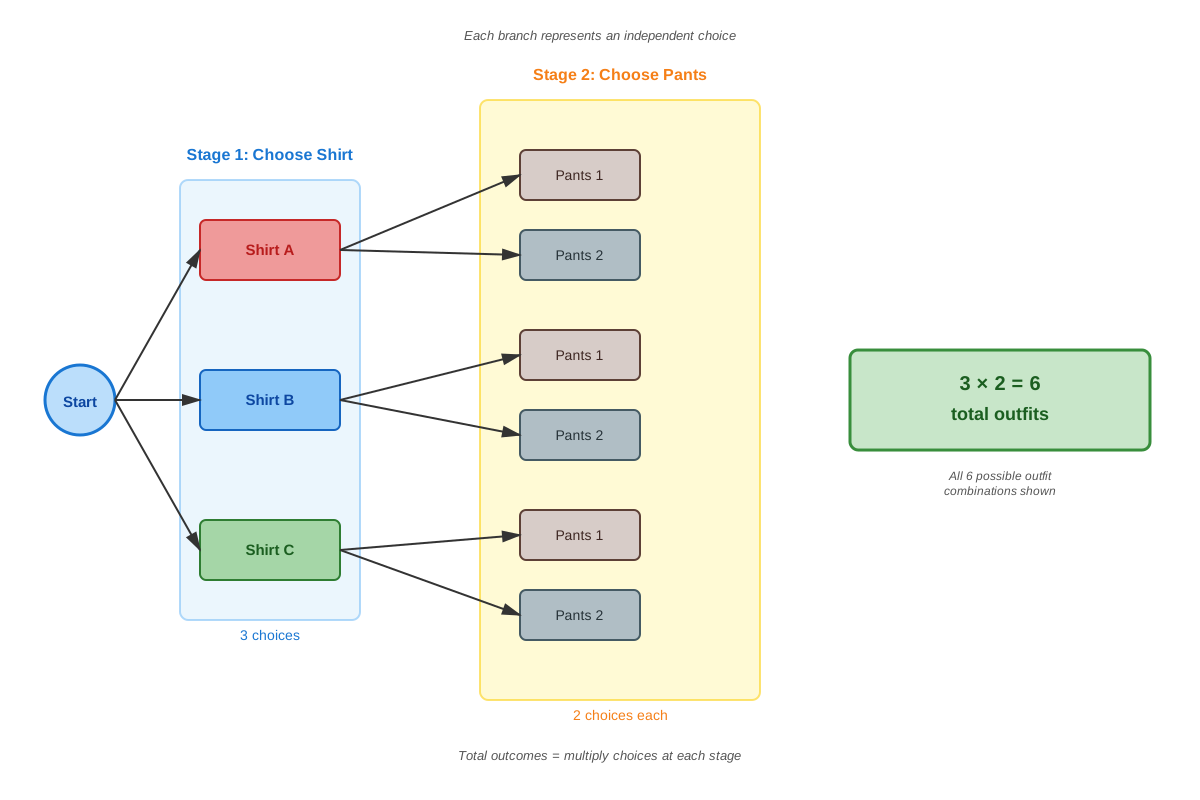
The counting principle states that if one event can occur in m ways and a second independent event can occur in n ways, then the two events together can occur in m × n ways. This extends to any number of sequential events: multiply the number of options at each stage to find the total number of outcomes.
Total Outcomes = (Options at Stage 1) × (Options at Stage 2) × ... × (Options at Stage n)The key requirement is independence: the number of choices available at each stage must not depend on previous choices. For example, when rolling two dice, the second die has 6 options regardless of what the first die shows, so the total outcomes equal 6 × 6 = 36.
When to Apply the Counting Principle
The counting principle applies when:
- Multiple independent decisions or selections occur in sequence
- Each stage has a fixed number of distinct options
- The question asks for total possible outcomes, arrangements, or combinations
- No specific ordering or selection is required beyond the sequential structure
Trigger phrases in SAT questions include "how many different ways," "how many possible," "total number of outcomes," and "how many distinct arrangements."
Multi-Stage Problems
Many SAT counting problems involve three or more stages. Consider creating a three-character code using one letter followed by two digits:
- Stage 1 (Letter): 26 options (A through Z)
- Stage 2 (First digit): 10 options (0 through 9)
- Stage 3 (Second digit): 10 options (0 through 9)
Total codes = 26 × 10 × 10 = 2,600
The systematic approach involves:
- Identifying each distinct stage or position
- Determining the number of options at each stage
- Verifying independence between stages
- Multiplying all values together
Problems with Restrictions
Restrictions add complexity by limiting choices at certain stages. The strategy is to handle the most restrictive stage first, then proceed to less restrictive stages.
Example: How many three-digit numbers can be formed using digits 1-5 without repetition?
- Stage 1 (Hundreds place): 5 options (any of 1, 2, 3, 4, 5)
- Stage 2 (Tens place): 4 options (any digit except the one used in Stage 1)
- Stage 3 (Units place): 3 options (any digit except those used in Stages 1 and 2)
Total = 5 × 4 × 3 = 60 three-digit numbers
When a specific position has special restrictions (like "the first digit cannot be 0"), address that constraint explicitly before calculating.
Counting Principle vs. Addition Principle
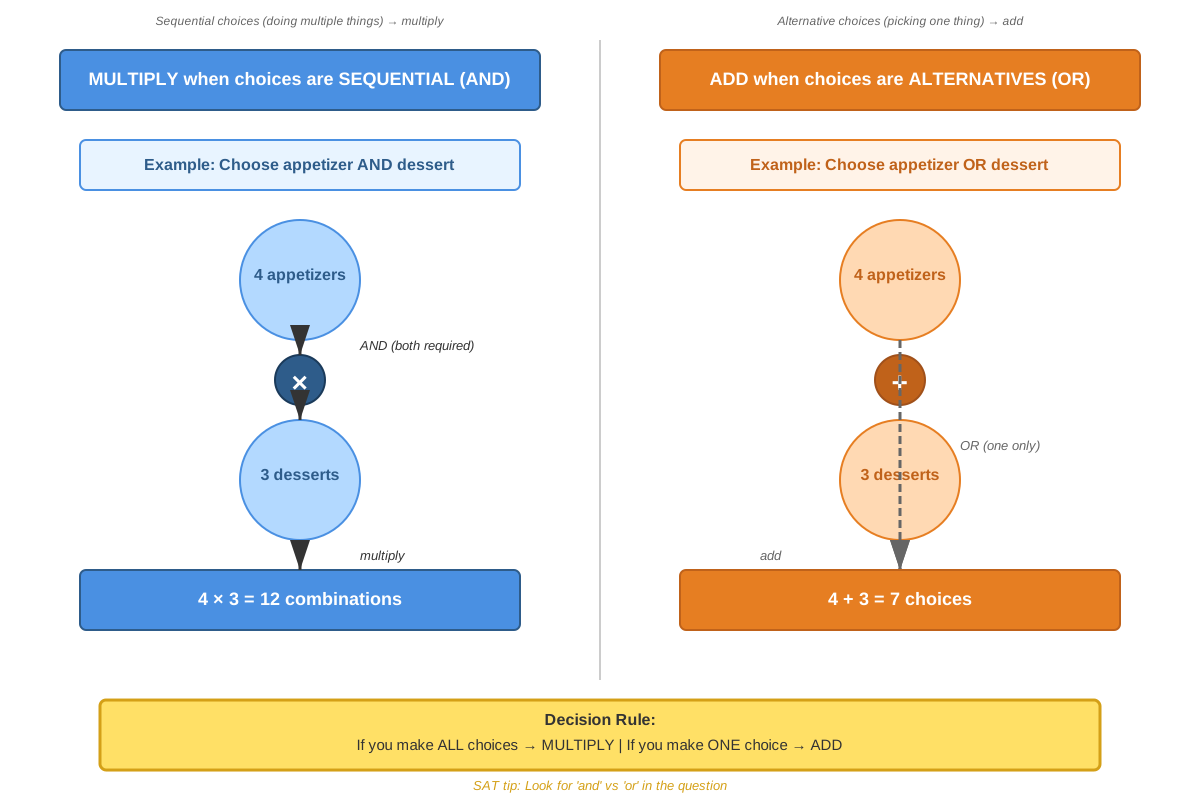
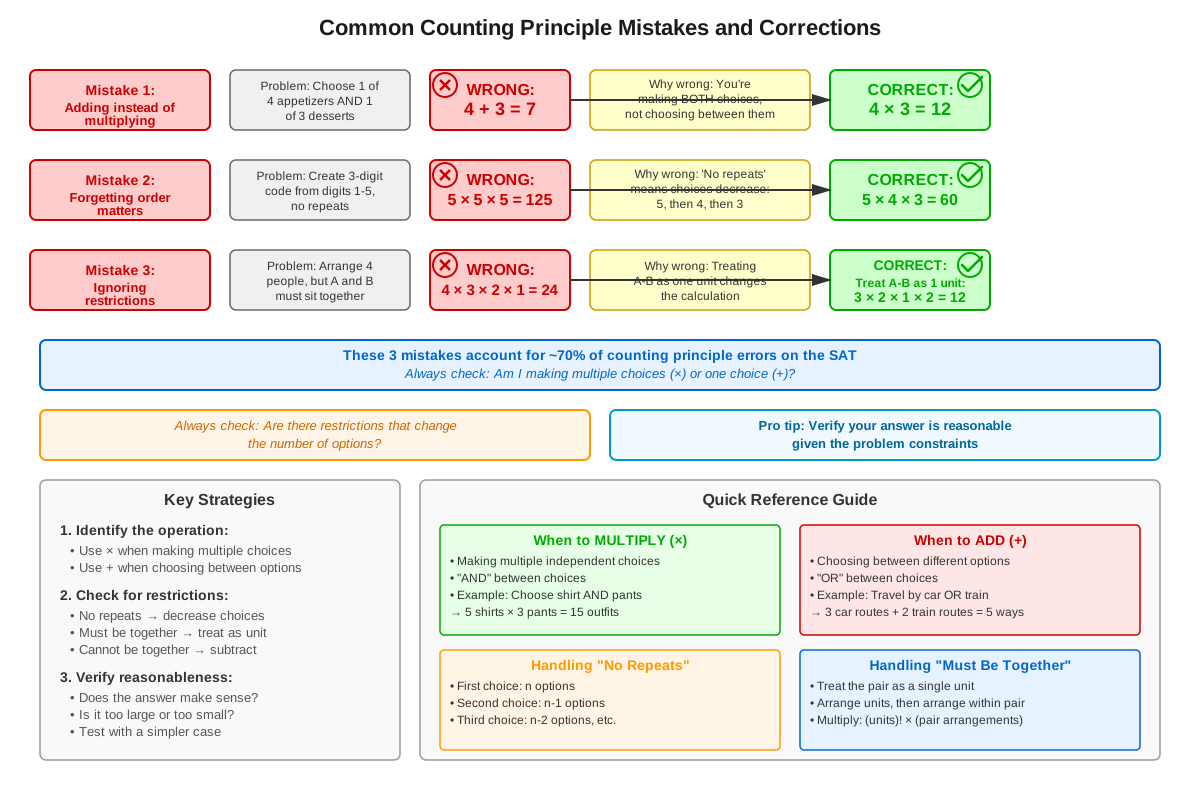
Students must distinguish between situations requiring multiplication (counting principle) versus addition (addition principle):
| Situation | Operation | Example |
|---|---|---|
| Sequential choices (AND) | Multiply | Shirt AND pants: 5 × 3 = 15 |
| Alternative choices (OR) | Add | Route A OR Route B: 4 + 6 = 10 |
| Multiple stages in sequence | Multiply | Three-stage process: 2 × 3 × 4 = 24 |
| Mutually exclusive options | Add | Category 1 OR Category 2: 8 + 5 = 13 |
The word "and" typically signals multiplication (both events occur), while "or" signals addition (one event or the other occurs, but not both).
Repetition Allowed vs. No Repetition
Whether elements can be reused dramatically affects the calculation:
With repetition allowed: Each stage maintains the same number of options.
- Four-digit PIN (digits 0-9, repetition allowed): 10 × 10 × 10 × 10 = 10,000
Without repetition: Each stage has one fewer option than the previous stage.
- Four-digit PIN (digits 0-9, no repetition): 10 × 9 × 8 × 7 = 5,040
Always check problem wording carefully for phrases like "distinct," "different," "without replacement," or "no repetition" that signal the no-repetition scenario.
Combining with Probability
The counting principle often serves as the foundation for probability calculations. Probability equals favorable outcomes divided by total possible outcomes, and the counting principle helps determine both values.
Example: What's the probability that a three-letter code using A-E (with repetition) contains no vowels?
- Total possible codes: 5 × 5 × 5 = 125
- Codes with no vowels (only B, C, D): 3 × 3 × 3 = 27
- Probability = 27/125
Concept Relationships
The counting principle serves as the foundational concept that connects to virtually all other counting and probability topics. Understanding independent events (prerequisite knowledge) enables proper application of the multiplication rule, since the counting principle only works when choices at each stage don't affect subsequent choices.
Within this topic, the relationship flows as follows:
Basic Counting Principle → Multi-Stage Problems → Problems with Restrictions → Combination with Probability
Each level builds on the previous: multi-stage problems extend the basic principle to more than two events; restrictions add constraints that require strategic ordering of calculations; probability applications use counting principle results as inputs for fraction calculations.
The distinction between multiplication (AND) versus addition (OR) represents a parallel concept that students must master alongside the counting principle itself. These two operations address different question types but often appear together in complex problems.
The counting principle also connects forward to more advanced topics like permutations (ordered arrangements) and combinations (unordered selections), though these typically appear less frequently on the SAT. The principle provides the conceptual foundation: permutations use the counting principle with decreasing options at each stage (no repetition), while combinations involve dividing counting principle results by the number of redundant arrangements.
Quick check — test yourself on Counting principle so far.
Try Flashcards →High-Yield Facts
⭐ The counting principle multiplies the number of options at each independent stage to find total outcomes
⭐ Use multiplication for sequential choices (AND); use addition for alternative choices (OR)
⭐ When repetition is not allowed, decrease the number of options by one at each subsequent stage
⭐ Handle the most restrictive condition first when solving problems with constraints
⭐ The counting principle provides the denominator (total outcomes) for probability calculations
- Independence between stages is required for the counting principle to apply correctly
- Three-stage problems are the most common format on the SAT
- "How many different ways" and "how many possible" are key trigger phrases
- Verification by listing outcomes is practical only for small numbers (typically under 20 total outcomes)
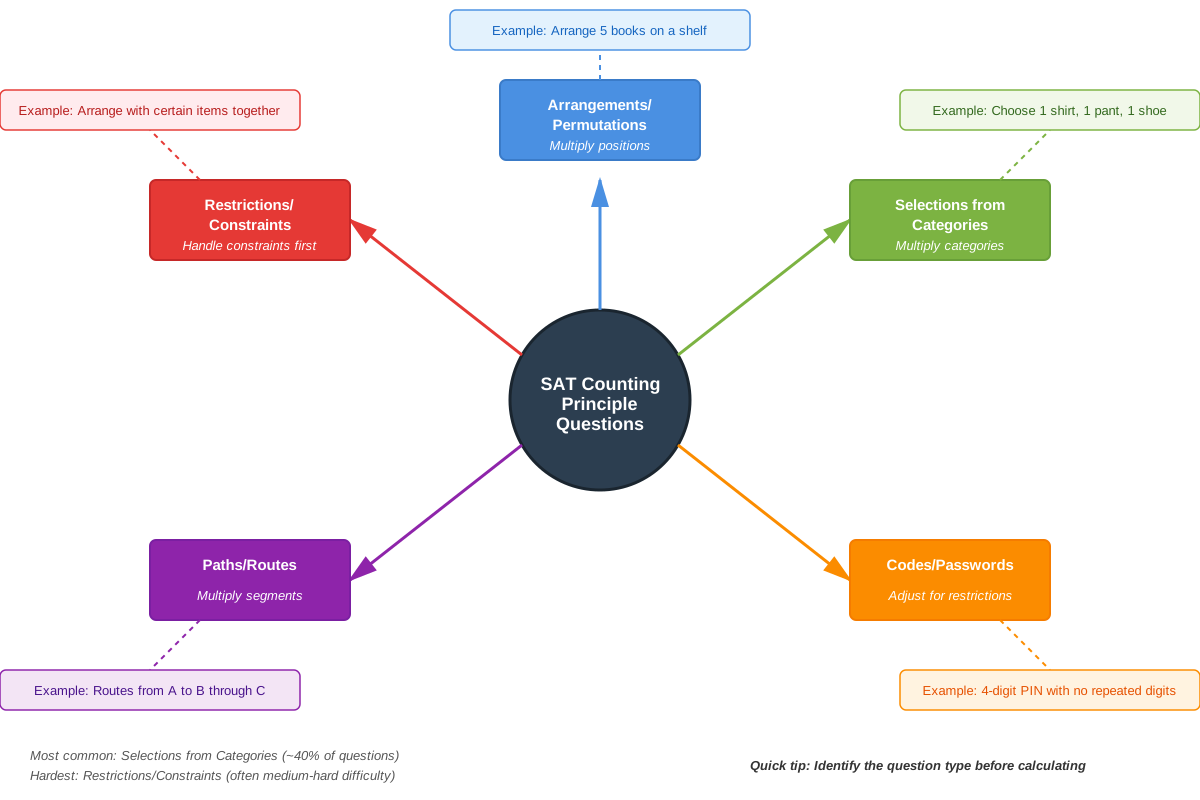
- The counting principle applies to arrangements, selections, paths, codes, and combinations
- Zero is a valid digit choice unless explicitly excluded (like in the first position of a multi-digit number)
- When positions have identical restrictions, the calculation involves exponents (e.g., 5³ for three positions each with 5 options)
- Grid-in questions often require calculating the counting principle result as the final numerical answer
- Some problems require multiple applications of the counting principle for different scenarios, then adding results
- Calculator use is permitted and recommended for multiplying larger numbers in counting principle problems
Common Misconceptions
Misconception: The counting principle applies to all counting problems regardless of whether events are independent.
Correction: The counting principle only works when choices at each stage are independent. If selecting one option affects the available options at the next stage (beyond simple "no repetition" scenarios), more complex methods may be needed.
Misconception: When a problem says "no repetition," simply multiply the same number repeatedly.
Correction: "No repetition" means each stage has one fewer option than the previous stage. For example, selecting 3 items from 5 without repetition is 5 × 4 × 3, not 5 × 5 × 5.
Misconception: Always multiply all the numbers given in a problem.
Correction: Only multiply when dealing with sequential stages of a single process. If the problem presents alternative scenarios or mutually exclusive options, addition may be required instead or in combination with multiplication.
Misconception: The order of multiplication doesn't matter, so stages can be calculated in any sequence.
Correction: While multiplication is commutative (order doesn't affect the final product), calculating stages in logical order—especially handling restrictions first—prevents errors and makes verification easier.
Misconception: Zero cannot be used as a digit in counting problems.
Correction: Zero is a valid digit (0-9 gives 10 options) unless the problem specifically excludes it or unless it would create an invalid result (like 0 in the first position of a multi-digit number, which wouldn't actually be that many digits).
Misconception: If a problem involves probability, the counting principle doesn't apply.
Correction: The counting principle is essential for probability problems—it determines both the total possible outcomes (denominator) and often the favorable outcomes (numerator).
Worked Examples
Example 1: Restaurant Menu Selection
Problem: A restaurant offers a prix fixe menu where diners choose one appetizer from 4 options, one entrée from 6 options, and one dessert from 3 options. How many different three-course meals are possible?
Solution:
Step 1: Identify the stages and independence.
- Stage 1: Appetizer selection (independent choice)
- Stage 2: Entrée selection (independent of appetizer)
- Stage 3: Dessert selection (independent of previous choices)
Step 2: Determine options at each stage.
- Appetizers: 4 options
- Entrées: 6 options
- Desserts: 3 options
Step 3: Apply the counting principle.
Total meals = 4 × 6 × 3 = 72
Answer: 72 different three-course meals are possible.
Connection to learning objectives: This problem demonstrates the basic application of the counting principle to a real-world scenario typical of SAT questions. It requires identifying independent stages and multiplying options.
Example 2: License Plate with Restrictions
Problem: A state issues license plates with 2 letters followed by 3 digits. The first letter must be a vowel (A, E, I, O, U), and the first digit cannot be 0. How many different license plates are possible?
Solution:
Step 1: Identify stages and restrictions.
- Position 1: First letter (restricted to vowels)
- Position 2: Second letter (no restriction)
- Position 3: First digit (cannot be 0)
- Position 4: Second digit (no restriction)
- Position 5: Third digit (no restriction)
Step 2: Handle restrictions by determining options at each position.
- Position 1: 5 options (A, E, I, O, U only)
- Position 2: 26 options (any letter A-Z)
- Position 3: 9 options (1-9, since 0 is excluded)
- Position 4: 10 options (0-9)
- Position 5: 10 options (0-9)
Step 3: Apply the counting principle.
Total plates = 5 × 26 × 9 × 10 × 10
Step 4: Calculate.
= 5 × 26 × 900
= 130 × 900
= 117,000
Answer: 117,000 different license plates are possible.
Connection to learning objectives: This problem demonstrates handling restrictions within a counting principle problem, a common SAT challenge. It requires careful attention to which positions have constraints and correctly applying those constraints before multiplying.
Exam Strategy
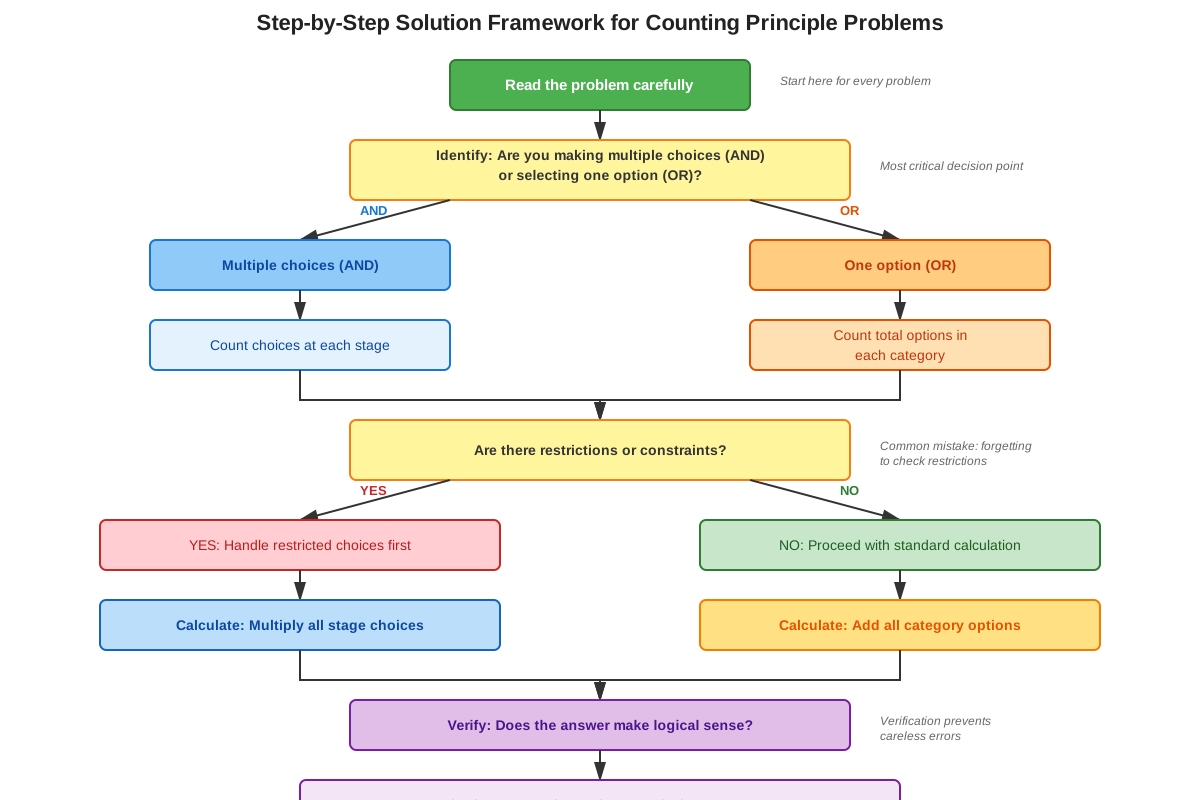
When approaching sat counting principle questions, follow this systematic process:
- Identify the structure: Determine how many distinct stages, positions, or choices the problem involves. Draw blanks or boxes to represent each position if helpful.
- Check for independence: Verify that choices at each stage don't affect subsequent stages (beyond simple "no repetition" scenarios). If choices are truly dependent in complex ways, the counting principle alone may not suffice.
- Spot restrictions first: Before calculating anything, identify all constraints (specific positions with limited options, digits that cannot be zero, letters that must be vowels, etc.). Handle the most restrictive positions first.
- Watch for trigger words:
- "How many different ways" → counting principle
- "Without repetition" or "distinct" → decrease options at each stage
- "At least one" → often requires complementary counting (total minus unwanted cases)
- "Or" → consider addition instead of or in addition to multiplication
- Set up before calculating: Write out the multiplication expression completely before computing. This allows you to verify your logic and catch errors before committing to an answer.
- Use your calculator efficiently: For multi-digit multiplication, use the calculator's memory or parentheses to avoid transcription errors. Calculate step-by-step for complex expressions.
- Verify with smaller numbers: If time permits and the answer seems questionable, test your logic with a simplified version (fewer stages or fewer options) where you can list outcomes manually.
- Eliminate unreasonable answers: Use estimation to eliminate obviously wrong multiple-choice options. For example, if you have 5 options at one stage and 4 at another, the answer must be at least 20.
Time Management Tip: Counting principle problems typically require 60-90 seconds. If you find yourself trying to list all possibilities manually, stop and reconsider whether the counting principle applies.
Memory Techniques
Mnemonic for when to multiply vs. add: "AND means MULTIPLY, OR means ADD"
- If you need choice A AND choice B, multiply the options
- If you need choice A OR choice B, add the options
Visualization strategy: Picture a tree diagram where each branch represents a choice. The counting principle counts the total number of paths from start to finish without drawing the entire tree. Each level of branching multiplies the paths.
RICE acronym for problem-solving steps:
- Read carefully for restrictions
- Identify all stages/positions
- Count options at each stage
- Execute multiplication
Restriction reminder: "Most Restrictive First" (MRF) - Always handle the position with the most constraints before calculating others. This prevents logical errors and makes verification easier.
Independence check: Ask yourself: "Does my first choice change what's available for my second choice?" If no (beyond simple no-repetition), multiply. If yes in complex ways, reconsider your approach.
Summary
The counting principle is a fundamental mathematical tool that determines total possible outcomes by multiplying the number of options at each independent stage of a sequential process. On the SAT, this principle appears in various contexts including arrangements, selections, codes, paths, and probability calculations. Success requires identifying when the principle applies (independent sequential choices), distinguishing multiplication scenarios from addition scenarios, handling restrictions by addressing constrained positions first, and recognizing whether repetition is allowed. The most common SAT format involves three-stage problems with one or two restrictions, often embedded in real-world contexts like menu selections, license plates, or tournament structures. Mastery involves both conceptual understanding—knowing why multiplication works for independent events—and procedural fluency in systematically working through multi-stage problems without errors.
Key Takeaways
- The counting principle multiplies options at each independent stage to find total outcomes: Stage 1 × Stage 2 × Stage 3 × ...
- Use multiplication for "AND" scenarios (sequential choices) and addition for "OR" scenarios (alternative choices)
- When repetition is not allowed, decrease the number of available options by one at each subsequent stage
- Always identify and handle restrictions first, particularly positions with limited choices or excluded values
- The counting principle provides the foundation for probability calculations by determining total possible outcomes
- Common SAT formats include three-stage problems with constraints, often presented in real-world contexts
- Verification through estimation and logical reasoning prevents calculation errors and confirms answer reasonableness
Related Topics
Probability Fundamentals: The counting principle provides the denominator (total outcomes) and often the numerator (favorable outcomes) for probability fractions. Mastering counting enables progression to conditional probability and compound events.
Permutations and Combinations: These advanced counting methods build directly on the counting principle. Permutations apply the principle with decreasing options (no repetition) for ordered arrangements, while combinations adjust for redundant orderings.
Set Theory and Venn Diagrams: Understanding overlapping and non-overlapping sets helps determine when to add versus multiply outcomes, particularly in complex problems involving multiple categories.
Sequences and Series: The counting principle connects to arithmetic and geometric sequences when problems involve patterns in the number of options at each stage.
Data Analysis and Statistics: Sample space determination, a key application of the counting principle, underlies statistical sampling and experimental design concepts.
Practice CTA
Now that you've mastered the core concepts of the counting principle, it's time to solidify your understanding through active practice. Attempt the practice questions to apply these strategies to SAT-style problems, and use the flashcards to reinforce key facts and formulas. Remember, the counting principle is a high-yield topic that appears on virtually every SAT—investing time now in deliberate practice will pay dividends on test day. Challenge yourself to work through problems systematically, identify restrictions first, and verify your reasoning. You've got this!
Sign up free to keep reading
Create a free AnvayaPrep account to finish this SAT guide on Counting principle — plus flashcards and practice questions.