Overview
Expected value basics is a fundamental concept in probability that measures the average outcome of a random event if it were repeated many times. On the SAT math section, expected value problems test a student's ability to calculate weighted averages, interpret probability scenarios, and make decisions based on mathematical reasoning. This topic bridges basic probability concepts with real-world decision-making, making it both practically useful and frequently tested.
Understanding sat expected value basics is essential because these questions appear regularly in the Problem Solving and Data Analysis domain of the SAT. The College Board includes expected value problems to assess whether students can work with probability distributions, perform multi-step calculations, and interpret results in context. These problems often involve scenarios like game outcomes, investment returns, or quality control situations where students must calculate the long-term average result.
Expected value connects directly to fundamental probability concepts, weighted averages, and data analysis. It requires students to multiply probabilities by their corresponding outcomes and sum the results—a process that combines arithmetic operations with probabilistic thinking. Mastering this topic strengthens overall mathematical reasoning and prepares students for more advanced statistical concepts they'll encounter in college coursework.
Learning Objectives
- [ ] Identify key features of Expected value basics
- [ ] Explain how Expected value basics appears on the SAT
- [ ] Apply Expected value basics to answer SAT-style questions
- [ ] Calculate expected values for discrete probability distributions with multiple outcomes
- [ ] Interpret expected value results in real-world contexts and make informed decisions
- [ ] Distinguish between expected value and actual outcomes in probability scenarios
- [ ] Solve multi-step problems involving expected value combined with other probability concepts
Prerequisites
- Basic probability concepts: Understanding how to calculate simple probabilities (favorable outcomes/total outcomes) is essential because expected value requires multiplying probabilities by outcomes
- Fractions, decimals, and percentages: Converting between these forms is necessary since probabilities can be expressed in any format on the SAT
- Weighted averages: Expected value is fundamentally a weighted average where probabilities serve as the weights
- Basic algebraic operations: Multiplying and adding multiple terms is required to compute expected values
- Understanding of negative numbers: Some expected value problems involve losses or negative outcomes that must be handled correctly
Why This Topic Matters
Expected value is one of the most practical mathematical concepts students will encounter, with applications spanning finance, insurance, business decisions, game theory, and risk assessment. Insurance companies use expected value to set premiums, investors use it to evaluate potential returns, and businesses use it to make strategic decisions about product development and quality control. Understanding expected value enables rational decision-making when facing uncertainty.
On the SAT, expected value questions appear approximately 1-2 times per test, making them high-yield content for focused study. These problems typically appear in the calculator-permitted section and are worth the same points as any other question, but they often take longer to solve due to multiple calculation steps. The College Board frequently presents expected value in contexts involving games, raffles, business scenarios, or quality control situations.
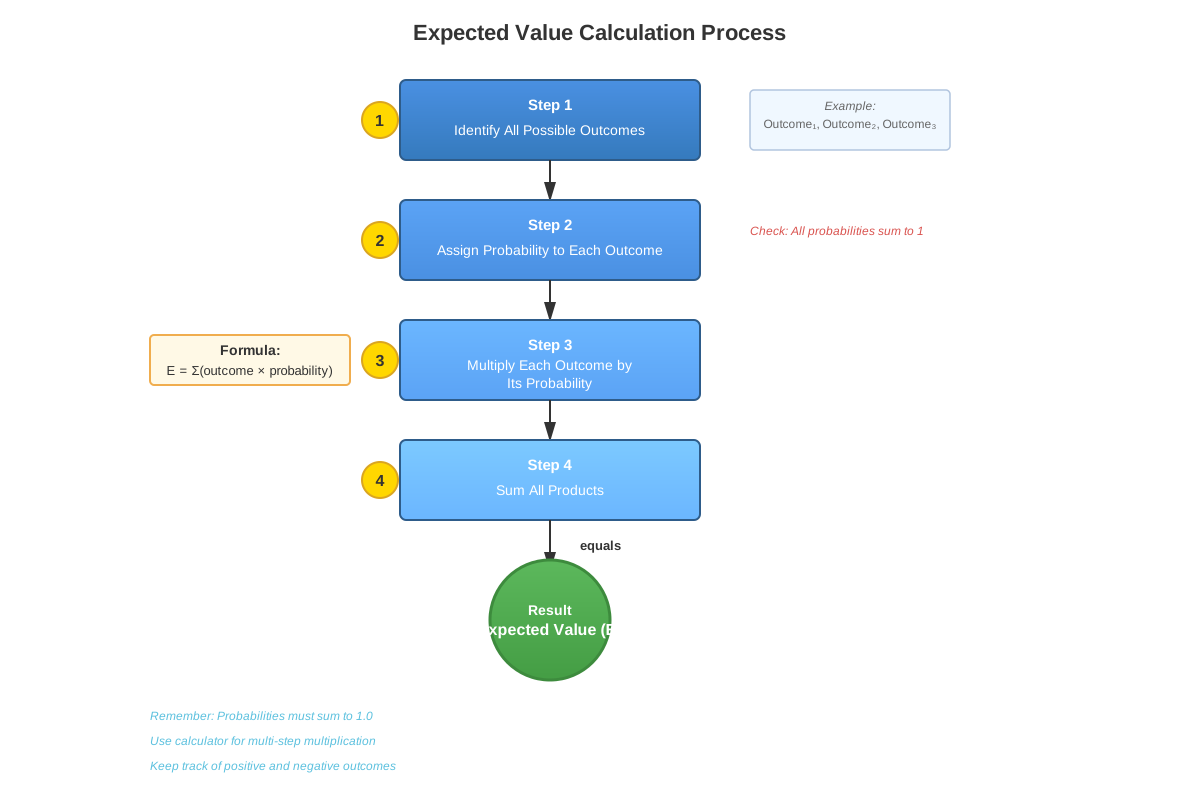
Expected value problems on the SAT commonly appear as word problems requiring students to: (1) identify all possible outcomes and their probabilities, (2) assign numerical values to each outcome, (3) multiply each value by its probability, and (4) sum the results. Questions may also ask students to compare expected values of different scenarios, determine whether a game is "fair," or calculate break-even points. The ability to set up and solve these problems efficiently is a distinguishing skill among high-scoring students.
Core Concepts
Definition of Expected Value
Expected value (often denoted as E(X) or EV) represents the average outcome of a random variable if an experiment were repeated infinitely many times. It is calculated by multiplying each possible outcome by its probability and summing all these products. The formula is:
E(X) = x₁ · P(x₁) + x₂ · P(x₂) + x₃ · P(x₃) + ... + xₙ · P(xₙ)Where x₁, x₂, x₃, ..., xₙ represent all possible outcomes and P(x₁), P(x₂), P(x₃), ..., P(xₙ) represent their respective probabilities. The sum of all probabilities must equal 1 (or 100%).
Components of Expected Value Calculations
Every expected value problem contains three essential components that students must identify:
- All possible outcomes: The complete set of results that could occur
- Probability of each outcome: The likelihood that each specific result will occur
- Value associated with each outcome: The numerical payoff, cost, or measurement for each result
Missing any of these components will result in an incorrect calculation. On the SAT, these components may be presented in tables, word problems, or scenarios requiring students to determine probabilities from given information.
Calculating Expected Value: Step-by-Step Process
The systematic approach to solving expected value problems involves:
- Identify all possible outcomes: List every distinct result that could occur
- Determine the probability of each outcome: Calculate or extract the probability for each result
- Assign a numerical value to each outcome: Determine the payoff, cost, or measurement (including negative values for losses)
- Multiply each value by its probability: Compute the product for each outcome-probability pair
- Sum all products: Add all the products together to obtain the expected value
This process works for any discrete probability distribution, regardless of how many outcomes exist.
Interpreting Expected Value Results
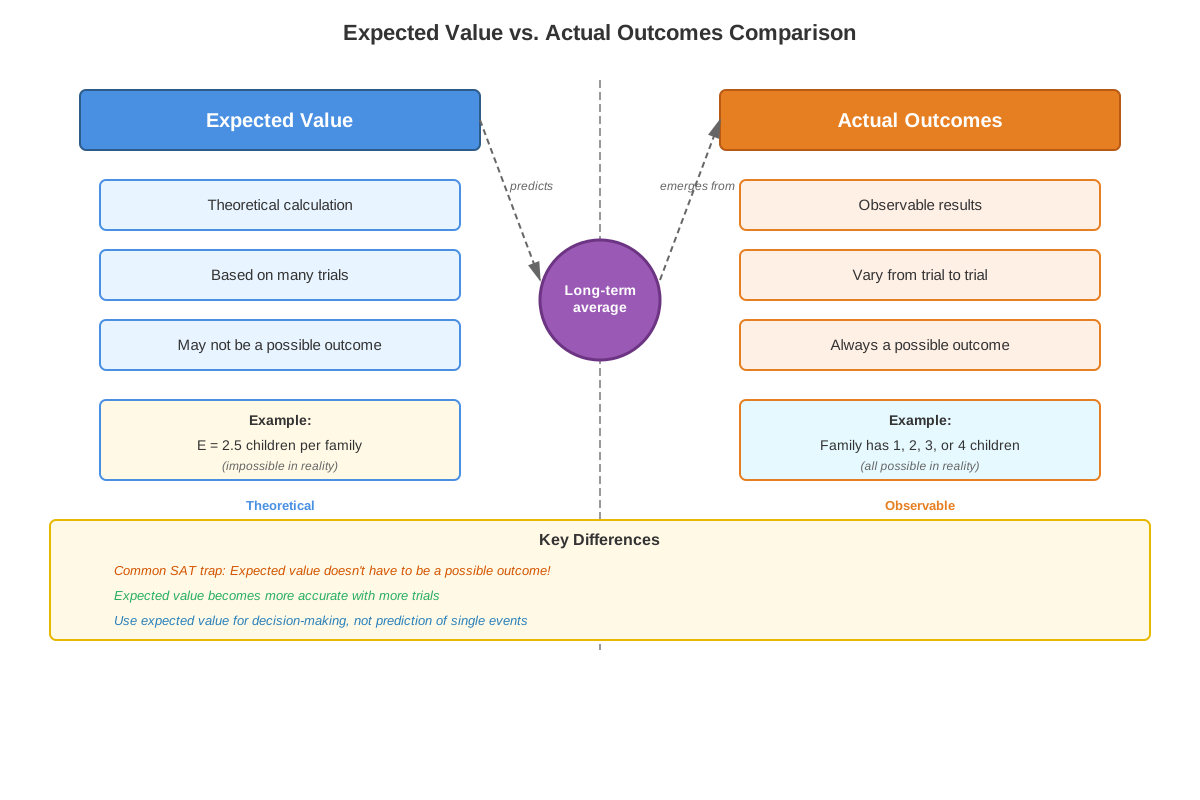
The expected value represents a long-run average, not a prediction of what will happen on any single trial. For example, if a game has an expected value of $2.50, this doesn't mean any single play will yield exactly $2.50. Instead, it means that over many plays, the average outcome will approach $2.50 per play.
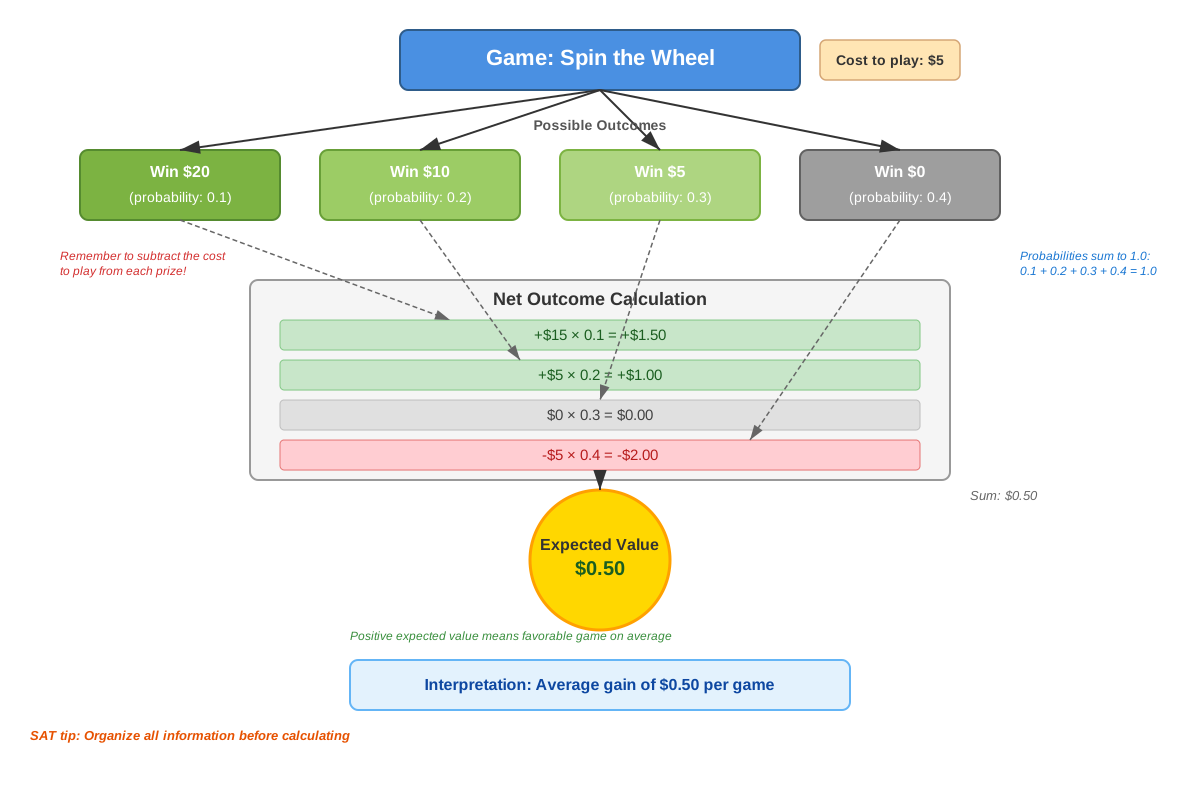
A positive expected value indicates a favorable situation (on average, you gain), a negative expected value indicates an unfavorable situation (on average, you lose), and an expected value of zero indicates a fair game where neither party has an advantage over the long run.
Expected Value in Decision-Making
On the SAT, students often must use expected value to compare options or make decisions. When comparing two scenarios, the one with the higher expected value is mathematically superior from a long-term perspective. However, context matters—a scenario with a slightly lower expected value but less risk might be preferable in real-world situations, though SAT questions typically focus on the mathematical comparison.
Common Expected Value Scenarios on the SAT
| Scenario Type | Description | Key Features |
|---|---|---|
| Games/Raffles | Calculating average winnings or determining ticket prices | Often involves small probabilities of large wins |
| Quality Control | Expected defects or costs in manufacturing | May involve costs of defects vs. inspection |
| Investment Returns | Average return on investments with uncertain outcomes | Can include both gains and losses |
| Insurance/Risk | Expected costs or payouts | Balances premiums against probability of claims |
| Survey/Sampling | Expected characteristics in a sample | Connects to data analysis concepts |
Concept Relationships
Expected value builds directly on fundamental probability concepts, as it requires calculating or using given probabilities for each outcome. The relationship flows: Basic Probability → Multiple Outcomes with Probabilities → Weighted Average (Expected Value) → Decision Analysis.
Within expected value problems, the concepts are interconnected: identifying outcomes determines what probabilities are needed, probabilities must sum to 1 (a validation check), and the values assigned to outcomes directly impact whether the expected value is positive or negative. The calculation process itself demonstrates the relationship between multiplication (for individual outcome contributions) and addition (for combining all contributions).
Expected value connects forward to more advanced statistical concepts like variance, standard deviation, and risk analysis. It also relates to the broader SAT math topics of ratios, proportions, and data interpretation. Students who master expected value develop stronger skills in multi-step problem solving and contextual interpretation—abilities that transfer to other SAT math domains.
The concept also bridges to real-world applications: Expected Value in Games → Fair Pricing → Business Decisions → Risk Management. Understanding this progression helps students see why the SAT tests this concept and how it applies beyond the exam.
High-Yield Facts
⭐ Expected value is calculated by multiplying each outcome by its probability and summing all products: E(X) = Σ[x · P(x)]
⭐ The sum of all probabilities in an expected value problem must equal 1 (or 100%): This serves as a validation check for problem setup
⭐ Expected value represents a long-run average, not a single-trial prediction: Individual outcomes may differ significantly from the expected value
⭐ A game is "fair" when its expected value equals zero: Neither player has a mathematical advantage
⭐ Negative outcomes (losses) must be represented as negative numbers in calculations: Forgetting the negative sign is a common error
- Expected value can be positive, negative, or zero depending on the scenario
- The expected value doesn't need to be a possible outcome (e.g., expected value of 2.5 children per family)
- Multiplying all outcomes by the same constant multiplies the expected value by that constant
- Adding the same constant to all outcomes adds that constant to the expected value
- Expected value problems on the SAT typically involve 2-5 distinct outcomes
- Calculator use is essential for expected value problems to avoid arithmetic errors
Quick check — test yourself on Expected value basics so far.
Try Flashcards →Common Misconceptions
Misconception: Expected value tells you what will happen on the next trial → Correction: Expected value represents the average outcome over many trials, not a prediction for any single event. A game with expected value of $3 doesn't mean you'll win $3 on your next play.
Misconception: The expected value must be one of the possible outcomes → Correction: Expected value is often a value that cannot occur in a single trial. For example, the expected value of rolling a standard die is 3.5, which is impossible to roll.
Misconception: A positive expected value guarantees you'll make money → Correction: A positive expected value means you'll make money on average over many trials, but you can still lose money on individual attempts or even over several attempts due to random variation.
Misconception: Probabilities can be ignored if all outcomes are equally likely → Correction: Even when outcomes are equally likely, you must still multiply each outcome by its probability (which would be 1/n for n equally likely outcomes) to calculate expected value correctly.
Misconception: Expected value and probability are the same thing → Correction: Probability measures the likelihood of an event (always between 0 and 1), while expected value measures the average numerical outcome (can be any real number). Expected value uses probabilities in its calculation but represents a different concept.
Misconception: The highest probability outcome is the expected value → Correction: Expected value considers all outcomes weighted by their probabilities. The most likely outcome may differ significantly from the expected value, especially when outcomes have very different values.
Misconception: You should always choose the option with higher expected value → Correction: While mathematically sound for repeated decisions, a single high-stakes decision might warrant considering risk tolerance. However, on the SAT, questions typically expect you to identify the higher expected value as the better choice.
Worked Examples
Example 1: Raffle Expected Value
Problem: A school raffle sells 500 tickets at $5 each. There is one grand prize of $1,000, two second prizes of $250 each, and five third prizes of $50 each. What is the expected value of purchasing one ticket?
Solution:
Step 1: Identify all possible outcomes and their values
- Win grand prize: $1,000 (but paid $5 for ticket, so net gain = $995)
- Win second prize: $250 (net gain = $245)
- Win third prize: $50 (net gain = $45)
- Win nothing: $0 (net loss = -$5)
Step 2: Determine probabilities
- P(grand prize) = 1/500
- P(second prize) = 2/500
- P(third prize) = 5/500
- P(nothing) = 492/500
Step 3: Calculate expected value
E(X) = ($995)(1/500) + ($245)(2/500) + ($45)(5/500) + (-$5)(492/500)
E(X) = $995/500 + $490/500 + $225/500 - $2,460/500
E(X) = ($995 + $490 + $225 - $2,460)/500
E(X) = -$750/500
E(X) = -$1.50Interpretation: The expected value is -$1.50, meaning on average, a ticket buyer loses $1.50. This is typical for fundraising raffles where the organization expects to profit.
Connection to Learning Objectives: This problem demonstrates identifying key features (outcomes, probabilities, values), applying the expected value formula, and interpreting results in context.
Example 2: Quality Control Decision
Problem: A factory produces widgets. Each widget costs $8 to produce. Without inspection, 5% of widgets are defective and must be discarded (total loss). An inspection system costs $1 per widget but catches all defects before shipping, allowing the factory to discard defects before additional shipping costs. Should the factory implement the inspection system based on expected value?
Solution:
Without Inspection:
- 95% probability: widget is good, cost = $8
- 5% probability: widget is defective, cost = $8 (total loss)
Expected cost per widget = (0.95)($8) + (0.05)($8) = $7.60 + $0.40 = $8.00
With Inspection:
- 95% probability: widget is good, cost = $8 + $1 = $9
- 5% probability: widget is defective, cost = $8 + $1 = $9 (but caught before shipping)
Expected cost per widget = (0.95)($9) + (0.05)($9) = $8.55 + $0.45 = $9.00
Analysis: Without inspection, expected cost is $8.00 per widget produced. With inspection, expected cost is $9.00 per widget. Based purely on expected value, the factory should NOT implement inspection as it increases expected cost by $1.00 per widget.
Note: This problem illustrates that expected value provides mathematical guidance, but real-world decisions might consider other factors like customer satisfaction, reputation, or warranty costs not included in this simplified model.
Connection to Learning Objectives: This example shows how expected value applies to real-world decision-making and demonstrates comparing expected values of different scenarios—a common SAT question type.
Exam Strategy
When approaching expected value questions on the SAT, follow this strategic framework:
Recognition Phase: Identify expected value problems by watching for trigger phrases like "average outcome," "expected winnings," "long-run average," "fair game," or scenarios involving multiple outcomes with different probabilities. Questions asking "what should someone expect to win/lose" or "what is the average result" typically involve expected value.
Setup Phase: Create a systematic table or list with three columns: Outcome, Probability, and Value. This organization prevents errors and makes calculations manageable. Verify that all probabilities sum to 1 before proceeding—if they don't, you've missed an outcome or made an error.
Calculation Phase: Use your calculator for all arithmetic to avoid errors. Calculate each product (outcome × probability) separately, then sum them. Don't round intermediate values; only round the final answer if the question specifies.
Interpretation Phase: Read the question carefully to determine what it's asking. Are you finding expected value, comparing two scenarios, determining a fair price, or calculating break-even points? The expected value calculation is often just one step toward answering the actual question.
Exam Tip: If a question asks whether a game is "fair," calculate the expected value. If E(X) = 0, the game is fair. If E(X) > 0, the player has an advantage. If E(X) < 0, the house has an advantage.
Process of Elimination: When answer choices are given, you can sometimes eliminate options without full calculation. If all outcomes are positive, the expected value must be positive. If most probability is concentrated on negative outcomes, the expected value should be negative. Use this logic to eliminate impossible answers.
Time Management: Expected value problems typically require 2-3 minutes due to multiple calculations. Don't rush—arithmetic errors are costly. If you're running short on time, these problems are good candidates to skip and return to later since they're calculation-intensive rather than conceptually difficult.
Memory Techniques
Mnemonic for Expected Value Steps: "O-P-V-M-S" = Outcomes, Probabilities, Values, Multiply, Sum
- This reminds you of the five-step process: identify Outcomes, determine Probabilities, assign Values, Multiply each pair, Sum all products
Visualization Strategy: Picture expected value as a "weighted balance" where each outcome is a weight on a balance beam. Heavier weights (higher probabilities) pull the balance point (expected value) toward their position. This helps understand why high-probability outcomes influence expected value more than low-probability outcomes.
Fair Game Memory Aid: "Zero is Hero" for fair games—when expected value equals zero, neither side has an advantage, making the game fair.
Probability Check: "Probabilities Perfectly Total One" (PPTO)—always verify that probabilities sum to 1 (or 100%) before calculating expected value.
Sign Convention: "Losses are Less" (negative)—remember to use negative numbers for losses, costs, or unfavorable outcomes in your calculations.
Summary
Expected value basics represents a fundamental probability concept that calculates the long-run average outcome of a random event by multiplying each possible outcome by its probability and summing the results. On the SAT math section, these problems test students' ability to identify outcomes and probabilities, perform multi-step calculations, and interpret results in practical contexts. The expected value formula E(X) = Σ[x · P(x)] requires systematic organization of information and careful arithmetic. Students must understand that expected value represents an average over many trials, not a prediction for any single event, and that it can be positive, negative, or zero. A fair game has an expected value of zero, while positive expected values favor the player and negative values favor the house. SAT questions typically present expected value in contexts involving games, quality control, investments, or decision-making scenarios where students must compare options or determine fair prices. Success requires recognizing the problem type, organizing information systematically, using calculators for accuracy, and interpreting results correctly within the given context.
Key Takeaways
- Expected value is calculated by multiplying each outcome by its probability and summing all products: E(X) = Σ[x · P(x)]
- Expected value represents a long-run average, not a prediction for any single trial or event
- All probabilities in an expected value problem must sum to exactly 1 (or 100%) as a validation check
- Negative outcomes such as losses or costs must be represented as negative numbers in calculations
- A game is mathematically "fair" when its expected value equals zero, giving neither party an advantage
- Expected value problems on the SAT require systematic organization of outcomes, probabilities, and values to avoid errors
- The expected value doesn't need to be a possible outcome—it's often a value that cannot occur in a single trial
Related Topics
Probability Distributions: Expected value is the foundation for understanding more complex probability distributions, including binomial and normal distributions that appear in advanced statistics courses.
Variance and Standard Deviation: After mastering expected value, students can learn about variance (average squared deviation from expected value) and standard deviation, which measure the spread of outcomes around the expected value.
Decision Theory and Game Theory: Expected value is central to rational decision-making under uncertainty and forms the basis for game theory concepts like Nash equilibrium.
Statistical Inference: Understanding expected value enables progression to sampling distributions, confidence intervals, and hypothesis testing in AP Statistics and college courses.
Risk Analysis: Expected value combined with variance creates risk-adjusted metrics used in finance, insurance, and business analytics.
Practice CTA
Now that you've mastered the core concepts of expected value basics, it's time to solidify your understanding through practice! Attempt the practice questions to apply these concepts to SAT-style problems, and use the flashcards to reinforce key formulas and definitions. Remember, expected value problems reward systematic organization and careful calculation—skills that improve dramatically with focused practice. Each problem you solve strengthens your ability to recognize patterns and execute the solution process efficiently. You've built a strong foundation; now transform that knowledge into test-day confidence through deliberate practice!
Sign up free to keep reading
Create a free AnvayaPrep account to finish this SAT guide on Expected value basics — plus flashcards and practice questions.