Overview
Probability word problems are among the most frequently tested topics in the SAT math section, appearing in both the calculator and no-calculator portions of the exam. These problems require students to interpret real-world scenarios, identify relevant information, and apply probability principles to calculate the likelihood of specific events occurring. Unlike straightforward computational probability questions, sat probability word problems embed mathematical concepts within narrative contexts, testing both reading comprehension and mathematical reasoning simultaneously.
Mastering probability word problems is essential for SAT success because these questions typically appear 2-4 times per test and often serve as medium-to-high difficulty problems that separate average scorers from top performers. The College Board designs these problems to assess whether students can translate verbal descriptions into mathematical models, distinguish between independent and dependent events, and work with concepts like complementary probability and conditional probability. Students who excel at these problems demonstrate the analytical thinking skills that colleges value.
Within the broader landscape of SAT Math, probability word problems connect to multiple mathematical domains including ratios, percentages, data analysis, and logical reasoning. They frequently integrate with statistics concepts, requiring students to interpret tables, charts, or data sets while calculating probabilities. Understanding this topic strengthens overall mathematical literacy and provides a foundation for more advanced statistical reasoning required in college-level coursework across STEM and social science disciplines.
Learning Objectives
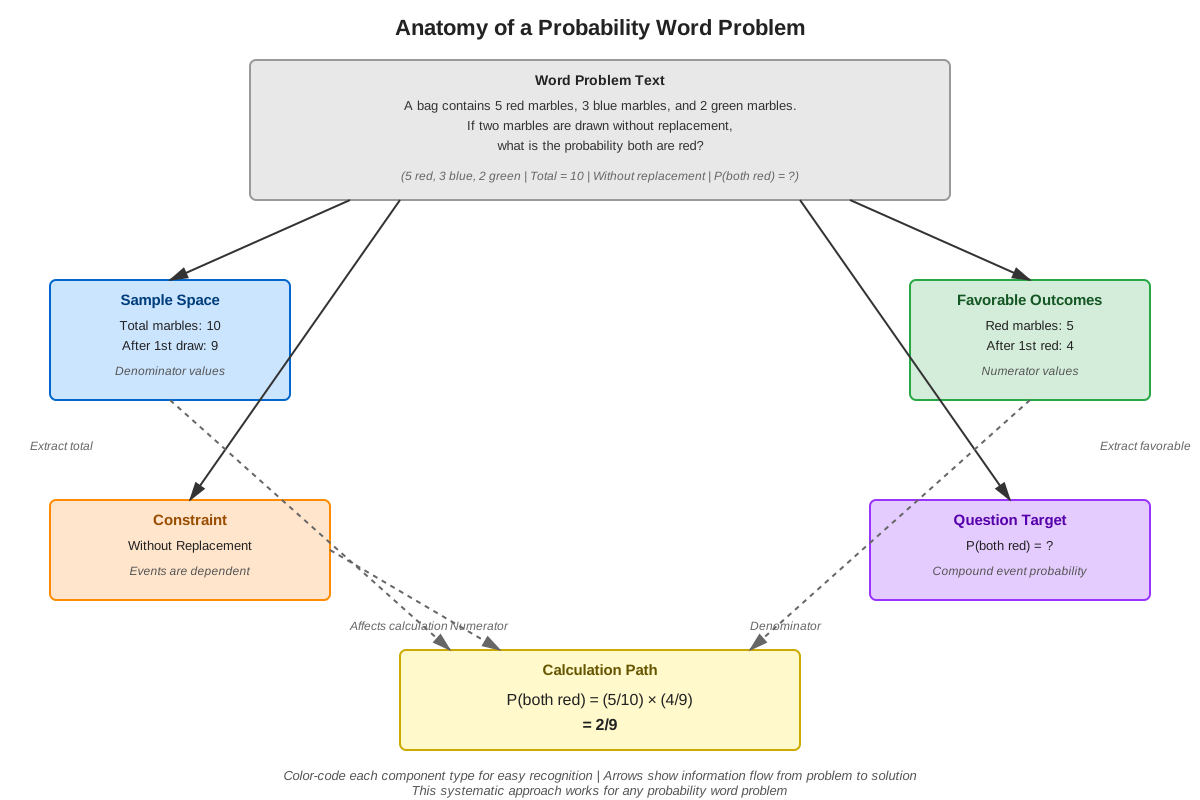
- [ ] Identify key features of probability word problems, including sample spaces, favorable outcomes, and constraints
- [ ] Explain how probability word problems appears on the SAT, including common question formats and difficulty patterns
- [ ] Apply probability word problems to answer SAT-style questions with accuracy and efficiency
- [ ] Calculate probabilities for independent and dependent events within word problem contexts
- [ ] Determine complementary probabilities and use them strategically to solve complex problems
- [ ] Interpret conditional probability scenarios and apply appropriate calculation methods
Prerequisites
- Basic fraction operations: Probability values are expressed as fractions, decimals, or percentages, requiring fluency in converting between these forms and simplifying fractions
- Ratio and proportion concepts: Understanding part-to-whole relationships is fundamental to probability calculations
- Set theory basics: Recognizing how to count elements in sets, unions, and intersections helps identify sample spaces and favorable outcomes
- Percentage calculations: Many probability problems require converting between probability values and percentages
- Basic counting principles: Understanding how to systematically count outcomes without duplication or omission
Why This Topic Matters
Probability word problems appear with remarkable consistency on the SAT, typically comprising 3-5% of all math questions. The College Board includes these problems because they assess multiple competencies simultaneously: reading comprehension, logical reasoning, mathematical modeling, and computational accuracy. Students who master this topic gain a reliable source of points that can significantly impact their overall math score.
In real-world applications, probability thinking underlies decision-making in medicine, business, engineering, and public policy. Understanding how to calculate the likelihood of events helps individuals make informed choices about risk, evaluate statistical claims in media, and interpret scientific research. From assessing medical test accuracy to understanding weather forecasts, probability literacy is a fundamental life skill.
On the SAT, probability word problems commonly appear as standalone questions in the calculator section, though they occasionally surface in the no-calculator portion when calculations are straightforward. These problems often involve scenarios like selecting items from groups, spinning wheels or drawing cards, analyzing survey data, or predicting outcomes of repeated trials. The College Board favors contexts that feel authentic to student experiences—school events, games, random selection processes, and everyday decision-making scenarios.
Core Concepts
Fundamental Probability Definition
Probability measures the likelihood of an event occurring, expressed as a ratio between 0 and 1 (or 0% to 100%). The basic probability formula is:
P(event) = (Number of favorable outcomes) / (Total number of possible outcomes)The sample space represents all possible outcomes of an experiment or situation, while favorable outcomes are those specific results that satisfy the condition being measured. For example, when rolling a standard six-sided die, the sample space contains 6 elements {1, 2, 3, 4, 5, 6}, and the probability of rolling an even number is 3/6 = 1/2, since three favorable outcomes (2, 4, 6) exist.
Independent vs. Dependent Events
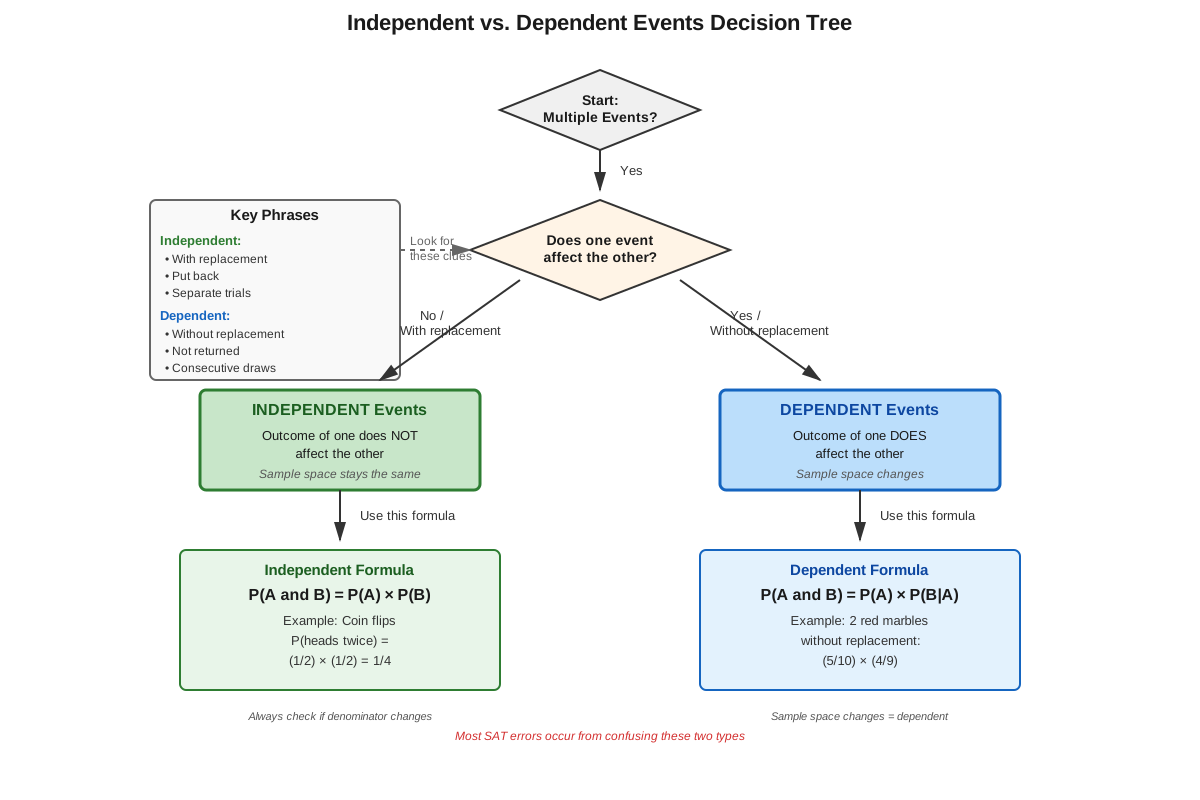
Independent events are those where the occurrence of one event does not affect the probability of another event. When calculating the probability of multiple independent events all occurring, multiply their individual probabilities:
P(A and B) = P(A) × P(B)For example, if you flip a coin twice, the probability of getting heads both times is 1/2 × 1/2 = 1/4, because each flip is independent.
Dependent events are those where the occurrence of one event changes the probability of subsequent events. This commonly occurs in "without replacement" scenarios. When selecting items without replacement, the sample space shrinks after each selection, affecting subsequent probabilities. For instance, if drawing two cards from a standard deck without replacement, the probability of drawing two aces is (4/52) × (3/51), because after drawing the first ace, only 3 aces remain among 51 total cards.
Complementary Probability
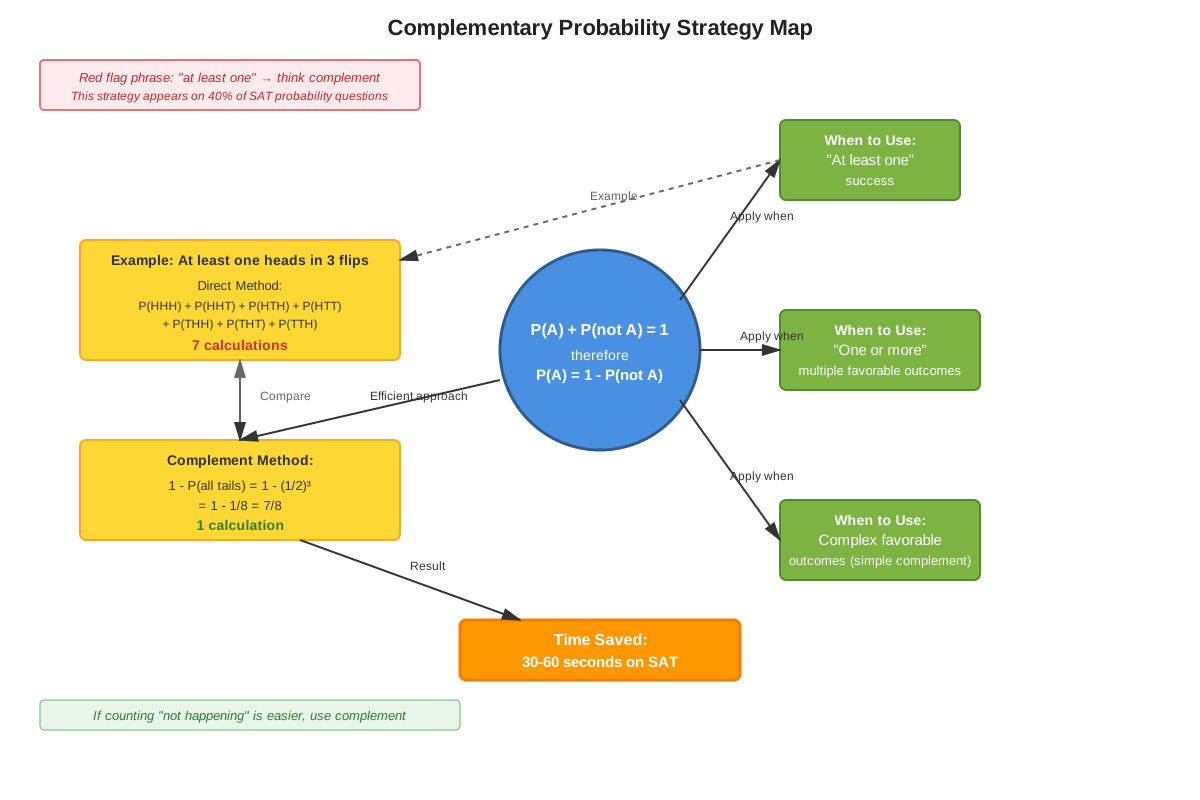
The complement of an event consists of all outcomes in the sample space that are NOT part of the original event. The probability of an event and its complement always sum to 1:
P(event) + P(not event) = 1Therefore:
P(not event) = 1 - P(event)This principle is particularly powerful for SAT problems asking about "at least one" scenarios. Rather than calculating multiple cases, students can find the probability of the complement (none occurring) and subtract from 1. For example, to find the probability of getting at least one heads in three coin flips, calculate the probability of getting no heads (all tails): (1/2)³ = 1/8, then subtract from 1: 1 - 1/8 = 7/8.
Conditional Probability
Conditional probability measures the likelihood of an event occurring given that another event has already occurred, denoted as P(A|B), read as "the probability of A given B." The formula is:
P(A|B) = P(A and B) / P(B)In word problems, conditional probability often appears when information restricts the sample space. For example, if a problem states "given that a student is in the math club," this condition narrows the sample space to only math club members, changing the probability calculations.
Probability with Two-Way Tables
SAT probability word problems frequently present data in two-way tables (also called contingency tables), which organize information by two categorical variables. To solve these problems:
- Identify the total sample size (usually the bottom-right cell)
- Locate the relevant subset based on the question's conditions
- Calculate the probability as the ratio of the subset to the appropriate total
| Category A | Category B | Total | |
|---|---|---|---|
| Group 1 | 20 | 30 | 50 |
| Group 2 | 15 | 35 | 50 |
| Total | 35 | 65 | 100 |
For example, using this table, the probability of randomly selecting someone from Group 1 who is in Category A would be 20/100 = 1/5.
Multiple Selection Scenarios
When problems involve selecting multiple items, carefully determine whether selection is with replacement (item returned before next selection, keeping sample space constant) or without replacement (item not returned, reducing sample space). This distinction fundamentally changes the calculation approach.
For combinations where order doesn't matter, students may need to count favorable outcomes systematically. For example, if selecting 2 students from a group of 5, there are 10 possible pairs (calculated using combinations: 5!/(2!×3!) = 10).
Concept Relationships
The core concepts in probability word problems build upon each other in a hierarchical structure. The fundamental probability definition serves as the foundation, establishing the basic ratio framework that all other concepts utilize. From this foundation, students must distinguish between independent and dependent events, which determines whether to multiply probabilities directly or adjust for changing sample spaces.
Complementary probability emerges as a strategic tool that simplifies calculations, particularly for complex scenarios involving "at least one" conditions. This concept connects directly to the fundamental definition through the principle that all probabilities in a sample space sum to 1.
Conditional probability represents a more sophisticated application that narrows the sample space based on given information. This concept integrates with two-way tables, which provide organized data structures for conditional probability calculations. The relationship flows: fundamental definition → independent/dependent distinction → complementary probability strategy → conditional probability refinement.
These concepts also connect to prerequisite knowledge: ratios and proportions underlie the fundamental probability formula, fraction operations enable probability calculations, and counting principles help determine sample spaces and favorable outcomes. Together, these relationships form a cohesive framework for approaching any probability word problem on the SAT.
High-Yield Facts
- ⭐ Probability values always fall between 0 and 1 inclusive (or 0% to 100%), with 0 meaning impossible and 1 meaning certain
- ⭐ For independent events occurring together, multiply their individual probabilities: P(A and B) = P(A) × P(B)
- ⭐ The complement rule states P(not A) = 1 - P(A), which is essential for "at least one" problems
- ⭐ In "without replacement" scenarios, the denominator decreases with each selection, creating dependent events
- ⭐ When using two-way tables, always verify whether the question asks for probability from the total population or from a specific subgroup
- The sum of all probabilities in a complete sample space equals 1
- Conditional probability P(A|B) restricts the sample space to only those outcomes where B has occurred
- "Or" in probability typically means addition (for mutually exclusive events): P(A or B) = P(A) + P(B)
- "And" in probability typically means multiplication: P(A and B) = P(A) × P(B) for independent events
- The probability of an event occurring at least once in n trials equals 1 minus the probability of it never occurring: P(at least one) = 1 - P(none)
- When order matters in selection problems, use permutations; when order doesn't matter, use combinations
- Mutually exclusive events cannot occur simultaneously, so P(A and B) = 0 for mutually exclusive A and B
Quick check — test yourself on Probability word problems so far.
Try Flashcards →Common Misconceptions
Misconception: Adding probabilities when events occur together (using "and").
Correction: When events occur together (both happening), multiply probabilities for independent events. Addition is used for "or" scenarios with mutually exclusive events. The word "and" signals multiplication: P(A and B) = P(A) × P(B) for independent events.
Misconception: Treating dependent events as independent, failing to adjust probabilities after each selection.
Correction: In "without replacement" scenarios, the sample space changes after each selection. If drawing 2 red marbles from a bag of 5 red and 5 blue marbles without replacement, the second probability is 4/9, not 5/10, because one red marble and one total marble have been removed.
Misconception: Believing that past outcomes affect future independent events (the "gambler's fallacy").
Correction: For truly independent events like coin flips, previous results do not influence future probabilities. If a fair coin has landed heads five times in a row, the probability of heads on the next flip remains exactly 1/2.
Misconception: Using the wrong total when calculating probabilities from two-way tables.
Correction: Carefully identify whether the question asks for probability from the entire population or from a specific subgroup. "What is the probability a randomly selected person is in Group A?" uses the grand total as denominator, while "What is the probability a person in Category 1 is also in Group A?" uses the Category 1 total as denominator.
Misconception: Forgetting to simplify probability fractions or convert to the requested format.
Correction: SAT questions may ask for probabilities as fractions, decimals, or percentages. Always simplify fractions to lowest terms and convert to the format specified in the question. A probability of 15/60 should be simplified to 1/4 or converted to 0.25 or 25% as appropriate.
Misconception: Calculating P(A or B) by simply adding P(A) + P(B) when events are not mutually exclusive.
Correction: When events can occur simultaneously, use the inclusion-exclusion principle: P(A or B) = P(A) + P(B) - P(A and B). The subtraction prevents double-counting outcomes where both events occur.
Worked Examples
Example 1: Independent Events with Complementary Probability
Problem: A quality control inspector tests electronic components. Each component has a 0.95 probability of passing inspection, independent of other components. If the inspector tests 3 components, what is the probability that at least one component fails inspection?
Solution:
Step 1: Identify the event type. The phrase "at least one" signals that complementary probability will be more efficient than calculating multiple cases.
Step 2: Define the complement. The complement of "at least one fails" is "none fail" or equivalently "all pass."
Step 3: Calculate the probability that all three pass. Since inspections are independent:
P(all pass) = P(first passes) × P(second passes) × P(third passes)
P(all pass) = 0.95 × 0.95 × 0.95 = 0.857375
Step 4: Apply the complement rule:
P(at least one fails) = 1 - P(all pass)
P(at least one fails) = 1 - 0.857375 = 0.142625
Step 5: Round appropriately (SAT typically accepts answers to 2-3 decimal places):
P(at least one fails) ≈ 0.143 or 14.3%
Connection to Learning Objectives: This example demonstrates applying probability word problems to SAT-style questions by identifying the complementary probability strategy and correctly handling independent events.
Example 2: Dependent Events with Two-Way Table
Problem: A school surveyed 200 students about their participation in sports and music programs. The results are shown in the table below:
| Plays Music | Doesn't Play Music | Total | |
|---|---|---|---|
| Plays Sports | 45 | 75 | 120 |
| Doesn't Play Sports | 30 | 50 | 80 |
| Total | 75 | 125 | 200 |
If two students are randomly selected without replacement, what is the probability that both play sports and music?
Solution:
Step 1: Identify the favorable outcome. Students who play both sports and music are in the top-left cell: 45 students.
Step 2: Calculate the probability for the first selection:
P(first student plays both) = 45/200Step 3: Recognize this is a dependent event (without replacement). After selecting one student who plays both, only 44 such students remain among 199 total students.
Step 4: Calculate the probability for the second selection:
P(second student plays both | first plays both) = 44/199Step 5: Multiply the probabilities:
P(both students play both) = (45/200) × (44/199)
P(both students play both) = 1980/39800
Step 6: Simplify the fraction:
1980/39800 = 99/1990 ≈ 0.0497 or approximately 0.05Connection to Learning Objectives: This example demonstrates identifying key features (two-way table, without replacement), explaining how such problems appear on the SAT (integrated data interpretation), and applying dependent event probability calculations.
Exam Strategy
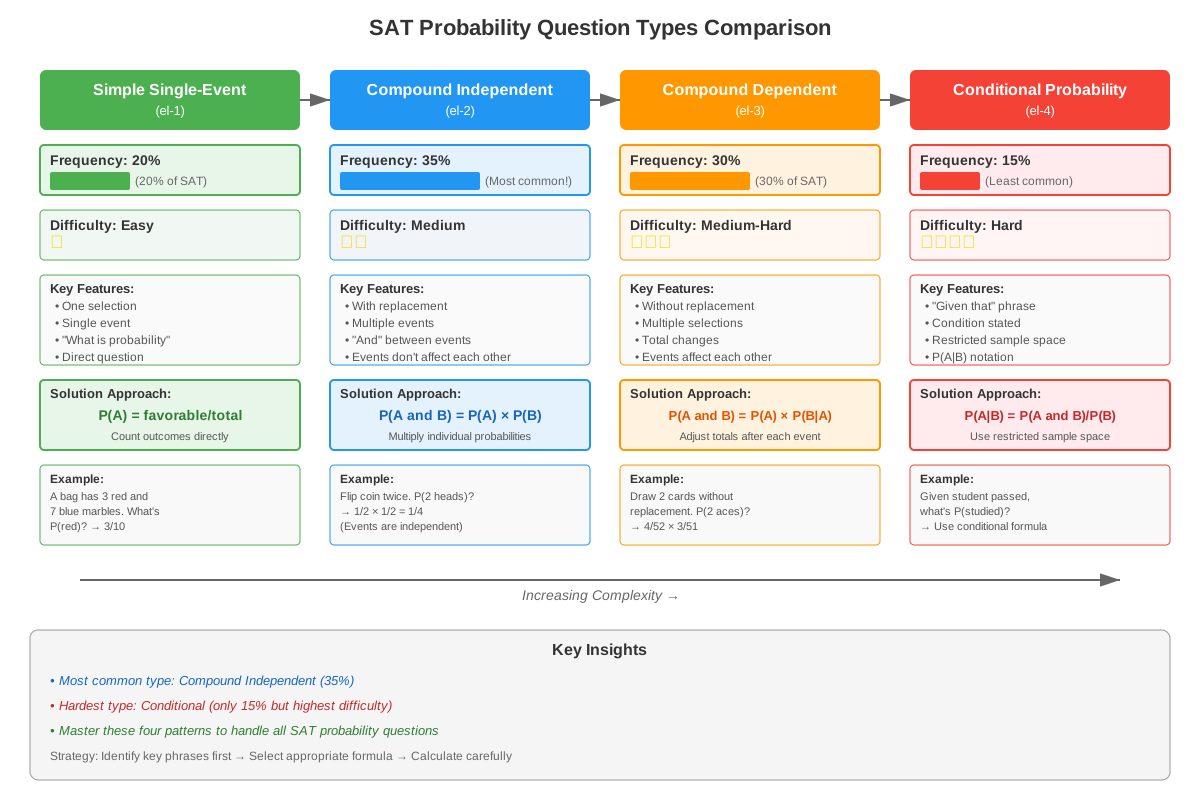
When approaching SAT probability word problems, begin by carefully reading the entire problem to identify the scenario type. Look for trigger words that signal specific probability concepts:
- "At least one" → Use complementary probability
- "Without replacement" → Dependent events, adjust denominators
- "Independent" or "each time" → Multiply probabilities without adjustment
- "Given that" → Conditional probability, restrict sample space
- "Or" → Addition (for mutually exclusive events)
- "And" → Multiplication
Create a systematic approach: First, identify the total sample space. Second, determine the favorable outcomes. Third, assess whether events are independent or dependent. Fourth, choose the most efficient calculation method (direct calculation vs. complementary probability).
Exam Tip: When problems involve "at least one" scenarios with three or more trials, complementary probability almost always saves time. Calculate the probability of zero occurrences and subtract from 1.
For two-way table problems, use your pencil to circle or mark the relevant cells before calculating. This prevents selecting the wrong values. Always verify whether the question asks for probability from the total population or from a conditional subset.
Time allocation: Spend 30-45 seconds reading and identifying the problem type, 60-90 seconds calculating, and 15-30 seconds checking your answer. If a problem requires more than 2 minutes, mark it and return later—probability problems should not consume excessive time once you recognize the pattern.
Process of elimination: If answer choices are given, eliminate any probability values outside the 0-1 range (or 0%-100%). For "at least one" problems, the answer must be greater than the probability of a single occurrence. For dependent events without replacement, subsequent probabilities must be smaller than initial probabilities.
Memory Techniques
MADS - Multiply AND, Divide Sample
- Multiply probabilities when events occur together (AND)
- Add probabilities for mutually exclusive OR scenarios
- Divide favorable outcomes by total outcomes
- Subtract from 1 for complementary probability
The Complement Shortcut: Visualize a complete pie chart representing probability = 1. When asked about "at least one," imagine coloring in the tiny slice representing "none," then recognizing that everything else (the complement) is what you want.
Replacement Reminder: "Without replacement = Watch the denominator Wither" - The denominator decreases each time.
Two-Way Table Technique: Draw a quick arrow from the condition to the relevant row or column, then circle the intersection cell. This visual guide prevents selecting wrong values.
Independent Events Acronym - MINT:
- Multiply the probabilities
- Independent means no influence
- No change in sample space
- Together means AND
Summary
Probability word problems on the SAT test students' ability to translate real-world scenarios into mathematical models and calculate the likelihood of events. Success requires mastering the fundamental probability formula (favorable outcomes divided by total outcomes), distinguishing between independent and dependent events, and strategically applying complementary probability for complex scenarios. Students must recognize when selection occurs with or without replacement, as this determines whether the sample space remains constant or changes. Two-way tables frequently appear, requiring careful identification of the appropriate subset and total for probability calculations. The most efficient approach involves identifying trigger words, determining the event type, and selecting the optimal calculation strategy. Complementary probability proves especially valuable for "at least one" problems, while conditional probability requires restricting the sample space to given conditions. Mastery of these concepts, combined with systematic problem-solving approaches and awareness of common misconceptions, enables students to confidently tackle probability word problems and secure valuable points on the SAT Math section.
Key Takeaways
- Probability always equals favorable outcomes divided by total possible outcomes, with values between 0 and 1
- Multiply probabilities for independent events occurring together; adjust denominators for dependent events without replacement
- Use complementary probability (1 - P(none)) for efficient calculation of "at least one" scenarios
- Two-way tables require careful identification of whether probability is calculated from the total population or a conditional subset
- Trigger words like "at least," "without replacement," "given that," and "independent" signal specific probability concepts and calculation approaches
- Complementary probability, independent/dependent event distinction, and two-way table interpretation are the highest-yield skills for SAT probability word problems
- Always simplify fractions and convert to the requested format (fraction, decimal, or percentage) before submitting answers
Related Topics
Statistics and Data Analysis: Probability concepts extend naturally into statistical inference, hypothesis testing, and confidence intervals. Mastering probability word problems provides the foundation for understanding sampling distributions and statistical significance.
Combinatorics and Counting Principles: Advanced probability problems require systematic counting of outcomes using permutations and combinations. Understanding when order matters and how to count without duplication enhances probability problem-solving.
Expected Value: Building on basic probability, expected value calculations weight outcomes by their probabilities to determine long-term averages, appearing in decision-making contexts on standardized tests.
Set Theory and Venn Diagrams: Visual representations of overlapping sets help solve complex probability problems involving unions, intersections, and complements, particularly for non-mutually exclusive events.
Practice CTA
Now that you've mastered the core concepts of probability word problems, it's time to solidify your understanding through practice. Attempt the practice questions designed specifically to mirror SAT-style probability problems, focusing on applying the strategies and techniques covered in this guide. Use the flashcards to reinforce high-yield facts and formulas until they become automatic. Remember, probability problems are among the most predictable on the SAT—consistent practice transforms them from challenging obstacles into reliable point opportunities. Each problem you solve strengthens your pattern recognition and builds the confidence needed to excel on test day. Start practicing now to turn probability word problems into one of your strongest areas!
Sign up free to keep reading
Create a free AnvayaPrep account to finish this SAT guide on Probability word problems — plus flashcards and practice questions.