Overview
SAT probability traps represent one of the most challenging categories of questions on the SAT math section, not because the underlying probability concepts are inherently difficult, but because these questions are deliberately designed to mislead even well-prepared students. These traps exploit common reasoning errors, hasty assumptions, and intuitive but incorrect approaches to probability problems. Understanding these traps is crucial because the SAT consistently includes probability questions that test not just mathematical knowledge but also careful reading, logical reasoning, and the ability to avoid cognitive pitfalls.
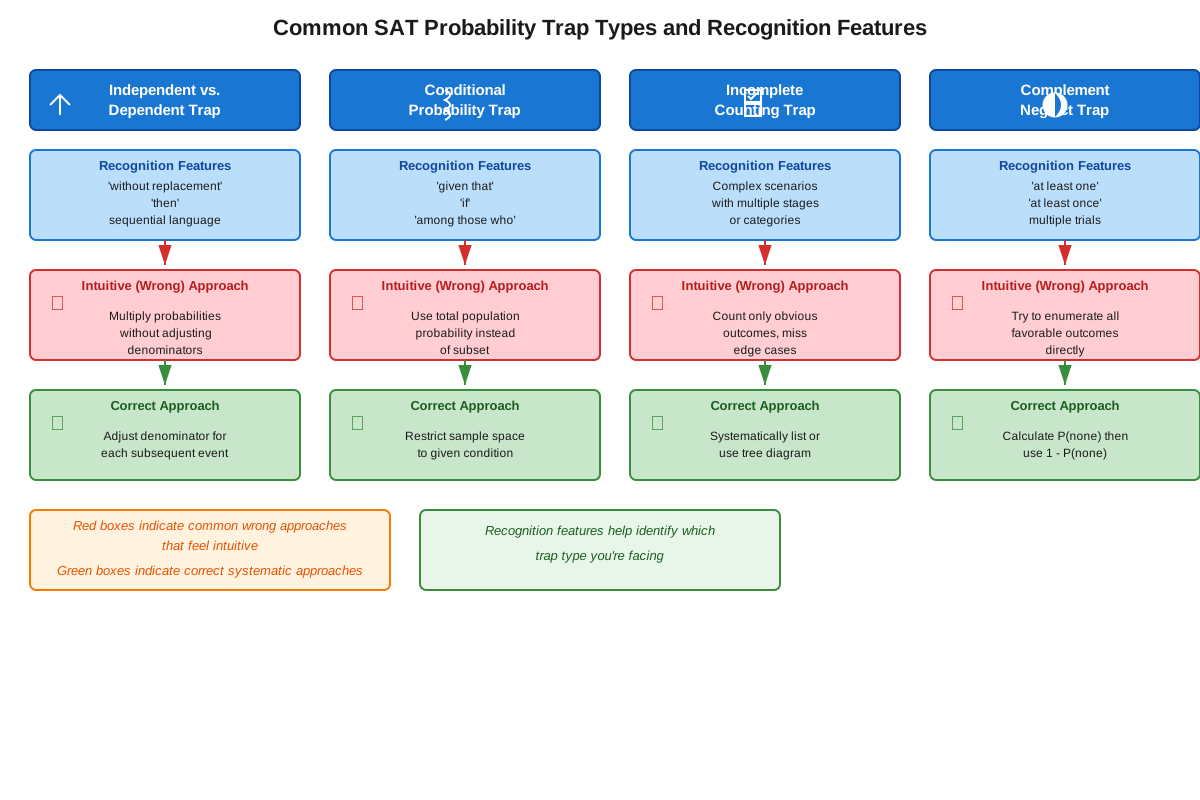
The College Board designs probability questions with specific traps in mind, knowing that students under time pressure will gravitate toward certain incorrect answers. These traps often involve confusion between independent and dependent events, misunderstanding of conditional probability, incorrect counting of outcomes, or failure to recognize when events are mutually exclusive. Mastering sat probability traps means developing the ability to recognize these deliberate misdirections and apply systematic problem-solving strategies that bypass intuitive but flawed reasoning.
Within the broader SAT math curriculum, probability connects to fundamental concepts in counting, fractions, percentages, and logical reasoning. Success with probability traps requires not just memorizing formulas but developing a disciplined approach to analyzing scenarios, identifying what information is truly relevant, and checking whether initial intuitions align with mathematical reality. This topic typically appears in 2-4 questions per SAT administration, making it a high-yield area for focused preparation.
Learning Objectives
- [ ] Identify key features of SAT probability traps
- [ ] Explain how SAT probability traps appears on the SAT
- [ ] Apply SAT probability traps to answer SAT-style questions
- [ ] Distinguish between independent and dependent probability scenarios in trap questions
- [ ] Recognize when the SAT is testing conditional probability versus simple probability
- [ ] Systematically verify that all possible outcomes have been considered before calculating probability
- [ ] Identify when complementary counting (1 - P(not event)) provides a more efficient solution path
Prerequisites
- Basic probability formula (favorable outcomes / total outcomes): Essential foundation for understanding how traps manipulate either numerator or denominator
- Fraction operations and simplification: Probability answers are typically expressed as simplified fractions or decimals
- Understanding of "and" versus "or" in probability: Critical for recognizing when to multiply versus add probabilities
- Basic counting principles: Necessary to enumerate all possible outcomes correctly
- Set theory basics (unions and intersections): Helps visualize overlapping events and avoid double-counting
Why This Topic Matters
Probability questions on the SAT serve as excellent discriminators between students who can apply formulas mechanically and those who can reason through complex scenarios. The College Board values these questions because they assess critical thinking, careful reading, and the ability to avoid cognitive biases—skills essential for college-level work. In real-world applications, probability reasoning appears in medical decision-making, financial planning, risk assessment, and data science, making this mathematical literacy genuinely valuable beyond test day.
On the SAT, probability questions appear with moderate frequency—typically 2-4 questions per test administration, representing approximately 4-7% of the math section. These questions can appear in both multiple-choice and student-produced response formats, and they often carry medium to high difficulty ratings. The College Board strategically places probability questions throughout the test, sometimes embedding them in word problems that require extracting relevant information from complex scenarios.
Common question formats include: selecting items without replacement from containers, calculating probabilities of compound events, determining conditional probabilities given partial information, and analyzing probability in geometric contexts (such as randomly selecting points in regions). The most challenging versions combine multiple traps in a single question, requiring students to navigate several potential pitfalls before reaching the correct answer.
Core Concepts
The Replacement Trap
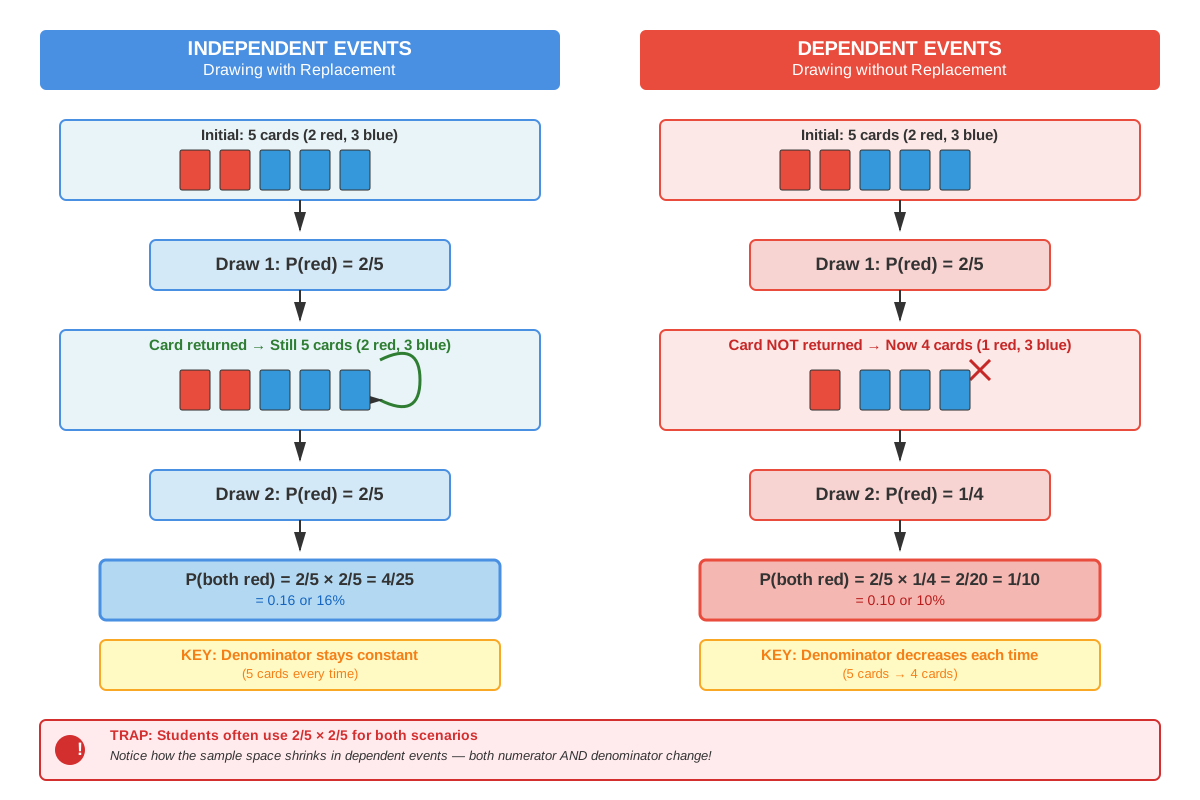
The replacement trap is perhaps the most common probability trap on the SAT. This trap exploits the difference between independent events (where one outcome doesn't affect another) and dependent events (where previous outcomes change subsequent probabilities). When selecting items from a group, whether items are replaced after selection fundamentally changes the calculation.
Without replacement: If you draw a red marble from a bag containing 3 red and 7 blue marbles, then draw again without replacing the first marble, the second draw occurs from a bag with only 9 marbles remaining. The probabilities are dependent.
With replacement: If you replace the first marble before drawing again, each draw occurs from the same 10-marble population, making the events independent.
The SAT exploits this by:
- Using ambiguous language that doesn't clearly specify replacement
- Presenting scenarios where students assume independence when events are actually dependent
- Creating answer choices that correspond to both interpretations, with the incorrect assumption leading to a trap answer
The "At Least One" Trap
Questions asking for the probability of "at least one" success often trap students who try to calculate directly. The phrase "at least one" means "one or more," which could include many different scenarios. For example, "at least one head in three coin flips" includes: exactly one head, exactly two heads, or three heads.
The complementary counting approach provides the elegant solution: P(at least one) = 1 - P(none). This works because "at least one" and "none" are complementary events that together encompass all possibilities. Students who miss this trap often attempt to add multiple probabilities and either make calculation errors or run out of time.
The Conditional Probability Trap
Conditional probability questions ask for the probability of event A given that event B has already occurred, written as P(A|B). The trap occurs when students calculate P(A) instead of P(A|B), ignoring the condition that restricts the sample space.
For example: "In a class of 30 students, 18 play soccer and 12 play basketball, with 7 playing both. If a student plays soccer, what's the probability they also play basketball?" The trap answer calculates 7/30 (probability any random student plays both), while the correct answer is 7/18 (probability a soccer player also plays basketball, given the restricted sample space of soccer players).
The Order Matters Trap
The SAT frequently tests whether students recognize when order matters in probability calculations. This trap appears in questions about arrangements, sequences, or selections where the distinction between permutations (order matters) and combinations (order doesn't matter) affects the outcome count.
Consider: "What's the probability that Amy and Bob sit next to each other when 5 people randomly arrange themselves in a row?" Students who don't carefully consider whether "Amy-Bob" and "Bob-Amy" are different arrangements will miscalculate the favorable outcomes.
The Overlapping Events Trap
When calculating P(A or B), students often incorrectly add P(A) + P(B), forgetting to subtract P(A and B) when events overlap. The correct formula is:
P(A or B) = P(A) + P(B) - P(A and B)The SAT creates trap answers by providing P(A) + P(B) as an option, knowing students will select it when events aren't mutually exclusive. This trap often appears in Venn diagram contexts or scenarios involving students with multiple characteristics.
The Sample Space Trap
Perhaps the most fundamental trap involves miscounting the total possible outcomes (the denominator in probability calculations). The SAT creates scenarios where the obvious count is incorrect because:
- Some outcomes are impossible or restricted by constraints
- The question asks about a subset of all possibilities
- Outcomes aren't equally likely (violating the assumption behind simple probability)
For example: "A four-digit code uses digits 1-5 without repetition. What's the probability the code starts with 1?" The trap is calculating 1/5 (treating each starting digit as equally likely in all codes) rather than recognizing that exactly 1/5 of all valid codes start with 1, but this requires understanding that the sample space is all permutations of 4 digits from 5.
The Independence Assumption Trap
Students often assume events are independent when they're actually dependent, or vice versa. The SAT tests this by presenting scenarios where the relationship between events isn't immediately obvious. Two events A and B are independent only if P(A and B) = P(A) × P(B).
Common scenarios where students incorrectly assume independence:
- Drawing cards without replacement
- Selecting people from the same group for different roles
- Events that share a common cause or constraint
The Geometric Probability Trap
When probability involves randomly selecting points in geometric regions, students often confuse area with perimeter or length, or fail to correctly calculate the relevant geometric measurements. The probability equals the ratio of the favorable region's area (or length, for one-dimensional problems) to the total region's area (or length).
The trap intensifies when regions have irregular shapes or when the favorable region isn't explicitly shaded or described, requiring students to determine it from the problem conditions.
Concept Relationships
The core probability traps interconnect through a common theme: they exploit the gap between intuitive reasoning and rigorous mathematical analysis. The replacement trap and independence assumption trap are closely related—both involve understanding when events affect each other. Recognizing dependent events (replacement trap) requires checking whether events are truly independent (independence assumption trap).
The conditional probability trap connects to the sample space trap because conditional probability essentially redefines the sample space based on given information. When calculating P(A|B), the sample space shrinks from all outcomes to only those where B occurs.
The "at least one" trap relates to the overlapping events trap through complementary counting and the addition rule. Both require careful attention to whether outcomes can occur simultaneously and how to avoid double-counting.
Relationship map:
Sample Space Definition → affects → All Probability Calculations → branches into → Independent Events (Replacement Trap, Independence Assumption) and Dependent Events (Conditional Probability Trap) → both connect to → Compound Events (At Least One Trap, Overlapping Events Trap) → all require → Careful Counting (Order Matters Trap, Geometric Probability Trap)
Quick check — test yourself on SAT probability traps so far.
Try Flashcards →High-Yield Facts
⭐ The probability of "at least one" success equals 1 minus the probability of zero successes—this complementary approach almost always simplifies calculation
⭐ Without replacement, probabilities change after each selection; with replacement, each selection is independent with identical probabilities
⭐ Conditional probability P(A|B) uses only outcomes where B occurred as the sample space, not all possible outcomes
⭐ For overlapping events, P(A or B) = P(A) + P(B) - P(A and B); forgetting to subtract the overlap is a designed trap
⭐ When order matters in arrangements, the number of outcomes is typically much larger than when order doesn't matter
- Independent events satisfy P(A and B) = P(A) × P(B); if this equation doesn't hold, events are dependent
- The sample space must include all equally likely outcomes; if outcomes aren't equally likely, simple counting fails
- Geometric probability uses area ratios for two-dimensional regions and length ratios for one-dimensional regions
- Mutually exclusive events cannot occur simultaneously, so P(A and B) = 0 for such events
- The sum of all probabilities in a complete sample space always equals 1; this provides a useful check for calculations
Common Misconceptions
Misconception: Drawing without replacement doesn't significantly change probabilities if the population is large → Correction: While the effect diminishes with larger populations, the SAT specifically designs problems where the change matters. Always adjust probabilities for dependent events, regardless of population size.
Misconception: P(A or B) always equals P(A) + P(B) → Correction: This only holds for mutually exclusive events. When events can occur together, you must subtract P(A and B) to avoid counting the overlap twice.
Misconception: "At least one" means "exactly one" → Correction: "At least one" means "one or more," including all scenarios with one, two, three, or more successes. Use complementary counting: P(at least one) = 1 - P(none).
Misconception: Conditional probability P(A|B) equals P(B|A) → Correction: These are generally different values. P(A|B) asks about A given B occurred, while P(B|A) asks about B given A occurred. The condition changes which event's probability you're calculating.
Misconception: If two events seem unrelated, they must be independent → Correction: Independence requires mathematical verification: P(A and B) = P(A) × P(B). Events can be related through hidden connections or shared constraints even when they seem unrelated.
Misconception: The probability of a sequence of events equals the probability of any single event → Correction: For independent events, multiply probabilities: P(A and B) = P(A) × P(B). For dependent events, adjust each subsequent probability based on previous outcomes.
Misconception: Geometric probability can use any measurement (perimeter, area, volume) interchangeably → Correction: The measurement must match the dimension of random selection. For points randomly placed in a region, use area (2D) or volume (3D); for points on a line segment, use length (1D).
Worked Examples
Example 1: The Replacement Trap with Conditional Probability
Problem: A bag contains 5 red marbles and 3 blue marbles. Two marbles are drawn without replacement. What is the probability that the second marble is red, given that the first marble was blue?
Solution:
Step 1: Identify the trap. The question asks for conditional probability, and the scenario involves dependent events (without replacement). Students might incorrectly calculate 5/8 (the probability of drawing red initially) or 5/7 (the probability of drawing red second without considering the condition).
Step 2: Understand what "given that the first marble was blue" means. This condition tells us that one blue marble has been removed, so the bag now contains 5 red and 2 blue marbles (7 total).
Step 3: Calculate the conditional probability. Given the first marble was blue, the sample space for the second draw contains 7 marbles, of which 5 are red.
P(second is red | first is blue) = 5/7
Step 4: Verify the answer makes sense. Since a blue marble was removed, the proportion of red marbles increased from 5/8 to 5/7, which is logical.
Connection to learning objectives: This example demonstrates identifying the replacement trap (dependent events), recognizing conditional probability, and systematically working through the restricted sample space.
Example 2: The "At Least One" Trap
Problem: A fair coin is flipped 4 times. What is the probability of getting at least one head?
Solution:
Step 1: Recognize the trap. Calculating "at least one head" directly requires finding P(exactly 1 head) + P(exactly 2 heads) + P(exactly 3 heads) + P(exactly 4 heads), which involves multiple binomial calculations.
Step 2: Apply complementary counting. "At least one head" is the complement of "no heads" (all tails).
P(at least one head) = 1 - P(no heads)
Step 3: Calculate P(no heads). For all tails in 4 flips:
P(all tails) = (1/2) × (1/2) × (1/2) × (1/2) = 1/16
Step 4: Calculate the final answer:
P(at least one head) = 1 - 1/16 = 15/16
Step 5: Verify. Out of 16 equally likely outcomes (HHHH, HHHT, HHTH, ..., TTTT), only one outcome (TTTT) has no heads, leaving 15 outcomes with at least one head. This confirms 15/16.
Connection to learning objectives: This example shows how to identify the "at least one" trap, apply complementary counting efficiently, and verify the answer through systematic enumeration.
Exam Strategy
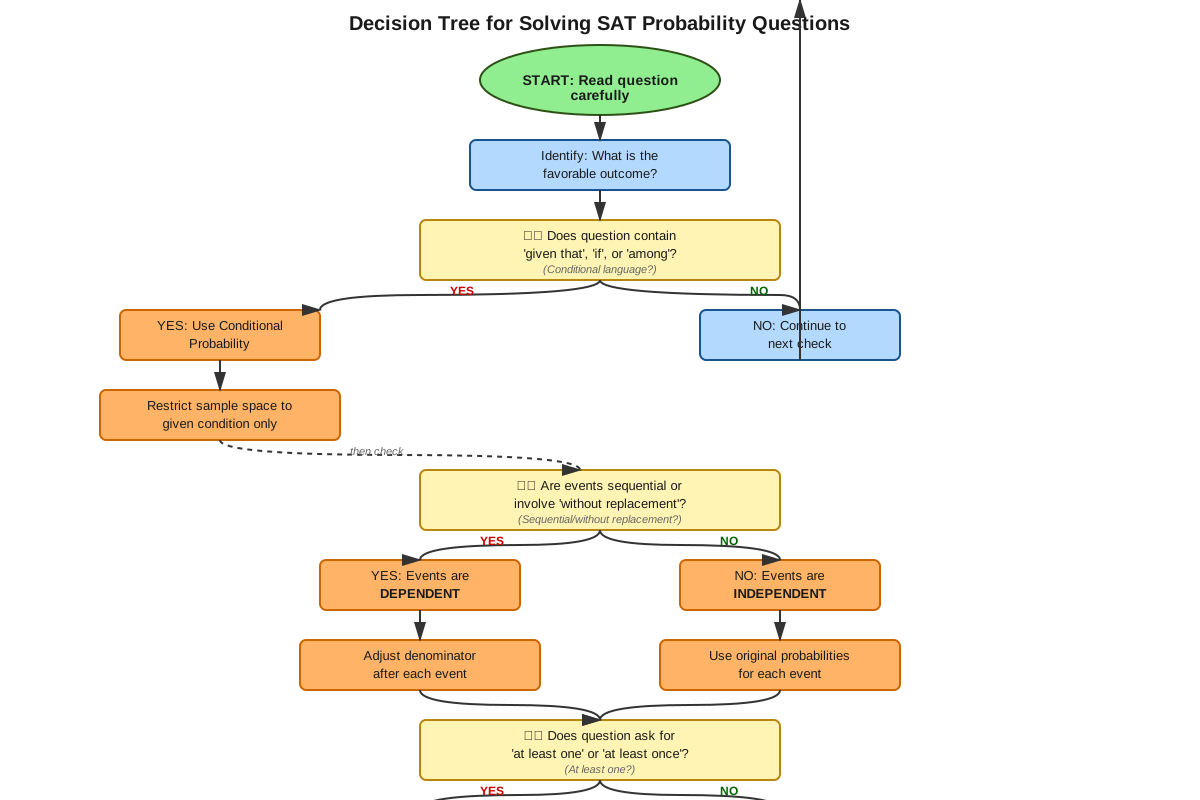
When approaching SAT probability questions, implement this systematic process:
Step 1: Read carefully and identify the scenario type. Look for trigger phrases:
- "Without replacement" or "not returned" → dependent events
- "At least one" or "one or more" → use complementary counting
- "Given that" or "if we know" → conditional probability
- "Or" → check if events overlap (use addition rule with overlap subtraction)
- "And" → typically multiply probabilities (check independence first)
Step 2: Define the sample space explicitly. Write down or mentally enumerate:
- Total number of possible outcomes
- Any restrictions or constraints that eliminate outcomes
- Whether outcomes are equally likely
Step 3: Identify favorable outcomes. Count carefully:
- Does order matter in this scenario?
- Are there any outcomes being double-counted?
- Does the condition restrict which outcomes are favorable?
Step 4: Check for trap indicators:
- Does the problem involve multiple stages or selections?
- Are events described as independent, or should you verify?
- Is there an "obvious" answer that seems too simple?
Step 5: Calculate and verify. After computing the probability:
- Does the answer fall between 0 and 1?
- Is it in simplified form?
- Does it make intuitive sense given the scenario?
Exam Tip: If a probability question seems to have an immediate, obvious answer, pause and check for traps. The SAT rarely rewards hasty intuition in probability questions.
Time allocation: Spend 60-90 seconds on straightforward probability questions, but allow up to 2 minutes for complex scenarios involving multiple traps. If you're stuck after 2 minutes, mark the question and return to it after completing easier problems.
Process of elimination: Eliminate answers that:
- Are greater than 1 or less than 0
- Represent probabilities of the wrong event (e.g., P(A) when the question asks for P(A|B))
- Result from adding probabilities when multiplication is needed, or vice versa
- Ignore the "without replacement" condition in dependent events
Memory Techniques
RICE for probability trap categories:
- Replacement (with or without)
- Independence (verify, don't assume)
- Conditional (given that = restricted sample space)
- Enumeration (count all outcomes carefully)
"1 minus" for "at least": Whenever you see "at least one," think "1 minus none." This mnemonic reminds you to use complementary counting.
"And means multiply, Or means add": This basic rule helps with compound events, but remember to check for overlaps when using "or" (subtract the intersection).
Visualization strategy: For complex probability scenarios, draw a tree diagram or two-way table. Visual representations make dependent events and conditional probabilities more concrete and reduce calculation errors.
The "shrinking bag" mental model: For without-replacement problems, visualize the container physically shrinking after each selection. This reinforces that both the numerator (favorable outcomes) and denominator (total outcomes) change.
Summary
SAT probability traps represent carefully designed questions that exploit common reasoning errors and hasty assumptions. The most prevalent traps involve confusion between independent and dependent events (particularly in replacement scenarios), misunderstanding conditional probability by failing to restrict the sample space, incorrectly calculating "at least one" probabilities through direct enumeration rather than complementary counting, and miscounting total or favorable outcomes. Success requires moving beyond intuitive reasoning to systematic analysis: explicitly defining the sample space, carefully identifying whether events are independent or dependent, recognizing when conditional probability restricts the relevant outcomes, and verifying that calculations account for all constraints. The SAT consistently includes 2-4 probability questions per administration, making this a high-yield topic where focused preparation on recognizing and avoiding traps can significantly improve scores. Mastery involves not just knowing probability formulas but developing the disciplined approach of questioning initial assumptions, checking for trap indicators, and systematically working through each component of probability calculations.
Key Takeaways
- Without replacement creates dependent events—always adjust probabilities after each selection when items aren't returned to the population
- Use complementary counting for "at least one" questions—calculate 1 - P(none) rather than summing multiple scenarios
- Conditional probability restricts the sample space—P(A|B) uses only outcomes where B occurred, not all possible outcomes
- Verify independence mathematically—don't assume events are independent; check whether P(A and B) = P(A) × P(B)
- For overlapping events, subtract the intersection—P(A or B) = P(A) + P(B) - P(A and B) prevents double-counting
- Count the sample space carefully—enumerate all equally likely outcomes and verify no outcomes are impossible or restricted
- Pause when an answer seems obvious—SAT probability questions reward careful analysis over quick intuition
Related Topics
Counting Principles and Combinatorics: Understanding permutations and combinations provides the foundation for calculating total and favorable outcomes in complex probability scenarios. Mastering probability traps enables progression to more sophisticated counting problems.
Statistics and Data Analysis: Probability concepts extend naturally into statistical inference, where understanding conditional probability and independence becomes crucial for interpreting data relationships and making predictions.
Set Theory and Venn Diagrams: Visual representations of overlapping events through Venn diagrams clarify the addition rule for probability and help avoid double-counting errors in complex scenarios.
Binomial Probability: After mastering basic probability traps, students can progress to binomial probability distributions, which formalize the calculation of "exactly k successes in n trials."
Expected Value: Probability serves as the foundation for expected value calculations, which appear in SAT questions involving games, investments, and decision-making scenarios.
Practice CTA
Now that you understand the common traps in SAT probability questions, it's time to put your knowledge into practice. Work through the practice questions to encounter these traps in realistic SAT contexts, and use the flashcards to reinforce the key distinctions between independent and dependent events, conditional and simple probability, and direct versus complementary counting. Remember: recognizing these traps during practice builds the pattern recognition that will save you time and boost accuracy on test day. Each trap you learn to avoid is a question you'll confidently answer correctly when it matters most!
Sign up free to keep reading
Create a free AnvayaPrep account to finish this SAT guide on SAT probability traps — plus flashcards and practice questions.