Overview
The quadratic form is one of the most fundamental and frequently tested concepts in SAT math. Understanding quadratic form means recognizing and working with quadratic expressions and equations in their standard structure: ax² + bx + c, where a, b, and c are constants and a ≠ 0. This topic appears across multiple question types on the SAT, from straightforward algebraic manipulation to complex word problems involving parabolic motion, area calculations, and optimization scenarios. Mastery of quadratic form is not merely about memorizing a formula—it requires understanding how to identify, manipulate, and transform quadratic expressions to solve problems efficiently.
On the SAT, quadratic form questions typically account for 10-15% of the math section, making this a high-yield topic that directly impacts your score. These questions test your ability to recognize when an equation is quadratic, convert between different forms (standard, factored, and vertex), and apply appropriate solution strategies. The College Board frequently embeds quadratic form within real-world contexts, requiring students to translate verbal descriptions into mathematical expressions and interpret solutions within practical constraints.
The significance of quadratic form extends beyond isolated algebraic manipulation. It serves as a bridge connecting linear equations, polynomial functions, graphing concepts, and systems of equations. Understanding quadratic form provides the foundation for analyzing parabolas, determining maximum and minimum values, and solving complex problems involving projectile motion, profit optimization, and geometric relationships. This interconnectedness makes quadratic form an essential building block for success not only on the SAT but also in higher-level mathematics.
Learning Objectives
- [ ] Identify key features of quadratic form including coefficients, degree, and standard structure
- [ ] Explain how quadratic form appears on the SAT across different question types and contexts
- [ ] Apply quadratic form to answer SAT-style questions efficiently and accurately
- [ ] Convert between standard form, factored form, and vertex form of quadratic expressions
- [ ] Determine the number and nature of solutions using the discriminant
- [ ] Recognize when a real-world problem requires quadratic modeling
- [ ] Interpret the meaning of coefficients and solutions within context-based problems
Prerequisites
- Linear equations and expressions: Understanding how to solve first-degree equations provides the foundation for recognizing the increased complexity of second-degree (quadratic) equations
- Order of operations and algebraic manipulation: Essential for expanding, factoring, and simplifying quadratic expressions correctly
- Coordinate plane and graphing basics: Necessary for visualizing parabolas and understanding the geometric interpretation of quadratic solutions
- Exponent rules: Required for working with squared terms and understanding why x² creates the characteristic parabolic shape
- Factoring techniques: Basic factoring skills enable the conversion between different forms of quadratic expressions
Why This Topic Matters
Quadratic form represents a critical transition point in mathematical thinking—moving from linear relationships to non-linear models that better represent real-world phenomena. In practical applications, quadratic equations model countless scenarios: the trajectory of a basketball shot, the profit-maximizing price point for a product, the optimal dimensions of a rectangular garden with fixed perimeter, and the relationship between braking distance and vehicle speed. Engineers use quadratic models to design suspension bridges, physicists apply them to projectile motion, and economists employ them to analyze cost-benefit relationships.
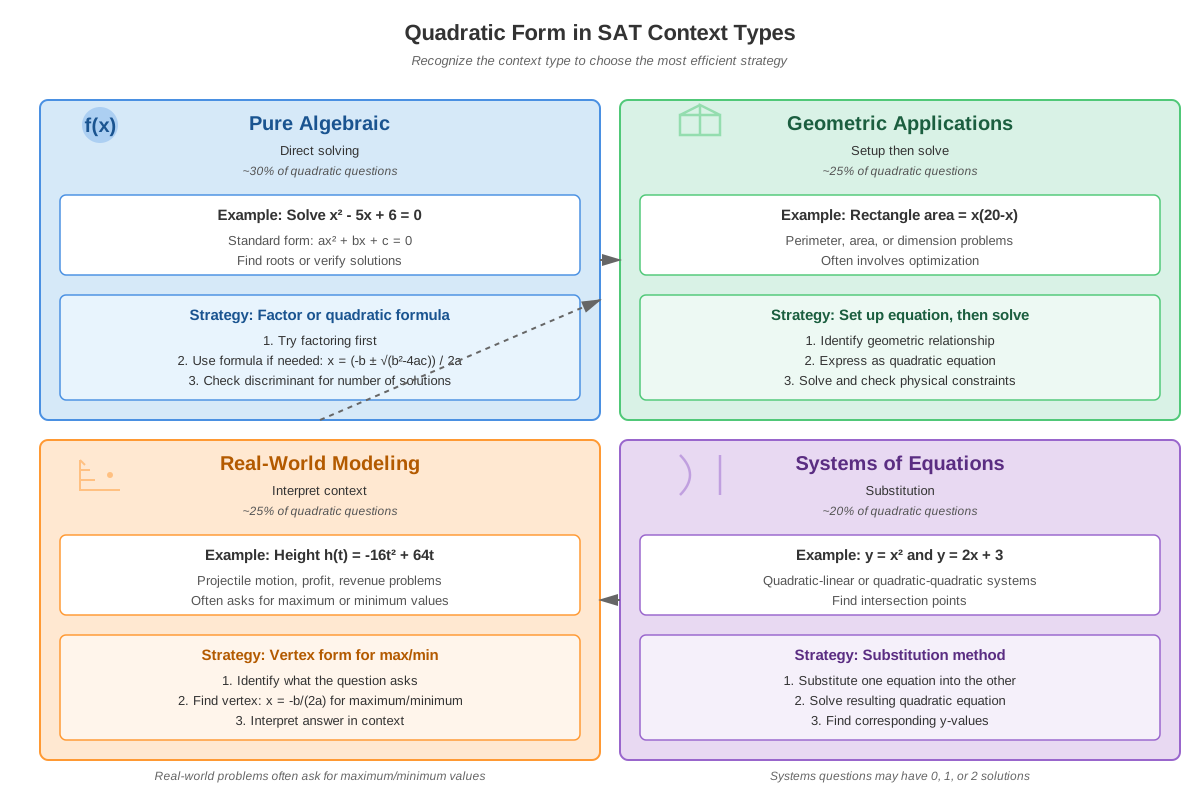
On the SAT, quadratic form appears in approximately 4-6 questions per test, distributed across both the calculator and no-calculator sections. These questions manifest in several distinct formats: direct algebraic manipulation (expanding or factoring expressions), solving quadratic equations using various methods, interpreting graphs of parabolas, analyzing word problems that require quadratic modeling, and working with systems that include one quadratic and one linear equation. The College Board particularly favors questions that require students to move flexibly between algebraic and graphical representations or to interpret solutions within real-world constraints.
Common SAT question types include: identifying the vertex or axis of symmetry from an equation, determining how many solutions exist without fully solving, finding the value of a coefficient given specific conditions about the parabola, solving systems graphically or algebraically, and translating word problems into quadratic equations. The test frequently presents quadratics in non-standard forms, requiring recognition and transformation before solution. Understanding quadratic form thoroughly enables students to approach these varied question types with confidence and efficiency, often identifying shortcuts that save valuable test time.
Core Concepts
Standard Form of a Quadratic
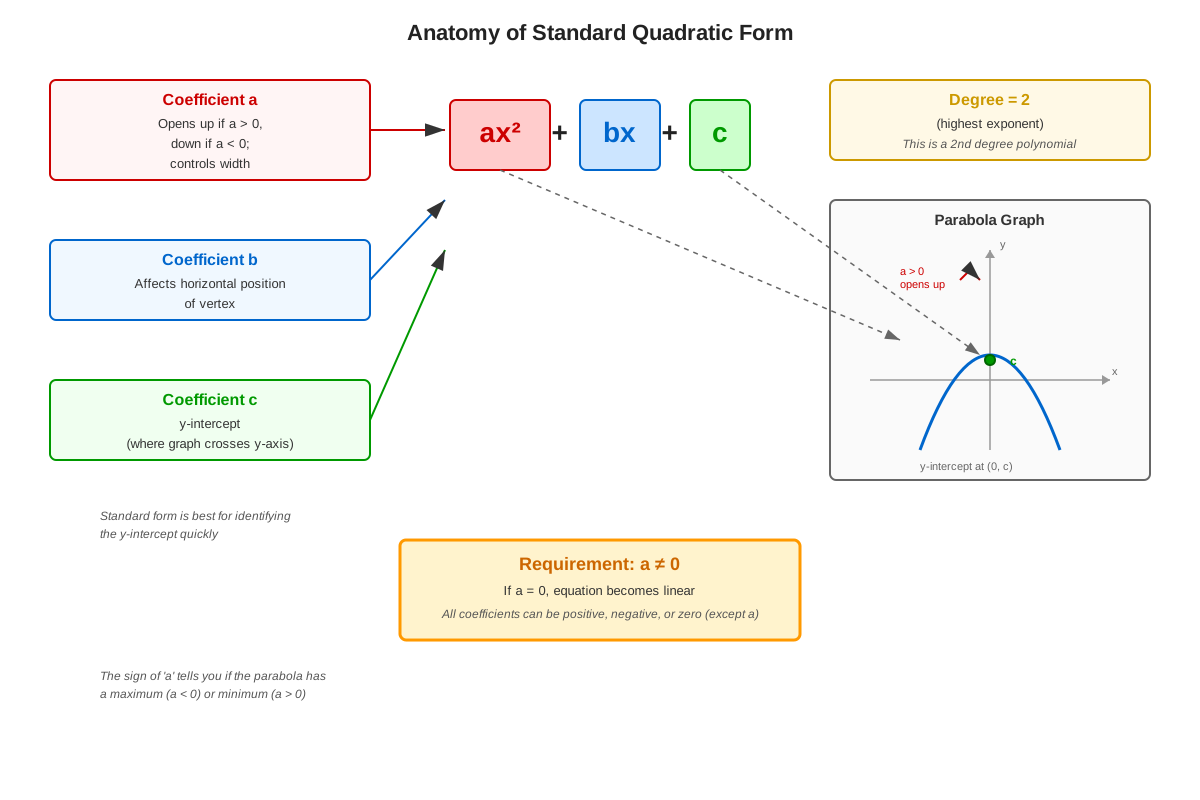
The standard form (also called general form) of a quadratic expression is written as ax² + bx + c, where:
- a is the coefficient of the squared term (must be non-zero)
- b is the coefficient of the linear term
- c is the constant term
The value of a determines the parabola's direction and width: when a > 0, the parabola opens upward (has a minimum point); when a < 0, it opens downward (has a maximum point). The absolute value of a affects the width—larger |a| values create narrower parabolas, while smaller |a| values create wider ones.
Standard form is particularly useful for quickly identifying the y-intercept (which equals c when x = 0) and for applying the quadratic formula. On the SAT, recognizing standard form allows immediate identification of key features and appropriate solution strategies.
Factored Form of a Quadratic
The factored form of a quadratic expression is written as a(x - r₁)(x - r₂), where r₁ and r₂ are the roots (also called zeros or solutions) of the equation. These roots represent the x-intercepts of the parabola—the points where the graph crosses the x-axis.
Factored form provides immediate access to the solutions of the equation. If a quadratic equation equals zero, the Zero Product Property states that at least one factor must equal zero, so x = r₁ or x = r₂. This form is especially valuable when the SAT asks about x-intercepts, the number of solutions, or the sum and product of roots.
Converting from standard form to factored form requires factoring techniques:
- Factor out the greatest common factor if present
- Look for patterns (difference of squares, perfect square trinomials)
- Use the AC method or trial-and-error for trinomials
- Apply the quadratic formula when factoring is difficult
Vertex Form of a Quadratic
The vertex form of a quadratic expression is written as a(x - h)² + k, where the point (h, k) represents the vertex of the parabola—its highest or lowest point. The vertex is the turning point of the parabola and represents either the maximum value (when a < 0) or minimum value (when a > 0) of the quadratic function.
The axis of symmetry is the vertical line x = h that passes through the vertex, dividing the parabola into mirror images. Vertex form immediately reveals both the vertex coordinates and the axis of symmetry, making it invaluable for optimization problems and graphing questions on the SAT.
Converting from standard form to vertex form requires completing the square:
- Factor out a from the x² and x terms (if a ≠ 1)
- Take half of the x coefficient, square it, and add/subtract inside the expression
- Factor the perfect square trinomial
- Simplify to isolate the vertex form structure
The Discriminant and Nature of Solutions
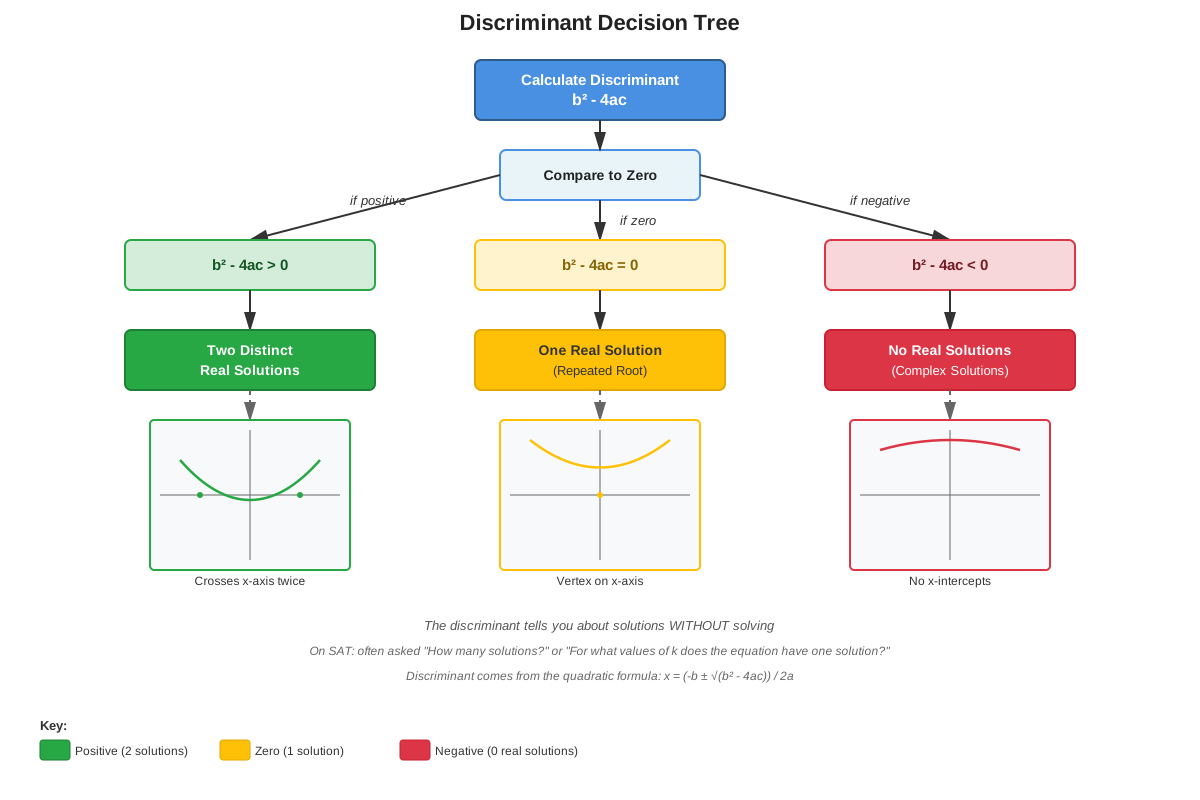
The discriminant is the expression b² - 4ac found under the square root in the quadratic formula. This single value determines the number and type of solutions without requiring complete solution:
| Discriminant Value | Number of Real Solutions | Graphical Interpretation |
|---|---|---|
| b² - 4ac > 0 | Two distinct real solutions | Parabola crosses x-axis twice |
| b² - 4ac = 0 | One real solution (repeated root) | Parabola touches x-axis at vertex |
| b² - 4ac < 0 | No real solutions | Parabola does not intersect x-axis |
The SAT frequently asks students to determine how many solutions exist or to find conditions on coefficients that produce a specific number of solutions. Calculating the discriminant provides this information efficiently without solving the entire equation.
The Quadratic Formula
The quadratic formula provides the solutions to any quadratic equation in standard form:
x = (-b ± √(b² - 4ac)) / (2a)This formula works universally, even when factoring is impossible or impractical. The ± symbol indicates two solutions (corresponding to addition and subtraction), which may be real and distinct, real and equal, or complex conjugates depending on the discriminant.
On the SAT, the quadratic formula is particularly useful when:
- The quadratic doesn't factor easily with integers
- The question asks for exact values rather than approximations
- Time is limited and factoring attempts are unsuccessful
- The coefficients are fractions or decimals
Sum and Product of Roots
For a quadratic equation ax² + bx + c = 0 with roots r₁ and r₂, two important relationships exist:
Sum of roots: r₁ + r₂ = -b/a
Product of roots: r₁ × r₂ = c/a
These relationships, derived from Vieta's formulas, allow students to answer questions about roots without finding their individual values. The SAT occasionally asks for the sum or product of solutions, making these formulas valuable shortcuts. Additionally, these relationships help verify solutions and construct quadratic equations from given roots.
Concept Relationships
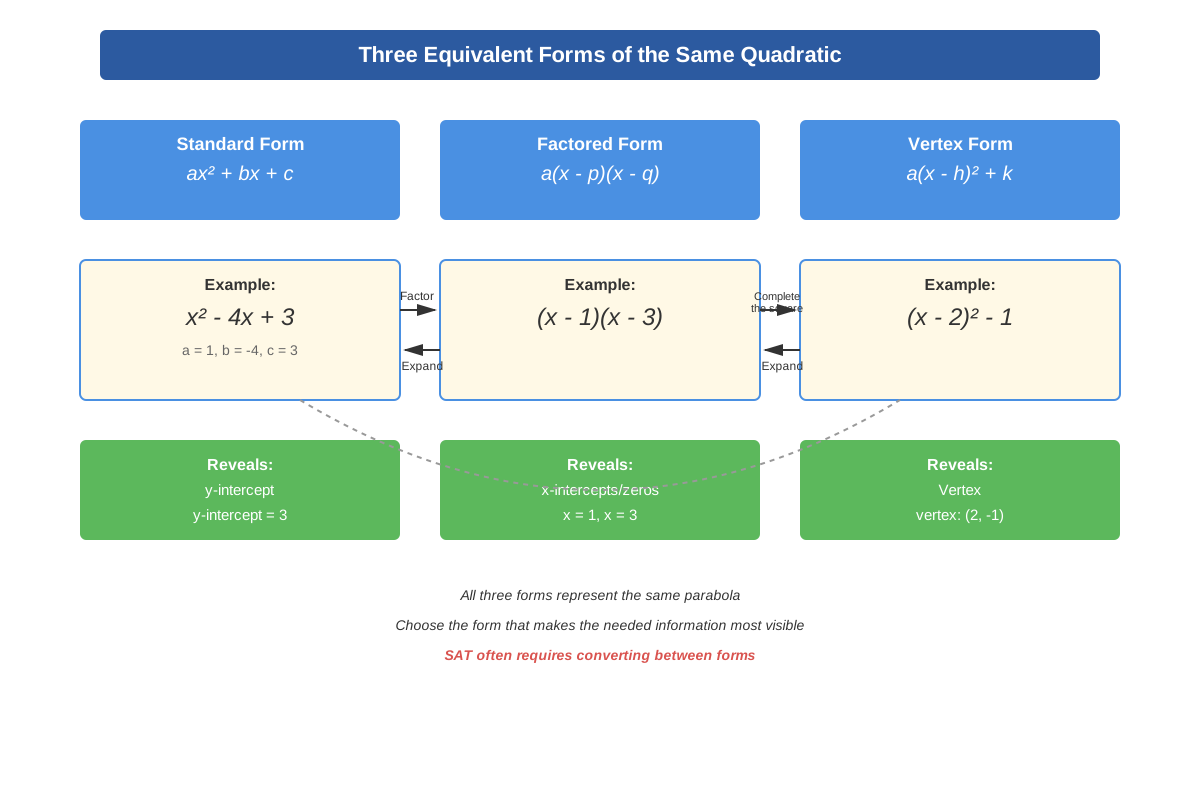
The various forms of quadratic expressions are interconnected through algebraic transformations. Standard form (ax² + bx + c) serves as the central representation, from which both factored form and vertex form can be derived. Factored form emerges through factoring techniques or by applying the quadratic formula to find roots, then reconstructing the expression as a(x - r₁)(x - r₂). Vertex form results from completing the square on standard form, revealing the parabola's turning point.
The discriminant (b² - 4ac) connects directly to the quadratic formula, determining whether the square root produces real or complex values. This connection explains why the discriminant predicts the number of real solutions: positive discriminants yield two distinct real roots, zero discriminants produce one repeated root, and negative discriminants indicate no real solutions (the parabola doesn't cross the x-axis).
The relationship map flows as follows:
Standard Form → (factoring) → Factored Form → (Zero Product Property) → Solutions/Roots
Standard Form → (completing the square) → Vertex Form → (direct reading) → Vertex and Axis of Symmetry
Standard Form → (quadratic formula) → Solutions → (Vieta's formulas) → Sum and Product of Roots
Standard Form → (discriminant calculation) → Nature of Solutions → (graphical interpretation) → Number of x-intercepts
These transformations are bidirectional—given any form, students can derive the others through appropriate algebraic techniques. Understanding these connections enables flexible problem-solving, allowing students to choose the most efficient approach for each SAT question type.
High-Yield Facts
⭐ The standard form of a quadratic is ax² + bx + c where a ≠ 0; if a = 0, the expression is linear, not quadratic
⭐ The sign of coefficient a determines whether the parabola opens upward (a > 0, minimum value) or downward (a < 0, maximum value)
⭐ The discriminant b² - 4ac determines the number of real solutions: positive gives 2, zero gives 1, negative gives 0
⭐ The vertex form a(x - h)² + k immediately reveals the vertex at point (h, k) and axis of symmetry at x = h
⭐ The factored form a(x - r₁)(x - r₂) immediately reveals the x-intercepts at x = r₁ and x = r₂
- The y-intercept of any quadratic in standard form equals the constant term c (found by substituting x = 0)
- The axis of symmetry in standard form can be found using x = -b/(2a)
- The sum of the roots equals -b/a and the product of the roots equals c/a (Vieta's formulas)
- A quadratic equation can have at most two distinct real solutions because it is a second-degree polynomial
- Perfect square trinomials factor as (x + p)² or (x - p)² and have discriminant equal to zero
- The quadratic formula x = (-b ± √(b² - 4ac))/(2a) works for all quadratic equations regardless of whether they factor nicely
- When a quadratic is written in vertex form, the value k represents the maximum or minimum value of the function
- The distance between the two roots of a quadratic equals √(b² - 4ac)/|a|
Quick check — test yourself on Quadratic form so far.
Try Flashcards →Common Misconceptions
Misconception: The coefficient a in ax² + bx + c can equal zero → Correction: If a = 0, the expression becomes bx + c, which is linear, not quadratic. By definition, a quadratic must have a non-zero squared term, making a ≠ 0 a fundamental requirement.
Misconception: A negative discriminant means the quadratic has no solutions at all → Correction: A negative discriminant means no real solutions exist, but the quadratic still has two complex solutions. On the SAT, this typically means the parabola doesn't cross the x-axis, but the equation still has mathematical solutions in the complex number system.
Misconception: The vertex form is a(x - h)² + k, so for the parabola y = 2(x + 3)² - 5, the vertex is at (3, -5) → Correction: The vertex is at (-3, -5). The form uses (x - h), so when the expression shows (x + 3), this equals (x - (-3)), meaning h = -3. The sign inside the parentheses is opposite to the x-coordinate of the vertex.
Misconception: If a quadratic factors as (x - 4)(x + 2), the solutions are x = -4 and x = 2 → Correction: The solutions are x = 4 and x = -2. Using the Zero Product Property, set each factor equal to zero: x - 4 = 0 gives x = 4, and x + 2 = 0 gives x = -2. The solutions are the values that make each factor zero, not the constants in the factors.
Misconception: The quadratic formula only works when the equation is already set equal to zero → Correction: While the quadratic formula is derived assuming the equation equals zero, any quadratic equation must first be rearranged to standard form (ax² + bx + c = 0) before applying the formula. The formula itself requires this form, so rearrangement is a necessary preliminary step, not a limitation.
Misconception: Completing the square always requires adding (b/2)² to both sides of an equation → Correction: When completing the square within an expression (not an equation), you must add and subtract (b/2)² on the same side to maintain equality, creating a zero-sum addition. Only when working with equations do you add to both sides; when transforming expressions, you must balance additions with subtractions.
Misconception: A wider parabola has a larger value of a → Correction: A wider parabola has a smaller absolute value of a (closer to zero). The coefficient a controls the vertical stretch: |a| > 1 creates a narrower parabola, while 0 < |a| < 1 creates a wider parabola. Larger |a| values mean steeper sides and a narrower shape.
Worked Examples
Example 1: Converting Forms and Finding Key Features
Problem: The equation y = 2x² - 12x + 10 represents a parabola. Find the vertex, axis of symmetry, and y-intercept.
Solution:
Step 1: Identify the y-intercept from standard form.
The y-intercept occurs when x = 0, so y = 2(0)² - 12(0) + 10 = 10. The y-intercept is (0, 10).
Step 2: Find the axis of symmetry using the formula x = -b/(2a).
Here, a = 2 and b = -12, so x = -(-12)/(2·2) = 12/4 = 3. The axis of symmetry is x = 3.
Step 3: Convert to vertex form by completing the square.
y = 2x² - 12x + 10
y = 2(x² - 6x) + 10 [factor out a = 2 from the x terms]
y = 2(x² - 6x + 9 - 9) + 10 [add and subtract (6/2)² = 9 inside]
y = 2(x² - 6x + 9) - 18 + 10 [distribute the 2 to the -9]
y = 2(x - 3)² - 8 [factor the perfect square]
Step 4: Read the vertex from vertex form.
From y = 2(x - 3)² - 8, the vertex is (3, -8).
Answer: Vertex: (3, -8); Axis of symmetry: x = 3; Y-intercept: (0, 10)
Connection to Learning Objectives: This example demonstrates identifying key features of quadratic form and applying transformations between standard and vertex forms—essential skills for SAT questions that ask about parabola characteristics.
Example 2: Using the Discriminant to Determine Solutions
Problem: For what value of k does the equation x² + 6x + k = 0 have exactly one real solution?
Solution:
Step 1: Recognize that "exactly one real solution" means the discriminant equals zero.
A quadratic has one real solution when b² - 4ac = 0 (the parabola touches the x-axis at exactly one point—the vertex).
Step 2: Identify the coefficients.
In standard form ax² + bx + c = 0, we have a = 1, b = 6, and c = k.
Step 3: Set up the discriminant equation.
b² - 4ac = 0
(6)² - 4(1)(k) = 0
36 - 4k = 0
Step 4: Solve for k.
36 = 4k
k = 9
Step 5: Verify the answer.
With k = 9, the equation becomes x² + 6x + 9 = 0, which factors as (x + 3)² = 0, giving the single solution x = -3. This confirms our answer.
Answer: k = 9
Connection to Learning Objectives: This example shows how to apply the discriminant concept to answer SAT-style questions about the nature of solutions, demonstrating the practical application of quadratic form theory without requiring complete solution of the equation.
Exam Strategy
When approaching sat quadratic form questions, begin by identifying which form the quadratic is presented in and which form would most efficiently answer the question. If asked about x-intercepts or solutions, look for factored form or consider factoring; if asked about the vertex or maximum/minimum values, vertex form is ideal; if asked about the y-intercept or applying the quadratic formula, standard form is appropriate.
Trigger words and phrases to watch for include:
- "Maximum" or "minimum" → vertex form or completing the square
- "Crosses the x-axis" or "x-intercepts" → factored form or quadratic formula
- "How many solutions" → discriminant
- "Vertex" or "turning point" → vertex form
- "Opens upward/downward" → sign of coefficient a
- "Axis of symmetry" → x = -b/(2a) or x = h from vertex form
Process-of-elimination strategies specific to quadratic form:
- If a question asks how many real solutions exist, calculate the discriminant first—this often eliminates 2-3 answer choices immediately
- When given answer choices for a vertex, substitute the x-coordinate into the original equation to verify the y-coordinate
- For questions about the sign of a coefficient, sketch a quick graph based on the description to eliminate impossible answers
- If asked to identify an equivalent form, check one specific value (like x = 0 or x = 1) in both the original and answer choices to eliminate non-equivalent expressions
Time allocation advice: Spend 15-20 seconds identifying the form and required approach before beginning calculations. Factoring attempts should be limited to 30 seconds—if no obvious factors emerge, switch to the quadratic formula or completing the square. For questions asking about multiple features (vertex, intercepts, etc.), determine which feature is easiest to find first, as it may help verify answer choices or provide information for finding other features. Remember that the SAT rewards efficiency: choosing the right form and method initially saves more time than correcting a complicated approach midway through.
Memory Techniques
Mnemonic for Standard Form: "Always Bring Coffee" reminds you of the order ax² + bx + c, with A being the squared term coefficient, B the linear coefficient, and C the constant.
Mnemonic for Discriminant Interpretation: "Positive = Pair, Zero = Zing (one), Negative = None" helps remember that positive discriminants give two solutions, zero gives one, and negative gives no real solutions.
Visualization for Vertex Form: Picture the vertex form a(x - h)² + k as a "shift and stretch" of the basic parabola y = x². The h value shifts horizontally (opposite sign!), the k value shifts vertically (same sign), and a stretches or compresses vertically.
Acronym for Solution Methods: "FQCG" = Factoring, Quadratic formula, Completing the square, Graphing—the four main approaches to solving quadratic equations, listed from generally fastest to slowest.
Memory aid for axis of symmetry: The formula x = -b/(2a) can be remembered as "negative bee over two aye" said in a pirate voice, making it memorable and helping recall the negative sign that students often forget.
Visualization for parabola direction: Hold your hands in a "U" shape for a > 0 (positive, upward, "U" for "up") and flip them to an upside-down U for a < 0 (negative, downward). This physical gesture reinforces the connection between the sign of a and parabola direction.
Summary
Quadratic form represents the structure and various representations of second-degree polynomial expressions and equations, fundamental to SAT math success. The three primary forms—standard (ax² + bx + c), factored (a(x - r₁)(x - r₂)), and vertex (a(x - h)² + k)—each reveal different features of the parabola and enable different solution strategies. The coefficient a determines the parabola's direction and width, while the discriminant b² - 4ac predicts the number of real solutions without complete solving. Converting between forms through factoring, completing the square, or algebraic expansion allows flexible problem-solving tailored to each question's requirements. The quadratic formula provides a universal solution method, while Vieta's formulas connect roots to coefficients. Mastering quadratic form means recognizing which representation and technique best suits each problem type, efficiently extracting key features like vertices, intercepts, and axes of symmetry, and interpreting solutions within real-world contexts. This topic's high frequency on the SAT and its connections to graphing, systems of equations, and word problems make it essential for achieving a competitive math score.
Key Takeaways
- Quadratic form refers to expressions of the form ax² + bx + c where a ≠ 0, appearing in standard, factored, and vertex forms that reveal different parabola features
- The discriminant b² - 4ac determines the number of real solutions: positive yields two, zero yields one, negative yields none
- The coefficient a controls parabola direction (positive opens up, negative opens down) and width (larger |a| creates narrower parabolas)
- Vertex form a(x - h)² + k immediately reveals the vertex at (h, k) and axis of symmetry at x = h, essential for optimization problems
- Converting between forms strategically—factoring for roots, completing the square for vertices, using standard form for the quadratic formula—enables efficient problem-solving
- The SAT tests quadratic form through direct algebraic manipulation, graphical interpretation, word problems, and systems of equations, making it a high-yield topic worth thorough mastery
- Recognizing trigger words like "maximum," "x-intercepts," and "how many solutions" guides selection of the most efficient solution approach
Related Topics
Polynomial Functions: Quadratic form serves as the foundation for understanding higher-degree polynomials. Mastering quadratics enables progression to cubic and quartic functions, where similar concepts of roots, end behavior, and graphical features apply with increased complexity.
Systems of Equations: Quadratic form extends to systems involving one quadratic and one linear equation, or two quadratic equations. These systems may have zero, one, two, or infinitely many solutions, requiring both algebraic and graphical solution methods.
Inequalities: Quadratic inequalities (ax² + bx + c > 0 or < 0) build directly on quadratic form understanding, requiring students to determine where parabolas lie above or below the x-axis and express solutions as intervals.
Functions and Their Graphs: Quadratic functions f(x) = ax² + bx + c introduce function notation and transformations, connecting algebraic manipulation to graphical interpretation and preparing students for more complex function families.
Complex Numbers: When the discriminant is negative, quadratic solutions involve complex numbers (a + bi form), extending the number system and preparing students for advanced algebra and precalculus topics.
Practice CTA
Now that you've mastered the core concepts of quadratic form, it's time to solidify your understanding through active practice. Attempt the practice questions designed specifically for this topic, focusing on applying the different forms strategically and recognizing which approach each question requires. Use the flashcards to reinforce key formulas, discriminant interpretations, and form conversions until they become automatic. Remember, the SAT rewards both accuracy and speed—consistent practice with these materials will build the fluency needed to tackle quadratic form questions confidently under test conditions. Every practice problem you solve strengthens your pattern recognition and problem-solving efficiency, directly translating to points on test day. You've got this!
Sign up free to keep reading
Create a free AnvayaPrep account to finish this SAT guide on Quadratic form — plus flashcards and practice questions.