Overview
SAT rational expression traps represent one of the most strategically important categories of questions in the math section of the SAT. These questions are specifically designed to catch students who rush through algebraic manipulations without carefully considering domain restrictions, extraneous solutions, and the subtle differences between equivalent and identical expressions. The College Board deliberately constructs these problems to reward careful, methodical thinking over speed, making them high-value targets for score improvement.
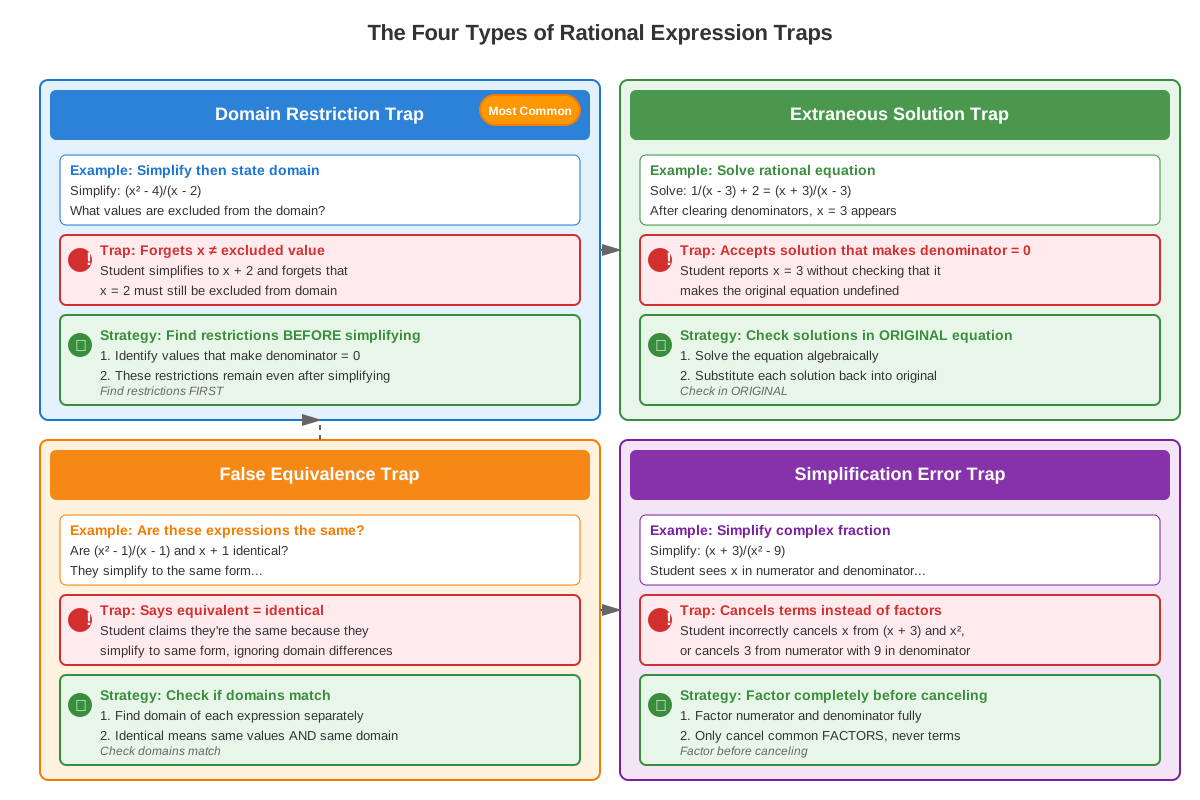
Rational expressions—fractions containing polynomials in the numerator and denominator—appear frequently on the SAT, but the "traps" refer to specific question types that exploit common student errors. These include forgetting to check for values that make denominators zero, incorrectly simplifying expressions, failing to recognize when solutions must be excluded, and misunderstanding what it means for two rational expressions to be equivalent. Understanding these traps is essential because they appear in approximately 2-4 questions per test, often in both multiple-choice and grid-in formats, and frequently serve as medium-to-hard difficulty questions that separate score ranges.
Mastering rational expression traps connects directly to broader algebraic reasoning skills tested throughout the SAT. These questions integrate polynomial factoring, equation solving, function notation, and logical reasoning about mathematical validity. Success with rational expressions also builds the foundation for understanding more complex algebraic relationships, including systems of equations, quadratic functions, and even some advanced topics in the additional math section. The skills developed here—careful attention to domain restrictions and systematic verification of solutions—transfer to virtually every other mathematical topic on the exam.
Learning Objectives
- [ ] Identify key features of SAT rational expression traps
- [ ] Explain how SAT rational expression traps appears on the SAT
- [ ] Apply SAT rational expression traps to answer SAT-style questions
- [ ] Determine domain restrictions for rational expressions and identify excluded values
- [ ] Distinguish between equivalent expressions and identical expressions in rational form
- [ ] Verify solutions to rational equations and eliminate extraneous solutions
- [ ] Recognize common distractor answer choices based on typical student errors
Prerequisites
- Polynomial factoring: Essential for simplifying rational expressions and identifying common factors that can be canceled
- Solving linear and quadratic equations: Required to find solutions to rational equations and to determine when denominators equal zero
- Understanding of fractions and fraction operations: The foundation for all work with rational expressions, including finding common denominators
- Function notation and evaluation: Necessary for understanding when expressions are undefined and for substituting values
- Basic algebraic manipulation: Needed to rearrange equations, combine like terms, and perform operations on rational expressions
Why This Topic Matters
Rational expression traps matter because they directly test mathematical maturity—the ability to think beyond mechanical procedures to consider the logical validity of mathematical operations. In real-world applications, rational expressions model rates, proportions, and relationships where certain values are impossible or undefined (like division by zero representing an impossible scenario). Engineers use rational functions to model electrical resistance in parallel circuits, economists use them for cost-benefit analysis, and scientists employ them in rate calculations where certain conditions would be physically impossible.
On the SAT, rational expression questions appear with remarkable consistency. Approximately 10-15% of algebra questions involve rational expressions, with 2-4 questions per test specifically designed as "trap" questions. These questions most commonly appear in the calculator-permitted section but can also show up in the no-calculator portion. The College Board favors these questions because they efficiently distinguish between students who have procedural knowledge and those who understand mathematical reasoning. Questions typically appear as:
- Multiple-choice questions asking which value is NOT in the domain of an expression
- Grid-in questions requiring students to find the sum of all valid solutions
- Multiple-choice questions asking for equivalent expressions with specific restrictions
- Word problems involving rates or proportions where certain values are impossible
- Questions asking students to identify values that make expressions undefined
The trap element comes from answer choices that include common errors: values obtained by solving without checking, simplified expressions that ignore domain restrictions, or solutions that seem correct but are actually extraneous. These questions reward students who work systematically and verify their answers, making them high-yield targets for score improvement through strategic preparation.
Core Concepts
Understanding Rational Expressions
A rational expression is a fraction where both the numerator and denominator are polynomials. The expression $\frac{x^2 + 3x - 4}{x - 1}$ is rational because both parts are polynomials. The critical feature that creates traps is that rational expressions are undefined when their denominator equals zero. This creates domain restrictions—values that must be excluded from the set of possible inputs.
For any rational expression, the first step is always to identify values that make the denominator zero. For $\frac{x^2 + 3x - 4}{x - 1}$, setting $x - 1 = 0$ gives $x = 1$, so the expression is undefined at $x = 1$. This restriction remains true even after simplification. This is the foundation of most SAT rational expression traps: the College Board creates questions where students must remember these restrictions even after algebraic manipulation.
Domain Restrictions and Excluded Values
The domain of a rational expression is the set of all real numbers except those that make any denominator zero. When working with rational expressions, students must:
- Identify all denominators in the original expression
- Set each denominator equal to zero and solve
- Exclude these values from the domain
- Remember these restrictions throughout all subsequent work
Consider $\frac{2x + 6}{x^2 - 9}$. The denominator factors as $(x + 3)(x - 3)$, so the expression is undefined at $x = -3$ and $x = 3$. Even if this expression is later simplified or combined with other expressions, these restrictions persist. The SAT frequently asks questions like "For which value of $x$ is the expression undefined?" with answer choices including values that might seem correct after simplification but weren't restrictions in the original expression.
Simplifying Rational Expressions and Hidden Traps
When simplifying rational expressions by canceling common factors, the domain restrictions from the original expression must be preserved. This creates a subtle but important distinction:
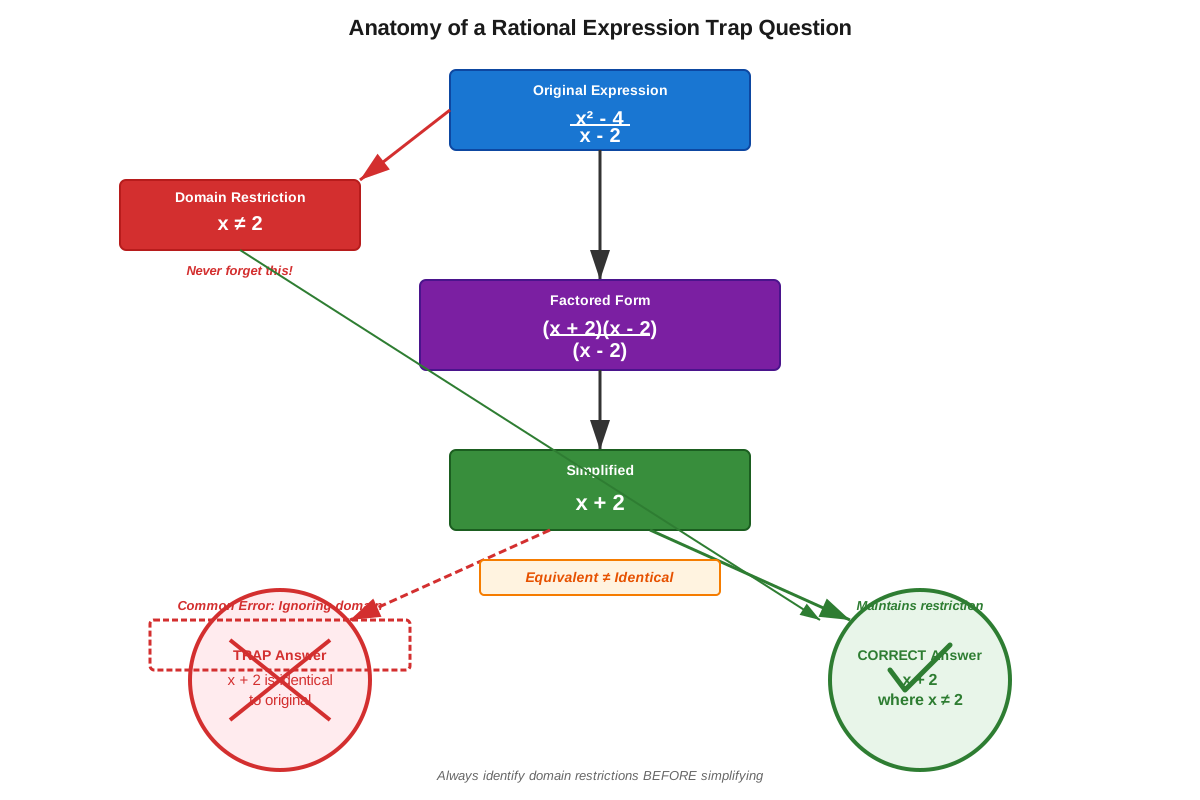
Before simplification: $\frac{x^2 - 4}{x - 2}$
After simplification: $\frac{(x + 2)(x - 2)}{x - 2} = x + 2$ (for $x \neq 2$)
The simplified form $x + 2$ is defined at $x = 2$ (it equals 4), but the original rational expression is not. These expressions are equivalent (they produce the same output for all values in their common domain) but not identical (they don't have the same domain). The SAT exploits this by:
- Asking if two expressions are equivalent without mentioning domain restrictions
- Providing answer choices that ignore the original restrictions
- Creating word problems where the restricted value has physical meaning
Solving Rational Equations and Extraneous Solutions
A rational equation contains rational expressions set equal to a value or another expression. Solving these equations typically requires:
- Identifying domain restrictions before solving
- Multiplying both sides by the least common denominator (LCD)
- Solving the resulting polynomial equation
- Checking each solution against the original restrictions
The trap occurs when the solving process produces extraneous solutions—values that satisfy the transformed equation but not the original. For example:
$$\frac{x}{x - 2} = \frac{2}{x - 2} + 1$$
Multiplying by $(x - 2)$: $x = 2 + (x - 2) = x$
This seems to suggest all values work, but $x = 2$ makes the original equation undefined. The SAT frequently asks for "the solution" or "the sum of all solutions," with trap answers including extraneous values.
Equivalent Expressions vs. Identical Expressions
This distinction is crucial for SAT rational expression traps:
| Aspect | Equivalent Expressions | Identical Expressions |
|---|---|---|
| Definition | Produce same output for all values in common domain | Produce same output for all real numbers |
| Domain | May have different domains | Must have identical domains |
| Example | $\frac{x^2-1}{x-1}$ and $x+1$ | $2x + 4$ and $2(x + 2)$ |
| SAT Testing | Frequently tested in trap questions | Less commonly the focus |
The SAT often asks "Which expression is equivalent to..." and includes answer choices that are algebraically correct but have different domains. Students must recognize that equivalence on the SAT typically means "for all values where both are defined."
Operations with Rational Expressions
When adding, subtracting, multiplying, or dividing rational expressions, new domain restrictions can emerge:
Addition/Subtraction: Find LCD, combine numerators, factor and simplify. Domain excludes values making any denominator zero.
Multiplication: Multiply numerators and denominators, then simplify. Domain excludes values making any factor in any denominator zero.
Division: Multiply by the reciprocal. Domain excludes values making any denominator zero AND values making the divisor equal to zero.
The trap: Students often forget that when dividing by a rational expression, they must exclude values that make the entire divisor equal to zero, not just its denominator.
Complex Fractions
A complex fraction has fractions in its numerator, denominator, or both. For example:
$$\frac{\frac{1}{x} + \frac{1}{y}}{\frac{1}{x} - \frac{1}{y}}$$
To simplify, multiply numerator and denominator by the LCD of all internal fractions (here, $xy$):
$$\frac{xy(\frac{1}{x} + \frac{1}{y})}{xy(\frac{1}{x} - \frac{1}{y})} = \frac{y + x}{y - x}$$
The domain excludes $x = 0$, $y = 0$, and $x = y$. The SAT creates traps by asking about domain restrictions in complex fractions where students might miss one of the multiple restrictions.
Concept Relationships
The concepts within rational expression traps form a hierarchical structure. Understanding rational expressions serves as the foundation, leading directly to identifying domain restrictions, which must be applied throughout all subsequent work. Domain restrictions connect to simplifying rational expressions because simplification can hide original restrictions, creating the distinction between equivalent and identical expressions.
When solving problems, simplifying rational expressions feeds into solving rational equations, where the process of clearing denominators can introduce extraneous solutions. The need to check for extraneous solutions loops back to domain restrictions—the original constraints that determine which solutions are valid.
Operations with rational expressions and complex fractions represent applications that combine all previous concepts. Each operation requires identifying domain restrictions, simplifying carefully, and maintaining awareness of excluded values throughout multi-step procedures.
The relationship to prerequisite topics is direct: polynomial factoring enables identification of domain restrictions and simplification; equation solving provides the tools to find excluded values and solve rational equations; fraction operations transfer directly to rational expression operations with the added complexity of variable expressions.
Textual map: Domain Restrictions → Simplification → Equivalent vs. Identical → Solving Equations → Checking for Extraneous Solutions → Verification against Original Restrictions
Quick check — test yourself on SAT rational expression traps so far.
Try Flashcards →High-Yield Facts
⭐ The domain of a rational expression excludes all values that make any denominator equal to zero, even after simplification.
⭐ When simplifying a rational expression by canceling common factors, the domain restrictions from the original expression still apply.
⭐ Extraneous solutions arise when multiplying both sides of an equation by an expression containing a variable; always check solutions in the original equation.
⭐ Two expressions are equivalent if they produce the same output for all values in their common domain, but they may have different domains.
⭐ When dividing by a rational expression, exclude values that make the divisor equal to zero (not just its denominator).
- The LCD method for solving rational equations can introduce extraneous solutions that must be eliminated.
- Complex fractions have multiple potential restrictions: values making internal denominators zero and values making the main denominator zero.
- If a rational equation has no solution, it's often because all algebraic solutions are extraneous (excluded by domain restrictions).
- The sum or difference of rational expressions has a domain that excludes values making any original denominator zero.
- When a question asks "for what value is the expression undefined," it's testing domain restrictions, not solving an equation.
- Factoring denominators completely is essential for identifying all domain restrictions.
- The expression $\frac{0}{0}$ is indeterminate (undefined), not equal to zero or one.
Common Misconceptions
Misconception: After simplifying $\frac{x^2 - 9}{x - 3}$ to $x + 3$, the expression is now defined at $x = 3$. → Correction: The simplified form $x + 3$ is algebraically equivalent to the original for all $x \neq 3$, but the original expression's domain restriction ($x \neq 3$) remains. The expressions are equivalent but not identical.
Misconception: When solving $\frac{5}{x-2} = 3$, multiplying both sides by $(x-2)$ gives $5 = 3(x-2)$, so $x = \frac{11}{3}$ is automatically the answer. → Correction: While $x = \frac{11}{3}$ is algebraically correct, students must verify it doesn't make any denominator zero. In this case, it's valid, but the checking step is essential because other problems may yield extraneous solutions.
Misconception: The expressions $\frac{x+2}{x-1}$ and $\frac{x+2}{x-1} \cdot \frac{x+3}{x+3}$ are different because one has been multiplied by something. → Correction: These are identical expressions because $\frac{x+3}{x+3} = 1$ for all $x \neq -3$. However, the second form has an additional domain restriction ($x \neq -3$), making them equivalent but not identical in domain.
Misconception: If an equation simplifies to $0 = 0$ or another identity, then all real numbers are solutions. → Correction: Only values in the domain of the original equation are solutions. If the original equation had restrictions, those still apply. For example, if $\frac{x}{x-1} = \frac{x}{x-1}$ simplifies to an identity, $x = 1$ is still not a solution.
Misconception: When adding $\frac{1}{x} + \frac{1}{x+1}$, the domain only excludes $x = 0$ because that's the first denominator. → Correction: The domain excludes both $x = 0$ and $x = -1$ because both denominators must be considered. Any value making any denominator zero is excluded.
Misconception: Extraneous solutions only occur with radical equations, not rational equations. → Correction: Extraneous solutions commonly arise in rational equations when multiplying by the LCD introduces solutions that make the original denominators zero. Always check solutions against the original equation's domain.
Misconception: If $\frac{A}{B} = \frac{C}{D}$, then $A = C$ and $B = D$. → Correction: Cross-multiplication gives $AD = BC$, not $A = C$ and $B = D$. For example, $\frac{2}{3} = \frac{4}{6}$ but $2 \neq 4$ and $3 \neq 6$.
Worked Examples
Example 1: Identifying Domain Restrictions and Equivalent Expressions
Problem: Which of the following is equivalent to $\frac{x^2 + 5x + 6}{x^2 - 4}$ for all values of $x$ for which the expression is defined?
A) $\frac{x+3}{x-2}$
B) $\frac{x+2}{x-2}$
C) $\frac{x+3}{x+2}$
D) $x + 3$
Solution:
Step 1: Identify domain restrictions before simplifying.
- Denominator: $x^2 - 4 = (x+2)(x-2)$
- Set equal to zero: $(x+2)(x-2) = 0$
- Domain restrictions: $x \neq -2$ and $x \neq 2$
Step 2: Factor the numerator.
- $x^2 + 5x + 6 = (x+2)(x+3)$
Step 3: Simplify by canceling common factors.
$$\frac{(x+2)(x+3)}{(x+2)(x-2)} = \frac{x+3}{x-2}$$ for $x \neq -2, 2$
Step 4: Evaluate answer choices.
- Choice A: $\frac{x+3}{x-2}$ matches our simplified form
- Choice B: Incorrect numerator
- Choice C: Incorrect denominator
- Choice D: Not in rational form; would be defined at $x = 2$, but original isn't
Answer: A
Key insight: This problem tests whether students remember that "equivalent" means producing the same values where both are defined. Choice A maintains the correct domain restrictions.
Example 2: Solving a Rational Equation with Extraneous Solutions
Problem: What is the sum of all solutions to the equation $\frac{x}{x-3} + \frac{2}{x+3} = \frac{6x}{x^2-9}$?
Solution:
Step 1: Identify domain restrictions.
- Denominators: $(x-3)$, $(x+3)$, and $x^2-9 = (x-3)(x+3)$
- Domain restrictions: $x \neq 3$ and $x \neq -3$
Step 2: Find the LCD.
- LCD = $(x-3)(x+3)$
Step 3: Multiply every term by the LCD.
$$\frac{x}{x-3} \cdot (x-3)(x+3) + \frac{2}{x+3} \cdot (x-3)(x+3) = \frac{6x}{(x-3)(x+3)} \cdot (x-3)(x+3)$$
$$x(x+3) + 2(x-3) = 6x$$
Step 4: Expand and simplify.
$$x^2 + 3x + 2x - 6 = 6x$$
$$x^2 + 5x - 6 = 6x$$
$$x^2 - x - 6 = 0$$
Step 5: Factor and solve.
$$(x-3)(x+2) = 0$$
$$x = 3 \text{ or } x = -2$$
Step 6: Check against domain restrictions.
- $x = 3$: Makes denominators zero in original equation → extraneous
- $x = -2$: Doesn't violate any restrictions → valid
Step 7: Find the sum of all valid solutions.
- Only valid solution: $x = -2$
- Sum = $-2$
Answer: $-2$
Key insight: This problem demonstrates the classic trap of obtaining a solution algebraically that must be rejected because it violates the original domain. Students who don't check would incorrectly answer $3 + (-2) = 1$.
Exam Strategy
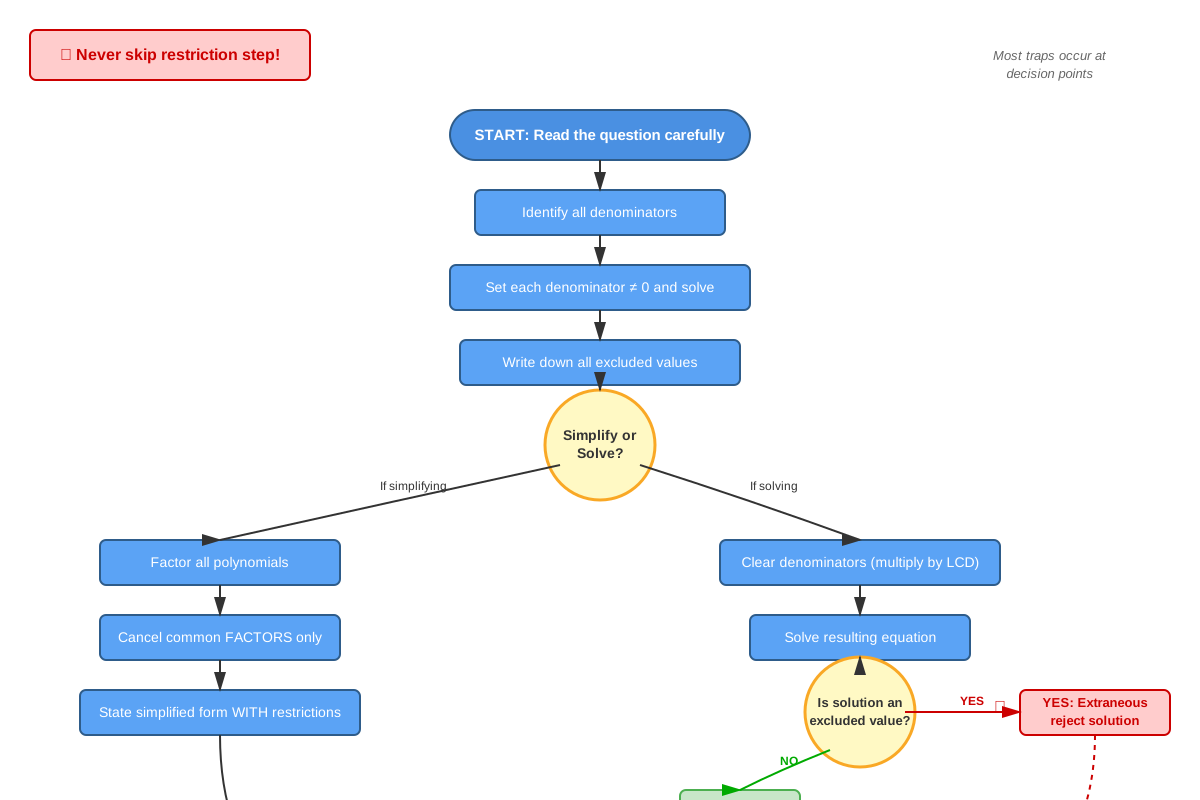
When approaching SAT rational expression traps questions, employ a systematic four-step process: Restrict, Simplify, Solve, Verify (RSSV).
Restrict: Before performing any operations, identify all domain restrictions by setting each denominator equal to zero and solving. Write these restrictions down explicitly—they're easy to forget during multi-step problems.
Simplify: Factor all polynomials completely before canceling. This helps identify common factors and ensures no restrictions are missed. Remember that canceling a factor doesn't eliminate its associated restriction.
Solve: If solving an equation, use the LCD method carefully. When multiplying both sides by an expression containing variables, recognize that this operation can introduce extraneous solutions.
Verify: Always check solutions against the original domain restrictions. For multiple-choice questions, eliminate answers that include restricted values.
Trigger words and phrases to watch for:
- "For which value is the expression undefined" → Find domain restrictions
- "Equivalent to" → Check if domains match or if question specifies "where defined"
- "Sum of all solutions" → Signals potential extraneous solutions to eliminate
- "For all values of $x$" → Requires identical domains, not just equivalent expressions
- "Simplified form" → Remember original restrictions still apply
Process-of-elimination tips:
- Immediately eliminate any answer choice that includes a value making an original denominator zero
- For "equivalent expression" questions, eliminate choices with different domain restrictions unless the question says "where defined"
- If solving an equation yields multiple solutions, eliminate answer choices that include values making denominators zero
- For "undefined" questions, test each answer choice by substituting into denominators
Time allocation: Rational expression questions typically require 60-90 seconds. Spend 15-20 seconds identifying restrictions upfront—this investment prevents errors that waste more time. If a problem seems to have no solution or all solutions are extraneous, that's likely correct; don't second-guess systematic work.
Exam Tip: The SAT rarely asks purely computational rational expression questions. If a problem seems straightforward, double-check for the trap—usually a domain restriction or extraneous solution.
Memory Techniques
RSSV Method: Restrict, Simplify, Solve, Verify—the systematic approach to all rational expression problems. Visualize a four-step staircase where skipping any step causes you to fall.
"Zero Below, Can't Go": A denominator of zero means the expression is undefined—you "can't go" there. This rhyme reinforces that zero denominators create restrictions.
"Cancel the Factor, Keep the Restriction": When you cancel a common factor like $(x-2)$, you must keep the restriction $x \neq 2$. Visualize crossing out the factor but circling the restriction.
"LCD Multiply, Solutions May Lie": When you multiply by the LCD to solve an equation, solutions may be false (extraneous). This reminds you that the multiplication step can introduce invalid solutions.
The "Domain Detective" Approach: Before solving any problem, play detective and investigate all denominators for restrictions. Write "DNE" (Does Not Exist) next to restricted values.
Acronym for checking equivalence—DOVE: Domain, Output, Values, Equal. For expressions to be equivalent, their domains should be considered, their outputs must be equal, and this must hold for all values where both are defined.
Visualization for extraneous solutions: Picture a locked door (domain restriction) that remains locked even after you've found a key (algebraic solution). The key doesn't work if the door was locked from the start.
Summary
SAT rational expression traps represent a high-yield category of questions that test mathematical reasoning beyond procedural fluency. The core principle underlying all traps is that rational expressions have domain restrictions—values that make denominators zero—and these restrictions persist through all algebraic manipulations. When simplifying expressions by canceling common factors, the original domain restrictions remain, creating a distinction between equivalent expressions (same output where both defined) and identical expressions (same domain and output). Solving rational equations requires identifying restrictions before solving, then checking all algebraic solutions against these restrictions to eliminate extraneous solutions introduced by multiplying by the LCD. The SAT exploits common errors: forgetting original restrictions after simplification, including extraneous solutions, confusing equivalent with identical, and missing restrictions in complex fractions. Success requires systematic application of the RSSV method—Restrict, Simplify, Solve, Verify—with particular attention to the verification step that distinguishes high-scoring students from those who rely solely on algebraic manipulation.
Key Takeaways
- Domain restrictions (values making denominators zero) must be identified before any algebraic work and remain valid throughout all subsequent steps
- Simplifying a rational expression by canceling common factors creates an equivalent expression with the same domain restrictions as the original
- Extraneous solutions arise when solving rational equations by multiplying by the LCD; always verify solutions against original restrictions
- The SAT distinguishes between equivalent expressions (same output where both defined) and identical expressions (same domain and output)
- Use the RSSV method (Restrict, Simplify, Solve, Verify) systematically on every rational expression problem
- Questions asking for "sum of all solutions" or "equivalent expressions" are high-probability trap questions requiring careful verification
- When dividing by a rational expression, exclude values making the entire divisor zero, not just its denominator
Related Topics
Polynomial Functions and Graphs: Understanding rational expressions provides the foundation for analyzing rational functions, including asymptotes (which occur at domain restrictions), holes in graphs (from canceled factors), and end behavior. Mastering rational expression traps directly enables interpretation of rational function graphs.
Systems of Equations: Rational equations often appear within systems, particularly in word problems involving rates and work. The skills of identifying restrictions and checking solutions transfer directly to solving systems where one or more equations involve rational expressions.
Advanced Equation Solving: Rational equations serve as a bridge to more complex equation types, including those with radicals and absolute values, which also produce extraneous solutions. The verification habits developed here are essential for all advanced algebra.
Word Problems with Rates and Proportions: Many SAT word problems involve rational expressions representing rates (distance/time, work/time) or proportions. Understanding domain restrictions helps interpret which values are physically meaningful in context.
Practice CTA
Now that you've mastered the concepts behind SAT rational expression traps, it's time to cement your understanding through active practice. Attempt the practice questions to apply the RSSV method and test your ability to identify traps before they catch you. Use the flashcards to reinforce domain restrictions, extraneous solutions, and the distinction between equivalent and identical expressions. Remember: these questions are designed to reward careful, systematic thinking—exactly the approach you've learned here. Each practice problem you solve correctly builds the pattern recognition and confidence you need to handle these high-value questions efficiently on test day. You've got this!
Sign up free to keep reading
Create a free AnvayaPrep account to finish this SAT guide on SAT rational expression traps — plus flashcards and practice questions.