Overview
Part-whole relationships form a fundamental concept in SAT Math that appears consistently across multiple question types in the Ratios, Rates, and Proportions unit. These relationships describe how individual components relate to a complete set or total quantity, and understanding them is essential for solving problems involving percentages, fractions, ratios, and proportional reasoning. On the SAT, part-whole relationships manifest in various contexts: from calculating what fraction of a budget goes to specific expenses, to determining how many students in a class meet certain criteria, to analyzing data sets where subgroups must be compared to the whole population.
The concept of sat part-whole relationships extends beyond simple arithmetic—it requires students to think proportionally and understand how changes in one part affect the whole, or how knowing the whole and one part allows calculation of the remaining parts. This type of reasoning appears in approximately 8-12% of SAT Math questions, making it a high-yield topic that directly impacts test scores. Questions may present scenarios involving populations, measurements, financial data, or abstract quantities, requiring students to identify which value represents the part and which represents the whole before performing calculations.
Mastering part-whole relationships creates a foundation for more advanced mathematical concepts tested on the SAT, including probability, statistics, and data analysis. This topic connects directly to ratio and proportion problems, percentage calculations, and algebraic modeling. Students who develop strong intuition for part-whole relationships can approach complex multi-step problems with confidence, recognizing patterns and relationships that lead to efficient solutions. The ability to translate word problems into mathematical relationships involving parts and wholes is a critical skill that distinguishes high-scoring students from those who struggle with applied mathematics.
Learning Objectives
- [ ] Identify key features of part-whole relationships in various mathematical contexts
- [ ] Explain how part-whole relationships appears on the SAT across different question formats
- [ ] Apply part-whole relationships to answer SAT-style questions efficiently and accurately
- [ ] Convert between different representations of part-whole relationships (fractions, decimals, percentages, ratios)
- [ ] Solve multi-step problems where multiple parts combine to form a whole
- [ ] Analyze word problems to correctly identify which quantities represent parts versus the whole
- [ ] Apply part-whole reasoning to data interpretation and real-world scenarios
Prerequisites
- Basic fraction operations: Understanding how to add, subtract, multiply, and divide fractions is essential since parts are often expressed as fractions of the whole
- Decimal and percentage conversions: Part-whole relationships frequently require converting between these formats to solve problems efficiently
- Ratio fundamentals: Ratios describe relationships between parts or between a part and the whole, forming the basis for proportional reasoning
- Basic algebraic manipulation: Setting up and solving equations involving unknown parts or wholes requires comfort with variables and algebraic expressions
- Order of operations: Multi-step part-whole problems require correct sequencing of mathematical operations to arrive at accurate solutions
Why This Topic Matters
Part-whole relationships appear in countless real-world situations that students encounter daily. Financial literacy depends on understanding how portions of income are allocated to expenses, savings, and investments. Scientific research requires analyzing how subgroups within a population exhibit certain characteristics. Business decisions rely on calculating market share, profit margins, and resource allocation—all applications of part-whole thinking. Medical dosing, recipe scaling, and construction measurements all require proportional reasoning rooted in part-whole relationships.
On the SAT, part-whole relationships appear in approximately 3-5 questions per test, distributed across both the calculator and no-calculator sections. These questions typically fall into several categories: direct calculation problems where students must find a missing part or whole, percentage problems requiring conversion between parts and wholes, ratio problems involving multiple parts that sum to a whole, and data interpretation questions where students analyze graphs or tables showing part-whole distributions. The College Board frequently embeds part-whole relationships within word problems that test reading comprehension alongside mathematical reasoning.
Common SAT question formats include: "If x represents 30% of the total, and y represents 45% of the total, what percent of the total do x and y represent together?" or "A mixture contains ingredients in the ratio 2:3:5. If the total mixture weighs 120 grams, how much of the first ingredient is present?" Questions may also present scenarios involving before-and-after comparisons, where a change in one part affects the whole or the proportions of other parts. Data sufficiency questions may ask whether given information is adequate to determine a specific part-whole relationship, testing conceptual understanding rather than just computational skills.
Core Concepts
Defining Parts and Wholes
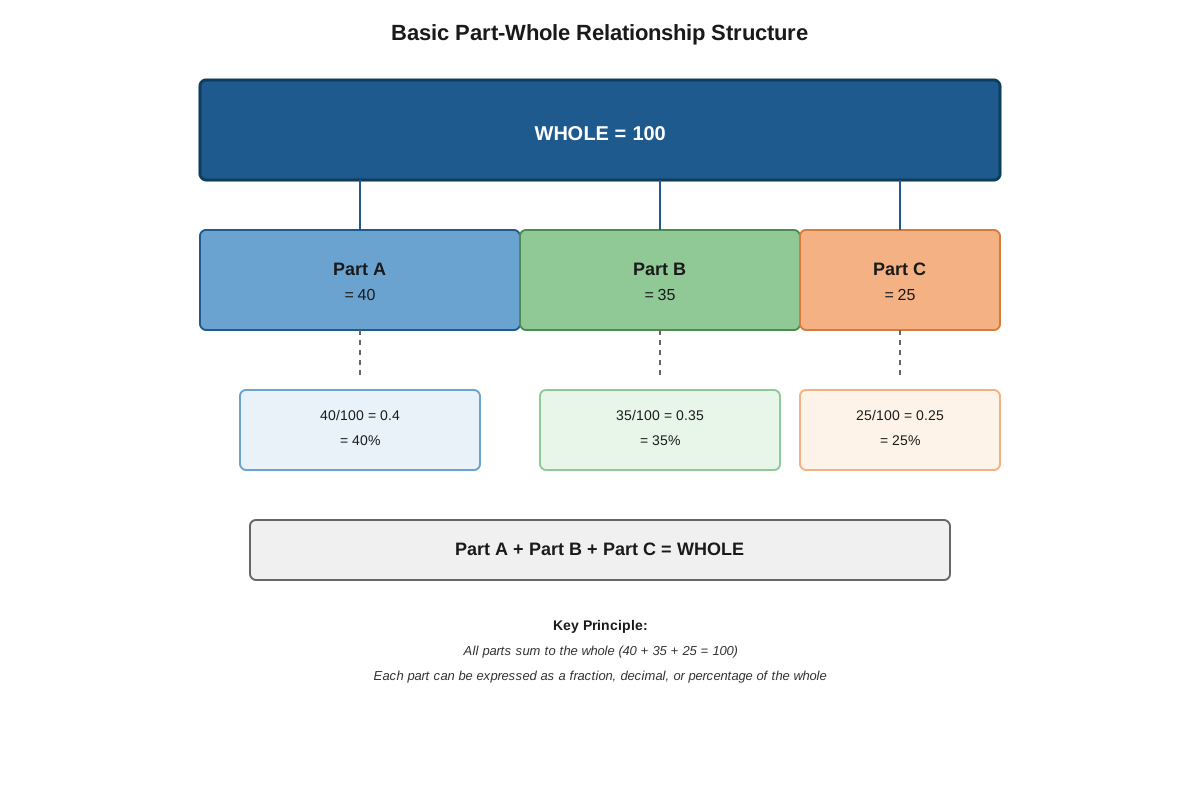
A part-whole relationship describes the connection between a subset (the part) and the complete set (the whole) that contains it. The fundamental principle states that all parts must sum to equal the whole. Mathematically, if a whole is divided into n parts (P₁, P₂, P₃, ... Pₙ), then:
P₁ + P₂ + P₃ + ... + Pₙ = WholeEach part can be expressed as a fraction of the whole: Part/Whole. This fraction can be converted to a decimal by performing the division, or to a percentage by multiplying the decimal by 100. Understanding these equivalent representations allows students to work flexibly with whatever format a problem presents or requires.
The complement principle states that if you know the whole and one part, you can find the remaining part(s) by subtraction: Remaining Parts = Whole - Known Part(s). This principle proves especially useful on the SAT when problems provide indirect information about parts.
Expressing Part-Whole Relationships
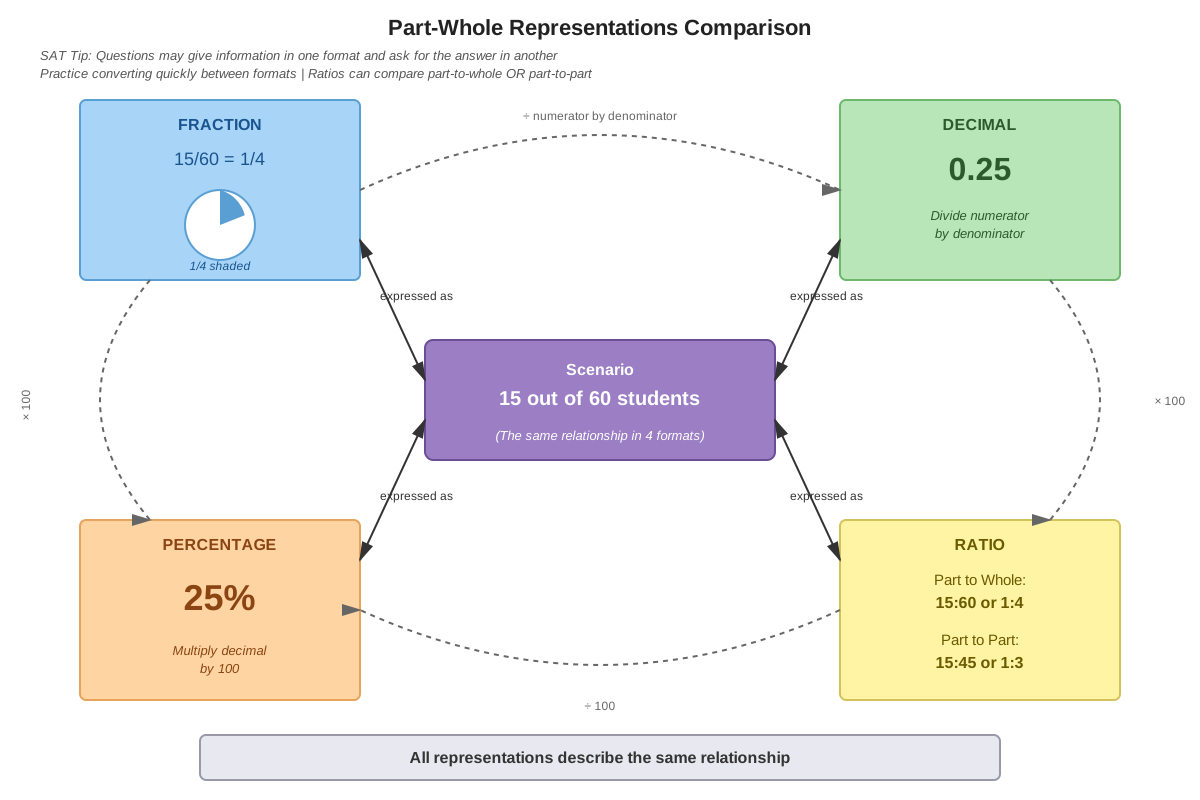
Part-whole relationships can be represented in multiple equivalent forms:
| Representation | Example (15 out of 60) | Calculation |
|---|---|---|
| Fraction | 15/60 = 1/4 | Simplify by dividing numerator and denominator by GCF |
| Decimal | 0.25 | Divide numerator by denominator: 15 ÷ 60 |
| Percentage | 25% | Multiply decimal by 100: 0.25 × 100 |
| Ratio (part:whole) | 15:60 or 1:4 | Express as simplified ratio |
| Ratio (part:part) | 15:45 or 1:3 | Compare one part to remaining parts |
The SAT frequently tests whether students can move fluently between these representations. A problem might provide information as a percentage but require an answer as a fraction, or present a ratio and ask for a percentage.
Calculating Unknown Parts or Wholes
When solving for an unknown part, use the formula:
Part = (Fraction or Percentage) × WholeFor example, to find 35% of 80: Part = 0.35 × 80 = 28
When solving for an unknown whole, rearrange the formula:
Whole = Part ÷ (Fraction or Percentage)For example, if 28 represents 35% of a whole: Whole = 28 ÷ 0.35 = 80
When multiple parts are given as percentages or fractions and you need to find a specific part's actual value, first ensure you know the whole, then apply the appropriate fraction or percentage to that whole.
Multi-Part Problems
Many SAT questions involve scenarios where a whole is divided into three or more parts. These problems require careful organization and often benefit from creating a visual representation or table. The key principle remains: all parts must sum to the whole.
Example scenario: A school's 1,200 students are distributed among freshmen, sophomores, juniors, and seniors in the ratio 5:4:3:3. To find the number of juniors:
- Sum the ratio parts: 5 + 4 + 3 + 3 = 15
- Each ratio unit represents: 1,200 ÷ 15 = 80 students
- Juniors represent 3 units: 3 × 80 = 240 students
This approach—finding the value of one ratio unit—provides a systematic method for solving complex part-whole problems.
Part-to-Part vs. Part-to-Whole Ratios
A critical distinction exists between part-to-part ratios and part-to-whole ratios. A part-to-part ratio compares two components within the whole (e.g., "the ratio of boys to girls is 3:2"), while a part-to-whole ratio compares one component to the entire set (e.g., "boys represent 3/5 of the class").
To convert a part-to-part ratio to part-to-whole:
- Sum all parts to find the whole
- Express each part as a fraction of this sum
For the ratio 3:2 (boys:girls):
- Total parts = 3 + 2 = 5
- Boys represent 3/5 of the whole
- Girls represent 2/5 of the whole
Percentage Change and Part-Whole Relationships
When a part changes, it affects the whole and potentially the proportions of other parts. If a part increases by a certain percentage, the new part equals:
New Part = Original Part × (1 + Percentage Increase)The new whole becomes the sum of all parts with their respective changes applied. SAT questions often ask students to determine how a change in one part affects the percentage that another part represents of the new whole.
Weighted Averages and Part-Whole Thinking
Weighted averages represent a sophisticated application of part-whole relationships. When different parts contribute unequally to a whole, the overall average must account for these different weights:
Weighted Average = (Part₁ × Weight₁ + Part₂ × Weight₂ + ...) ÷ Total WeightThis concept appears in SAT problems involving grade calculations, mixture problems, and population statistics where subgroups have different characteristics.
Concept Relationships
Part-whole relationships serve as the foundation for understanding proportional reasoning throughout mathematics. The core concept of expressing a part as a fraction of the whole leads to percentage calculations, which are simply part-whole relationships expressed per hundred. This connection enables students to solve percentage increase and decrease problems by recognizing that the new value represents a different part-whole relationship than the original.
The relationship between parts and wholes connects directly to ratio concepts, since ratios describe how parts relate to each other or to the whole. When a ratio is given, it implicitly defines part-whole relationships for each component. This understanding extends to proportion problems, where equivalent part-whole relationships exist across different scenarios (e.g., if 3 items cost $12, then 5 items cost $20, maintaining the same part-whole relationship between quantity and cost).
Part-whole thinking forms the basis for probability calculations, where the probability of an event equals the number of favorable outcomes (part) divided by the total number of possible outcomes (whole). Similarly, it underlies statistical concepts like relative frequency and percentile rankings, where individual data points or groups are compared to the entire data set.
In algebraic contexts, part-whole relationships translate into equations where variables represent unknown parts or wholes. The constraint that parts must sum to the whole creates systems of equations that can be solved using algebraic techniques. This connection bridges arithmetic and algebra, showing students how concrete part-whole scenarios can be modeled abstractly.
High-Yield Facts
⭐ All parts of a whole must sum to exactly 100% (or 1 when expressed as decimals, or the total value when expressed in actual quantities)
⭐ To find what percentage one quantity is of another, divide the part by the whole and multiply by 100
⭐ When given a part-to-part ratio, add all ratio components to find the total number of parts before calculating individual values
⭐ If a part represents x% of the whole, the remaining parts represent (100 - x)% of the whole
⭐ To find the whole when given a part and its percentage: Whole = Part ÷ (Percentage ÷ 100)
- When converting between fractions, decimals, and percentages, the underlying part-whole relationship remains constant
- In mixture problems, the sum of all component quantities equals the total mixture quantity
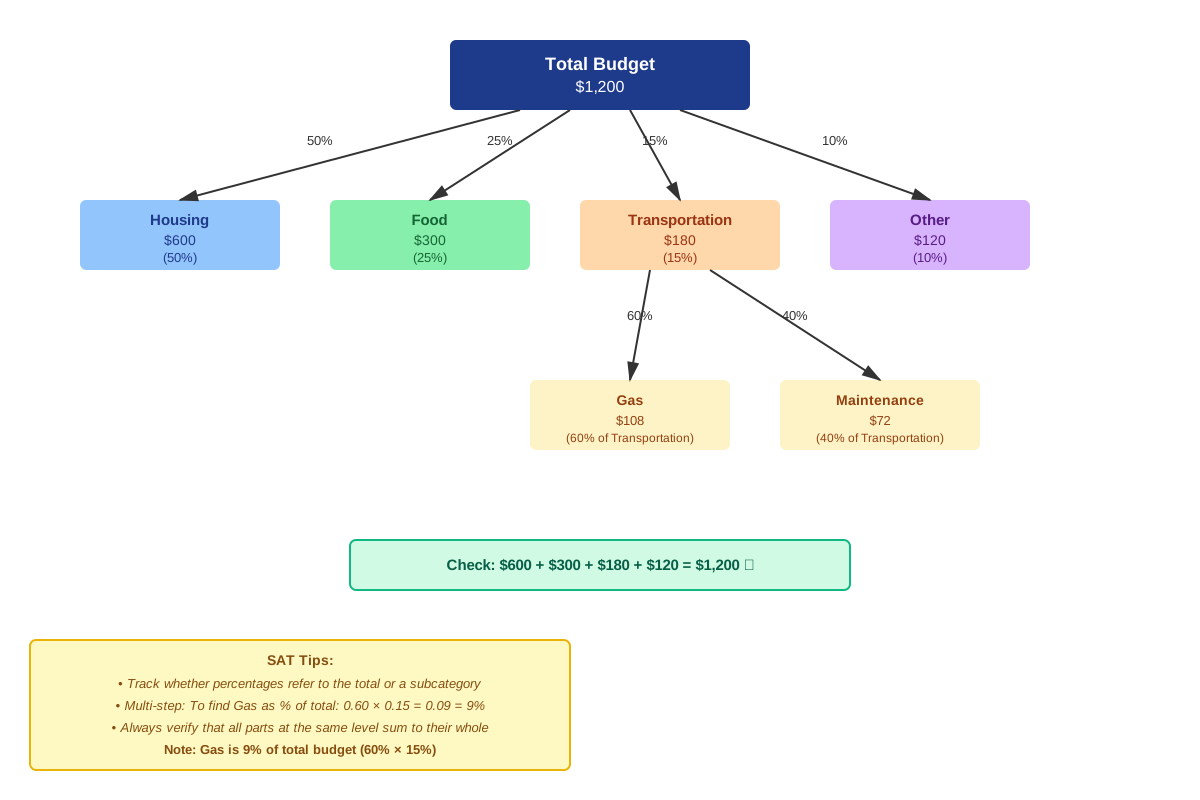
- Percentage of a percentage requires multiplication: 20% of 50% = 0.20 × 0.50 = 0.10 = 10%
- If two parts are in ratio a:b, the first part represents a/(a+b) of the whole and the second represents b/(a+b)
- When a whole increases but a part stays constant, that part represents a smaller percentage of the new whole
- Part-whole relationships remain valid under scaling: if you multiply or divide both the part and whole by the same non-zero number, the relationship is preserved
- In data interpretation questions, always verify whether percentages are given as part of the whole or part of a subgroup
Quick check — test yourself on Part-whole relationships so far.
Try Flashcards →Common Misconceptions
Misconception: When given "A is 50% more than B," students incorrectly conclude that B is 50% less than A.
Correction: If A is 50% more than B, then A = 1.5B, which means B = A/1.5 ≈ 0.667A, so B is approximately 33.3% less than A, not 50% less. Percentage increases and decreases are not symmetric because they reference different bases.
Misconception: Adding percentages directly when they refer to different wholes.
Correction: You cannot add "30% of Group A" and "40% of Group B" to get "70% of something" unless Groups A and B are the same size. Always convert percentages to actual values before adding, or ensure the percentages reference the same whole.
Misconception: Confusing part-to-part ratios with part-to-whole ratios.
Correction: A ratio of 3:2 does not mean the first quantity is 3/2 of the whole; it means the first quantity is 3/5 of the whole (since 3 + 2 = 5 total parts). Always sum ratio components to find the denominator for part-whole fractions.
Misconception: Believing that if Part A is twice Part B, then Part A is 2/3 of the whole.
Correction: This is only true if A and B are the only parts. If A = 2B and these are the only parts, then the whole = A + B = 2B + B = 3B, so A = 2B/3B = 2/3 of the whole. However, if there are other parts, this relationship doesn't hold.
Misconception: When a part increases by 25%, assuming the whole also increases by 25%.
Correction: The whole only increases by 25% if that part represents 100% of the whole. If the part represents a fraction f of the whole, the whole increases by 25% × f. For example, if a part representing 40% of the whole increases by 25%, the whole increases by 25% × 0.40 = 10%.
Misconception: Treating "out of" and "more than" as equivalent phrases.
Correction: "15 out of 60" means 15/60 = 25%, but "15 more than 60" means 75, which is 75/60 = 125% of 60. The phrase "out of" indicates a part-whole relationship, while "more than" indicates addition.
Worked Examples
Example 1: Multi-Step Part-Whole Problem
Problem: In a company of 240 employees, the ratio of managers to non-managers is 1:7. Among the managers, 60% work in the sales department. How many managers work in the sales department?
Solution:
Step 1: Identify the part-whole relationship for managers vs. non-managers.
- The ratio 1:7 means for every 1 manager, there are 7 non-managers
- Total ratio parts = 1 + 7 = 8
- Managers represent 1/8 of all employees
Step 2: Calculate the number of managers.
- Number of managers = (1/8) × 240 = 30 managers
Step 3: Apply the second part-whole relationship.
- 60% of managers work in sales
- Sales managers = 0.60 × 30 = 18 managers
Answer: 18 managers work in the sales department.
Connection to learning objectives: This problem requires identifying multiple part-whole relationships (managers as part of all employees, sales managers as part of all managers) and applying them sequentially. It demonstrates how SAT questions layer part-whole concepts within a single problem.
Example 2: Finding the Whole from a Part
Problem: After spending 35% of her money on a jacket and $78 on shoes, Maria has $117 left. How much money did Maria have originally?
Solution:
Step 1: Set up the part-whole relationship.
- Let x = original amount of money
- Money spent on jacket = 0.35x
- Money spent on shoes = $78
- Money remaining = $117
- All parts must sum to the whole: 0.35x + 78 + 117 = x
Step 2: Solve for the whole.
- 0.35x + 195 = x
- 195 = x - 0.35x
- 195 = 0.65x
- x = 195 ÷ 0.65
- x = 300
Step 3: Verify the answer.
- Jacket: 0.35 × 300 = $105
- Shoes: $78
- Remaining: $117
- Total: 105 + 78 + 117 = $300 ✓
Answer: Maria originally had $300.
Connection to learning objectives: This problem demonstrates how to work backward from parts to find the whole, a common SAT question type. It requires setting up an equation where all parts (including percentages and fixed amounts) sum to the unknown whole, then solving algebraically.
Example 3: Changing Part-Whole Relationships
Problem: A solution contains 40% acid and 60% water. If 10 liters of water are added to 50 liters of this solution, what percentage of the new solution is acid?
Solution:
Step 1: Calculate the amount of acid in the original solution.
- Original solution = 50 liters
- Acid = 40% of 50 = 0.40 × 50 = 20 liters
- Water = 60% of 50 = 0.60 × 50 = 30 liters
Step 2: Determine the new amounts after adding water.
- Acid remains the same = 20 liters (no acid was added)
- Water increases = 30 + 10 = 40 liters
- New total solution = 20 + 40 = 60 liters
Step 3: Calculate the new percentage.
- Percentage of acid = (Part ÷ Whole) × 100
- Percentage of acid = (20 ÷ 60) × 100
- Percentage of acid = (1/3) × 100 ≈ 33.33%
Answer: The new solution is approximately 33.3% acid (or exactly 33⅓%).
Connection to learning objectives: This problem illustrates how adding to one part changes the whole and therefore changes the percentage that other parts represent. It's a common SAT scenario that tests whether students understand that percentages are relative to the current whole, not fixed values.
Exam Strategy
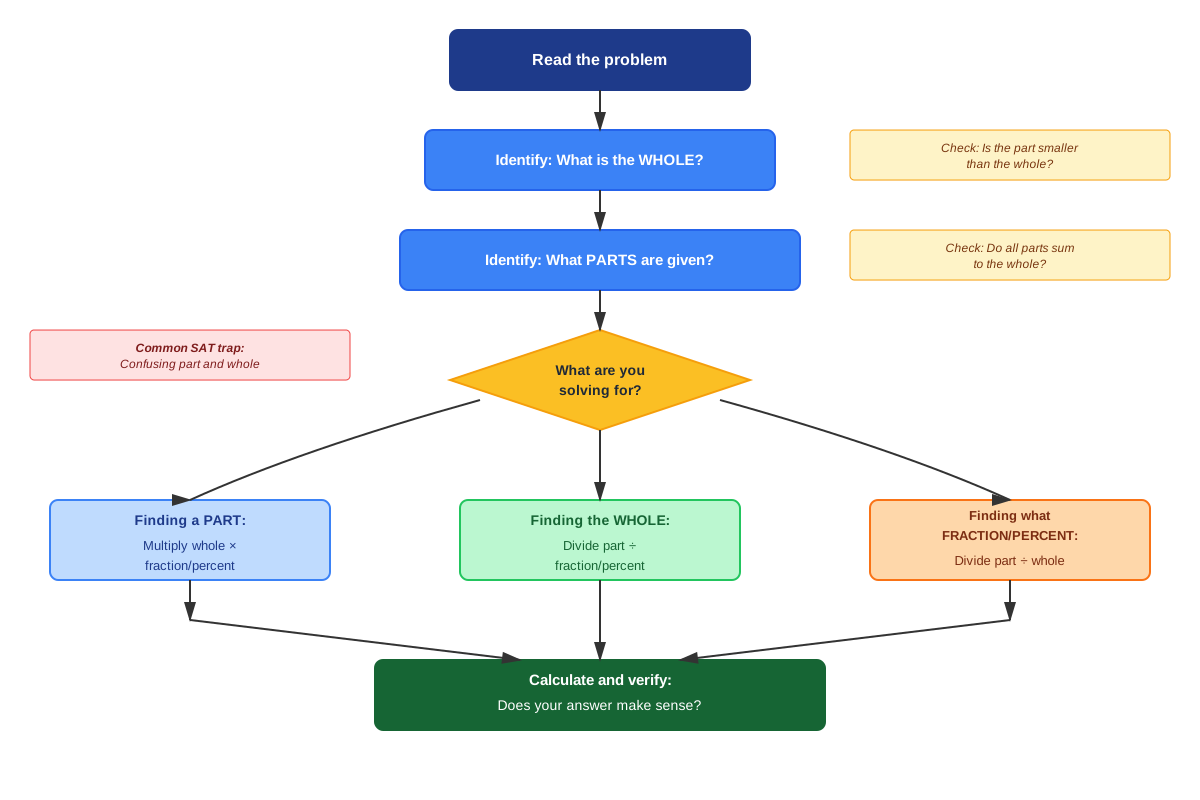
When approaching SAT questions involving part-whole relationships, begin by identifying what represents the "whole" in the problem. Look for phrases like "total," "entire," "all," or "complete" that signal the whole quantity. Then identify all the parts mentioned and determine whether you're given enough information to account for 100% of the whole. If parts are described but don't explicitly sum to 100%, you may need to calculate the "remaining" or "other" category.
Trigger words and phrases to watch for include:
- "What fraction/percent of..." (signals part-whole calculation)
- "Out of" (indicates part out of whole)
- "Ratio of A to B" (may be part-to-part or part-to-whole depending on context)
- "Remaining," "rest," "other" (indicates complement of stated parts)
- "Increased by," "decreased by" (signals changing part-whole relationships)
- "Represents," "accounts for," "makes up" (indicates part-whole relationship)
For process of elimination, use these strategies:
- Eliminate answers that exceed 100% when the question asks for a part of a whole (unless the context involves growth or comparison to a different base)
- Eliminate answers that would make the sum of all parts exceed or fall short of the stated whole
- Check whether answer choices are in the requested format (fraction, decimal, or percentage)
- For ratio problems, eliminate answers that don't maintain the correct proportional relationship
Time allocation: Simple part-whole problems (direct calculation of a percentage or fraction) should take 30-45 seconds. Multi-step problems involving ratios or multiple parts may require 60-90 seconds. Complex word problems with changing part-whole relationships might need up to 2 minutes. If you find yourself spending more than 2 minutes, mark the question and return to it after completing easier problems.
Strategic approach:
- Read the entire problem to understand what's being asked
- Identify and label the whole and all parts
- Determine what format the answer requires (fraction, decimal, percentage, actual value)
- Set up the relationship mathematically before calculating
- Perform calculations carefully, using your calculator when available
- Verify that your answer makes logical sense in context
Exam Tip: When a problem provides a ratio, immediately write down the sum of ratio parts. This total represents how many "units" make up the whole and is essential for converting ratio information into actual values or percentages.
Memory Techniques
PART mnemonic for solving part-whole problems:
- Proportion: Set up the relationship as part/whole
- Assess: Determine what's given and what's unknown
- Represent: Choose the best format (fraction, decimal, percentage)
- Transform: Convert and calculate to find the answer
The Pizza Visualization: Imagine a whole pizza cut into slices. Each slice is a part, and all slices together make the whole pizza. If someone eats slices, the remaining slices are still parts of the original whole pizza, not a new whole. This mental image helps students remember that parts are always relative to a defined whole.
The 100% Rule: Create a mental checkpoint that asks "Do all my parts add up to 100%?" This prevents the common error of forgetting to account for all components or double-counting parts.
Ratio to Fraction Conversion: Remember "Sum Then Divide" (STD)
- Sum all parts of the ratio
- This sum becomes the denominator (the whole)
- Divide each ratio part by this sum to get individual fractions
Percentage-Decimal-Fraction Triangle: Visualize these three representations at the points of a triangle, with arrows showing conversions:
- Percentage → Decimal: divide by 100
- Decimal → Percentage: multiply by 100
- Decimal → Fraction: write as fraction and simplify
- Fraction → Decimal: divide numerator by denominator
The Complement Shortcut: When you know one part as a percentage, subtract from 100 to find the remaining parts' total percentage. Think "100 minus gives you the rest."
Summary
Part-whole relationships form a cornerstone of proportional reasoning on the SAT Math section, appearing in multiple question types across both calculator and no-calculator portions. The fundamental principle—that all parts must sum to equal the whole—enables students to solve problems involving percentages, fractions, ratios, and proportions. Success requires fluency in converting between different representations (fractions, decimals, percentages, ratios) and recognizing whether given information describes part-to-part or part-to-whole relationships. Multi-step problems often require identifying multiple layers of part-whole relationships, such as finding a part of a part, or determining how changes in one component affect the proportions of others. Students must carefully distinguish between the whole in a given context and avoid common errors like adding percentages that reference different bases or confusing ratio formats. Strategic problem-solving involves identifying the whole, accounting for all parts, setting up relationships mathematically before calculating, and verifying that answers make logical sense. Mastery of part-whole relationships provides the foundation for more advanced topics including probability, statistics, weighted averages, and algebraic modeling.
Key Takeaways
- Part-whole relationships describe how components relate to a complete set, with all parts summing to equal the whole (100% or the total value)
- Fluency in converting between fractions, decimals, percentages, and ratios is essential for solving SAT part-whole problems efficiently
- Always identify what represents the "whole" in a problem before calculating parts, and distinguish between part-to-part and part-to-whole ratios
- When given a ratio, sum all components to find the total number of parts, then use this to calculate individual values or percentages
- Changes in one part affect the whole and the percentages that other parts represent, requiring recalculation of part-whole relationships
- Use the formula Part = (Percentage/100) × Whole to find unknown parts, and Whole = Part ÷ (Percentage/100) to find unknown wholes
- Verify answers by checking that all parts sum correctly to the whole and that the answer format matches what the question requests
Related Topics
Percentage Problems: Building directly on part-whole relationships, percentage problems involve calculating increases, decreases, and percent change. Mastering part-whole concepts makes percentage problems significantly more intuitive.
Ratio and Proportion: These topics extend part-whole thinking to comparisons between quantities and equivalent relationships across different scenarios. Understanding how ratios define part-whole relationships is essential for solving proportion problems.
Probability and Statistics: Probability calculations rely on part-whole relationships where favorable outcomes (part) are compared to total possible outcomes (whole). Statistical measures like percentiles and relative frequency also depend on part-whole reasoning.
Mixture Problems: These advanced applications combine part-whole relationships with weighted averages, requiring students to track how different components contribute to a total mixture's properties.
Algebraic Word Problems: Many algebra problems involve setting up equations based on part-whole relationships, translating verbal descriptions into mathematical expressions where variables represent unknown parts or wholes.
Practice CTA
Now that you've mastered the core concepts of part-whole relationships, it's time to solidify your understanding through practice. Attempt the practice questions designed specifically for this topic, focusing on applying the strategies and techniques you've learned. Use the flashcards to reinforce key formulas, conversion methods, and common problem patterns. Remember that part-whole relationships appear frequently on the SAT, so investing time in practice now will pay dividends on test day. Approach each practice problem systematically: identify the whole, account for all parts, and verify your answers make sense in context. With consistent practice, you'll develop the intuition and speed needed to excel on these high-yield questions!
Sign up free to keep reading
Create a free AnvayaPrep account to finish this SAT guide on Part-whole relationships — plus flashcards and practice questions.