Overview
Proportion traps are among the most deceptive question types on the SAT Math section, designed specifically to catch students who rush through calculations without careful analysis. These questions present scenarios involving ratios, proportions, or percentages where the most intuitive approach leads directly to an incorrect answer. The SAT test writers deliberately construct these problems to exploit common mathematical shortcuts and assumptions that work in simpler contexts but fail when additional constraints or relationships are present.
Understanding proportion traps is essential for achieving a top math score because these questions appear frequently—typically 2-4 times per test—and carry the same point value as straightforward problems despite requiring more sophisticated reasoning. Students who recognize the warning signs of proportion traps can avoid careless errors that cost valuable points. These questions test not just computational ability but also critical thinking, careful reading, and the discipline to verify that solutions make logical sense within the problem's constraints.
Proportion traps connect to broader mathematical concepts including ratios, rates, percentages, and algebraic reasoning. They often appear in word problems involving mixtures, populations, geometric scaling, or comparative statistics. Mastering this topic strengthens overall problem-solving skills and builds the analytical mindset necessary for tackling complex multi-step problems across all SAT Math domains. The ability to identify and navigate these traps demonstrates mathematical maturity that extends beyond memorized procedures to genuine conceptual understanding.
Learning Objectives
- [ ] Identify key features of proportion traps
- [ ] Explain how proportion traps appears on the SAT
- [ ] Apply proportion traps to answer SAT-style questions
- [ ] Distinguish between situations where direct proportional reasoning applies versus where it leads to errors
- [ ] Analyze word problems to identify hidden constraints that invalidate simple proportional approaches
- [ ] Verify solutions by checking whether they satisfy all conditions stated in the problem
- [ ] Recognize common trap answer choices and understand why they appear tempting but incorrect
Prerequisites
- Basic ratio and proportion concepts: Understanding equivalent ratios and cross-multiplication is fundamental to recognizing when these standard techniques are being misapplied
- Percentage calculations: Many proportion traps involve percentage changes or comparisons that require distinguishing between percentage of different base values
- Algebraic equation setup: Setting up equations from word problems helps identify all constraints rather than focusing on only the most obvious relationship
- Part-to-whole relationships: Recognizing how individual components relate to totals prevents errors when proportions change the underlying quantities
Why This Topic Matters
Proportion traps represent a high-yield topic for SAT preparation because they directly test mathematical reasoning rather than mere calculation. The College Board includes these questions to differentiate between students who apply formulas mechanically and those who think critically about problem structure. Research on SAT question statistics shows that proportion trap questions have among the lowest correct response rates (often 30-45% on difficult versions), making them excellent opportunities for prepared students to gain competitive advantage.
In real-world applications, proportion trap scenarios mirror situations professionals encounter regularly: adjusting recipes when ingredient quantities change, calculating medication dosages based on body weight, analyzing survey data with changing sample sizes, or scaling architectural plans. The ability to recognize when simple proportional reasoning fails prevents costly errors in fields from engineering to finance to healthcare.
On the SAT, proportion traps most commonly appear as word problems in the Heart of Algebra and Problem Solving and Data Analysis domains. They frequently involve scenarios with changing totals, nested ratios (ratios within ratios), percentage changes applied sequentially, or geometric scaling where area or volume relationships differ from linear proportions. Questions may appear in both multiple-choice and student-produced response formats, with trap answers strategically placed among the choices to catch students who make predictable errors.
Core Concepts
What Makes a Proportion Trap
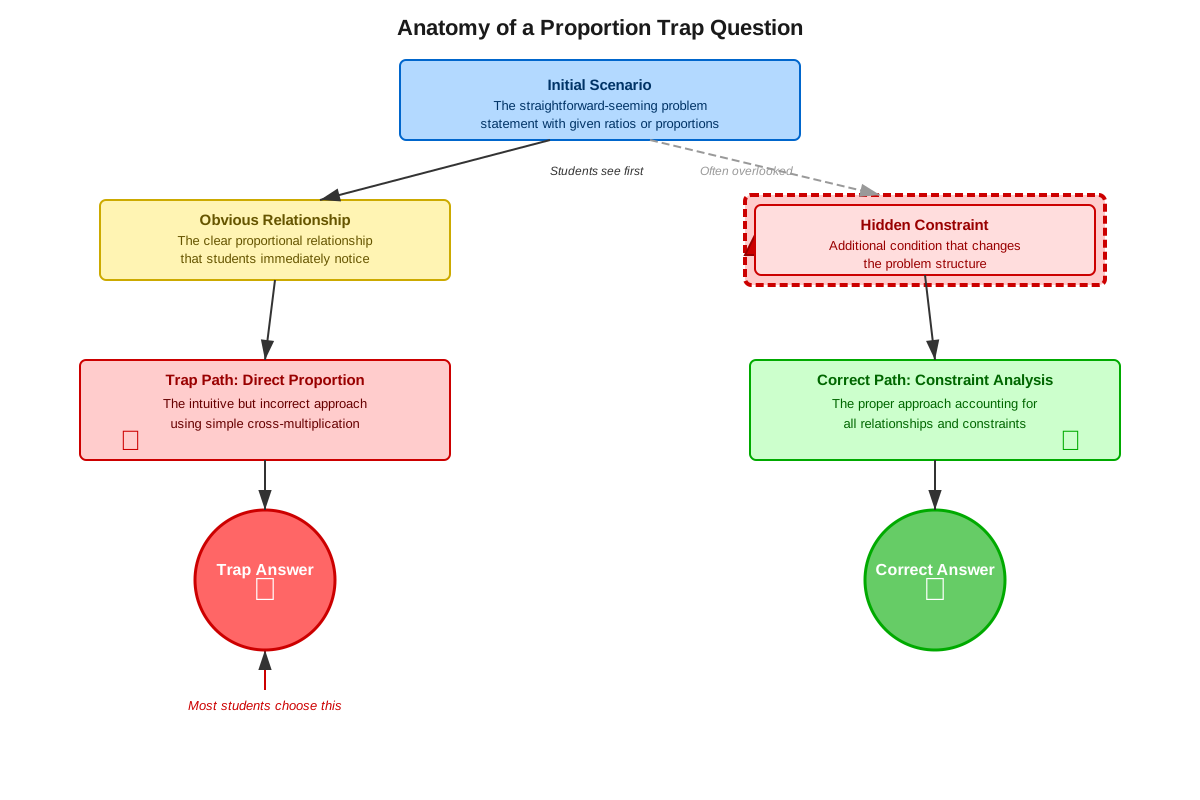
A proportion trap occurs when a problem's structure tempts students to apply direct proportional reasoning in situations where additional factors make such reasoning invalid. The defining characteristic is that the "obvious" proportional calculation yields a number that appears among the answer choices but is mathematically incorrect. These traps exploit the fact that proportional relationships work beautifully in many contexts, leading students to apply them reflexively without checking whether all necessary conditions are met.
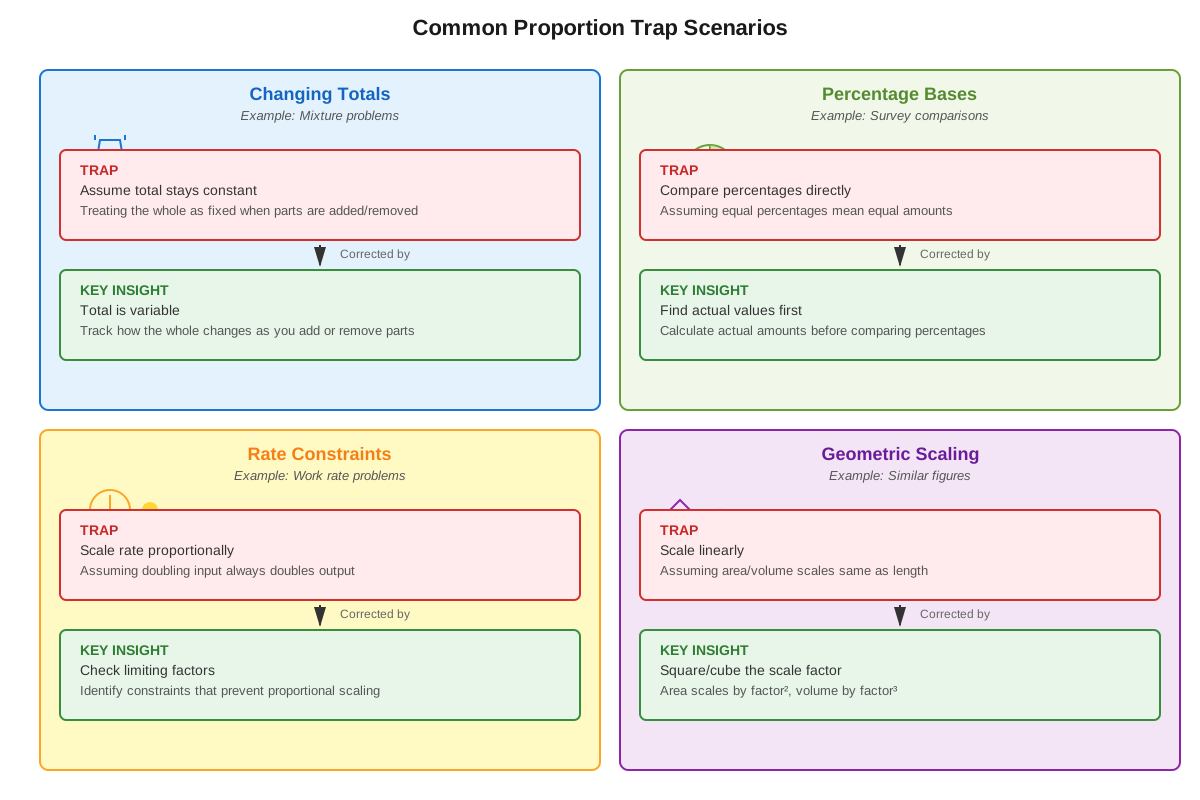
The key features that signal a potential proportion trap include:
- Problems involving changing totals or base values
- Scenarios where multiple proportional relationships interact
- Questions about "new" ratios after quantities change
- Situations involving percentages of different wholes
- Geometric scaling problems involving area or volume
- Word problems with subtle constraints buried in the text
The Changing Total Trap
The most common proportion trap involves ratios where the total quantity changes. Consider a classic example: "In a class, the ratio of boys to girls is 3:5. If 4 more boys join the class, what is the new ratio?" The trap is assuming the number of girls remains constant while only boys increase—this is correct. However, students often make errors by trying to maintain the original ratio or by incorrectly scaling both quantities.
The critical insight is that when one part of a ratio changes, the total changes, which affects how we calculate the new ratio. The original ratio 3:5 means for every 3 boys there are 5 girls, with a total of 8 students per "group." If the class has 3k boys and 5k girls (where k is some multiplier), adding 4 boys creates (3k + 4) boys and still 5k girls. The new ratio is (3k + 4):5k, which cannot be simplified without knowing k.
The Percentage of Different Bases Trap
Another frequent trap involves percentages calculated from different base values. For example: "Store A's revenue increased by 20% while Store B's revenue increased by 30%. If Store A originally had twice the revenue of Store B, which store now has more revenue?" The trap is assuming Store B must now have more revenue because 30% > 20%.
The correct approach requires calculating actual values. If Store B originally had revenue x, then Store A had 2x. After increases:
- Store A: 2x × 1.20 = 2.4x
- Store B: x × 1.30 = 1.3x
Store A still has more revenue despite the smaller percentage increase because percentages are relative to different bases. This trap appears frequently in data analysis questions and real-world comparison scenarios.
The Geometric Scaling Trap
When geometric figures are scaled, linear dimensions, areas, and volumes scale differently—a relationship that creates powerful proportion traps. If a rectangle's length and width are both doubled, the perimeter doubles but the area quadruples. If a cube's edge length is tripled, the surface area increases by a factor of 9 (3²) while the volume increases by a factor of 27 (3³).
The trap occurs when students apply the scaling factor uniformly to all measurements. SAT proportion traps frequently test this by asking about area or volume after a linear scaling, with the linear scaling factor appearing as a trap answer. The correct approach requires recognizing:
| Dimension Type | Scaling Relationship | Example: Scale factor = 2 |
|---|---|---|
| Linear (length, width, height) | Scales by factor k | Multiplied by 2 |
| Area (surface area, cross-section) | Scales by factor k² | Multiplied by 4 |
| Volume (capacity, space) | Scales by factor k³ | Multiplied by 8 |
The Nested Ratio Trap
Nested ratios involve relationships between ratios, such as "The ratio of cats to dogs is 2:3, and the ratio of dogs to birds is 4:5. What is the ratio of cats to birds?" The trap is simply multiplying ratios: 2:3 × 4:5, which is meaningless.
The correct approach requires finding a common term (dogs) and scaling the ratios so the dog quantities match:
- Cats:Dogs = 2:3 can be written as 8:12 (multiply by 4)
- Dogs:Birds = 4:5 can be written as 12:15 (multiply by 3)
- Now with dogs = 12 in both, Cats:Birds = 8:15
This requires recognizing that ratios can be scaled (multiplied by the same number) without changing the relationship, then finding equivalent ratios that share a common term.
The Sequential Percentage Change Trap
When percentage changes are applied sequentially, they don't add arithmetically. If a price increases by 20% then decreases by 20%, the final price is not the original price. The trap is calculating 20% - 20% = 0% change.
The correct calculation:
- Start with price P
- After 20% increase: P × 1.20 = 1.20P
- After 20% decrease: 1.20P × 0.80 = 0.96P
The final price is 96% of the original, representing a 4% decrease overall. This occurs because the second percentage is calculated from a different base (the increased price) than the first. Sequential percentage changes must be multiplied as factors, not added as percentages.
Verification Strategies
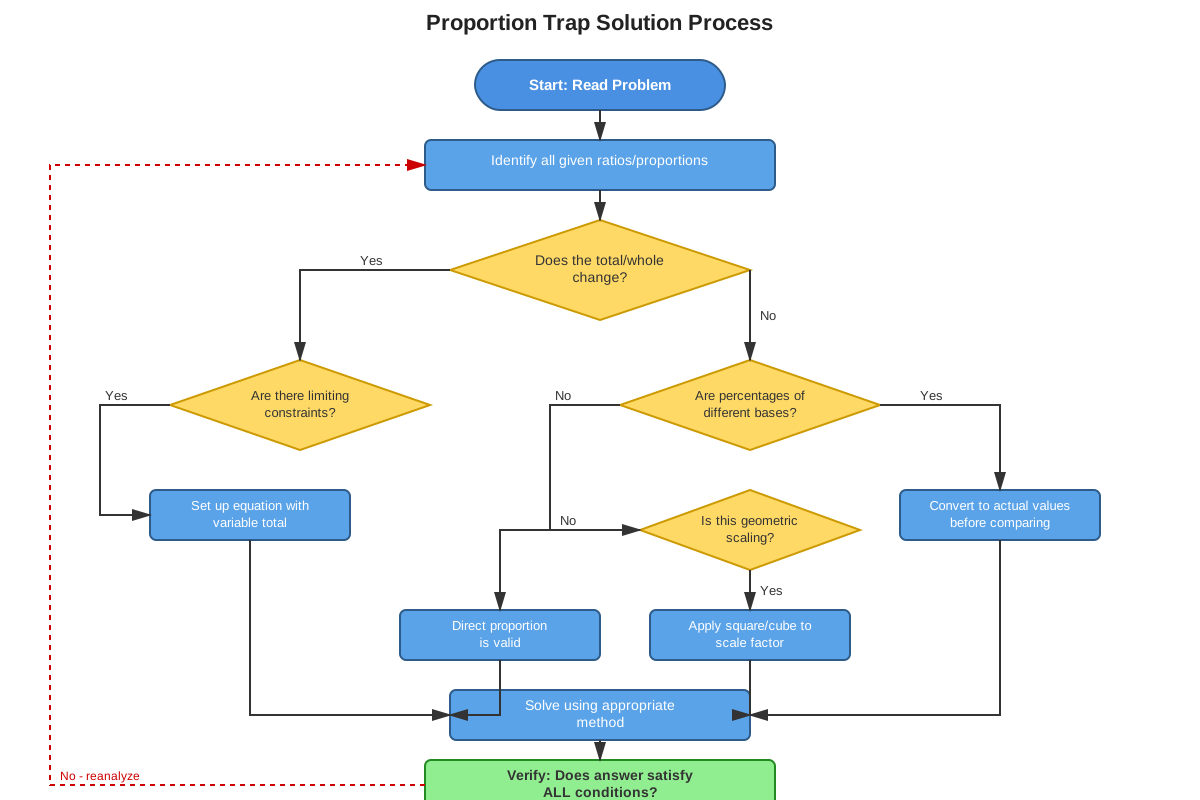
The most powerful defense against proportion traps is systematic verification. After calculating an answer, check:
- Does the answer make logical sense? If a quantity should increase, did it? If something should be larger than another, is it?
- Do all parts sum to the stated whole? If the problem gives a total, verify your answer components add up correctly.
- Are units consistent? Mixing rates with different time units or comparing percentages of different bases often signals errors.
- Does the answer satisfy all stated constraints? Reread the problem to ensure no conditions were overlooked.
Concept Relationships
The core concepts within proportion traps are interconnected through the central theme of recognizing when standard proportional reasoning breaks down. The changing total trap serves as the foundation, establishing that proportions are only preserved when the relationship between parts and wholes remains constant. This concept directly leads to understanding the percentage of different bases trap, since percentages are simply proportions expressed as parts per hundred—when bases differ, percentage comparisons become meaningless without converting to absolute values.
The geometric scaling trap extends proportional reasoning into multiple dimensions, showing that the relationship between scaling factors depends on whether we're measuring length (1D), area (2D), or volume (3D). This connects back to the fundamental principle that proportions must account for all relevant dimensions of change.
Nested ratios combine multiple proportional relationships, requiring students to find common terms before establishing new ratios. This builds on basic ratio manipulation skills and demonstrates that ratios can be scaled without changing the underlying relationship. The sequential percentage change trap similarly shows that multiple proportional changes must be combined multiplicatively rather than additively, connecting to exponential growth concepts.
All these concepts flow into verification strategies, which provide systematic methods for checking whether proportional reasoning has been correctly applied. The relationship map:
Changing Totals → Percentage Base Differences → Sequential Changes → Verification
↓
Nested Ratios ← Geometric Scaling
Each trap type teaches a specific way that naive proportional reasoning fails, while verification strategies provide the metacognitive framework for catching errors across all trap types.
High-Yield Facts
⭐ Proportion traps always include the "obvious but wrong" answer among the multiple-choice options to catch students who don't verify their work.
⭐ When a ratio changes because one quantity changes, you cannot determine the new ratio without knowing the actual quantities or having additional information.
⭐ Percentage increases and decreases are calculated from different bases when applied sequentially, so they must be multiplied as factors (1.20 × 0.80) not added as percentages (20% - 20%).
⭐ In geometric scaling, if linear dimensions scale by factor k, areas scale by k² and volumes scale by k³.
⭐ When comparing percentage changes, always convert to absolute values if the base quantities differ.
- Ratios can be scaled by multiplying all terms by the same number without changing the relationship (2:3 = 4:6 = 8:12).
- To combine ratios with a common term (nested ratios), scale each ratio so the common term has the same value in both.
- A quantity that increases by x% then decreases by x% does not return to its original value (except when x = 0).
- Word problems with "new ratio" or "after the change" are high-probability proportion trap indicators.
- The trap answer is typically the result of the most direct calculation that ignores a key constraint.
- Verification by checking whether parts sum to the whole catches most proportion trap errors.
- Problems involving "ratio of ratios" or "percentage of percentages" almost always contain traps.
Quick check — test yourself on Proportion traps so far.
Try Flashcards →Common Misconceptions
Misconception: If the ratio of A to B is 3:5 and A increases by 6, the new ratio is 9:5 (just add 6 to the 3).
Correction: Ratios represent relationships between actual quantities, not the quantities themselves. If the original ratio is 3:5, the actual quantities are 3k and 5k for some multiplier k. Adding 6 gives (3k + 6):5k, which cannot be simplified without knowing k. The ratio 3:5 means "for every 3 of A there are 5 of B," not "there are exactly 3 of A."
Misconception: A 20% increase followed by a 20% decrease returns to the original value because the percentages cancel out.
Correction: The decrease is calculated from the increased value, not the original. Starting with 100: increase by 20% gives 120, then decrease 120 by 20% gives 96, not 100. Sequential percentage changes multiply: 1.20 × 0.80 = 0.96, representing a 4% net decrease.
Misconception: If Store A's revenue is 50% more than Store B's, then Store B's revenue is 50% less than Store A's.
Correction: These percentages have different bases. If B = 100, then A = 150 (50% more than B). But B is not 50% less than A; it's 33.3% less (B = 150 - 50 = 100, and 50/150 = 1/3 ≈ 33.3%). The percentage difference depends on which value serves as the base.
Misconception: When a rectangle's dimensions double, its area doubles.
Correction: Area is two-dimensional, so it scales by the square of the linear scaling factor. If length and width both double (scale factor = 2), the area multiplies by 2² = 4. Original area = l × w; new area = (2l) × (2w) = 4lw.
Misconception: To find the ratio of A to C when given A:B and B:C, simply multiply the ratios.
Correction: Ratios are not fractions that can be multiplied directly. Instead, scale the ratios so the common term (B) has the same value in both, then read off the A:C relationship. For example, if A:B = 2:3 and B:C = 4:5, scale to A:B = 8:12 and B:C = 12:15, giving A:C = 8:15.
Misconception: In proportion trap questions, the correct answer is always the most complicated calculation.
Correction: While trap answers result from oversimplified reasoning, the correct answer may be straightforward if you identify the right approach. The key is careful analysis of what the problem actually asks, not assuming complexity equals correctness.
Misconception: If two quantities are in ratio 3:5, there are exactly 3 of one and 5 of the other.
Correction: The ratio 3:5 means the quantities are in that proportion, but actual values are 3k and 5k where k can be any positive number. There could be 6 and 10 (k=2), or 30 and 50 (k=10), or any other pair maintaining that 3:5 relationship.
Worked Examples
Example 1: The Changing Class Ratio
Problem: In a school club, the ratio of seniors to juniors is 5:3. After 6 more seniors join and 2 juniors leave, there are 24 seniors in the club. What is the new ratio of seniors to juniors?
Step 1 - Identify the trap: The tempting wrong approach is to say the ratio changes from 5:3 to (5+6):(3-2) = 11:1. This appears as a trap answer but treats the ratio numbers as actual quantities.
Step 2 - Set up with variables: The original ratio 5:3 means there are 5k seniors and 3k juniors for some value k.
Step 3 - Use the given information: After changes, there are (5k + 6) seniors. We're told this equals 24:
5k + 6 = 24
5k = 18
k = 3.6
Step 4 - Find the original quantities:
- Original seniors: 5k = 5(3.6) = 18
- Original juniors: 3k = 3(3.6) = 10.8
Wait—we can't have 10.8 people! Let's reconsider. Actually, k must make both quantities whole numbers.
Step 2 (revised) - Work backward from the constraint: We know the final number of seniors is 24. If originally there were S seniors, then S + 6 = 24, so S = 18 seniors originally.
Step 3 (revised) - Use the ratio: If the ratio was 5:3 and there were 18 seniors:
5/3 = 18/J
5J = 54
J = 10.8
This suggests our problem statement might have non-integer values, or we should verify. Actually, let's check if 18 seniors fits the 5:3 ratio. For the ratio to be exactly 5:3, we need 5k = 18, giving k = 3.6, and 3k = 10.8 juniors. Since the problem gives us 24 seniors after adding 6, we must accept that k = 3.6.
Step 4 (revised) - Calculate new quantities:
- New seniors: 24 (given)
- Original juniors: 10.8, after 2 leave: 10.8 - 2 = 8.8
Step 5 - Find new ratio:
24:8.8 = 240:88 = 30:11Verification: Original ratio 18:10.8 = 180:108 = 5:3 ✓. After changes: 24:8.8 = 30:11 ✓
Answer: The new ratio is 30:11.
Connection to learning objectives: This example demonstrates identifying the trap (treating ratio terms as actual quantities), applying systematic algebraic setup, and verifying the solution makes sense with the given constraints.
Example 2: Sequential Percentage Changes with Different Bases
Problem: Product A costs $120 and Product B costs $80. Product A's price increases by 25%, while Product B's price increases by 50%. After these changes, Product B's price is then reduced by 20%. What is the difference between the final prices?
Step 1 - Identify potential traps:
- Trap 1: Thinking B ends up more expensive because 50% > 25%
- Trap 2: Thinking B's 50% increase then 20% decrease equals a 30% net increase
- Trap 3: Comparing percentage changes without calculating actual prices
Step 2 - Calculate Product A's final price:
A_final = 120 × 1.25 = $150Step 3 - Calculate Product B's price after first increase:
B_after_increase = 80 × 1.50 = $120Step 4 - Calculate Product B's final price after decrease:
B_final = 120 × 0.80 = $96Note: The 20% decrease is applied to $120, not the original $80. This is why we can't simply calculate 50% - 20% = 30% net increase.
Step 5 - Find the difference:
Difference = 150 - 96 = $54Verification:
- A increased from $120 to $150: increase of $30 (25% of 120 = 30) ✓
- B increased from $80 to $120: increase of $40 (50% of 80 = 40) ✓
- B decreased from $120 to $96: decrease of $24 (20% of 120 = 24) ✓
- Final difference: $54, with A more expensive ✓
Alternative verification - check B's net change:
B_net_multiplier = 1.50 × 0.80 = 1.20
B_final = 80 × 1.20 = $96 ✓
Product B increased by 20% overall (not 30%), demonstrating that sequential percentage changes multiply rather than add.
Answer: The difference between final prices is $54, with Product A costing more.
Connection to learning objectives: This example shows how sat proportion traps exploit assumptions about percentage changes, demonstrates the importance of calculating from the correct base, and illustrates verification by checking each step's arithmetic.
Exam Strategy
When approaching SAT questions involving ratios, proportions, or percentages, implement this systematic strategy:
1. Read twice, calculate once: Before performing any calculations, read the entire problem carefully to identify all constraints, given values, and what specifically is being asked. Proportion traps rely on students missing subtle details.
2. Watch for trigger phrases:
- "new ratio" or "after the change" → likely changing total trap
- "increased by X% then decreased by Y%" → sequential percentage trap
- "ratio of A to B is... ratio of B to C is..." → nested ratio trap
- "dimensions are doubled/tripled" → geometric scaling trap
- "percentage more/less than" → different bases trap
3. Set up variables for unknowns: When dealing with ratios, use variables like 3k and 5k rather than assuming the ratio terms represent actual quantities. This prevents the most common proportion trap error.
4. Identify the trap answer: Before calculating, predict what wrong answer would result from the most obvious (but incorrect) approach. This answer will almost certainly appear among the choices. Knowing what to avoid helps confirm your correct answer.
5. Calculate step-by-step: Break complex problems into smaller steps, writing out each calculation. This prevents errors and makes verification easier. For sequential percentage changes, calculate each change separately rather than trying to combine them mentally.
6. Verify before selecting: Use these quick checks:
- Do parts sum to the whole?
- Does the answer make logical sense (right direction, reasonable magnitude)?
- Plug your answer back into the original conditions—does it satisfy all constraints?
7. Time allocation: Proportion trap questions typically require 90-120 seconds—longer than straightforward calculation problems but less than complex multi-step algebra. If you find yourself stuck after 90 seconds, mark the question and return to it rather than rushing to a likely trap answer.
8. Process of elimination:
- Eliminate answers that violate basic logic (negative quantities when all inputs are positive, ratios that don't simplify correctly)
- Eliminate the "obvious" answer if you suspect a trap
- Check remaining answers against your calculated result
9. Use answer choices strategically: If stuck, work backward from answer choices, especially for ratio problems. Plug each choice back into the problem conditions to see which satisfies all constraints.
Memory Techniques
TRAP Acronym for Proportion Traps:
- Totals change (watch for changing wholes)
- Ratios need actual values (3:5 doesn't mean 3 and 5)
- Areas scale squared, volumes cubed (geometric scaling)
- Percentages need same base (different bases can't be compared directly)
The "Multiply, Don't Add" Rule: For sequential percentage changes, remember "multiply the multipliers, don't add the percentages." Visualize: 1.20 × 0.80 ≠ 1.00, even though +20% and -20% seem like they should cancel.
The k-Trick: Whenever you see a ratio, immediately write it with k: "ratio 3:5" → "3k and 5k." This single habit prevents the majority of proportion trap errors.
Geometric Scaling Rhyme:
"One dimension, multiply by k,
Two dimensions, k-squared is the way,
Three dimensions, k-cubed for the day"
Base-Check Visualization: When comparing percentages, visualize two different-sized pizzas. 50% of a large pizza is more than 50% of a small pizza—percentages alone don't tell you which is more without knowing the base size.
The Verification Checklist (memorize as "PLUS"):
- Parts sum to whole?
- Logical direction (increase/decrease)?
- Units consistent?
- Satisfies all constraints?
Summary
Proportion traps represent a high-yield SAT Math topic that tests conceptual understanding rather than mechanical calculation. These questions deliberately include trap answers that result from common errors: treating ratio terms as actual quantities, comparing percentages with different bases, adding sequential percentage changes instead of multiplying them, applying linear scaling factors to areas or volumes, and combining nested ratios incorrectly. Success requires recognizing warning signs (trigger phrases like "new ratio" or "after the change"), using variables to represent unknown quantities in ratios (the k-trick), calculating each step carefully, and systematically verifying answers. The most powerful defense is understanding that proportional reasoning only works when the relationship between parts and wholes remains constant—when totals change, bases differ, or dimensions scale non-linearly, naive proportional thinking fails. Students who master proportion traps gain not just points on the SAT but also critical thinking skills for analyzing complex quantitative relationships in academic and real-world contexts.
Key Takeaways
- Proportion traps always include the "obvious but wrong" answer among choices; verify your work before selecting
- Use variables (3k and 5k) for ratios rather than treating ratio terms as actual quantities
- Sequential percentage changes multiply as factors (1.20 × 0.80), not add as percentages (20% - 20%)
- Geometric scaling: linear dimensions scale by k, areas by k², volumes by k³
- Percentages can only be compared directly when they share the same base value
- The TRAP acronym (Totals change, Ratios need values, Areas scale squared, Percentages need same base) covers the main trap types
- Systematic verification using the PLUS checklist (Parts sum, Logical direction, Units consistent, Satisfies constraints) catches most errors
Related Topics
Ratio and Proportion Fundamentals: Mastering proportion traps builds on basic ratio concepts and prepares students for more complex applications in mixture problems, rate problems, and similar figure geometry. Understanding when proportional reasoning works versus when it fails is essential for advanced problem-solving.
Percentage Applications: Proportion traps involving percentages connect to topics like percent increase/decrease, compound interest, and data analysis with percentages. The skills developed here transfer directly to interpreting statistical claims and financial calculations.
Geometric Similarity and Scaling: The geometric scaling aspects of proportion traps lead naturally to similar triangles, scale factors in coordinate geometry, and three-dimensional geometry problems involving surface area and volume.
Algebraic Word Problems: The systematic approach to proportion traps—setting up variables, identifying constraints, and verifying solutions—applies broadly to all SAT word problems, strengthening overall problem-solving methodology.
Data Analysis and Interpretation: Many proportion traps appear in data analysis contexts, so mastering this topic enhances skills in interpreting tables, graphs, and statistical claims where proportional relationships may be misleading.
Practice CTA
Now that you understand the key features of proportion traps and strategies for avoiding them, it's time to apply these concepts! Work through the practice questions to test your ability to identify trap answers, set up problems correctly using variables, and verify your solutions systematically. Each practice problem is designed to reinforce the specific trap types covered in this guide. Remember: recognizing the trap is half the battle—the other half is executing the correct approach with confidence. The flashcards will help you memorize trigger phrases and verification strategies so they become automatic during the actual exam. You've got this!
Sign up free to keep reading
Create a free AnvayaPrep account to finish this SAT guide on Proportion traps — plus flashcards and practice questions.