Overview
Ratios are one of the most fundamental and frequently tested concepts in SAT math, appearing in approximately 10-15% of all math questions across both calculator and no-calculator sections. A ratio expresses the relationship between two or more quantities, showing how many times one value contains or is contained within another. Understanding ratios is essential not only for direct ratio problems but also for solving questions involving proportions, rates, percentages, scale drawings, and probability—making this topic a cornerstone of SAT mathematical reasoning.
The SAT tests ratios in multiple contexts: word problems involving recipe adjustments, geometric figures with proportional sides, data interpretation requiring ratio analysis, and algebraic expressions where variables represent ratio relationships. Questions may present ratios in various formats (a:b, a to b, a/b, or "a for every b"), and students must fluently translate between these representations while applying ratio reasoning to solve complex, multi-step problems.
Mastering ratios creates a foundation for success across the entire Ratios, Rates, and Proportions unit and connects directly to other high-yield SAT topics including linear relationships, similar triangles, unit conversions, and percent change. The ability to set up and manipulate ratio relationships efficiently distinguishes high-scoring students from those who struggle with SAT math's more challenging problem types.
Learning Objectives
- [ ] Identify key features of ratios including part-to-part and part-to-whole relationships
- [ ] Explain how ratios appear on the SAT across different question formats and contexts
- [ ] Apply ratios to answer SAT-style questions involving multiple steps and algebraic reasoning
- [ ] Convert between different ratio representations and equivalent forms
- [ ] Solve problems involving ratio distribution when given a total quantity
- [ ] Combine multiple ratios to find indirect relationships between quantities
- [ ] Recognize when to use ratio reasoning versus other mathematical approaches
Prerequisites
- Basic arithmetic operations: Multiplication, division, and simplification of fractions are essential for manipulating ratio expressions and finding equivalent ratios
- Algebraic equation solving: Setting up and solving equations with variables allows students to work with unknown quantities in ratio problems
- Fraction operations: Since ratios can be expressed as fractions, understanding fraction equivalence and simplification directly applies to ratio work
- Basic geometry: Many ratio problems involve geometric figures, requiring knowledge of perimeter, area, and angle relationships
Why This Topic Matters
Ratios appear throughout everyday life: mixing paint colors, adjusting recipe quantities, comparing prices, analyzing financial statements, and interpreting maps. In professional fields from architecture to medicine to finance, ratio reasoning enables critical decision-making and quantitative analysis. Understanding ratios develops proportional reasoning skills that extend far beyond mathematics into scientific thinking and logical problem-solving.
On the SAT, ratio questions appear with high frequency—typically 3-5 questions per test—and often serve as the foundation for more complex problems worth multiple points. The College Board specifically tests ratios in several distinct formats: direct ratio problems asking students to find unknown quantities, word problems requiring ratio setup from verbal descriptions, geometry problems involving similar figures or scale factors, and data analysis questions requiring ratio interpretation from tables or graphs.
Common SAT question types include: "If the ratio of x to y is 3:5, and x = 12, what is y?"; problems involving distributing a total amount according to a given ratio; questions requiring students to combine multiple ratios (if a:b = 2:3 and b:c = 4:5, find a:c); and application problems where students must first identify the appropriate ratio relationship before solving. These questions frequently appear in the middle-to-difficult range of SAT math sections, making ratio mastery essential for achieving scores above 600.
Core Concepts
Understanding Ratio Fundamentals
A ratio is a comparison of two or more quantities measured in the same units. Ratios can be written in three equivalent forms: using a colon (3:4), using the word "to" (3 to 4), or as a fraction (3/4). Each representation conveys the same relationship, though the fractional form often proves most useful for algebraic manipulation on the SAT.
Ratios express relative size rather than absolute quantities. The ratio 2:3 means that for every 2 units of the first quantity, there are 3 units of the second quantity. This relationship holds whether discussing 2 apples and 3 oranges, 20 apples and 30 oranges, or 200 apples and 300 oranges—the ratio remains constant at 2:3.
Part-to-Part vs. Part-to-Whole Ratios
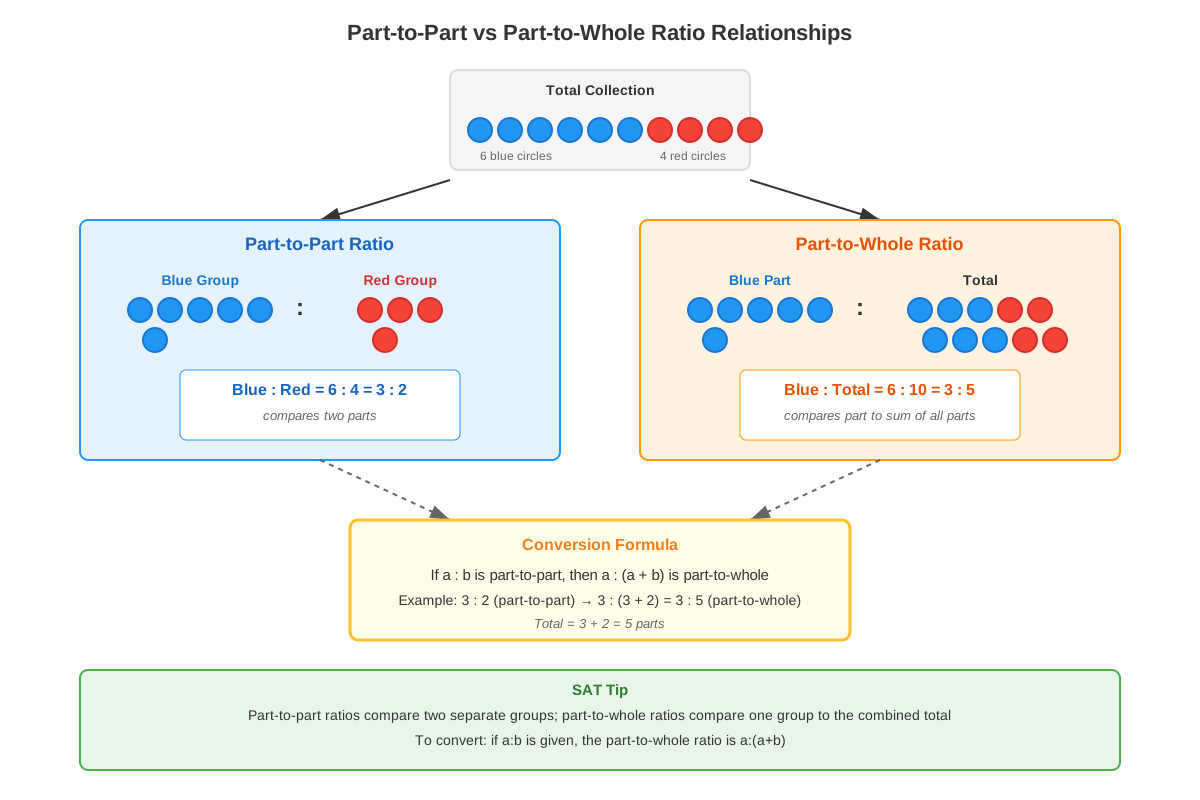
Understanding the distinction between part-to-part and part-to-whole ratios is crucial for SAT success. A part-to-part ratio compares two components of a whole to each other. For example, if a class has 12 boys and 18 girls, the part-to-part ratio of boys to girls is 12:18, which simplifies to 2:3.
A part-to-whole ratio compares one component to the entire set. Using the same class, the part-to-whole ratio of boys to total students is 12:30 or 2:5, while the ratio of girls to total students is 18:30 or 3:5. Notice that when given a part-to-part ratio of a:b, the part-to-whole ratios are a:(a+b) and b:(a+b).
| Ratio Type | Example | Interpretation |
|---|---|---|
| Part-to-Part | 2:3 (boys to girls) | For every 2 boys, there are 3 girls |
| Part-to-Whole | 2:5 (boys to total) | Boys represent 2 out of every 5 students |
| Part-to-Whole | 3:5 (girls to total) | Girls represent 3 out of every 5 students |
Simplifying and Scaling Ratios
Ratios should be expressed in simplest form by dividing all terms by their greatest common factor (GCF). The ratio 15:25 simplifies to 3:5 by dividing both terms by 5. Simplified ratios make relationships clearer and calculations easier.
Scaling ratios involves multiplying or dividing all terms by the same number to find equivalent ratios. This technique is essential when the SAT provides a total quantity and asks students to find individual amounts. If the ratio of red to blue marbles is 3:7 and there are 50 total marbles, students must find the scaling factor:
- Sum the ratio parts: 3 + 7 = 10 parts total
- Divide the actual total by ratio parts: 50 ÷ 10 = 5 (this is the multiplier)
- Multiply each ratio term: Red marbles = 3 × 5 = 15; Blue marbles = 7 × 5 = 35
Ratio Distribution Problems
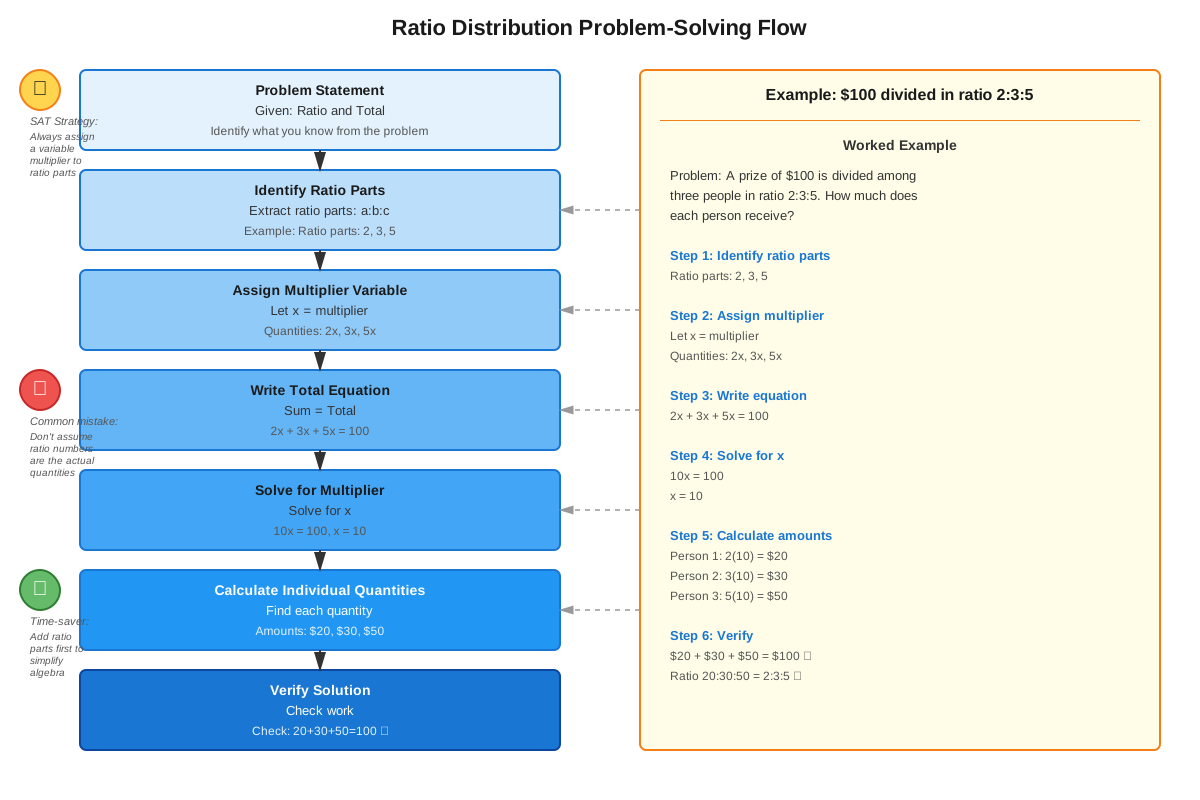
Ratio distribution problems provide a total quantity and ask students to divide it according to a given ratio. The systematic approach involves:
- Add all parts of the ratio to find total parts
- Divide the actual total by total parts to find the value of one part
- Multiply each ratio term by this value to find individual quantities
- Verify that individual quantities sum to the given total
For example: "A prize of $840 is divided among three people in the ratio 3:5:6. How much does each person receive?"
- Total ratio parts: 3 + 5 + 6 = 14
- Value per part: $840 ÷ 14 = $60
- First person: 3 × $60 = $180
- Second person: 5 × $60 = $300
- Third person: 6 × $60 = $360
- Verification: $180 + $300 + $360 = $840 ✓
Combining Multiple Ratios
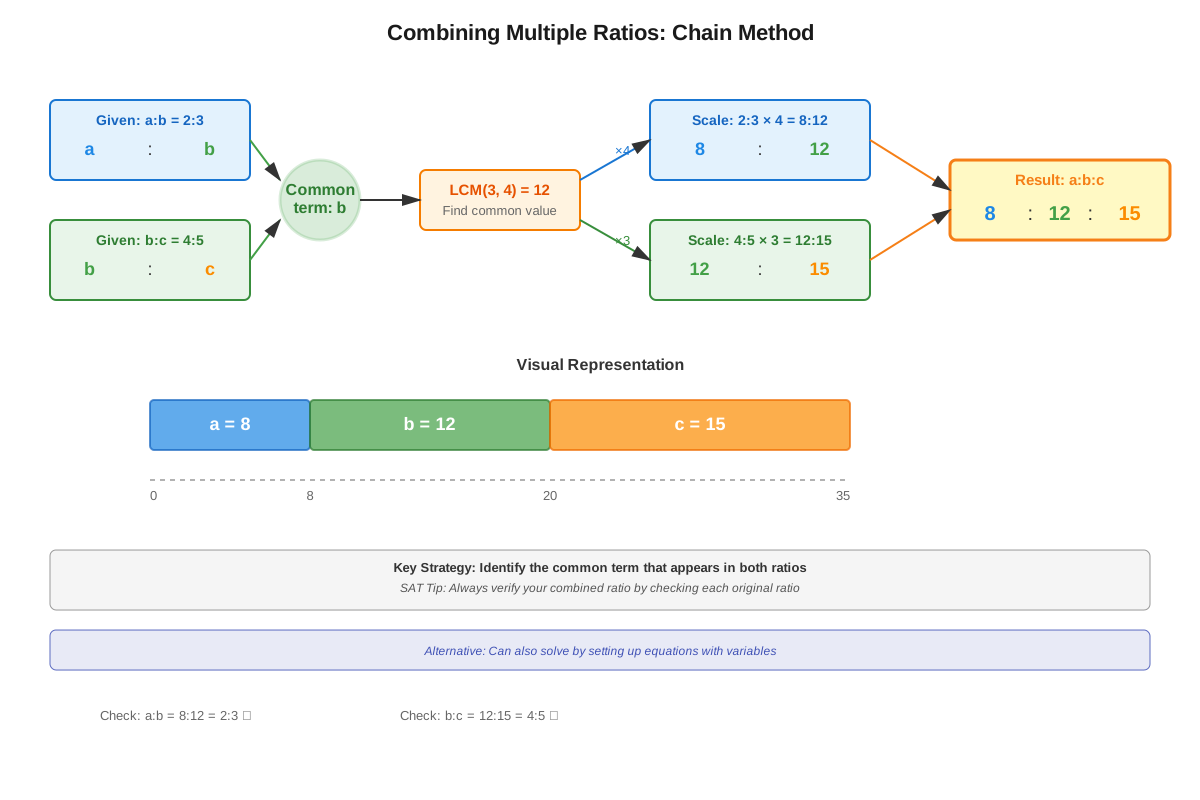
The SAT frequently tests the ability to combine ratios when given indirect relationships. If a:b = 2:3 and b:c = 4:5, finding a:c requires making the b terms equal in both ratios.
Method for combining ratios:
- Identify the common term (b in this example)
- Find the least common multiple of the b values (LCM of 3 and 4 = 12)
- Scale each ratio so the common term equals the LCM
- First ratio: multiply by 4 → a:b = 8:12
- Second ratio: multiply by 3 → b:c = 12:15
- Write the combined ratio: a:b:c = 8:12:15
- Extract the desired relationship: a:c = 8:15
Algebraic Ratio Problems
Many SAT ratio problems require setting up algebraic equations. When a ratio is given as a:b = m:n, this can be expressed as a/b = m/n, which cross-multiplies to an = bm. This algebraic form enables solving for unknown variables.
For problems stating "the ratio of x to y is 5 to 8," represent this as:
- x/y = 5/8, or
- x = 5k and y = 8k (where k is a constant multiplier)
The second representation proves particularly powerful because it expresses both quantities in terms of a single variable, simplifying equation setup when additional constraints are provided.
Concept Relationships
Ratio fundamentals → serve as the foundation for → ratio distribution problems, which require understanding how to scale ratios to match given totals. The distinction between part-to-part and part-to-whole ratios → determines → which ratio form to use when setting up equations, as misidentifying the ratio type leads to incorrect solutions.
Simplifying ratios → connects to → fraction operations and finding greatest common factors, prerequisite skills that make ratio manipulation efficient. Scaling ratios → directly applies to → solving distribution problems and → extends to → understanding proportions (covered in the next topic), where equivalent ratios form the basis of proportional relationships.
Algebraic ratio representation → enables → solving complex multi-step problems and → connects to → linear equations, as ratio relationships often translate into linear algebraic expressions. Combining multiple ratios → builds upon → simplifying and scaling ratios while → preparing students for → rate problems where multiple conversion factors must be chained together.
The entire ratios topic → provides essential foundation for → rates (ratios with different units), proportions (equations stating two ratios are equal), percentages (ratios with denominator 100), probability (ratios of favorable to total outcomes), and similar figures in geometry (corresponding sides in constant ratio).
High-Yield Facts
⭐ A ratio a:b can be represented algebraically as a = mx and b = nx, where m and n are the ratio terms and x is a common multiplier
⭐ When given a part-to-part ratio a:b and a total T, each part equals: first part = a/(a+b) × T and second part = b/(a+b) × T
⭐ Ratios must compare quantities in the same units; convert units before setting up ratio relationships
⭐ The ratio a:b:c means the quantities are in the relationship a/(a+b+c), b/(a+b+c), and c/(a+b+c) of the total
⭐ To combine ratios with a common term, scale each ratio so the common term has the same value in both ratios
- Ratios remain constant when both terms are multiplied or divided by the same non-zero number
- A ratio of 1:1 indicates equal quantities; ratios greater than 1:1 indicate the first quantity is larger
- In word problems, "ratio of A to B" means A:B, with A as the first term
- Simplifying ratios before calculation reduces arithmetic complexity and minimizes errors
- When a ratio problem involves percentages, convert percentages to whole numbers before forming ratios
- Three-term ratios (a:b:c) appear frequently in SAT problems involving three categories or groups
- The reciprocal of ratio a:b is b:a; this relationship helps when problems provide inverse information
Quick check — test yourself on Ratios so far.
Try Flashcards →Common Misconceptions
Misconception: The ratio 3:5 means there are exactly 3 of one item and 5 of another.
Correction: Ratios express relative amounts, not absolute quantities. A 3:5 ratio could represent 3 and 5, 6 and 10, 30 and 50, or any pair where the first quantity is 3/5 of the second. The actual amounts depend on additional information provided in the problem.
Misconception: When given "the ratio of boys to girls is 2:3" and asked for the fraction of students who are boys, the answer is 2/3.
Correction: This confuses part-to-part with part-to-whole ratios. If boys to girls is 2:3, then boys to total students is 2:(2+3) = 2:5, making the fraction of boys 2/5, not 2/3. Always identify whether the question asks for a part-to-part or part-to-whole relationship.
Misconception: To combine ratios a:b = 2:3 and b:c = 4:5, simply write a:b:c = 2:3:4:5.
Correction: The common term (b) must have the same value in both ratios before combining. Scale the first ratio by 4 (giving 8:12) and the second by 3 (giving 12:15), then combine as a:b:c = 8:12:15. The b term must match in both ratios.
Misconception: Ratios can compare quantities with different units without conversion.
Correction: Ratios only make sense when comparing quantities in the same units. If comparing 2 feet to 18 inches, first convert to common units: 2 feet = 24 inches, so the ratio is 24:18 = 4:3. Never form ratios from quantities in different units without conversion.
Misconception: In a ratio problem with a total, each part equals the ratio term times the total.
Correction: Each part equals the ratio term times the value of one part, not the total. If dividing 100 in ratio 3:7, one part equals 100÷(3+7) = 10, so the parts are 3×10 = 30 and 7×10 = 70. Multiplying ratio terms directly by the total (3×100 and 7×100) produces incorrect results.
Misconception: Simplifying ratios is optional and doesn't affect the answer.
Correction: While equivalent ratios represent the same relationship, failing to simplify can complicate calculations and increase error risk. Additionally, SAT answer choices typically present ratios in simplest form, so unsimplified ratios may not match any option. Always simplify ratios by dividing by the GCF.
Worked Examples
Example 1: Ratio Distribution with Three Terms
Problem: A school's budget of $45,000 is allocated to three departments—Math, Science, and English—in the ratio 5:7:3. How much money does the Science department receive?
Solution:
Step 1: Identify the given information
- Total budget: $45,000
- Ratio Math:Science:English = 5:7:3
- Find: Science department allocation
Step 2: Calculate total ratio parts
Total parts = 5 + 7 + 3 = 15 parts
Step 3: Find the value of one part
Value per part = $45,000 ÷ 15 = $3,000
Step 4: Calculate Science department allocation
Science receives 7 parts
Science allocation = 7 × $3,000 = $21,000
Step 5: Verify (optional but recommended)
- Math: 5 × $3,000 = $15,000
- Science: 7 × $3,000 = $21,000
- English: 3 × $3,000 = $9,000
- Total: $15,000 + $21,000 + $9,000 = $45,000 ✓
Answer: The Science department receives $21,000.
Connection to Learning Objectives: This problem demonstrates applying ratios to SAT-style questions by distributing a total according to a three-term ratio, a high-frequency SAT question type.
Example 2: Combining Ratios with Algebraic Reasoning
Problem: In a mixture, the ratio of ingredient A to ingredient B is 3:4, and the ratio of ingredient B to ingredient C is 5:2. If there are 30 units of ingredient A, how many units of ingredient C are there?
Solution:
Step 1: Write the given ratios
- A:B = 3:4
- B:C = 5:2
Step 2: Make the B terms equal by finding the LCM
The B term is 4 in the first ratio and 5 in the second ratio
LCM(4, 5) = 20
Step 3: Scale both ratios so B = 20
- First ratio: multiply by 5 → A:B = 15:20
- Second ratio: multiply by 4 → B:C = 20:8
Step 4: Combine the ratios
A:B:C = 15:20:8
Step 5: Use the given value to find the multiplier
A = 30 units, and A represents 15 parts
Multiplier = 30 ÷ 15 = 2
Step 6: Calculate C
C represents 8 parts
C = 8 × 2 = 16 units
Answer: There are 16 units of ingredient C.
Connection to Learning Objectives: This problem requires combining multiple ratios to find indirect relationships and applying algebraic reasoning to solve for unknown quantities—both essential SAT skills.
Exam Strategy
When approaching SAT ratio questions, begin by identifying what type of ratio relationship is presented: part-to-part, part-to-whole, or a combination of multiple ratios. This classification determines the solution approach and prevents the most common errors.
Trigger words and phrases that signal ratio problems include: "ratio of," "for every," "per," "to every," "distributed in the ratio," "proportional to," and "in the relationship." When these appear, immediately consider whether ratio reasoning applies. Questions asking "what fraction" or "what percent" after providing a part-to-part ratio require converting to part-to-whole relationships.
For process of elimination, recognize that ratio answers must maintain the given relationship. If a problem states a ratio of 3:5 and asks for possible values, eliminate any answer choice where the first value divided by the second doesn't equal 3/5. When answer choices present ratios, simplify each to compare them efficiently—the SAT often includes unsimplified ratios as distractors.
Time allocation strategy: Simple ratio problems (identifying or simplifying ratios) should take 30-45 seconds. Distribution problems requiring one calculation typically need 60-90 seconds. Complex problems involving combined ratios or multiple steps may require 2-3 minutes. If a ratio problem seems to require more than 3 minutes, mark it for review and move forward—you may be overcomplicating the approach.
Systematic problem-solving approach:
- Read carefully to identify all ratio relationships (30 seconds)
- Determine if the problem involves distribution, combination, or direct calculation (15 seconds)
- Set up the ratio algebraically or numerically (30 seconds)
- Perform calculations methodically (45-90 seconds)
- Verify the answer makes sense in context (15 seconds)
Exam Tip: When stuck on a ratio problem, try assigning algebraic variables (like x) to represent the common multiplier. Express all quantities in terms of x, then use any additional constraint to solve for x. This technique transforms complex ratio problems into straightforward algebra.
Memory Techniques
PART mnemonic for ratio distribution problems:
- Parts: Add all ratio terms to find total parts
- Amount: Divide the total amount by total parts
- Ratio: Multiply each ratio term by the amount per part
- Test: Verify individual amounts sum to the given total
"Same Units, Same Ratio" - Before forming any ratio, ensure both quantities use identical units. This rhyme reminds students that unit conversion must precede ratio formation.
The "Common Term Bridge" visualization: When combining ratios like a:b and b:c, visualize b as a bridge connecting the two ratios. To cross the bridge, both sides must have the same height (value), requiring scaling.
3-5-8 Pattern for part-to-whole conversion: Given part-to-part ratio 3:5, remember the pattern "3-5-8" where 8 is the sum. This creates part-to-whole ratios 3:8 and 5:8. The pattern "ratio terms → sum" helps quickly convert between ratio types.
"Multiply to Simplify" paradox: When combining ratios, you must multiply (scale) each ratio before you can simplify the combined result. This counterintuitive phrase helps students remember the two-step process.
Acronym SCALE for ratio problems:
- Simplify the given ratio first
- Calculate total parts
- Allocate by dividing total by parts
- List each quantity (multiply ratio terms)
- Evaluate by checking the sum
Summary
Ratios represent fundamental relationships between quantities, expressing how many times one value contains another. On the SAT, ratio mastery requires fluency in multiple skills: distinguishing part-to-part from part-to-whole ratios, distributing totals according to given ratios, combining multiple ratios through common terms, and translating word problems into ratio relationships. The key to success lies in systematic problem-solving—identifying the ratio type, setting up relationships algebraically when needed, and performing calculations methodically. Students must recognize that ratios express relative rather than absolute quantities, requiring a multiplier to connect ratio relationships to actual values. Whether problems involve two-term or three-term ratios, the fundamental approach remains consistent: find total parts, determine the value per part, and scale appropriately. By mastering these core concepts and avoiding common misconceptions like confusing ratio types or combining ratios incorrectly, students can confidently tackle the 3-5 ratio questions appearing on every SAT, securing valuable points in this high-yield topic area.
Key Takeaways
- Ratios express relative relationships between quantities and can be written as a:b, a to b, or a/b, with all forms representing the same relationship
- Part-to-part ratios compare components to each other (boys:girls = 2:3), while part-to-whole ratios compare a component to the total (boys:total = 2:5)
- To distribute a total T according to ratio a:b, calculate each part as a/(a+b) × T and b/(a+b) × T
- Combining ratios with a common term requires scaling each ratio so the common term has equal value in both ratios before combining
- Algebraic representation (a = mx, b = nx) transforms ratio problems into solvable equations when additional constraints are provided
- Always simplify ratios to lowest terms and ensure quantities share the same units before forming ratio relationships
- Systematic approaches (identify ratio type → set up relationship → calculate → verify) prevent errors and save time on test day
Related Topics
Proportions: Building directly on ratio concepts, proportions are equations stating that two ratios are equal (a/b = c/d). Mastering ratios enables students to set up and solve proportion problems, including cross-multiplication techniques and finding missing values in proportional relationships.
Rates: Rates are special ratios comparing quantities with different units (miles per hour, dollars per pound). Understanding ratio fundamentals transfers directly to rate problems, which appear frequently on the SAT in contexts like speed, unit pricing, and work rates.
Percentages: Percentages represent ratios with a denominator of 100. Students who understand part-to-whole ratios can easily convert between ratios, fractions, decimals, and percentages—a critical skill for SAT data interpretation and word problems.
Similar Figures: In geometry, similar figures have corresponding sides in constant ratio. Ratio mastery enables students to solve problems involving scale factors, proportional side lengths, and area/volume relationships in similar shapes.
Probability: Probability expresses the ratio of favorable outcomes to total possible outcomes. Understanding part-to-whole ratios provides the foundation for calculating and interpreting probabilities on the SAT.
Practice CTA
Now that you've mastered the core concepts of ratios, it's time to solidify your understanding through active practice. Complete the practice questions to apply these strategies to authentic SAT-style problems, and use the flashcards to reinforce key definitions and formulas. Remember, ratio problems reward systematic thinking and careful setup—skills that improve dramatically with deliberate practice. Each problem you solve strengthens your pattern recognition and builds the confidence needed to tackle any ratio question on test day. You've built a strong foundation; now transform that knowledge into points!
Sign up free to keep reading
Create a free AnvayaPrep account to finish this SAT guide on Ratios — plus flashcards and practice questions.