Overview
SAT ratio traps represent one of the most frequently tested—and most commonly missed—question types in the math section of the SAT. These deceptive problems exploit common misconceptions about how ratios work, particularly when students attempt to combine, manipulate, or interpret ratio information without fully understanding the underlying quantities. The College Board deliberately designs these questions to catch students who rush through problems or apply memorized formulas without critical thinking.
Understanding ratio traps is essential because they appear in approximately 2-4 questions per SAT exam, often in both the calculator and no-calculator sections. These questions typically carry medium to high difficulty ratings and can significantly impact your score if you fall into their carefully constructed pitfalls. The most common trap involves students incorrectly adding or combining ratios without considering the actual quantities they represent, leading to systematically wrong answers that appear among the multiple-choice options.
Mastering sat ratio traps connects directly to broader mathematical reasoning skills tested throughout the SAT, including proportional relationships, algebraic thinking, and data interpretation. This topic builds upon fundamental ratio and proportion concepts while requiring deeper analytical skills to recognize when standard approaches will lead you astray. Success with ratio traps demonstrates the kind of mathematical maturity that distinguishes high scorers from average performers.
Learning Objectives
- [ ] Identify key features of SAT ratio traps
- [ ] Explain how SAT ratio traps appears on the SAT
- [ ] Apply SAT ratio traps to answer SAT-style questions
- [ ] Distinguish between situations where ratios can and cannot be directly combined
- [ ] Convert ratio information into actual quantities using algebraic variables
- [ ] Recognize trigger words and phrases that signal potential ratio trap questions
- [ ] Verify ratio-based answers by checking against the original constraints
Prerequisites
- Basic ratio notation and simplification: Understanding that ratios express relative quantities and can be written as fractions, with colons, or using "to" notation is fundamental to recognizing when trap conditions exist
- Algebraic variable manipulation: The ability to represent unknown quantities with variables and solve simple equations is essential for the most reliable method of avoiding ratio traps
- Fraction operations: Since ratios are often expressed as fractions, comfort with adding, subtracting, and comparing fractions helps identify when operations are valid or invalid
- Proportional reasoning: Recognizing when two ratios are equivalent and understanding cross-multiplication provides the foundation for legitimate ratio problem-solving
Why This Topic Matters
Ratio traps appear with remarkable consistency on the SAT because they efficiently test multiple mathematical competencies simultaneously: conceptual understanding of ratios, algebraic reasoning, and critical thinking. According to College Board data, these questions have among the highest discrimination indices, meaning they effectively separate students who truly understand mathematical relationships from those who rely on pattern recognition or memorized procedures.
In real-world applications, ratio reasoning appears constantly in contexts like recipe scaling, financial analysis, mixing solutions, population demographics, and data interpretation. The ability to avoid ratio traps translates directly to avoiding costly errors in professional and personal decision-making. For instance, understanding that you cannot simply add ratios prevents mistakes in business contexts like combining profit margins from different product lines or averaging rates of return from different investment periods.
On the SAT, ratio trap questions typically appear as word problems involving comparisons between groups, mixing problems, or questions about combined populations. They frequently show up in questions 10-20 of each math section (the medium-to-hard range) and are particularly common in grid-in questions where students cannot use process of elimination. The SAT test writers specifically include answer choices that represent common trap answers, making it crucial to recognize these patterns before attempting the problem.
Core Concepts
The Fundamental Ratio Trap: Adding Ratios Directly
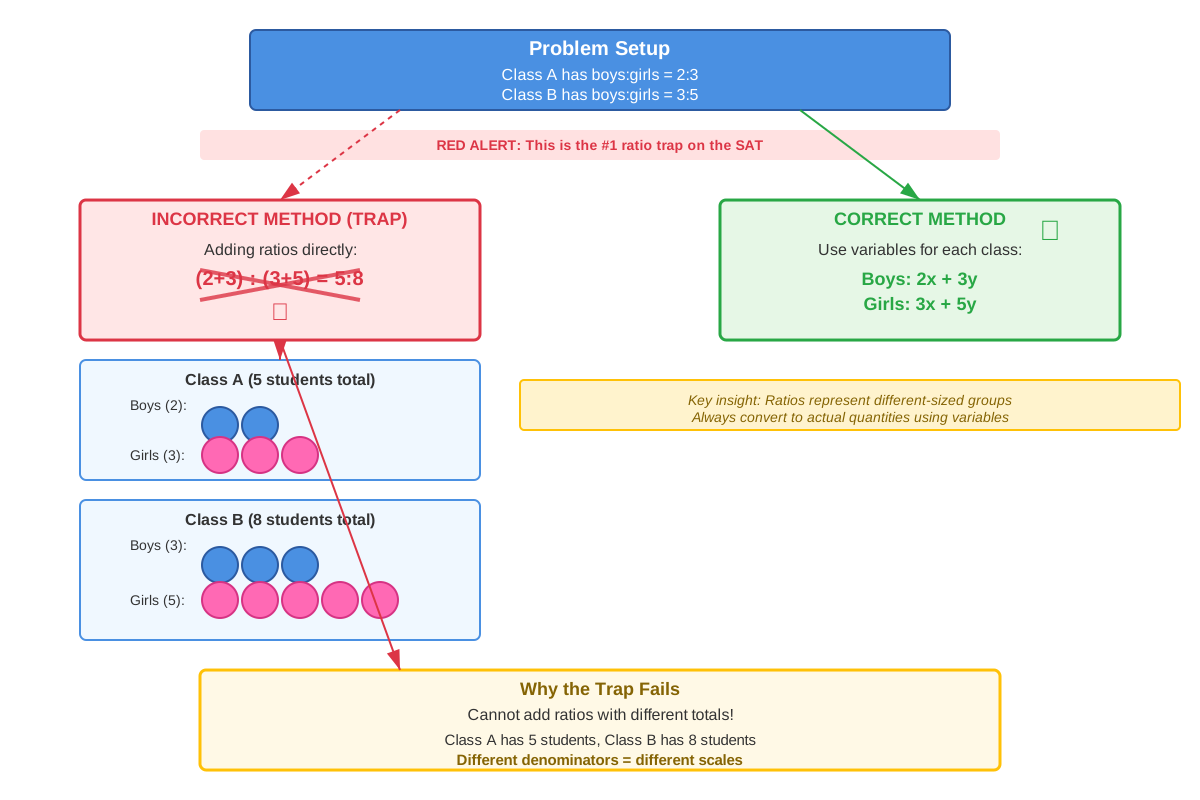
The most common sat ratio traps involves the temptation to add ratios directly when combining groups. Consider this scenario: Class A has a boy-to-girl ratio of 2:3, and Class B has a boy-to-girl ratio of 3:4. Students instinctively want to add these ratios (2+3):(3+4) = 5:7 for the combined classes, but this is almost always incorrect.
The error occurs because ratios represent relative quantities, not absolute quantities. A 2:3 ratio could represent 2 boys and 3 girls, or 20 boys and 30 girls, or any multiple thereof. Without knowing the actual sizes of the groups, you cannot determine the combined ratio. The combined ratio depends on the actual number of students in each class, not just their internal ratios.
The correct approach requires either:
- Knowing the actual quantities in at least one group
- Being given information that allows you to determine actual quantities
- Recognizing that the problem cannot be solved with the given information
Converting Ratios to Algebraic Expressions
The most reliable method for avoiding ratio traps involves converting ratio information into algebraic expressions with variables. When you see a ratio like 2:3, represent the actual quantities as 2x and 3x, where x is a common multiplier.
For example, if boys to girls is 2:3:
- Number of boys = 2x
- Number of girls = 3x
- Total students = 2x + 3x = 5x
This algebraic representation makes it clear that you're working with actual quantities that can be legitimately added, subtracted, or combined. When combining two groups with different ratios, you must use different variables (like x and y) unless you have information connecting them.
Part-to-Part vs. Part-to-Whole Ratios
Understanding the distinction between part-to-part and part-to-whole ratios is crucial for avoiding traps. A part-to-part ratio compares two components (boys:girls = 2:3), while a part-to-whole ratio compares one component to the total (boys:total = 2:5).
| Ratio Type | Example | Boys | Girls | Total |
|---|---|---|---|---|
| Part-to-Part | 2:3 | 2x | 3x | 5x |
| Part-to-Whole (boys) | 2:5 | 2x | 3x | 5x |
| Part-to-Whole (girls) | 3:5 | 2x | 3x | 5x |
The SAT frequently creates traps by mixing these ratio types within a single problem or by providing one type when students expect another. Always identify which type you're given and which type the question asks for.
The Weighted Average Connection
Many ratio trap questions are actually disguised weighted average problems. When combining groups with different ratios, the combined ratio is a weighted average based on the sizes of the groups. A larger group has more influence on the combined ratio than a smaller group.
For instance, if Class A (20 students) has a 2:3 boy-to-girl ratio and Class B (30 students) has a 3:4 ratio, Class B's ratio has more weight in determining the combined ratio. This concept helps you estimate reasonable answers and eliminate trap choices that ignore the weighting effect.
Ratio Scaling and Constraints
Some ratio traps involve scaling ratios up or down while maintaining certain constraints. For example, if a ratio must be expressed in whole numbers and you're told the total must be a specific value, you need to find the appropriate multiplier that satisfies both conditions.
The key principle: when you multiply all parts of a ratio by the same value, the ratio remains equivalent. However, the SAT creates traps by suggesting operations that don't maintain this equivalence or by providing constraints that seem compatible but actually aren't.
Ratio Trap in Rate Problems
Ratios appear in rate problems (speed, work rate, price per unit) where the trap involves incorrectly averaging rates or combining them. The harmonic mean, not the arithmetic mean, applies to rates when distances or quantities are equal. For example, if you drive to school at 30 mph and return at 60 mph, your average speed is NOT 45 mph—it's 40 mph.
This connects to ratio traps because students often treat rates as simple ratios that can be averaged arithmetically, falling into the same conceptual error as adding ratios directly.
Concept Relationships
The core concepts within ratio traps form an interconnected web of mathematical reasoning. Converting ratios to algebraic expressions serves as the foundational technique that prevents most traps, leading directly to the ability to distinguish between part-to-part and part-to-whole ratios since the algebraic form makes these relationships explicit.
Understanding that ratios cannot be added directly connects to weighted average concepts because the correct method for combining ratios is essentially a weighted average calculation based on actual group sizes. This relationship explains why the combined ratio depends on more than just the individual ratios—it requires knowing the weights (actual quantities).
The prerequisite knowledge of proportional reasoning enables recognition of ratio scaling and constraints, as both involve maintaining equivalent relationships while changing absolute values. Meanwhile, algebraic variable manipulation skills support all other concepts by providing the mathematical tools to represent and solve ratio problems rigorously.
The relationship map flows as follows:
Basic Ratio Understanding → Algebraic Representation (2x, 3x) → Recognition of Part-to-Part vs. Part-to-Whole → Understanding Why Direct Addition Fails → Application of Weighted Average Principles → Successful Problem Solving
High-Yield Facts
⭐ Ratios cannot be added directly unless the groups have the same size or you're given information to determine actual quantities
⭐ Always convert ratios to algebraic expressions (2x, 3x) to work with actual quantities rather than relative quantities
⭐ A ratio of a:b means the first quantity is (a/b) times the second quantity, and together they total (a+b) parts
⭐ When combining groups with different ratios, the combined ratio is a weighted average based on group sizes
⭐ Part-to-part ratios (boys:girls) and part-to-whole ratios (boys:total) contain the same information but require conversion between forms
- The SAT specifically includes answer choices that represent common ratio trap errors to catch students who rush
- If a problem gives you two ratios without actual quantities and asks for a combined ratio, check whether additional information is hidden in the problem
- Ratios remain equivalent when all parts are multiplied or divided by the same non-zero number
- The phrase "respectively" in ratio problems indicates the order of correspondence between quantities and ratio parts
- Grid-in ratio questions are more likely to be traps because you cannot use process of elimination to avoid obvious wrong answers
Quick check — test yourself on SAT ratio traps so far.
Try Flashcards →Common Misconceptions
Misconception: You can add ratios by adding their corresponding parts (if ratio 1 is 2:3 and ratio 2 is 3:4, the combined ratio is 5:7)
→ Correction: Ratios represent relative quantities, not absolute quantities. Without knowing actual group sizes, you cannot determine a combined ratio. The combined ratio depends on how many items are in each group, not just their internal proportions.
Misconception: A ratio of 2:3 means there are exactly 2 of the first item and 3 of the second item
→ Correction: A ratio of 2:3 means the quantities are in that proportion—there could be 2 and 3, or 4 and 6, or 200 and 300. The ratio tells you the relative relationship, not the absolute quantities unless additional information is provided.
Misconception: If boys:girls is 2:3, then boys represent 2/3 of the total
→ Correction: If boys:girls is 2:3, then boys represent 2/(2+3) = 2/5 of the total, not 2/3. The denominator must include all parts of the ratio when converting to a fraction of the whole.
Misconception: Averaging two ratios gives you the ratio for the combined group
→ Correction: The combined ratio is a weighted average based on group sizes, not a simple arithmetic average. A group twice as large has twice the influence on the combined ratio.
Misconception: If you know the ratio and one quantity, you can always find the other quantities
→ Correction: You can find other quantities only if you know an actual value for one part of the ratio or the total. Knowing that boys:girls is 2:3 and that there are "some boys" doesn't help without a specific number.
Worked Examples
Example 1: The Classic Ratio Trap
Problem: In Class A, the ratio of boys to girls is 3:5. In Class B, the ratio of boys to girls is 2:3. If Class A has 24 students and Class B has 30 students, what is the ratio of boys to girls in the combined classes?
Trap Answer: Students might try to add ratios: (3+2):(5+3) = 5:8
Correct Solution:
Step 1: Convert Class A's ratio to actual quantities
- Boys:Girls = 3:5 means boys = 3x and girls = 5x
- Total = 3x + 5x = 8x = 24 students
- Therefore x = 3
- Boys in Class A = 3(3) = 9
- Girls in Class A = 5(3) = 15
Step 2: Convert Class B's ratio to actual quantities
- Boys:Girls = 2:3 means boys = 2y and girls = 3y
- Total = 2y + 3y = 5y = 30 students
- Therefore y = 6
- Boys in Class B = 2(6) = 12
- Girls in Class B = 3(6) = 18
Step 3: Combine the actual quantities
- Total boys = 9 + 12 = 21
- Total girls = 15 + 18 = 33
- Combined ratio = 21:33 = 7:11 (simplified)
Key Insight: The answer 7:11 is completely different from the trap answer 5:8. This problem demonstrates why you must work with actual quantities, not just ratios. The algebraic approach with variables (x and y) ensures you're adding real numbers of students, not abstract ratio parts.
Example 2: Ratio Trap with Constraints
Problem: A paint mixture requires red and blue paint in a ratio of 5:3. A second mixture requires red and blue paint in a ratio of 3:2. If you combine equal volumes of these two mixtures, what is the ratio of red to blue paint in the final mixture?
Solution:
Step 1: Recognize that "equal volumes" gives us the connection between the two mixtures
Step 2: Choose a convenient volume (like 1 gallon) for each mixture
For Mixture 1 (ratio 5:3):
- Total parts = 5 + 3 = 8 parts
- Red paint = (5/8) × 1 gallon = 5/8 gallon
- Blue paint = (3/8) × 1 gallon = 3/8 gallon
For Mixture 2 (ratio 3:2):
- Total parts = 3 + 2 = 5 parts
- Red paint = (3/5) × 1 gallon = 3/5 gallon
- Blue paint = (2/5) × 1 gallon = 2/5 gallon
Step 3: Add the actual quantities
- Total red = 5/8 + 3/5 = 25/40 + 24/40 = 49/40 gallons
- Total blue = 3/8 + 2/5 = 15/40 + 16/40 = 31/40 gallons
Step 4: Express as a ratio
- Red:Blue = (49/40):(31/40) = 49:31
Key Insight: The phrase "equal volumes" was crucial—it allowed us to assign actual quantities to each mixture. Without this information, the problem would be unsolvable. This example shows how ratio problems often hide the key information you need to avoid the trap.
Exam Strategy
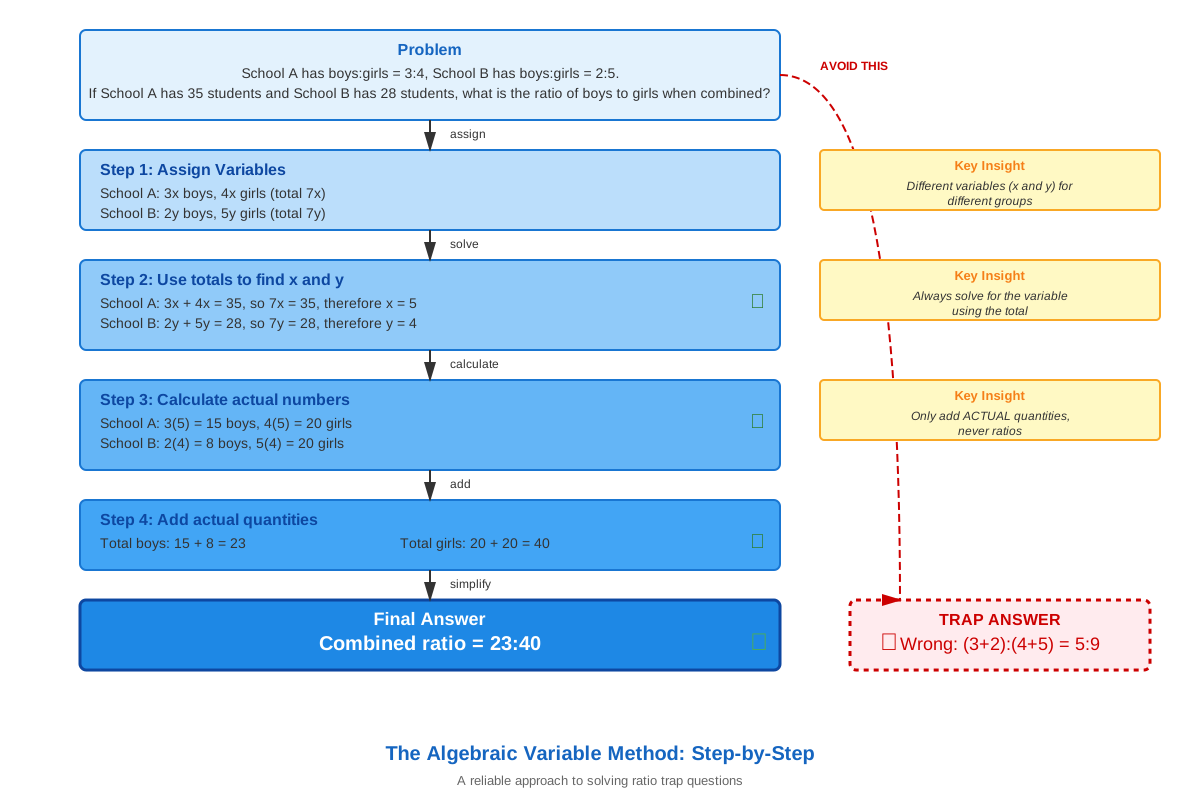
When approaching ratio problems on the SAT, follow this systematic process:
Step 1: Identify the trap potential
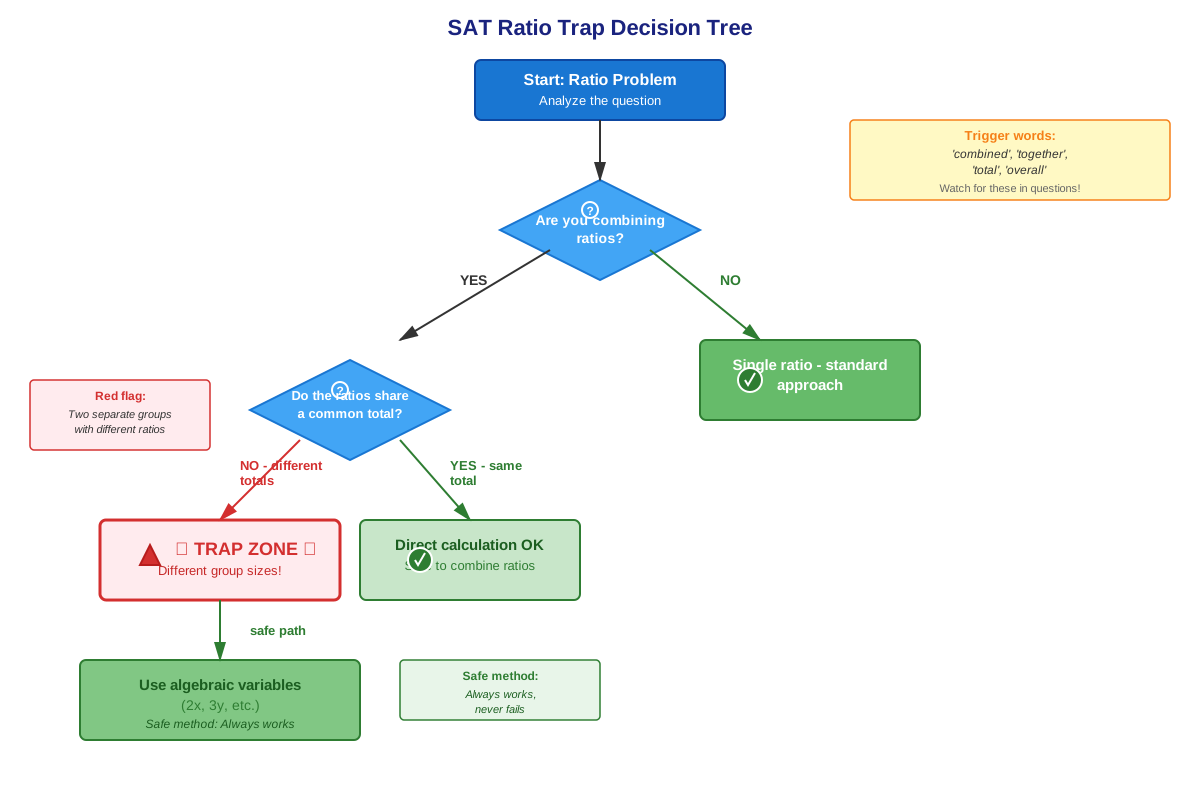
Look for these warning signs:
- Multiple ratios given without actual quantities
- Questions asking for a "combined" or "overall" ratio
- Answer choices that include simple sums of ratio parts
- Problems involving mixing, combining, or averaging
Step 2: Convert immediately to algebra
As soon as you see a ratio, write it algebraically:
- Ratio a:b → quantities are ax and bx
- Use different variables (x, y, z) for different groups unless you have information connecting them
Step 3: Find the connection
Look for information that allows you to determine actual quantities:
- Total number of items
- Actual value of one component
- Relationship between group sizes
- Equal amounts or volumes
Step 4: Work with actual quantities
Once you have algebraic expressions, solve for the variables and calculate actual numbers before combining groups or finding new ratios.
Exam Tip: If you find yourself adding ratio parts directly (like 2:3 plus 3:4 equals 5:7), stop immediately. This is almost certainly wrong unless the problem explicitly states the groups are equal in size.
Trigger words and phrases to watch for:
- "Combined," "together," "overall," "total" (suggesting you need to combine groups)
- "Respectively" (indicating order matters in matching quantities to ratio parts)
- "Equal amounts," "same number," "identical quantities" (providing the connection between groups)
- "On average," "average ratio" (often a trap—ratios don't average simply)
Time allocation: Spend 30-45 seconds setting up the algebraic representation correctly. This upfront investment prevents the 2-3 minutes you'd waste pursuing a trap answer and then having to restart.
Memory Techniques
R.A.T.I.O. Method for avoiding traps:
- Recognize the ratio notation and what it represents
- Algebraic variables for each group (2x, 3x)
- Total parts calculation (2x + 3x = 5x)
- Identify actual quantities using given information
- Operate only on actual numbers, never on ratio parts alone
The "Can't Add Apples to Oranges" Principle: Remember that ratios are like comparing apples to oranges—you can't add "2 apples per orange" to "3 apples per orange" and get "5 apples per orange" unless you know how many oranges you have in each case.
Visualization Strategy: Picture ratios as recipes. If Recipe A uses 2 cups flour to 3 cups sugar, and Recipe B uses 3 cups flour to 4 cups sugar, you can't just add them to get a new recipe ratio unless you know how many batches of each you're making.
The X-Factor Mnemonic: "X marks the spot where ratios become real." Always introduce variable x (and y, z if needed) to convert ratios into actual quantities you can work with.
Summary
SAT ratio traps exploit the common misconception that ratios can be directly added or combined like regular numbers. The fundamental principle to remember is that ratios represent relative quantities, not absolute quantities, and therefore cannot be manipulated arithmetically without first converting them to actual values. The most reliable strategy involves immediately translating any ratio into algebraic expressions using variables (representing a:b as ax and bx), then using given information about totals, actual quantities, or relationships between groups to solve for these variables. Only after determining actual quantities should you combine groups or calculate new ratios. The SAT deliberately includes answer choices representing trap answers—typically the result of directly adding ratio parts—making it essential to recognize these patterns and avoid the intuitive but incorrect approach. Success with ratio problems requires understanding part-to-part versus part-to-whole relationships, recognizing when ratios function as weighted averages, and maintaining disciplined algebraic problem-solving rather than rushing to numerical answers.
Key Takeaways
- Ratios cannot be added directly; they must first be converted to actual quantities using algebraic variables
- Always represent a ratio a:b as ax and bx, where x is a common multiplier that can be solved for using additional information
- The combined ratio of two groups depends on both their individual ratios AND their relative sizes (weighted average principle)
- Part-to-part ratios (boys:girls = 2:3) and part-to-whole ratios (boys:total = 2:5) contain equivalent information but require conversion
- SAT answer choices deliberately include trap answers from incorrect direct addition of ratios
- Look for trigger words like "combined," "overall," and "respectively" that signal potential ratio trap questions
- Spending extra time on proper algebraic setup prevents falling into traps and saves time overall
Related Topics
Proportions and Cross-Multiplication: Understanding how to set up and solve proportions extends ratio concepts and provides alternative solution methods for some ratio problems, particularly when dealing with scaling or equivalent ratios.
Weighted Averages: Since combining ratios is fundamentally a weighted average problem, mastering weighted average calculations provides deeper insight into why ratios behave as they do when groups are combined.
Systems of Equations: More complex ratio problems may involve multiple constraints that require setting up and solving systems of equations, building on the algebraic variable approach used to avoid ratio traps.
Percent Problems: Ratios and percents are closely related (percents are ratios with denominator 100), and many percent traps mirror ratio traps in their logical structure.
Rate Problems: Understanding ratio traps helps avoid similar traps in rate problems, particularly those involving average speed or combined work rates.
Practice CTA
Now that you understand the mechanics and traps of SAT ratio problems, it's time to cement your knowledge through practice. Attempt the practice questions associated with this topic, focusing on identifying trap answers before solving. Use the flashcards to reinforce the key principles, especially the algebraic conversion technique. Remember: every ratio trap you learn to avoid is a question you'll confidently answer correctly on test day, potentially adding valuable points to your score. The difference between a good score and a great score often comes down to mastering exactly these types of medium-difficulty questions that separate careful thinkers from hasty problem-solvers.
Sign up free to keep reading
Create a free AnvayaPrep account to finish this SAT guide on SAT ratio traps — plus flashcards and practice questions.