Overview
Business systems represent one of the most practical and frequently tested applications of systems of linear equations on the SAT math section. These problems model real-world scenarios involving revenue, costs, profits, pricing strategies, and break-even analysis—situations that businesses encounter daily. Understanding how to translate business language into mathematical equations and solve for unknown quantities is not only crucial for SAT success but also provides foundational skills for economics, finance, and entrepreneurship.
On the SAT, sat business systems questions typically present scenarios involving two or more related quantities that must be determined simultaneously. Students might encounter problems about calculating the price of individual items when given total costs, determining production quantities that maximize profit, or finding break-even points where revenue equals expenses. These questions test the ability to construct systems of equations from word problems, manipulate algebraic expressions, and interpret solutions within a business context.
Business systems problems integrate multiple mathematical competencies: translating verbal descriptions into algebraic notation, solving systems of equations using substitution or elimination methods, and validating that solutions make sense in real-world contexts. Mastery of this topic strengthens overall problem-solving abilities and connects abstract algebra to tangible applications, making it a high-yield area for focused study. The SAT frequently uses business contexts because they provide clear, relatable scenarios that test mathematical reasoning without requiring specialized business knowledge.
Learning Objectives
- [ ] Identify key features of business systems including variables, constraints, and relationships
- [ ] Explain how business systems appears on the SAT in various question formats
- [ ] Apply business systems to answer SAT-style questions accurately and efficiently
- [ ] Translate business word problems into systems of linear equations with appropriate variables
- [ ] Determine which solution method (substitution, elimination, or graphing) is most efficient for a given business problem
- [ ] Interpret solutions to business systems in context and verify their reasonableness
Prerequisites
- Linear equations in one variable: Essential for understanding each individual equation within a system and for solving after substitution or elimination reduces the system to one equation
- Systems of linear equations fundamentals: Required to understand solution methods (substitution, elimination, graphing) that apply to business contexts
- Basic algebraic manipulation: Necessary for rearranging equations, combining like terms, and isolating variables during the solution process
- Word problem translation skills: Critical for converting business scenarios described in words into mathematical expressions and equations
- Basic business vocabulary: Understanding terms like revenue, cost, profit, price, and quantity helps decode problem statements quickly
Why This Topic Matters
Business systems problems appear with remarkable frequency on the SAT, typically showing up in 2-4 questions per test administration. These questions often appear in both the calculator and no-calculator sections, with varying difficulty levels. The College Board favors business contexts because they assess mathematical modeling—the ability to represent real situations mathematically—which is a core competency for college readiness across multiple disciplines.
In real-world applications, business systems thinking is fundamental to entrepreneurship, corporate finance, economics, and operations management. Every business must understand the relationship between costs and revenues, determine optimal pricing strategies, and calculate break-even points. Small business owners use these concepts daily when deciding how many units to produce, what prices to charge, and whether a venture will be profitable. Financial analysts employ systems of equations to model complex business scenarios involving multiple products, variable costs, and market constraints.
On the SAT, business systems questions commonly appear as multi-step word problems requiring students to set up two equations with two unknowns, solve the system, and sometimes interpret the meaning of the solution. These questions may ask for individual prices when given combination purchases, production quantities that yield specific profit levels, or the point at which two different pricing plans become equivalent. The SAT particularly favors scenarios involving ticket sales, product pricing, service charges, and simple profit calculations because they're universally relatable and don't require specialized knowledge.
Core Concepts
Fundamental Components of Business Systems
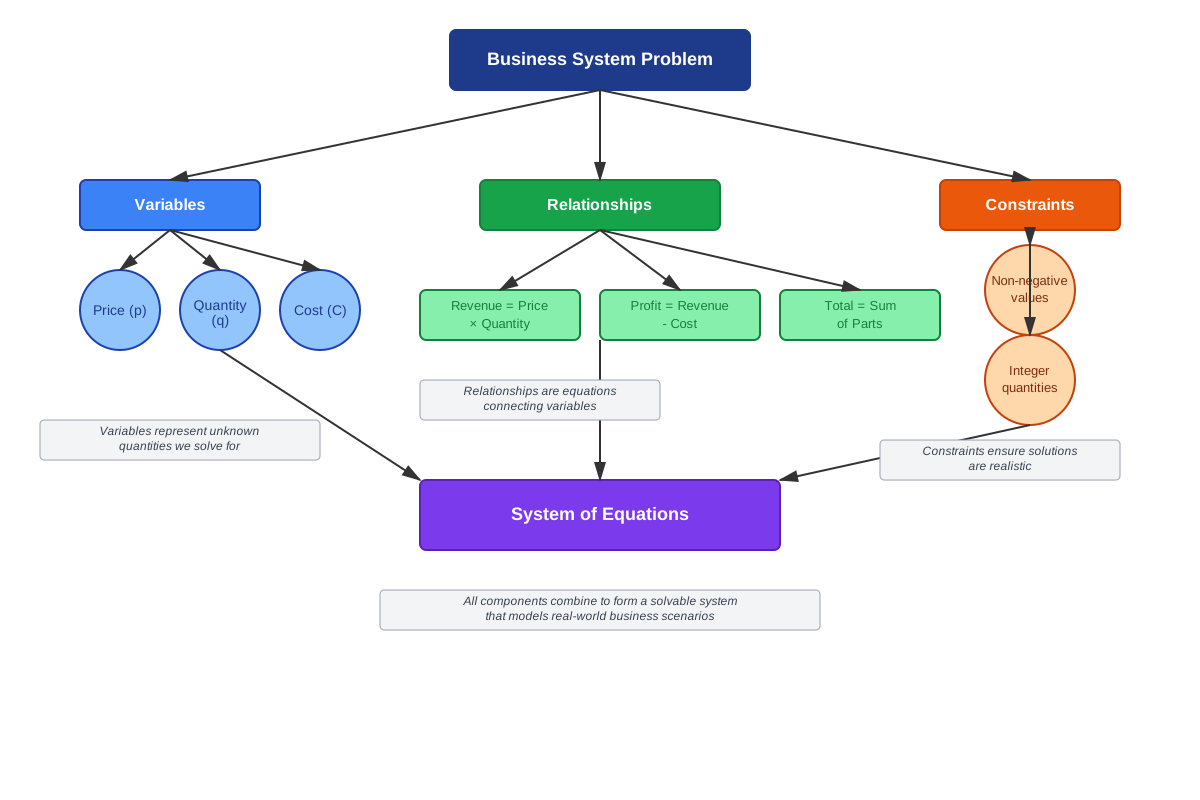
Business systems in mathematics refer to scenarios where multiple business-related quantities are connected through linear relationships, requiring simultaneous equations to solve. Every business system problem contains several key components that must be identified before constructing equations.
Variables represent the unknown quantities you need to find. In business contexts, these typically include prices, quantities, costs per unit, or time periods. Choosing clear, meaningful variable names (like p for price or q for quantity) helps prevent errors during problem-solving.
Constraints are the conditions or relationships given in the problem that limit possible solutions. These might include total revenue amounts, budget limitations, or relationships between different products' prices. Each constraint typically translates into one equation in your system.
Parameters are the known values provided in the problem, such as total sales, number of items purchased, or fixed costs. These numbers appear as constants in your equations.
Revenue, Cost, and Profit Relationships
The fundamental business equation that appears repeatedly on the SAT is:
Profit = Revenue - CostRevenue (also called income or sales) represents money coming into a business, calculated as:
Revenue = (Price per unit) × (Quantity sold)Cost represents money spent by the business, which may include:
- Fixed costs: Expenses that don't change with production quantity (rent, salaries, equipment)
- Variable costs: Expenses that change with production quantity (materials, hourly labor)
- Total cost: Fixed costs + (Variable cost per unit × Quantity)
Total Cost = Fixed Cost + (Variable Cost per unit) × (Quantity)Profit is the money remaining after subtracting all costs from revenue. A positive profit indicates the business is making money, while a negative profit (called a loss) indicates the business is losing money.
Break-Even Analysis
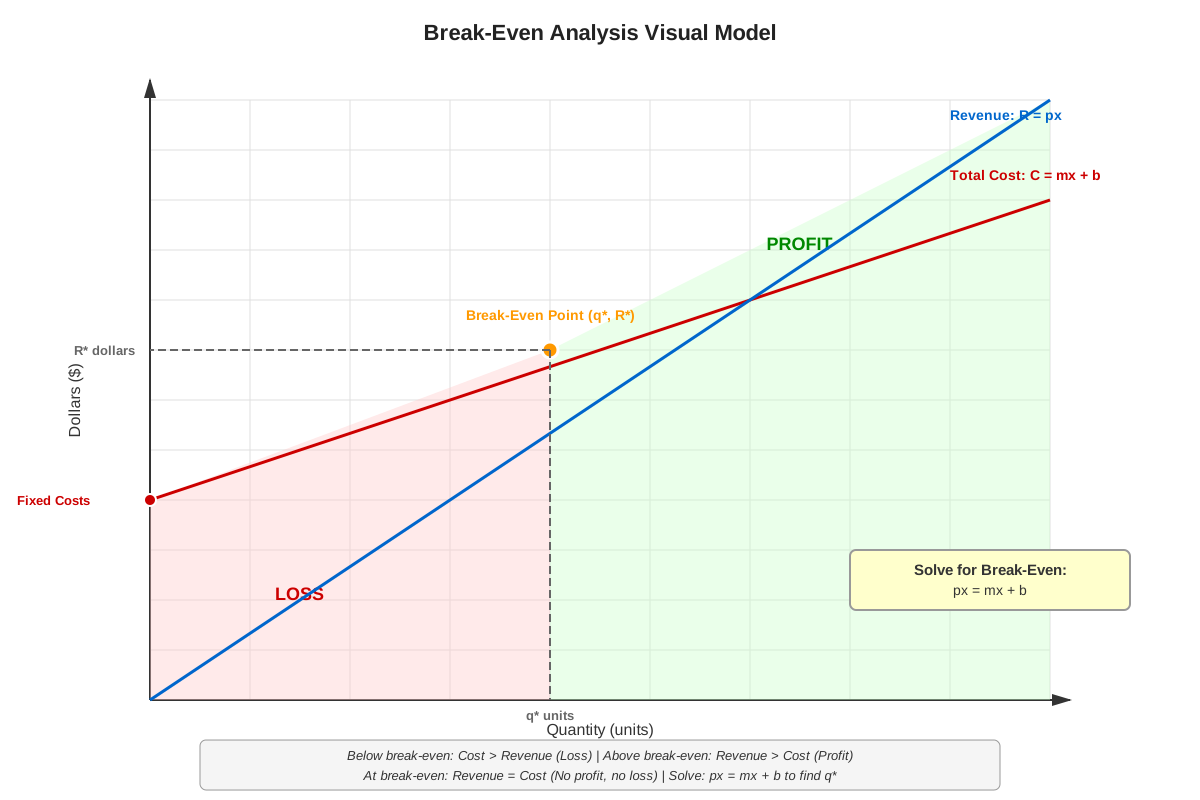
The break-even point occurs when revenue exactly equals cost, resulting in zero profit. This is a critical business concept that frequently appears on the SAT. At break-even:
Revenue = CostFinding the break-even point typically involves setting up an equation where the revenue expression equals the cost expression, then solving for the quantity or price that makes this true. Understanding break-even analysis helps businesses determine minimum sales targets and pricing strategies.
Setting Up Systems from Business Scenarios
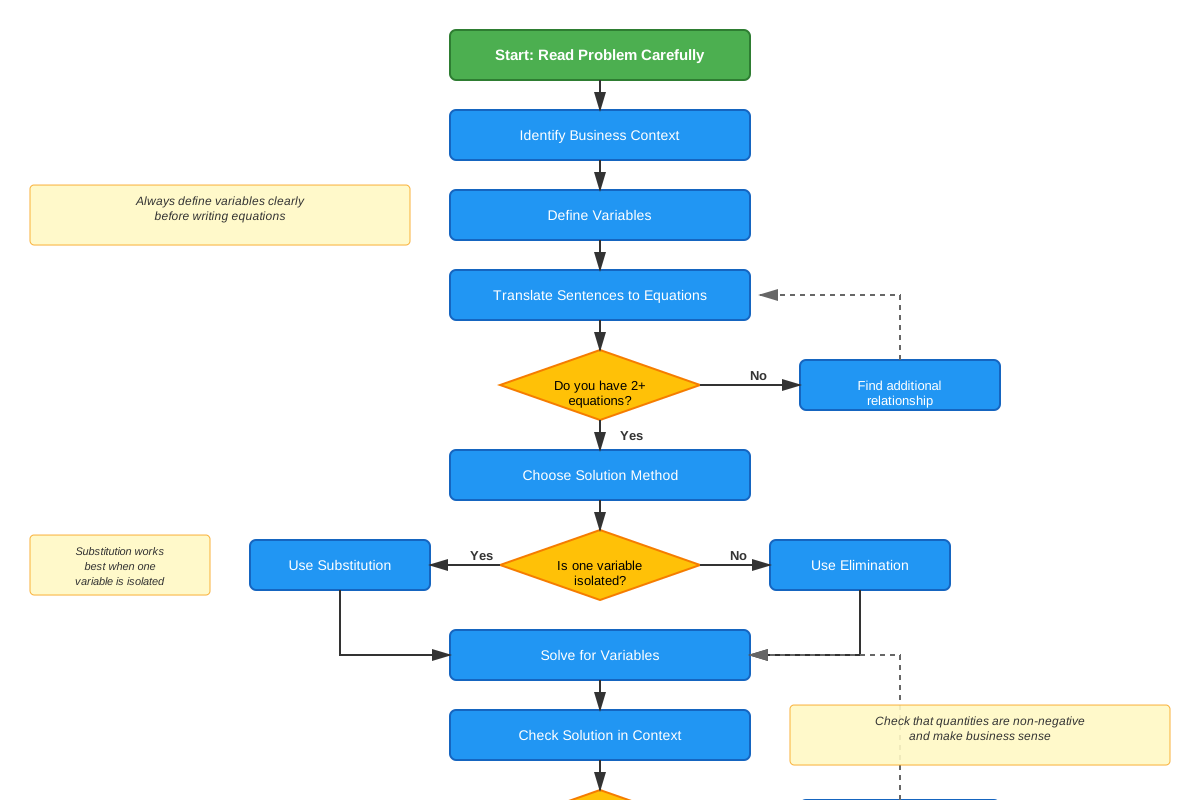
Translating business word problems into mathematical systems requires a systematic approach:
- Identify what you're asked to find and assign variables to these unknowns
- Extract numerical information from the problem statement
- Identify relationships between quantities (usually signaled by words like "total," "combined," "difference," or "more than")
- Write one equation for each relationship using your variables and the given numbers
- Verify you have as many equations as unknowns (typically two equations for two unknowns)
Common Business System Scenarios
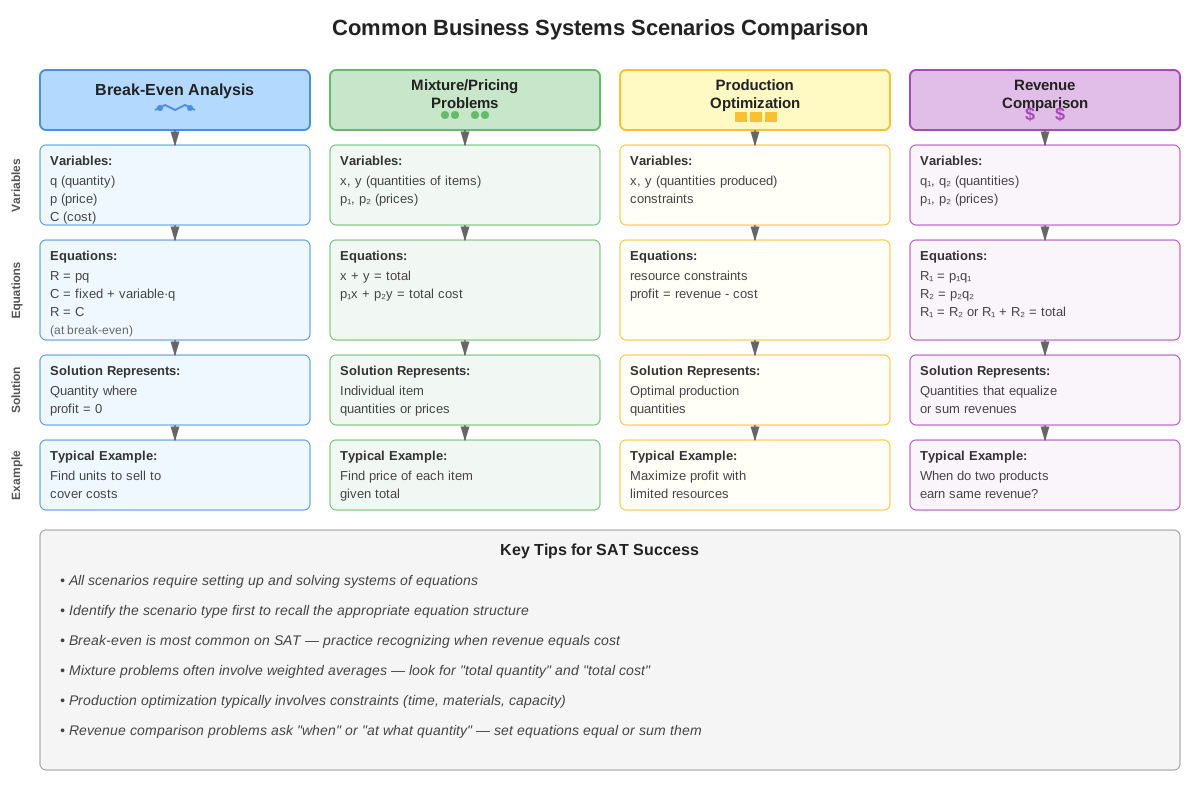
| Scenario Type | Typical Setup | Example Variables |
|---|---|---|
| Mixed product pricing | Total cost of different combinations | x = price of item A, y = price of item B |
| Ticket sales | Different ticket types with total revenue | a = adult tickets, c = child tickets |
| Production planning | Quantity and profit relationships | q = quantity produced, p = profit per unit |
| Service pricing | Flat fees plus per-unit charges | h = hours, c = total cost |
| Investment allocation | Money distributed across options | x = amount in option 1, y = amount in option 2 |
Solution Methods for Business Systems
Substitution method works well when one equation easily expresses one variable in terms of the other. This is common when a problem states a direct relationship like "the price of item A is $3 more than item B."
Elimination method (also called addition/subtraction method) is efficient when coefficients can be easily manipulated to cancel one variable. This often works well with business problems involving quantities and totals.
Graphing method is rarely the most efficient for SAT business problems but can provide visual insight into the relationship between variables, particularly for break-even analysis.
Interpreting Solutions in Context
After solving a business system mathematically, always verify that your solution makes sense in the real-world context:
- Prices should be positive (negative prices don't make business sense)
- Quantities should be non-negative (you can't sell negative items)
- Check units (dollars, items, hours, etc.)
- Verify the solution satisfies both original equations by substituting back
- Consider reasonableness (a $10,000 price for a pencil would signal an error)
Concept Relationships
Business systems concepts build upon and interconnect with multiple mathematical foundations. The core relationship flows as follows:
Linear equations → Systems of linear equations → Business applications of systems
Within business systems themselves, the concepts form an interconnected web. Variables and parameters must be identified before equation construction can occur. The revenue-cost-profit relationship provides the framework for understanding break-even analysis, which is itself a special case of solving systems where profit equals zero.
Translation skills (converting words to equations) enable system setup, which then requires solution methods (substitution or elimination) to find answers. Finally, contextual interpretation validates that mathematical solutions make business sense.
Business systems connect backward to prerequisite topics: solving systems requires algebraic manipulation skills, while setting up systems demands strong word problem translation abilities. The topic connects forward to more advanced concepts like linear programming (optimization with constraints), inequalities (when business constraints involve minimums or maximums), and functions (when business relationships are expressed as input-output rules).
The relationship between business systems and other SAT math topics is particularly strong with ratios and proportions (unit pricing), percentages (profit margins, discounts), and data analysis (interpreting business data from tables and graphs).
High-Yield Facts
⭐ Revenue equals price per unit multiplied by quantity sold: R = p × q
⭐ Profit equals revenue minus total cost: Profit = Revenue - Cost
⭐ Break-even occurs when revenue equals cost: Set revenue expression equal to cost expression and solve
⭐ Each distinct relationship in a word problem typically yields one equation: Look for statements about totals, combinations, or comparisons
⭐ The number of equations needed equals the number of unknowns: Two unknowns require two independent equations
- Total cost includes both fixed costs (constant) and variable costs (dependent on quantity)
- When a problem describes two purchases with different quantities and gives total costs, set up two equations with price variables
- Substitution works best when one equation is already solved for a variable or can be easily solved
- Elimination works best when coefficients of one variable are equal or can be made equal through multiplication
- Always check that your solution makes sense in the business context (positive prices, reasonable values)
- The phrase "costs $x more than" translates to an equation with addition: a = b + x
- "Combined" or "total" signals addition in your equation
- "Difference" signals subtraction in your equation
- When asked for profit, you must calculate revenue minus cost, not just revenue
- If a solution yields a negative price or quantity, recheck your work—these typically indicate an error
Quick check — test yourself on Business systems so far.
Try Flashcards →Common Misconceptions
Misconception: Revenue and profit are the same thing. → Correction: Revenue is total income from sales, while profit is what remains after subtracting all costs from revenue. The SAT specifically tests whether students understand this distinction.
Misconception: In a system with two unknowns, you can solve with just one equation. → Correction: You need as many independent equations as you have unknowns. One equation with two variables has infinitely many solutions; you need a second equation to find a unique solution.
Misconception: The break-even point means the business is making money. → Correction: At break-even, profit is exactly zero—the business is neither making nor losing money. It's the minimum point where the business covers all costs.
Misconception: Fixed costs change when production quantity changes. → Correction: By definition, fixed costs remain constant regardless of production level. Only variable costs change with quantity. Total cost = fixed cost + (variable cost per unit × quantity).
Misconception: When a problem says "Item A costs $3 more than Item B," you should write A = B - 3. → Correction: "More than" means addition, so the correct equation is A = B + 3. This sign error is one of the most common mistakes in business systems problems.
Misconception: You can use the same variable for different quantities if they're related. → Correction: Each distinct unknown quantity needs its own variable. Even if two quantities are related, they should have separate variables connected by an equation expressing their relationship.
Misconception: The solution to a system is complete once you find one variable. → Correction: Unless the question specifically asks for only one variable, you typically need to find both unknowns and verify they satisfy both original equations.
Worked Examples
Example 1: Mixed Product Pricing
Problem: A coffee shop sells small and large coffees. On Monday, 3 small coffees and 2 large coffees cost $14.50. On Tuesday, 5 small coffees and 1 large coffee cost $15.00. What is the price of one large coffee?
Solution:
Step 1: Define variables
- Let s = price of one small coffee (in dollars)
- Let l = price of one large coffee (in dollars)
Step 2: Translate Monday's information into an equation
- 3 small coffees and 2 large coffees cost $14.50
- Equation: 3s + 2l = 14.50
Step 3: Translate Tuesday's information into an equation
- 5 small coffees and 1 large coffee cost $15.00
- Equation: 5s + l = 15.00
Step 4: Choose a solution method
- The second equation has a coefficient of 1 for l, making substitution efficient
- Solve the second equation for l: l = 15.00 - 5s
Step 5: Substitute into the first equation
- 3s + 2(15.00 - 5s) = 14.50
- 3s + 30.00 - 10s = 14.50
- -7s + 30.00 = 14.50
- -7s = -15.50
- s = 2.214... ≈ 2.21 (but continue with exact value)
Step 6: Find l using the substitution equation
- l = 15.00 - 5(15.50/7)
- l = 15.00 - 77.50/7
- l = (105.00 - 77.50)/7
- l = 27.50/7
- l ≈ 3.93
Step 7: Verify the solution
- Check first equation: 3(2.21) + 2(3.93) = 6.63 + 7.86 = 14.49 ≈ 14.50 ✓
- Check second equation: 5(2.21) + 3.93 = 11.05 + 3.93 = 14.98 ≈ 15.00 ✓
Answer: The price of one large coffee is approximately $3.93 (or exactly $27.50/7).
This problem demonstrates the core business systems skill of translating purchase combinations into equations and solving for individual prices.
Example 2: Break-Even Analysis
Problem: A small business produces handmade candles. The fixed costs (rent, equipment) are $800 per month. Each candle costs $3 in materials to produce, and the business sells each candle for $12. How many candles must the business sell to break even?
Solution:
Step 1: Identify what we're finding
- We need the quantity of candles where profit = 0 (break-even)
- Let q = number of candles sold
Step 2: Write the revenue equation
- Revenue = (price per candle) × (quantity)
- R = 12q
Step 3: Write the cost equation
- Total Cost = Fixed Cost + Variable Cost
- C = 800 + 3q
Step 4: Set up the break-even equation
- At break-even: Revenue = Cost
- 12q = 800 + 3q
Step 5: Solve for q
- 12q - 3q = 800
- 9q = 800
- q = 800/9
- q ≈ 88.89
Step 6: Interpret in context
- Since you can't sell a fraction of a candle, round up to 89 candles
- Selling 88 candles would result in a small loss
- Selling 89 candles would result in a small profit
Step 7: Verify
- Revenue from 89 candles: 12(89) = $1,068
- Cost for 89 candles: 800 + 3(89) = 800 + 267 = $1,067
- Profit: 1,068 - 1,067 = $1 (small profit, confirming break-even is between 88 and 89)
Answer: The business must sell 89 candles to break even (or exceed break-even).
This problem illustrates break-even analysis and the importance of interpreting mathematical solutions in a business context where fractional units may not make sense.
Exam Strategy
When approaching SAT business systems questions, follow this strategic process:
1. Read carefully and identify the question target: Determine exactly what the question asks for before setting up equations. The SAT may ask for one variable, both variables, a sum, a difference, or an interpretation of the solution.
2. Watch for trigger words and phrases:
- "Total," "combined," "altogether" → addition in your equation
- "Difference," "more than," "less than" → subtraction or comparison
- "Each," "per," "apiece" → multiplication (unit price × quantity)
- "Break even" → set revenue equal to cost
- "Profit" → revenue minus cost
3. Set up before solving: Resist the urge to start calculating immediately. Write down your variables clearly, then construct both equations. This organized approach prevents errors and makes checking work easier.
4. Choose the most efficient solution method:
- If one equation has a variable with coefficient 1, use substitution
- If coefficients are already aligned or easily made equal, use elimination
- Don't waste time graphing unless specifically asked
5. Use process of elimination on multiple-choice questions:
- Eliminate answers that are negative when prices/quantities must be positive
- Eliminate unreasonably large or small values
- Plug remaining answer choices back into the original equations if solving algebraically seems complex
6. Manage time effectively: Business systems problems typically take 2-3 minutes. If you're stuck after 90 seconds, mark the question and move on. Return to it after completing easier questions.
7. Always verify your answer makes sense: A $0.50 concert ticket or a $500 pencil should trigger a recheck of your work.
Exam Tip: If the problem gives you two scenarios with purchases or sales, you almost certainly need to set up a system of two equations. Don't try to solve it with just one equation.
Memory Techniques
PRC Mnemonic for Business Fundamentals: Profit = Revenue - Cost
- Picture a "PRC" label on a business ledger to remember this fundamental relationship
VIPER for System Setup:
- Variables: Define what you're finding
- Information: Extract numbers from the problem
- Phrases: Identify relationship words (total, combined, more than)
- Equations: Write one equation per relationship
- Review: Check you have enough equations
Break-Even Visualization: Picture a balance scale with "Revenue" on one side and "Cost" on the other. At break-even, the scale is perfectly balanced (equal).
"More Than" = Addition: Remember "MORE = ADD" by thinking: if something costs MORE, you ADD to the base price.
Two Unknowns, Two Equations: Hold up two fingers on each hand to remember: 2 unknowns need 2 equations. This physical reminder helps during test stress.
PRICE Acronym for Checking Answers:
- Positive: Are prices/quantities positive?
- Reasonable: Do values make real-world sense?
- Insert: Plug back into original equations
- Calculate: Verify both equations are satisfied
- Examine: Does this answer the question asked?
Summary
Business systems represent a high-yield SAT math topic that combines algebraic skills with real-world applications. These problems require students to translate business scenarios—involving revenue, costs, profits, and pricing—into systems of linear equations, then solve for unknown quantities. The fundamental relationship Profit = Revenue - Cost underpins most business problems, while break-even analysis (where revenue equals cost) represents a critical special case. Success with business systems demands three core competencies: translating word problems into mathematical equations, solving systems using substitution or elimination methods, and interpreting solutions within business contexts to verify reasonableness. Students must recognize that each distinct relationship in a problem yields one equation, and two unknowns require two independent equations for a unique solution. The SAT favors scenarios involving mixed product pricing, ticket sales, and production planning because they test mathematical modeling without requiring specialized business knowledge.
Key Takeaways
- Business systems translate real-world scenarios into systems of linear equations involving revenue, cost, profit, prices, and quantities
- The fundamental business equation is Profit = Revenue - Cost, with Revenue = Price × Quantity and Cost = Fixed Cost + Variable Cost × Quantity
- Break-even occurs when revenue equals cost (profit = 0), requiring you to set revenue and cost expressions equal and solve
- Each relationship or constraint in a word problem generates one equation; two unknowns require two independent equations
- Substitution works best when one variable has a coefficient of 1; elimination works best when coefficients align easily
- Always verify solutions make business sense: prices and quantities should be positive and reasonable
- Watch for trigger words like "total" (addition), "more than" (addition), "difference" (subtraction), and "per" (multiplication) to construct equations correctly
Related Topics
Linear Inequalities in Business Contexts: Extends business systems to scenarios with constraints like "at least," "no more than," or "between," requiring inequality notation and solution sets rather than single solutions.
Quadratic Business Models: Explores non-linear business relationships where revenue or cost functions are quadratic, introducing concepts like maximum profit through vertex calculations.
Systems with Three Variables: Advances to more complex business scenarios involving three products or three constraints, requiring three equations and extended solution methods.
Linear Programming: Applies systems of inequalities to optimization problems where businesses maximize profit or minimize cost subject to multiple constraints, often solved graphically.
Functions in Business: Represents business relationships as functions, enabling analysis of how changes in one variable (like price) affect another (like revenue), connecting to the SAT's function questions.
Mastering business systems provides essential preparation for these advanced topics while building problem-solving skills applicable across the SAT math section.
Practice CTA
Now that you've mastered the core concepts of business systems, it's time to solidify your understanding through active practice. Attempt the practice questions designed specifically for this topic, focusing on translating word problems into equations and solving systems efficiently. Use the flashcards to reinforce key formulas and relationships until they become automatic. Remember: business systems questions are high-yield on the SAT, and consistent practice with these problem types will significantly boost your score. Each practice problem you solve strengthens your pattern recognition and builds the confidence you need to tackle any business scenario on test day. You've got this!
Sign up free to keep reading
Create a free AnvayaPrep account to finish this SAT guide on Business systems — plus flashcards and practice questions.