Overview
Distance systems represent a specialized category of linear equation problems that appear frequently on the SAT math section. These problems combine the fundamental distance formula (distance = rate × time) with systems of equations, requiring students to set up and solve multiple equations simultaneously. Unlike simple distance problems that involve a single moving object, distance systems involve two or more objects moving in relation to each other—whether traveling toward each other, moving in opposite directions, or one object catching up to another.
Understanding distance systems is essential for SAT success because these problems test multiple mathematical competencies simultaneously: translating word problems into algebraic expressions, manipulating systems of equations, and applying logical reasoning to real-world scenarios. The College Board consistently includes 2-3 distance-related problems per test, and approximately 40% of these involve systems of equations rather than single-variable problems. Mastering this topic directly impacts your ability to handle the more complex problem-solving questions that distinguish high scorers from average performers.
Distance systems connect to broader mathematical concepts including linear equations, rates, proportional relationships, and algebraic modeling. They serve as practical applications of systems of linear equations, demonstrating why solving multiple equations simultaneously matters beyond abstract mathematics. The skills developed through distance systems—particularly the ability to define variables strategically, establish relationships between quantities, and solve multi-step problems—transfer directly to other SAT topics including mixture problems, work-rate problems, and even some geometry applications involving motion.
Learning Objectives
- [ ] Identify key features of distance systems including the number of moving objects, their directions, and the relationship between their motions
- [ ] Explain how distance systems appears on the SAT, including common problem formats and question structures
- [ ] Apply distance systems to answer SAT-style questions by setting up and solving appropriate systems of equations
- [ ] Construct appropriate variable definitions and equations from verbal descriptions of motion scenarios
- [ ] Distinguish between different types of distance system problems (meeting, overtaking, opposite directions) and select appropriate solution strategies
- [ ] Verify solutions by checking whether answers satisfy both the mathematical equations and the real-world constraints of the problem
Prerequisites
- Basic distance formula (d = rt): Essential foundation for all distance problems; every distance system equation builds from this relationship
- Solving linear equations: Required to isolate variables and find numerical solutions once the system is established
- Systems of linear equations (substitution and elimination methods): Core techniques needed to solve the two or more equations that define distance systems
- Unit conversion and dimensional analysis: Necessary to ensure consistency when problems mix units like miles/kilometers or hours/minutes
- Translating word problems into algebraic expressions: Critical skill for converting verbal descriptions of motion into mathematical equations
Why This Topic Matters
Distance systems represent one of the most practical applications of algebra that students encounter in daily life. From calculating travel times for road trips to understanding when two delivery vehicles will meet, these problems model real situations where multiple moving objects interact. The logical thinking required to analyze these scenarios—identifying what's known, what's unknown, and how quantities relate—develops problem-solving skills that extend far beyond mathematics into fields like logistics, engineering, and computer science.
On the SAT, distance systems appear in approximately 2-3 questions per test, typically in the calculator-permitted section. These problems usually appear as medium-to-hard difficulty questions (questions 10-22 in each math section), making them crucial for students aiming for scores above 650. The College Board particularly favors "meeting problems" where two objects travel toward each other, and "overtaking problems" where a faster object catches up to a slower one. Approximately 60% of distance system questions appear as multiple-choice, while 40% appear as grid-in questions requiring numerical answers.
The SAT presents distance systems in various formats: straightforward word problems describing two vehicles, contextualized scenarios involving runners or cyclists, and occasionally abstract problems about two objects without specifying the mode of transportation. Recent tests have shown an increased emphasis on problems requiring students to interpret what their solutions mean in context, not just calculate numerical answers. Understanding distance systems also provides a foundation for the more complex rate problems involving work rates or mixture problems that occasionally appear on the test.
Core Concepts
The Fundamental Distance Relationship
Every distance system problem builds on the fundamental relationship: distance = rate × time, commonly abbreviated as d = rt. In sat distance systems, this formula must be applied to multiple objects simultaneously, creating a system of equations. The key insight is that while each object has its own rate and potentially its own time, the distances traveled by the objects relate to each other in specific ways depending on the problem type.
When working with distance systems, establishing clear variable definitions is crucial. Rather than arbitrarily choosing variables, strategic selection simplifies the problem-solving process. For instance, if two objects travel for the same amount of time, defining a single variable t for time (rather than t₁ and t₂) immediately reduces complexity.
Types of Distance Systems
Meeting Problems (Objects Traveling Toward Each Other)
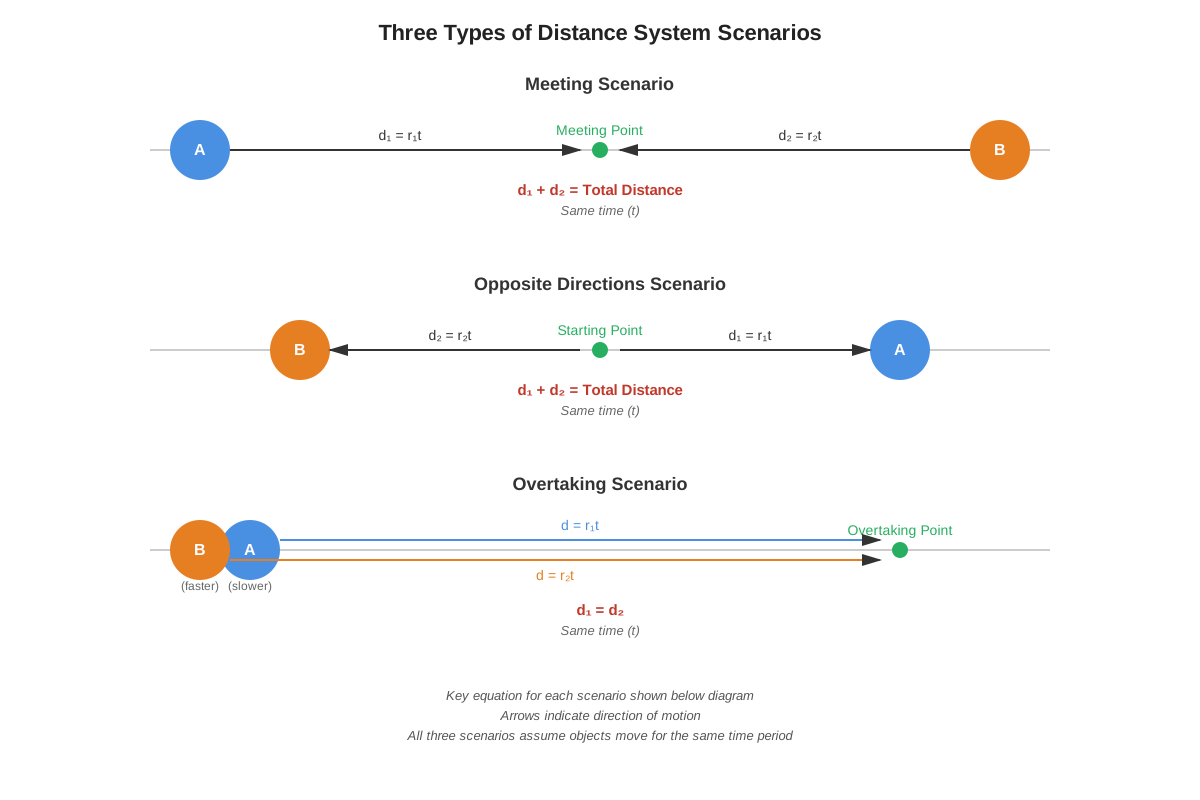
In meeting problems, two objects start at different locations and travel toward each other until they meet. The critical insight is that when they meet, the sum of their individual distances equals the total distance between their starting points.
If Object A travels at rate r₁ and Object B travels at rate r₂, both for time t until they meet, and the initial distance between them is D, then:
r₁ × t + r₂ × t = DThis can be factored as: t(r₁ + r₂) = D
The combined rate concept (r₁ + r₂) represents how quickly the distance between the objects decreases.
Overtaking Problems (Same Direction, Different Speeds)
In overtaking problems, two objects travel in the same direction, with one eventually catching up to the other. The faster object typically starts behind or starts later. When the faster object catches up, both objects have traveled the same total distance from a common reference point.
If Object A (slower) has a head start of distance d₀ or time t₀, and Object B (faster) catches up after time t:
r₁ × (t + t₀) = r₂ × t + d₀Or more commonly, if they start simultaneously but from different positions:
r₁ × t = r₂ × t + d₀Opposite Direction Problems
When objects travel in opposite directions from the same starting point, the distance between them increases at the sum of their rates. After time t, the distance between them is:
Distance apart = r₁ × t + r₂ × t = (r₁ + r₂) × tSetting Up Distance Systems
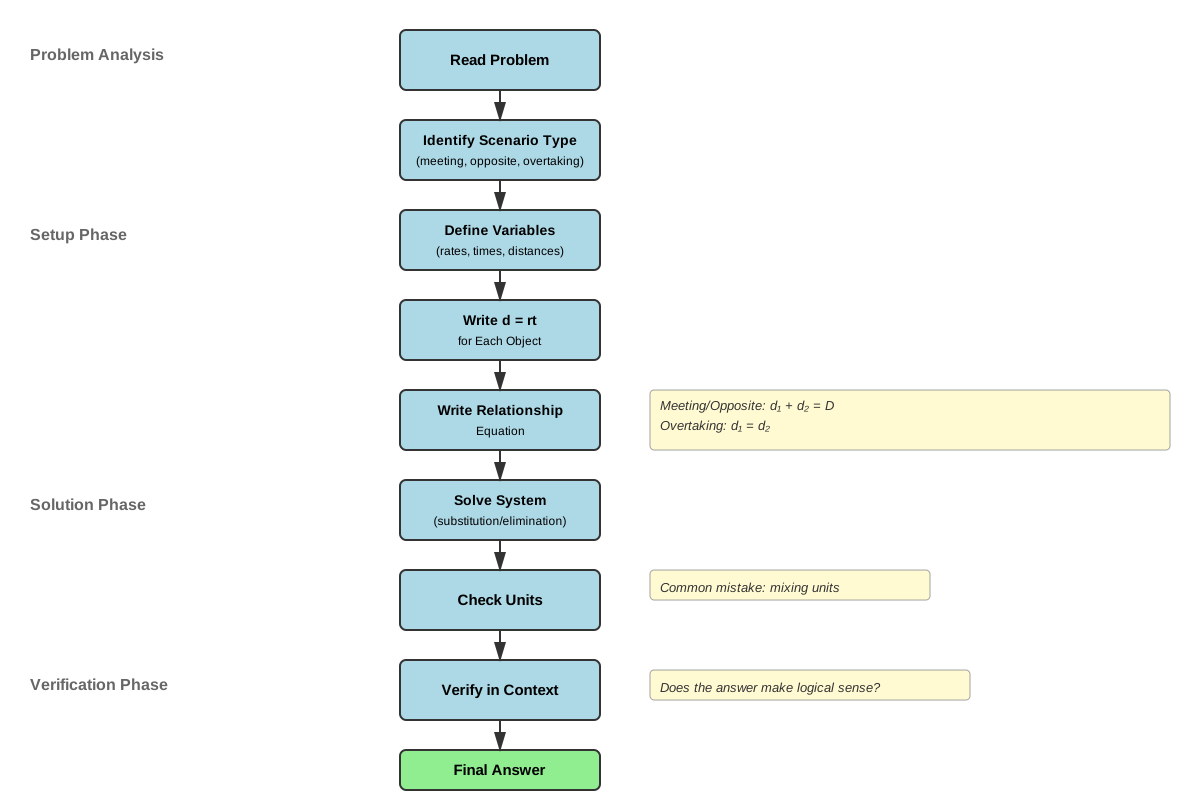
The systematic approach to distance systems involves five steps:
- Define variables clearly: Choose variables that minimize complexity (use one time variable if times are equal)
- Create a distance table: Organize rate, time, and distance for each object
- Write individual distance equations: Apply d = rt for each object
- Establish the relationship equation: Connect the distances based on problem type
- Solve the system: Use substitution or elimination
| Object | Rate | Time | Distance |
|---|---|---|---|
| Object 1 | r₁ | t | r₁t |
| Object 2 | r₂ | t | r₂t |
Common Variations and Complications
Different Time Intervals
Some problems involve objects that don't travel for the same duration. One object might start earlier or stop sooner. In these cases, use different time variables or express one time in terms of the other.
Example: If Car A travels for 2 hours more than Car B travels for time t, then Car A travels for time (t + 2).
Unit Consistency
SAT problems may present rates in miles per hour but ask for time in minutes, or provide distances in kilometers while rates are in meters per second. Always convert to consistent units before setting up equations.
Round-Trip Scenarios
Some distance systems involve an object traveling to a destination and returning. The key insight is that the distance going equals the distance returning, but rates may differ (especially if wind or current affects the motion).
Solving Techniques
Substitution Method
When one equation easily expresses one variable in terms of another, substitution is efficient. This is particularly useful when the problem gives you a direct relationship like "Car B travels twice as fast as Car A" (r₂ = 2r₁).
Elimination Method
When both equations are in standard form with similar structure, elimination (adding or subtracting equations) can be faster. This works well when both equations have the same time variable with different coefficients.
Combined Rate Approach
For meeting problems, recognizing that the combined rate (r₁ + r₂) represents the rate at which the gap closes can lead to a single-equation solution rather than a system, simplifying calculations significantly.
Concept Relationships
The concepts within distance systems build hierarchically. The fundamental distance formula (d = rt) serves as the foundation → this formula is applied to multiple objects to create individual distance equations → these individual equations are connected through a relationship equation based on problem type (meeting, overtaking, or opposite directions) → the resulting system is solved using algebraic techniques → finally, the solution is interpreted in the context of the original problem.
Distance systems connect backward to prerequisite topics: they require fluency with systems of linear equations (the algebraic machinery for solving), unit conversion (ensuring dimensional consistency), and word problem translation (converting scenarios into mathematics). They connect forward to more advanced topics: work-rate problems use identical mathematical structures with different contexts, mixture problems apply similar system-solving techniques, and even some physics problems on the SAT (if applicable) use these motion concepts.
The relationship map: Basic d = rt formula → Multiple objects create multiple equations → Spatial relationship determines how equations connect → System of equations formed → Algebraic solution methods applied → Answer interpreted in context → Solution verified against problem constraints
Quick check — test yourself on Distance systems so far.
Try Flashcards →High-Yield Facts
- ⭐ In meeting problems where objects travel toward each other, the sum of distances traveled equals the initial separation distance
- ⭐ The combined rate in meeting problems (r₁ + r₂) represents how fast the gap between objects closes
- ⭐ In overtaking problems, when the faster object catches up, both objects have traveled the same total distance from a reference point
- ⭐ When objects travel in opposite directions from the same point, the distance between them equals (r₁ + r₂) × t
- ⭐ Always define variables before writing equations; strategic variable choice simplifies the entire problem
- The distance formula d = rt can be rearranged to solve for any variable: r = d/t or t = d/r
- If two objects travel for the same time, use a single time variable for both to reduce complexity
- Unit consistency is non-negotiable; convert all measurements to the same units before calculating
- In round-trip problems, the distance going always equals the distance returning, even if rates differ
- The number of equations needed equals the number of unknown variables; distance systems typically require two equations
- When a problem asks "how far" or "what distance," you're solving for a distance variable; when it asks "how long" or "when," you're solving for time
- Head start problems (one object starts earlier) require adding the head start time to that object's travel time
- The SAT never requires solving systems with more than two variables in distance problems
Common Misconceptions
Misconception: In meeting problems, each object travels half the total distance. → Correction: Objects only travel equal distances if they have equal rates. The distance each travels depends on its rate: a faster object covers more distance in the same time. The sum of distances equals the total, but individual distances are proportional to rates.
Misconception: The combined rate (r₁ + r₂) applies to all distance system problems. → Correction: Combined rates only apply when objects move toward each other or in opposite directions. In overtaking problems (same direction), you must work with individual rates and set the distances equal, not add the rates.
Misconception: If Car A is twice as fast as Car B, Car A travels twice as far in any scenario. → Correction: This is only true if both cars travel for the same amount of time. If they travel for different durations, the distance relationship depends on both the rate ratio and the time ratio.
Misconception: You always need to solve for both variables in a system. → Correction: Often the question asks for only one variable (like time or one object's distance). Once you find that variable, you can stop—no need to find the other unless required to answer the question.
Misconception: Distance systems always require two equations with two unknowns. → Correction: Sometimes the problem provides enough information to express everything in terms of a single variable, or one equation contains only one unknown. Always assess what's given before assuming you need a full system.
Misconception: The object that starts first always travels farther. → Correction: Total distance depends on both rate and time. A faster object starting later can travel farther than a slower object with a head start, depending on the specific values.
Worked Examples
Example 1: Meeting Problem
Problem: Two trains leave stations 450 miles apart and travel toward each other. Train A travels at 60 mph and Train B travels at 75 mph. How long will it take for the trains to meet?
Solution:
Step 1: Define variables
Let t = time (in hours) until the trains meet
Step 2: Set up distance table
| Train | Rate (mph) | Time (hours) | Distance (miles) |
|---|---|---|---|
| Train A | 60 | t | 60t |
| Train B | 75 | t | 75t |
Step 3: Write the relationship equation
Since the trains travel toward each other, the sum of their distances equals the initial separation:
60t + 75t = 450Step 4: Solve
135t = 450
t = 450/135
t = 10/3 hours = 3.33 hours
Step 5: Verify
Train A travels: 60 × (10/3) = 200 miles
Train B travels: 75 × (10/3) = 250 miles
Total: 200 + 250 = 450 miles ✓
Answer: The trains will meet in 10/3 hours or 3 hours and 20 minutes.
This problem demonstrates the combined rate approach: instead of creating a system, we recognized that the combined rate (135 mph) represents how fast the gap closes, leading to a single equation.
Example 2: Overtaking Problem with Head Start
Problem: A cyclist leaves a rest stop traveling at 12 mph. Two hours later, a motorcyclist leaves the same rest stop traveling at 36 mph in the same direction. How long after the motorcyclist leaves will the motorcyclist catch up to the cyclist?
Solution:
Step 1: Define variables
Let t = time (in hours) the motorcyclist travels until catching up
Step 2: Analyze the situation
The cyclist has a 2-hour head start, so when the motorcyclist catches up, the cyclist has been traveling for (t + 2) hours.
Step 3: Set up distance table
| Person | Rate (mph) | Time (hours) | Distance (miles) |
|---|---|---|---|
| Cyclist | 12 | t + 2 | 12(t + 2) |
| Motorcyclist | 36 | t | 36t |
Step 4: Write the relationship equation
When the motorcyclist catches up, both have traveled the same distance from the rest stop:
12(t + 2) = 36tStep 5: Solve
12t + 24 = 36t
24 = 36t - 12t
24 = 24t
t = 1
Step 6: Verify
Cyclist's distance: 12(1 + 2) = 12(3) = 36 miles
Motorcyclist's distance: 36(1) = 36 miles ✓
Answer: The motorcyclist will catch up to the cyclist 1 hour after leaving the rest stop.
This problem illustrates the importance of carefully tracking different time intervals. The question asks for the motorcyclist's travel time, not the total time since the cyclist left (which would be 3 hours).
Exam Strategy
When approaching sat distance systems questions, begin by reading the entire problem carefully to identify: (1) how many objects are moving, (2) whether they're moving toward each other, away from each other, or in the same direction, and (3) what the question is actually asking for (time, distance, or rate).
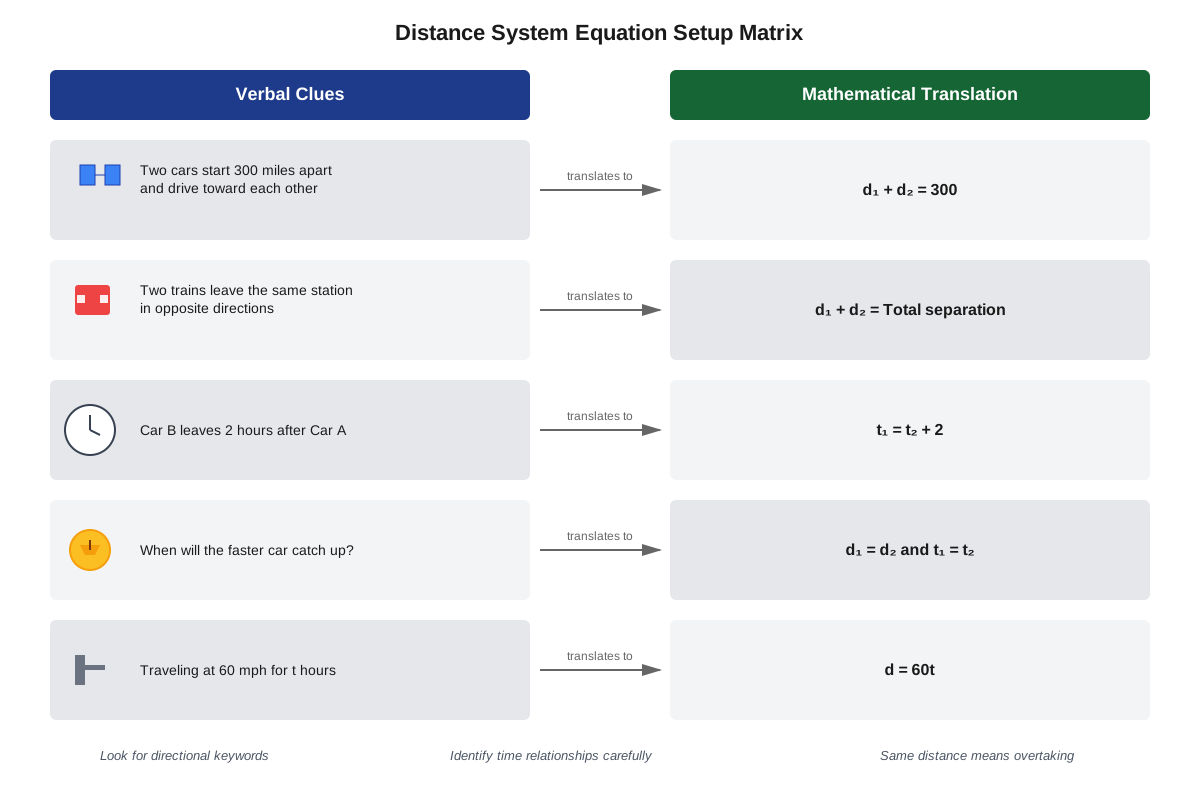
Trigger words and phrases to watch for:
- "Travel toward each other" or "meet" → meeting problem, add distances
- "Catch up" or "overtake" → same direction problem, set distances equal
- "In opposite directions" → moving apart, add distances for separation
- "Head start" or "leaves earlier" → different time intervals, add extra time
- "How long until" → solve for time
- "How far" or "what distance" → solve for distance
- "At what rate" → solve for rate (less common)
Process-of-elimination tips:
- Eliminate answers with wrong units (if the question asks for hours, eliminate answers in miles)
- Check reasonableness: a slower object can't travel farther than a faster one in the same time
- For meeting problems, if answer choices are times, the correct answer should make the sum of distances equal the given total distance
- Extreme value testing: if rates are very different, the faster object should travel much farther in the same time
Time allocation: Distance system problems typically require 2-3 minutes. Spend 30-45 seconds understanding the scenario and setting up your table, 60-90 seconds writing and solving equations, and 30 seconds verifying your answer makes sense. If you're stuck after 2 minutes, mark the question and return to it—these problems reward careful setup, so rushing leads to errors.
Strategic approach:
- Draw a simple diagram showing the starting positions and directions of motion
- Create a distance table (rate, time, distance) even if it seems unnecessary—it prevents errors
- Write out what you're solving for before you start calculating
- After solving, ask: "Does this answer make sense in the real world?" (negative time or impossibly high speeds indicate errors)
Memory Techniques
Mnemonic for problem types: "MOO" helps remember the three main types:
- Meeting problems → add distances
- Overtaking problems → equal distances
- Opposite directions → add distances (for separation)
Visualization strategy: Always sketch the scenario. Draw a horizontal line representing the path, mark starting positions with dots, and use arrows to show direction of motion. This visual representation immediately clarifies whether distances add or equal each other.
The "DRT Triangle": Visualize a triangle with D at the top, R and T at the bottom corners. Cover the variable you're solving for to see the formula:
- Cover D: D = R × T
- Cover R: R = D/T
- Cover T: T = D/R
Acronym for setup steps: "DVRES" (pronounced "diverse")
- Define variables
- Visualize with a diagram
- Record in a table
- Establish relationship equation
- Solve and verify
Combined rate memory aid: "When objects move toward each other, their rates combine like teammates working together—add them. When moving the same direction, they compete—compare individual distances."
Summary
Distance systems represent a high-yield SAT math topic that combines the fundamental distance formula (d = rt) with systems of linear equations. These problems involve two or more objects moving in relation to each other, requiring students to set up multiple equations and solve them simultaneously. The three primary problem types—meeting problems (objects traveling toward each other), overtaking problems (same direction, different speeds), and opposite direction problems—each have characteristic equation structures. Success requires strategic variable definition, systematic organization using distance tables, careful attention to whether times are equal or different, and rigorous unit consistency. The key insight distinguishing high performers is recognizing that the relationship between distances (whether they add or equal each other) depends entirely on the direction of motion. By mastering the setup process and practicing the solution techniques of substitution and elimination, students can reliably solve these medium-to-hard difficulty problems that appear 2-3 times per SAT test, directly impacting scores in the 650+ range.
Key Takeaways
- Distance systems combine d = rt with systems of equations, requiring simultaneous solution of multiple equations describing related motion
- Meeting problems (toward each other) require adding distances; overtaking problems (same direction) require setting distances equal
- Strategic variable definition—especially using one time variable when objects travel for equal durations—dramatically simplifies problems
- Creating a distance table (rate, time, distance for each object) prevents errors and organizes information systematically
- The combined rate concept (r₁ + r₂) applies only to meeting and opposite-direction problems, not overtaking scenarios
- Always verify solutions by checking that calculated distances satisfy both the equations and the real-world constraints
- Unit consistency is essential; convert all measurements to the same units before setting up equations
Related Topics
Work-Rate Problems: These problems use identical mathematical structures to distance systems but apply them to tasks completed over time rather than physical motion. Mastering distance systems provides the foundation for understanding combined work rates.
Mixture Problems: Similar system-solving techniques apply when combining substances with different concentrations, with the mixture equation playing the role of the distance relationship equation.
Linear Motion in Physics: For students taking physics, distance systems provide the algebraic foundation for kinematics problems involving constant velocity motion.
Optimization Problems: More advanced problems may ask for maximum or minimum distances or times, building on distance system concepts but adding calculus or algebraic optimization techniques.
Systems of Linear Equations (General): Distance systems represent one application of this broader topic; mastering them reinforces general system-solving skills applicable across algebra.
Practice CTA
Now that you've mastered the concepts, strategies, and techniques for distance systems, it's time to solidify your understanding through practice. Attempt the practice questions designed specifically for this topic, focusing on applying the systematic setup process you've learned. Use the flashcards to reinforce key formulas, problem types, and common pitfalls. Remember: distance systems reward careful, methodical work more than speed. Take your time setting up each problem correctly, and the solutions will follow naturally. Every practice problem you complete builds the pattern recognition and confidence you need to excel on test day. You've got this!
Sign up free to keep reading
Create a free AnvayaPrep account to finish this SAT guide on Distance systems — plus flashcards and practice questions.