Overview
Interpreting systems of linear equations is a critical skill on the SAT Math section that goes beyond simply solving for x and y values. This topic requires students to understand what systems of equations represent in real-world contexts, what their solutions mean, and how changes to the system affect those solutions. Rather than mechanically applying algebraic techniques, students must demonstrate conceptual understanding by analyzing what happens when two linear relationships interact, identifying whether solutions exist, and explaining what those solutions represent in practical scenarios.
On the SAT, interpreting systems questions frequently appear as word problems where two different situations or constraints are modeled by linear equations. Students must translate between algebraic representations and real-world meanings, determine what the intersection point signifies, or explain why no solution exists in a given context. These questions test mathematical reasoning and literacy—the ability to read, understand, and communicate about mathematical relationships—which aligns with the SAT's emphasis on problem-solving in realistic contexts.
This topic connects fundamentally to broader math concepts including linear functions, graphing, algebraic manipulation, and mathematical modeling. Mastery of sat interpreting systems builds upon understanding individual linear equations and extends to analyzing how multiple constraints interact simultaneously. This skill appears not only in the Systems of Linear Equations unit but also connects to functions, coordinate geometry, and data analysis questions throughout the SAT Math section.
Learning Objectives
- [ ] Identify key features of interpreting systems, including solution types and their meanings
- [ ] Explain how interpreting systems appears on the SAT in various question formats
- [ ] Apply interpreting systems to answer SAT-style questions accurately and efficiently
- [ ] Determine what the solution to a system represents in a given real-world context
- [ ] Analyze systems to identify whether they have one solution, no solution, or infinitely many solutions
- [ ] Translate between verbal descriptions, algebraic representations, and graphical interpretations of systems
Prerequisites
- Linear equations in one and two variables: Understanding how to write, manipulate, and solve basic linear equations is essential because systems consist of multiple linear equations that must be analyzed together
- Graphing linear equations: Recognizing that linear equations represent lines on a coordinate plane helps visualize systems as intersecting, parallel, or coincident lines
- Slope and y-intercept: These features determine whether lines will intersect and where, which directly relates to whether systems have solutions
- Basic algebraic manipulation: Skills like combining like terms, isolating variables, and substitution are necessary for solving and analyzing systems
- Word problem translation: Converting verbal descriptions into mathematical expressions is crucial since most SAT systems questions present real-world scenarios
Why This Topic Matters
In real-world applications, systems of linear equations model situations where multiple constraints or relationships must be satisfied simultaneously. Businesses use systems to determine break-even points where costs equal revenue, economists model supply and demand equilibrium, and engineers calculate where different design specifications intersect. Understanding how to interpret these systems allows students to make sense of complex situations where multiple factors interact.
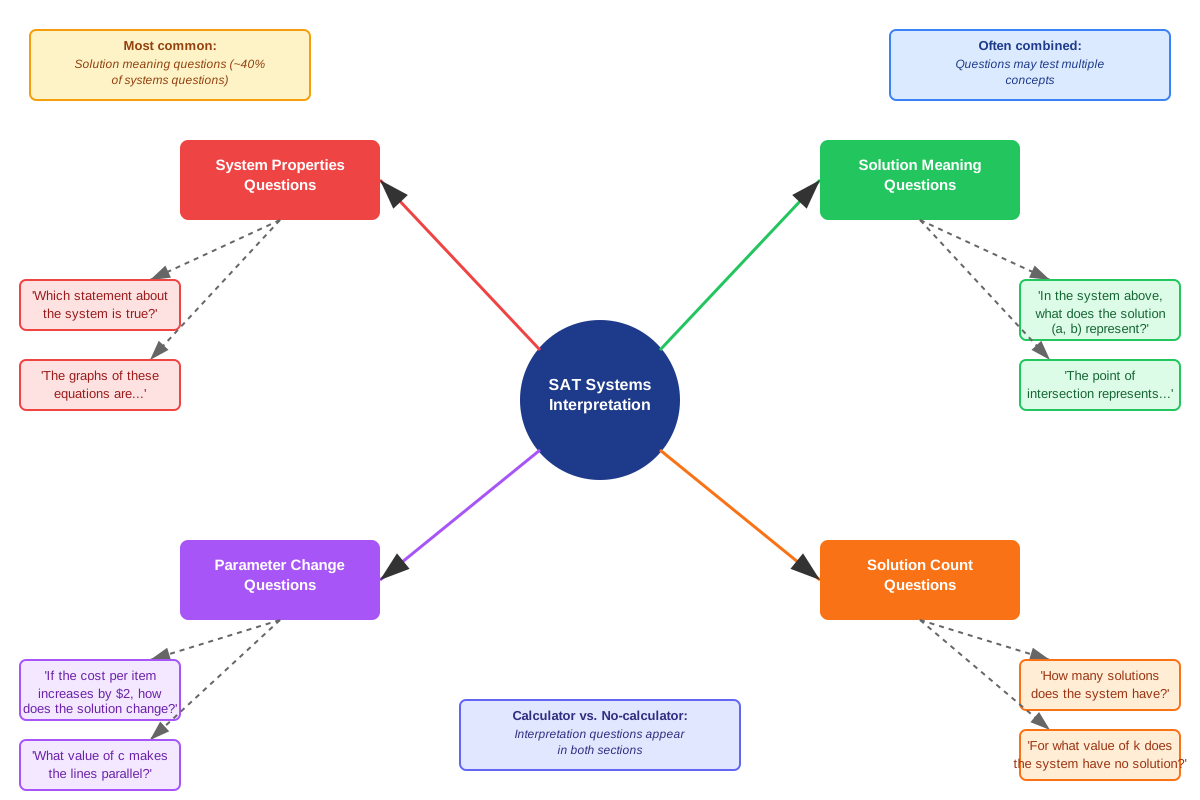
On the SAT, interpreting systems questions appear with high frequency—typically 2-4 questions per test across both the calculator and no-calculator sections. These questions account for approximately 5-8% of the total Math score, making them a high-yield topic for focused study. The College Board emphasizes this topic because it assesses both algebraic fluency and conceptual understanding, two core competencies in the SAT Math framework.
Common question formats include: identifying what a solution point represents in context, determining which system correctly models a word problem, explaining why a system has no solution based on the scenario, analyzing how changing one equation affects the solution, and selecting statements that must be true about the solution. Questions may present systems algebraically, graphically, or through tables, requiring students to move flexibly between representations.
Core Concepts
What Systems of Linear Equations Represent
A system of linear equations consists of two or more linear equations involving the same variables. Each equation represents a constraint or relationship, and the system asks: "What values satisfy all constraints simultaneously?" On the SAT, systems typically involve two equations with two variables (x and y), representing two different linear relationships that must both be true.
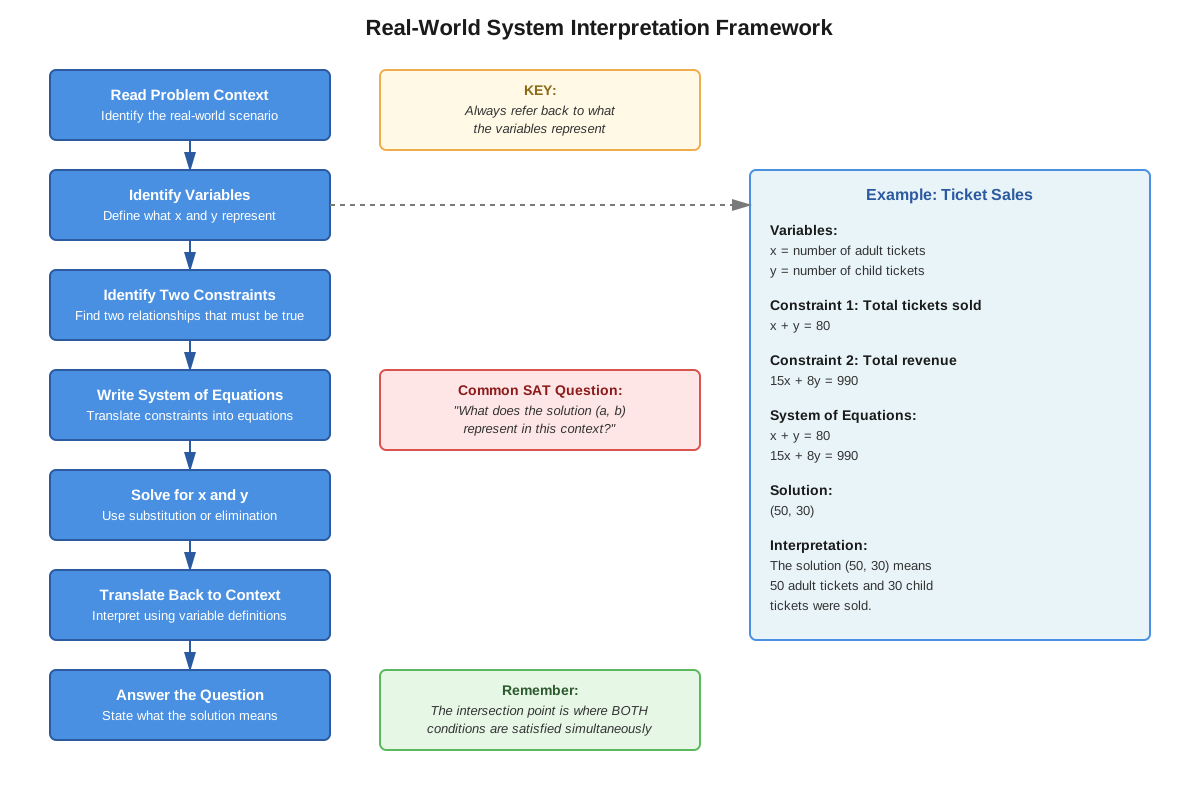
When interpreting systems, the key insight is that each equation describes a condition or rule. For example, one equation might represent the total cost of items purchased, while another represents a budget constraint. The solution to the system—the point where both equations are satisfied—represents the scenario where both conditions are met.
Types of Solutions and Their Meanings
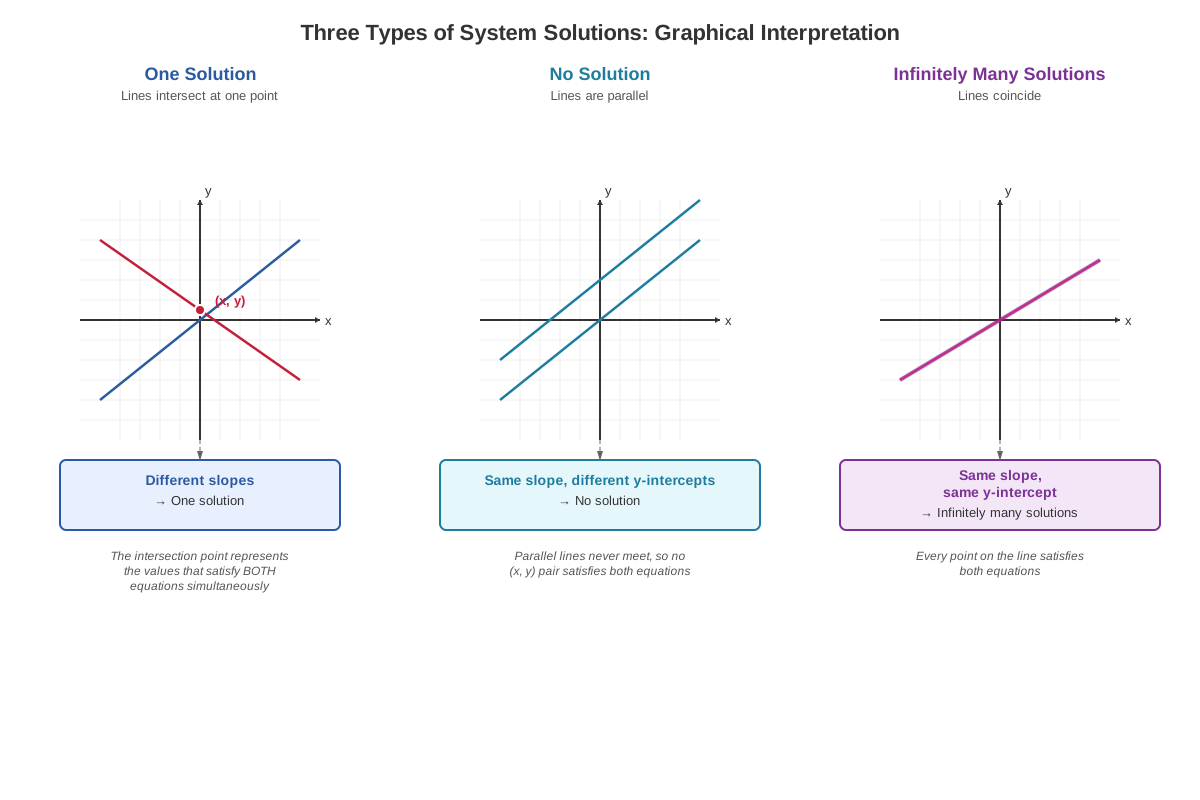
Systems of linear equations can have exactly one solution, no solution, or infinitely many solutions. Understanding what each case means both algebraically and graphically is essential for SAT success.
| Solution Type | Algebraic Meaning | Graphical Meaning | Real-World Interpretation |
|---|---|---|---|
| One solution | Unique (x, y) pair satisfies both equations | Lines intersect at exactly one point | One specific scenario satisfies both constraints |
| No solution | No (x, y) pair satisfies both equations | Lines are parallel (never intersect) | The constraints are contradictory; no scenario works |
| Infinitely many solutions | All solutions to one equation satisfy the other | Lines are coincident (same line) | The constraints are equivalent; many scenarios work |
Interpreting the Solution Point
When a system has one solution, that solution point (x, y) has specific meaning in context. On the SAT, questions frequently ask students to identify what these coordinates represent. For example, if x represents hours worked and y represents total earnings, the solution point tells you exactly how many hours result in a specific earning amount under both payment schemes being compared.
The x-coordinate and y-coordinate each have distinct meanings based on what the variables represent. Students must carefully read the problem to understand what each variable measures, including units. A common SAT question format presents a system and asks: "What does the y-coordinate of the solution represent?"
Analyzing No-Solution Systems
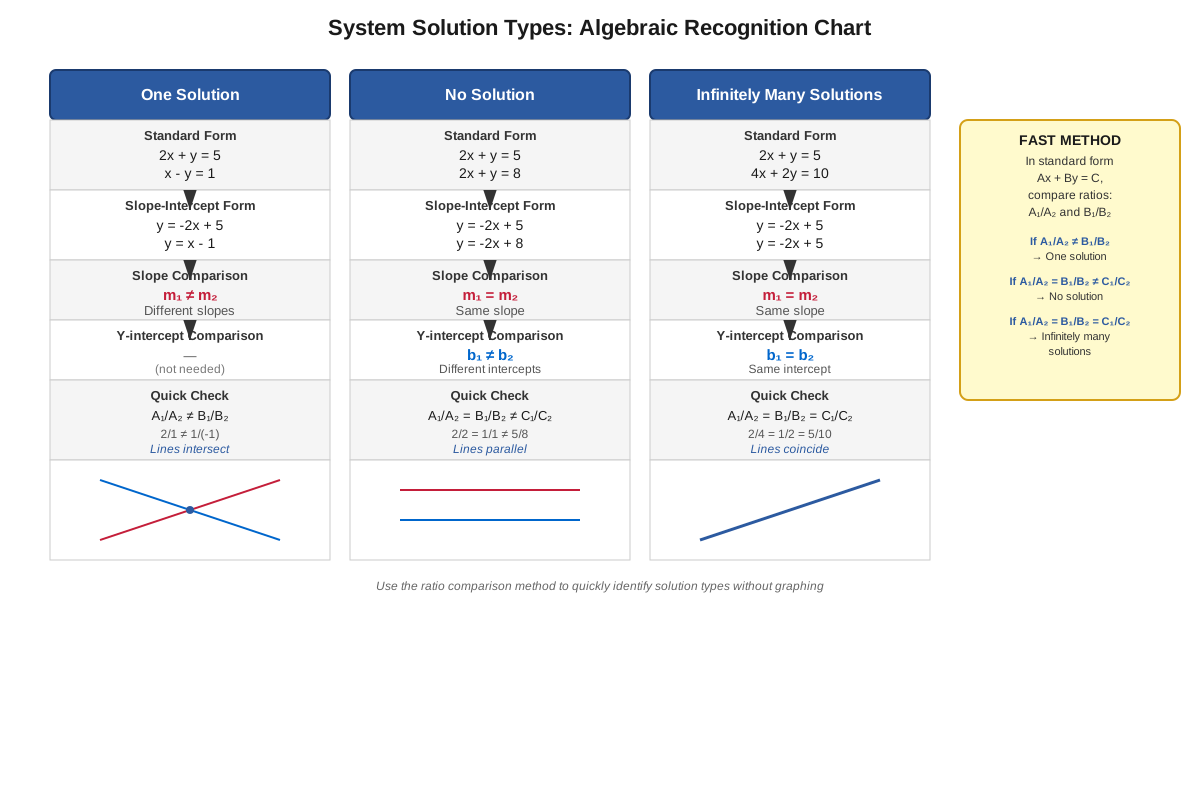
When a system has no solution, the lines are parallel—they have the same slope but different y-intercepts. In real-world contexts, this means the two constraints cannot both be satisfied. For example, if one equation represents "total cost equals $50" and another represents "total cost equals $75" for the same items, no solution exists because the total cannot simultaneously equal two different values.
On the SAT, recognizing no-solution systems often involves identifying contradictory constraints in word problems or recognizing that two equations have equal slopes but different y-intercepts when written in slope-intercept form (y = mx + b).
Analyzing Infinite-Solution Systems
When a system has infinitely many solutions, the two equations are actually the same line written in different forms. This means every point on the line satisfies both equations—the constraints are equivalent or redundant. For example, if one equation is 2x + 4y = 10 and another is x + 2y = 5, dividing the first equation by 2 yields the second equation, confirming they're identical.
In context, infinite solutions mean the two relationships always agree—they're describing the same constraint in different ways. SAT questions might ask students to identify what value makes a system have infinitely many solutions, requiring them to manipulate equations to make them identical.
Graphical Interpretation
Graphically, systems of linear equations appear as two lines on the coordinate plane. The solution is where the lines intersect. Students must be able to:
- Identify the solution point from a graph
- Determine whether lines will intersect by comparing slopes
- Understand that the intersection point satisfies both equations
- Relate the graphical intersection to the algebraic solution
SAT questions may show a graph and ask what the intersection point means, or present equations and ask students to determine whether the lines intersect, are parallel, or coincident.
Context-Based Interpretation
The most challenging SAT questions require interpreting systems within specific contexts. Students must:
- Identify what each variable represents (including units)
- Understand what each equation models
- Determine what the solution means for the scenario
- Recognize when a solution makes sense contextually (e.g., negative time might not be meaningful)
For example, if a system models two phone plans where x = number of minutes and y = total cost, the solution point tells you at what usage level both plans cost the same amount. Questions might ask: "For what number of minutes do the plans cost the same?" or "What is the cost when both plans are equal?"
Concept Relationships
The core concepts within interpreting systems build upon each other hierarchically. Understanding what systems represent → enables recognition of solution types → which leads to interpreting solution meanings → and ultimately allows analysis of real-world applications.
The relationship between algebraic and graphical representations is bidirectional: algebraic properties (like equal slopes) determine graphical features (like parallel lines), while graphical observations (like intersection points) correspond to algebraic solutions. This dual representation strengthens understanding and provides multiple problem-solving approaches.
Interpreting systems connects backward to prerequisite topics: linear equations provide the building blocks, graphing skills enable visualization, and slope concepts determine solution types. It connects forward to more advanced topics like systems of inequalities, optimization problems, and mathematical modeling in higher mathematics.
Within the SAT Math section, interpreting systems relates to function questions (where systems might involve function notation), word problems (requiring translation skills), and data analysis (where systems might model trends). The skill of extracting meaning from mathematical representations applies across all SAT Math domains.
High-Yield Facts
⭐ The solution to a system is the point (x, y) that satisfies both equations simultaneously
⭐ A system with one solution has lines with different slopes; the lines intersect at exactly one point
⭐ A system with no solution has parallel lines with equal slopes but different y-intercepts
⭐ A system with infinitely many solutions has coincident lines; one equation is a multiple of the other
⭐ The coordinates of the solution point have specific meanings based on what the variables represent in context
- When interpreting systems graphically, the intersection point's coordinates can be read directly from the graph
- Parallel lines never intersect, meaning their corresponding system has no solution
- If two equations can be manipulated to become identical, the system has infinitely many solutions
- The x-coordinate and y-coordinate of a solution each answer different questions about the scenario
- Systems can be presented algebraically, graphically, in tables, or through word problems—all representations are equivalent
- Changing the slope of one equation changes whether the system has one solution, no solution, or infinitely many solutions
- In real-world contexts, solutions must make sense (e.g., you cannot have negative quantities of physical objects)
Quick check — test yourself on Interpreting systems so far.
Try Flashcards →Common Misconceptions
Misconception: The solution to a system is just finding x and y values through algebraic manipulation.
Correction: While solving is important, interpreting systems requires understanding what those x and y values mean in the given context. The SAT tests whether you can explain what the solution represents, not just calculate it.
Misconception: If a system has no solution, one of the equations must be wrong or invalid.
Correction: No solution simply means the constraints are contradictory—both equations can be perfectly valid, but no scenario satisfies both simultaneously. This is a legitimate mathematical outcome.
Misconception: The solution point is always where the lines cross on a graph, so you just need to find the intersection.
Correction: While the intersection point is the solution, SAT questions require you to interpret what that point means. You must identify what the x and y coordinates represent in context, not just locate the point.
Misconception: Systems with infinitely many solutions mean the equations are different but happen to have all the same solutions.
Correction: Infinitely many solutions occur only when the equations are actually identical—one is a multiple or rearrangement of the other. They represent the exact same line.
Misconception: When a system models a real-world scenario, any mathematical solution is valid.
Correction: Solutions must make sense in context. For example, if x represents number of people, x = -3 is mathematically valid but contextually meaningless. Always check whether solutions are reasonable for the scenario.
Misconception: The y-intercept of the solution is the y-intercept of one of the lines.
Correction: The y-coordinate of the solution point is the y-value where both equations are satisfied. This is different from the y-intercept of either individual line (where x = 0).
Worked Examples
Example 1: Interpreting a Solution in Context
Problem: A gym charges a monthly membership fee plus an additional cost per class attended. The total monthly cost C (in dollars) for attending n classes is given by C = 20 + 5n. A different gym charges according to C = 35 + 3n. At how many classes do both gyms charge the same total cost, and what is that cost?
Solution:
Step 1: Recognize this as a system of equations where we need to find when both equations give the same C value for the same n value.
System:
C = 20 + 5n
C = 35 + 3n
Step 2: Since both expressions equal C, set them equal to each other:
20 + 5n = 35 + 3nStep 3: Solve for n:
5n - 3n = 35 - 20
2n = 15
n = 7.5
Step 4: Find C by substituting n = 7.5 into either equation:
C = 20 + 5(7.5) = 20 + 37.5 = 57.5Step 5: Interpret the solution: The solution (7.5, 57.5) means that when attending 7.5 classes per month, both gyms charge $57.50.
Context interpretation: For fewer than 7.5 classes, the first gym (with lower per-class fee) is cheaper. For more than 7.5 classes, the second gym becomes cheaper despite its higher base fee.
This example demonstrates Learning Objective: Apply interpreting systems to answer SAT-style questions by solving the system and explaining what the solution means in context.
Example 2: Analyzing Solution Types
Problem: Consider the system:
3x + 2y = 12
6x + 4y = k
For what value of k does this system have infinitely many solutions? What does this mean graphically?
Solution:
Step 1: Recognize that infinitely many solutions occur when the equations represent the same line.
Step 2: Manipulate the first equation to match the form of the second. Multiply the entire first equation by 2:
2(3x + 2y) = 2(12)
6x + 4y = 24
Step 3: Compare with the second equation (6x + 4y = k). For the equations to be identical, k must equal 24.
Step 4: Verify: When k = 24, the second equation is exactly twice the first equation, meaning they represent the same line.
Graphical interpretation: When k = 24, both equations graph as the same line, so every point on that line is a solution. The lines are coincident (overlap completely).
Additional analysis:
- If k ≠ 24, the lines have the same slope (both have slope -3/2 when written in slope-intercept form) but different y-intercepts, making them parallel with no solution.
- There is no value of k that gives exactly one solution because the left sides of the equations are proportional.
This example demonstrates Learning Objective: Analyze systems to identify whether they have one solution, no solution, or infinitely many solutions, and connects to graphical interpretation.
Exam Strategy
When approaching SAT questions on interpreting systems, follow this systematic process:
Step 1: Identify what you're being asked. SAT questions rarely ask you to simply "solve the system." Instead, they ask what the solution represents, what a specific coordinate means, or which statement about the solution is true. Read the question carefully before solving.
Step 2: Determine what the variables represent. Look for explicit statements like "where x represents the number of hours" or "where C represents total cost in dollars." Write these down to avoid confusion.
Step 3: Decide whether you need to solve. Sometimes you can answer interpretation questions without fully solving the system. For example, if asked whether a system has a solution, checking if slopes are equal may be sufficient.
Trigger words and phrases to watch for:
- "What does the x-coordinate represent?" → Identify the meaning of the x variable in context
- "At what point do the lines intersect?" → Solve the system and state the solution point
- "For what value does the system have no solution?" → Set slopes equal and y-intercepts different
- "What does the solution mean in this context?" → Interpret the numerical solution in real-world terms
- "Which system represents the situation?" → Translate word problem into equations
Process-of-elimination tips:
- Eliminate answer choices with incorrect units (e.g., if the question asks for cost in dollars, eliminate answers in hours)
- Eliminate interpretations that don't match both equations (the solution must satisfy both)
- For "which system represents" questions, check whether each equation matches its described constraint
- Eliminate answers that are contextually impossible (negative quantities, non-integer people, etc.)
Time allocation: Spend 30-45 seconds reading and understanding the context, 45-60 seconds solving or analyzing the system, and 15-30 seconds interpreting and selecting your answer. Don't rush the interpretation step—this is where points are won or lost.
Exam Tip: If a question shows a graph of two lines, you can often read the solution directly from the intersection point without algebraic solving. However, you still must interpret what those coordinates mean.
Memory Techniques
Mnemonic for Solution Types - "SIP":
- Same slope, different intercepts = Separate (no solution, parallel lines)
- Identical equations = Infinite solutions (coincident lines)
- Point of intersection = Precisely one solution (different slopes)
Visualization Strategy: Picture systems as two roads on a map:
- Roads that cross = one meeting point (one solution)
- Roads that run parallel = never meet (no solution)
- Roads that overlap = infinite meeting points (infinitely many solutions)
Acronym for Interpretation Steps - "WISE":
- What do the variables represent?
- Identify the solution (solve if needed)
- State what each coordinate means
- Evaluate whether it makes sense in context
Memory aid for context checking: "NUMS" - Numbers must make sense:
- Negatives: Can the answer be negative in this context?
- Units: Do the units match what's being asked?
- Magnitude: Is the size reasonable?
- Sense: Does the answer logically fit the scenario?
Summary
Interpreting systems of linear equations on the SAT requires understanding what systems represent, identifying solution types, and explaining what solutions mean in real-world contexts. A system consists of multiple linear equations that must all be satisfied simultaneously, and the solution represents the scenario where all constraints are met. Systems can have exactly one solution (intersecting lines with different slopes), no solution (parallel lines with equal slopes but different intercepts), or infinitely many solutions (coincident lines that are actually the same equation). The key SAT skill is not just solving systems algebraically but interpreting what the solution coordinates represent based on the context—what the variables measure, what units they use, and what the specific x and y values mean for the scenario. Success requires translating between verbal descriptions, algebraic representations, and graphical interpretations while always checking that solutions make contextual sense. This topic appears frequently on the SAT in various formats and connects to broader mathematical reasoning skills essential for college-level mathematics.
Key Takeaways
- The solution to a system is the point where all equations are satisfied simultaneously, representing a scenario that meets all constraints
- One solution (intersecting lines) occurs when equations have different slopes; no solution (parallel lines) when slopes are equal but y-intercepts differ; infinitely many solutions (coincident lines) when equations are identical
- Always identify what each variable represents before interpreting a solution—the x and y coordinates answer different questions about the scenario
- SAT questions emphasize interpretation over mechanical solving—focus on what solutions mean, not just calculating them
- Check that solutions make contextual sense: negative values, incorrect units, or unreasonable magnitudes indicate errors
- Move flexibly between algebraic, graphical, and verbal representations—the SAT tests all three
- Parallel lines (no solution) represent contradictory constraints; coincident lines (infinite solutions) represent redundant or equivalent constraints
Related Topics
Systems of Linear Inequalities: Extends interpreting systems to inequality constraints, where solutions are regions rather than points. Mastering systems of equations provides the foundation for understanding how multiple inequality constraints interact.
Linear Functions and Modeling: Deeper exploration of how linear equations model real-world relationships. Interpreting systems builds on understanding individual linear models and extends to analyzing multiple models simultaneously.
Quadratic-Linear Systems: Systems involving one linear and one quadratic equation, which can have zero, one, or two solutions. Understanding linear systems provides the conceptual framework for analyzing more complex system types.
Matrices and System Solving: Advanced algebraic techniques for solving systems, particularly those with three or more variables. The interpretation skills developed here apply to larger systems encountered in advanced mathematics.
Optimization and Linear Programming: Applications where systems of inequalities define feasible regions and solutions optimize some objective. Interpreting systems provides essential background for understanding constrained optimization.
Practice CTA
Now that you've mastered the core concepts of interpreting systems, it's time to solidify your understanding through practice. Attempt the practice questions to apply these interpretation skills to SAT-style problems, and use the flashcards to reinforce key facts and solution types. Remember, the SAT rewards not just computational ability but deep conceptual understanding—practice explaining what solutions mean, not just finding them. Each practice problem you complete builds the pattern recognition and reasoning skills that lead to confident, accurate performance on test day. You've got this!
Sign up free to keep reading
Create a free AnvayaPrep account to finish this SAT guide on Interpreting systems — plus flashcards and practice questions.