Overview
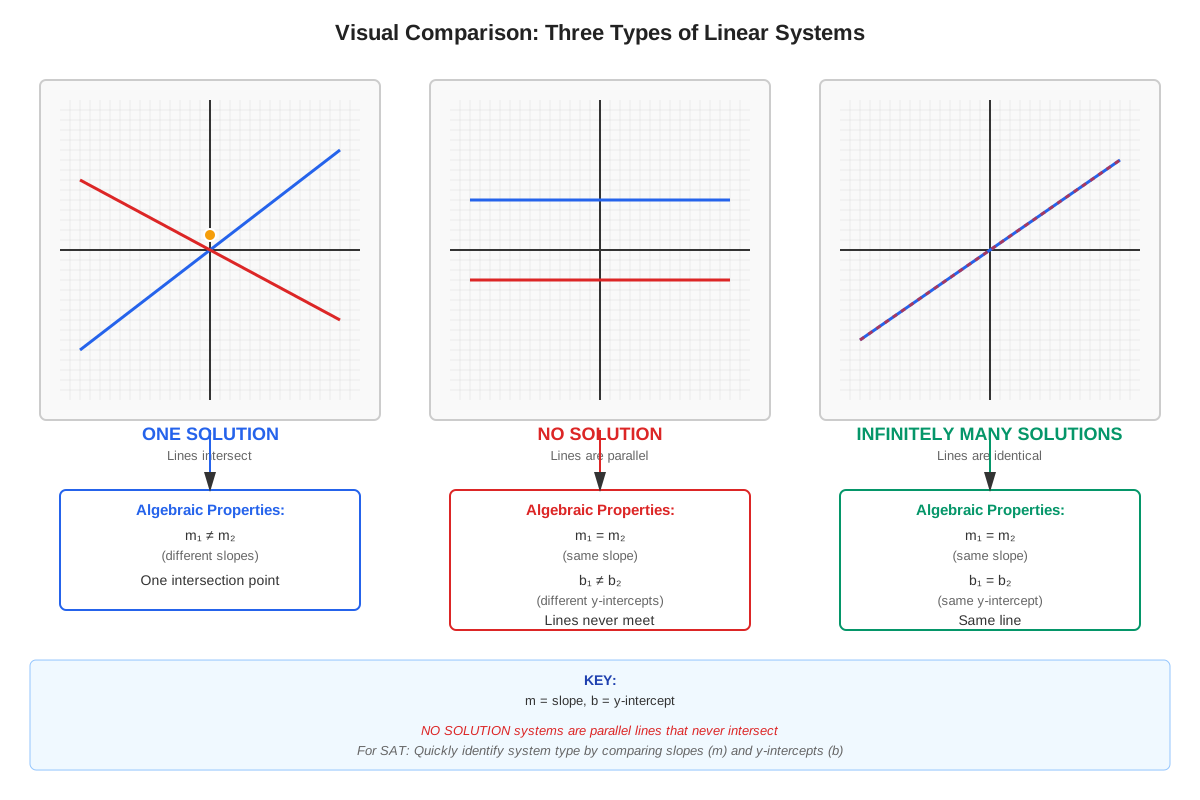
No solution systems represent a critical category of linear equation systems that students must master for SAT success. When two or more linear equations describe parallel lines that never intersect, the system has no solution—there exists no ordered pair (x, y) that simultaneously satisfies all equations. This concept tests both algebraic manipulation skills and geometric understanding of linear relationships.
Understanding sat no solution systems is essential because the SAT frequently tests whether students can identify when systems are inconsistent (have no solution), consistent with one solution (intersecting lines), or consistent with infinitely many solutions (identical lines). These questions appear in both multiple-choice and grid-in formats, often requiring students to determine unknown coefficients that would create a no solution scenario. The ability to recognize parallel lines through their slopes and y-intercepts, or through algebraic manipulation, separates high-scoring students from those who struggle with systems of equations.
This topic connects fundamentally to broader math concepts including linear functions, slope-intercept form, graphing, and algebraic reasoning. Mastery of no solution systems builds upon understanding of linear equations while preparing students for more advanced topics like systems with three variables, matrices, and linear programming. The SAT dedicates approximately 2-4 questions per test to systems of equations, with no solution systems appearing regularly as a high-yield concept that rewards careful analysis.
Learning Objectives
- [ ] Identify key features of no solution systems
- [ ] Explain how no solution systems appears on the SAT
- [ ] Apply no solution systems to answer SAT-style questions
- [ ] Determine the conditions that create parallel lines algebraically
- [ ] Calculate unknown coefficients that would make a system have no solution
- [ ] Distinguish between no solution, one solution, and infinitely many solutions by inspection
- [ ] Convert between different forms of linear equations to identify parallel relationships
Prerequisites
- Slope-intercept form (y = mx + b): Essential for quickly identifying slopes and y-intercepts to determine if lines are parallel
- Standard form of linear equations (Ax + By = C): Necessary for manipulating equations and comparing coefficients
- Concept of slope: Understanding that parallel lines have identical slopes is fundamental to recognizing no solution systems
- Solving systems of equations: Basic substitution and elimination methods help reveal when contradictions arise
- Graphing linear equations: Visualizing lines helps confirm algebraic conclusions about intersection points
Why This Topic Matters
In real-world applications, no solution systems model situations where constraints cannot be simultaneously satisfied—such as budget limitations that exceed available resources, or scheduling conflicts where requirements are mutually exclusive. Engineers encounter no solution scenarios when design specifications conflict, while economists analyze market conditions where supply and demand constraints cannot reach equilibrium under certain parameters.
On the SAT, systems of equations questions appear in approximately 10-15% of the math section, with no solution systems representing a significant subset. The College Board specifically tests this concept because it assesses multiple skills simultaneously: algebraic manipulation, geometric reasoning, and logical analysis. Questions typically appear as:
- Coefficient determination problems: "For what value of k does the system have no solution?"
- System classification: "How many solutions does this system have?"
- Conceptual understanding: "Which statement about these lines is true?"
- Applied context problems: Word problems where students must recognize impossible constraint combinations
These questions frequently appear in the calculator and no-calculator sections, often positioned in the medium-to-hard difficulty range (questions 10-20 in each section). The SAT favors this topic because it efficiently tests whether students truly understand linear relationships beyond mere procedural calculation.
Core Concepts
Definition of No Solution Systems
A no solution system (also called an inconsistent system) occurs when two or more linear equations represent parallel lines that never intersect. Since a solution to a system requires finding point(s) where all equations are simultaneously true, parallel lines—which maintain constant distance and never meet—cannot produce a solution. Algebraically, attempting to solve such systems leads to false statements like "0 = 5" or "3 = -2," indicating the impossibility of finding values that satisfy both equations.
Geometric Interpretation
Graphically, no solution systems appear as parallel lines. Two lines in the coordinate plane are parallel when they have:
- Identical slopes (same rate of change)
- Different y-intercepts (different starting points on the y-axis)
This combination ensures the lines travel in the same direction at the same angle but never converge. For example, the lines y = 2x + 3 and y = 2x - 1 both have slope 2 but different y-intercepts (3 and -1), making them parallel with no intersection point.
Algebraic Identification Methods
Method 1: Slope-Intercept Comparison
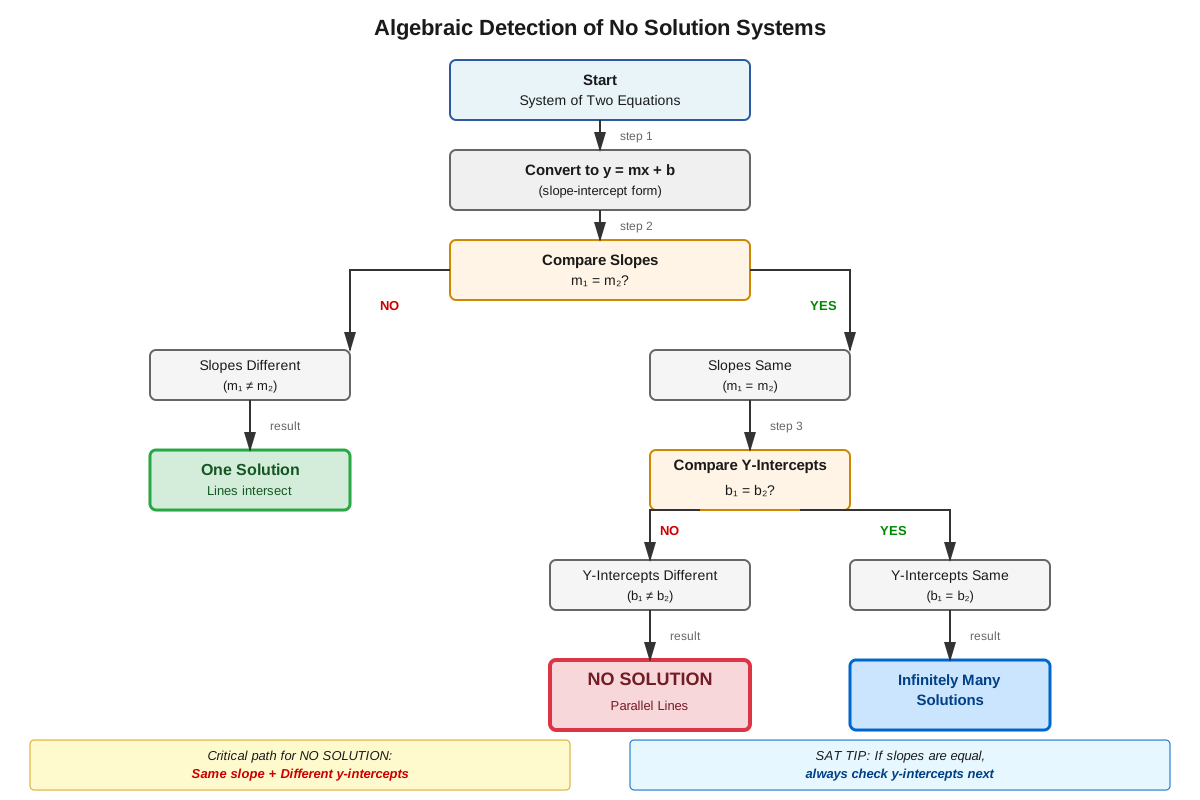
Convert both equations to slope-intercept form (y = mx + b) and compare:
- If slopes are equal (m₁ = m₂) AND y-intercepts are different (b₁ ≠ b₂), the system has no solution
- If slopes are equal AND y-intercepts are equal, the system has infinitely many solutions
- If slopes are different, the system has exactly one solution
Example:
- Equation 1: 2x + y = 5 → y = -2x + 5
- Equation 2: 4x + 2y = 6 → y = -2x + 3
Both have slope -2, but different y-intercepts (5 and 3), confirming no solution.
Method 2: Coefficient Ratio Analysis
For equations in standard form:
- Equation 1: A₁x + B₁y = C₁
- Equation 2: A₂x + B₂y = C₂
Compare the ratios:
| Condition | Number of Solutions |
|---|---|
| A₁/A₂ = B₁/B₂ ≠ C₁/C₂ | No solution (parallel lines) |
| A₁/A₂ = B₁/B₂ = C₁/C₂ | Infinitely many solutions (same line) |
| A₁/A₂ ≠ B₁/B₂ | Exactly one solution (intersecting lines) |
Example:
- 3x + 6y = 12
- 2x + 4y = 10
Ratios: 3/2 = 6/4 = 3/2, but 12/10 = 6/5
Since 3/2 ≠ 6/5, this system has no solution.
Method 3: Elimination Leading to Contradiction
When using elimination method, multiply equations to create matching coefficients, then add or subtract:
2x + 3y = 7    (multiply by 2)  →  4x + 6y = 14
4x + 6y = 20                    →  4x + 6y = 20
                                   _______________
                    Subtract:      0 = -6  (FALSE)
The false statement (0 = -6) proves no solution exists.
Determining Unknown Coefficients
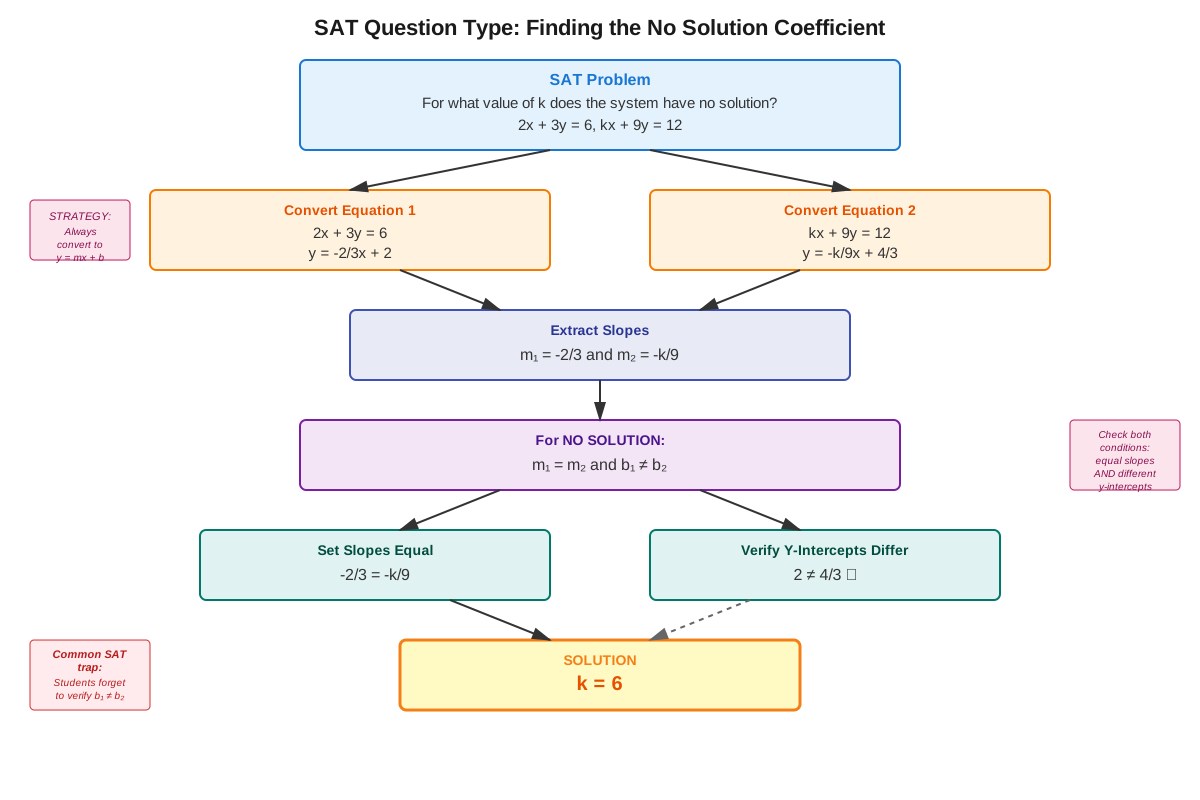
SAT questions frequently ask: "For what value of k does the system have no solution?" This requires setting up conditions for parallel lines.
Strategy:
- Convert both equations to slope-intercept form (or compare coefficient ratios)
- Set slopes equal: m₁ = m₂
- Ensure y-intercepts are different: b₁ ≠ b₂
- Solve for the unknown coefficient
Example Problem:
For what value of k does this system have no solution?
- 3x + 4y = 12
- kx + 8y = 20
Solution:
Convert to slope-intercept form:
- First equation: y = -¾x + 3 (slope = -¾)
- Second equation: y = -(k/8)x + 5/2 (slope = -k/8)
For no solution, slopes must be equal:
-¾ = -k/8
k/8 = ¾
k = 6
Verify y-intercepts differ: 3 ≠ 5/2 ✓
Therefore, k = 6 creates a no solution system.
Special Cases and Edge Conditions
Vertical Lines: Equations like x = 3 and x = 5 represent vertical parallel lines (undefined slope) with no solution. These are special cases where slope-intercept form doesn't apply directly.
Proportional Equations: If one equation is a multiple of another except for the constant term, the system has no solution. For example:
- 2x + 3y = 6
- 4x + 6y = 15 (not 12, which would make them identical)
The second equation is 2 times the first in coefficients but not in the constant, guaranteeing parallel lines.
Concept Relationships
The hierarchy of concepts flows as follows:
Linear Equations → define individual lines → Slope and Y-intercept → determine line position and direction → Systems of Equations → combine multiple lines → Solution Classification → branches into three categories:
- No Solution (parallel lines, this topic)
- One Solution (intersecting lines)
- Infinitely Many Solutions (identical lines)
Parallel Lines ← geometric concept → connects to → No Solution Systems ← algebraic concept
The coefficient ratio method connects directly to proportional relationships and similar triangles from geometry. When A₁/A₂ = B₁/B₂, the direction vectors of the lines are proportional, creating parallelism. The additional condition C₁/C₂ ≠ A₁/A₂ ensures the lines are distinct rather than coincident.
Understanding no solution systems strengthens comprehension of:
- Function behavior: Recognizing when equations cannot share output values
- Constraint analysis: Identifying impossible condition combinations
- Algebraic manipulation: Converting between forms to reveal relationships
- Logical reasoning: Drawing conclusions from contradictory statements
This topic serves as a foundation for advanced concepts like linear independence in vectors, rank of matrices, and feasibility regions in linear programming.
High-Yield Facts
⭐ A system has no solution when lines are parallel: equal slopes but different y-intercepts
⭐ For standard form equations, if A₁/A₂ = B₁/B₂ ≠ C₁/C₂, the system has no solution
⭐ Elimination method producing a false statement (like 0 = 5) confirms no solution
⭐ To create a no solution system with unknown coefficient k, set slopes equal while ensuring different y-intercepts
⭐ Vertical lines x = a and x = b (where a ≠ b) always form a no solution system
- Multiplying an entire equation by a non-zero constant doesn't change the line it represents, but changing only the constant term creates a parallel line
- Graphically, parallel lines maintain constant perpendicular distance throughout their entire length
- No solution systems are called "inconsistent" because no point satisfies all equations simultaneously
- The SAT never asks about systems with more than two equations, simplifying analysis
- Converting to slope-intercept form is typically faster than coefficient ratio comparison for simple equations
- When both equations have the same x-coefficient and y-coefficient but different constants, no solution is guaranteed
- Substitution method will also reveal no solution through contradiction, though elimination is usually more efficient
- The phrase "for all values of x" or "for no values of x" in answer choices often signals a no solution question
Quick check — test yourself on No solution systems so far.
Try Flashcards →Common Misconceptions
Misconception: If two equations look different, they must have a solution.
Correction: Equations can appear different but still represent parallel lines. Always check slopes and y-intercepts or use coefficient ratios to determine the relationship.
Misconception: A system with no solution means the equations are wrong or contain errors.
Correction: No solution is a valid mathematical outcome indicating parallel lines. The equations are correct; they simply describe lines that never intersect.
Misconception: Setting slopes equal is sufficient to guarantee no solution.
Correction: Equal slopes create parallel OR identical lines. You must also verify that y-intercepts (or constant terms) differ to confirm the lines are distinct and parallel, not coincident.
Misconception: The elimination method "failing" means you made an algebraic mistake.
Correction: When elimination produces a false statement like 0 = 7, this is the correct result showing no solution exists. This is the method working properly, not an error.
Misconception: Vertical lines have slope zero.
Correction: Vertical lines have undefined slope (division by zero), while horizontal lines have slope zero. Two vertical lines with different x-values (x = 2 and x = 5) form a no solution system.
Misconception: If A₁/A₂ = B₁/B₂, the system automatically has no solution.
Correction: This ratio equality indicates parallel OR identical lines. You must check if C₁/C₂ also equals this ratio. If all three ratios are equal, the system has infinitely many solutions (same line). Only when C₁/C₂ differs does no solution occur.
Misconception: No solution systems only appear in abstract math problems.
Correction: Real-world scenarios frequently involve impossible constraint combinations, such as budgets that require spending more than available funds or schedules requiring someone to be in two places simultaneously.
Worked Examples
Example 1: Identifying No Solution from Given Equations
Problem: Determine whether the following system has no solution, one solution, or infinitely many solutions:
6x - 2y = 10
9x - 3y = 12Solution:
Step 1: Choose a method. We'll use coefficient ratio comparison since the equations are in standard form.
Step 2: Identify coefficients:
- Equation 1: A₁ = 6, B₁ = -2, C₁ = 10
- Equation 2: A₂ = 9, B₂ = -3, C₂ = 12
Step 3: Calculate ratios:
- A₁/A₂ = 6/9 = 2/3
- B₁/B₂ = -2/-3 = 2/3
- C₁/C₂ = 10/12 = 5/6
Step 4: Compare ratios:
Since A₁/A₂ = B₁/B₂ (both equal 2/3) but C₁/C₂ = 5/6 ≠ 2/3, the system has no solution.
Step 5: Verify using slope-intercept form:
- Equation 1: 6x - 2y = 10 → -2y = -6x + 10 → y = 3x - 5
- Equation 2: 9x - 3y = 12 → -3y = -9x + 12 → y = 3x - 4
Both lines have slope 3, but different y-intercepts (-5 and -4), confirming they are parallel with no intersection.
Connection to Learning Objectives: This example demonstrates identifying key features of no solution systems (equal slopes, different y-intercepts) and applying multiple methods to reach the same conclusion.
Example 2: Finding Unknown Coefficient for No Solution
Problem: For what value of k does the following system have no solution?
4x + 6y = 18
2x + ky = 15Solution:
Step 1: Understand the requirement. For no solution, we need parallel lines: equal slopes but different y-intercepts.
Step 2: Convert to slope-intercept form to find slopes:
Equation 1: 4x + 6y = 18
- 6y = -4x + 18
- y = -⅔x + 3
- Slope₁ = -⅔
Equation 2: 2x + ky = 15
- ky = -2x + 15
- y = -2/k·x + 15/k
- Slope₂ = -2/k
Step 3: Set slopes equal:
-⅔ = -2/k
Step 4: Solve for k:
-⅔ = -2/k
⅔ = 2/k (multiply both sides by -1)
2k = 6 (cross multiply)
k = 3
Step 5: Verify y-intercepts differ:
- When k = 3: y = -⅔x + 15/3 = -⅔x + 5
- Original: y = -⅔x + 3
- Y-intercepts: 5 ≠ 3 ✓
Step 6: Alternative verification using coefficient ratios:
With k = 3, the equations become:
- 4x + 6y = 18
- 2x + 3y = 15
Ratios: 4/2 = 2, 6/3 = 2, 18/15 = 6/5
Since 2 = 2 ≠ 6/5, no solution is confirmed.
Answer: k = 3
Connection to Learning Objectives: This example applies no solution systems to SAT-style questions by determining conditions that create parallel lines, a high-frequency question type on the exam.
Exam Strategy
Approaching SAT Questions
Step 1: Identify the Question Type
Look for trigger phrases:
- "For what value of k does the system have no solution?"
- "How many solutions does this system have?"
- "The lines represented by these equations are parallel"
- "The system is inconsistent"
Step 2: Choose Your Method Strategically
| Situation | Best Method |
|---|---|
| Equations already in y = mx + b form | Direct slope/y-intercept comparison |
| Simple coefficients in standard form | Coefficient ratio method |
| Unknown coefficient to find | Convert to slope-intercept, set slopes equal |
| Multiple choice with numerical answers | Test answer choices |
| Complex coefficients | Elimination method to check for contradiction |
Step 3: Work Efficiently
- For coefficient questions, set up the slope equality equation first
- Always verify y-intercepts differ after finding the coefficient
- Use calculator for arithmetic but not for algebraic manipulation
- Double-check signs when converting forms
Process of Elimination Tips
When answer choices are given:
- Eliminate values that make slopes unequal: If testing k values, quickly calculate resulting slopes and eliminate any that differ
- Eliminate values that make y-intercepts equal: These would create infinitely many solutions, not no solution
- Watch for trap answers: The SAT often includes the value that makes slopes equal AND y-intercepts equal (infinitely many solutions) as a distractor
- Check extreme values: k = 0 or k = 1 are often trap answers that create one solution instead of no solution
Time Allocation
- Simple identification (given two equations, determine solution count): 30-45 seconds
- Finding unknown coefficient: 60-90 seconds
- Word problem requiring system setup: 90-120 seconds
If a problem exceeds these times, mark it and return later. No solution questions are high-yield but shouldn't consume disproportionate time.
Red Flags and Verification
Before finalizing your answer:
- ✓ Slopes are equal
- ✓ Y-intercepts (or constants) are different
- ✓ Arithmetic is correct (especially signs)
- ✓ Answer makes logical sense (k = 0 rarely creates no solution)
Memory Techniques
Mnemonic for No Solution: "PANDA"
- Parallel lines
- Always
- Never
- Do
- Agree (have no solution)
Slope-Intercept Memory Aid: "Same Slope, Different Height = Never Meet"
Visualize two parallel roads (same slope) at different elevations (different y-intercepts) that can never intersect.
Coefficient Ratio Acronym: "ABC Rule"
- All ratios equal → infinitely many solutions
- Both A and B ratios equal, C different → no solution
- Coefficient ratios unequal → one solution
Visual Memory Technique: Picture railroad tracks (parallel lines) that extend forever without meeting. The rails have the same slope but different positions (y-intercepts), perfectly modeling a no solution system.
Contradiction Memory: When elimination gives "0 = [non-zero number]," remember "Zero Equals Nothing" → the system has no solution (nothing satisfies both equations).
Summary
No solution systems occur when linear equations represent parallel lines that never intersect, making it impossible to find values that simultaneously satisfy all equations. The defining characteristics are equal slopes with different y-intercepts, which can be identified through direct comparison in slope-intercept form, coefficient ratio analysis in standard form, or elimination methods that produce contradictions. On the SAT, these systems appear frequently in questions asking students to classify solution types or determine unknown coefficients that create parallel lines. Mastery requires understanding both the geometric interpretation (parallel lines maintaining constant distance) and algebraic manifestations (equal slope ratios but unequal constant ratios). The key to success is quickly recognizing the conditions for no solution—A₁/A₂ = B₁/B₂ ≠ C₁/C₂ in standard form—and efficiently applying this knowledge to find unknown parameters. Students must distinguish no solution systems from the other two possibilities: one solution (intersecting lines with different slopes) and infinitely many solutions (identical lines with all ratios equal). This topic integrates fundamental linear equation concepts with logical reasoning, making it a high-yield area for SAT preparation.
Key Takeaways
- No solution systems have parallel lines: equal slopes (m₁ = m₂) but different y-intercepts (b₁ ≠ b₂)
- Coefficient ratio test: A₁/A₂ = B₁/B₂ ≠ C₁/C₂ confirms no solution in standard form
- Elimination producing false statements (like 0 = 5) definitively proves no solution exists
- To find unknown coefficients: set slopes equal, then verify y-intercepts differ
- SAT questions favor coefficient determination problems where students calculate k values that create parallel lines
- Three solution types must be distinguished: no solution (parallel), one solution (intersecting), infinitely many (identical)
- Verification is essential: always confirm both conditions (equal slopes AND different intercepts) before concluding no solution
Related Topics
Systems with One Solution: Understanding intersecting lines (different slopes) provides contrast to parallel lines and completes the classification framework. Mastering no solution systems makes identifying unique solutions more intuitive.
Systems with Infinitely Many Solutions: When all coefficient ratios are equal (A₁/A₂ = B₁/B₂ = C₁/C₂), lines are identical. This completes the triad of system types and helps students avoid confusing parallel with coincident lines.
Linear Inequalities and Systems: No solution concepts extend to inequality systems where shaded regions don't overlap, representing impossible constraint combinations in optimization problems.
Matrices and Determinants: In advanced courses, no solution systems correspond to singular matrices (determinant = 0) with inconsistent augmented matrices, building on these foundational concepts.
Parametric Equations: Understanding when parametric representations describe parallel paths applies no solution reasoning to motion and vector problems.
Practice CTA
Now that you've mastered the core concepts of no solution systems, it's time to solidify your understanding through active practice. The practice questions and flashcards are specifically designed to mirror SAT question formats and difficulty levels, giving you the repetition needed to recognize these problems instantly on test day. Focus especially on coefficient determination problems, as these appear frequently and reward the systematic approach you've learned. Remember: understanding the theory is just the first step—applying it under timed conditions is what translates knowledge into points. Challenge yourself with the practice materials, and you'll build the confidence and speed necessary to excel on every systems of equations question the SAT presents!
Sign up free to keep reading
Create a free AnvayaPrep account to finish this SAT guide on No solution systems — plus flashcards and practice questions.