Overview
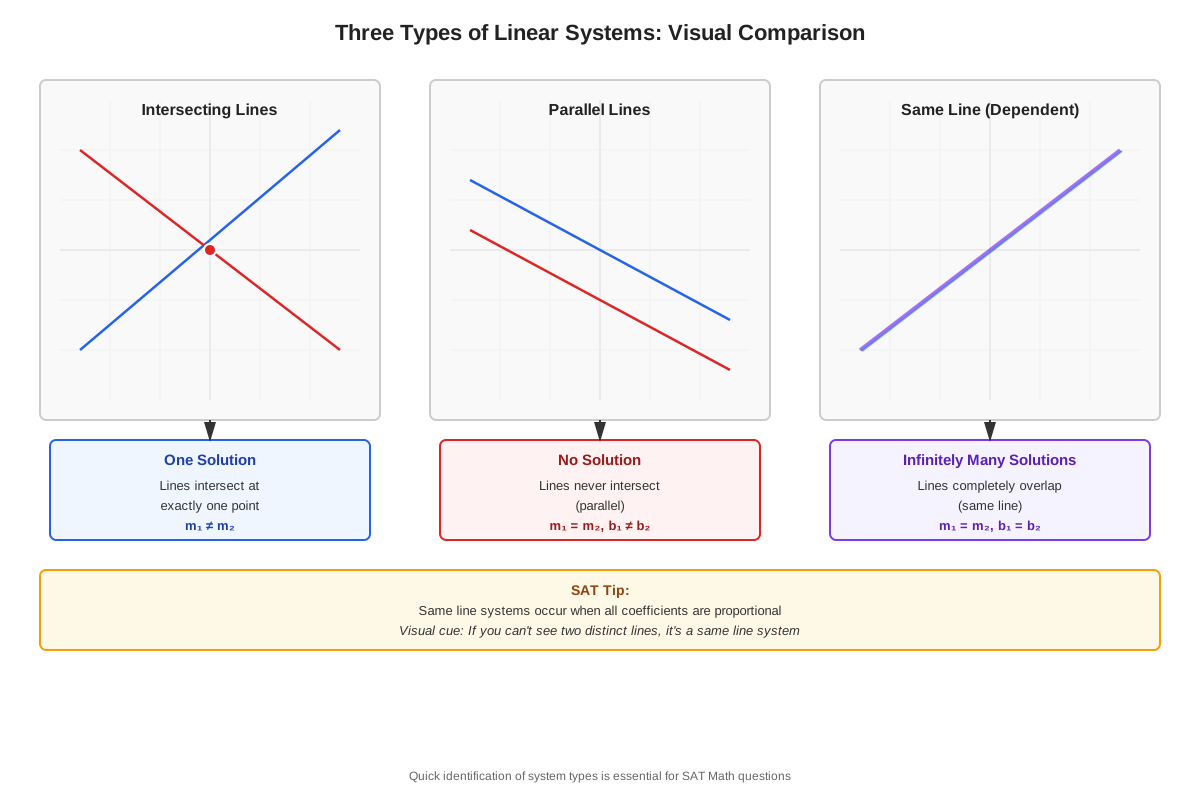
Same line systems represent one of three possible outcomes when solving systems of linear equations—a critical concept tested on the SAT math section. When two linear equations describe the exact same line in the coordinate plane, they form a same line system, also known as a dependent or consistent system with infinitely many solutions. Unlike systems with one unique solution (intersecting lines) or no solution (parallel lines), same line systems have every point on the line as a valid solution.
Understanding sat same line systems is essential because the SAT frequently tests whether students can recognize when two equations are actually equivalent forms of the same relationship. These questions often appear in both multiple-choice and grid-in formats, requiring students to identify conditions that make systems dependent or to determine the value of a coefficient that creates infinitely many solutions. The College Board particularly favors questions where students must manipulate algebraic expressions to recognize equivalent equations.
This topic connects directly to fundamental algebraic concepts including equation manipulation, proportional relationships, and the graphical interpretation of linear equations. Mastery of same line systems strengthens understanding of linear relationships overall and provides essential problem-solving strategies for more complex algebraic scenarios. Students who can quickly identify same line systems gain a significant advantage in time management during the exam, as recognizing this pattern immediately reveals that the system has infinitely many solutions without requiring extensive calculation.
Learning Objectives
- [ ] Identify key features of same line systems
- [ ] Explain how same line systems appears on the SAT
- [ ] Apply same line systems to answer SAT-style questions
- [ ] Determine algebraically whether two equations represent the same line
- [ ] Calculate unknown coefficients that create same line systems
- [ ] Distinguish between same line systems, parallel lines, and intersecting lines graphically and algebraically
Prerequisites
- Linear equations in standard form (Ax + By = C) and slope-intercept form (y = mx + b): Essential for recognizing equivalent equations and comparing their characteristics
- Solving systems of linear equations: Provides context for understanding why same line systems produce infinitely many solutions
- Proportional relationships: Necessary for identifying when coefficients maintain constant ratios across equations
- Basic algebraic manipulation: Required for transforming equations into comparable forms to test equivalence
- Graphing linear equations: Helps visualize why same line systems represent identical lines in the coordinate plane
Why This Topic Matters
Same line systems appear in real-world scenarios whenever two different descriptions or measurements represent the same relationship. For example, a company might express its pricing structure in two different ways (cost per unit versus total cost equations), or scientific data might be recorded using different units that ultimately describe identical linear trends. Recognizing these equivalent relationships prevents redundant analysis and reveals underlying patterns in data.
On the SAT, same line systems questions appear approximately 2-3 times per test, making this a high-yield topic that directly impacts scores. These questions typically appear in the calculator and no-calculator sections, often as medium-to-hard difficulty problems worth the same points as easier questions. The College Board particularly favors questions that require students to find an unknown coefficient value that makes a system dependent, testing both conceptual understanding and algebraic manipulation skills.
Common SAT question formats include: presenting two equations with a variable coefficient and asking what value creates infinitely many solutions; providing a system and asking how many solutions exist; describing a real-world scenario where two equations must represent the same relationship; and requiring students to identify which transformation proves two equations are equivalent. These questions often serve as "gatekeepers" that separate students who deeply understand linear systems from those who only memorize procedures.
Core Concepts
Definition of Same Line Systems
A same line system occurs when two linear equations in a system represent the exact same line in the coordinate plane. Mathematically, this means one equation is a scalar multiple of the other—every coefficient in one equation can be obtained by multiplying the corresponding coefficient in the other equation by the same constant. When graphed, these equations produce a single line rather than two distinct lines, resulting in infinitely many solutions since every point on the line satisfies both equations simultaneously.
For example, the system:
2x + 3y = 6
4x + 6y = 12
represents the same line because the second equation equals the first equation multiplied by 2. Every ordered pair (x, y) that satisfies the first equation automatically satisfies the second equation.
Algebraic Identification Methods
To determine whether two equations form a same line system, students can employ several algebraic strategies:
Method 1: Coefficient Ratio Comparison
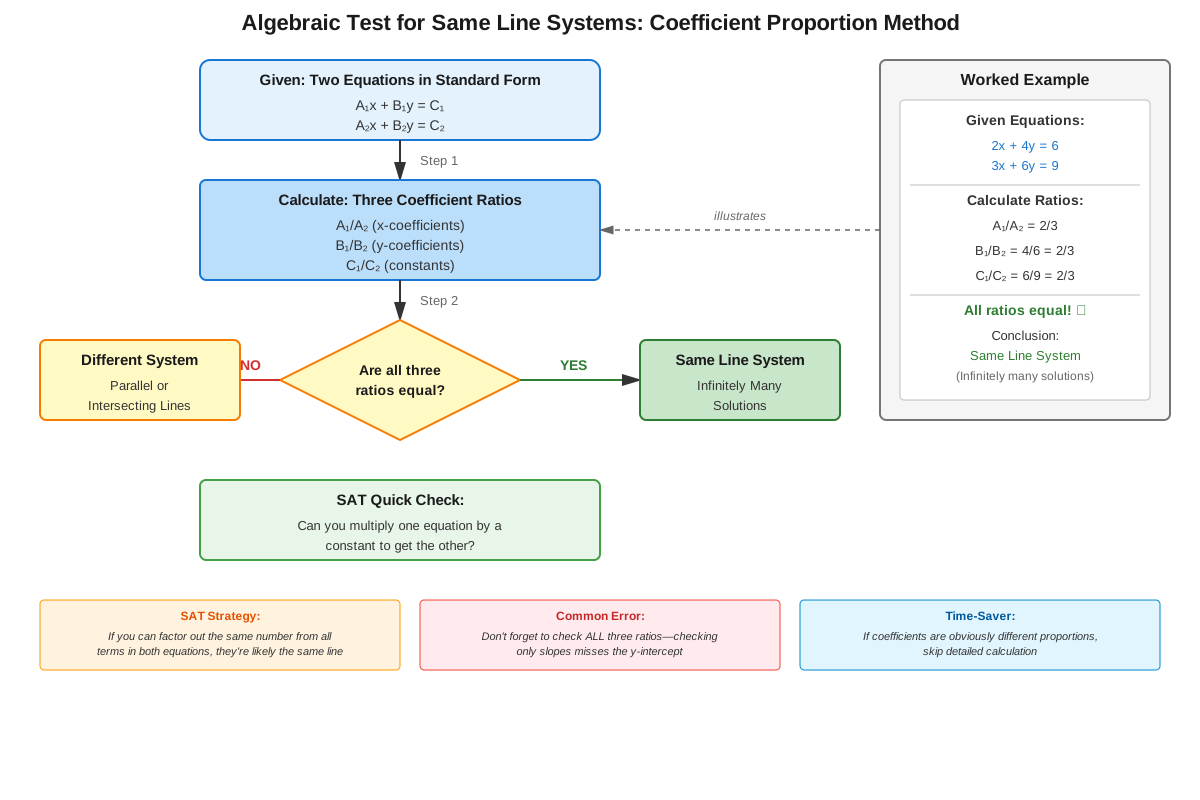
For equations in standard form (Ax + By = C), check whether the ratios of corresponding coefficients are equal:
A₁/A₂ = B₁/B₂ = C₁/C₂If all three ratios equal the same value, the equations represent the same line. For instance:
3x + 6y = 9
5x + 10y = 15
Checking ratios: 3/5 = 6/10 = 9/15, which simplifies to 3/5 = 3/5 = 3/5 ✓
Method 2: Equation Transformation
Transform both equations into the same form (typically slope-intercept form y = mx + b) and verify they produce identical equations. If both the slope (m) and y-intercept (b) are equal, the lines are the same.
Method 3: Elimination Method
Attempt to solve the system using elimination. If both variables eliminate simultaneously and produce a true statement (like 0 = 0 or 6 = 6), the system represents the same line.
Characteristics of Same Line Systems
| Feature | Same Line System | Intersecting Lines | Parallel Lines |
|---|---|---|---|
| Number of Solutions | Infinitely many | Exactly one | Zero |
| Graphical Representation | Single line | Two lines crossing | Two lines never meeting |
| Coefficient Relationship | A₁/A₂ = B₁/B₂ = C₁/C₂ | A₁/A₂ ≠ B₁/B₂ | A₁/A₂ = B₁/B₂ ≠ C₁/C₂ |
| Slopes | Equal | Different | Equal |
| Y-intercepts | Equal | May differ | Different |
| System Classification | Dependent and Consistent | Independent and Consistent | Inconsistent |
Finding Unknown Coefficients
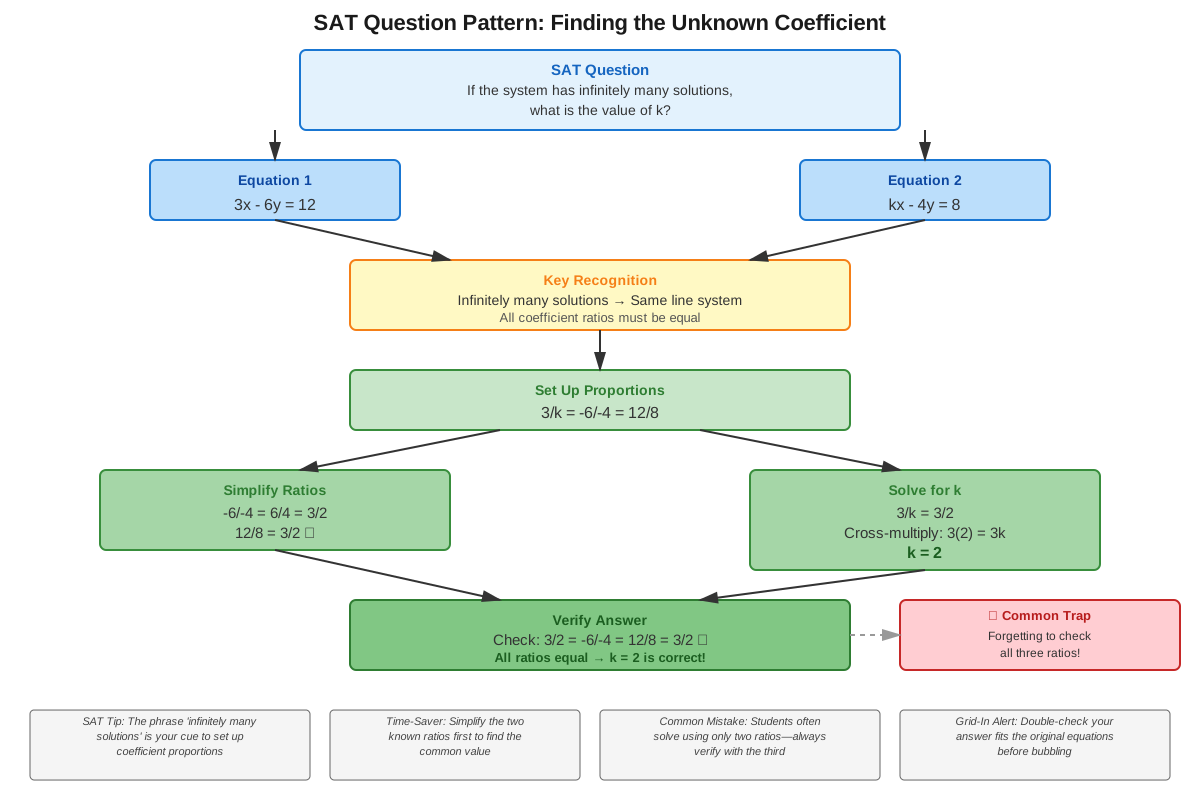
The SAT frequently presents systems with one unknown coefficient and asks students to find the value that creates a same line system. The strategy involves:
- Set up the coefficient ratio equation
- Cross-multiply to solve for the unknown
- Verify the solution creates equal ratios for all coefficients
Example: For what value of k does this system have infinitely many solutions?
6x + 9y = 12
4x + ky = 8
Solution Process:
- Set up ratios: 6/4 = 9/k = 12/8
- Simplify known ratios: 3/2 = 9/k = 3/2
- Solve for k: 9/k = 3/2
- Cross-multiply: 3k = 18
- Therefore: k = 6
Graphical Interpretation
When graphing same line systems, both equations produce identical lines that overlap completely. This visual representation helps students understand why infinitely many solutions exist—every point on the line represents an (x, y) pair that satisfies both equations. The graphical approach provides intuitive confirmation of algebraic findings and serves as an excellent checking method during exam conditions.
Concept Relationships
Same line systems connect to broader linear equation concepts through a hierarchical relationship. Understanding linear equations in various forms provides the foundation → recognizing equivalent equations through algebraic manipulation builds the next layer → identifying coefficient relationships enables comparison → determining system types (same line, intersecting, parallel) completes the conceptual framework.
The relationship between same line systems and other system types follows a decision tree structure: When analyzing any system of linear equations, first compare slopes to distinguish between parallel lines (equal slopes, different intercepts) and non-parallel lines (different slopes or same line). If slopes are equal, then compare y-intercepts or coefficient ratios to distinguish between parallel lines (different intercepts) and same line systems (equal intercepts).
Same line systems also connect to proportional relationships since the defining characteristic—equal coefficient ratios—represents a proportional relationship between the two equations. This connection extends to scaling transformations, where multiplying an entire equation by a non-zero constant creates an equivalent equation. Understanding these relationships helps students recognize that operations like multiplying both sides of an equation by the same number preserve the solution set, a fundamental principle underlying same line systems.
High-Yield Facts
⭐ A same line system has infinitely many solutions because every point on the line satisfies both equations
⭐ For equations in standard form, check if A₁/A₂ = B₁/B₂ = C₁/C₂ to identify same line systems
⭐ One equation being a scalar multiple of the other guarantees a same line system
⭐ Same line systems are classified as dependent and consistent
⭐ When solving by elimination, getting 0 = 0 or another true statement indicates a same line system
- Two equations with identical slopes and y-intercepts represent the same line
- Graphically, same line systems appear as a single line, not two separate lines
- The SAT often asks for coefficient values that create infinitely many solutions
- Transforming both equations to slope-intercept form provides a reliable comparison method
- Same line systems differ from parallel lines only in the constant term ratio
Quick check — test yourself on Same line systems so far.
Try Flashcards →Common Misconceptions
Misconception: If two equations look different, they cannot represent the same line → Correction: Equations can appear very different yet represent the same line if one is a scalar multiple of the other. Always check coefficient ratios rather than relying on visual appearance. For example, 2x + 4y = 6 and 3x + 6y = 9 look different but represent the same line.
Misconception: Same line systems have no solution because the equations are "the same" → Correction: Same line systems have infinitely many solutions, not zero solutions. Every point on the line satisfies both equations. Zero solutions occur only with parallel lines (inconsistent systems).
Misconception: Only the x and y coefficient ratios need to be equal, not the constant term ratio → Correction: All three ratios must be equal: A₁/A₂ = B₁/B₂ = C₁/C₂. If only the coefficient ratios are equal but the constant ratio differs, the lines are parallel with no solutions.
Misconception: When elimination produces 0 = 0, there's an error in the calculation → Correction: Getting 0 = 0 or any true statement (like 5 = 5) during elimination correctly indicates a same line system with infinitely many solutions. This is the expected result, not an error.
Misconception: Same line systems and intersecting lines both have solutions, so they're essentially the same → Correction: Same line systems have infinitely many solutions (every point on the line), while intersecting lines have exactly one solution (the intersection point). This fundamental difference affects how problems are solved and interpreted.
Worked Examples
Example 1: Identifying a Same Line System
Problem: Determine whether the following system represents the same line, intersecting lines, or parallel lines:
3x - 6y = 12
-2x + 4y = -8Solution:
Step 1: Put both equations in standard form with positive leading coefficients.
- First equation: 3x - 6y = 12 (already in standard form)
- Second equation: -2x + 4y = -8, multiply by -1: 2x - 4y = 8
Step 2: Check coefficient ratios.
- A₁/A₂ = 3/2
- B₁/B₂ = -6/-4 = 3/2
- C₁/C₂ = 12/8 = 3/2
Step 3: Interpret the results.
Since all three ratios equal 3/2, this is a same line system with infinitely many solutions.
Verification: The first equation equals the second equation multiplied by 3/2:
- (3/2)(2x - 4y) = (3/2)(8)
- 3x - 6y = 12 ✓
Connection to Learning Objectives: This example demonstrates how to identify key features of same line systems using the coefficient ratio method, a high-yield SAT strategy.
Example 2: Finding an Unknown Coefficient
Problem: For what value of k does the following system have infinitely many solutions?
4x + 6y = 10
6x + ky = 15Solution:
Step 1: Recognize that infinitely many solutions means same line system.
For a same line system: A₁/A₂ = B₁/B₂ = C₁/C₂
Step 2: Set up the ratio equation using known values.
- A₁/A₂ = 4/6 = 2/3
- C₁/C₂ = 10/15 = 2/3
- Therefore, B₁/B₂ must also equal 2/3
Step 3: Solve for k.
- 6/k = 2/3
- Cross-multiply: 2k = 18
- k = 9
Step 4: Verify the solution.
With k = 9, check all ratios:
- 4/6 = 2/3 ✓
- 6/9 = 2/3 ✓
- 10/15 = 2/3 ✓
All ratios equal 2/3, confirming k = 9 creates a same line system.
Alternative Method: Transform to slope-intercept form.
- First equation: 6y = -4x + 10 → y = -2/3x + 5/3
- Second equation: ky = -6x + 15 → y = -6/k·x + 15/k
- For same line: -6/k = -2/3 and 15/k = 5/3
- From either equation: k = 9
Connection to Learning Objectives: This problem type appears frequently on the SAT and requires applying same line system principles to calculate unknown coefficients—a critical skill for test success.
Exam Strategy
When approaching SAT questions on same line systems, follow this systematic process:
Recognition Phase: Identify trigger words and phrases that signal same line system questions:
- "infinitely many solutions"
- "dependent system"
- "the same line"
- "for what value of [variable] does the system have infinitely many solutions"
- "how many solutions does the system have"
Analysis Phase: Quickly determine which method will be most efficient:
- If equations are already in standard form with simple coefficients, use the ratio method (fastest)
- If one coefficient is unknown, set up ratio equations immediately
- If equations look complex, consider transforming to slope-intercept form
- If asked about number of solutions without specific values, use elimination to check for 0 = 0
Calculation Phase: Execute the chosen method carefully:
- Write out the ratio equation: A₁/A₂ = B₁/B₂ = C₁/C₂
- Simplify fractions before comparing
- When solving for unknowns, cross-multiply and check your arithmetic
- Always verify that ALL three ratios are equal, not just two
Verification Phase: Use remaining time to confirm answers:
- Substitute found values back into the original system
- Check that the coefficient ratios actually equal each other
- If time permits, graph both equations on your calculator to visually confirm they overlap
Time-Saving Tip: If you immediately recognize that one equation is a multiple of the other (like 2x + 3y = 6 and 4x + 6y = 12), you can conclude "infinitely many solutions" without detailed calculations.
Process of Elimination for Multiple Choice:
- Eliminate any answer choice that would make coefficient ratios unequal
- If asked about number of solutions, eliminate "no solution" if slopes are different, and eliminate "one solution" if all coefficient ratios are equal
- For unknown coefficient problems, plug answer choices into the ratio equation to test which works
Memory Techniques
Mnemonic for System Types: "SIP" helps remember the three system types:
- Same line = infinitely many solutions
- Intersecting = one solution
- Parallel = zero solutions
Ratio Rule Rhyme: "All three must agree, for infinity" reminds students that A₁/A₂, B₁/B₂, and C₁/C₂ must all equal the same value for infinitely many solutions.
Visual Memory Aid: Picture two identical transparent sheets perfectly aligned—you see only one line even though two sheets exist. This image reinforces that same line systems appear as a single line graphically.
Acronym for Checking: "RACE" for systematic verification:
- Ratios: Check all coefficient ratios
- Algebra: Verify one equation is a multiple of the other
- Constant: Confirm the constant term ratio matches
- Elimination: Test by elimination to get 0 = 0
Finger Method: Hold up three fingers to remember three ratios must be checked (A, B, and C coefficients), and make them touch to remember they must all be equal.
Summary
Same line systems represent a fundamental concept in linear algebra where two equations describe identical lines in the coordinate plane, resulting in infinitely many solutions. The defining characteristic of these systems is that one equation can be obtained by multiplying the other by a constant, which manifests algebraically as equal ratios of all corresponding coefficients: A₁/A₂ = B₁/B₂ = C₁/C₂. On the SAT, these systems appear in questions asking students to identify the number of solutions, find unknown coefficients that create infinitely many solutions, or distinguish between same line systems and other system types. Mastery requires understanding both the algebraic ratio method and the graphical interpretation, recognizing that same line systems differ from parallel lines (which have equal coefficient ratios but different constant ratios) and intersecting lines (which have different slopes). The elimination method provides an alternative identification strategy: when both variables eliminate and produce a true statement like 0 = 0, the system represents the same line. Success on SAT questions demands quick recognition of same line system indicators, efficient application of the ratio method, and careful verification that all three coefficient ratios are equal.
Key Takeaways
- Same line systems have infinitely many solutions because both equations represent the exact same line
- The coefficient ratio test (A₁/A₂ = B₁/B₂ = C₁/C₂) provides the fastest method to identify same line systems on the SAT
- One equation being a scalar multiple of the other guarantees a same line system
- When solving by elimination, obtaining 0 = 0 or any true statement confirms infinitely many solutions
- To find unknown coefficients that create same line systems, set the coefficient ratios equal and solve
- Same line systems differ from parallel lines only in the constant term ratio—parallel lines have A₁/A₂ = B₁/B₂ but C₁/C₂ is different
- Always verify all three ratios are equal, not just the x and y coefficient ratios
Related Topics
Parallel Line Systems: Understanding same line systems provides the foundation for recognizing parallel lines, which share equal coefficient ratios for x and y terms but have different constant term ratios, resulting in zero solutions.
Intersecting Line Systems: Mastery of same line systems helps distinguish cases with exactly one solution, where coefficient ratios are unequal, enabling efficient system classification.
Matrix Methods for Systems: Advanced students can extend same line system concepts to matrix representations, where row equivalence indicates dependent systems.
Linear Inequalities: The principles of equivalent equations in same line systems transfer to understanding equivalent inequalities and their solution sets.
Parametric Equations: Same line systems introduce the concept of infinitely many solutions, which connects to parametric representations where one variable is expressed in terms of a parameter.
Practice CTA
Now that you've mastered the core concepts of same line systems, it's time to solidify your understanding through active practice. Attempt the practice questions to test your ability to identify same line systems, calculate unknown coefficients, and distinguish between different system types under timed conditions. The flashcards will help you memorize key facts and recognition patterns that save valuable seconds during the actual SAT. Remember: understanding the concept is just the first step—consistent practice transforms knowledge into test-day confidence and higher scores. Challenge yourself to explain why each answer is correct, not just to select the right option. Your investment in mastering this high-yield topic will pay dividends across multiple questions on test day!
Sign up free to keep reading
Create a free AnvayaPrep account to finish this SAT guide on Same line systems — plus flashcards and practice questions.