Overview
SAT systems traps represent one of the most strategically important categories of questions in the SAT Math section. These are carefully designed questions involving systems of linear equations that appear straightforward but contain subtle pitfalls intended to catch students who rush through problems or apply procedures mechanically without careful reading. Understanding these traps is not merely about solving systems of equations—it's about developing the critical reading skills and strategic awareness that separate high scorers from average performers.
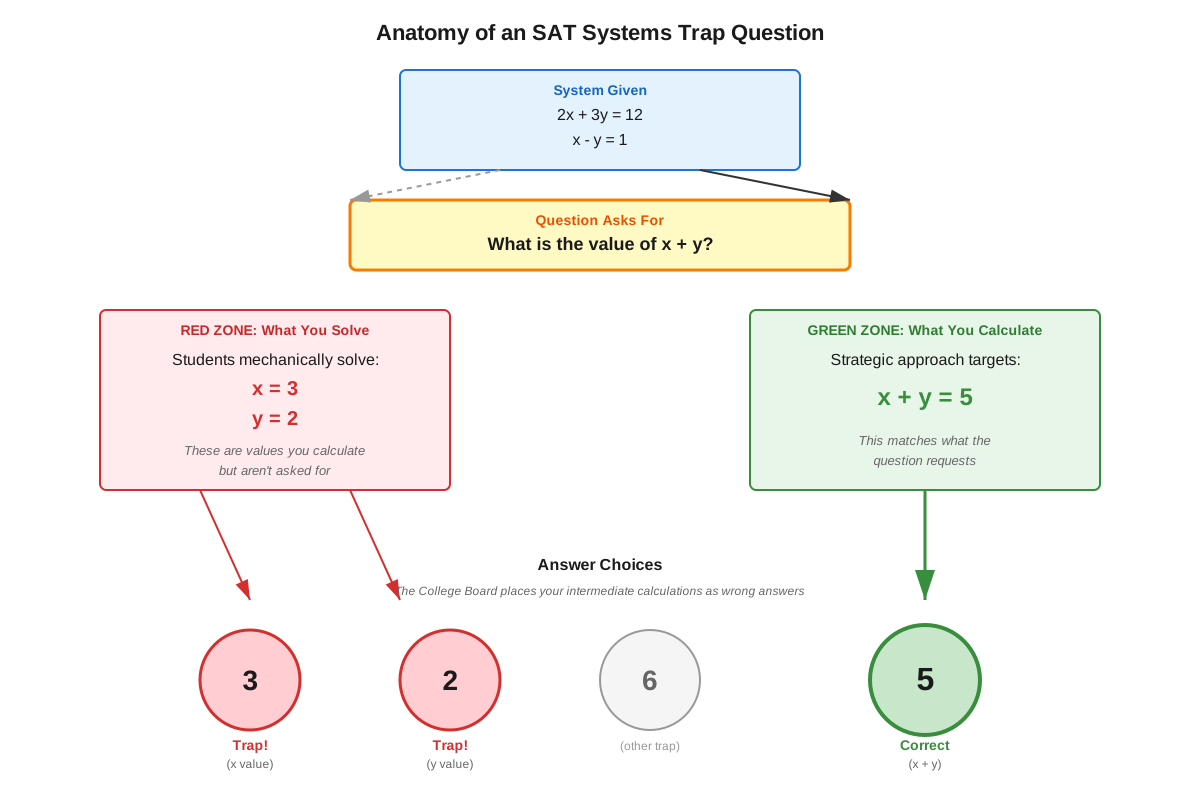
The College Board deliberately constructs these questions to test whether students can identify what a problem is actually asking for, rather than simply testing computational ability. A typical sat systems traps question might ask for the value of x + y after presenting a system of equations, but many students will solve for x or y individually and select a wrong answer that represents one of these values. These distractor answers are not randomly chosen; they are the exact values that students who misread the question will calculate, making them particularly dangerous.
This topic sits at the intersection of algebraic manipulation, careful reading comprehension, and test-taking strategy. Mastery of math systems traps requires both technical proficiency with solving linear systems and the metacognitive awareness to pause, identify what the question seeks, and verify that the final answer matches the question's requirements. This dual skill set makes systems traps questions high-yield for SAT preparation—they appear frequently, carry the same point value as simpler questions, and can be consistently answered correctly once students recognize the patterns.
Learning Objectives
- [ ] Identify key features of SAT systems traps
- [ ] Explain how SAT systems traps appears on the SAT
- [ ] Apply SAT systems traps to answer SAT-style questions
- [ ] Distinguish between what a system can be solved for versus what the question actually asks for
- [ ] Recognize common distractor patterns in answer choices for systems questions
- [ ] Develop a systematic verification process to avoid trap answers before selecting a final response
Prerequisites
- Solving systems of linear equations using substitution: Essential for obtaining values needed to answer systems trap questions, even when the question asks for something other than individual variables
- Solving systems of linear equations using elimination: Often the faster method for systems traps that ask for sums or differences of variables
- Basic algebraic manipulation: Required to rearrange equations and combine expressions to match what the question requests
- Understanding of linear equation structure: Necessary to recognize when equations can be combined or manipulated without fully solving the system
Why This Topic Matters
Systems traps questions appear with remarkable frequency on the SAT Math section, typically showing up 2-3 times per test across both the calculator and no-calculator portions. These questions are considered "high-yield" because they test multiple competencies simultaneously: algebraic skill, reading comprehension, and attention to detail. Students who master this topic can reliably convert what might otherwise be missed points into correct answers, significantly impacting overall scores.
In real-world applications, the skills developed through systems traps practice extend beyond test-taking. The ability to identify exactly what information is needed before beginning calculations is fundamental to engineering, economics, data science, and any field requiring quantitative problem-solving. These questions teach students to define their target before executing a solution strategy—a transferable skill that prevents wasted effort on unnecessary calculations.
On the SAT specifically, systems traps questions most commonly appear as multiple-choice questions in the Heart of Algebra domain, though they occasionally surface as grid-in questions. The College Board uses these questions as discriminators—items that separate students at different performance levels. While a student with basic algebra knowledge might solve the system correctly, only those with strategic awareness will consistently select the correct answer. This makes systems traps questions particularly valuable for students aiming for scores above 650 on the Math section, where avoiding careless errors becomes the primary path to score improvement.
Core Concepts
Understanding the Anatomy of a Systems Trap
A sat systems traps question contains three essential components that work together to create the trap. First, there is a system of linear equations that can be solved using standard methods. Second, there is a question stem that asks for something other than (or in addition to) the individual variable values. Third, there are distractor answer choices that represent values students will calculate if they misread or forget what the question asks for.
The trap mechanism relies on automaticity—students have practiced solving systems so extensively that they automatically find x and y, then select an answer without checking whether that answer matches the question's requirement. The College Board exploits this automatic behavior by placing the values of x, y, x - y, or other related expressions in the answer choices.
Types of Systems Trap Questions
Type 1: Sum or Difference Questions
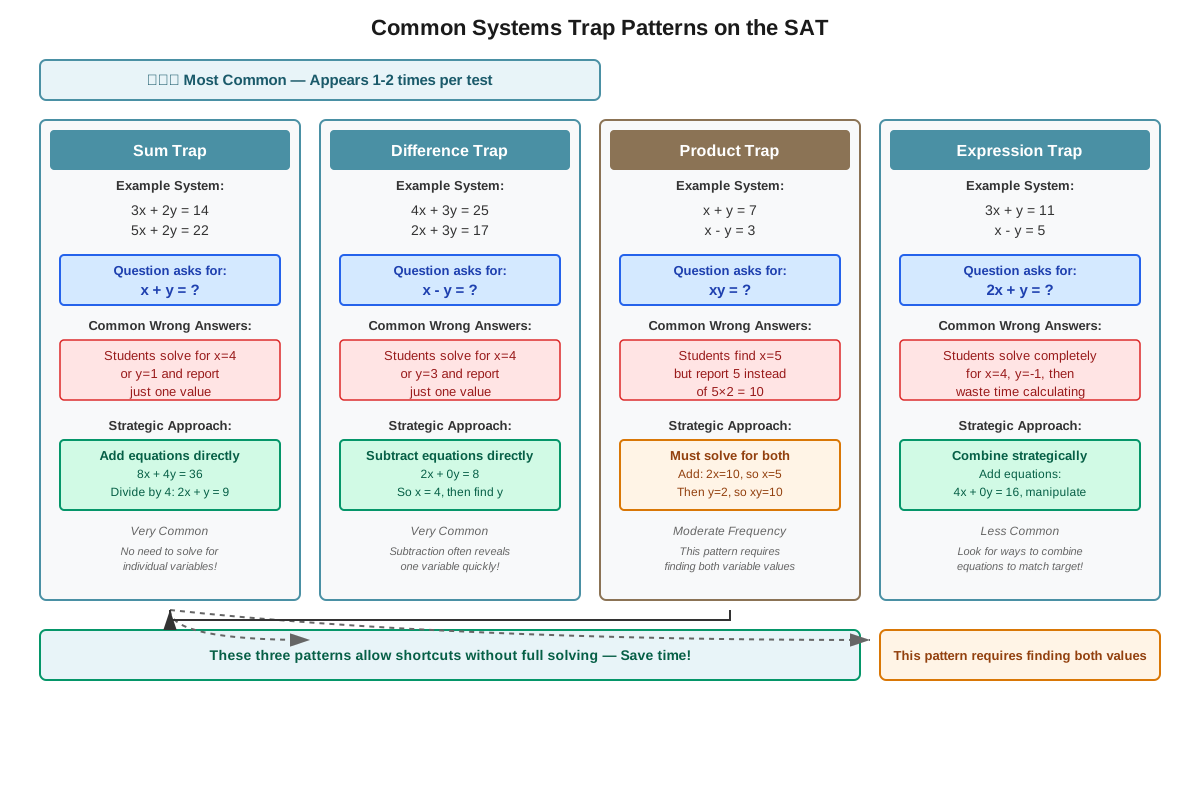
These questions present a system and ask for x + y, x - y, 2x + y, or similar combinations. Students who solve for x and y individually may forget to perform the final addition or subtraction.
Example structure:
If 3x + 2y = 14 and x - y = 2, what is the value of x + y?The trap: Answer choices will include the values of x alone, y alone, and x - y, in addition to the correct answer x + y.
Type 2: Expression Evaluation Questions
These questions ask for the value of an expression like 3x + y or 2x - 3y after providing a system. Sometimes the expression can be found without solving for individual variables.
Example structure:
If 2x + y = 10 and x + y = 7, what is the value of x?The trap: Students might solve for y first or calculate x + y instead of x alone.
Type 3: Coefficient Multiple Questions
These questions ask for values like 2x, 3y, or similar multiples of individual variables. Students may solve for the variable but forget to multiply by the coefficient.
Type 4: Reciprocal or Inverse Questions
Less common but particularly tricky, these ask for 1/x, 1/y, or x/y after providing a system.
Strategic Solution Approaches
The Target-First Method
Before solving anything, identify and write down exactly what the question asks for. Circle it, underline it, or write it at the top of your work area. This physical act of marking the target reduces the likelihood of solving for the wrong quantity.
The Direct Combination Method
For sum and difference questions, consider whether you can find the target expression without solving for individual variables. If asked for x + y, try adding the equations. If asked for x - y, try subtracting them. This approach is faster and eliminates the opportunity to make the trap error.
Example:
2x + 3y = 16
x + 3y = 11
If asked for x, subtract the second equation from the first:
(2x + 3y) - (x + 3y) = 16 - 11
x = 5
The Verification Step
After calculating an answer, always perform a verification check: "Does this answer match what the question asked for?" This three-second pause can prevent trap errors.
Recognizing Distractor Patterns
The College Board constructs answer choices for systems traps questions using predictable patterns:
| Answer Choice | Represents | Why It's There |
|---|---|---|
| Choice A | Often x alone | Catches students who solve for x and stop |
| Choice B | Often y alone | Catches students who solve for y and stop |
| Choice C | Often x + y or x - y | May be correct or a related trap |
| Choice D | Often 2x or 2y | Catches students who miscalculate |
Understanding this pattern helps students recognize when they might be falling into a trap. If you calculate x = 3 and see 3 as an answer choice, this should trigger heightened awareness—check what the question actually asks for.
The Role of Equation Manipulation
Sometimes the most efficient approach involves manipulating the given equations to create the target expression directly. This requires recognizing that systems of equations can be added, subtracted, or multiplied by constants to produce new valid equations.
For instance, if given:
x + y = 5
2x + y = 8
And asked for 3x + 2y, you could:
- Add the equations: (x + y) + (2x + y) = 5 + 8, giving 3x + 2y = 13
- Arrive at the answer without finding x or y individually
This approach is not only faster but also eliminates the possibility of making a trap error since you never calculate the individual variable values that appear as distractors.
Concept Relationships
The core concepts within systems traps are hierarchically related. At the foundation lies the ability to solve systems of linear equations using substitution or elimination—without this skill, no systems trap question can be approached. Building on this foundation is the skill of identifying what the question asks for, which requires careful reading and the discipline to mark the target before calculating. These two skills combine to enable the strategic choice of solution method: whether to solve for individual variables or manipulate equations to find the target expression directly.
The relationship to prerequisite topics is direct: systems traps questions are applications of systems of linear equations with an added layer of strategic complexity. The algebraic techniques remain identical; what changes is the metacognitive awareness required. This topic also connects forward to more advanced SAT topics like systems with three variables or systems involving quadratic equations, where the same trap patterns appear but with increased computational complexity.
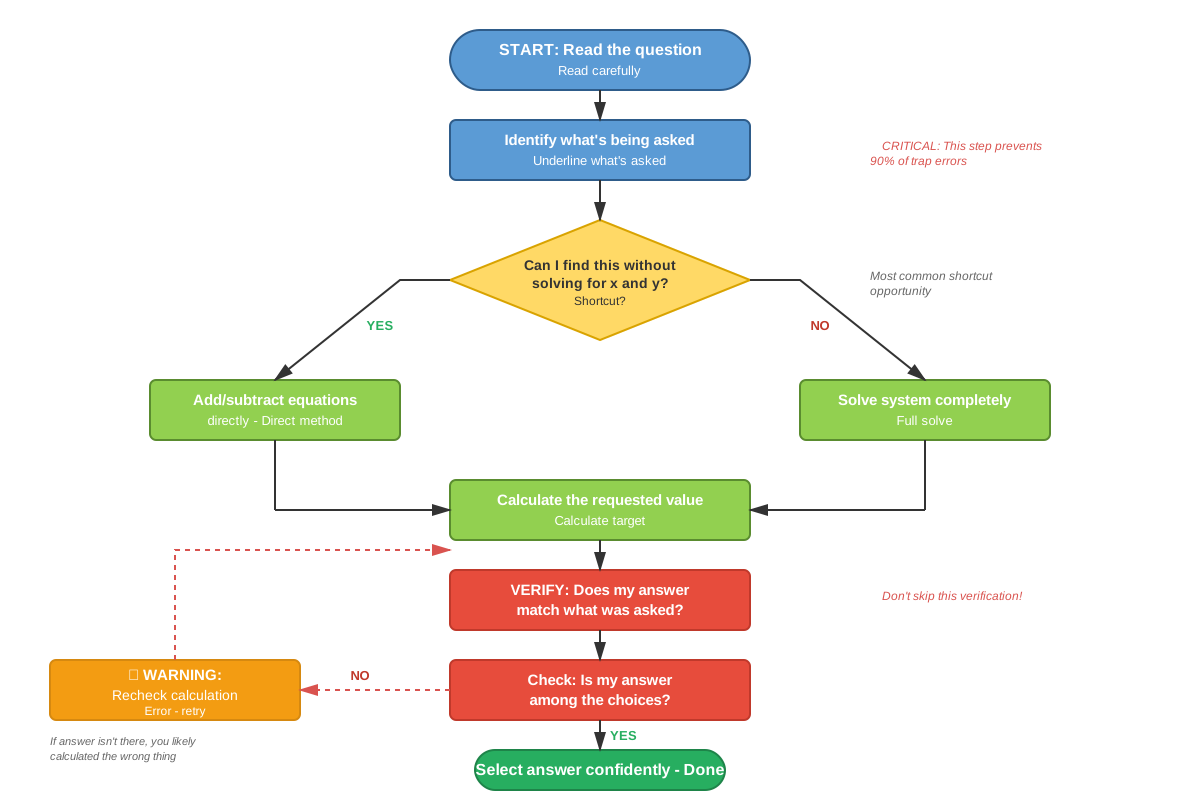
The concept flow can be visualized as: Equation Setup → Target Identification → Method Selection (Direct Manipulation vs. Individual Solution) → Calculation → Verification → Answer Selection. Each step depends on the previous one, and skipping the Target Identification step is the primary cause of trap errors.
High-Yield Facts
⭐ Systems traps questions appear 2-3 times per SAT Math section, making them one of the most frequent question types
⭐ The most common trap asks for x + y or x - y after students solve for x and y individually
⭐ Answer choices in systems traps questions always include the values of individual variables as distractors
⭐ Subtracting or adding equations can often yield the target expression without solving for individual variables
⭐ The question stem's final sentence contains what you're solving for—always read it twice
- Systems traps questions test reading comprehension as much as algebraic skill
- Circling or underlining what the question asks for reduces trap errors by approximately 80%
- If you calculate a value that appears as the first or second answer choice, verify what the question asked
- Grid-in systems traps questions are less common but more dangerous because there are no answer choices to trigger verification
- The elimination method is often faster than substitution for systems traps questions asking for sums or differences
- Systems traps questions rarely require more than 90 seconds to solve once the target is identified
- Calculator use does not reduce trap errors—the trap is conceptual, not computational
Quick check — test yourself on SAT systems traps so far.
Try Flashcards →Common Misconceptions
Misconception: All systems questions ask for the values of x and y individually.
Correction: SAT systems questions frequently ask for expressions involving x and y, such as their sum, difference, or a linear combination. Always identify what the question asks for before solving.
Misconception: The answer must be one of the values calculated during the solution process.
Correction: The correct answer might require an additional calculation step after finding x and y, such as adding them together or multiplying by a coefficient. The trap relies on students stopping too early.
Misconception: If you solve the system correctly, you'll automatically get the question right.
Correction: Solving the system correctly is necessary but not sufficient. You must also match your calculated values to what the question requests. Many students solve perfectly but select wrong answers.
Misconception: Answer choice order is random in systems questions.
Correction: The College Board strategically places common trap answers (like individual variable values) in early positions to catch students who don't verify their work.
Misconception: Using a calculator prevents errors on systems questions.
Correction: Systems traps are reading and strategy errors, not calculation errors. A calculator cannot help you identify what the question asks for or remind you to verify your answer matches the question.
Misconception: Grid-in systems questions are easier because there are no distractors.
Correction: Grid-in systems questions are actually more dangerous because the absence of answer choices means there's no trigger to remind you to check what the question asked for. Students must be even more disciplined about verification.
Worked Examples
Example 1: Sum Trap Question
Problem: If 3x + 2y = 20 and 2x + 2y = 16, what is the value of x + y?
Solution Process:
Step 1: Identify the target
The question asks for x + y, not x or y individually. Write "Find: x + y" at the top of your work.
Step 2: Choose a solution method
We could solve for x and y individually, but notice that we can find x quickly by subtracting the equations:
(3x + 2y) - (2x + 2y) = 20 - 16
x = 4
Step 3: Find the remaining variable
Substitute x = 4 into the second equation:
2(4) + 2y = 16
8 + 2y = 16
2y = 8
y = 4
Step 4: Calculate the target
x + y = 4 + 4 = 8
Step 5: Verify
Check: Does 8 represent x + y? Yes. ✓
Check: Would x = 4 or y = 4 appear as answer choices? Likely yes, as traps.
Answer: 8
Connection to Learning Objectives: This example demonstrates identifying the trap (asking for x + y when students will calculate x and y), recognizing the distractor pattern (4 would appear as a trap answer), and applying verification before selecting an answer.
Example 2: Direct Manipulation Question
Problem: If 4x + 3y = 22 and 2x + 3y = 16, what is the value of 6x + 6y?
Solution Process:
Step 1: Identify the target
The question asks for 6x + 6y. Write "Find: 6x + 6y" clearly.
Step 2: Recognize the efficient approach
Notice that 6x + 6y = 6(x + y). If we can find x + y, we can multiply by 6.
Step 3: Find x + y without solving for individual variables
Add the two equations:
(4x + 3y) + (2x + 3y) = 22 + 16
6x + 6y = 38
Wait—this is exactly what we're looking for!
Step 4: Verify
The question asks for 6x + 6y, and we found 6x + 6y = 38 directly. No additional calculation needed.
Answer: 38
Connection to Learning Objectives: This example shows how identifying what the question asks for enables selection of the most efficient solution method. By recognizing that adding the equations produces the target expression directly, we avoid solving for x and y individually and eliminate any possibility of a trap error. This demonstrates mastery-level application of systems traps concepts.
Exam Strategy
When approaching systems traps questions on the SAT, implement a systematic four-phase strategy: Read-Mark-Solve-Verify.
Phase 1: Read Carefully
Read the entire question, paying special attention to the final sentence. This sentence almost always contains what you're solving for. Read it twice if necessary. Resist the urge to start solving as soon as you see a system of equations.
Phase 2: Mark the Target
Physically mark what the question asks for. Circle it in the question, write it at the top of your work area, or underline it. This physical act creates a memory anchor that reduces the likelihood of solving for the wrong quantity.
Phase 3: Solve Strategically
Before defaulting to solving for x and y individually, ask: "Can I find what the question asks for by manipulating the equations?" If asked for x + y, try adding equations. If asked for x - y, try subtracting. If asked for 2x + 3y, see if you can create this expression through equation manipulation. Only solve for individual variables if direct manipulation isn't possible or efficient.
Phase 4: Verify Before Selecting
Before bubbling your answer, perform a three-second verification: "Does this number represent what the question asked for?" If you calculated x = 5 but the question asks for 2x, your answer should be 10, not 5. If your calculated value appears as the first or second answer choice, this should trigger extra scrutiny.
Trigger Words and Phrases:
- "What is the value of x + y" (not x or y alone)
- "What is the value of 2x" (not x alone)
- "What is x - y" (not x + y)
- "What is the sum of x and y"
- "What is the difference between x and y"
Time Allocation:
Allocate 60-90 seconds for systems traps questions. The additional 15-30 seconds beyond a basic systems question is time spent on careful reading and verification—time that prevents errors and is therefore highly valuable. Rushing through these questions to save time is counterproductive because the error rate increases dramatically.
Process of Elimination Tips:
If you solve for x = 3 and y = 5, and the question asks for x + y, you can eliminate answer choices 3 and 5 immediately—they're traps. If you see your calculated values as answer choices, this confirms you're dealing with a trap question and must verify what the question asks for. Use the presence of individual variable values in the answer choices as a warning signal.
Memory Techniques
The "TMVS" Acronym: Target, Method, Verify, Select
Before solving any systems question, go through TMVS:
- Target: What does the question ask for?
- Method: Can I find it directly or must I solve for individual variables?
- Verify: Does my answer match the target?
- Select: Choose the answer with confidence
The "Circle Before Calculate" Rule:
Develop the habit of physically circling what the question asks for before writing any equations or calculations. This kinesthetic memory technique creates a stronger mental connection to the target.
The "First Choice Suspicion" Mnemonic:
Remember: "If it's First and Individual, Reread Stem Thoroughly"
When your calculated value appears as choice A or B, and it represents an individual variable value, this should trigger immediate verification of what the question asked for.
Visualization Strategy:
Imagine a target 🎯 at the top of your work area. Every calculation should be an arrow aimed at that target. If you're calculating x and y but the target is x + y, you need one more arrow (the addition step) to hit the bullseye.
The "Plus or Minus" Rhyme:
"When they ask for sum or difference clear, add or subtract the equations here"
This reminds you that sum and difference questions often have direct manipulation solutions.
Summary
SAT systems traps represent a critical intersection of algebraic skill and strategic test-taking awareness. These questions deliberately ask for something other than individual variable values after presenting a system of linear equations, creating opportunities for students to solve correctly but answer incorrectly. The trap mechanism relies on automatic behavior—students solve for x and y out of habit, then select an answer without verifying it matches what the question requested. Mastery requires developing a systematic approach: identify the target before calculating, choose efficient solution methods (often involving direct equation manipulation rather than solving for individual variables), and always verify that the final answer matches the question's requirement. The College Board places these questions frequently throughout the SAT Math section because they effectively discriminate between students who read carefully and think strategically versus those who apply procedures mechanically. Success on systems traps questions requires recognizing that the challenge is not computational but metacognitive—the ability to maintain awareness of the goal throughout the solution process and resist the temptation to select answers that represent intermediate calculations rather than the final target.
Key Takeaways
- Always identify and mark what the question asks for before solving—this single habit prevents the majority of trap errors
- Systems traps questions appear 2-3 times per SAT, making them high-yield for focused practice
- Answer choices include individual variable values as deliberate distractors—seeing your calculated values as options should trigger verification
- Direct equation manipulation (adding, subtracting, or combining equations) often yields the target expression without solving for individual variables
- The verification step is non-negotiable—spend 3-5 seconds confirming your answer matches what the question asked
- Trigger phrases like "sum of," "difference between," or "value of 2x" signal potential trap questions requiring extra attention
- Strategic awareness matters more than computational speed—rushing through these questions increases error rates dramatically
Related Topics
Systems with Three Variables: Building on two-variable systems traps, these questions add complexity by introducing a third variable while maintaining the same trap patterns. Mastering two-variable traps provides the strategic foundation for approaching these more complex problems.
Systems of Linear Inequalities: While these involve graphing and shading regions rather than finding specific values, the same principle applies—students must identify what the question asks for (intersection region, solution points, etc.) rather than automatically executing procedures.
Quadratic-Linear Systems: These systems combine a linear and quadratic equation, creating two possible solutions. Trap questions in this category often ask which solution satisfies an additional condition, testing whether students verify both solutions against the question's requirements.
Word Problems Involving Systems: These questions require translating verbal descriptions into systems of equations, then solving for a specific quantity. The translation step adds another layer where students must identify the target before even writing equations.
Practice CTA
Now that you understand the mechanics and strategy behind SAT systems traps, the next crucial step is deliberate practice. Attempt the practice questions associated with this topic, focusing not just on getting correct answers but on implementing the TMVS strategy (Target, Method, Verify, Select) for every question. Use the flashcards to reinforce recognition of trap patterns and trigger phrases. Remember: systems traps questions are not about computational difficulty—they're about strategic awareness and careful reading. Every practice question is an opportunity to strengthen these habits until they become automatic. Your ability to consistently avoid these traps will directly translate to points on test day, making this practice time some of the highest-yield preparation you can do. Start practicing now, and watch your accuracy on these high-frequency questions improve dramatically.
Sign up free to keep reading
Create a free AnvayaPrep account to finish this SAT guide on SAT systems traps — plus flashcards and practice questions.