Overview
Solving systems by graphing is a fundamental algebraic technique that allows students to find the solution to two or more linear equations by representing them visually on a coordinate plane. This method transforms abstract algebraic relationships into concrete visual representations, making it easier to understand where two lines intersect—the point that satisfies both equations simultaneously. On the SAT, this topic appears frequently in both multiple-choice and grid-in questions, often requiring students to interpret graphs, identify solution points, or determine the number of solutions a system possesses based on visual information.
Understanding solving systems by graphing is essential for SAT success because it bridges multiple mathematical domains. This topic connects algebraic manipulation, coordinate geometry, and visual reasoning—all critical skills tested throughout the math section. Questions may present pre-drawn graphs requiring interpretation, ask students to determine which graph represents a given system, or require analysis of how changing parameters affects the intersection point. The College Board consistently includes 2-4 questions per test that directly or indirectly assess this concept, making it a high-yield area for focused study.
Beyond isolated system-solving questions, this topic forms the foundation for understanding more complex mathematical relationships. The graphical approach to systems connects to functions, transformations, quadratic equations, and even real-world modeling scenarios that appear in SAT word problems. Mastering this visual method provides students with an intuitive understanding of solution existence and uniqueness—concepts that extend throughout higher mathematics and appear in various disguised forms on the exam.
Learning Objectives
- [ ] Identify key features of solving systems by graphing, including intersection points, parallel lines, and coincident lines
- [ ] Explain how solving systems by graphing appears on the SAT, including question formats and common variations
- [ ] Apply solving systems by graphing to answer SAT-style questions accurately and efficiently
- [ ] Determine the number of solutions to a system by analyzing the slopes and y-intercepts of linear equations
- [ ] Convert between standard form, slope-intercept form, and graphical representations of linear systems
- [ ] Interpret the meaning of intersection points in real-world context problems
Prerequisites
- Slope-intercept form (y = mx + b): Essential for quickly graphing lines and identifying key features that determine intersection behavior
- Coordinate plane fundamentals: Required to plot points accurately and understand the relationship between algebraic equations and their visual representations
- Linear equation graphing: The foundation for representing each equation in a system visually before finding their intersection
- Solving linear equations: Necessary for verifying solutions algebraically and converting between different equation forms
- Understanding slope and y-intercept: Critical for determining whether lines will intersect, be parallel, or coincide
Why This Topic Matters
In real-world applications, systems of linear equations model countless practical scenarios: determining break-even points in business, finding optimal solutions in resource allocation, analyzing supply and demand equilibrium in economics, and calculating intersection times in motion problems. The graphical approach provides immediate visual insight into these relationships, making abstract problems concrete and interpretable.
On the SAT, solving systems by graphing appears in approximately 10-15% of all algebra questions, translating to 2-4 questions per test administration. The College Board tests this concept through multiple question types: direct interpretation of pre-drawn graphs, identification of solution coordinates, determination of solution quantity (zero, one, or infinite solutions), and application problems requiring students to set up and analyze systems graphically. Questions may appear in both the calculator and no-calculator sections, though graphical interpretation questions more commonly appear where calculators are permitted.
Common SAT presentations include: graphs showing two lines with students identifying the intersection point coordinates; word problems describing two scenarios that must be modeled as linear equations; questions asking how many solutions exist based on given information about slopes or y-intercepts; and problems requiring students to determine which system of equations corresponds to a displayed graph. The visual nature of these questions makes them excellent candidates for process-of-elimination strategies, but only when students thoroughly understand the underlying principles.
Core Concepts
Understanding Systems of Linear Equations
A system of linear equations consists of two or more linear equations involving the same variables. The solution to such a system is the ordered pair (x, y) that satisfies all equations simultaneously. When solving systems by graphing, each equation is represented as a line on the coordinate plane, and the solution corresponds to the point(s) where these lines intersect.
For a system of two linear equations in two variables:
- Equation 1: a₁x + b₁y = c₁
- Equation 2: a₂x + b₂y = c₂
The graphical solution is the point where both lines meet, meaning both equations are true for those specific x and y values.
The Three Types of Solutions
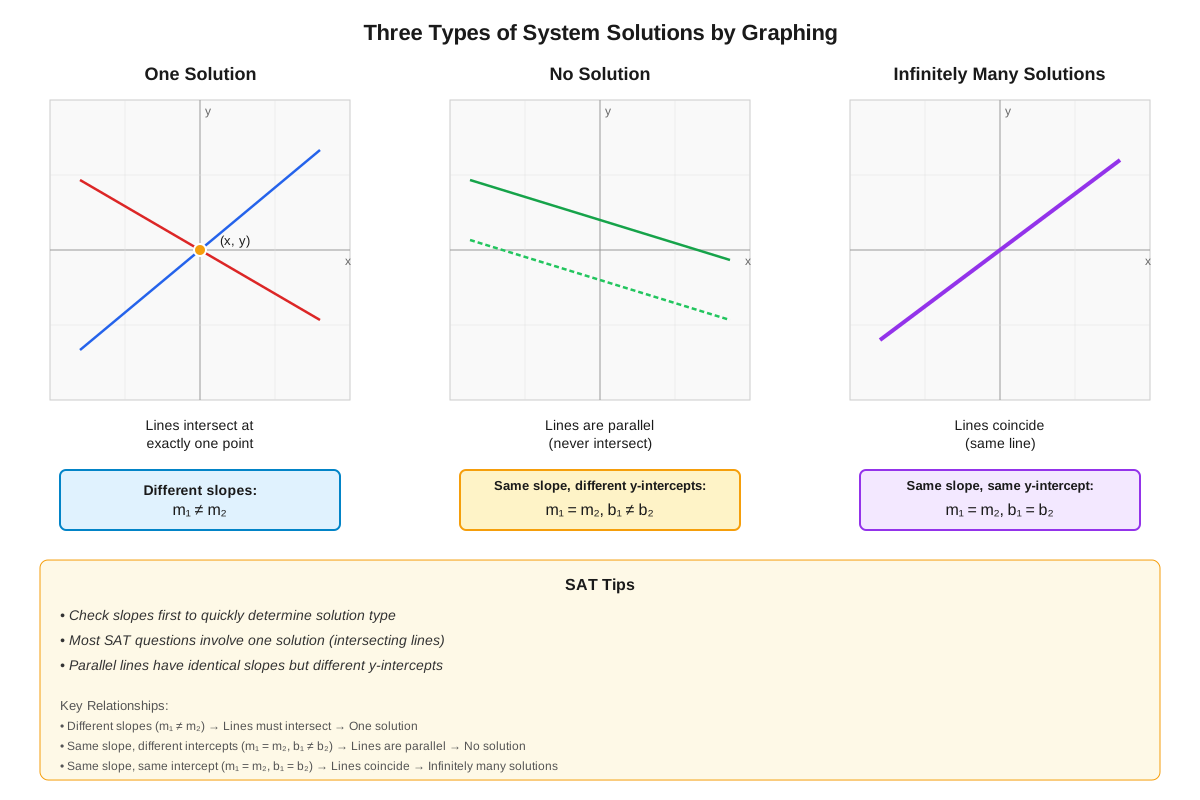
Systems of linear equations can have exactly three possible outcomes, each with distinct graphical characteristics:
| Solution Type | Graphical Appearance | Algebraic Relationship | Number of Solutions |
|---|---|---|---|
| One solution | Lines intersect at exactly one point | Different slopes (m₁ ≠ m₂) | 1 |
| No solution | Lines are parallel | Same slope, different y-intercepts (m₁ = m₂, b₁ ≠ b₂) | 0 |
| Infinite solutions | Lines coincide (same line) | Same slope and y-intercept (m₁ = m₂, b₁ = b₂) | ∞ |
Understanding these three cases is crucial for SAT solving systems by graphing questions, as the exam frequently asks students to determine how many solutions exist without actually solving the system.
Step-by-Step Graphing Process
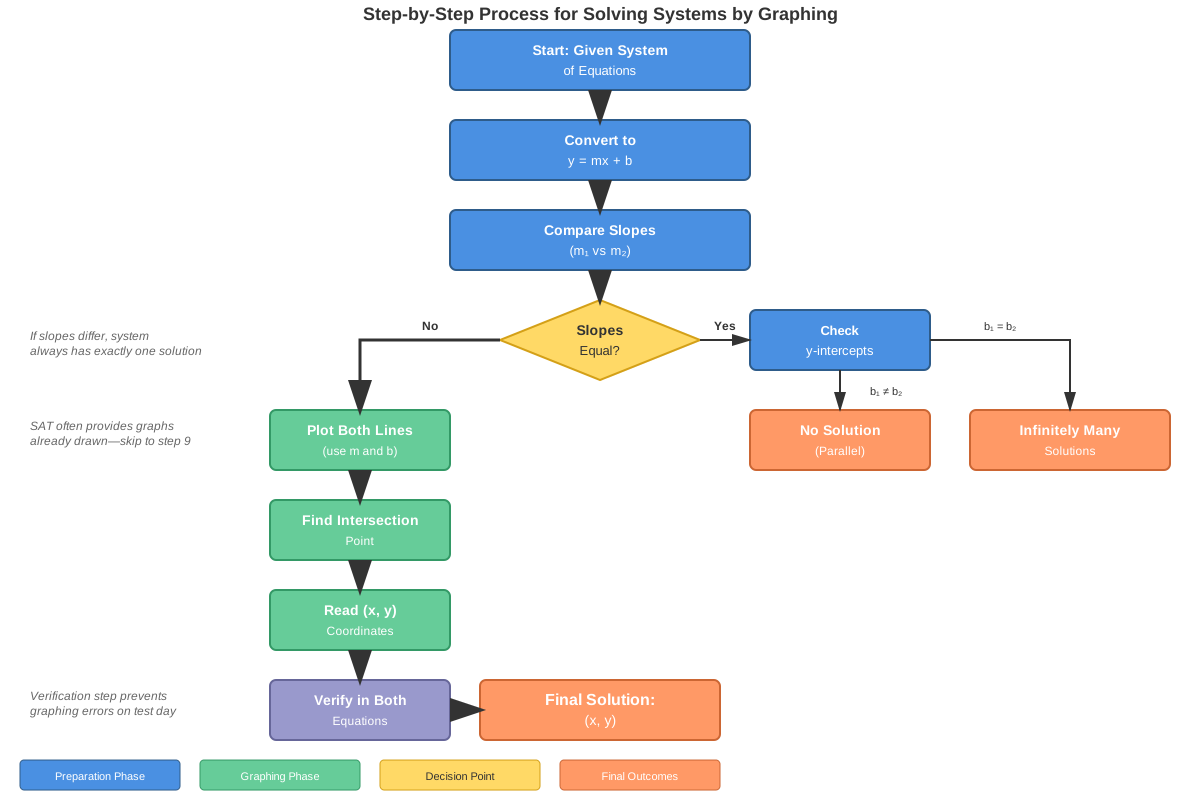
To solve a system by graphing, follow this systematic approach:
- Convert to slope-intercept form: Rewrite each equation as y = mx + b to easily identify the slope (m) and y-intercept (b)
- Plot the y-intercept: For each line, mark the point where it crosses the y-axis at (0, b)
- Use slope to find additional points: From the y-intercept, apply the slope (rise over run) to locate at least one more point on each line
- Draw the lines: Connect the points with straight lines, extending them across the coordinate plane
- Identify the intersection: Locate the point where the lines cross
- Verify the solution: Substitute the coordinates back into both original equations to confirm accuracy
Slope-Intercept Form Analysis
The slope-intercept form (y = mx + b) is the most efficient form for graphical analysis because it immediately reveals:
- Slope (m): The rate of change; determines the line's steepness and direction
- Y-intercept (b): The starting value; where the line crosses the y-axis
When comparing two equations in this form:
- If m₁ ≠ m₂: The lines will intersect at exactly one point
- If m₁ = m₂ and b₁ ≠ b₂: The lines are parallel (no intersection)
- If m₁ = m₂ and b₁ = b₂: The lines are identical (infinite intersections)
Reading Intersection Points from Graphs
On the SAT, many questions present pre-drawn graphs requiring students to identify the solution coordinates. The intersection point (x, y) represents the values that satisfy both equations. Key skills include:
- Precise coordinate reading: Carefully identify both the x-coordinate and y-coordinate of the intersection
- Grid line counting: When the intersection falls between grid lines, estimate or use given scale information
- Multiple intersection analysis: Some questions involve non-linear systems where multiple intersection points may exist
Converting Between Forms
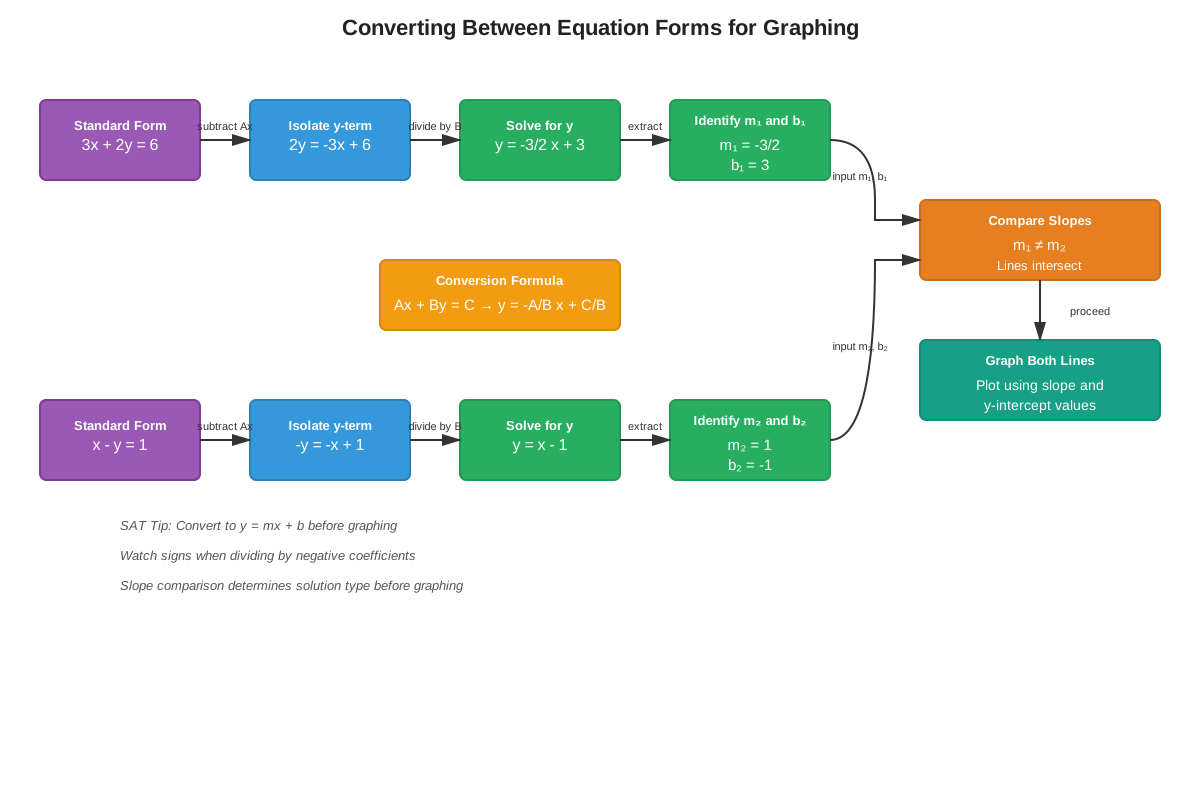
SAT questions may present equations in various forms, requiring conversion for efficient graphing:
Standard form to slope-intercept form:
- Given: Ax + By = C
- Solve for y: y = (-A/B)x + (C/B)
- Slope: m = -A/B
- Y-intercept: b = C/B
Point-slope form to slope-intercept form:
- Given: y - y₁ = m(x - x₁)
- Distribute and isolate y: y = mx - mx₁ + y₁
Determining Solution Quantity Without Graphing
For efficiency on timed exams, students can determine the number of solutions by comparing slopes and y-intercepts without creating detailed graphs:
- Convert both equations to y = mx + b form
- Compare slopes:
- Different slopes → one solution
- Same slopes → check y-intercepts
- If slopes are equal, compare y-intercepts:
- Different y-intercepts → no solution (parallel lines)
- Same y-intercepts → infinite solutions (same line)
This analytical approach saves valuable time on the SAT while maintaining accuracy.
Concept Relationships
The concepts within solving systems by graphing form an interconnected web of understanding. Slope-intercept form serves as the foundation, enabling quick identification of slope and y-intercept, which directly determine the number of solutions a system possesses. The relationship flows: equation form → graphical representation → intersection analysis → solution interpretation.
This topic builds directly on prerequisite knowledge of linear equations and coordinate geometry. The ability to graph individual lines combines with understanding of simultaneous satisfaction to create the complete picture of system solving. The visual approach complements algebraic methods (substitution and elimination), providing a verification tool and intuitive understanding of solution existence.
Looking forward, solving systems by graphing connects to systems of inequalities (shading regions instead of drawing lines), quadratic systems (where parabolas and lines may intersect at zero, one, or two points), and functions (understanding when two functions have equal outputs). The concept map flows:
Linear equations → Graphing individual lines → Systems of equations → Intersection analysis → Solution types → Applications in word problems → Extension to non-linear systems → Optimization problems
High-Yield Facts
⭐ The solution to a system of linear equations is the ordered pair (x, y) where the graphs of the equations intersect
⭐ Two lines with different slopes always intersect at exactly one point
⭐ Parallel lines have the same slope but different y-intercepts, resulting in no solution
⭐ Lines with identical slopes and y-intercepts are the same line, producing infinite solutions
⭐ Converting equations to y = mx + b form is the fastest way to compare slopes and y-intercepts
- The x-coordinate of the intersection point represents the value where both equations have the same y-value
- When reading intersection points from graphs, both coordinates must satisfy both original equations
- A system with no solution is called inconsistent; a system with at least one solution is consistent
- Vertical lines (undefined slope) and horizontal lines (zero slope) can intersect at exactly one point
- The graphical method provides visual confirmation of solution reasonableness, helping catch algebraic errors
- On the SAT, intersection points typically occur at integer coordinates or simple fractions for grid-in questions
- Systems appearing in word problems often represent scenarios where two changing quantities become equal
Quick check — test yourself on Solving systems by graphing so far.
Try Flashcards →Common Misconceptions
Misconception: The intersection point is the solution only if it has integer coordinates → Correction: Any point where the lines cross is the solution, regardless of whether coordinates are integers, fractions, or irrational numbers. The SAT typically uses integer or simple fraction coordinates for practical testing purposes, but the mathematical principle applies to all real number coordinates.
Misconception: If two lines look parallel on a roughly drawn graph, the system has no solution → Correction: Visual appearance alone is insufficient; lines must be algebraically verified to have identical slopes and different y-intercepts. Small differences in slope that are hard to see visually still result in intersection, just at a point far from the origin.
Misconception: The y-intercept is the solution to the system → Correction: The y-intercept is where each individual line crosses the y-axis (at x = 0). The solution is where the two lines cross each other, which could occur anywhere on the coordinate plane.
Misconception: Systems with infinite solutions have no specific answer → Correction: While infinite solutions means countless points satisfy both equations, this occurs only when the equations represent the same line. Every point on that line is a valid solution, and this is a specific, meaningful mathematical result.
Misconception: Graphing is always the fastest method for solving systems → Correction: Graphing provides visual insight and is excellent for understanding, but algebraic methods (substitution or elimination) are often faster and more precise, especially when dealing with non-integer solutions or when graphs aren't provided.
Misconception: If lines intersect below the x-axis, the solution is negative → Correction: The solution is the ordered pair (x, y) at the intersection point. Both coordinates could be positive, negative, or zero depending on where the intersection occurs. The sign of each coordinate is independent.
Worked Examples
Example 1: Identifying Solutions from a Graph
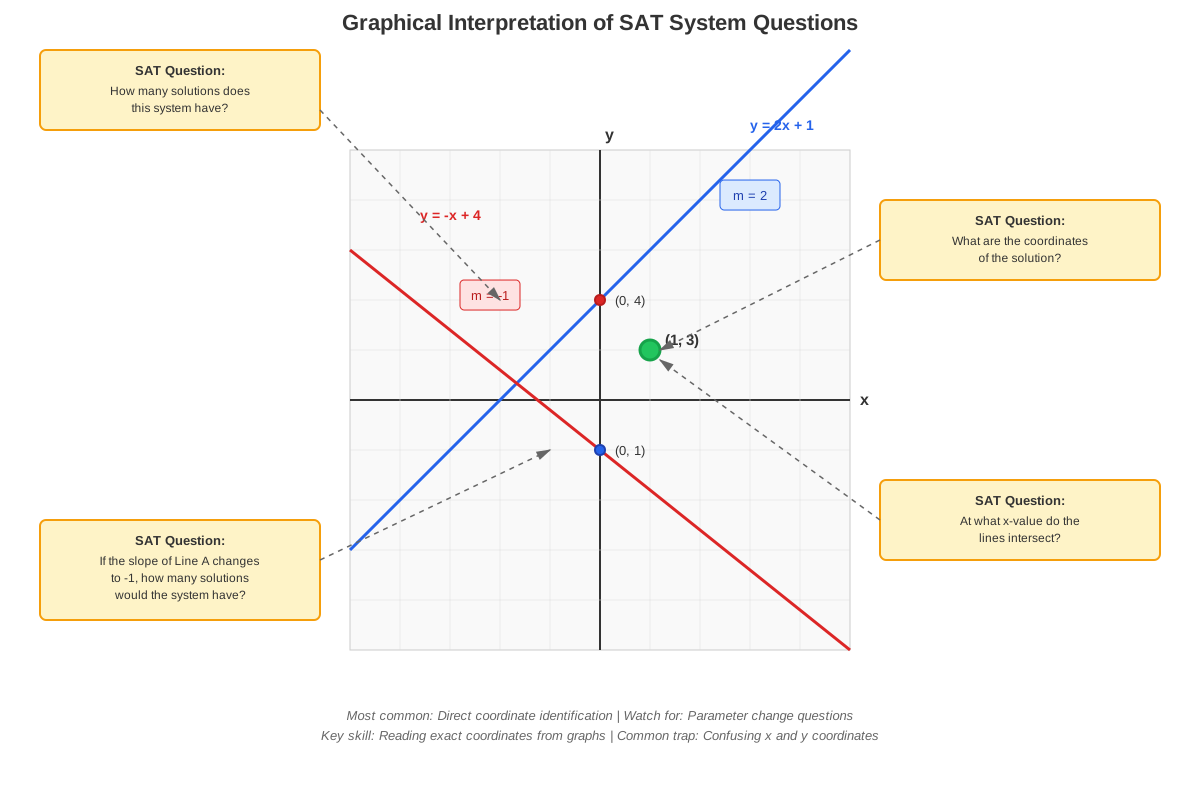
Problem: The graph below shows two lines representing the system:
- Line 1: y = 2x + 1
- Line 2: y = -x + 4
The lines intersect at point P. What are the coordinates of point P?
Solution:
Step 1: Understand what we're looking for. The intersection point P is where both equations are simultaneously true, meaning the x and y values satisfy both y = 2x + 1 and y = -x + 4.
Step 2: Set the equations equal since both equal y at the intersection:
2x + 1 = -x + 4
Step 3: Solve for x:
2x + x = 4 - 1
3x = 3
x = 1
Step 4: Substitute x = 1 into either original equation to find y:
Using y = 2x + 1:
y = 2(1) + 1 = 3
Step 5: Verify using the second equation:
y = -x + 4 = -(1) + 4 = 3 ✓
Answer: The coordinates of point P are (1, 3).
Connection to learning objectives: This example demonstrates applying solving systems by graphing to find exact solution coordinates, a common SAT question type. It shows how algebraic verification confirms graphical observations.
Example 2: Determining Number of Solutions
Problem: For what value of k does the following system have no solution?
- Equation 1: y = 3x - 2
- Equation 2: y = kx + 5
Solution:
Step 1: Recall that a system has no solution when the lines are parallel—same slope, different y-intercepts.
Step 2: Identify the slope of Equation 1:
From y = 3x - 2, the slope m₁ = 3
Step 3: For parallel lines, the slopes must be equal:
k = 3
Step 4: Verify the y-intercepts are different:
Equation 1 has b₁ = -2
Equation 2 has b₂ = 5
Since -2 ≠ 5, the lines will be parallel (not coincident)
Step 5: Confirm understanding by checking other values:
- If k ≠ 3: Lines have different slopes → one solution
- If k = 3 and the y-intercept were also -2: Infinite solutions (same line)
Answer: k = 3
Connection to learning objectives: This example demonstrates identifying key features of systems (parallel lines) and explaining how this concept appears on the SAT (parameter-based questions requiring analysis of solution types).
Example 3: Real-World Application
Problem: A gym charges a $50 membership fee plus $30 per month. A different gym charges no membership fee but costs $40 per month. After how many months will the total cost be the same at both gyms?
Solution:
Step 1: Define variables and set up equations:
Let x = number of months
Let y = total cost in dollars
Gym 1: y = 30x + 50 (slope = 30, y-intercept = 50)
Gym 2: y = 40x (slope = 40, y-intercept = 0)
Step 2: Understand graphically what we're finding:
The intersection point represents when both gyms cost the same amount.
Step 3: Set equations equal:
30x + 50 = 40x
Step 4: Solve for x:
50 = 40x - 30x
50 = 10x
x = 5
Step 5: Find the cost at 5 months (optional but helpful):
y = 40(5) = 200
Answer: After 5 months, both gyms will cost $200 total.
Connection to learning objectives: This example applies solving systems by graphing to a real-world SAT-style question, demonstrating how intersection points represent meaningful solutions in context.
Exam Strategy
When approaching SAT solving systems by graphing questions, begin by identifying the question type: Are you given a graph to interpret, or must you analyze equations to determine solution characteristics? For graph interpretation questions, carefully read both axes labels and scale markings before identifying intersection coordinates. Count grid lines precisely rather than estimating, as SAT answers are designed to catch careless reading errors.
Trigger words and phrases to watch for include: "intersection point," "solution to the system," "how many solutions," "for what value of [parameter] does the system have no solution," "where the lines cross," and "simultaneously satisfy both equations." Questions asking about "no solution" or "infinitely many solutions" signal the need to analyze slopes and y-intercepts rather than find specific coordinates.
For process-of-elimination strategies, use these approaches:
- If answer choices are coordinate pairs, quickly substitute them into both equations; the correct answer must satisfy both
- If asked about number of solutions, eliminate answers that contradict slope relationships (e.g., if slopes are different, eliminate "no solution" and "infinite solutions")
- For graphical answer choices showing different systems, eliminate graphs where slopes don't match the given equations
- When equations are in standard form, convert to slope-intercept form first to make comparisons easier
Time allocation advice: Spend 30-45 seconds analyzing the question type and given information, 60-90 seconds solving or analyzing, and 15-30 seconds verifying your answer. If a question requires extensive graphing from scratch, consider whether algebraic methods might be faster. However, if a graph is provided, use it—the visual information is given to save time, not waste it.
For questions involving parameters (like "for what value of k..."), immediately identify what condition creates the desired solution type (no solution requires equal slopes and different y-intercepts; infinite solutions requires equal slopes and equal y-intercepts). This analytical approach is faster than testing multiple values.
Memory Techniques
Mnemonic for solution types: "DIP" helps remember the three cases:
- Different slopes → Intersect at one Point
- Identical slopes, different intercepts → Parallel (no solution)
- Identical slopes and intercepts → Perfectly overlapping (infinite solutions)
Visualization strategy: Picture two pencils representing lines. When held at different angles, they must cross somewhere (one solution). When held parallel, they never meet (no solution). When one pencil lies exactly on top of the other, every point matches (infinite solutions).
Slope-intercept acronym: "YMXB" sounds like "Why am I X-ing B?" to remember y = mx + b, where:
- Y is the output
- M is the slope (multiplies x)
- X is the input
- B is the y-intercept (beginning point)
Parallel lines memory aid: "Parallel lines are like train tracks—same slope, never meet, always the same distance apart (different y-intercepts)."
Intersection point reminder: "The intersection is where both equations agree—it's the compromise point where x and y satisfy both parties (equations)."
Summary
Solving systems by graphing is a visual method for finding values that simultaneously satisfy two or more linear equations. The solution corresponds to the intersection point of the lines representing each equation on the coordinate plane. Systems can have exactly one solution (lines intersect), no solution (parallel lines), or infinite solutions (coincident lines), determined by comparing slopes and y-intercepts. Converting equations to slope-intercept form (y = mx + b) enables quick analysis: different slopes guarantee one solution, while equal slopes require checking y-intercepts to distinguish between no solution and infinite solutions. On the SAT, this topic appears in multiple formats including graph interpretation, solution determination, and real-world applications. Success requires fluency in converting between equation forms, accurately reading coordinates from graphs, and understanding the relationship between algebraic properties and graphical behavior. The graphical approach provides intuitive understanding and visual verification, making it an essential tool for both solving systems and checking answers obtained through algebraic methods.
Key Takeaways
- The solution to a system of linear equations is the point (x, y) where the graphs intersect, satisfying all equations simultaneously
- Three solution types exist: one solution (different slopes), no solution (parallel lines with same slope, different y-intercepts), or infinite solutions (identical lines)
- Converting to slope-intercept form (y = mx + b) is the most efficient way to analyze systems and determine solution types
- On the SAT, carefully read graph scales and count grid lines precisely when identifying intersection coordinates
- Comparing slopes and y-intercepts allows determination of solution quantity without actually graphing or solving
- Real-world SAT problems often involve finding when two scenarios result in equal values, represented by the intersection point
- Algebraic verification of graphical solutions catches errors and confirms answer accuracy
Related Topics
Systems of Linear Inequalities: Extends graphing systems from lines to shaded regions, requiring understanding of boundary lines and solution regions rather than single points. Mastering systems of equations provides the foundation for analyzing where multiple inequalities overlap.
Quadratic-Linear Systems: Involves finding intersections between parabolas and lines, which can result in zero, one, or two solutions. The graphical approach learned here transfers directly, though the algebra becomes more complex.
Substitution and Elimination Methods: Algebraic approaches to solving systems that complement the graphical method. Understanding all three methods allows strategic selection based on question format and efficiency.
Functions and Their Graphs: The concept of intersection points extends to finding where two functions have equal outputs, connecting systems to broader function analysis tested throughout the SAT.
Linear Programming: Advanced application of systems of inequalities used in optimization problems, building on the foundational understanding of how linear relationships interact graphically.
Practice CTA
Now that you've mastered the core concepts of solving systems by graphing, it's time to solidify your understanding through active practice. Attempt the practice questions designed specifically for this topic, focusing on applying the strategies and techniques covered in this guide. Use the flashcards to reinforce high-yield facts and test your ability to quickly identify solution types from slopes and y-intercepts. Remember, the SAT rewards both accuracy and efficiency—practice will build the pattern recognition that makes these questions quick points on test day. Every system you solve strengthens your mathematical intuition and brings you closer to your target score. You've got this!
Sign up free to keep reading
Create a free AnvayaPrep account to finish this SAT guide on Solving systems by graphing — plus flashcards and practice questions.