Overview
Systems from tables is a critical topic in SAT Math that tests a student's ability to analyze numerical data presented in tabular format and determine whether ordered pairs satisfy multiple linear equations simultaneously. This skill bridges algebraic reasoning with data interpretation, requiring students to extract information from tables and apply it to solve systems of equations. Unlike traditional algebraic approaches where equations are given explicitly, table-based problems require students to identify patterns, test values, and verify solutions across multiple constraints.
The SAT frequently presents systems from tables questions because they efficiently assess multiple competencies: reading comprehension of mathematical data, logical reasoning, and algebraic fluency. These problems typically appear in both the calculator and no-calculator sections, often worth 1-2 questions per test administration. Mastering this topic is essential because it represents a practical application of systems of equations—a foundational concept that appears throughout higher mathematics and real-world problem-solving scenarios.
Understanding systems from tables strengthens broader math skills by reinforcing the connection between abstract equations and concrete numerical values. This topic directly relates to linear functions, coordinate geometry, and data analysis—all high-yield areas on the SAT. Students who excel at interpreting tables can quickly eliminate incorrect answer choices and verify solutions, making this an efficient pathway to correct answers under time pressure.
Learning Objectives
- [ ] Identify key features of systems from tables, including solution points and constraint patterns
- [ ] Explain how systems from tables appears on the SAT, including question formats and common variations
- [ ] Apply systems from tables to answer SAT-style questions efficiently and accurately
- [ ] Determine whether a given ordered pair satisfies multiple equations by substituting values from tables
- [ ] Recognize when a table represents a system with no solution, one solution, or infinitely many solutions
- [ ] Convert information from tables into algebraic equations when necessary for verification
Prerequisites
- Linear equations and functions: Understanding how to evaluate expressions and substitute values is fundamental to checking whether table entries satisfy equations
- Ordered pairs and coordinate plane: Recognizing that (x, y) represents a point and knowing how to interpret x and y values separately is essential for table analysis
- Basic algebraic manipulation: Simplifying expressions and solving simple equations helps verify solutions quickly
- Function notation: Understanding f(x) and g(x) notation aids in interpreting tables that represent multiple functions
Why This Topic Matters
In real-world applications, systems from tables model scenarios where multiple conditions must be satisfied simultaneously—such as finding production levels that meet both cost and quality constraints, determining intersection points of supply and demand curves, or analyzing data sets where multiple variables interact. Engineers, economists, data scientists, and business analysts regularly work with tabular data representing systems of relationships.
On the SAT, sat systems from tables questions appear with notable frequency, typically 1-2 questions per test administration. These problems account for approximately 3-5% of the total Math section score. The College Board favors this format because it tests multiple skills simultaneously: data literacy, algebraic reasoning, and logical verification. Questions may present tables showing x and y values for two different functions, asking students to identify where both functions yield the same output, or they may provide a table of values and ask which system of equations the data satisfies.
Common exam presentations include: tables showing input-output pairs for two functions with questions about their intersection points; tables with partial information requiring students to identify which ordered pair completes a system; and tables presenting real-world data (like time and distance for two moving objects) where students must determine when conditions align. The SAT particularly favors questions that combine table interpretation with other skills like graphing or equation-writing, making this a high-leverage topic for score improvement.
Core Concepts
Understanding Systems of Equations from Tables
A system of equations consists of two or more equations that must be satisfied simultaneously. When working with systems from tables, the equations are represented through numerical data rather than algebraic expressions. The solution to a system is any ordered pair (x, y) that makes all equations true at the same time. Tables provide a concrete way to visualize potential solutions by showing which x-values produce which y-values for each equation or function.
Consider a table showing values for two functions, f(x) and g(x):
| x | f(x) | g(x) |
|---|---|---|
| 1 | 5 | 8 |
| 2 | 7 | 7 |
| 3 | 9 | 6 |
| 4 | 11 | 5 |
The solution to the system f(x) = y and g(x) = y occurs where f(x) and g(x) have the same value. In this table, when x = 2, both functions equal 7, making (2, 7) the solution to the system.
Identifying Solutions in Tables
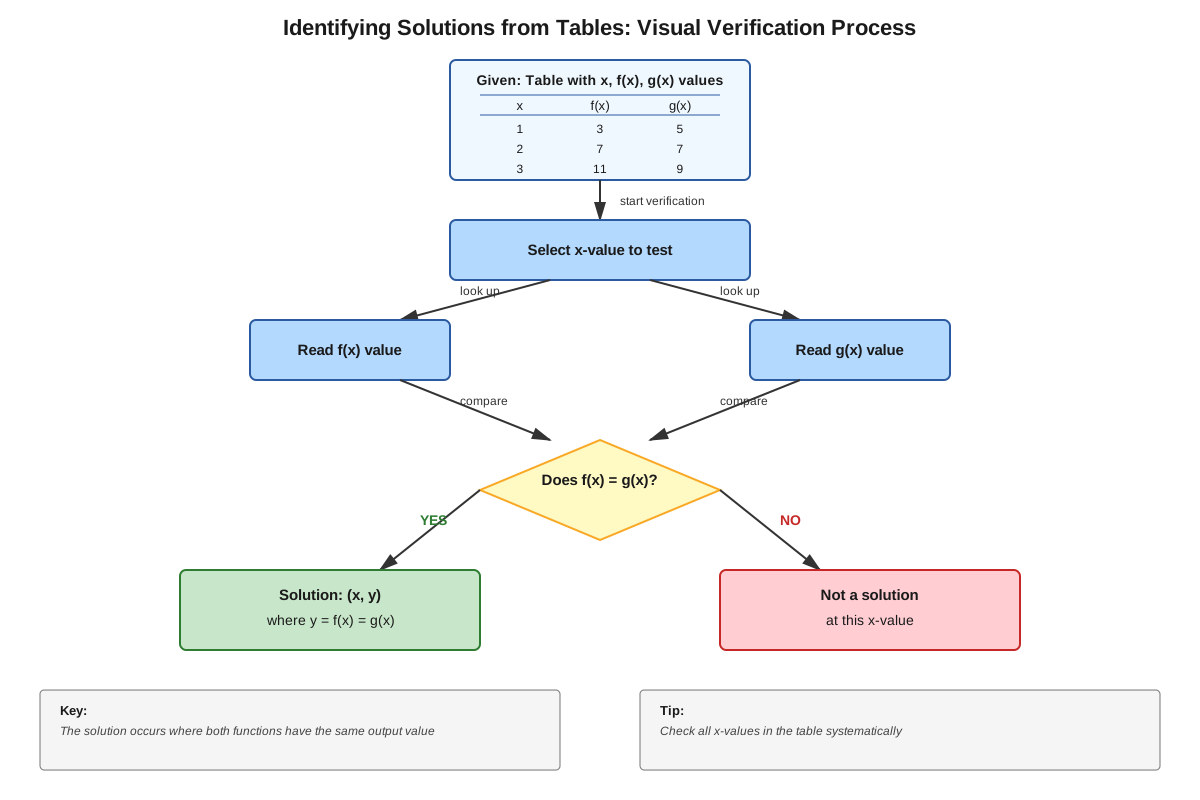
To identify solutions in table format, students must systematically compare values across rows. The key principle is that a solution point must satisfy all equations simultaneously—meaning for a given x-value, all corresponding y-values (or function outputs) must be equal. This requires careful attention to detail and organized comparison.
Step-by-step process for finding solutions:
- Scan each row of the table, focusing on the x-value
- Compare all y-values or function outputs in that row
- Identify rows where all outputs are identical
- Record the ordered pair (x, common y-value) as the solution
- Verify by checking that no other rows produce matching outputs (unless the system has multiple solutions)
Types of Systems Represented in Tables
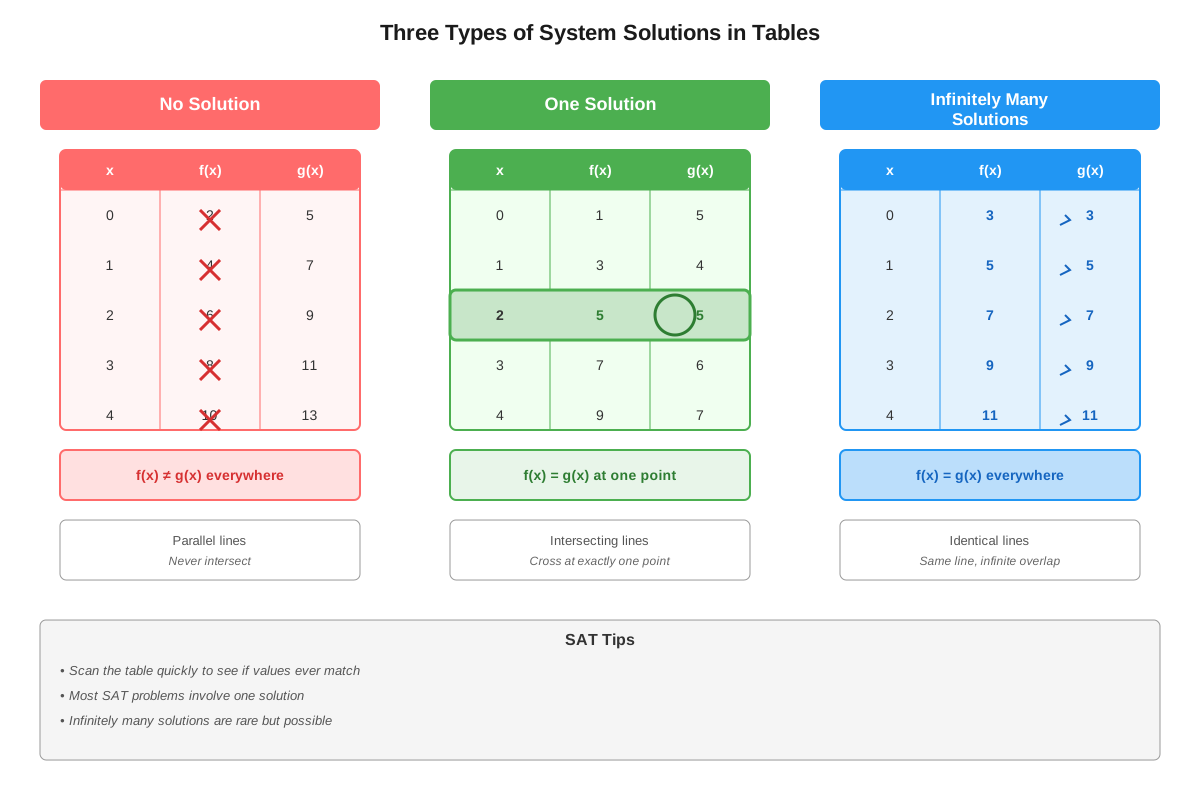
Tables can represent three types of systems, each with distinct characteristics:
One Solution (Consistent and Independent): The most common type on the SAT, where exactly one ordered pair satisfies all equations. The table will show exactly one row where all function values match.
No Solution (Inconsistent): The functions never produce the same output for any given input. In the table, no row will show matching values across all functions. This often occurs with parallel lines that never intersect.
Infinitely Many Solutions (Consistent and Dependent): All rows show matching values because the equations represent the same relationship. Every ordered pair in the table is a solution. This is rare on the SAT but important to recognize.
Converting Tables to Equations
Sometimes SAT questions require students to determine which system of equations matches a given table. This involves identifying the pattern or rule that generates each column of outputs. For linear relationships, students should:
- Calculate the rate of change (slope) by finding the difference in consecutive y-values divided by the difference in consecutive x-values
- Identify the y-intercept by extending the pattern backward or using the point-slope form
- Write the equation in the form y = mx + b or f(x) = mx + b
For example, if a table shows f(x) values increasing by 3 for each increase of 1 in x, and f(1) = 4, the equation is f(x) = 3x + 1.
Partial Tables and Missing Information
Advanced SAT questions may present incomplete tables where students must determine which ordered pair could complete the system. These problems require understanding the constraints imposed by the existing data and testing answer choices against those constraints. Students should:
- Identify the pattern in existing data points
- Determine what characteristics the missing value must have
- Eliminate answer choices that violate the established pattern
- Verify the remaining choice satisfies all conditions
Real-World Context in Table Problems
The SAT often embeds systems from tables in real-world scenarios. Common contexts include:
- Time and distance problems: Two objects moving at different rates, finding when they're at the same location
- Cost analysis: Comparing pricing plans to find when they cost the same amount
- Population or growth models: Determining when two changing quantities become equal
- Business scenarios: Finding break-even points or optimal production levels
In these contexts, the table columns represent meaningful quantities (time, cost, population, etc.), and the solution represents a significant real-world event (meeting point, equal cost, etc.). Students must interpret the mathematical solution within the given context.
Concept Relationships
The concepts within systems from tables build upon each other hierarchically. Understanding what a system of equations is → leads to → recognizing how tables represent systems → enables → identifying solutions by comparing values → which supports → converting between table and equation representations → ultimately allowing → solving complex real-world problems presented in tabular format.
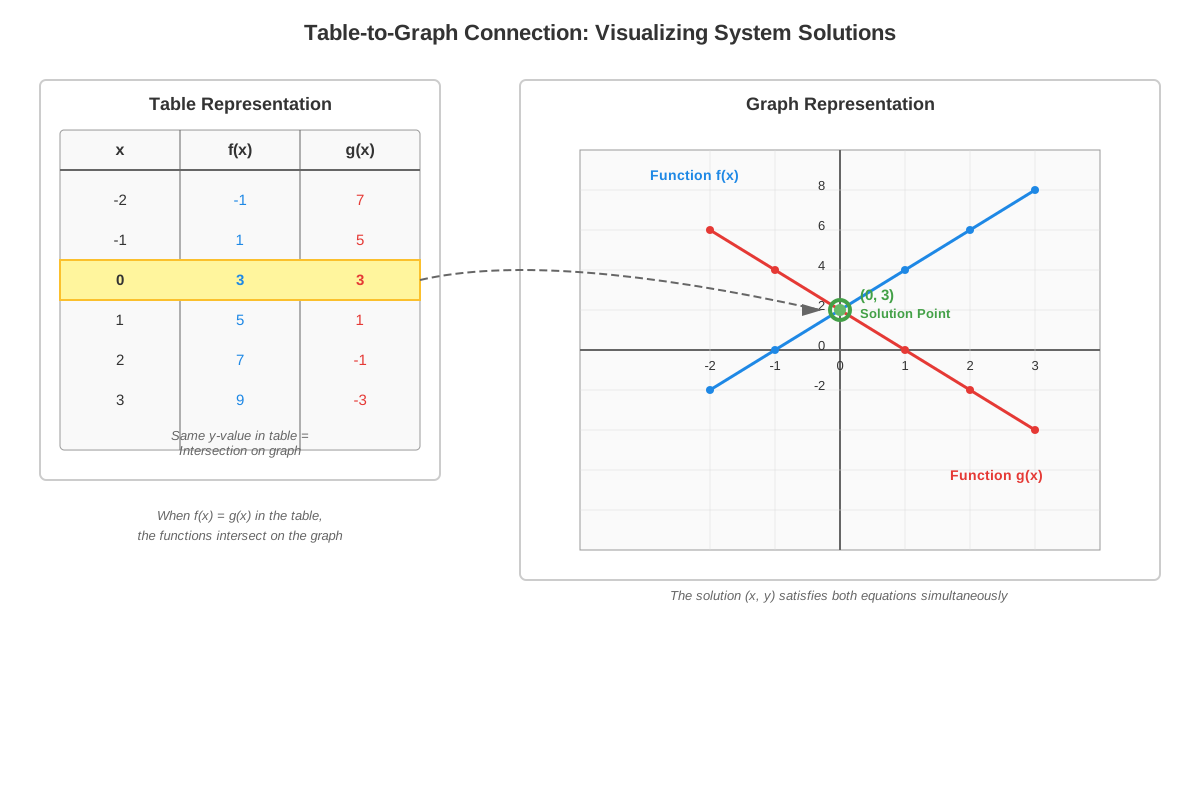
Systems from tables connects directly to prerequisite knowledge of linear equations and ordered pairs. The ability to evaluate expressions (prerequisite) → enables → checking whether table values satisfy equations. Understanding coordinate planes (prerequisite) → supports → interpreting table solutions as intersection points on a graph.
This topic also bridges to related concepts: systems from tables → extends to → graphical representations of systems (where table points become plotted coordinates) → and connects to → algebraic solution methods (where table patterns can be expressed as equations to solve). Additionally, systems from tables → reinforces → function notation and evaluation → which appears throughout → SAT algebra and function questions.
High-Yield Facts
⭐ The solution to a system from tables is the ordered pair (x, y) where all functions or equations produce the same y-value for the same x-value
⭐ To find a solution, scan each row and identify where all output values match exactly
⭐ If no row shows matching values across all functions, the system has no solution
⭐ Linear functions in tables show constant rates of change between consecutive points
⭐ The SAT commonly presents two functions in table form and asks where they intersect or are equal
- Tables may show partial information, requiring students to test answer choices against the given data
- Real-world context problems use tables to represent time-dependent or quantity-dependent relationships
- Some questions ask which system of equations matches a given table, requiring pattern recognition
- When tables show multiple matching rows, the system may have infinitely many solutions (rare but possible)
- Calculator-permitted questions may involve tables with non-integer values or larger numbers requiring computational verification
Quick check — test yourself on Systems from tables so far.
Try Flashcards →Common Misconceptions
Misconception: Any row in the table represents a solution to the system → Correction: Only rows where ALL function values match represent solutions. A solution must satisfy every equation simultaneously, not just one.
Misconception: If two functions have the same y-value at different x-values, those points are solutions → Correction: A solution requires the same x-value producing the same y-value across all functions. The ordered pair must be identical, not just the y-coordinate.
Misconception: Tables always show the solution point explicitly → Correction: Some SAT questions present tables that don't include the solution, requiring students to identify that no solution exists within the given range or to extrapolate beyond the table.
Misconception: The solution is always in the middle of the table → Correction: Solutions can appear anywhere in the table or not at all. Students must check every row systematically rather than assuming a particular location.
Misconception: If functions are increasing or decreasing, they must intersect somewhere → Correction: Parallel lines (same rate of change, different starting points) never intersect. Tables showing functions with identical rates of change but no matching values represent systems with no solution.
Misconception: Larger numbers in tables indicate the solution → Correction: The magnitude of values is irrelevant; only the matching of values across functions matters for identifying solutions.
Worked Examples
Example 1: Finding the Solution Point
Problem: The table below shows values for functions f(x) and g(x). For what value of x does f(x) = g(x)?
| x | f(x) | g(x) |
|---|---|---|
| -2 | 1 | 9 |
| -1 | 3 | 7 |
| 0 | 5 | 5 |
| 1 | 7 | 3 |
| 2 | 9 | 1 |
Solution:
Step 1: Understand what we're looking for. We need the x-value where f(x) and g(x) produce the same output.
Step 2: Systematically check each row:
- When x = -2: f(-2) = 1, g(-2) = 9 → Not equal
- When x = -1: f(-1) = 3, g(-1) = 7 → Not equal
- When x = 0: f(0) = 5, g(0) = 5 → Equal!
- When x = 1: f(1) = 7, g(1) = 3 → Not equal
- When x = 2: f(2) = 9, g(2) = 1 → Not equal
Step 3: Identify the solution. At x = 0, both functions equal 5, so the solution is x = 0 (or the ordered pair (0, 5)).
Step 4: Verify the answer makes sense. Looking at the pattern, f(x) is increasing while g(x) is decreasing, so they should intersect exactly once, which matches our finding.
Answer: x = 0
This example demonstrates Learning Objective 3 (applying systems from tables to SAT questions) by showing the systematic comparison process that leads to the correct answer.
Example 2: Real-World Application with Partial Information
Problem: Two phone plans are represented in the table below, showing the total cost in dollars for different numbers of months.
| Months | Plan A Cost | Plan B Cost |
|---|---|---|
| 1 | 45 | 30 |
| 2 | 70 | 55 |
| 3 | 95 | 80 |
| 4 | 120 | 105 |
Based on the pattern shown, after how many months will both plans cost the same amount?
Solution:
Step 1: Identify the patterns in each plan.
- Plan A: Increases by $25 each month (70-45=25, 95-70=25, 120-95=25)
- Plan B: Increases by $25 each month (55-30=25, 80-55=25, 105-80=25)
Step 2: Recognize that both plans increase at the same rate but start at different values. This means they're parallel in the given range but we need to check if they intersect.
Step 3: Notice that Plan A is always $15 more than Plan B in the table (45-30=15, 70-55=15, etc.). Since both increase at the same rate, this difference remains constant.
Step 4: Realize this is a trick question—the plans will NEVER cost the same amount because they're parallel lines with different starting points.
However, if the question asks when they'll be closest or if we misread the table, let's verify by writing equations:
- Plan A: Cost = 25m + 20 (where m = months, starting from month 0)
- Plan B: Cost = 25m + 5
Step 5: Set them equal: 25m + 20 = 25m + 5
This gives 20 = 5, which is impossible.
Answer: The plans will never cost the same amount (no solution exists).
Alternative scenario: If the table showed different rates of change, we would extend the pattern until finding where costs match, demonstrating how to work beyond the given table data.
This example illustrates Learning Objectives 1 and 2 by showing how to identify key features (parallel relationships) and recognize how the SAT presents systems that may have no solution.
Exam Strategy
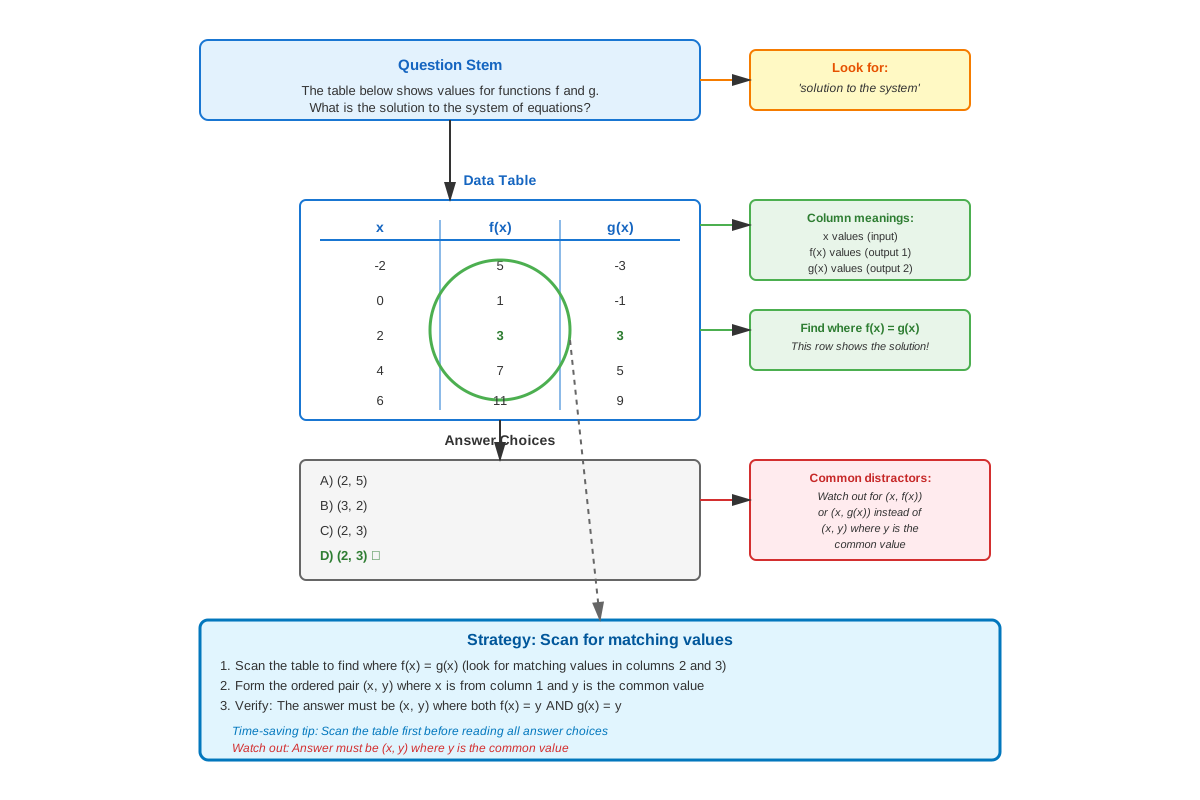
When approaching sat systems from tables questions, begin by quickly scanning the table structure to understand what information is provided. Identify whether you're looking at function values, real-world quantities, or abstract data. Read the question carefully to determine exactly what's being asked—the solution point, the x-value where functions are equal, or whether a given point satisfies the system.
Trigger words and phrases to watch for:
- "For what value of x..." indicates you need to find the x-coordinate of the solution
- "Which ordered pair..." suggests testing answer choices against table data
- "When are the functions equal..." means finding where outputs match
- "Based on the pattern..." signals you may need to extend beyond the given table
- "Which system of equations..." requires identifying the algebraic rules generating the table
Process of elimination strategies:
- Immediately eliminate any answer choice with an x-value not shown in the table (unless the question asks about extending patterns)
- For "which ordered pair" questions, check the x-coordinate first—if it's not in the table, eliminate that choice
- If comparing function values, eliminate any row where values clearly don't match before detailed checking
- For equation-matching questions, test one point from the table in each answer choice equation—eliminate any that don't work
Time allocation advice:
Spend 30-45 seconds reading and understanding the table structure, 45-60 seconds systematically checking values or testing answer choices, and 15-30 seconds verifying your answer. These questions typically take 1.5-2 minutes total. If you find yourself spending more than 2.5 minutes, mark your best answer and move on—you can return if time permits. The systematic nature of table checking makes these questions excellent candidates for calculator use when available, as you can quickly verify arithmetic.
Exam Tip: Always check every row of the table, even if you think you've found the answer early. The SAT occasionally includes distractors where values are close but not exactly equal.
Memory Techniques
MATCH mnemonic for finding solutions in tables:
- Mark the x-values in the first column
- Analyze each row systematically
- Test for equality across all functions
- Confirm only one match exists (typically)
- Highlight the solution ordered pair
Visualization strategy: Picture the table as a horizontal race where each function is a runner. The solution is the "finish line" where all runners cross at the same time (same x-value) and position (same y-value). This helps remember that both coordinates must align.
"Same X, Same Y, Same Time" rule: For a solution to exist, you need the same x-value producing the same y-value at the same time (same row). This three-part check prevents common errors.
Pattern recognition acronym - RISE:
- Rate of change (slope) between consecutive points
- Initial value (y-intercept or starting point)
- Solution point (where values match)
- Equation form (y = mx + b if needed)
Summary
Systems from tables represent a high-yield SAT Math topic that combines data interpretation with algebraic reasoning. The core skill involves identifying ordered pairs that satisfy multiple equations simultaneously by systematically comparing values across table rows. Solutions occur where all function outputs match for a given input value, creating an ordered pair (x, y) that satisfies the entire system. Students must recognize three possible outcomes: one solution (most common), no solution (when values never match), or infinitely many solutions (when all rows match). The SAT presents these problems in various formats—pure function tables, real-world contexts, partial information requiring pattern extension, and equation-matching scenarios. Success requires methodical row-by-row comparison, attention to detail in matching values exactly, and the ability to convert between tabular and algebraic representations when necessary. Understanding that solutions represent intersection points connects this topic to graphical interpretations of systems, while recognizing patterns in tables reinforces linear function concepts throughout the Math section.
Key Takeaways
- The solution to a system from tables is the ordered pair where all function values match for the same x-value
- Systematically check every row of the table by comparing all output values before concluding about solutions
- Linear patterns in tables show constant rates of change, which can be used to write equations or extend patterns
- No solution exists when no row shows matching values across all functions, indicating parallel relationships
- Real-world table problems require interpreting the solution within context (meeting point, equal cost, etc.)
- SAT questions may ask for the x-value, the complete ordered pair, or which equations match the table
- Always verify your answer by confirming the values match exactly, not just approximately
Related Topics
Graphing Systems of Linear Equations: After mastering systems from tables, students can visualize these same systems on coordinate planes, where table solutions become intersection points of lines. This graphical approach provides geometric insight into why systems have one, none, or infinitely many solutions.
Algebraic Solution Methods: Understanding systems from tables provides concrete numerical examples that make abstract algebraic techniques (substitution and elimination) more intuitive. Students can verify algebraic solutions by creating tables of values.
Linear Functions and Modeling: The patterns identified in tables directly connect to writing and analyzing linear functions, a broader SAT topic. Mastering table interpretation strengthens function notation fluency and rate-of-change concepts.
Inequalities and Systems: Building on systems of equations, students can extend to systems of inequalities, where tables help identify regions of solutions rather than single points.
Practice CTA
Now that you've mastered the core concepts of systems from tables, it's time to solidify your understanding through active practice. Attempt the practice questions designed specifically for this topic, focusing on applying the systematic comparison process you've learned. Use the flashcards to reinforce key definitions and solution strategies until they become automatic. Remember, the SAT rewards both accuracy and speed—practice will build both. Each problem you solve strengthens your pattern recognition and builds confidence for test day. You've got this!
Sign up free to keep reading
Create a free AnvayaPrep account to finish this SAT guide on Systems from tables — plus flashcards and practice questions.