Overview
Trigonometric ratios form one of the most consistently tested concepts in SAT math, appearing in approximately 5-10% of all math questions on the exam. These ratios—sine, cosine, and tangent—describe the relationships between the angles and sides of right triangles, providing a powerful toolkit for solving geometric problems. Understanding trigonometric ratios is essential not only for direct trigonometry questions but also for problems involving coordinate geometry, circles, and real-world applications that the SAT frequently presents.
The SAT tests trigonometric ratios primarily through right triangle problems, where students must identify which ratio to use based on given information and what needs to be found. Questions may present triangles in standard orientation or require students to recognize right triangles embedded within more complex figures. The exam also tests the complementary relationship between sine and cosine, as well as the ability to work with special right triangles (30-60-90 and 45-45-90) where trigonometric values can be determined without a calculator.
Mastery of trigonometric ratios connects directly to broader mathematical concepts tested on the SAT, including the Pythagorean theorem, similar triangles, and coordinate geometry. These ratios serve as a bridge between pure geometry and algebraic problem-solving, making them a high-yield topic that rewards thorough understanding. Students who confidently apply trigonometric ratios gain a significant advantage on test day, as these questions often appear in both the calculator and no-calculator sections.
Learning Objectives
- [ ] Identify key features of trigonometric ratios
- [ ] Explain how trigonometric ratios appears on the SAT
- [ ] Apply trigonometric ratios to answer SAT-style questions
- [ ] Calculate sine, cosine, and tangent values for angles in right triangles given side lengths
- [ ] Determine unknown side lengths or angles using appropriate trigonometric ratios
- [ ] Recognize and apply the complementary angle relationships between sine and cosine
- [ ] Solve multi-step problems that combine trigonometric ratios with other geometric concepts
Prerequisites
- Right triangle properties: Understanding that right triangles contain one 90-degree angle is fundamental, as trigonometric ratios only apply to right triangles on the SAT
- Pythagorean theorem (a² + b² = c²): Frequently used in conjunction with trigonometric ratios to find missing side lengths before calculating ratios
- Basic angle measurement: Knowing that angles are measured in degrees and that triangle angles sum to 180° helps identify complementary angles
- Fraction and decimal operations: Trigonometric ratios produce fractional or decimal values that require computational fluency
- Special right triangles (30-60-90 and 45-45-90): These triangles have predictable side ratios that connect directly to trigonometric values
Why This Topic Matters
Trigonometric ratios represent a critical intersection between geometry and real-world problem-solving. In practical applications, these ratios enable calculations involving heights, distances, and angles that cannot be measured directly—from determining building heights using shadows to calculating navigation paths. Engineers, architects, surveyors, and physicists rely on trigonometric ratios daily, making this topic both academically important and professionally relevant.
On the SAT, trigonometric ratios appear with remarkable consistency. Students can expect 2-4 questions directly testing these concepts, with additional questions incorporating trigonometry as part of multi-step problems. These questions typically appear in both the calculator and no-calculator sections, with no-calculator questions often featuring special right triangles where exact values can be determined. The College Board considers trigonometry essential for college readiness in STEM fields, which explains its prominent placement on the exam.
Common SAT question formats include: identifying which trigonometric ratio to use given a diagram and specific information; calculating an unknown side length when given an angle and one side; determining an angle measure when given two sides; recognizing complementary angle relationships (sin(x) = cos(90° - x)); and applying trigonometric ratios to word problems involving real-world scenarios like ramps, ladders, or sight lines. Questions may also test whether students understand that trigonometric ratios depend only on the angle measure, not the triangle's size, connecting to the concept of similar triangles.
Core Concepts
The Three Primary Trigonometric Ratios
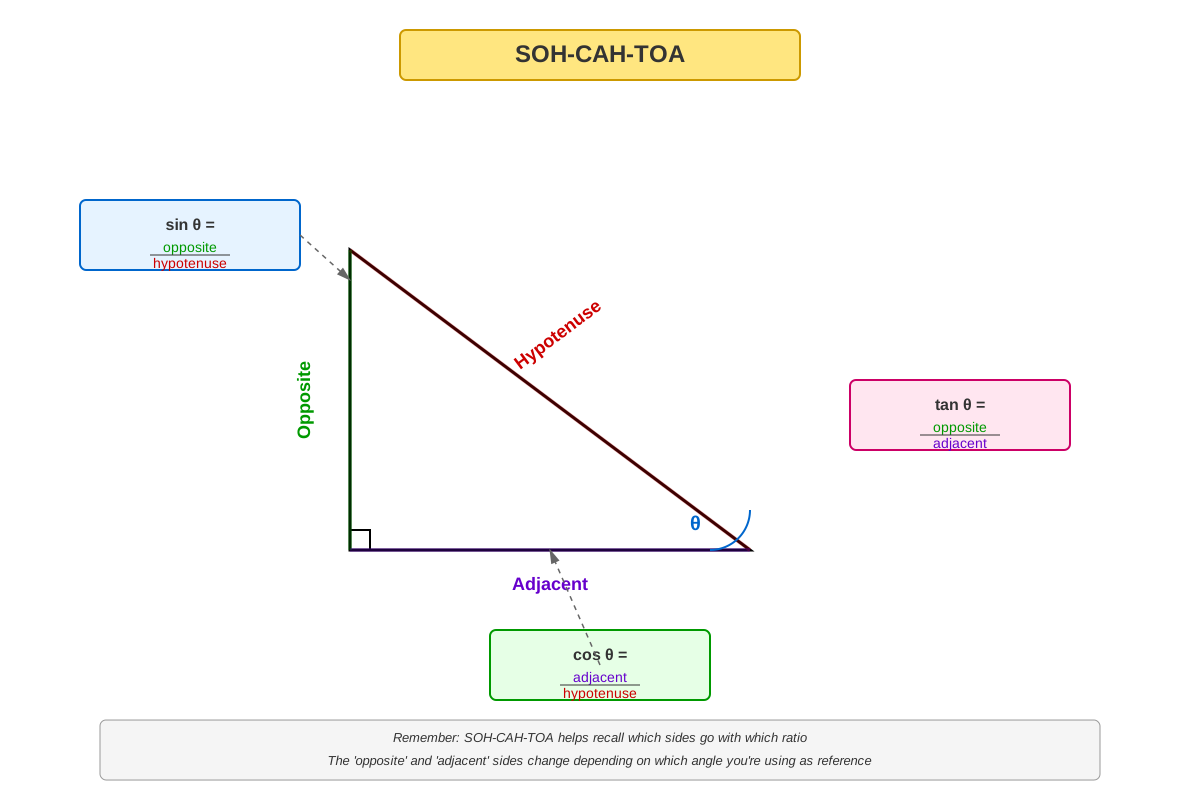
The foundation of trigonometry rests on three fundamental ratios that relate the sides of a right triangle to its acute angles. Each ratio compares two specific sides of the triangle relative to a chosen angle. To understand these ratios, students must first identify the three sides of a right triangle relative to a specific acute angle:
- Opposite side: The side across from the angle in question
- Adjacent side: The side next to the angle in question (but not the hypotenuse)
- Hypotenuse: The longest side, opposite the right angle (this never changes regardless of which acute angle is considered)
The three primary trigonometric ratios are:
sin(θ) = opposite/hypotenuse
cos(θ) = adjacent/hypotenuse
tan(θ) = opposite/adjacent
Where θ (theta) represents the angle measure. The most popular mnemonic for remembering these ratios is SOH-CAH-TOA:
- Sine = Opposite/Hypotenuse
- Cosine = Adjacent/Hypotenuse
- Tangent = Opposite/Adjacent
Understanding Angle Reference
A critical skill for SAT success involves correctly identifying which sides are opposite and adjacent relative to the angle being considered. In a right triangle with acute angles A and B:
- For angle A: one leg is opposite, the other is adjacent
- For angle B: the roles reverse—what was opposite becomes adjacent and vice versa
- The hypotenuse remains the hypotenuse for both angles
This means that sin(A) = cos(B) when A and B are complementary angles (they sum to 90°), a relationship the SAT frequently tests.
Calculating Trigonometric Values
When given a right triangle with known side lengths, calculating trigonometric ratios involves three steps:
- Identify the angle for which the ratio is being calculated
- Label the sides as opposite, adjacent, or hypotenuse relative to that angle
- Apply the appropriate ratio formula and simplify
For example, in a right triangle where the side opposite angle θ measures 3, the adjacent side measures 4, and the hypotenuse measures 5:
- sin(θ) = 3/5 = 0.6
- cos(θ) = 4/5 = 0.8
- tan(θ) = 3/4 = 0.75
Using Trigonometric Ratios to Find Unknown Values
The SAT frequently presents problems where students must work backward from a trigonometric ratio to find an unknown side length. This requires algebraic manipulation:
Given an angle and one side, find another side:
If sin(30°) = x/10, where x is the opposite side and 10 is the hypotenuse:
- Write the equation: sin(30°) = x/10
- Multiply both sides by 10: x = 10 × sin(30°)
- Calculate: x = 10 × 0.5 = 5
Special Angle Values
The SAT expects students to know or quickly derive trigonometric values for special angles without a calculator:
| Angle | sin | cos | tan |
|---|---|---|---|
| 30° | 1/2 | √3/2 | √3/3 or 1/√3 |
| 45° | √2/2 or 1/√2 | √2/2 or 1/√2 | 1 |
| 60° | √3/2 | 1/2 | √3 |
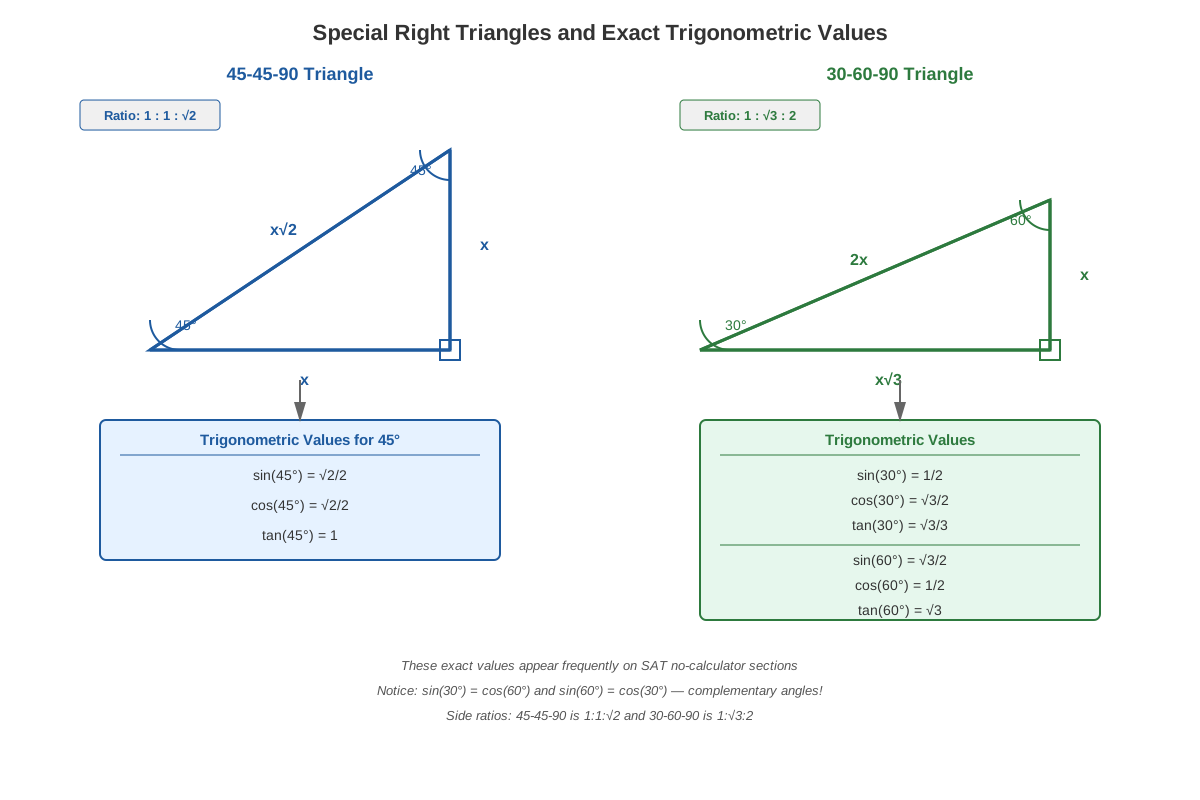
These values derive directly from the side ratios of 30-60-90 triangles (sides in ratio 1:√3:2) and 45-45-90 triangles (sides in ratio 1:1:√2).
Complementary Angle Relationships
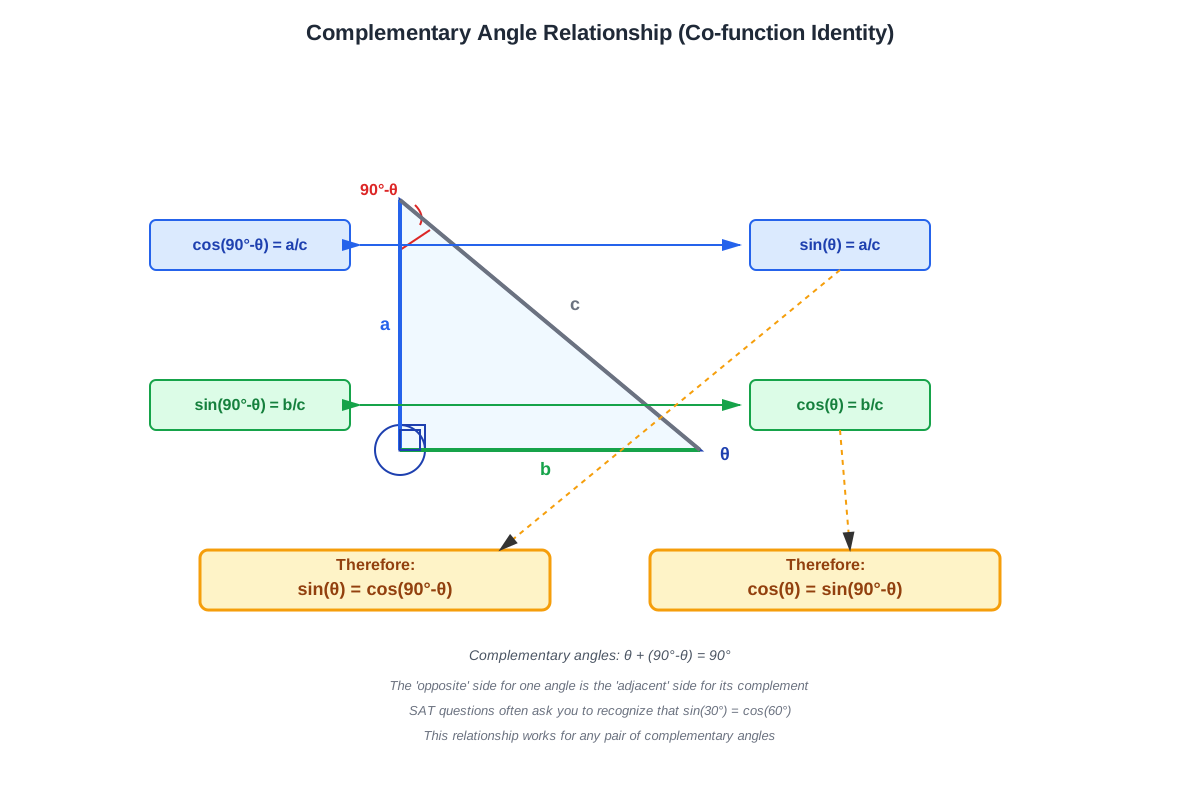
One of the most elegant properties of trigonometric ratios involves complementary angles (two angles that sum to 90°). In any right triangle, the two acute angles are complementary, leading to these relationships:
- sin(θ) = cos(90° - θ)
- cos(θ) = sin(90° - θ)
- tan(θ) = 1/tan(90° - θ)
This means sin(30°) = cos(60°), sin(60°) = cos(30°), and so forth. The SAT tests this concept by asking students to recognize equivalent expressions or to simplify expressions involving complementary angles.
Inverse Trigonometric Functions
While less common on the SAT, inverse trigonometric functions (arcsin, arccos, arctan, or sin⁻¹, cos⁻¹, tan⁻¹) allow students to find angle measures when given a ratio. For example:
If sin(θ) = 0.5, then θ = sin⁻¹(0.5) = 30°
Most SAT questions involving inverse functions can be solved using special angle knowledge or a calculator.
Application to Non-Standard Orientations
The SAT often presents right triangles in various orientations—not always with the right angle in the bottom-left corner. Students must mentally rotate or relabel triangles to identify the correct opposite and adjacent sides. The key is always to start by identifying the angle in question, then labeling sides relative to that angle, regardless of the triangle's orientation on the page.
Concept Relationships
The three primary trigonometric ratios (sine, cosine, tangent) are intrinsically connected through their definitions, all stemming from the same right triangle but emphasizing different side relationships. Sine and cosine share a complementary relationship: the sine of one acute angle equals the cosine of the other acute angle in the same right triangle, expressed as sin(θ) = cos(90° - θ). This relationship exists because what serves as the opposite side for one angle becomes the adjacent side for the complementary angle.
Tangent connects to both sine and cosine through the algebraic relationship tan(θ) = sin(θ)/cos(θ), which can be verified by substituting the ratio definitions: (opposite/hypotenuse) ÷ (adjacent/hypotenuse) = opposite/adjacent. This relationship occasionally appears in SAT questions that require simplification of trigonometric expressions.
The connection to prerequisite knowledge is direct: trigonometric ratios build upon the Pythagorean theorem, as students often need to find a third side before calculating ratios. For example, if given the opposite side and hypotenuse, students might need the Pythagorean theorem to find the adjacent side before calculating cosine or tangent. Similarly, special right triangles (30-60-90 and 45-45-90) provide the side ratios that generate the special angle trigonometric values, creating a bridge between geometric patterns and trigonometric functions.
Within the broader SAT math curriculum, trigonometric ratios connect forward to coordinate geometry (where sine and cosine describe positions on the unit circle), circles (where trigonometry helps solve chord and arc problems), and complex word problems that model real-world scenarios. The relationship map flows: Right Triangle Properties → Pythagorean Theorem → Special Right Triangles → Trigonometric Ratios → Applications in Coordinate Geometry and Word Problems.
High-Yield Facts
⭐ SOH-CAH-TOA encodes the three primary trigonometric ratios: sin = opposite/hypotenuse, cos = adjacent/hypotenuse, tan = opposite/adjacent
⭐ The sine of an angle equals the cosine of its complement: sin(θ) = cos(90° - θ)
⭐ For a 30° angle: sin(30°) = 1/2, cos(30°) = √3/2, tan(30°) = √3/3
⭐ For a 45° angle: sin(45°) = cos(45°) = √2/2, tan(45°) = 1
⭐ For a 60° angle: sin(60°) = √3/2, cos(60°) = 1/2, tan(60°) = √3
- The hypotenuse is always the longest side and is always opposite the right angle
- The opposite and adjacent sides switch roles depending on which acute angle is being considered
- Trigonometric ratios depend only on the angle measure, not the triangle's size (similar triangles have identical trigonometric ratios)
- Tangent can be expressed as sine divided by cosine: tan(θ) = sin(θ)/cos(θ)
- All three trigonometric ratios are positive for acute angles (0° < θ < 90°)
- The inverse trigonometric functions (sin⁻¹, cos⁻¹, tan⁻¹) return angle measures when given ratio values
- When a trigonometric ratio equals 1, it indicates a special relationship: tan(45°) = 1 because opposite and adjacent sides are equal
- Sine and cosine values for acute angles always fall between 0 and 1 (since the hypotenuse is the longest side)
Quick check — test yourself on Trigonometric ratios so far.
Try Flashcards →Common Misconceptions
Misconception: The hypotenuse changes depending on which angle is being considered.
Correction: The hypotenuse is always the side opposite the right angle and remains constant regardless of which acute angle is the focus. Only the opposite and adjacent sides switch roles.
Misconception: Sine, cosine, and tangent can be applied to any triangle.
Correction: On the SAT, these basic trigonometric ratios apply only to right triangles. For non-right triangles, different formulas (Law of Sines, Law of Cosines) are needed, though these rarely appear on the SAT.
Misconception: sin(A + B) = sin(A) + sin(B)
Correction: Trigonometric functions do not distribute over addition. The sine of a sum requires a specific formula: sin(A + B) = sin(A)cos(B) + cos(A)sin(B), though this formula is beyond SAT scope. Students should never split trigonometric functions across addition.
Misconception: Larger angles always produce larger sine values.
Correction: While this is true for acute angles (0° to 90°), it's not universally true. For SAT purposes, students should focus on the specific values for 30°, 45°, and 60° rather than making generalizations about angle size and ratio values.
Misconception: The adjacent side is always the horizontal side of the triangle.
Correction: The adjacent side is determined by its relationship to the angle in question, not by the triangle's orientation on the page. Students must identify the angle first, then determine which side is adjacent to that angle (touching it, but not the hypotenuse).
Misconception: Trigonometric ratios always produce nice, simple numbers.
Correction: While special angles (30°, 45°, 60°) produce recognizable values, most angles produce decimal approximations. Students should be comfortable working with both exact values (like √3/2) and decimal approximations (like 0.866).
Misconception: Tangent is less important than sine and cosine.
Correction: The SAT tests all three ratios with similar frequency. Tangent is particularly useful when the hypotenuse is unknown, as it relates the two legs directly without involving the hypotenuse.
Worked Examples
Example 1: Finding an Unknown Side Length
Problem: In right triangle ABC, angle A measures 60°, and the side adjacent to angle A measures 7. What is the length of the hypotenuse?
Solution:
Step 1: Identify what is given and what is needed.
- Given: angle A = 60°, adjacent side = 7
- Need: hypotenuse
Step 2: Determine which trigonometric ratio relates the adjacent side and hypotenuse.
- The ratio that uses adjacent and hypotenuse is cosine
- cos(θ) = adjacent/hypotenuse
Step 3: Set up the equation.
- cos(60°) = 7/hypotenuse
Step 4: Recall or calculate cos(60°).
- cos(60°) = 1/2
Step 5: Solve for the hypotenuse.
- 1/2 = 7/hypotenuse
- hypotenuse = 7 ÷ (1/2)
- hypotenuse = 7 × 2
- hypotenuse = 14
Answer: The hypotenuse measures 14 units.
Connection to Learning Objectives: This problem demonstrates the application of trigonometric ratios to find unknown side lengths (Objective 3) and requires identifying which ratio to use based on given information (Objective 1).
Example 2: Using Complementary Angle Relationships
Problem: In a right triangle, one acute angle measures x degrees. If sin(x) = 0.6, what is the value of cos(90° - x)?
Solution:
Step 1: Recognize the complementary angle relationship.
- The problem asks for cos(90° - x), where x is one of the acute angles
- In a right triangle, the two acute angles are complementary (they sum to 90°)
Step 2: Apply the complementary angle property.
- sin(x) = cos(90° - x)
- This is a fundamental identity: the sine of an angle equals the cosine of its complement
Step 3: Substitute the given value.
- Since sin(x) = 0.6
- And sin(x) = cos(90° - x)
- Therefore, cos(90° - x) = 0.6
Answer: cos(90° - x) = 0.6
Alternative Approach: Students could also solve this by finding the actual angle:
- If sin(x) = 0.6, then x ≈ 36.87°
- 90° - x ≈ 53.13°
- cos(53.13°) ≈ 0.6
However, recognizing the complementary relationship is faster and demonstrates deeper understanding.
Connection to Learning Objectives: This problem tests the ability to recognize and apply complementary angle relationships (Objective 6) and demonstrates how trigonometric ratios appear on the SAT through property-based questions (Objective 2).
Example 3: Multi-Step Problem with Special Triangles
Problem: A ladder leans against a wall, forming a 60° angle with the ground. If the ladder is 20 feet long, how high up the wall does the ladder reach?
Solution:
Step 1: Visualize and label the problem.
- The ladder, wall, and ground form a right triangle
- The ladder is the hypotenuse (20 feet)
- The angle between the ladder and ground is 60°
- The height up the wall is the side opposite the 60° angle
Step 2: Identify the appropriate trigonometric ratio.
- Given: hypotenuse = 20, angle = 60°
- Need: opposite side
- Use sine: sin(θ) = opposite/hypotenuse
Step 3: Set up and solve the equation.
- sin(60°) = height/20
- √3/2 = height/20
- height = 20 × (√3/2)
- height = 10√3
Step 4: Calculate the decimal approximation if needed.
- height ≈ 10 × 1.732
- height ≈ 17.32 feet
Answer: The ladder reaches 10√3 feet (approximately 17.32 feet) up the wall.
Connection to Learning Objectives: This problem combines trigonometric ratios with real-world applications (Objective 3), requires identifying the correct ratio (Objective 1), and demonstrates how the SAT presents trigonometry in word problem format (Objective 2).
Exam Strategy
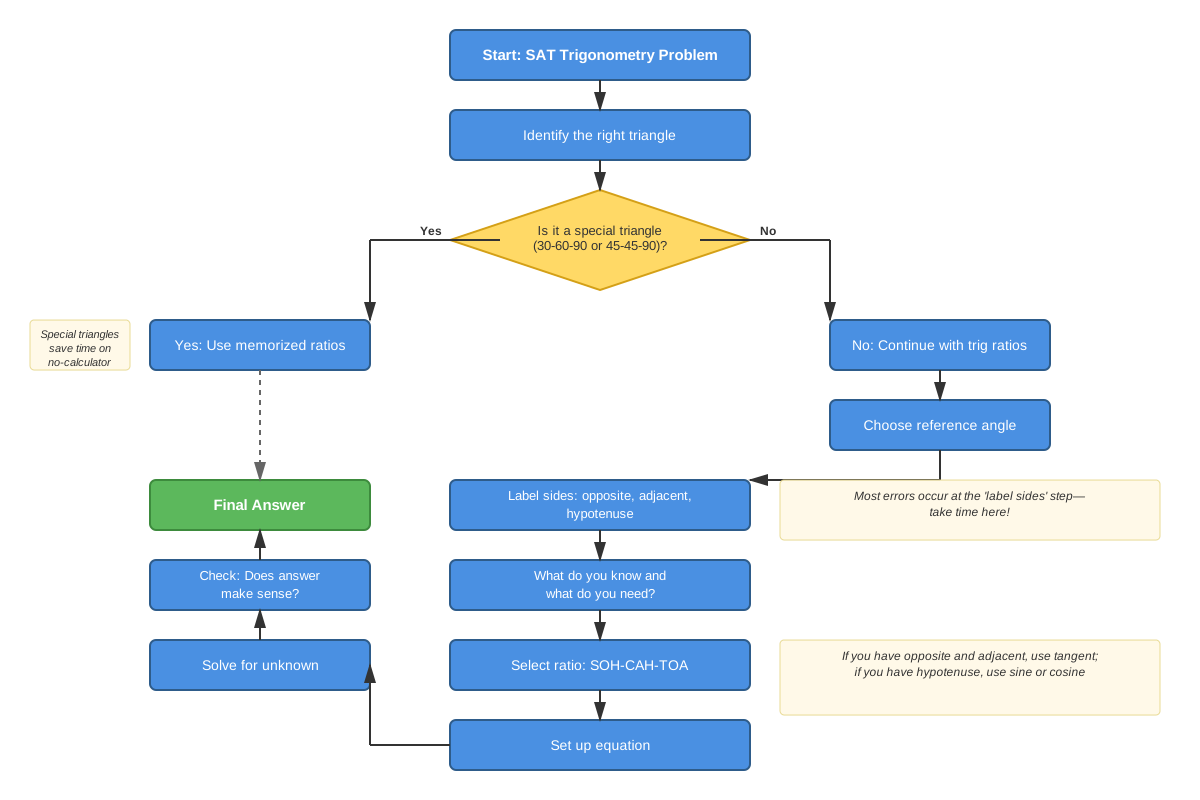
When approaching SAT questions involving trigonometric ratios, begin by identifying whether a right triangle is present or can be constructed from the given information. Look for the right angle symbol (a small square in the corner) or statements indicating a 90° angle. If the triangle isn't obviously a right triangle, the problem likely doesn't require trigonometric ratios.
Trigger words and phrases that signal trigonometric ratio questions include: "angle of elevation," "angle of depression," "forms an angle with," "incline," "slope," and any mention of sine, cosine, or tangent. Word problems involving ladders, ramps, shadows, or sight lines almost always involve right triangles and trigonometric ratios.
Step-by-step approach:
- Draw and label a diagram if one isn't provided
- Mark the right angle clearly
- Identify the angle for which you're calculating or using a ratio
- Label sides as opposite, adjacent, or hypotenuse relative to that angle
- Determine what's given and what's needed
- Select the appropriate ratio (SOH-CAH-TOA)
- Set up the equation and solve
Process-of-elimination tips: If answer choices include both exact values (like √3/2) and decimal approximations (like 0.866), the question likely appears in the no-calculator section and expects an exact answer. Eliminate decimal approximations. If answer choices show different trigonometric ratios (some with sine, others with cosine), check which sides of the triangle are involved in the problem—this immediately eliminates incorrect ratios.
Time allocation: Most trigonometric ratio questions should take 1-2 minutes. If a problem takes longer, verify that the correct ratio has been identified and that the opposite/adjacent sides are labeled correctly relative to the angle in question. Common time-wasters include using the wrong ratio or mislabeling sides.
Exam Tip: On calculator-permitted sections, verify special angle values (30°, 45°, 60°) using the calculator if uncertain. However, recognizing these values without calculation saves valuable time.
Common trap answers: The SAT often includes answer choices that result from using the wrong trigonometric ratio. For example, if the correct answer uses sine, trap answers might show what would result from using cosine or tangent instead. Always verify that the chosen ratio matches the given and needed information.
Memory Techniques
SOH-CAH-TOA remains the most effective mnemonic for remembering the three primary trigonometric ratios. To make it more memorable, create a phrase: "Some Old Hippie Caught Another Hippie Tripping On Acid" (or create a personal, school-appropriate version).
Visual memory technique: Picture a right triangle with a specific angle marked. Mentally label the three sides, then trace your finger from the angle to each side while saying "opposite," "adjacent," and "hypotenuse." Repeat this visualization until the labels become automatic.
Complementary angle mnemonic: Remember "COsine goes with COmplementary" to recall that cos(θ) = sin(90° - θ). The "co" prefix in both words signals their relationship.
Special angle values: For 30-60-90 triangles, remember the side ratio 1:√3:2, then derive trigonometric values. For 45-45-90 triangles, remember the sides are equal (ratio 1:1:√2), making sine and cosine equal. Create a small reference card with these values and review it daily until memorized.
Finger trick for special angles: Hold up your left hand with fingers spread. For angles 0°, 30°, 45°, 60°, 90° (represented by thumb through pinky), the sine values follow the pattern √0/2, √1/2, √2/2, √3/2, √4/2. Cosine values are the same pattern in reverse.
Acronym for problem-solving steps: DRAW - Diagram the problem, Recognize the right angle, Annotate sides (opposite, adjacent, hypotenuse), Write the appropriate ratio equation.
Summary
Trigonometric ratios—sine, cosine, and tangent—form essential tools for solving right triangle problems on the SAT. These ratios relate the sides of a right triangle to its acute angles through the formulas sin(θ) = opposite/hypotenuse, cos(θ) = adjacent/hypotenuse, and tan(θ) = opposite/adjacent, easily remembered through the mnemonic SOH-CAH-TOA. Success with these concepts requires correctly identifying which sides are opposite and adjacent relative to the angle in question, recognizing that the hypotenuse never changes. The SAT frequently tests special angle values (30°, 45°, 60°) that derive from special right triangles, as well as the complementary angle relationship where sin(θ) = cos(90° - θ). Questions appear in various formats: direct calculation of ratios from given side lengths, finding unknown sides using trigonometric equations, recognizing equivalent expressions through complementary relationships, and applying ratios to real-world scenarios involving angles of elevation, ramps, or shadows. Mastery requires both conceptual understanding of what each ratio represents and procedural fluency in setting up and solving equations.
Key Takeaways
- SOH-CAH-TOA encodes all three primary trigonometric ratios and should be memorized completely
- Always identify the angle first, then label sides as opposite, adjacent, or hypotenuse relative to that specific angle
- The sine of any angle equals the cosine of its complement: sin(θ) = cos(90° - θ)
- Special angles (30°, 45°, 60°) have exact trigonometric values that should be memorized or quickly derived from special right triangles
- Trigonometric ratios apply only to right triangles; always verify that a right angle exists before applying these formulas
- The hypotenuse is always the longest side and always opposite the right angle, regardless of which acute angle is being considered
- When solving for an unknown side, set up an equation with the appropriate ratio, substitute known values, and solve algebraically
Related Topics
Unit Circle and Radian Measure: While the SAT focuses primarily on right triangle trigonometry with degree measures, understanding how trigonometric ratios extend to the unit circle provides deeper insight and prepares students for calculus-level mathematics.
Law of Sines and Law of Cosines: These formulas extend trigonometry to non-right triangles, though they rarely appear on the SAT. Mastering right triangle trigonometry provides the foundation for these more advanced concepts.
Vectors and Components: Trigonometric ratios are essential for decomposing vectors into horizontal and vertical components, a concept that appears in physics and advanced mathematics courses.
Coordinate Geometry Applications: Trigonometric ratios help calculate distances, slopes, and angles in the coordinate plane, connecting geometry to algebra in ways the SAT frequently tests.
Three-Dimensional Geometry: Extending trigonometric concepts to three dimensions requires understanding how right triangles can be identified within 3D figures, a skill that builds directly on the concepts in this guide.
Practice CTA
Now that you've mastered the core concepts of trigonometric ratios, it's time to solidify your understanding through active practice. Attempt the practice questions designed specifically for this topic, focusing on applying SOH-CAH-TOA systematically to each problem. Use the flashcards to drill special angle values and complementary relationships until they become automatic. Remember, trigonometric ratios appear consistently on every SAT, making this practice time a high-yield investment in your score. Approach each practice problem methodically: draw diagrams, label sides carefully, and verify your ratio selection before calculating. With focused practice, these questions will become some of the fastest points you can earn on test day!
Sign up free to keep reading
Create a free AnvayaPrep account to finish this SAT guide on Trigonometric ratios — plus flashcards and practice questions.