Overview
The SAT Reading and Writing section tests not just whether students can read a passage, but whether they can read it with precision and resist the lure of cleverly designed incorrect answers. Common trap answers in details questions represent one of the most significant obstacles between students and their target scores. These questions ask test-takers to identify specific information stated or implied in a passage, and the College Board deliberately crafts wrong answers that appear correct at first glance. Understanding these traps is not merely helpful—it's essential for consistent performance.
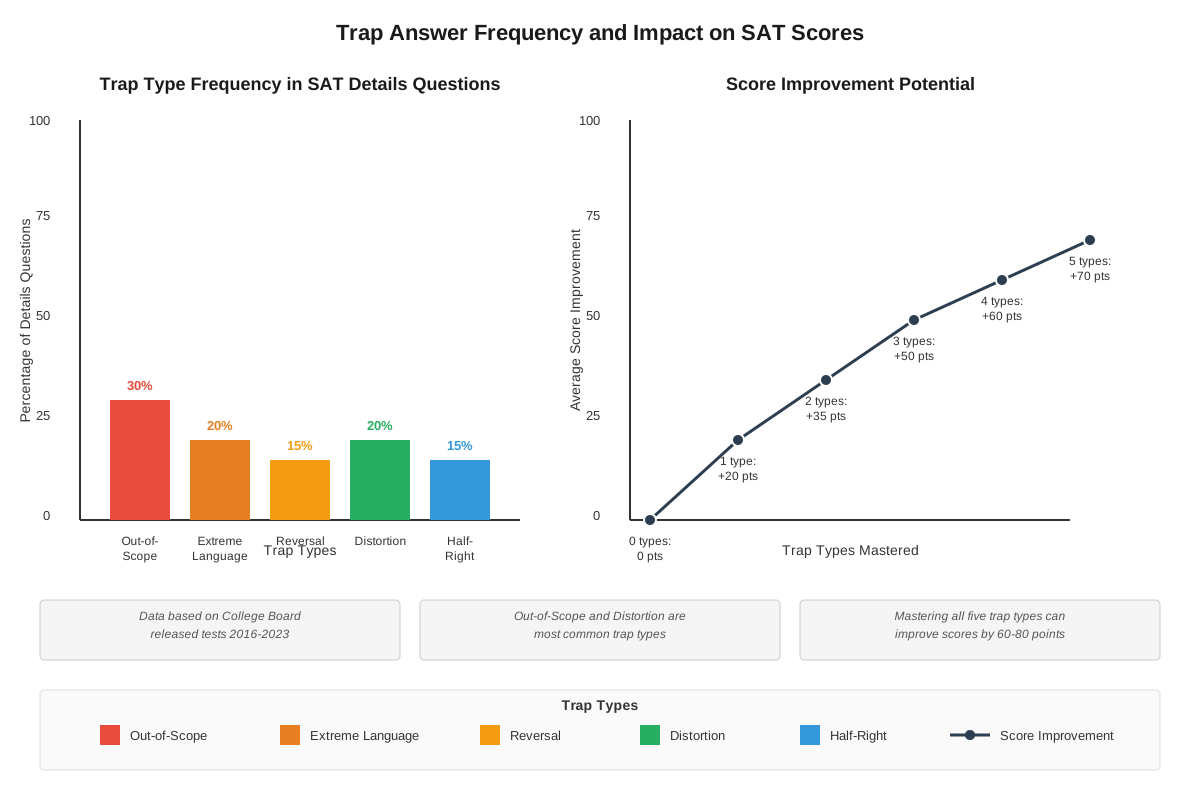
Details questions constitute approximately 20-25% of the Reading and Writing section, making them one of the most frequently tested question types. The SAT common trap answers in details questions follow predictable patterns that, once recognized, become significantly easier to avoid. These questions typically begin with phrases like "According to the passage," "The author indicates," or "Which statement is supported by the text?" While they may seem straightforward, the incorrect options are specifically engineered to exploit common reading errors: skimming too quickly, making unwarranted assumptions, or confusing similar concepts.
Mastering trap answer recognition connects directly to broader RW (Reading and Writing) skills including careful textual analysis, evidence-based reasoning, and critical reading comprehension. This topic builds upon fundamental passage comprehension skills while preparing students for more complex inference and synthesis questions. The ability to distinguish between what a passage actually states and what seems plausible represents a cornerstone skill that elevates performance across all question types in the Reading and Writing section.
Learning Objectives
- [ ] Identify key features of common trap answers in details questions
- [ ] Explain how common trap answers in details questions appears on the SAT
- [ ] Apply common trap answers in details questions to answer SAT-style questions
- [ ] Distinguish between textually supported details and plausible-sounding distractors
- [ ] Recognize the five major categories of trap answers and their distinguishing characteristics
- [ ] Develop a systematic approach to eliminating trap answers before selecting the correct response
- [ ] Analyze answer choices for subtle word changes that alter meaning from the passage
Prerequisites
- Basic reading comprehension: The ability to understand main ideas and supporting details in college-level texts is fundamental, as trap answer recognition requires first understanding what the passage actually communicates.
- Vocabulary knowledge: Familiarity with common SAT-level vocabulary enables students to detect subtle meaning shifts between passage language and answer choice language.
- Passage annotation skills: The practice of marking key information while reading helps students return to specific textual evidence when evaluating answer choices.
- Understanding of question stems: Recognizing what different question types ask for (stated information vs. inference vs. purpose) helps students apply appropriate evaluation criteria.
Why This Topic Matters
In real-world contexts, the ability to distinguish between what a source actually states and what seems reasonable but unsupported is critical for academic research, professional communication, and informed citizenship. Students who master this skill become better consumers of information, more careful readers of contracts and policies, and more effective researchers who can accurately cite sources.
On the SAT specifically, details questions appear in approximately 10-12 questions per test across the Reading and Writing section. These questions carry the same weight as more complex inference or rhetorical analysis questions, making them high-value targets for score improvement. The College Board reports that mid-range scorers (500-600) frequently miss details questions not because they misunderstand the passage, but because they select trap answers that seem correct without careful verification.
Details questions typically appear with passages ranging from 25-150 words across diverse subjects including literature, history, science, and social studies. Common question formats include: "According to the text, what is true about X?", "The author indicates that...", "Which statement about X is supported by the passage?", and "Based on the text, how does Y relate to Z?" Each format invites specific trap answer types that exploit predictable reading errors. Understanding these patterns transforms details questions from unpredictable challenges into systematic opportunities for correct answers.
Core Concepts
The Five Major Trap Answer Categories
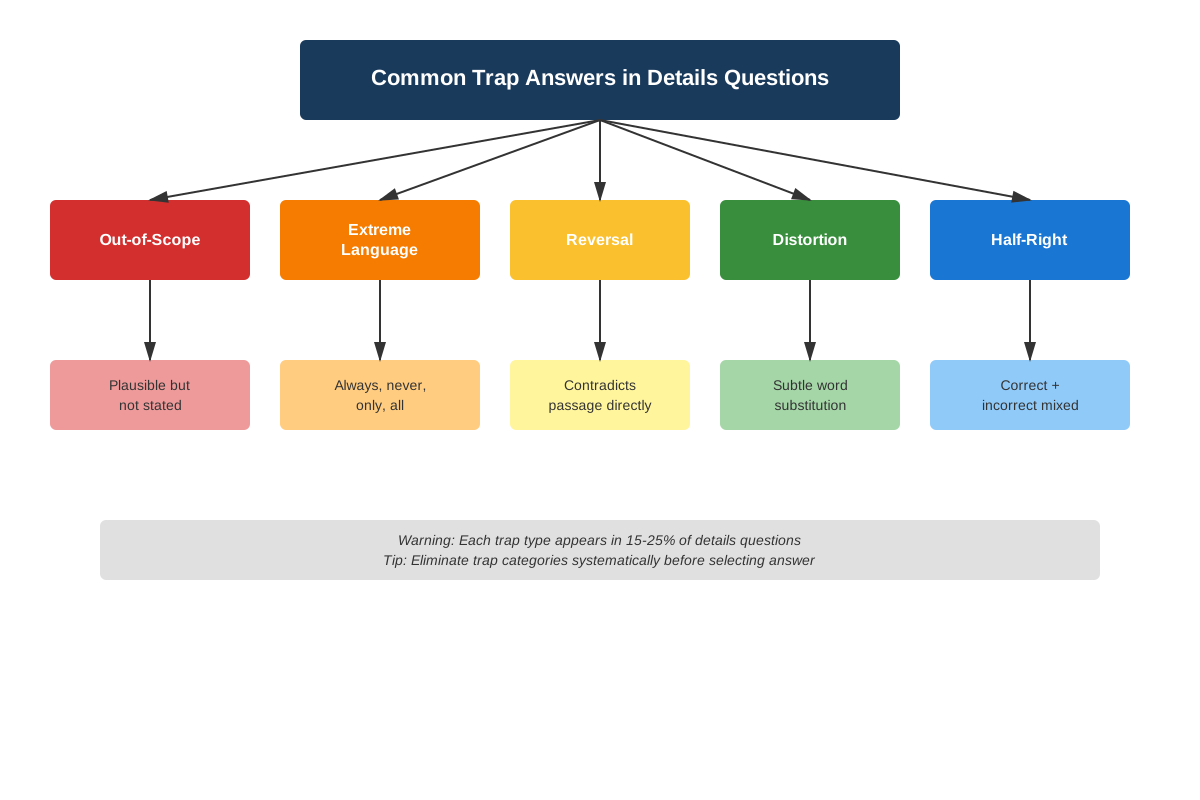
Common trap answers in details questions fall into five primary categories, each exploiting a different aspect of how readers process information. Recognizing these categories enables systematic elimination of incorrect options.
1. The "Too Extreme" Trap
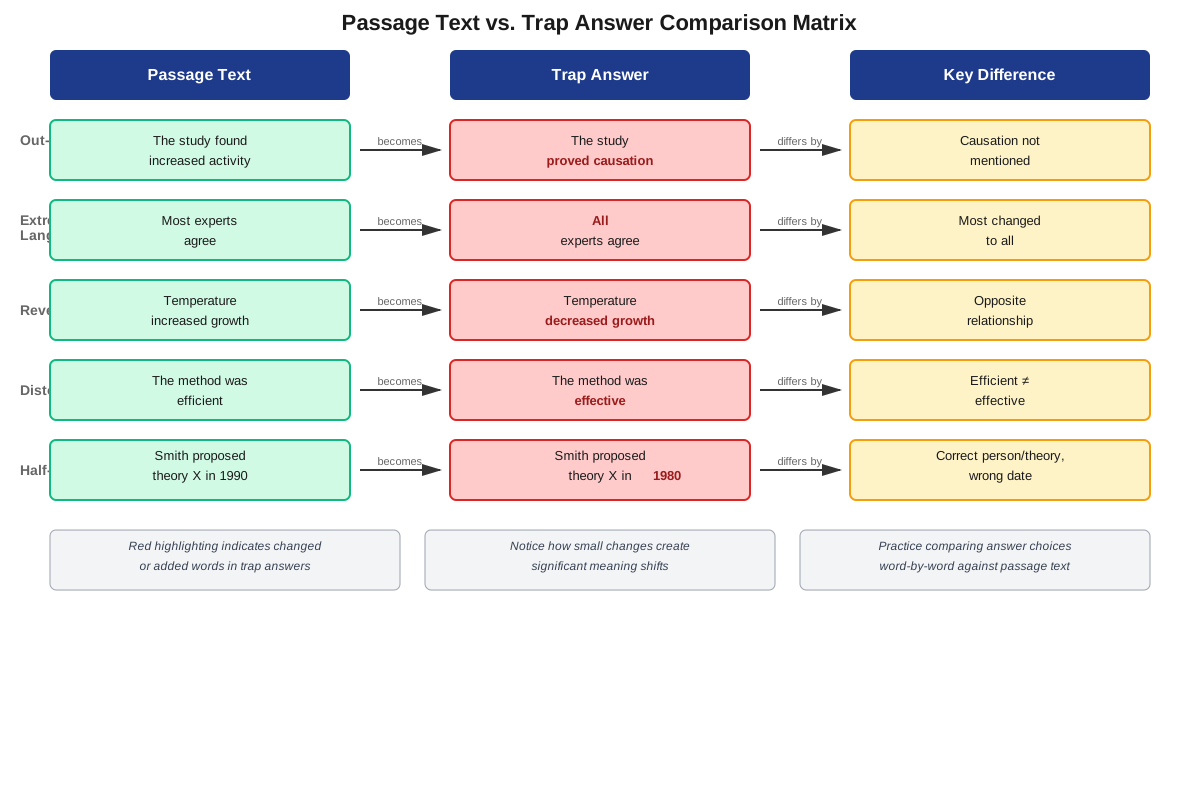
This trap answer takes information from the passage and intensifies it beyond what the text actually supports. The passage might state that something is "often" true, while the trap answer claims it is "always" true. Similarly, the passage might describe something as "significant," but the trap answer escalates this to "the most important factor."
Key indicators: Absolute language including always, never, only, must, impossible, all, none, completely, entirely, exclusively, and definitively. While not every answer with these words is wrong, they signal the need for careful verification against the passage.
2. The "Out of Scope" Trap
These answers introduce information that seems related to the passage topic but isn't actually mentioned or supported by the text. The trap exploits students' background knowledge or assumptions about the subject matter. For instance, if a passage discusses renewable energy benefits, an out-of-scope trap might mention specific government policies that weren't discussed in the passage.
Key indicators: Information that seems plausible and topically relevant but cannot be traced to specific passage sentences. These answers often feel "right" based on general knowledge rather than textual evidence.
3. The "Distortion" Trap
Distortion traps use actual words and phrases from the passage but twist their meaning, reverse relationships, or misrepresent the context. A passage might state "A causes B," while the distortion trap claims "B causes A." Alternatively, the passage might present something as a problem, while the trap answer presents it as a solution.
Key indicators: Familiar vocabulary from the passage arranged in ways that subtly alter meaning. These require the most careful reading because they contain genuine passage elements in incorrect configurations.
4. The "Wrong Detail" Trap
This category includes information that is actually stated in the passage but doesn't answer the specific question being asked. The passage might discuss multiple subjects or time periods, and the wrong detail trap pulls accurate information from the wrong section. This trap exploits students who recognize passage content without verifying it addresses the question.
Key indicators: Statements that are textually accurate but irrelevant to the question stem. These require careful attention to what the question specifically asks.
5. The "Opposite" Trap
These answers directly contradict what the passage states, often by adding or removing negation. If the passage says "Scientists have not found evidence of X," the opposite trap might claim "Scientists have confirmed X." This trap catches students who skim quickly or confuse similar-sounding concepts.
Key indicators: Answers that reverse the passage's stance, negate positive statements, or affirm negative statements. These often involve words like "not," "un-," "dis-," or "in-" prefixes.
The Anatomy of a Details Question
Understanding the structure of details questions helps identify where traps typically appear:
| Question Component | Purpose | Trap Vulnerability |
|---|---|---|
| Question stem | Directs attention to specific passage content | May be misread, causing focus on wrong passage section |
| Correct answer | Directly supported by passage text | Often uses synonyms rather than exact passage language |
| Trap answer 1 | Usually "too extreme" or "distortion" | Most tempting to students who understood passage generally |
| Trap answer 2 | Typically "out of scope" or "wrong detail" | Catches students using background knowledge |
| Trap answer 3 | Often "opposite" or another "distortion" | Traps students who skimmed or misread key words |
The Verification Process
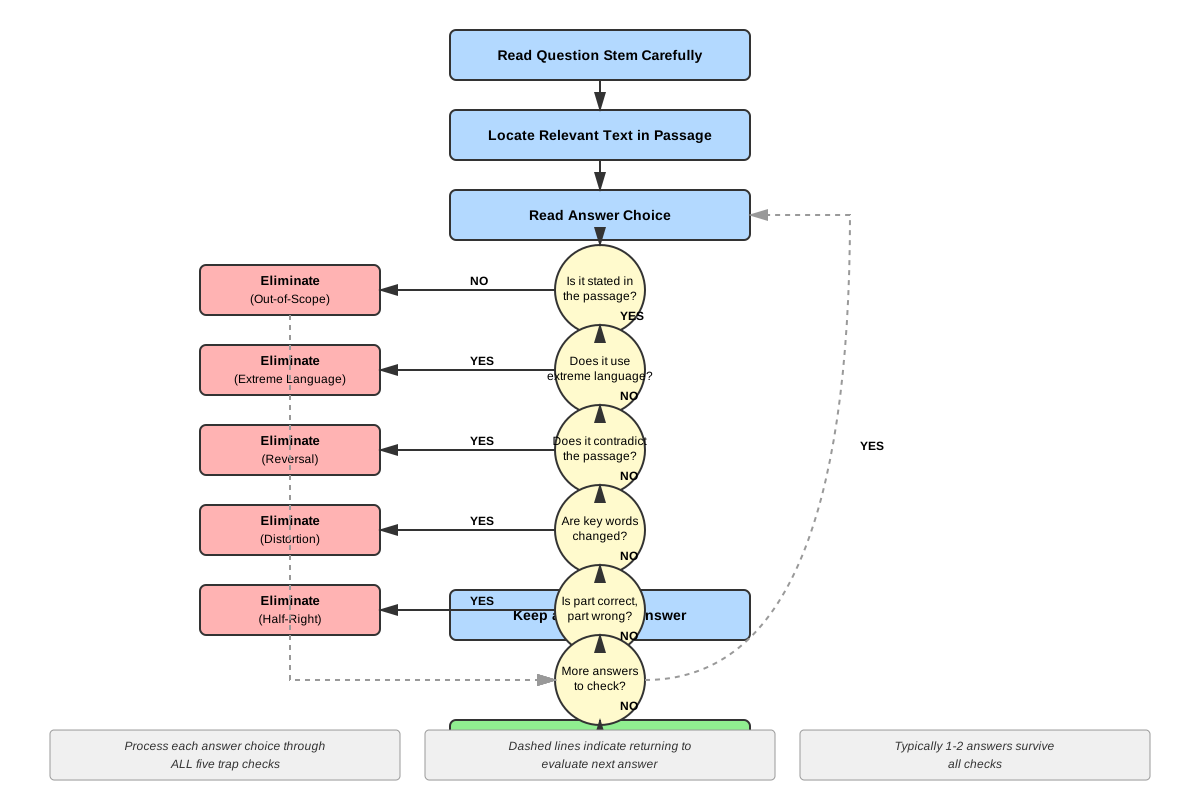
Effective trap answer avoidance requires a systematic verification process:
- Read the question stem carefully: Identify exactly what information is being requested and any limiting factors (time period, specific subject, particular relationship).
- Return to the passage: Locate the relevant section before looking at answer choices. This prevents answers from influencing interpretation.
- Predict an answer: Based on passage content, formulate what the correct answer should convey before evaluating options.
- Evaluate each choice against passage text: For each answer, identify the specific sentence(s) that would support it. If no specific support exists, eliminate it.
- Watch for synonym substitution: The correct answer often paraphrases passage content rather than quoting it directly, while trap answers may use exact passage words in incorrect contexts.
Language Precision Markers
The SAT tests reading precision through subtle language variations. Understanding these markers helps distinguish correct from incorrect answers:
Degree modifiers: Words like "somewhat," "generally," "often," "may," and "can" indicate qualified claims that are easier to support than absolute statements. Correct answers frequently use moderate language matching the passage's level of certainty.
Causal language: Words like "causes," "results in," "leads to," and "produces" establish specific relationships. Trap answers often confuse correlation with causation or reverse causal directions.
Temporal markers: Words like "before," "after," "during," "initially," and "eventually" establish sequence. Trap answers may present events in incorrect chronological order.
Scope indicators: Words like "some," "many," "most," and "all" define the breadth of claims. Trap answers frequently expand scope beyond what the passage supports.
Concept Relationships
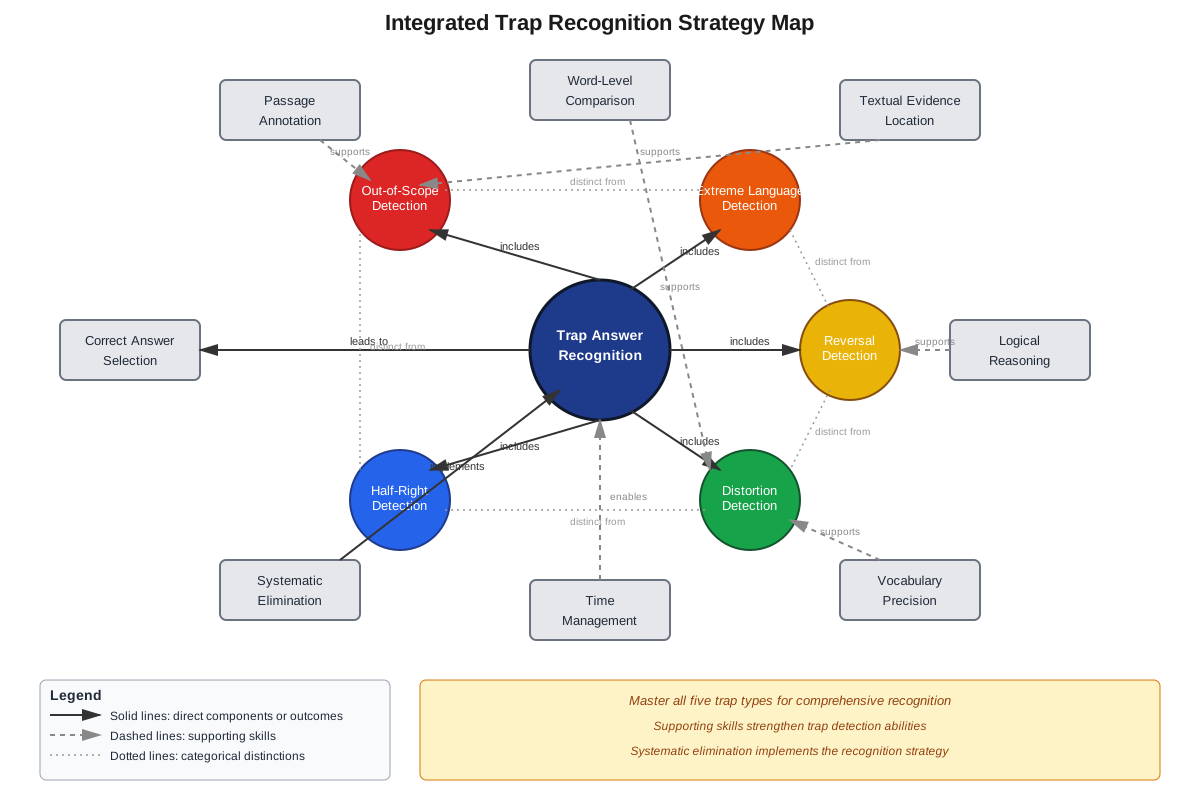
The five trap answer categories interconnect in important ways. Too extreme traps and distortion traps both involve taking passage information and altering it, but extreme traps change degree while distortions change meaning or relationships. Out of scope traps differ fundamentally from wrong detail traps: out-of-scope information isn't in the passage at all, while wrong details are in the passage but don't answer the question. Opposite traps represent an extreme form of distortion where the meaning is completely reversed.
These trap types connect to the verification process through a hierarchy of elimination. Out of scope and opposite traps are typically easiest to eliminate because they lack textual support or directly contradict the passage. Wrong detail traps require careful attention to the question stem. Too extreme and distortion traps demand the most careful reading because they contain elements of truth that have been subtly altered.
The relationship map flows as follows:
Careful passage reading → Understanding question requirements → Locating relevant passage section → Recognizing trap answer patterns → Systematic elimination → Verification of correct answer → Confident selection
This process connects to prerequisite skills: vocabulary knowledge enables detection of subtle meaning shifts (distortion traps), annotation skills facilitate returning to relevant passage sections (avoiding wrong detail traps), and comprehension skills provide the foundation for recognizing when information is out of scope or too extreme.
High-Yield Facts
⭐ Approximately 20-25% of SAT Reading and Writing questions are details questions, making trap answer recognition a high-impact skill.
⭐ The correct answer to a details question is always directly supported by specific passage text, never by background knowledge or assumptions.
⭐ Trap answers most frequently fall into five categories: too extreme, out of scope, distortion, wrong detail, and opposite.
⭐ Words indicating absolute certainty (always, never, only, must, all, none) appear more frequently in trap answers than correct answers.
⭐ The correct answer often uses synonyms or paraphrases of passage content rather than exact quotations, while trap answers may use passage words in incorrect contexts.
- Distortion traps are the most sophisticated trap type, requiring careful verification of relationships and context, not just vocabulary recognition.
- Wrong detail traps exploit students who recognize passage content without verifying it answers the specific question being asked.
- Out of scope traps frequently introduce plausible information about the passage topic that wasn't actually discussed in the text.
- Opposite traps often involve subtle negation words (not, un-, dis-, in-) that reverse passage meaning.
- The verification process should always move from passage to answer choices, not from answer choices back to passage, to avoid confirmation bias.
- Moderate, qualified language in answer choices (often, may, can, some, generally) typically indicates careful, supportable claims more likely to be correct.
- Causal language (causes, results in, leads to) in answer choices requires verification that the passage establishes that specific relationship, not just mentions both elements.
Quick check — test yourself on Common trap answers in details questions so far.
Try Flashcards →Common Misconceptions
Misconception: If an answer choice contains words directly from the passage, it must be correct.
Correction: Trap answers frequently use exact passage vocabulary but arrange it incorrectly or place it in wrong contexts. The distortion trap specifically exploits this by using familiar words in unfamiliar configurations. Correct answers often paraphrase passage content using synonyms.
Misconception: The longest or most detailed answer choice is usually correct.
Correction: Answer length has no correlation with correctness on the SAT. The College Board deliberately varies answer length to prevent pattern-based guessing. Some correct answers are concise; others are detailed. Evaluate based on textual support, not length.
Misconception: If something is generally true about the topic, it's a safe answer choice even if the passage doesn't explicitly state it.
Correction: Details questions test what the passage states or directly supports, not general knowledge about the topic. Out of scope traps specifically exploit this misconception by presenting topically relevant but textually unsupported information.
Misconception: Extreme language (always, never, only) automatically makes an answer wrong.
Correction: While extreme language appears more frequently in trap answers, some correct answers use absolute language when the passage genuinely supports it. The key is verification: does the passage actually support this level of certainty? Don't eliminate based on language alone; verify against the text.
Misconception: The correct answer will be obvious after reading the passage once.
Correction: The SAT deliberately designs details questions to require careful verification. Even strong readers must return to the passage to confirm answer choices. The verification process isn't a sign of weakness; it's the intended approach.
Misconception: If an answer seems too simple or obvious, it's probably a trap.
Correction: Some details questions have straightforward correct answers. Second-guessing simple answers that are clearly supported by the passage leads to unnecessary errors. Trust textual evidence over intuition about difficulty.
Worked Examples
Example 1: Scientific Passage
Passage: "Recent studies of coral reef ecosystems have revealed that parrotfish play a crucial role in maintaining reef health. By consuming algae that would otherwise overwhelm coral structures, parrotfish populations help preserve the delicate balance necessary for coral survival. However, overfishing has significantly reduced parrotfish numbers in many Caribbean reefs, and researchers have observed corresponding increases in algae coverage. While some conservation efforts have focused on establishing marine protected areas, scientists note that these measures alone may not be sufficient without concurrent efforts to restore parrotfish populations."
Question: According to the passage, what role do parrotfish play in coral reef ecosystems?
Answer Choices:
A) They are the most important species for reef survival and must be protected above all other conservation priorities.
B) They help maintain reef health by consuming algae that could otherwise harm coral structures.
C) They have been successfully restored through marine protected areas in the Caribbean.
D) They prevent all algae growth in healthy reef ecosystems.
Analysis:
Choice A - This is a too extreme trap. The passage states parrotfish play "a crucial role" but never claims they are "the most important species" or should be protected "above all other conservation priorities." The passage actually suggests multiple conservation approaches are needed. Eliminate.
Choice B - This directly paraphrases the passage: "By consuming algae that would otherwise overwhelm coral structures, parrotfish populations help preserve the delicate balance necessary for coral survival." The answer uses "help maintain reef health" (synonym for "preserve the delicate balance necessary for coral survival") and "consuming algae that could otherwise harm coral structures" (paraphrase of "consuming algae that would otherwise overwhelm coral structures"). This is correct.
Choice C - This is a distortion trap. The passage mentions marine protected areas as conservation efforts but explicitly states these "may not be sufficient without concurrent efforts to restore parrotfish populations." The passage does not claim parrotfish have been "successfully restored." Eliminate.
Choice D - This is a too extreme trap using absolute language. The passage states parrotfish "consume algae," but never claims they "prevent all algae growth." The word "all" makes this unsupportable. Eliminate.
Correct Answer: B
Example 2: Historical Passage
Passage: "The Harlem Renaissance of the 1920s represented a flourishing of African American artistic and intellectual achievement. Writers like Langston Hughes and Zora Neale Hurston gained national recognition, while musicians such as Duke Ellington transformed American jazz. Although centered in New York City's Harlem neighborhood, the movement's influence extended throughout the United States and even internationally. The Renaissance emerged partly as a response to the Great Migration, during which hundreds of thousands of African Americans moved from the rural South to northern cities seeking economic opportunities and escape from Jim Crow segregation."
Question: Based on the passage, which statement about the Harlem Renaissance is supported?
Answer Choices:
A) The movement was exclusively limited to Harlem and did not affect other regions.
B) Economic factors were the sole cause of the cultural flowering in Harlem.
C) The movement included achievements in both literature and music.
D) Langston Hughes was the most influential figure of the entire Renaissance period.
Analysis:
Choice A - This is an opposite trap. The passage explicitly states "Although centered in New York City's Harlem neighborhood, the movement's influence extended throughout the United States and even internationally." This directly contradicts the claim that it was "exclusively limited to Harlem." Eliminate.
Choice B - This is a too extreme trap. The passage mentions economic opportunities as one factor ("seeking economic opportunities and escape from Jim Crow segregation"), but the word "sole" makes this unsupportable. The passage indicates multiple factors, including escaping segregation. Eliminate.
Choice C - This is directly supported by the passage: "Writers like Langston Hughes and Zora Neale Hurston gained national recognition, while musicians such as Duke Ellington transformed American jazz." Literature (writers) and music (musicians) are both explicitly mentioned. This is correct.
Choice D - This is a too extreme trap. While the passage mentions Langston Hughes as one writer who "gained national recognition," it never claims he was "the most influential figure." Multiple artists are mentioned without ranking. Eliminate.
Correct Answer: C
Exam Strategy
Systematic Approach to Details Questions
Step 1: Identify the question type - Confirm this is asking for stated or directly supported information (key phrases: "according to the passage," "the text indicates," "which statement is supported").
Step 2: Note specific requirements - Identify any limiting factors in the question stem (specific subject, time period, relationship, or aspect being asked about).
Step 3: Return to passage before reading choices - Locate the relevant section and refresh understanding of what it actually states. This prevents answer choices from biasing interpretation.
Step 4: Predict the answer - Formulate what the correct answer should convey based on passage content. This prediction serves as a benchmark for evaluating choices.
Step 5: Eliminate systematically - Evaluate each choice against the passage, actively looking for trap patterns:
- Does this use extreme language unsupported by the passage?
- Does this introduce information not in the passage?
- Does this twist passage meaning or relationships?
- Does this answer the wrong question?
- Does this contradict the passage?
Step 6: Verify the remaining choice - Before selecting, confirm the answer is directly supported by specific passage text.
Trigger Words and Phrases
In question stems, watch for:
- "According to the passage" = must be explicitly stated
- "The author indicates" = may be directly stated or clearly implied
- "Which statement is supported" = requires textual evidence
- "Based on the text" = must derive from passage content
In answer choices, be alert for:
- Extreme language: always, never, only, must, all, none, completely, entirely, impossible, exclusively
- Causal claims: causes, results in, leads to, produces, creates (verify the passage establishes this relationship)
- Superlatives: most, least, best, worst, primary, main (verify the passage makes this ranking)
- Negation: not, un-, dis-, in-, never (verify this matches passage meaning)
Process of Elimination Tips
Eliminate first: Answers that introduce information clearly not discussed in the passage (out of scope) or that directly contradict passage statements (opposite).
Eliminate second: Answers that use passage vocabulary but don't answer the specific question being asked (wrong detail).
Evaluate carefully: Answers with extreme language or distorted relationships. These require word-by-word verification against the passage.
Confirm finally: The remaining answer by locating specific passage support. Never select by elimination alone without positive verification.
Time Allocation
Details questions should take approximately 45-60 seconds each:
- 10-15 seconds: Read and understand the question
- 15-20 seconds: Locate and review relevant passage section
- 20-25 seconds: Evaluate answer choices and eliminate traps
- 5-10 seconds: Verify correct answer
If a details question exceeds 90 seconds, mark it for review and move forward. These questions should be among the faster question types since they require finding stated information rather than complex inference.
Memory Techniques
The SCOPE Acronym for Trap Recognition
Superlatives and extreme language (always, never, most, only)
Contradictions of passage statements (opposite traps)
Outside information not in the passage (out of scope)
Passage words in wrong contexts (distortions)
Elsewhere in passage but wrong for this question (wrong detail)
The Three-Point Verification System
Remember: "Find it, Match it, Check it"
- Find it: Locate the specific passage section relevant to the question
- Match it: Identify which answer choice aligns with passage meaning (not just words)
- Check it: Verify no subtle distortions or scope changes exist
Visualization Strategy
Picture a spotlight on the passage. The question stem directs where the spotlight shines. Correct answers stay within the spotlight's circle. Trap answers either:
- Shine the spotlight on the wrong passage section (wrong detail)
- Claim to see things outside the spotlight (out of scope)
- Distort what's visible in the spotlight (distortion/extreme/opposite)
The "Prove It" Mantra
Before selecting any answer, mentally state: "I can prove this with specific passage text." If you cannot point to specific words or sentences supporting the answer, it's likely a trap.
Summary
Common trap answers in details questions represent predictable patterns that, once recognized, transform these questions from unpredictable challenges into systematic scoring opportunities. The five major trap categories—too extreme, out of scope, distortion, wrong detail, and opposite—exploit specific reading errors including skimming, assumption-making, and imprecise verification. Success requires a systematic approach: carefully reading the question stem, returning to the relevant passage section before evaluating choices, recognizing trap patterns through language markers, and verifying the correct answer against specific textual evidence. The correct answer to a details question is always directly supported by passage text, often using paraphrases or synonyms rather than exact quotations, while trap answers frequently use passage vocabulary in incorrect contexts or introduce plausible but unsupported information. Mastering trap recognition requires understanding that details questions test reading precision—the ability to distinguish between what a passage actually states and what seems reasonable but lacks textual support.
Key Takeaways
- Details questions constitute 20-25% of SAT Reading and Writing questions, making trap answer recognition essential for score improvement
- The five trap categories (too extreme, out of scope, distortion, wrong detail, opposite) account for virtually all incorrect answer choices in details questions
- Extreme language (always, never, only, all, none) appears more frequently in trap answers than correct answers and signals the need for careful verification
- The correct answer is always directly supported by specific passage text, never by background knowledge, and often uses synonyms rather than exact passage words
- Systematic verification—returning to the passage before evaluating choices and confirming textual support—prevents trap answer selection
- Distortion traps are the most sophisticated, using passage vocabulary in incorrect contexts or reversing relationships
- The SCOPE acronym (Superlatives, Contradictions, Outside info, Passage words misused, Elsewhere in passage) provides a systematic framework for trap recognition
Related Topics
Inference Questions in Reading and Writing: While details questions ask for stated information, inference questions require drawing conclusions from textual evidence. Mastering trap answers in details questions provides the foundation for recognizing unsupported inferences, as both question types require distinguishing between what the passage supports and what seems plausible.
Command of Evidence Questions: These questions explicitly ask students to identify which passage excerpt best supports a previous answer. The skills developed in verifying details against passage text directly transfer to selecting appropriate evidence citations.
Vocabulary in Context: Understanding how words function in specific contexts helps recognize distortion traps that use passage vocabulary incorrectly. The precision required for vocabulary questions reinforces the careful reading necessary for avoiding details question traps.
Rhetorical Synthesis: Higher-level questions asking about passage purpose or structure build upon the foundational skill of accurately identifying what passages state. Students who master details questions develop the textual precision necessary for more complex analytical tasks.
Practice CTA
Now that you understand the patterns behind common trap answers in details questions, it's time to apply this knowledge. The practice questions and flashcards will help you recognize these traps in real SAT contexts and build the automatic recognition that leads to faster, more confident performance. Remember: every trap answer you correctly identify is a point earned. These patterns are predictable—master them, and details questions become one of your most reliable scoring opportunities. Start practicing, and watch your accuracy improve!
Sign up free to keep reading
Create a free AnvayaPrep account to finish this SAT guide on Common trap answers in details questions — plus flashcards and practice questions.