Overview
Connecting details to claims is a foundational skill tested extensively throughout the SAT Reading and Writing section. This skill requires students to evaluate whether specific textual evidence logically supports, illustrates, or proves a given assertion or argument. On the SAT, questions assessing this ability typically present a claim followed by four answer choices, each containing different details from a passage or research finding. Students must identify which detail most effectively supports or completes the claim. This question type appears frequently in the RW (Reading and Writing) section and represents one of the most direct assessments of analytical reading comprehension.
Mastering this topic is essential because it forms the backbone of critical thinking and evidence-based reasoning—skills that permeate every aspect of the SAT Reading and Writing section. Unlike questions that simply ask for main ideas or vocabulary definitions, sat connecting details to claims questions require students to understand both the logical structure of arguments and the relationship between general statements and specific supporting information. These questions test whether students can distinguish between relevant and irrelevant evidence, recognize when details genuinely support a claim versus merely relating to the same topic, and evaluate the strength of evidentiary connections.
This topic connects directly to other central concepts in SAT Reading and Writing, including identifying main ideas, understanding textual evidence, analyzing argumentative structure, and evaluating the effectiveness of supporting details. Students who excel at connecting details to claims demonstrate sophisticated reading comprehension that extends beyond surface-level understanding to encompass logical reasoning and analytical evaluation. This skill translates directly to college-level academic work, where constructing and evaluating evidence-based arguments is fundamental to success across all disciplines.
Learning Objectives
- [ ] Identify key features of connecting details to claims
- [ ] Explain how connecting details to claims appears on the SAT
- [ ] Apply connecting details to claims to answer SAT-style questions
- [ ] Distinguish between details that directly support a claim versus those that are merely related to the topic
- [ ] Evaluate the relative strength of different pieces of evidence in supporting a specific assertion
- [ ] Recognize common patterns in how SAT questions frame claims and present supporting details
- [ ] Analyze the logical relationship between general statements and specific examples or data
Prerequisites
- Reading comprehension fundamentals: Understanding main ideas, supporting details, and paragraph structure is necessary because connecting details to claims builds upon the ability to identify what information a passage contains
- Basic logical reasoning: Recognizing cause-and-effect relationships and understanding how evidence supports conclusions provides the foundation for evaluating whether details adequately support claims
- Vocabulary in context: Comprehending the precise meaning of words and phrases ensures accurate interpretation of both claims and the details that might support them
- Identifying central ideas: Distinguishing between main points and supporting information helps students recognize the hierarchical relationship between claims and details
Why This Topic Matters
In academic and professional contexts, the ability to connect details to claims is fundamental to critical thinking, research evaluation, and persuasive communication. Scientists must link experimental data to hypotheses, historians must connect primary sources to interpretive arguments, and business professionals must support recommendations with relevant evidence. This skill enables students to become discerning consumers of information who can evaluate whether arguments are well-supported or rely on weak, irrelevant, or misleading evidence.
On the SAT, connecting details to claims questions appear with high frequency, typically comprising 13-15% of all Reading and Writing questions. Students can expect to encounter approximately 5-7 questions of this type across the entire exam. These questions appear in both literary and informational passages, spanning topics from science and social studies to humanities and literature. The College Board considers this skill essential for college readiness because it directly reflects the analytical demands of undergraduate coursework.
Common manifestations of this topic on the SAT include questions that ask students to identify which finding from a study best supports a researcher's conclusion, which quotation from a text most effectively illustrates a character's trait, which data point best completes a claim about a trend, or which example most strongly supports a generalization about a phenomenon. The questions typically follow a consistent format: a claim or partial claim is presented, followed by four options containing different details, only one of which provides the most logical and direct support for the claim.
Core Concepts
Understanding Claims
A claim is an assertion, argument, or statement that requires support through evidence, examples, or reasoning. Claims can be factual assertions ("The population increased"), interpretive statements ("The author uses imagery to convey isolation"), or argumentative positions ("This policy would be effective"). On the SAT, claims vary in specificity and scope. Some are broad generalizations requiring illustrative examples, while others are specific assertions requiring precise data or quotations.
Claims possess several key characteristics that students must recognize. First, claims are debatable or non-obvious—they present information that requires substantiation rather than self-evident facts. Second, claims establish a direction or focus that constrains what kind of evidence would be relevant. A claim about increasing temperatures requires numerical data, while a claim about a character's motivation requires textual evidence of thoughts or actions. Third, claims often contain qualifying language (such as "primarily," "suggests," or "one factor") that affects what evidence would appropriately support them.
Understanding Details
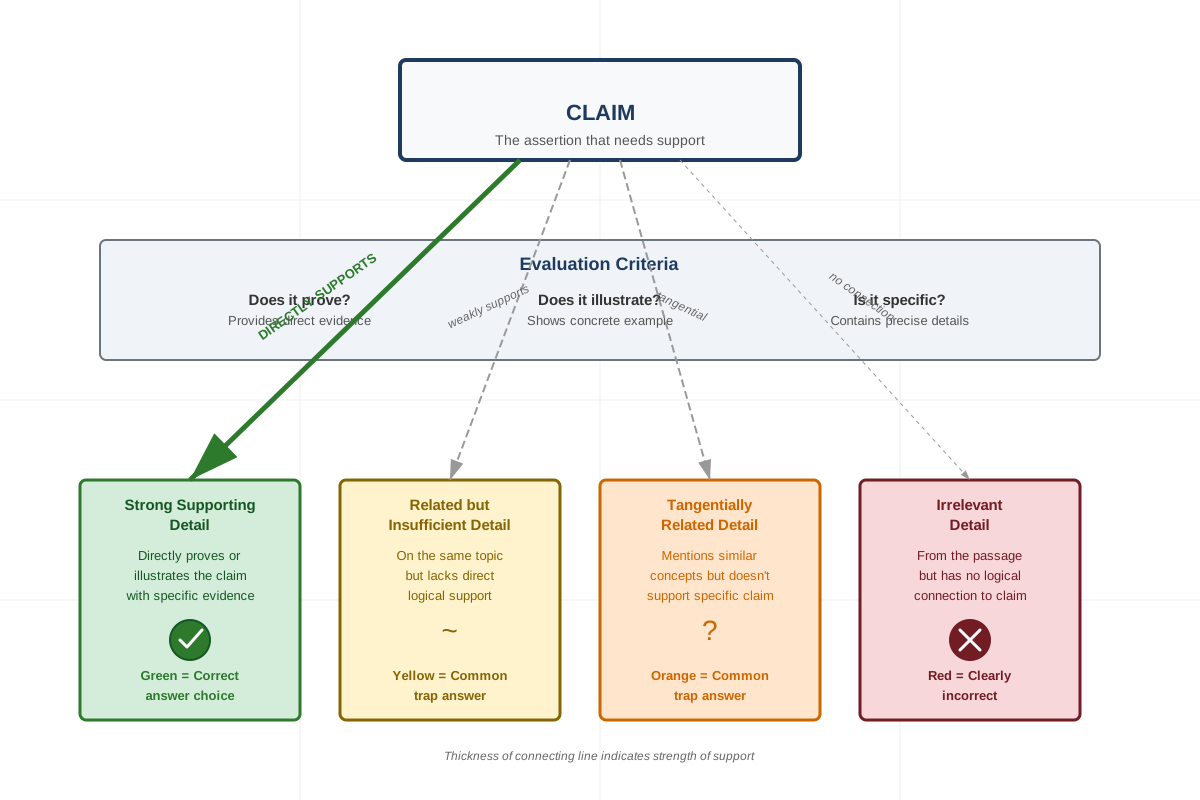
Details are specific pieces of information—facts, data points, quotations, examples, or observations—that can potentially support claims. Not all details are created equal in their evidentiary value. The SAT tests whether students can distinguish between details that directly support a claim, details that are related but tangential, and details that are irrelevant or contradictory.
Effective supporting details share several characteristics. They must be relevant to the specific claim being made, addressing the same subject matter and aspect. They must be sufficient in specificity and strength to actually prove or illustrate the claim. They must be logically connected to the claim through a clear reasoning pathway. Finally, they must be appropriate in type to the claim—quantitative claims require numerical evidence, while qualitative claims require descriptive or illustrative evidence.
The Connection Between Claims and Details
The relationship between claims and details operates through logical reasoning pathways. Understanding these pathways is crucial for SAT success. The most common relationships include:
| Relationship Type | Description | Example |
|---|---|---|
| Illustration | Detail provides a specific example of a general claim | Claim: "The novel depicts social inequality." Detail: "The protagonist lives in poverty while wealthy characters attend lavish parties." |
| Quantification | Detail provides numerical data supporting a measurable claim | Claim: "The temperature increased significantly." Detail: "Temperature rose from 15°C to 28°C over the decade." |
| Causation | Detail explains the mechanism or reason behind a claim | Claim: "The policy reduced pollution." Detail: "Emissions decreased by 40% after implementation." |
| Comparison | Detail provides comparative information supporting a relative claim | Claim: "Species A is more adaptable than Species B." Detail: "Species A survived in 15 environments while Species B survived in only 3." |
Evaluating Evidence Strength
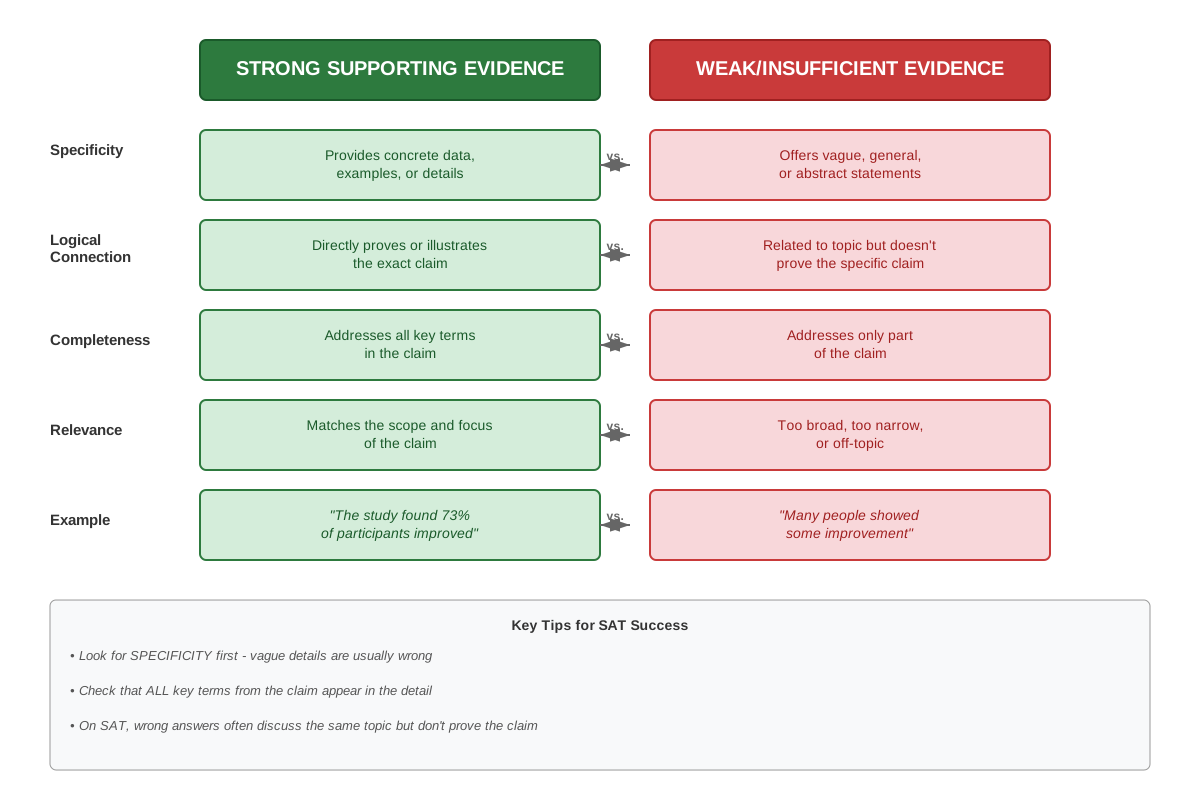
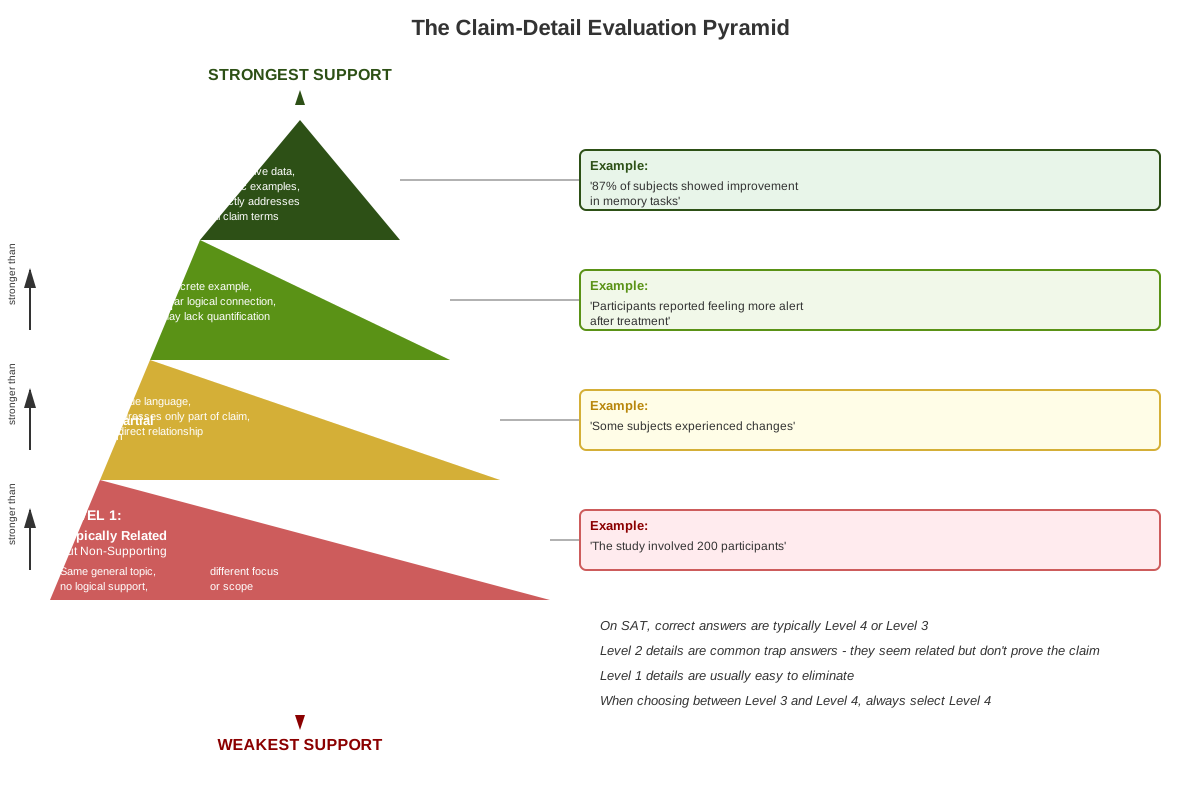
Not all supporting details are equally strong. The SAT frequently includes answer choices with details that are related to the topic but don't directly support the specific claim. Students must evaluate evidence strength by considering several factors:
Directness: The strongest evidence directly addresses the claim without requiring additional inferential steps. If a claim states that a character is courageous, a quotation showing the character facing danger is more direct than a quotation showing the character being praised by others.
Specificity: More specific details generally provide stronger support than vague or general statements. A claim about population growth is better supported by "population increased from 50,000 to 75,000" than by "population changed over time."
Relevance: The detail must address the precise aspect of the claim. If a claim focuses on economic impacts, environmental data—however interesting—would be less relevant than economic data.
Completeness: The detail should fully support the claim without leaving logical gaps. Partial support or support that requires additional unstated assumptions is weaker than complete, self-sufficient support.
Common Question Formats
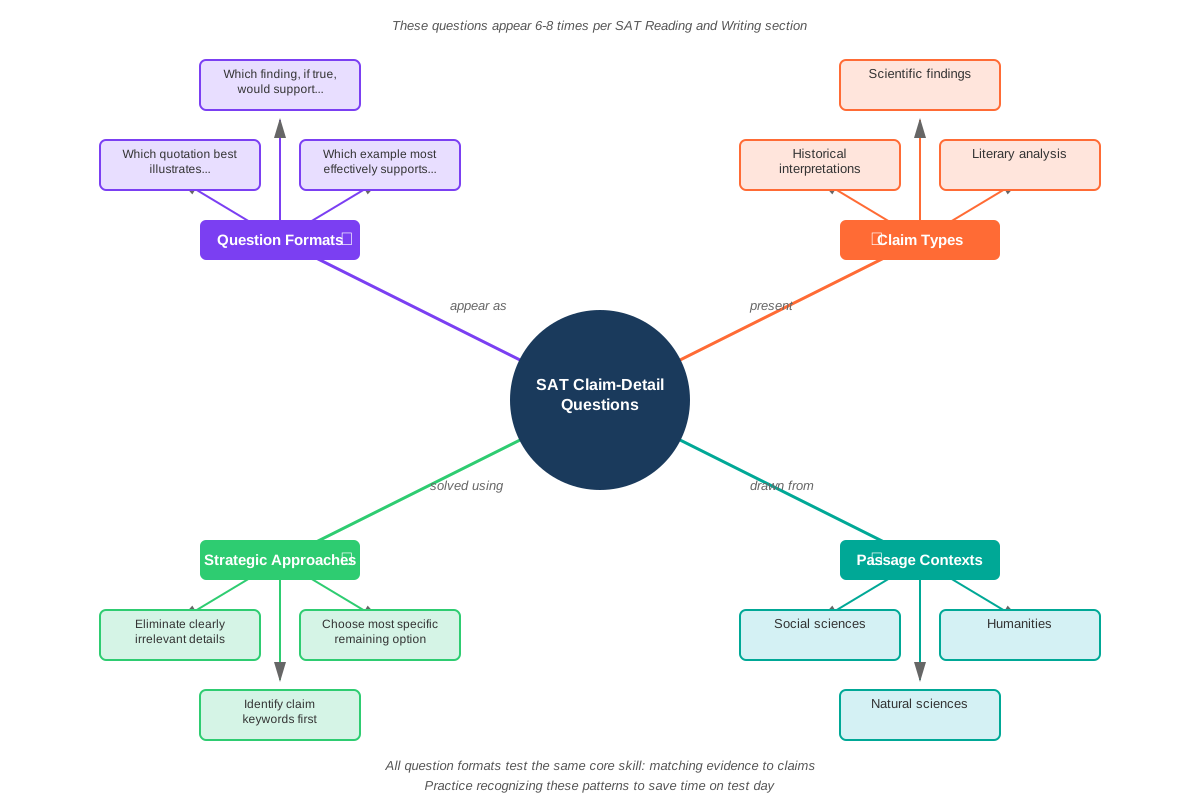
SAT questions testing this skill typically follow several standard formats:
- Completion format: "Which finding from the study, if true, would most directly support the researchers' claim?" This format presents a claim and asks students to identify supporting evidence.
- Quotation format: "Which quotation from the text most effectively illustrates the claim that [character] is [trait]?" This format requires students to connect textual evidence to interpretive claims.
- Data format: "Which choice best supports the statement that [trend occurred]?" This format presents numerical or scientific data as potential evidence.
- Example format: "Which example most strongly supports the generalization that [phenomenon occurs]?" This format tests whether students can identify appropriate illustrative examples.
The Role of Precision in Language
Precision in understanding both claims and details is critical. Small differences in wording can dramatically affect what evidence would be appropriate. A claim that something "primarily" causes an effect requires different evidence than a claim that something "partially contributes to" an effect. A claim about "rapid" change requires evidence of speed, while a claim about "significant" change requires evidence of magnitude. Students must read both claims and details with careful attention to qualifying language, scope indicators, and specific terminology.
Concept Relationships
The concepts within this topic form an interconnected logical framework. Understanding claims provides the foundation for evaluating details, as students must first comprehend what assertion needs support before they can identify appropriate evidence. This understanding of claims → enables evaluation of details → which allows assessment of connection strength → leading to selection of the best supporting evidence.
The relationship to prerequisite topics is equally important. Reading comprehension fundamentals enable students to extract both claims and details from passages accurately. Basic logical reasoning provides the framework for understanding how evidence supports conclusions. Vocabulary in context ensures precise interpretation of the specific language used in both claims and details. Identifying central ideas helps students distinguish between main claims and subordinate details.
This topic connects forward to more advanced skills in the SAT Reading and Writing section. Mastering connecting details to claims enables students to tackle questions about rhetorical effectiveness, where they must evaluate not just whether evidence supports a claim but how effectively it does so. It also supports success with synthesis questions that require combining information from multiple sources, as students must identify which details from various texts support overarching claims. The skill extends to the essay portion (when applicable) where constructing evidence-based arguments is essential.
Relationship Map: Reading Comprehension → Identifying Claims and Details → Evaluating Relevance → Assessing Connection Strength → Selecting Best Evidence → Advanced Rhetorical Analysis
High-Yield Facts
⭐ The correct answer directly addresses the specific claim without requiring additional inferential leaps or unstated assumptions
⭐ Wrong answers often relate to the general topic but don't specifically support the particular claim being made
⭐ Quantitative claims require numerical evidence; qualitative claims require descriptive or illustrative evidence
⭐ The strongest supporting detail matches the scope and specificity of the claim—neither too broad nor too narrow
⭐ Qualifying language in claims (such as "primarily," "one factor," or "suggests") constrains what evidence would be appropriate
- Details that contradict or complicate the claim are never correct answers, even if they're factually accurate
- The correct answer must be sufficient on its own to support the claim without requiring information from other answer choices
- When a claim uses comparative language ("more," "less," "increased"), the supporting detail must provide comparative information
- Temporal language in claims ("initially," "eventually," "during") requires details that match the specified time frame
- Details that support a related but different claim are common distractors designed to test precise reading
- The SAT never requires outside knowledge to connect details to claims—all necessary information appears in the question
- Answer choices are typically similar in length and grammatical structure to avoid giving away the correct answer through formatting
- The correct answer often contains specific examples, data points, or quotations rather than general statements
- When multiple details seem relevant, the one that most directly and completely supports the claim is correct
- Claims about causes or effects require details that demonstrate the causal mechanism or relationship
Quick check — test yourself on Connecting details to claims so far.
Try Flashcards →Common Misconceptions
Misconception: Any detail related to the same topic as the claim will support that claim → Correction: Details must specifically support the particular assertion being made, not just relate to the general subject. A passage about climate change might contain many facts about temperature, precipitation, and sea levels, but only specific details support specific claims about trends or causes.
Misconception: The longest or most detailed answer choice is most likely correct → Correction: The SAT carefully constructs answer choices to be similar in length and complexity. The correct answer is determined by logical connection to the claim, not by length or apparent sophistication. Sometimes the most concise detail provides the strongest support.
Misconception: If a detail is true and interesting, it supports any claim in the same passage → Correction: Truth and relevance are different qualities. A detail can be factually accurate and topically related but still fail to support a specific claim. Students must evaluate the logical connection between the detail and the precise assertion being made.
Misconception: Supporting details must use the same vocabulary as the claim → Correction: Effective evidence often uses different language while addressing the same concept. A claim about "economic hardship" might be supported by details about "unemployment rates" or "declining wages." Students must recognize conceptual connections beyond surface-level vocabulary matching.
Misconception: The correct answer will always be the most dramatic or extreme piece of evidence → Correction: The strength of evidence depends on its logical connection to the claim, not its dramatic impact. A moderate, precise detail that directly addresses the claim is stronger than an extreme detail that only tangentially relates to it.
Misconception: Personal interpretation or outside knowledge should guide the selection of supporting details → Correction: The SAT tests the ability to identify logical connections based solely on the information provided. Students should not bring in outside knowledge or personal opinions when evaluating whether details support claims. The connection must be evident from the text alone.
Misconception: If multiple answer choices seem to support the claim, any of them could be correct → Correction: The SAT always has one best answer that most directly and completely supports the claim. When multiple options seem plausible, students must evaluate which provides the most direct, specific, and complete support without requiring additional assumptions.
Worked Examples
Example 1: Scientific Research Context
Claim: Researchers studying urban wildlife have concluded that coyotes in metropolitan areas exhibit different hunting behaviors than their rural counterparts.
Answer Choices:
A) Coyotes are highly adaptable predators found throughout North America in diverse habitats.
B) Urban coyotes were observed hunting primarily at night and targeting small mammals near human residences, while rural coyotes hunted during various times and pursued larger prey in open fields.
C) The coyote population in cities has increased significantly over the past two decades.
D) Both urban and rural coyotes are members of the same species and share similar physical characteristics.
Analysis:
First, identify the key components of the claim. The claim asserts that urban coyotes exhibit different hunting behaviors compared to rural coyotes. The claim is specifically about behavioral differences, not population changes, adaptability, or physical characteristics.
Evaluate each answer choice:
Choice A discusses adaptability and habitat range. While this relates to coyotes generally, it doesn't address the specific claim about different hunting behaviors between urban and rural populations. This is a classic distractor—topically related but not specifically supportive.
Choice B provides specific behavioral information: urban coyotes hunt "primarily at night" and target "small mammals near human residences," while rural coyotes hunt "during various times" and pursue "larger prey in open fields." This directly addresses hunting behaviors and explicitly contrasts urban and rural populations, providing multiple specific differences (timing, prey type, location).
Choice C discusses population trends, which relates to urban coyotes but doesn't address hunting behaviors or comparisons with rural coyotes. This is irrelevant to the specific claim.
Choice D mentions that urban and rural coyotes share characteristics, which actually suggests similarity rather than difference, making it contradict the claim's emphasis on behavioral differences.
Correct Answer: B
This detail most directly supports the claim because it provides specific, contrasting information about hunting behaviors (the exact focus of the claim) in both urban and rural contexts (the exact comparison being made). The detail is sufficient, relevant, and directly connected to every component of the claim.
Example 2: Literary Analysis Context
Claim: In her novel, the author uses weather imagery to reflect the protagonist's emotional state throughout the narrative.
Answer Choices:
A) "The storm clouds gathered as Maria's anxiety intensified, and when her fears finally subsided, the sun emerged from behind the gray masses."
B) "The novel takes place over the course of one year, allowing the author to incorporate all four seasons into the setting."
C) "Maria often looked out the window, observing the changing weather patterns of her coastal town."
D) "Critics have praised the author's descriptive writing style and attention to atmospheric detail."
Analysis:
The claim makes a specific assertion about a literary technique: the author uses weather imagery to reflect (meaning mirror or correspond to) the protagonist's emotional state. The supporting detail must demonstrate this connection between weather and emotion.
Evaluate each answer choice:
Choice A provides a direct example where weather imagery ("storm clouds gathered," "sun emerged") explicitly corresponds to emotional states ("anxiety intensified," "fears finally subsided"). The parallel structure and temporal connection ("as," "when") demonstrate the reflective relationship the claim describes. This is a clear illustration of the technique.
Choice B discusses the temporal scope of the novel and mentions seasons, which relates to weather but doesn't connect weather to emotional states. This addresses setting but not the specific literary technique claimed.
Choice C shows the character observing weather, establishing that weather appears in the novel, but doesn't demonstrate that weather reflects emotional states. The character could observe weather without that weather mirroring her emotions.
Choice D provides critical reception information about descriptive writing generally but doesn't specifically address weather imagery or its connection to emotional states. This is too general to support the specific claim about a particular technique.
Correct Answer: A
This quotation directly illustrates the claim by providing a concrete example where weather imagery (storm clouds, sun) explicitly corresponds to emotional states (anxiety, fears subsiding). The detail demonstrates the "reflection" relationship central to the claim, making it the most direct and complete support.
Exam Strategy
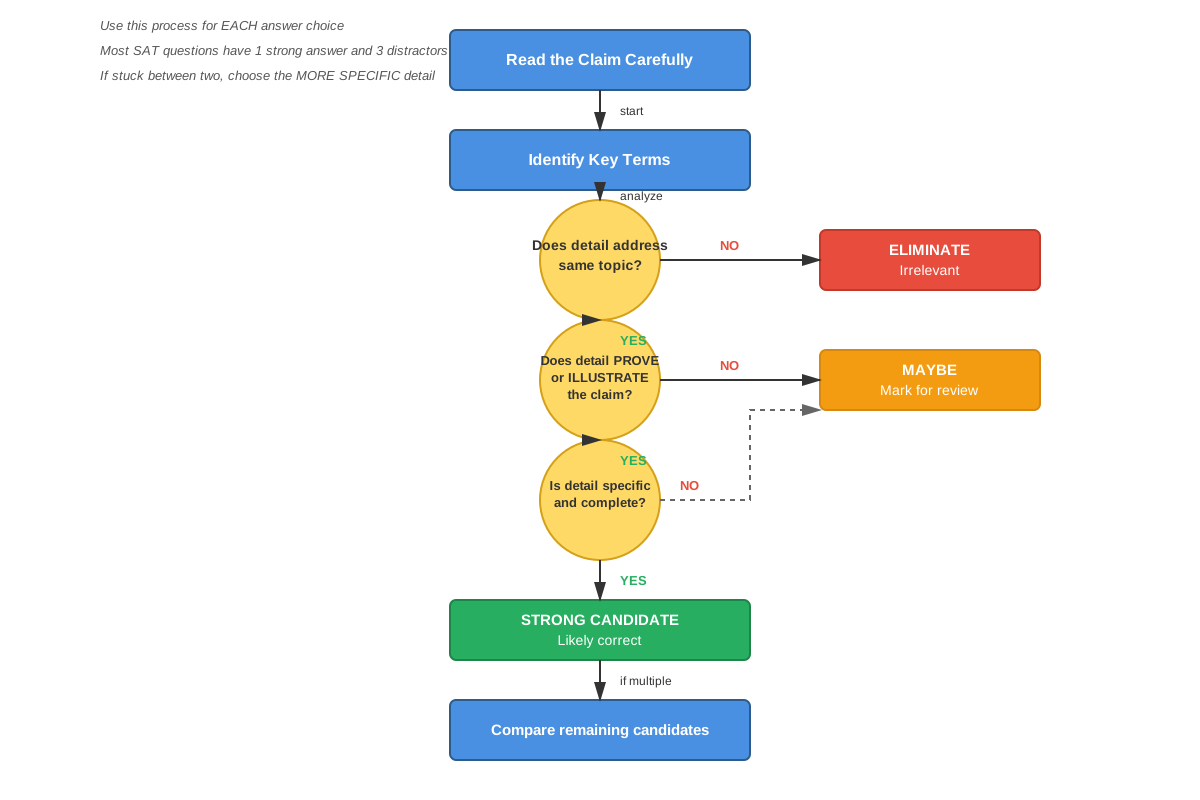
When approaching SAT questions about connecting details to claims, follow this systematic process:
Step 1: Analyze the claim carefully (15-20 seconds). Identify the key components: What is being asserted? What specific aspect or characteristic is mentioned? What scope or limitations are indicated by qualifying language? Underline or mentally note the most important words in the claim.
Step 2: Predict what type of evidence would support this claim (5-10 seconds). Before looking at answer choices, consider what kind of detail would logically support the assertion. Does the claim require numerical data, a specific example, a quotation, or a comparison? This prediction helps you recognize the correct answer and avoid distractors.
Step 3: Eliminate clearly irrelevant choices (10-15 seconds). Quickly scan answer choices and eliminate any that address different topics, time periods, or aspects than the claim specifies. This often eliminates 1-2 options immediately.
Step 4: Evaluate remaining choices for directness and completeness (20-30 seconds). For each remaining option, ask: Does this detail directly address the claim? Does it require additional assumptions or inferential leaps? Is it specific enough? Does it match the scope of the claim?
Exam Tip: Watch for trigger words in claims such as "primarily," "one factor," "suggests," "increased," or "different." These words constrain what evidence would be appropriate and often appear in both the claim and the correct answer (or synonyms appear).
Time allocation: Spend approximately 60-75 seconds per question of this type. Don't rush the initial analysis of the claim—misunderstanding what needs to be supported is the most common cause of errors. However, once you've identified the correct answer with confidence, move on rather than second-guessing.
Process of elimination tips specific to this topic:
- Eliminate details that are true but irrelevant to the specific claim
- Eliminate details that support a related but different claim
- Eliminate details that are too general or vague to adequately support the specific assertion
- Eliminate details that contradict or complicate the claim
- Eliminate details that require outside knowledge or additional unstated information to connect to the claim
Common trap patterns to recognize:
- The topic match trap: Details that relate to the same general topic but don't support the specific claim
- The interesting fact trap: Compelling or dramatic details that don't logically connect to the claim
- The partial support trap: Details that address part of the claim but leave significant components unsupported
- The vocabulary match trap: Details that use similar words to the claim but don't actually support the logical assertion
Memory Techniques
DIRECT Acronym for evaluating supporting details:
- Directly addresses the claim (no inferential leaps required)
- Includes specific information (not vague or general)
- Relevant to all components of the claim (not just the topic)
- Evidence type matches claim type (quantitative/qualitative alignment)
- Complete support (doesn't leave logical gaps)
- Textually sufficient (doesn't require outside knowledge)
Visualization Strategy: Picture the claim as a target with a bullseye. The correct supporting detail hits the bullseye directly. Wrong answers might hit the outer rings (related topic) or miss the target entirely (irrelevant), but only the correct answer strikes the center with precision.
The Bridge Metaphor: Think of the claim and detail as two points that need a bridge connecting them. The strongest answer builds the shortest, most direct bridge. Wrong answers either build bridges to the wrong destination (different claim) or require you to imagine parts of the bridge that aren't actually there (unstated assumptions).
Question Type Recognition Mnemonic: Remember "QCDE" for the four common formats:
- Quotation questions (literary analysis)
- Completion questions (fill in the claim)
- Data questions (scientific/numerical)
- Example questions (illustrative support)
Summary
Connecting details to claims is a high-frequency SAT skill that tests students' ability to evaluate whether specific evidence logically supports given assertions. Success requires careful analysis of claims to identify their key components, scope, and qualifying language, followed by systematic evaluation of potential supporting details for relevance, directness, specificity, and completeness. The strongest supporting details directly address all components of the claim without requiring inferential leaps or unstated assumptions, match the claim in type and scope, and provide sufficient information to prove or illustrate the assertion. Common pitfalls include selecting details that relate to the general topic but don't support the specific claim, choosing interesting but irrelevant information, or failing to recognize that the correct answer must be self-sufficient without requiring outside knowledge. By following a systematic approach—analyzing the claim, predicting appropriate evidence, eliminating irrelevant options, and evaluating remaining choices for logical connection—students can consistently identify the best supporting details and master this essential SAT skill.
Key Takeaways
- The correct answer always directly addresses the specific claim without requiring additional assumptions or inferential leaps beyond what's stated
- Wrong answers frequently relate to the same general topic but fail to support the particular assertion being made—topic relevance doesn't equal claim support
- Match evidence type to claim type: quantitative claims need numerical data, qualitative claims need descriptive examples or quotations
- Pay careful attention to qualifying language in claims ("primarily," "one factor," "suggests") as this constrains what evidence would appropriately support the assertion
- The strongest supporting detail is specific, complete, and directly relevant to all components of the claim, not just part of it
- Systematic analysis of the claim before evaluating answer choices prevents common errors and improves accuracy
- This skill appears in 13-15% of SAT Reading and Writing questions, making it one of the highest-yield topics to master
Related Topics
Identifying Central Ideas and Themes: Mastering the connection between details and claims provides the foundation for understanding how authors develop central ideas through accumulated evidence and examples. This skill builds directly on the ability to evaluate evidentiary relationships.
Analyzing Rhetorical Effectiveness: Once students can identify whether details support claims, they can progress to evaluating how effectively different types of evidence support arguments and how authors strategically deploy evidence for persuasive purposes.
Synthesizing Information from Multiple Texts: The ability to connect details to claims extends to identifying how information from different sources supports or contradicts overarching assertions, a more advanced skill tested in some SAT questions.
Evaluating Arguments and Reasoning: Understanding the relationship between claims and supporting details is foundational to analyzing the strength of arguments, identifying logical fallacies, and assessing the quality of reasoning in complex texts.
Practice CTA
Now that you've mastered the core concepts of connecting details to claims, it's time to apply this knowledge! Work through the practice questions to reinforce your understanding and build the speed and accuracy you'll need on test day. Each practice question is designed to mirror actual SAT formats and difficulty levels. As you practice, focus on implementing the systematic approach outlined in this guide: analyze the claim carefully, predict appropriate evidence, eliminate irrelevant options, and evaluate the logical connection. Remember, this skill appears frequently on the SAT, so the time you invest in practice will directly translate to points on exam day. You've got this—let's put your knowledge into action!
Sign up free to keep reading
Create a free AnvayaPrep account to finish this SAT guide on Connecting details to claims — plus flashcards and practice questions.