Overview
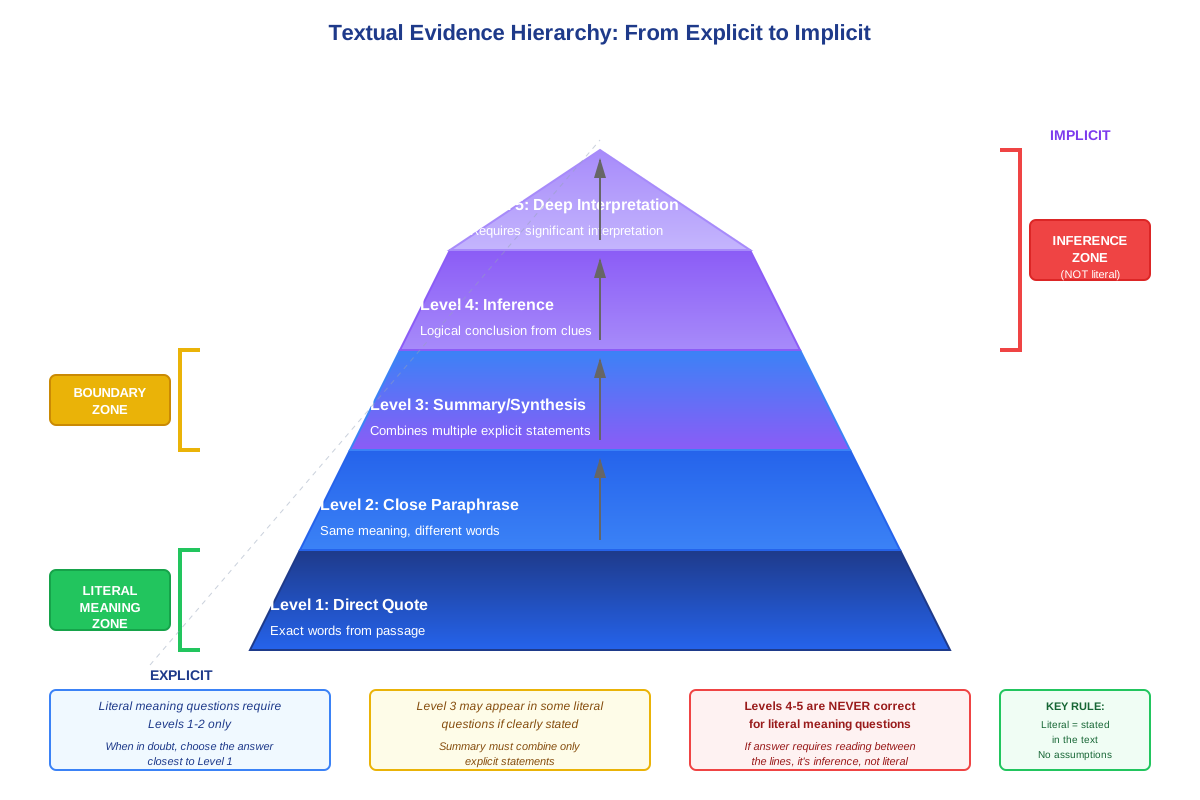
Interpreting literal meaning is a foundational skill tested extensively throughout the SAT Reading and Writing (RW) section. This skill requires students to accurately comprehend what a text explicitly states—without reading between the lines, making inferences, or analyzing deeper implications. While it may sound straightforward, literal comprehension questions are designed to test whether students can carefully track details, understand precise word meanings in context, and distinguish between what is directly stated versus what might be implied. These questions often appear deceptively simple but require meticulous attention to the exact language used in passages.
On the SAT, literal meaning questions constitute a significant portion of the Central Ideas and Details question category. Students must demonstrate their ability to identify specific information, understand the surface-level content of complex sentences, and recognize how details support broader points—all while working under time pressure. Mastery of literal interpretation serves as the bedrock for more advanced reading skills like inference, rhetorical analysis, and synthesis across multiple texts. Without solid literal comprehension, students cannot reliably tackle higher-order questions that build upon textual evidence.
The relationship between literal meaning and other Reading and Writing concepts is hierarchical and foundational. Before analyzing an author's purpose, evaluating arguments, or synthesizing information across passages, students must first accurately understand what the text actually says. Literal interpretation connects directly to evidence-based reasoning, vocabulary in context, and central idea identification—all critical components of SAT success. This topic represents the essential first step in the reading comprehension process that enables all subsequent analytical work.
Learning Objectives
- [ ] Identify key features of interpreting literal meaning in SAT passages
- [ ] Explain how interpreting literal meaning appears on the SAT and distinguish it from inference questions
- [ ] Apply interpreting literal meaning strategies to answer SAT-style questions accurately
- [ ] Distinguish between explicitly stated information and implied information in complex texts
- [ ] Locate and extract specific textual evidence that directly answers literal comprehension questions
- [ ] Recognize common distractors in answer choices that misrepresent literal meaning
- [ ] Demonstrate the ability to paraphrase literal meaning without adding interpretation
Prerequisites
- Basic reading comprehension: Understanding sentence structure and paragraph organization is essential for tracking what texts explicitly state
- Vocabulary fundamentals: Knowing common academic vocabulary helps students understand the literal meaning of sophisticated passages
- Ability to identify main ideas: Recognizing the central point of a passage provides context for understanding specific literal details
- Familiarity with SAT passage types: Understanding the format of literary, historical, scientific, and argumentative texts helps students navigate different content areas
Why This Topic Matters
Literal meaning interpretation is not merely an academic exercise—it represents a critical life skill for navigating contracts, instructions, news articles, academic texts, and professional communications. The ability to accurately understand what is explicitly stated, without adding assumptions or misinterpreting details, prevents costly mistakes in real-world scenarios. In academic settings, literal comprehension forms the foundation for research, analysis, and evidence-based argumentation.
On the SAT, literal meaning questions appear in approximately 25-30% of Reading and Writing questions, making them one of the most frequently tested skills. These questions typically ask students to identify what a text "states," "indicates," "suggests according to the passage," or "mentions." They appear across all passage types—from literary narratives and historical documents to scientific studies and argumentative essays. The College Board specifically tests whether students can distinguish between what is directly stated and what requires inference, making this a high-stakes skill for score improvement.
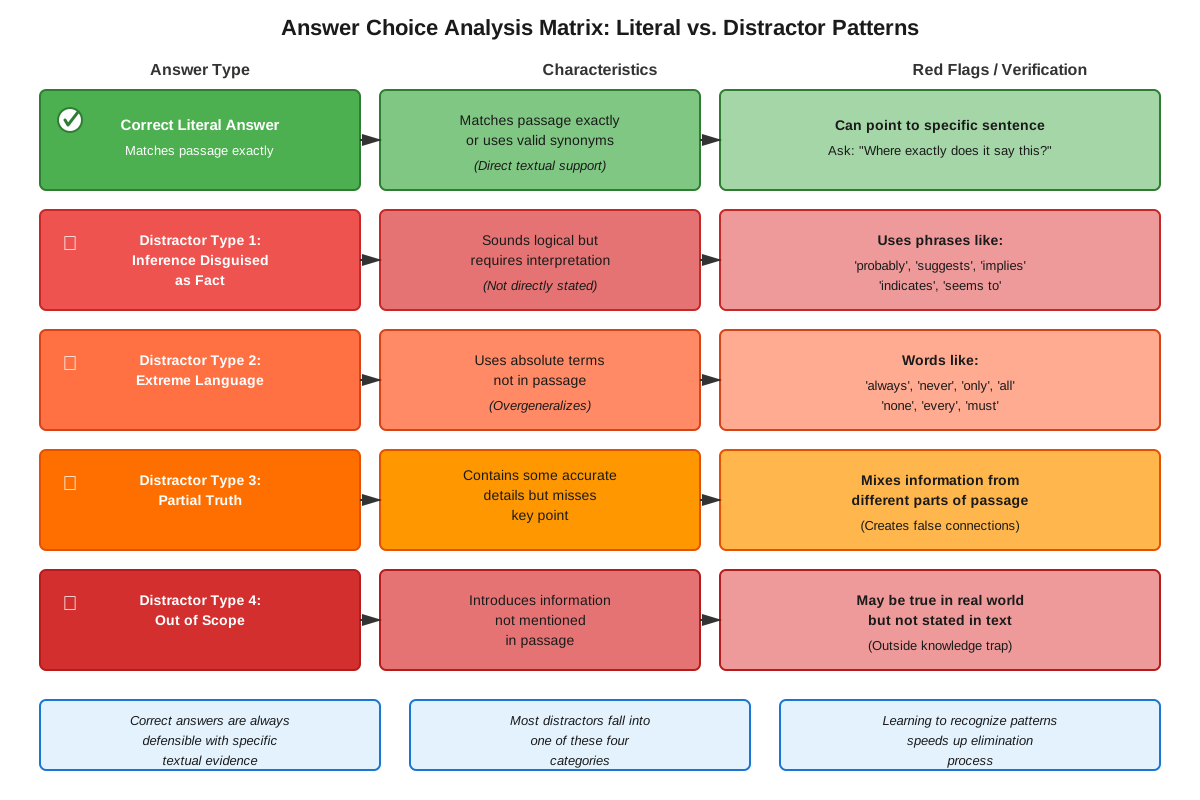
Common manifestations of literal meaning questions include: identifying specific details mentioned in the passage, understanding the explicit meaning of complex sentences, recognizing stated relationships between ideas, determining what information is directly provided versus implied, and selecting answer choices that accurately paraphrase textual content. These questions often feature answer choices that are partially correct, contain information from the wrong part of the passage, or subtly misrepresent what was actually stated—making careful reading essential.
Core Concepts
What Constitutes Literal Meaning
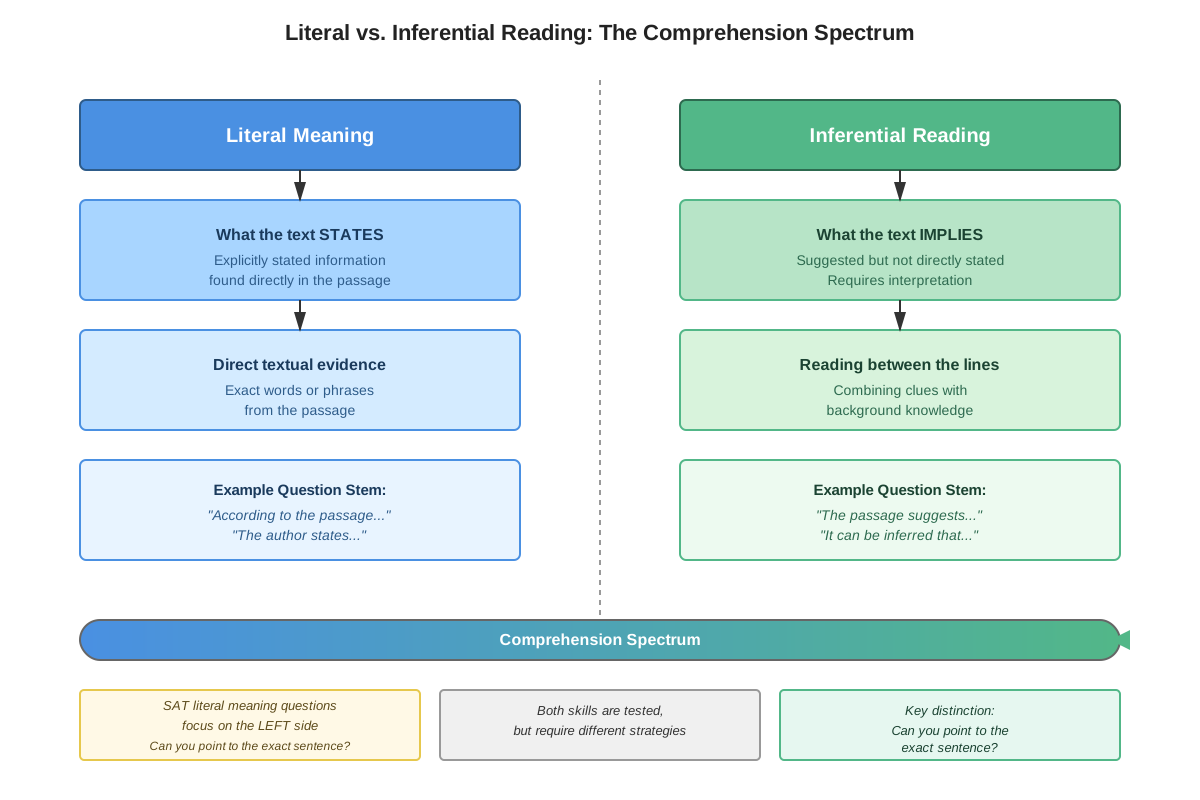
Literal meaning refers to the explicit, surface-level content of a text—exactly what the words say without interpretation, inference, or analysis of deeper significance. When interpreting literal meaning on the SAT, students must focus exclusively on information that is directly stated in the passage, using the precise language and details the author provides. This differs fundamentally from inferential reading, where students draw conclusions based on textual clues, or analytical reading, where students examine rhetorical strategies and authorial intent.
The key distinction lies in the question of evidence: literal meaning questions can be answered by pointing to specific sentences or phrases that explicitly contain the answer. If a passage states, "The experiment was conducted over three months in 2019," then the literal meaning includes the duration (three months) and the year (2019). Any answer choice suggesting the experiment was "lengthy" or "recent" would require interpretation beyond the literal text.
Characteristics of Literal Meaning Questions
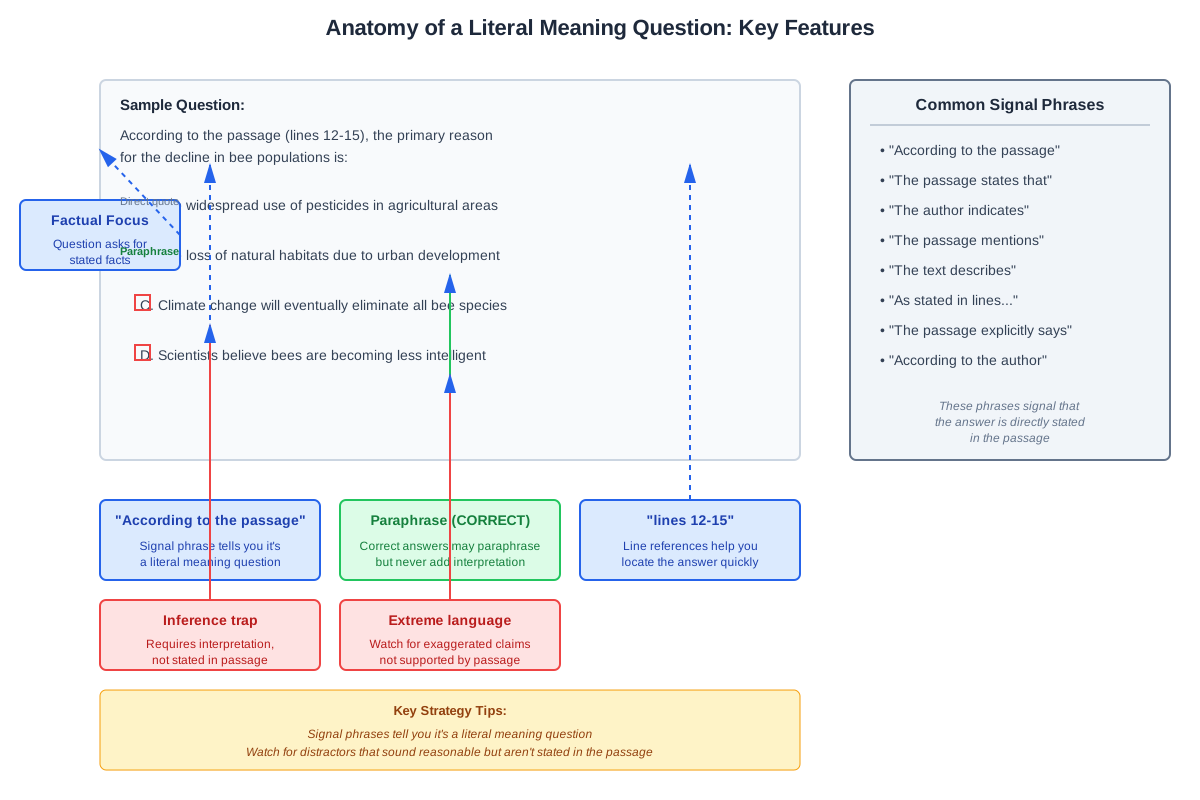
Literal meaning questions on the SAT exhibit several distinctive features that help students identify them. First, they typically use specific language cues such as "according to the text," "the passage states," "the author mentions," or "the text indicates." These phrases signal that the answer must come directly from the passage without additional reasoning.
Second, these questions focus on explicit information: facts, details, descriptions, stated relationships, and direct quotations. They ask about concrete elements like who did what, when events occurred, where actions took place, what specific characteristics were mentioned, or which details the author provided. The correct answer will be a faithful representation of textual content, often using synonyms or paraphrasing but never adding information not present in the original.
Third, literal meaning questions avoid language that suggests interpretation, such as "implies," "suggests indirectly," "the reader can infer," or "the underlying meaning." When such language appears, the question has shifted from literal comprehension to inference or analysis.
The Role of Paraphrasing
A critical aspect of SAT interpreting literal meaning questions involves recognizing accurate paraphrases. The SAT rarely presents answer choices using the exact wording from the passage; instead, correct answers typically restate the literal meaning using synonyms and different sentence structures. This tests whether students truly understand what was stated or are merely matching words.
For example, if a passage states, "The researcher discovered that urban environments contained significantly higher concentrations of particulate matter," a correct answer might read, "The scientist found that cities had much greater levels of air pollutants." Both sentences convey the same literal meaning despite using different vocabulary. Students must recognize that "researcher" = "scientist," "urban environments" = "cities," "concentrations" = "levels," and "particulate matter" = "air pollutants."
However, subtle changes can transform an accurate paraphrase into a distortion. If an answer choice stated, "The researcher proved that pollution causes health problems in cities," this would go beyond the literal meaning by introducing causation and health effects not mentioned in the original statement.
Distinguishing Literal from Inferential Content
One of the most challenging aspects of literal meaning interpretation involves distinguishing what is explicitly stated from what can be inferred. The SAT deliberately creates answer choices that blur this boundary to test careful reading. Consider this passage excerpt: "After reviewing the data for six hours, Dr. Martinez submitted her findings to the journal."
Literal information: Dr. Martinez reviewed data, the review took six hours, she submitted findings, the submission went to a journal.
Inferential information (not literal): Dr. Martinez was thorough (suggested by the six-hour duration but not stated), she was tired (not mentioned), her findings were significant (not stated), the journal would publish her work (not indicated).
Students must train themselves to recognize when they are adding interpretation, however reasonable, to what the text actually says. The SAT RW section specifically tests this distinction because it represents a fundamental academic skill.
Types of Literal Information Tested
The SAT tests several categories of literal information across different passage types:
| Category | Description | Example Question Stem |
|---|---|---|
| Factual Details | Specific facts, numbers, names, dates, or descriptions | "According to the passage, the study included how many participants?" |
| Stated Relationships | Explicitly mentioned connections between ideas or events | "The text indicates that X occurred as a result of what?" |
| Direct Descriptions | Characteristics or qualities explicitly attributed to subjects | "The passage describes the protagonist as..." |
| Quoted Material | Exact words or statements from sources within the passage | "What does the author state about the theory?" |
| Sequential Information | Order of events or steps as explicitly presented | "According to the text, what happened immediately after X?" |
| Comparative Statements | Direct comparisons made in the text | "The passage indicates that Method A differs from Method B in what way?" |
Processing Complex Sentences for Literal Meaning
Many SAT passages contain sophisticated sentence structures with multiple clauses, qualifiers, and embedded information. Extracting literal meaning from complex sentences requires systematic processing. Students should:
- Identify the main clause: Determine the core subject-verb-object structure
- Process modifying phrases: Understand how dependent clauses and phrases modify the main idea
- Track qualifiers: Note words like "some," "most," "often," "rarely" that limit scope
- Recognize conditional statements: Understand "if-then" relationships and their limitations
- Parse parallel structures: Identify lists and parallel elements that provide multiple pieces of information
For example: "While some researchers, particularly those working in urban settings, have documented increases in certain species populations, the majority of studies conducted across diverse ecosystems indicate overall biodiversity decline."
Breaking this down literally: Some researchers (specifically urban ones) found increases in certain species, BUT most studies (across various ecosystems) show overall biodiversity decline. The literal meaning includes both pieces of information with their qualifiers—not just one or the other.
Concept Relationships
The concepts within literal meaning interpretation form an interconnected system where each element supports the others. Identifying explicit information serves as the foundation → which enables accurate paraphrasing → which allows students to distinguish literal from inferential content → which helps them recognize correct answer choices → which ultimately demonstrates mastery of literal comprehension.
This topic connects directly to prerequisite knowledge of basic reading comprehension and vocabulary, as students cannot identify literal meaning if they misunderstand sentence structure or word definitions. The relationship flows upward to more advanced skills: literal meaning interpretation → enables inference and analysis → which supports synthesis across texts → which allows for rhetorical analysis and argument evaluation.
Within the broader SAT Reading and Writing framework, literal meaning connects to evidence-based reasoning (students must locate literal textual evidence), central idea identification (understanding literal details helps recognize main points), and vocabulary in context (precise word meaning affects literal interpretation). The skill also relates to the Command of Evidence questions, where students must identify which quotation best supports a claim—requiring accurate literal comprehension of both the claim and the potential evidence.
Quick check — test yourself on Interpreting literal meaning so far.
Try Flashcards →High-Yield Facts
⭐ Literal meaning questions ask only about information explicitly stated in the passage, never requiring inference or interpretation
⭐ Correct answers typically paraphrase the passage using synonyms rather than exact wording
⭐ Question stems containing "according to the text," "the passage states," or "the author mentions" signal literal meaning questions
⭐ Approximately 25-30% of SAT Reading and Writing questions test literal comprehension skills
⭐ The most common trap answers add reasonable but unstated information or misrepresent the scope of what was said
- Literal meaning questions appear across all passage types: literary, historical, scientific, and argumentative texts
- Qualifiers like "some," "most," "often," and "rarely" are crucial to literal meaning and frequently tested
- Students must distinguish between stated facts and implied conclusions, even when implications seem obvious
- Complex sentences may contain multiple pieces of literal information that must all be accurately processed
- Temporal and causal relationships must be explicitly stated to be considered literal meaning; otherwise they require inference
Common Misconceptions
Misconception: If something seems obviously true based on the passage, it counts as literal meaning → Correction: Literal meaning includes only what is explicitly stated; even obvious implications require inference and are not literal unless directly stated in the text
Misconception: Using different words than the passage means the answer is wrong → Correction: Correct answers typically paraphrase using synonyms and different sentence structures; exact word matching is not required and often indicates a trap answer
Misconception: All details mentioned in the passage are equally important for literal meaning questions → Correction: Literal meaning questions focus on specific details relevant to the question; students must locate the precise section of text that addresses what is being asked
Misconception: Literal meaning questions are always easy because they don't require deep thinking → Correction: These questions can be challenging because they require careful attention to precise wording, qualifiers, and the distinction between stated and implied information, especially in complex passages
Misconception: If an answer choice contains information from the passage, it must be correct → Correction: Trap answers often include accurate information from the wrong part of the passage or combine stated information with unstated claims; the answer must address the specific question asked
Misconception: Background knowledge about a topic can help answer literal meaning questions → Correction: Literal meaning questions must be answered solely from the passage text; outside knowledge often leads students to select answers that seem true but aren't stated in the passage
Worked Examples
Example 1: Scientific Passage
Passage Excerpt: "The research team, led by Dr. Yuki Tanaka, monitored coral reef ecosystems in the Caribbean over a five-year period from 2015 to 2020. Their findings, published in Marine Biology Quarterly, revealed that reefs located more than 50 kilometers from major coastal cities showed 40% less bleaching than those in proximity to urban centers. The study controlled for water temperature, depth, and natural predator populations."
Question: According to the passage, what did Dr. Tanaka's research reveal about coral reefs?
Answer Choices:
A) Urban pollution causes coral bleaching in Caribbean reefs
B) Reefs farther from cities experienced less bleaching than reefs near cities
C) Coral reefs are declining throughout the Caribbean region
D) Water temperature is the primary factor in coral bleaching
Analysis:
Step 1: Identify what the question asks—what the research "revealed" (literal finding)
Step 2: Locate the relevant sentence: "Their findings...revealed that reefs located more than 50 kilometers from major coastal cities showed 40% less bleaching than those in proximity to urban centers."
Step 3: Determine what is explicitly stated: Reefs far from cities (50+ km) had less bleaching than reefs near cities
Step 4: Evaluate each answer:
- Choice A: Introduces causation ("causes") not stated in the passage—the text only shows correlation. This goes beyond literal meaning. ❌
- Choice B: Accurately paraphrases the literal finding using "farther from cities" for "more than 50 kilometers from major coastal cities" and maintaining the comparison. ✓
- Choice C: Makes a general claim about Caribbean reefs declining that isn't stated in the passage. ❌
- Choice D: Contradicts the passage, which mentions temperature was controlled for, not identified as the primary factor. ❌
Correct Answer: B
Connection to Learning Objectives: This example demonstrates identifying explicit information, distinguishing stated facts from implications (correlation vs. causation), and recognizing accurate paraphrasing.
Example 2: Literary Passage
Passage Excerpt: "Elena had visited the library every Tuesday afternoon for three years, always selecting the same corner table beneath the stained-glass window. The librarian, Mrs. Chen, would nod in recognition but rarely spoke to her. On this particular Tuesday, however, Elena found a note on her usual table: 'The book you requested has arrived.'"
Question: The passage indicates that Elena's visits to the library were characterized by what?
Answer Choices:
A) A developing friendship with Mrs. Chen
B) An irregular and unpredictable schedule
C) A consistent routine over an extended period
D) A recent interest that began three weeks ago
Analysis:
Step 1: Identify what is being asked—characteristics of Elena's library visits
Step 2: Locate relevant information: "visited the library every Tuesday afternoon for three years, always selecting the same corner table"
Step 3: Extract literal meaning: Regular visits (every Tuesday), long duration (three years), same location (corner table)
Step 4: Evaluate each answer:
- Choice A: The passage states Mrs. Chen "rarely spoke to her," which contradicts the idea of a developing friendship. This misrepresents the literal content. ❌
- Choice B: "Every Tuesday" indicates a regular, predictable schedule, not irregular. This contradicts the literal meaning. ❌
- Choice C: "Every Tuesday...for three years...always selecting the same corner table" literally describes a consistent routine over an extended period. ✓
- Choice D: "Three years" contradicts "three weeks," and nothing suggests this is recent. ❌
Correct Answer: C
Connection to Learning Objectives: This example shows how to extract literal meaning from narrative description, recognize accurate paraphrasing ("consistent routine" for "every Tuesday...always selecting"), and avoid answers that contradict stated information.
Exam Strategy
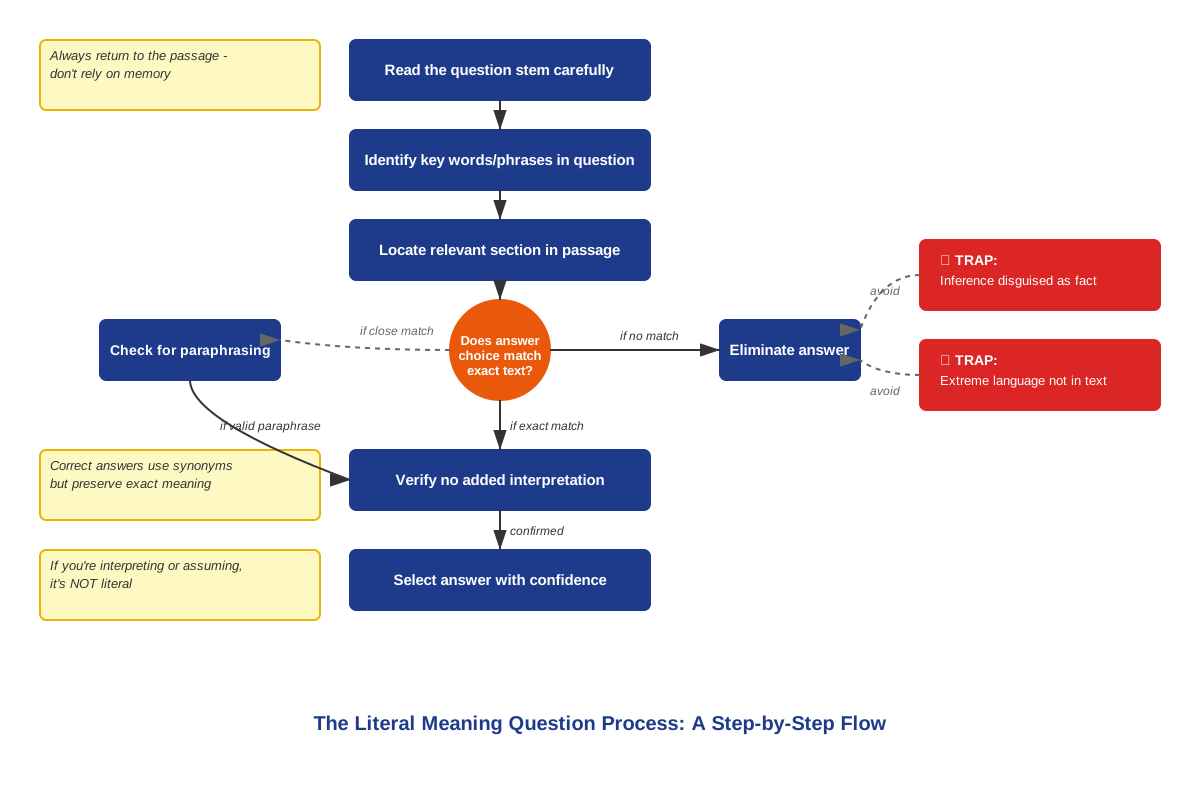
When approaching literal meaning questions on the SAT, students should implement a systematic process to maximize accuracy and efficiency:
Step 1: Identify the Question Type — Look for trigger phrases like "according to the passage," "the text states," "the author mentions," or "the passage indicates." These signal that the answer must come directly from the text without inference.
Step 2: Locate the Relevant Section — Use line references, paragraph indicators, or content clues to find where the answer appears. Don't rely on memory; return to the passage to verify exact wording.
Step 3: Read Carefully for Exact Meaning — Pay attention to qualifiers (some, most, all, never), scope limitations, and precise relationships stated. A single word can change literal meaning significantly.
Step 4: Predict Before Looking at Answers — Formulate what the answer should say based on the passage before examining choices. This prevents answer choices from influencing interpretation.
Step 5: Eliminate Systematically — Remove answers that:
- Add information not in the passage
- Use extreme language not present in the text
- Confuse cause and effect or other relationships
- Pull details from the wrong section
- Subtly misrepresent scope or qualifiers
Exam Tip: If you find yourself thinking "that makes sense" or "that's probably true" about an answer choice, verify that it's actually stated in the passage. Reasonable assumptions are often trap answers.
Time Allocation: Literal meaning questions should typically take 45-60 seconds each. If a question takes longer, you may be overthinking it or looking in the wrong section of the passage. These questions reward careful reading more than extended analysis.
Trigger Words to Watch:
- In questions: "states," "mentions," "indicates," "according to," "describes as," "identifies"
- In wrong answers: "implies," "suggests," "proves," "demonstrates" (when the passage only states), extreme words like "always," "never," "only" (unless the passage uses them)
Memory Techniques
STATED Acronym for checking if information is literal:
- Specifically mentioned in the text
- Textually supported with exact evidence
- Actually written, not assumed
- True to the passage's exact wording and scope
- Explicit, not requiring interpretation
- Directly answerable by pointing to specific sentences
Visualization Strategy: Imagine highlighting the exact sentence or phrase that answers the question. If you can't mentally highlight specific words that directly answer it, the information may not be literal.
The Paraphrase Test: When evaluating answer choices, mentally substitute the answer's wording back into the passage. If it changes the meaning or adds information, it's not an accurate representation of literal meaning.
Qualifier Awareness Mnemonic — "MOST SOME RARELY ALL" — Train yourself to notice these scope-limiting words in both passages and answer choices. They're frequently the difference between correct and incorrect answers.
Summary
Interpreting literal meaning represents a foundational skill for SAT Reading and Writing success, requiring students to accurately identify and comprehend information explicitly stated in passages without adding inference or interpretation. This skill involves distinguishing between what texts directly say and what they imply, recognizing accurate paraphrases that use different wording, and carefully tracking qualifiers and scope limitations that affect meaning. Literal meaning questions constitute approximately 25-30% of SAT RW questions and appear across all passage types, using trigger phrases like "according to the text" and "the passage states." Success requires systematic location of relevant textual sections, careful reading of exact wording, and elimination of trap answers that add unstated information, misrepresent scope, or confuse stated facts with reasonable implications. Mastery of literal interpretation serves as the essential foundation for all higher-order reading skills tested on the SAT, including inference, analysis, and synthesis.
Key Takeaways
- Literal meaning questions require answers based exclusively on explicitly stated information, never on inference or outside knowledge
- Correct answers typically paraphrase passage content using synonyms rather than exact wording, testing true comprehension
- Trigger phrases like "according to the text" and "the passage states" reliably identify literal meaning questions
- The most common trap answers add reasonable but unstated information or subtly misrepresent the scope of what was said
- Qualifiers such as "some," "most," "often," and "rarely" are crucial to literal meaning and frequently determine correct answers
- Systematic location of relevant text sections and careful verification of exact wording prevent careless errors
- Mastering literal interpretation provides the foundation for all other SAT Reading and Writing skills
Related Topics
Making Inferences — After mastering literal meaning, students progress to inference questions that require drawing conclusions based on textual evidence. Understanding the distinction between literal and inferential content is essential for this progression.
Command of Evidence — This skill builds directly on literal meaning interpretation, requiring students to identify which textual quotation best supports a given claim. Accurate literal comprehension ensures correct evidence selection.
Vocabulary in Context — Precise understanding of word meanings affects literal interpretation. These skills work together as students must comprehend exact word meanings to extract accurate literal meaning.
Central Ideas and Details — Literal meaning interpretation supports identification of main ideas, as students must accurately understand stated details before recognizing how they support broader central concepts.
Rhetorical Synthesis — Advanced synthesis across multiple texts requires first understanding what each text literally states before comparing perspectives or synthesizing information.
Practice CTA
Now that you understand the key concepts and strategies for interpreting literal meaning, it's time to apply these skills! Work through the practice questions to test your ability to identify explicit information, distinguish literal from inferential content, and recognize accurate paraphrases. Use the flashcards to reinforce high-yield facts and common trap patterns. Remember: literal meaning questions reward careful, precise reading—every practice attempt strengthens your ability to extract exactly what passages state, building the foundation for SAT Reading and Writing success. You've got this!
Sign up free to keep reading
Create a free AnvayaPrep account to finish this SAT guide on Interpreting literal meaning — plus flashcards and practice questions.