Overview
Paraphrasing central ideas is one of the most fundamental and frequently tested skills in the SAT Reading and Writing (RW) section. This skill requires students to read a passage carefully, identify its main point or primary argument, and then recognize which answer choice expresses that same idea using different words and sentence structures. Unlike simple vocabulary substitution, effective paraphrasing on the SAT demands deep comprehension of the passage's core message, the ability to distinguish essential information from supporting details, and the capacity to recognize semantic equivalence even when surface-level language differs significantly.
The SAT consistently includes questions that ask students to identify statements that "most accurately express the main idea" or "best summarize the passage." These questions appear across various passage types—from scientific research summaries to literary excerpts to historical documents—making this skill universally applicable throughout the exam. Students who master sat paraphrasing central ideas gain a significant advantage because this skill underpins success not only on explicit main-idea questions but also on inference questions, purpose questions, and even some vocabulary-in-context items.
Understanding paraphrasing central ideas connects directly to broader reading comprehension strategies within the RW section. This topic builds upon the ability to identify topic sentences, distinguish between main ideas and supporting details, and recognize authorial intent. It also serves as a foundation for more advanced skills like synthesizing information across multiple texts, evaluating arguments, and understanding rhetorical choices. Mastery of this topic enables students to approach SAT passages with confidence, knowing they can extract and recognize core meanings regardless of how they're expressed.
Learning Objectives
- [ ] Identify key features of paraphrasing central ideas
- [ ] Explain how paraphrasing central ideas appears on the SAT
- [ ] Apply paraphrasing central ideas to answer SAT-style questions
- [ ] Distinguish between central ideas and supporting details in passages of varying complexity
- [ ] Recognize semantic equivalence between original statements and paraphrased versions
- [ ] Evaluate answer choices to eliminate those that distort, narrow, or broaden the original central idea
- [ ] Synthesize information from multiple sentences to construct a complete understanding of a passage's main point
Prerequisites
- Basic reading comprehension: Understanding literal meaning of sentences and paragraphs is essential for identifying what needs to be paraphrased
- Vocabulary knowledge: Recognizing synonyms and understanding word relationships helps identify paraphrased content
- Sentence structure awareness: Understanding how ideas can be expressed through different grammatical constructions enables recognition of paraphrased ideas
- Ability to identify topic sentences: Knowing where main ideas typically appear in paragraphs provides a starting point for paraphrasing tasks
Why This Topic Matters
Paraphrasing central ideas represents a critical real-world literacy skill that extends far beyond standardized testing. In academic settings, students must regularly summarize research articles, restate thesis statements in their own words, and demonstrate comprehension by expressing ideas without plagiarizing. In professional contexts, the ability to extract and communicate key points from lengthy documents, meeting notes, or technical reports is invaluable. This skill also supports effective note-taking, study strategies, and information synthesis across disciplines.
On the SAT specifically, paraphrasing central ideas questions appear with remarkable frequency—typically 3-5 questions per test directly assess this skill, with many additional questions requiring it as a component of the correct answer. These questions appear in the Reading and Writing section across all four passage categories: Literature, History/Social Studies, Science, and Humanities. The College Board consistently includes these questions because they measure genuine reading comprehension rather than superficial pattern recognition.
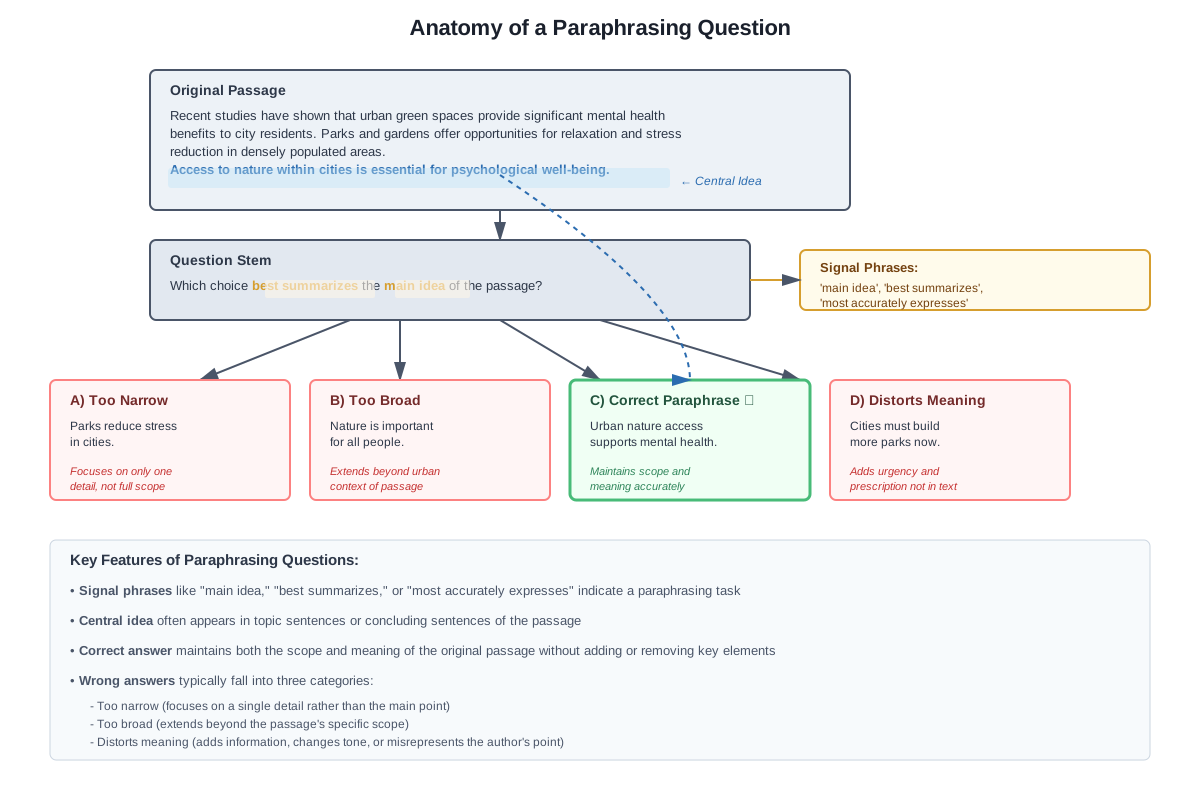
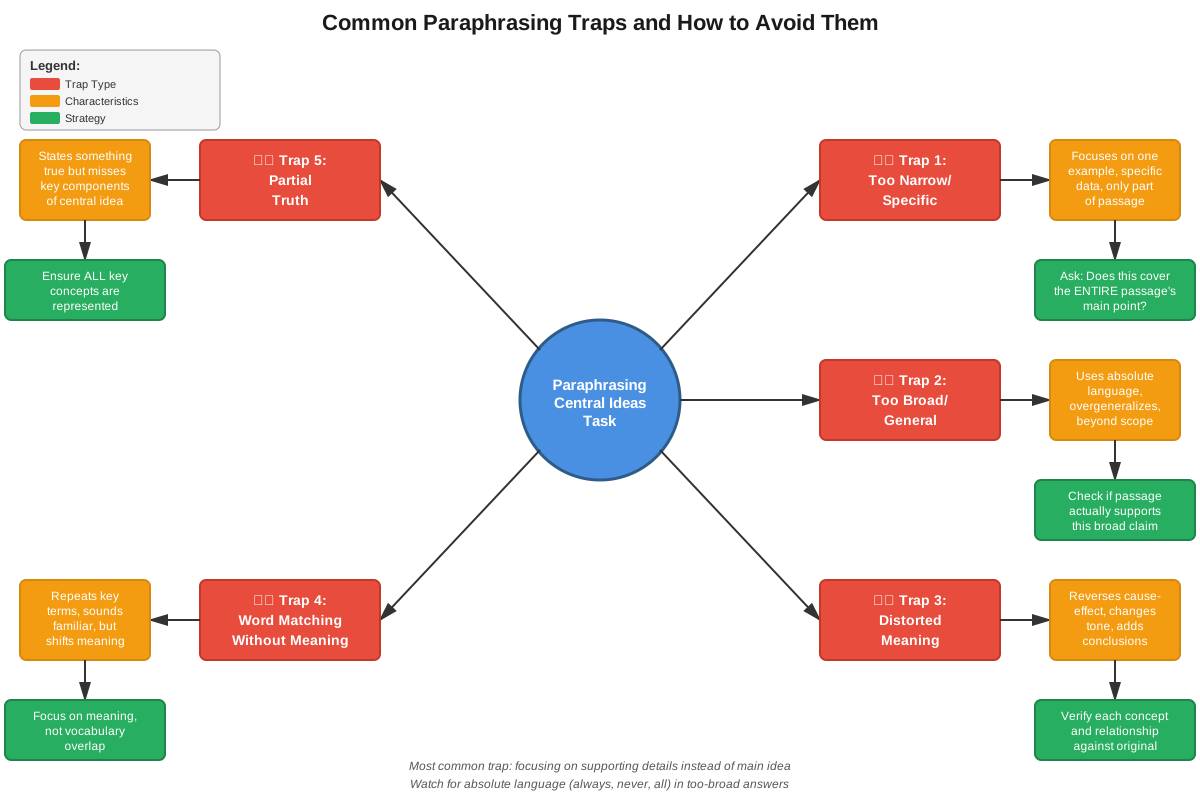
Common manifestations on the exam include passages followed by questions asking "Which choice best states the main idea of the text?" or "Which choice most effectively summarizes the passage?" The passages themselves vary in length from single paragraphs (50-100 words) to longer excerpts (150+ words), and they may present straightforward informational content or more complex argumentative structures. The answer choices typically include one correct paraphrase alongside distractors that are too narrow (focusing on a detail), too broad (overgeneralizing), distorted (misrepresenting the idea), or off-topic (introducing unrelated information).
Core Concepts
Understanding Central Ideas
A central idea is the primary point, argument, or message that a passage communicates. It represents the author's main purpose for writing and encompasses the most important information the reader should take away. Central ideas differ from topics (which are merely subjects being discussed) and from supporting details (which provide evidence, examples, or elaboration). For instance, if a passage's topic is "photosynthesis," the central idea might be "photosynthesis is essential for maintaining Earth's oxygen levels and supporting food chains." The central idea answers the question "What is the author's main point about this topic?"
Identifying central ideas requires distinguishing between what is most important and what is merely interesting or supplementary. In well-structured passages, the central idea often appears in a topic sentence at the beginning or end of a paragraph, but it may also be implied across multiple sentences. Students must learn to recognize thesis statements, concluding remarks, and repeated concepts that signal importance.
The Paraphrasing Process
Paraphrasing involves restating information using different words and sentence structures while preserving the original meaning. Effective paraphrasing is not simply replacing words with synonyms; it requires genuine comprehension and the ability to express the same idea through alternative linguistic choices. On the SAT, paraphrasing serves as proof of understanding—students who can recognize a correctly paraphrased central idea demonstrate that they've grasped the passage's core meaning.
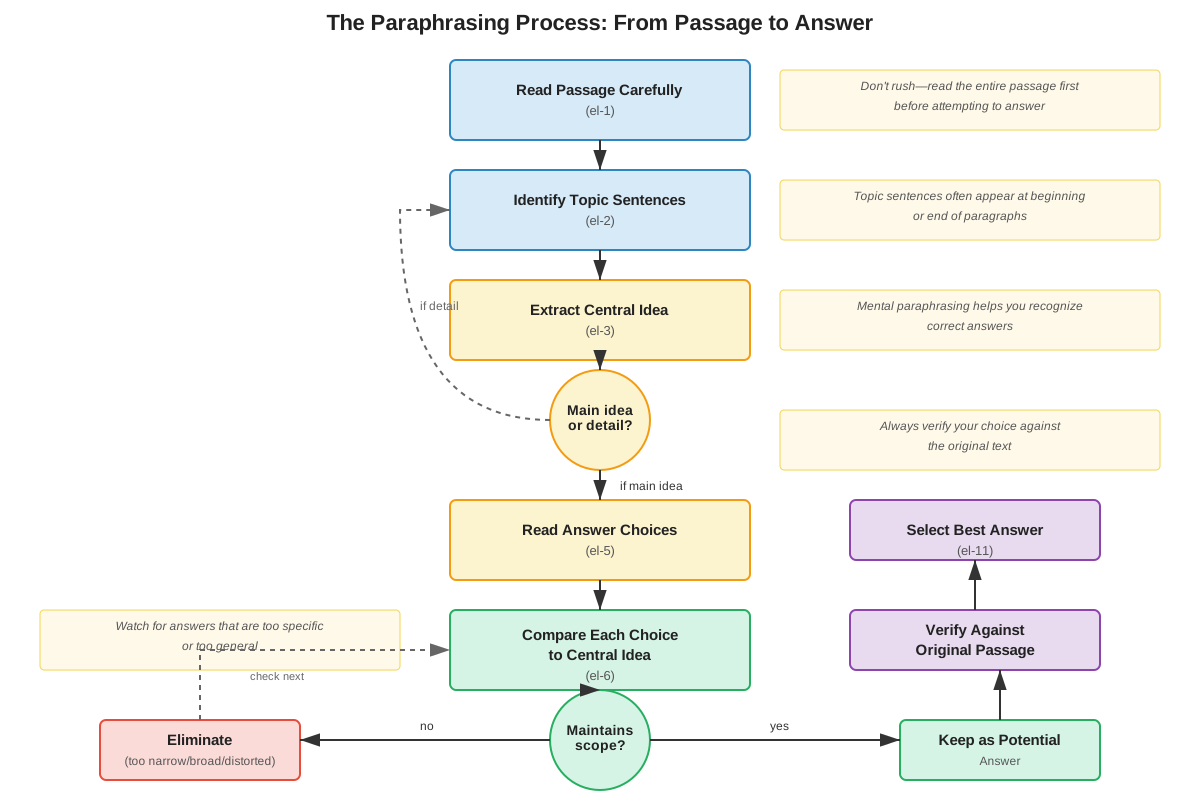
The paraphrasing process involves several cognitive steps:
- Comprehension: Fully understanding the original passage's meaning
- Abstraction: Identifying the essential components of the central idea
- Reconstruction: Expressing those components using different vocabulary and syntax
- Verification: Ensuring the paraphrased version maintains semantic equivalence
Semantic Equivalence
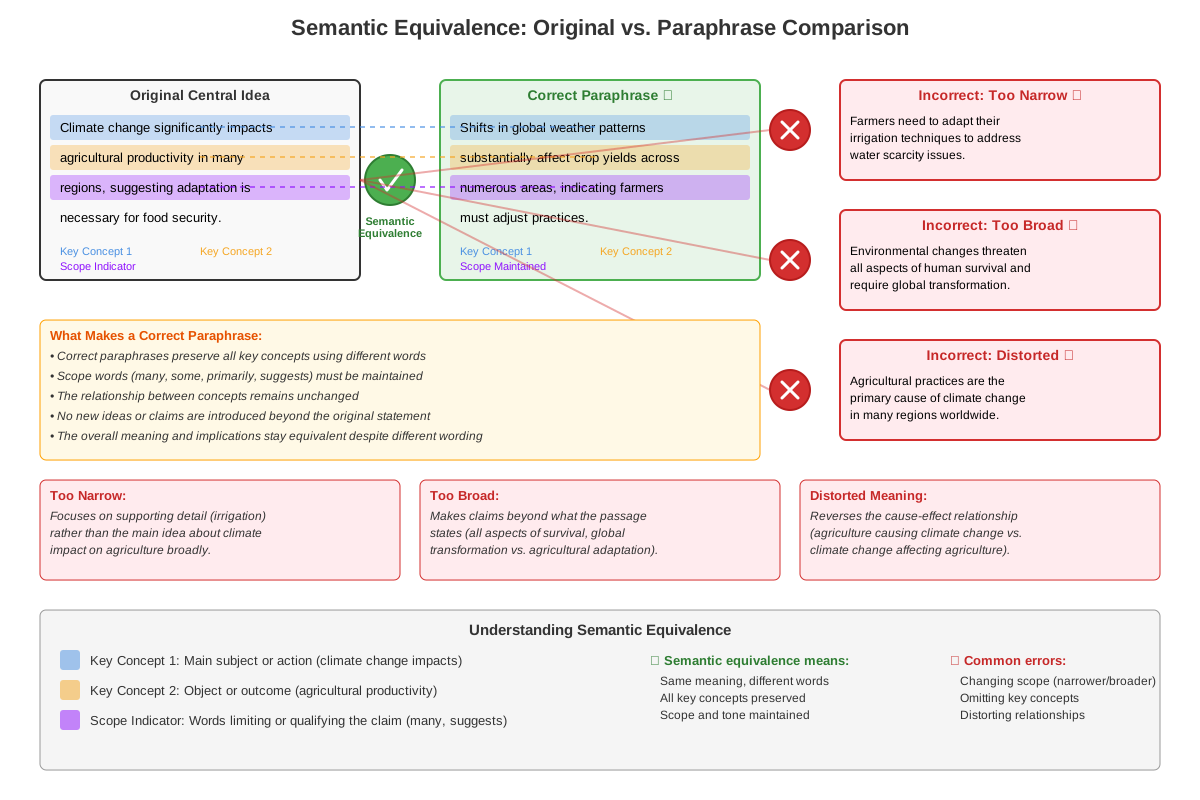
Semantic equivalence means that two statements convey the same essential meaning despite using different words or structures. This concept is crucial for SAT success because correct answer choices rarely use the exact language from the passage. Instead, they demonstrate equivalence through:
- Synonym substitution: Replacing words with similar-meaning alternatives (e.g., "crucial" becomes "essential")
- Structural transformation: Changing active voice to passive voice, or converting clauses to phrases
- Conceptual reframing: Expressing the same idea from a different angle (e.g., "X causes Y" becomes "Y results from X")
- Generalization or specification: Moving between concrete examples and abstract principles while maintaining the same scope
Distinguishing Central Ideas from Details
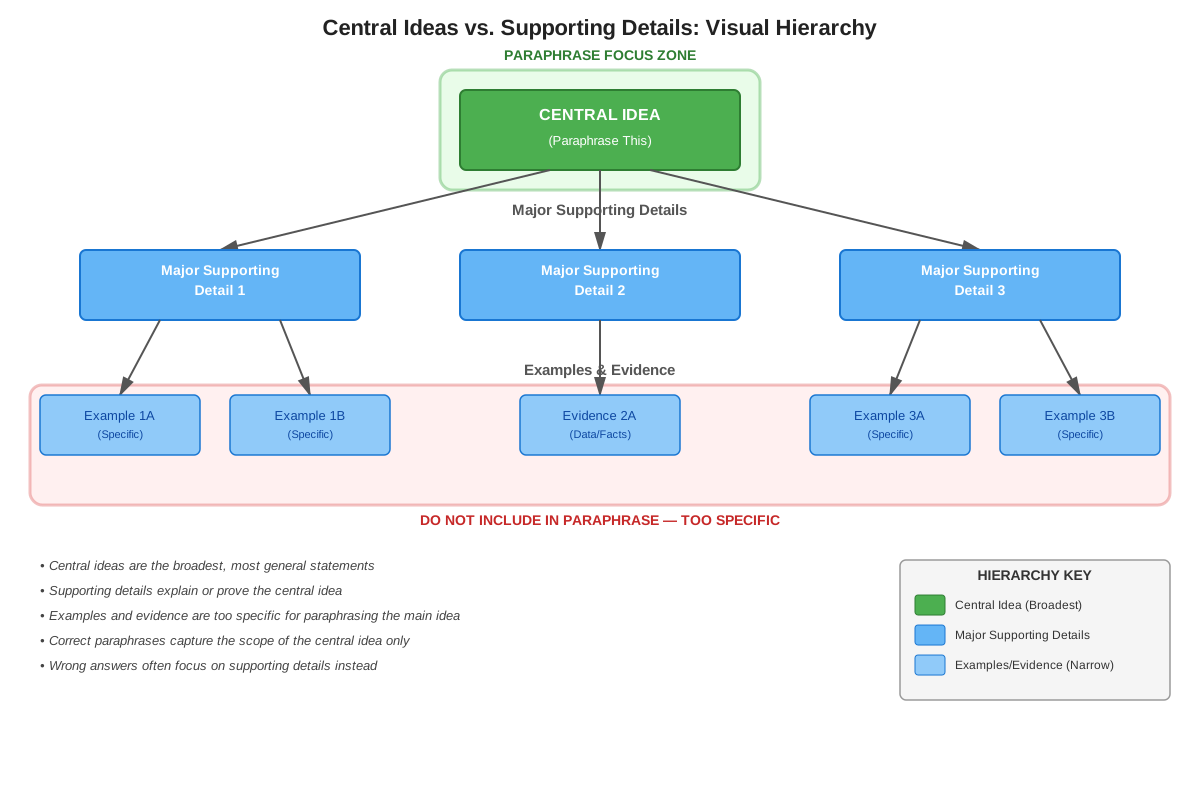
A critical skill in paraphrasing central ideas is recognizing what should be included in a paraphrase versus what should be omitted. Supporting details provide evidence, examples, statistics, or elaboration for the central idea but are not themselves the main point. Consider this distinction:
| Element | Characteristics | Example |
|---|---|---|
| Central Idea | Broad, encompassing, represents main point | "Urban gardens provide multiple benefits to communities" |
| Supporting Detail | Specific, illustrative, provides evidence | "The Riverside Community Garden increased local vegetable consumption by 23%" |
| Topic | Subject matter without assertion | "Urban gardens" |
Students often select answer choices that focus on compelling details rather than overarching ideas. Training to ask "Is this the main point or just an example?" helps avoid this error.
Common Paraphrasing Transformations
The SAT employs predictable patterns when creating paraphrased answer choices. Understanding these transformations helps students recognize correct answers:
Nominalization: Converting verbs to nouns (e.g., "Scientists discovered" becomes "The discovery by scientists")
Clause reduction: Transforming dependent clauses into phrases (e.g., "Although the experiment failed" becomes "Despite the experiment's failure")
Perspective shifts: Changing the grammatical subject while maintaining meaning (e.g., "The study revealed surprising results" becomes "Surprising results emerged from the study")
Abstraction levels: Moving between specific and general (e.g., "roses, tulips, and daisies" becomes "flowers")
Scope Accuracy
A correctly paraphrased central idea must match the scope of the original—neither too narrow nor too broad. Scope errors represent the most common type of incorrect answer choice on SAT paraphrasing questions:
- Too narrow: Focuses on one aspect or example rather than the complete central idea
- Too broad: Overgeneralizes beyond what the passage actually claims
- Distorted: Changes the meaning, emphasis, or relationships between ideas
- Off-topic: Introduces information not present in the passage
Evaluating scope requires asking: "Does this answer capture everything important from the passage without adding or removing key elements?"
Concept Relationships
The concepts within paraphrasing central ideas form an interconnected hierarchy. Understanding central ideas serves as the foundation—students must first identify what the main point is before they can recognize its paraphrase. This identification skill leads directly to distinguishing central ideas from details, which prevents students from selecting answer choices that focus on supporting information rather than the main message.
Once students can reliably identify central ideas, they must understand semantic equivalence to recognize when different language expresses the same meaning. This concept connects to common paraphrasing transformations, which provides the practical patterns students encounter on the exam. Both semantic equivalence and transformation patterns feed into scope accuracy, which represents the evaluative skill needed to eliminate incorrect answer choices.
The relationship map flows as follows:
Reading Comprehension → Understanding Central Ideas → Distinguishing Central Ideas from Details → Semantic Equivalence ↔ Common Paraphrasing Transformations → Scope Accuracy → Successful Answer Selection
This topic also connects to prerequisite knowledge: vocabulary skills enable recognition of synonyms used in paraphrases, while sentence structure awareness helps students see past grammatical transformations to the underlying meaning. Looking forward, mastery of paraphrasing central ideas enables success with synthesis questions (combining information from multiple texts), inference questions (extending central ideas), and rhetorical analysis (understanding how authors develop central ideas).
High-Yield Facts
- ⭐ The central idea represents the author's main point or primary argument, not merely the topic or subject matter
- ⭐ Correct paraphrases maintain semantic equivalence while using different vocabulary and sentence structures
- ⭐ Answer choices that focus on specific examples or supporting details are too narrow and incorrect
- ⭐ The scope of a paraphrase must match the original—neither broader nor narrower than the passage's actual claims
- ⭐ Central ideas often appear in topic sentences at the beginning or end of paragraphs, but may be implied across multiple sentences
- Paraphrasing questions typically ask "Which choice best states the main idea?" or similar phrasing
- Incorrect answer choices commonly distort meaning by changing relationships between concepts
- Synonym substitution alone does not constitute effective paraphrasing—structural changes are also necessary
- Answer choices that introduce information not present in the passage are always incorrect
- Effective paraphrasing requires complete comprehension of the original passage, not just surface-level reading
- The SAT tests paraphrasing across all passage types: literature, science, history/social studies, and humanities
- Overgeneralized answer choices that make claims beyond the passage's scope are incorrect even if they seem true
- Central ideas in argumentative passages include both the claim and the reasoning, not just the conclusion
- Time-efficient test-takers identify the central idea before reading answer choices
- Paraphrased central ideas should be verifiable by pointing to specific passage content
Quick check — test yourself on Paraphrasing central ideas so far.
Try Flashcards →Common Misconceptions
Misconception: The central idea is always stated explicitly in a single sentence within the passage.
Correction: While central ideas often appear in topic sentences, they may be implied across multiple sentences or developed throughout the passage. Students must sometimes synthesize information to construct the complete central idea.
Misconception: A paraphrase just means replacing words with synonyms while keeping the same sentence structure.
Correction: Effective paraphrasing involves both vocabulary changes and structural transformations. Simply substituting synonyms without altering syntax does not demonstrate genuine comprehension and is not how SAT answer choices are constructed.
Misconception: If an answer choice contains true information from the passage, it must be correct.
Correction: Answer choices may include accurate details from the passage but still be incorrect if they focus on supporting information rather than the central idea. Truth and relevance are both necessary for a correct answer.
Misconception: The longest or most detailed answer choice is most likely to be correct because it includes more information.
Correction: Correct paraphrases are often concise and focused. Longer answer choices may include extraneous details or overgeneralize, making them incorrect despite their length.
Misconception: The central idea is whatever seems most interesting or surprising in the passage.
Correction: The central idea is what the author emphasizes as most important, which may or may not be the most dramatic information. Compelling details often serve as support for a less flashy but more fundamental main point.
Misconception: If an answer choice uses different words than the passage, it cannot be correct.
Correction: Correct answer choices almost always use different vocabulary and structures than the original passage—that's the essence of paraphrasing. Students should look for semantic equivalence, not word-for-word matching.
Misconception: The central idea is always the first sentence of the passage.
Correction: While topic sentences often appear first, central ideas may be stated at the end (especially in inductive reasoning), implied throughout, or built progressively across the passage.
Worked Examples
Example 1: Scientific Passage
Passage:
"Recent studies of coral reef ecosystems have revealed that parrotfish play a more critical role in reef health than previously understood. By consuming algae that would otherwise smother coral polyps, parrotfish enable corals to access sunlight and nutrients necessary for growth. In regions where parrotfish populations have declined due to overfishing, coral reefs have experienced accelerated degradation, with algae coverage increasing by up to 40%. Conservation efforts that protect parrotfish populations have shown promising results, with some reefs demonstrating recovery within five years."
Question: Which choice best states the main idea of the text?
Answer Choices:
A) Parrotfish consume algae on coral reefs, preventing it from blocking sunlight.
B) Overfishing has reduced parrotfish populations in many reef ecosystems.
C) Parrotfish are essential to coral reef health, and protecting them aids reef conservation.
D) Conservation efforts can help coral reefs recover within five years.
Analysis:
First, identify the central idea by asking "What is the author's main point?" The passage discusses parrotfish, their role in reef ecosystems, the consequences of their decline, and the benefits of protecting them. The central idea encompasses all these elements: parrotfish are crucial for reef health, and conservation matters.
Now evaluate each choice:
Choice A is too narrow. It focuses on one specific detail (algae consumption and sunlight) but misses the broader point about overall reef health and conservation implications. This is a supporting detail, not the main idea.
Choice B is also too narrow. While the passage mentions overfishing, this is presented as context for understanding the importance of parrotfish, not as the main point itself.
Choice C correctly captures the complete central idea. It paraphrases "critical role in reef health" as "essential to coral reef health" and incorporates both the importance of parrotfish and the conservation implications. The scope matches perfectly—neither too narrow nor too broad.
Choice D focuses on a specific detail from the end of the passage (five-year recovery timeline) and misses the central role of parrotfish entirely. This represents a common trap: selecting information that seems important but is actually just supporting evidence.
Correct Answer: C
This example demonstrates how the correct answer uses different vocabulary ("essential" instead of "critical role") and structure (combining ideas into a single statement) while maintaining semantic equivalence with the passage's main point.
Example 2: Historical Passage
Passage:
"Historian Maria Chen challenges the traditional narrative that the Industrial Revolution resulted primarily from technological innovations. In her recent book, Chen argues that social and economic factors—particularly the reorganization of labor systems and the accumulation of capital through colonial trade—created the conditions that made technological advancement both possible and profitable. While not dismissing the importance of inventions like the steam engine, Chen demonstrates that these technologies succeeded because social structures were already transforming to accommodate them. Her work suggests that historical change results from complex interactions between technology, economics, and social organization rather than from isolated innovations."
Question: Which choice best summarizes Chen's argument?
Answer Choices:
A) The steam engine was less important to the Industrial Revolution than previously believed.
B) Colonial trade provided the capital necessary for Industrial Revolution technologies.
C) The Industrial Revolution stemmed from interconnected social, economic, and technological factors rather than technology alone.
D) Social structures transformed during the Industrial Revolution to accommodate new technologies.
Analysis:
The central idea here is Chen's argument, which challenges a traditional view and proposes an alternative explanation. Chen argues that the Industrial Revolution resulted from multiple interacting factors, not just technology.
Choice A is too narrow and somewhat distorted. While Chen mentions the steam engine as an example, her point is not specifically about downplaying this invention but about reframing the entire causal narrative.
Choice B identifies one supporting detail (colonial trade and capital) but misses Chen's broader argument about complex interactions between multiple factors. This is a component of her argument, not the complete thesis.
Choice C accurately paraphrases Chen's complete argument. It captures the challenge to technology-focused narratives ("rather than technology alone"), acknowledges the multiple factors Chen emphasizes ("social, economic, and technological"), and conveys the idea of interaction ("interconnected"). The phrase "stemmed from" effectively paraphrases "resulted from."
Choice D reverses the causal relationship Chen proposes. Chen argues that social structures transformed first, creating conditions for technology, not that technology drove social transformation. This represents a distortion of meaning.
Correct Answer: C
This example illustrates how paraphrasing requires understanding not just what information is present but also the relationships between ideas and the author's argumentative structure.
Exam Strategy
When approaching SAT paraphrasing central ideas questions, employ this systematic process:
Step 1: Read actively for the main point. Before looking at answer choices, articulate the central idea in your own words. Ask yourself: "If I had to tell someone what this passage is mainly about in one sentence, what would I say?" This prevents answer choices from influencing your interpretation.
Step 2: Identify trigger words in the question. Questions asking for the "main idea," "primary purpose," "best summary," or what the text "most strongly suggests" are all paraphrasing questions. Recognize these patterns to activate the appropriate strategy.
Step 3: Eliminate scope errors first. Quickly scan answer choices for obvious scope problems:
- Cross out choices that focus on specific examples or details
- Eliminate choices that make broader claims than the passage supports
- Remove choices that introduce topics not discussed in the passage
Step 4: Check for distortions. Among remaining choices, verify that relationships between ideas are preserved. Watch for:
- Reversed cause-and-effect relationships
- Changed emphasis (making a minor point seem major)
- Altered tone or stance (changing "suggests" to "proves")
Step 5: Verify semantic equivalence. The correct answer should align with your pre-formulated understanding of the central idea. Every component of the answer should be traceable to passage content.
Exam Tip: If two answer choices seem equally valid, one is likely too narrow. The correct answer will encompass the complete central idea, while the attractive distractor will focus on one important aspect.
Time allocation: Spend 30-45 seconds reading the passage carefully, 10-15 seconds formulating the central idea mentally, and 20-30 seconds evaluating answer choices. Don't rush the initial reading—comprehension is essential for efficient answer selection.
Trigger phrases to watch for in passages:
- "The main point is..."
- "Most importantly..."
- "The key factor..."
- "Ultimately..."
- "In essence..."
These phrases often signal where the author is stating or restating the central idea.
Process-of-elimination priorities:
- First, eliminate choices that are too narrow (focus on details)
- Second, eliminate choices that are too broad (overgeneralize)
- Third, eliminate distortions (change meaning)
- Finally, choose between remaining options based on completeness
Memory Techniques
SCOPE Acronym for evaluating answer choices:
- Supporting details are not central ideas
- Complete coverage of the main point is required
- Overgeneralization makes an answer incorrect
- Passage content must support every claim in the answer
- Equivalence in meaning, not matching words, indicates correctness
The "Umbrella Test": Visualize the central idea as an umbrella that covers all the important information in the passage. Supporting details are items under the umbrella. If an answer choice is itself under the umbrella (a detail) rather than being the umbrella itself (the main idea), it's incorrect.
The "Goldilocks Principle": Like Goldilocks seeking what's "just right," the correct paraphrase is not too narrow (focusing on one detail), not too broad (claiming more than the passage supports), but just right (matching the passage's scope exactly).
Paraphrase = Different Clothes, Same Person: Remember that paraphrasing is like seeing someone in different clothes—the appearance changes but the identity remains the same. The correct answer looks different from the passage but represents the same essential meaning.
Main vs. Supporting Mnemonic: "MAIN ideas are Mentioned Again In the passage; supporting details appear once." Central ideas are typically reinforced through repetition or emphasis, while details appear as single examples.
Summary
Paraphrasing central ideas is a foundational SAT Reading and Writing skill that requires students to identify a passage's main point and recognize when answer choices express that same idea using different vocabulary and sentence structures. Success depends on distinguishing central ideas from supporting details, understanding semantic equivalence, and evaluating whether paraphrased versions maintain the correct scope—neither too narrow nor too broad. The SAT consistently tests this skill across all passage types, making it one of the highest-yield areas for focused preparation. Students must learn to read actively for main points, formulate central ideas before examining answer choices, and systematically eliminate options that focus on details, overgeneralize, distort meaning, or introduce unrelated information. Mastery requires understanding that effective paraphrasing involves both vocabulary changes and structural transformations while preserving the essential meaning and relationships between ideas in the original passage.
Key Takeaways
- The central idea is the author's main point or primary argument, distinct from the topic or supporting details
- Correct paraphrases maintain semantic equivalence through different vocabulary and sentence structures, not just synonym substitution
- Scope accuracy is critical—correct answers match the passage's claims exactly without narrowing to details or broadening beyond what's stated
- Formulate your own understanding of the central idea before reading answer choices to avoid being misled by attractive distractors
- Systematically eliminate answer choices that are too narrow (focus on details), too broad (overgeneralize), distorted (change meaning), or off-topic (introduce new information)
- Central ideas may be explicitly stated in topic sentences or implied across multiple sentences, requiring synthesis
- The most common error is selecting answer choices that highlight compelling details rather than overarching main points
Related Topics
Inference Questions: Building on paraphrasing skills, inference questions require students to extend central ideas to logical conclusions not explicitly stated in the passage. Mastering central idea identification provides the foundation for making valid inferences.
Synthesis Across Multiple Texts: Advanced SAT questions ask students to identify relationships between two passages. This requires paraphrasing the central idea of each passage and then determining how they connect—whether they agree, disagree, or complement each other.
Purpose and Function Questions: Understanding why an author includes specific information or how a detail supports the main idea builds directly on the ability to identify central ideas and distinguish them from supporting elements.
Rhetorical Analysis: Examining how authors develop and emphasize central ideas through word choice, structure, and evidence requires first identifying what those central ideas are.
Practice CTA
Now that you've mastered the core concepts of paraphrasing central ideas, it's time to put your knowledge into action! Complete the practice questions to reinforce your understanding and build the speed and accuracy you need for test day. Use the flashcards to memorize key concepts and common patterns. Remember, paraphrasing central ideas appears on virtually every SAT Reading and Writing section—your investment in mastering this skill will pay dividends across multiple questions. Approach each practice question systematically, applying the strategies you've learned, and review your errors carefully to identify patterns in your thinking. You've got this!
Sign up free to keep reading
Create a free AnvayaPrep account to finish this SAT guide on Paraphrasing central ideas — plus flashcards and practice questions.